
Note: This article contains affiliate links. If you click on these links and make a purchase, we may earn a small commission at no extra cost to you. This helps support our research and content. Read our full affiliate disclosure here.
Picking the right quiet oscillating fan matters when you need cooling without constant background noise. Whether you sleep light, work from home, or want a less intrusive fan in a shared space, small differences in noise, airflow pattern, and control options change how comfortable you feel. This guide highlights our shortlist of top quiet oscillating fans. We focus on measurable factors like decibel output, effective coverage area, and ease of use so you can quickly match a fan to the rooms where silence matters most. Read on for the evaluation criteria and concise guidance to help you pick the best low-noise oscillating fan for your space.
Top Picks at a Glance
| Best Overall The best all-around choice for most situations | Levoit Classic 36-inch Tower Fan |  |
| Best Quality Built to a higher standard if you want something more solid | DREO TurboPoly DR-HPF013 Fan |  |
| Best Value The sweet spot between price and what you get | BEYOND BREEZE 12" Table Fan Fan-550 |  |
| Top Rated A top-rated pick with lots of positive feedback | IRIS USA WOOZOO Desk Fan PCF-HE18 |  |
| Most Popular A crowd favorite that many people choose with confidence | Honeywell TurboForce HT-900 |  |
| Best Seller A high-volume bestseller chosen again and again | DREO Tower Fan 307 |  |
Levoit Classic 36-inch Tower Fan

| Number of Speeds | 5 |
|---|---|
| Noise Level | 28 db |
| Wattage | 39 watts |
| Air Flow Capacity | 1044 cfm |
| Power Source | Corded Electric |
The Levoit Classic 36-inch tower fan is built for steady, low-noise air circulation in bedrooms and living spaces. It offers five speeds plus four modes including Normal, Turbo, Sleep and Auto, and the built-in temperature sensor adjusts fan speed automatically to maintain comfort without constant manual changes. The slim tower design and 90 degree oscillation spread airflow across a room while the included remote and touch controls make it easy to change settings from bed or couch. At 28 dB on low and a 12-hour timer the fan is suitable for light sleepers and overnight use, and the removable rear grille simplifies periodic cleaning. Expect a straightforward corded AC unit with a plastic housing rather than premium metal construction, and Turbo mode can be noticeably louder when maximizing airflow for quick cooling. The fan excels at quiet, whole-room circulation but does not include smart home connectivity or battery operation.
Best for: Buyers who want a quiet, easy-to-use bedroom or living-room fan that balances nightly low-noise operation with occasional high-output airflow and simple remote control.
Less Ideal for: People who need smart-home integration, battery-powered portability, or a premium metal build should look elsewhere.
- Very quiet at low speeds (around 28 dB), suitable for bedrooms and light sleepers
- Automatic mode with temperature sensor adjusts fan speed to room conditions
- Five speeds and four modes including Sleep and Turbo for flexible use
- Slim tower footprint with 90° oscillation spreads airflow across a room
- Includes remote control and 12-hour timer for convenient hands-off operation
- Plastic construction feels less premium than metal alternatives
- Turbo/high output is louder and aimed more at circulation than quiet operation
Verdict: Choose this Levoit tower fan if you want near-silent overnight operation with automatic temperature-adjusting airflow and easy remote control.
DREO TurboPoly DR-HPF013 Fan

| Power Source | Corded Electric |
|---|---|
| Number of Speeds | 8 |
| Noise Level | 28.2 db |
| Air Flow Capacity | 1000 cfm |
| Control Method | Remote, Touch |
The DREO TurboPoly DR-HPF013 is a freestanding DC‑motor pedestal fan designed to move a lot of air quietly across a whole room. In everyday use it offers eight speeds, an auto mode that adjusts output with temperature changes, 90° horizontal oscillation and a 105° pivoting head so you can direct airflow precisely or sweep it across a room. The brushless DC motor and refined blade design keep noise low while claiming 1000 CFM and up to a 90 ft throw, which makes it suitable for cooling living rooms or bedrooms without blasting high noise. Controls include a top touch panel and an included remote, plus an 8‑hour timer and detachable grille and blades for cleaning. Practical extras include adjustable height and an aroma pad for light fragrance. Trade offs are that the fan is plastic‑built and claims like exact throw distance will vary with room layout, so you should not expect industrial performance; also vertical tilt is manual rather than motorized. For buyers prioritizing powerful but quiet whole‑room circulation, this model balances strong airflow and low noise effectively.
Best for: Buyers who want a performance-oriented room fan that prioritizes strong airflow while keeping noise low for bedrooms and living spaces.
Less Ideal for: People seeking a premium metal build or fully motorized tilt and multi-room smart integration should consider different models.
- Brushless DC motor for efficient, quieter operation
- High airflow up to 1000 CFM and long throw up to 90 ft for whole‑room circulation
- Eight speeds plus auto mode and 90° horizontal oscillation for flexible airflow control
- Remote and touch controls with 8‑hour timer for convenient, hands‑off use
- Detachable grille and blades for easier cleaning
- Body and components are plastic rather than heavier metal construction
- Vertical adjustment is manual instead of motorized
Verdict: Choose this fan if you want a quiet, performance‑focused pedestal fan that delivers strong whole‑room airflow with convenient remote control.
BEYOND BREEZE 12" Table Fan Fan-550

| Number of Speeds | 3 |
|---|---|
| Wattage | 40 watts |
| Power Source | Corded Electric |
| Blade Diameter | 12 inches |
| Oscillation | 70° wide oscillation |
The BEYOND BREEZE 12" Table Fan (Fan-550) is a small oscillating desk fan designed to deliver focused airflow in bedrooms, dorms, and home offices. It offers three push-button speed settings and a 70 degree wide oscillation to spread air across a room or concentrate it on a workstation, while an adjustable tilt helps aim airflow where needed. The motor is described as very quiet, so the unit is suitable for nightstands or study desks where low noise matters. Construction is mostly plastic with a protective metal grill around three plastic blades, and assembly is quick using the included base. At 40 watts it is energy efficient for continuous use, but the compact size means it is best for personal cooling rather than moving air in large rooms. The controls are simple and there are no advanced features like timers or remote control, so expect straightforward operation without smart functions.
Best for: Buyers who want a simple, low-noise personal fan to improve airflow at a desk, bedside, or small room and prefer straightforward controls and easy setup.
Less Ideal for: People looking to cool large living rooms or open-plan spaces, or those who need app control, scheduling, or advanced features.
- Quiet motor suitable for bedrooms or study areas
- Wide 70° oscillation spreads airflow across a room
- Adjustable tilt lets you direct air precisely
- Simple three-speed push-button controls are easy to use
- No timer, remote, or smart controls for automated operation
- Compact 12-inch blade limits effectiveness in large rooms
Verdict: A quiet, no-frills 12-inch oscillating table fan that delivers focused personal cooling with simple controls and easy setup.
IRIS USA WOOZOO Desk Fan PCF-HE18

| Power Source | Corded Electric |
|---|---|
| Number of Speeds | 3 |
| Noise Level | 29 db |
| Wattage | 96 watts |
| Motor Type | Brushless |
The IRIS USA WOOZOO Desk Fan is a medium tabletop air circulator that moves air up to about 36 feet and is designed for quiet, everyday use in bedrooms, offices, and kitchens. It uses deep-pitch 7.1-inch blades and a spiral grid to focus airflow, offers three push-button speed settings, and features automatic oscillation and a 112° vertical tilt for broad coverage. A brushless motor helps keep noise down to roughly 29 dB on low while delivering stronger output on higher settings, and the lightweight plastic body with a built-in handle makes it easy to move between rooms. Practical benefits include efficient circulation for spaces up to roughly 244 sq ft and simple, reliable controls without complicated menus. Trade-offs are its basic plastic construction and limited speed range compared with multi-speed or remote-controlled models, so it is best when you want straightforward, dependable cooling rather than advanced controls or premium materials.
Best for: Buyers who prioritize reliable, low-noise performance and simple controls for everyday desk or bedside circulation in small to medium rooms.
Less Ideal for: Those who want premium build materials, many speed increments, remote control, or smart features should consider higher-end models instead.
- Brushless motor for quieter, longer-lasting operation
- Deep-pitch blades and spiral grid for focused airflow and up to 36 ft reach
- Compact, lightweight design with built-in handle for easy relocation
- Automatic oscillation and wide tilt for even room coverage
- Simple three-button controls that are easy to use
- Basic plastic construction instead of premium materials
- Only three speed settings and no remote or timer features
Verdict: Choose this fan if you want a dependable, quiet tabletop circulator with straightforward controls and solid airflow for small to medium rooms.
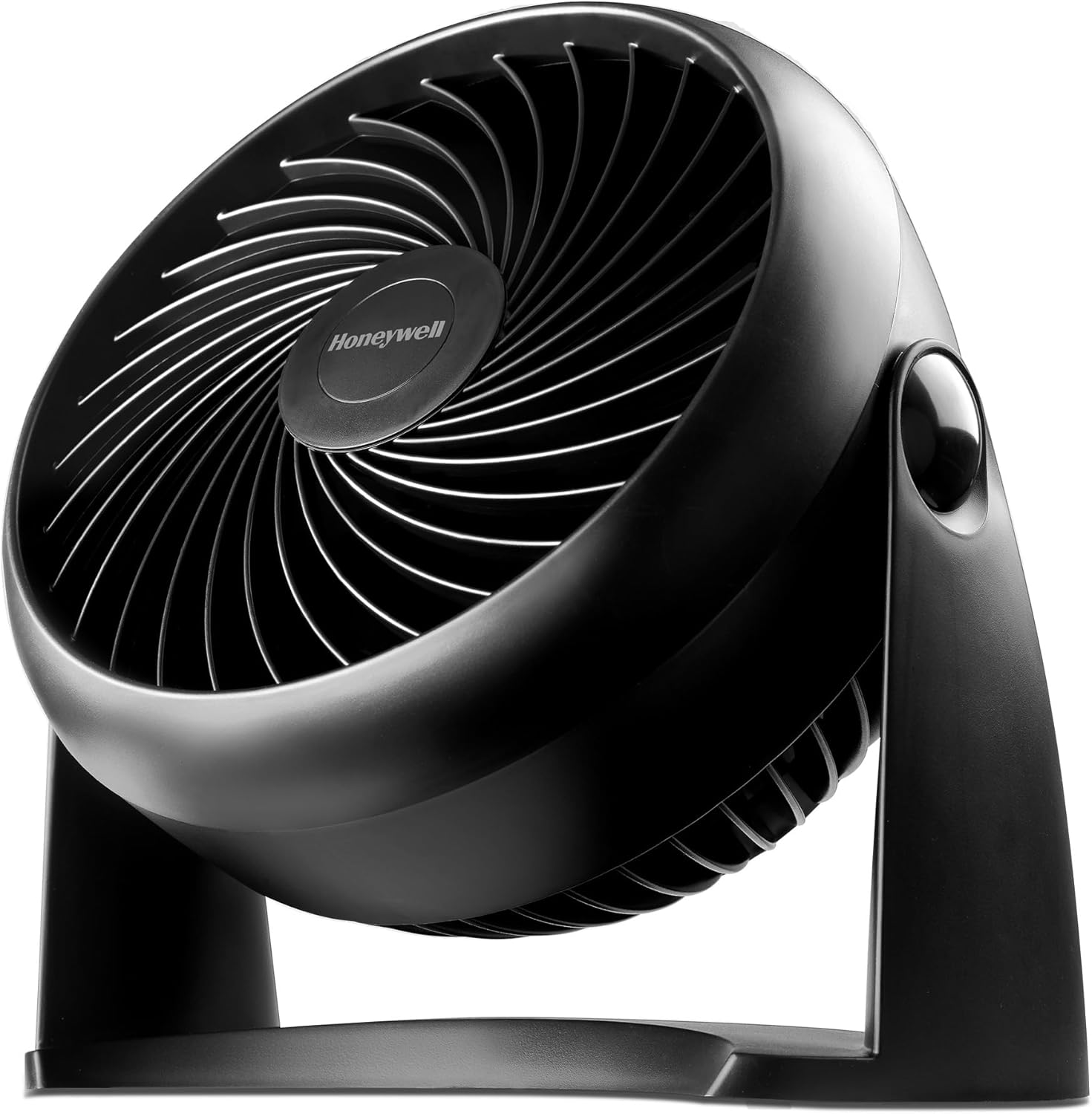
Honeywell TurboForce HT-900
| Power Source | Corded Electric |
|---|---|
| Number of Speeds | 3 |
| Air Flow Capacity | 185 cfm |
| Motor Type | brushless |
| Installation Type | Tabletop or Wall Mount |
The Honeywell TurboForce HT-900 is a small, versatile table fan built to move a surprising amount of air for its size while staying quietly out of the way. It offers three push-button speeds and a 90-degree pivoting head so you can direct airflow at a desk, bedside, or mounted on a wall; the aerodynamic turbo design and brushless motor deliver strong circulation rated at about 185 cfm, useful for cooling small to medium rooms or supplementing an air conditioner. Its plastic construction keeps the unit lightweight and easy to relocate, and the simple controls make it straightforward to use. Noise is minimal compared with similar sized fans, making it a reasonable choice for bedrooms or home offices, though it lacks oscillation and advanced controls like timers or remote operation. If you want a powerful, no-frills personal fan that focuses on focused airflow and quiet operation, the HT-900 does that well, but buyers who need wider coverage or smart features should look elsewhere.
Best for: Buyers who prioritize a proven, quiet personal fan with strong directional airflow and heavy user reviews to back reliability for bedrooms, desks, or small rooms.
Less Ideal for: People who need broad room coverage, oscillation, or smart/timed control features should consider larger or more feature-rich fans instead.
- Strong airflow for size (about 185 cfm) thanks to aerodynamic TurboForce design
- Three easy-to-use speed settings with push-button control
- Quiet operation aided by a brushless motor, suitable for bedrooms and offices
- 90-degree pivoting head allows precise direction of airflow
- Can be used tabletop or wall-mounted for flexible placement
- No oscillation function to spread air across a wider area
- Basic feature set with no timer, remote, or smart controls
Verdict: Choose the HT-900 if you want a compact, quietly powerful personal fan with straightforward controls and a long track record of reliable performance.
DREO Tower Fan 307

| Power Source | dc |
|---|---|
| Number of Speeds | 8 |
| Noise Level | 28 db |
| Air Flow Capacity | 1408 cfm |
| Motor Type | Brushless |
The DREO Tower Fan 307 is a compact freestanding tower fan designed to deliver adjustable airflow quietly for bedrooms and living spaces. It uses an upgraded brushless DC motor with an algorithmic impeller to produce strong airflow (listed at up to 28 ft/s and 1408 cfm) while keeping noise low, and it offers eight speed settings and four modes including Sleep and Natural. Controls are available on a touch panel or with the included remote, and the unit oscillates 90 degrees to broaden room coverage. Practical touches include a timer, removable rear grille for easier cleaning, and ETL safety certification. In use the fan balances usable power and subdued sound, making it suitable for night use or work-from-home setups, though it is a single-purpose air mover without cooling or air-filtration functions. The plastic construction keeps weight down but means it is not a premium metal build. If you want a quiet, user-friendly tower fan with flexible speed and mode control, this model performs well for typical indoor rooms.
Best for: Buyers who prioritize quiet, reliable airflow for bedrooms or home workspaces and want a simple plug-and-play fan with programmable modes and a remote.
Less Ideal for: People needing multi-function climate devices, heavy-duty metal fans for industrial use, or integrated air filtration should look elsewhere.
- Brushless DC motor and impeller design deliver strong airflow with lower noise
- Eight speed levels and four modes (Normal, Natural, Sleep, Auto) for tailored comfort
- Remote and touch controls plus timer for convenient operation
- 90° oscillation for broader room coverage and a removable rear grille for easier cleaning
- Plastic construction may feel less durable than metal alternatives
- No integrated cooling, humidifying, or air-filtration features
Verdict: A quiet, easy-to-use tower fan that delivers adjustable, room-filling airflow for sleep and work environments.
Choosing the Right Quiet Oscillating Fan: Key Factors to Consider
Noise Level and Perceived Quiet
Decibel ratings give a baseline for how loud a fan will be, but perceived quiet depends on frequency and steadiness of the sound as well. Fans with a low, steady whoosh are generally less annoying than those with high-pitched or fluctuating tones even at similar dB levels.
When you prioritize quiet operation, look for published noise measurements at multiple speeds and user feedback about the sound character. Consider whether you will run the fan near your head for sleep or across the room for general circulation, because acceptable noise thresholds differ by use case.
Airflow Performance and Room Coverage
A quiet fan must still move enough air to be useful. Check airflow figures, such as cubic feet per minute or manufacturer coverage claims, and think about the room size and layout.
Oscillating fans spread airflow across a wider zone than fixed fans, so effective coverage matters more than peak flow. For larger rooms you will want longer sweep angles and stronger low-speed output so the fan remains quiet without becoming ineffective.
Oscillation Range and Flexibility
Oscillation angle and the ability to adjust vertical tilt determine how broadly and precisely air is distributed. Fans with wide horizontal sweep reach more of the room, while adjustable tilt helps target airflow toward seating or sleeping areas.
Consider features like variable sweep speeds or programmable patterns if you need different airflow for daytime cooling versus nighttime white-noise preferences. Simpler constant-oscillation mechanisms can be quieter and more reliable over time.
Control Options and Ease of Use
Intuitive controls matter when you change fan settings frequently. Look for clear speed steps, responsive buttons or dials, and extras like remote control or app connectivity if you plan to adjust settings from a distance.
Timers and memory functions help conserve energy and avoid late-night adjustments. Controls that require minimal physical force or awkward reach make the fan easier to use in everyday scenarios.
Build Quality and Maintenance
A well-built fan runs quieter for longer and is easier to service. Check whether the design allows simple blade removal or frontal grille opening for cleaning without special tools.
Durable motors, stable stands, and quality materials reduce vibration and mechanical noise. Consider warranty terms and parts availability as proxies for expected longevity and customer support responsiveness.
Energy Use and Long-Term Cost
Lower power consumption reduces running cost and heat output, which is relevant if you run the fan for many hours each day. Brushless motors tend to be more efficient and quieter than older induction motors.
Compare wattage at typical operating speeds and consider whether variable-speed operation enables lower average energy use. Energy-efficient fans can be left on longer with less impact on electric bills and room temperature.
How Oscillating Fans Deliver Quieter Cooling
Oscillating fans reduce the need for high-speed output by sweeping airflow across a broader area. This makes it possible to maintain perceived cooling while running at lower, quieter speeds. Understanding how sweep pattern, blade design, and motor type interact helps you choose a fan that feels efficient without being loud.
Blade shape and housing influence both the volume of air moved and the tonal character of the sound. Fans designed for quiet operation often use smoother blade edges, guarded housings that limit turbulence, and motors with steady torque at low RPMs.
- Wide sweep lowers the need for top-end speed.
- Blade and grille design change turbulence and tone.
- Motor stability prevents rattles and fluctuating noise.
Placement Tips to Maximize Quiet Performance
Where you place the fan affects perceived noise and effectiveness. Position an oscillating fan so it circulates air across the room rather than blowing directly at a wall, which can reflect sound and create louder hotspots.
Elevating a fan on a table or stand can improve airflow distribution and reduce the need for higher speeds. In bedrooms, place the unit across the room or slightly offset from the bed to balance airflow and minimize direct noise exposure.
- Avoid tight corners and direct wall-facing placement.
- Use height to improve sweep coverage and reduce speed needs.
- Isolate the base from hard surfaces to cut vibration noise.
Maintenance Habits That Preserve Low Noise
Routine cleaning and light maintenance keep fans running quietly. Dust buildup on blades and inside the grille creates imbalance and increased vibration, which raises perceived noise over time. Make a simple schedule to remove the grille and wipe blades every few months.
Tighten hardware and check mounting points periodically. Loose screws and worn grommets are common sources of rattle. If a fan has a removable motor housing, inspect bearings and lubrication points according to the manufacturer's care guidance to prevent grinding sounds.
- Clean blades and grille regularly to avoid imbalance.
- Inspect and tighten fasteners to eliminate rattles.
- Follow motor care instructions to prevent bearing noise.
When to Choose Remote or App Controls
Remote control and app connectivity add convenience, especially if you operate the fan from bed or across a large room. These features let you lower speed incrementally without approaching the unit and can prevent repeated manual adjustments that disturb the device or its mount.
However, added electronics can slightly increase standby power draw and create more complex repair scenarios. Choose remote or smart features only if they significantly improve how you use the fan.
- Remote is helpful for bedroom or desk use.
- App control suits integration with home automation.
- Weigh convenience against slightly higher complexity.
Sizing an Oscillating Fan to Room Type
Match fan size and airflow to the room. Small oscillating fans work well for desks, nightstands, and compact bedrooms. Larger floors or open-plan living areas need higher airflow and wider sweep angles to be effective at whisper-quiet settings.
If you are uncertain, opt for a slightly more powerful unit that still performs quietly at low speeds. That gives you headroom on hot days while allowing quiet operation the rest of the time.
- Desk or bedside: compact units with narrow sweep.
- Bedrooms: medium-size fans with smooth low-speed output.
- Living rooms: larger fans with wide oscillation and higher CFM.
How We Chose the Best Quiet Oscillating Fan
We shortlisted quiet oscillating fans by focusing on measurable, user-facing criteria that matter in real-world use. Primary filters included verified low-noise performance, consistent oscillation coverage, and usable airflow at low speed. We prioritized fans that deliver meaningful air movement while keeping steady-state noise under commonly accepted thresholds for bedrooms and offices. Other evaluation points included control options and ergonomics, such as intuitive speed settings, timers, and remote control presence. Build quality and maintenance were considered to estimate longevity and ease of cleaning. Energy efficiency and motor type were used to assess running cost and expected wear. We excluded any unit lacking clear manufacturer noise specifications or products that sacrifice useful airflow for silence. We also left out single-purpose or decorative fans that do not offer adjustable oscillation or multiple speeds. The final picks balance low sound levels with practical cooling performance, user controls, and easy upkeep.
Our full evaluation process is outlined in our review methodology.
FAQ
How many decibels is considered quiet for an oscillating fan?
Quiet fans often range from about 30 to 45 dB at typical low-to-medium speeds. Lower numbers are better, but tone and steadiness matter; a steady 40 dB whoosh can be less disruptive than a fluctuating 35 dB high-pitch sound.
Can an oscillating fan cool a whole room or just a person?
Oscillating fans are designed to move air across a wider zone than fixed fans, so they can help cool an entire room by improving circulation. Effectiveness depends on fan size, sweep angle, and room layout; larger rooms may need a higher-capacity unit or multiple fans.
Will running a fan all night raise my energy bill significantly?
Most modern oscillating fans use relatively little power compared with air conditioning. Energy use depends on motor type and speed setting; brushless motors are more efficient. Running at a lower, quieter speed reduces consumption while still providing airflow.
How often should I clean my oscillating fan to keep it quiet?
A light cleaning every one to three months is usually sufficient for typical household dust levels. If you have pets or high dust, clean more frequently. Removing buildup prevents imbalance and the rattling or grinding noises that develop over time.
Do oscillating mechanisms cause extra noise or wear?
A well-designed oscillation mechanism operates smoothly and adds minimal noise. Cheaper or poorly maintained mechanisms can produce click or whirring sounds. Regular maintenance and choosing a fan with robust oscillation hardware reduce the chance of wear-related noise.
Final Verdict
When choosing a quiet oscillating fan, balance measured noise levels with real airflow and coverage. Prioritize units that maintain useful low-speed airflow, offer flexible oscillation angles, and include easy-to-use controls so you can tailor operation for sleep, work, or shared living spaces. Accept tradeoffs between the absolute lowest noise and practical cooling capacity. Focus on steady tonal character, serviceable construction, and convenient controls to get a fan that stays quiet and effective over time.