
Note: This article contains affiliate links. If you click on these links and make a purchase, we may earn a small commission at no extra cost to you. This helps support our research and content. Read our full affiliate disclosure here.
When you need extra warmth without the racket, a quiet portable heater can make living rooms, bedrooms, or home offices comfortable without interrupting sleep or focus. The right unit delivers steady heat, low operational noise, and efficient power use while fitting the space you have. This guide covers six shortlisted portable heaters chosen for their quiet operation and practical heating performance. We evaluate noise output, heating efficiency, safety features, and ease of daily use to help you pick the best option for your space. Read on to see concise, user-focused reasons each type of heater made the list.
Top Picks at a Glance
| Best Overall The best all-around choice for most situations | DREO Tower Space Heater DR-HSH003 |  |
| Best Quality Built to a higher standard if you want something more solid | BREEZOME Space Heater MG31QN |  |
| Best Value The sweet spot between price and what you get | TUNISE Q21 Portable Space Heater |  |
| Best Budget The cheapest option that still gets the job done reliably | Gaiatop Mini Space Heater SH-02 |  |
| Top Rated A top-rated pick with lots of positive feedback | DREO Space Heater HSH006 |  |
| Most Popular A crowd favorite that many people choose with confidence | GiveBest Portable Space Heater PTC-905 |  |
DREO Tower Space Heater DR-HSH003

| Heat Output | 1500 watts |
|---|---|
| Heating Coverage | 270 sq.ft. |
| Heating Element | PTC ceramic |
| Oscillation | 70° |
| Timer | 1–12 H |
The DREO DR-HSH003 is a tower ceramic space heater built to warm medium to large rooms quickly while staying quiet. It uses a PTC element and a 1500W top power setting (with an ECO mode that throttles to about 1000W) to heat up fast, and a 70° oscillation trackball spreads air toward room corners for more even coverage. The digital adjustable thermostat (41 to 95°F) plus a precise temperature sensor lets the unit cycle between modes to hold a set temperature and save energy. Controls include a remote, 12-hour timer and five fan speeds, and DREO highlights low operating noise around 34 dB so it is suitable for bedrooms or home offices. Safety features include ETL-listed construction, tip-over and overheat protection, and a long flat 6 ft cord. Downsides are the reliance on a standard two-prong plug (no grounded connection) and that tower heaters move warmed air rather than radiating heat, so very large open-plan spaces will warm more slowly than a centralized system.
Best for: Buyers who want a quiet, easy-to-use space heater that balances fast heat, even coverage and energy-saving controls for bedrooms, home offices or similar rooms.
Less Ideal for: People needing a grounded plug or those who want instant radiant heat for very large open-plan areas should consider other heater types.
- Fast warm-up from a 1500W PTC ceramic element for quick comfort
- 70° oscillation and a trackball system that helps distribute heat more evenly across the room
- Precise adjustable thermostat (41–95°F) and ECO mode for energy-conscious temperature control
- Very low operating noise (~34 dB) suitable for sleeping or working environments
- Remote control and 12-hour timer for convenient hands-off operation
- Uses a two-prong flat plug rather than a grounded plug
- As a forced-air tower heater it may take longer to feel warm in very large open rooms compared with whole-house heating
Verdict: A quiet, feature-rich tower heater that delivers fast, evenly distributed warmth with precise thermostat control and energy-saving ECO mode.
BREEZOME Space Heater MG31QN

| Heat Output | 1500 watts |
|---|---|
| Heating Element | PTC Ceramic |
| Number of Speeds | 3 |
| Voltage | 120 volts |
| Temperature Range | 59 °F to 95 °F |
The BREEZOME MG31QN is a compact 1500W PTC ceramic tabletop tower heater built to deliver fast, even warmth for small personal spaces. It offers three heat levels plus ECO smart mode with an adjustable thermostat and a 24-hour timer, so you can run it on a schedule or let the unit maintain a set temperature automatically. Its ducted design aims to push heat farther than a typical desk heater, and the denoise motor technology keeps operation very quiet at about 34 dB on the lowest setting, making it suitable for bedrooms and offices. Controls and a dimmable display make nighttime use less intrusive, and safety features include ETL certification, overheat protection, tip-over shutoff, and flame-retardant housing. The unit is lightweight and easy to relocate but is intended for single-room or close-range heating rather than replacing central systems. If you need straightforward, low-noise spot heating with programmable convenience and solid safety protections, this model performs well for that role.
Best for: Buyers who prioritize quiet, fast spot heating for bedrooms, home offices, or bedside tables and want simple programmable controls and built-in safety.
Less Ideal for: People seeking to heat large rooms or whole apartments who need higher sustained output or broader coverage should consider larger space heaters.
- 1500W PTC ceramic element for rapid, even heating
- Very quiet operation (about 34 dB) suitable for sleep or work
- Smart ECO thermostat mode and 24-hour timer for set-and-forget use
- Multiple safety features including ETL certification, overheat protection, and tip-over shutoff
- Compact, single-room output is not suitable for heating larger areas
Verdict: A quiet, safety-focused 1500W tabletop heater that delivers fast spot warmth with programmable thermostat and timer for bedrooms and home offices.
TUNISE Q21 Portable Space Heater
| Power Source | ac |
|---|---|
| Heating Method | Forced Air |
| Special Features | Overheat Protection |
| Form Factor | Tower |
| Room Type | Bathroom, Bedroom, Home Office |
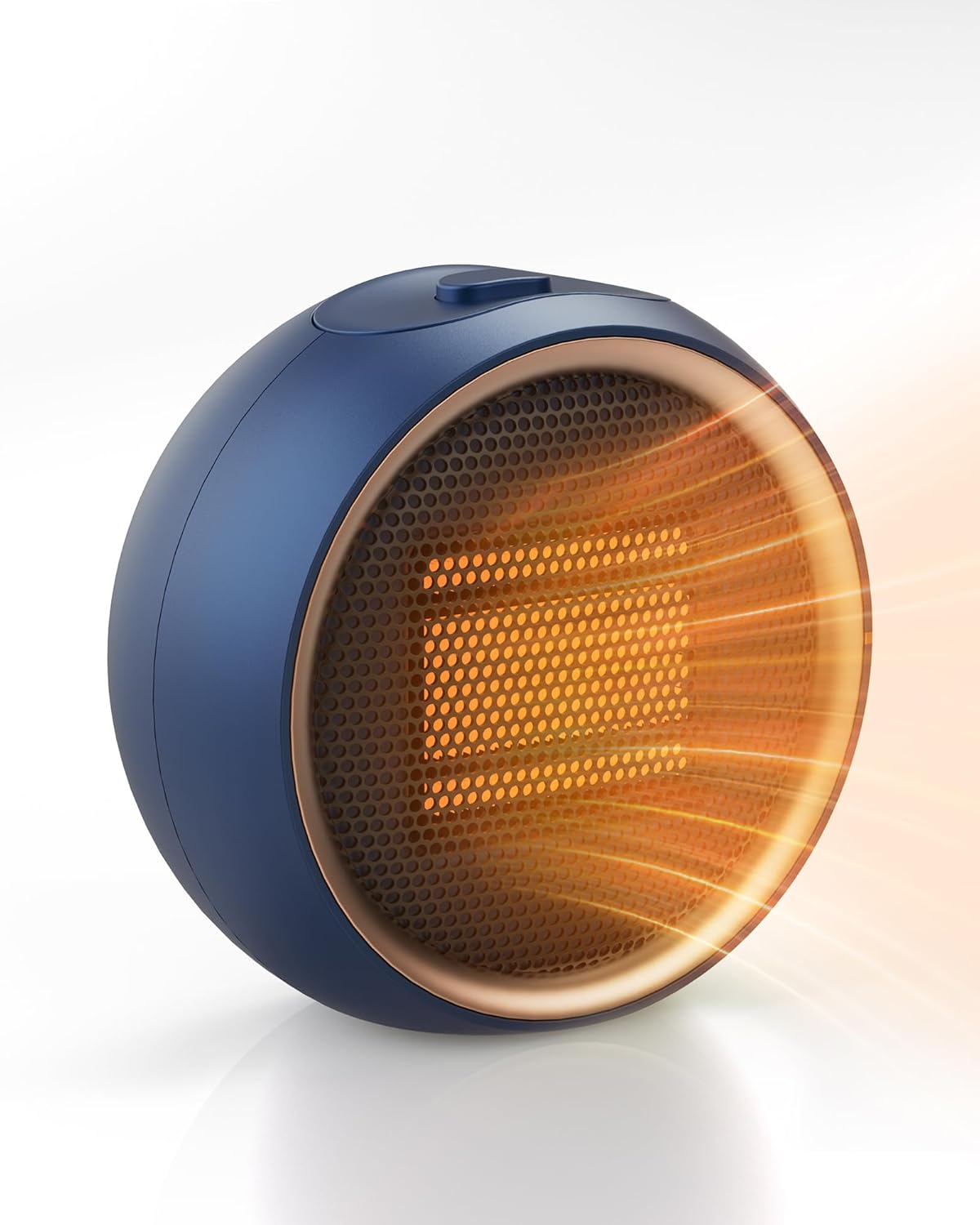
The TUNISE Q21 is a small plug-in ceramic space heater designed to warm a single spot quickly and quietly. It uses a PTC ceramic element with forced-air delivery that claims two-second fast heating, and simple one-touch LED controls make it easy to run from a desk, bedside table, or bathroom counter. Built-in safety features include tip-over and overheat auto-shutoff and flame-retardant housing, which are useful for unattended room-top use and households with pets. Its tower form factor and compact footprint fit tight spaces and won't dominate a small room, and the unit is notably quiet compared with larger fan heaters, making it suitable for bedrooms and home offices. Limitations are its single-room, personal-heater reach and the requirement to stay near an outlet since it is a plug-in unit with no battery or large oscillation coverage. If you need whole-room warming or adjustable thermostat zoning for larger spaces, a bigger heater would be more effective.
Best for: Buyers who want a low-noise, no-fuss personal heater for a bedroom, home office, or bathroom and prioritize safety and compact size over whole-room output.
Less Ideal for: People looking to heat larger living areas, open-plan rooms, or those who need programmable schedules or remote control should consider a more powerful or feature-rich heater.
- Very compact footprint for desktop or bedside placement
- PTC ceramic with forced-air gives quick warm-up
- Built-in tip-over and overheat auto-shutoff for safer use
- Simple one-touch LED controls that are easy to operate
- Quiet operation suitable for sleeping or focused work
- Designed for single-person or small-spot heating so not suitable for warming large rooms
- Requires nearby outlet placement with no remote or smart controls
Verdict: A quiet, compact plug-in ceramic heater that gives fast, safe spot warmth for a single user in small rooms.
Gaiatop Mini Space Heater SH-02

| Heat Output | 500 watts |
|---|---|
| Power Source | Corded Electric |
| Heating Method | Convection |
| Voltage | 120 volts |
| Safety Features | Tip-over and overheat protection |
This compact Gaiatop mini heater is built for personal heating at a desk, dorm room, or small office space. Its PTC ceramic element produces up to 500 watts of convection heat and is claimed to start warming within a couple of seconds, so you feel heat quickly without a long warm-up. The unit is very small and portable, making it easy to move between rooms or tuck on a tabletop, and it runs quietly enough for work or light sleeping environments. Safety features include 45 degree tip-over protection, overheating cutoff, V0 fireproof casing, and an anti-slip base, and an LED indicator shows operating status. Because it is only 500W, it excels at spot heating one person or a small area but will not warm larger rooms; expect modest temperature rise and lower power draw compared with higher-watt heaters. Controls are simple and the lightweight design keeps it inexpensive and easy to store when not in use.
Best for: Buyers wanting an inexpensive, ultra-portable heater for a single person’s workspace or a small room where quiet, immediate warmth matters.
Less Ideal for: People who need to heat medium or large rooms, or who want a heater with high wattage or advanced temperature controls.
- Fast PTC ceramic heating that produces noticeable warmth quickly
- Very compact and lightweight for easy tabletop or dorm use
- Quiet operation suitable for office or bedside use
- Built-in safety features including tip-over and overheat protection
- Low 500W output limits effective heating to a small personal area
- Minimal control complexity may lack adjustable heat levels for fine tuning
Verdict: A compact, quiet, and budget-friendly personal heater that delivers fast spot warmth for single-user desks and small rooms.
DREO Space Heater HSH006

| Heat Output | 1500 watts |
|---|---|
| Heating Element | PTC Ceramic |
| Heating Coverage | 200 sq.ft |
| Sound Level | 34 dB |
| Timer | 1-12 H |
The DREO HSH006 is a compact tower heater built to deliver quick, targeted warmth for small rooms and workspaces. It uses a 1500W PTC ceramic element and a funnel-style airflow design to produce forced-air heat that reaches up to about 200 sq ft, and the brushless DC motor keeps operation unusually quiet at around 34 dB. Controls include a precise thermostat adjustable from 41 to 95 F in 1 F steps, multiple heat modes (Power, ECO, Fan), a 12-hour timer, child lock, and a memory function, plus a handy remote for single-handed adjustments. Safety features are comprehensive with tip-over detection, overheat protection, flame-retardant materials and ETL listing, making it suitable for bedrooms and home offices. The unit is lightweight and easy to move but, as a forced-air PTC heater, it warms the air faster than it heats large open spaces and relies on airflow rather than radiant heat, so it is best for spot heating rather than whole-house use.
Best for: Someone who wants a quiet, safety-focused portable heater for a bedroom or home office and values precise temperature control and easy remote operation.
Less Ideal for: People needing to heat large, open floor plans or who prefer radiant-style heaters that deliver sustained warmth without relying on airflow.
- Brushless DC motor and winglet fan design for low noise (~34 dB) suitable for bedrooms
- Precise thermostat with 1°F increments from 41–95°F for fine temperature control
- Multiple modes, 12-hour timer and remote control for convenient everyday use
- ETL-listed safety features including tip-over and overheat protection and flame-retardant materials
- 1500W forced-air design is best for small to medium rooms and not ideal for heating large open areas
- Relies on airflow to distribute heat so may feel less warm if airflow is obstructed
Verdict: If you need a quiet, safety-oriented portable heater for bedrooms or small offices with precise thermostat control, this DREO model is a strong choice.
GiveBest Portable Space Heater PTC-905

| Heat Output | 1500 watts |
|---|---|
| Heating Coverage | 200 sq.ft |
| Number of Speeds | 2 |
| Max Temperature Setting | 158 °F |
| Power Source | Corded Electric |
The GiveBest PTC-905 is a compact ceramic space heater designed to warm small rooms and personal spaces quickly. It offers two heat modes (1500W and 750W) plus a cool-fan setting, and an adjustable thermostat that cycles the unit to hold a preset temperature without constant manual control. Practical safety features include overheat shutoff, tip-over protection and flame-resistant housing, and the built-in handle and light weight make it easy to move from office desk to bedroom. The heater is relatively quiet for a fan-forced ceramic design, so it is usable in bedrooms or home offices without producing distracting noise. Its coverage is rated around 200 sq ft, which matches typical bedrooms and small living areas, but buyers should expect lower output in larger or poorly insulated rooms. The unit runs on standard 120V power and provides straightforward controls rather than smart features, so it is best for someone who wants a simple, effective supplemental heater with proven safety elements.
Best for: Buyers who prioritize a quiet, safe, and easy-to-use supplemental heater for bedrooms, home offices, or desks and who want reassurance from strong safety features and broad positive user feedback.
Less Ideal for: Those looking for a whole-room or whole-house heating solution, advanced smart controls, or high-output heating for large, poorly insulated spaces should look elsewhere.
- Two heat settings (1500W and 750W) plus cool-fan mode for year-round use
- Adjustable electronic thermostat that cycles to maintain a set temperature
- Multiple safety systems including overheat shutoff and tip-over protection
- Compact, lightweight design with carry handle for easy portability
- Quiet operation suitable for bedrooms and home offices
- No smart features or remote control for remote scheduling
- Heats effectively only in small to medium rooms; not suited for large open areas
Verdict: A compact, quiet ceramic heater with solid safety features and thermostat control that reliably warms small rooms.
Choosing the Right Quiet Portable Heater: Key Factors to Consider
Noise Level and Sound Profile
How loud a heater runs matters most for bedrooms, home offices, and shared living spaces. Noise level is not just a single decibel number. Pay attention to the sound profile: some units produce a steady low hum while others make intermittent fan noise or high-frequency tones that seem louder than the dB reading.
Lower noise is important if you work from home, sleep in the same room, or run background audio. Look for published noise ratings measured at a realistic distance and read user reports about the character of the sound. A slightly less powerful heater with a whisper-quiet fan may be preferable to a higher-output unit that produces distracting noise.
Heating Efficiency and Coverage
Efficiency determines how effectively a heater converts electricity into usable warmth and how that warmth distributes through a room. Consider the wattage relative to the room size, and whether the unit uses convection, ceramic heating, or infrared elements. Each method has different strengths: convection spreads heat gradually, ceramic units react quickly, and radiant panels warm people and objects directly.
Also assess airflow and placement options. A compact heater with targeted airflow can warm a small area faster, while a model with better circulation will maintain even temperatures across a medium-sized room. Efficiency affects runtime on thermostatic cycles and your electricity usage, which matters for regular use.
Safety Features and Certifications
Safety is essential for any portable heater you plan to run unattended or near fabrics and furniture. Look for automatic shutoff on tip-over, overheat protection that cuts power if internal temperatures get too high, and cool-touch exteriors to reduce burn risk. Certification from a recognized testing lab provides third-party vetting of electrical safety.
If you have children, pets, or limited space, prioritize models with guarded heating elements and stable bases. Some units include child locks or timers that reduce the chance of accidental misuse. Safety features may affect size or airflow but are worth the tradeoff for peace of mind.
Thermostat Controls and Programmability
Accurate temperature control reduces energy waste and keeps a room comfortable without constant manual adjustments. Simple mechanical thermostats are reliable, while digital thermostats and programmable timers can maintain a target temperature and cycle the heater efficiently. Consider whether the unit maintains steady heat near the setpoint or exhibits wide temperature swings.
Programmability is useful for overnight or daytime schedules and can pair with eco-settings to limit power draw. User-friendly controls and a clear display make daily operation easier, especially in dimly lit rooms or for older users.
Size, Placement, and Portability
Portable heaters vary from heavy ceramic tower units to slim panel heaters and lightweight fan-assisted models. Think about where you will place the heater and how often you will move it. A lighter unit with an integrated handle and compact footprint is better for shifting between rooms, while a taller tower may provide steadier circulation.
Placement affects performance and safety. Keep heaters away from curtains and furniture and ensure they sit on stable, level surfaces. Storage ease matters if you only use the heater seasonally; foldable or slim designs are simpler to stow.
Energy Use and Operating Cost
Electric heaters vary in their instantaneous power draw and in how they cycle during thermostatic control. A higher-wattage unit will heat faster but may run less efficiently if it cycles too frequently or overshoots the setpoint. Look for features like eco modes, adjustable power settings, or thermostatic cycling that reduce overall energy consumption.
Consider how many hours per day you plan to run the heater and whether the unit's output matches the intended use. Efficient heat delivery and good insulation in the room reduce operating costs more than raw wattage alone.
Types of Quiet Portable Heaters
Portable heaters use different heating methods that affect both noise and how heat feels. Convection and oil-filled radiators operate with minimal fan noise but warm the room more slowly. Ceramic and fan-forced heaters offer rapid warmth but can produce audible airflow. Infrared or radiant panels heat people and objects directly and often run near-silent because they do not rely on fans.
Choosing the right type depends on how quickly you need heat and whether silence is the top priority. For bedrooms and close-up personal heating, near-silent radiant or oil-filled options are common choices. For occasional quick warm-up, a low-speed fan-assisted ceramic unit with a quiet sound profile can be a practical compromise.
- Convection/Oil-filled: very quiet, gradual heat
- Ceramic: fast warm-up, may include a quiet fan
- Infrared/Radiant: silent operation, direct warmth
Where to Position a Portable Heater for Best Results
Placement affects both performance and safety. Position the heater on a flat, stable surface clear of foot traffic and at least a few feet from curtains, bedding, or upholstery. If you want to heat a seating area, place the heater so its airflow or radiant surface faces the occupied zone rather than a corner.
Avoid placing heaters directly under shelves or near electronics that could be sensitive to heat. For tower or panel heaters, a central location in the room improves circulation. For radiant or personal heaters, closer placement to the user increases perceived warmth and allows lower power settings.
- Keep a clear zone around the heater to meet safety recommendations
- Place on level surfaces away from combustible materials
- Orient airflow or radiant face toward occupied areas for efficiency
Reducing Perceived Noise at Home
Even a low dB rating can feel intrusive if the noise frequency irritates you. To reduce perceived noise, place the heater on a soft surface that dampens vibration, use it at lower fan speeds, and avoid pushing units into tight corners that can amplify sound. Moving the heater slightly further from a desk or bed often reduces perceived volume without much loss in warmth.
Consider complementing a quiet heater with ambient sounds such as a white-noise machine or a low-volume fan if you are particularly sensitive to steady hums. Regular maintenance like removing dust from intake grills can also reduce rattles and maintain low noise levels over time.
- Lower fan speeds reduce noise more than they reduce heat output
- Regular cleaning prevents dust-driven rattles
- Placement adjustments can cut perceived volume significantly
Safety Best Practices for Indoor Use
Follow basic precautions every time you operate a portable heater. Keep flammable materials at a safe distance, run the heater on level ground, and never leave it running unattended for extended periods. Use units with automatic shutoff features where possible and unplug portable heaters when not in use for long stretches.
Use dedicated outlets and avoid power strips or extension cords that are not rated for high current. Check cords for wear and replace any unit that shows damage. For households with pets or children, choose models with guarded heating elements and stable bases to reduce tipping risk.
- Maintain clearance from curtains and furniture
- Use proper electrical outlets and avoid underrated extension cords
- Regularly inspect cords and connections for wear
Maintenance Tips to Keep Units Quiet and Efficient
Routine upkeep keeps a portable heater running quietly and safely. Dust buildup in grills and on internal fans can increase noise and reduce airflow. Clean intake and exhaust areas according to the manufacturer's instructions and vacuum dust from vents periodically with a brush attachment.
Store the heater in a dry place during off-season months and cover it loosely to prevent dust accumulation. Replace or service any user-replaceable parts like filters if present. Promptly address any new noises, smells, or performance drops to prevent escalation into electrical faults.
- Vacuum vents and wipe external shells regularly
- Store in dry, dust-free locations when not in use
- Address unusual noises or odors immediately
How We Chose the Best Quiet Portable Heater
We selected units that prioritize low-noise operation while still offering useful heat output for small to medium rooms. Our editorial filters focused on measurable performance and everyday usability rather than brand visibility. Key evaluation criteria included noise level under typical load, heating efficiency and runtime for the rated wattage, built-in safety features such as tip-over and overheat protection, user controls and thermostatic accuracy, and size or portability for easy placement and storage. We excluded devices that are intended only for workshop or outdoor use, products with inadequate safety certifications, and bare-bones models that lack simple user controls. We also filtered out units with unproven long-term reliability or lacking clear noise specifications. The result is a list of portable heaters that balance quiet operation with the features and safeguards most buyers need for indoor, everyday use.
Our full evaluation process is outlined in our review methodology.
FAQ
Are portable heaters safe to run overnight in a bedroom?
Many modern portable heaters include tip-over and overheat protection and can be used overnight if placed on a stable surface and kept away from combustibles. Use models with reliable automatic shutoff and follow the manufacturer's safety guidelines, and avoid running units on extension cords.
How do I know what size heater I need for my room?
Match the heater's stated coverage to your room square footage and ceiling height. For small bedrooms, a lower-wattage unit with good circulation is often sufficient, while larger rooms need higher output or multiple units. Consider insulation and window area as they affect how much heat is required.
Do quieter heaters use less energy?
Not necessarily. Quiet operation is more about fan speed and design than raw energy use. Efficiency depends on heating method and thermostatic control. A well-insulated room and accurate thermostat will reduce runtime and energy use regardless of how loud the unit is.
Is radiant heating better than fan-forced for silence?
Radiant heaters are generally quieter because they do not rely on fans, and they provide direct warmth to people and objects. Fan-forced models warm air faster and can be quiet if designed well, but they usually produce some airflow noise.
How can I reduce rattling or vibration noise from a heater?
Ensure the heater is on a level, stable surface and tighten any accessible fasteners per the manual. Clean dust from grills and fan housings, and consider placing a thin nonflammable mat beneath the unit to dampen vibration while maintaining airflow and safety clearances.
Final Verdict
Prioritize the tradeoffs that matter most to you: pure silence, rapid warm-up, or portability. If absolute quiet is the top requirement, favor radiant or oil-filled designs with minimal or no fan. If you need faster heat but still want low noise, look for fan-assisted ceramic units with low-speed settings and good thermostat control. Balance safety, thermostat accuracy, and energy use against size and placement needs to pick a heater that fits your routine. With attention to noise ratings, safety features, and proper placement, you can add reliable warmth to your space without distracting sound or undue energy costs.