
Note: This article contains affiliate links. If you click on these links and make a purchase, we may earn a small commission at no extra cost to you. This helps support our research and content. Read our full affiliate disclosure here.
If you need steady warmth without the distracting hum of a typical heater, choosing a quiet space heater matters. A low-noise heater keeps bedrooms, home offices, and small living areas comfortable without interrupting sleep, calls, or focus. This guide shortlists the top quiet space heaters that balance sound control with effective heat delivery, safety features, and efficient operation. We evaluated models that fit common room sizes and daily use patterns, and the picks below reflect options suited for overnight, all-day, or intermittent use. Read on to see the shortlisted choices and the evaluation criteria we used to select them.
Top Picks at a Glance
| Best Overall The best all-around choice for most situations | PELONIS Oil-Filled Radiator PHO15A2AGB |  |
| Best Quality Built to a higher standard if you want something more solid | PELONIS Oil-Filled Radiator |  |
| Best Value The sweet spot between price and what you get | BREEZOME Space Heater MG37QN |  |
| Best Budget The cheapest option that still gets the job done reliably | KIDEE Q22 Space Heater |  |
| Top Rated A top-rated pick with lots of positive feedback | DREO Space Heater HSH006 |  |
| Most Popular A crowd favorite that many people choose with confidence | DREO Atom One Space Heater |  |
| Best Seller A high-volume bestseller chosen again and again | GiveBest Portable Space Heater PTC-905 |  |
PELONIS Oil-Filled Radiator PHO15A2AGB

| Heat Output | 1500 watts |
|---|---|
| Number of Speeds | 3 |
| Power Source | ac |
| Voltage | 120 volts |
| Min Temperature Setting | 41 °F |
The PELONIS oil-filled radiator is a straightforward, quiet space heater intended to provide steady radiant warmth for bedrooms, home offices, and other indoor rooms. It offers three power modes (600W, 900W, 1500W) and an adjustable thermostat so you can dial in comfort while limiting energy use. Because it uses oil-filled radiant heat and lacks a fan, operation is very quiet, which makes it suitable for sleeping or focused work. Practical touches include caster wheels and a front carry handle for moving the unit between rooms and built-in safety protections such as tip-over and overheat shutoffs plus a power indicator light. Limitations are that control is manual via knobs rather than a digital timer or remote, and like all oil radiators it takes longer to change room temperature than fan-forced heaters, so it is best for maintaining warmth rather than rapid spot heating.
Best for: Buyers who value near-silent operation and steady, dry-free radiant heat to maintain comfortable temperatures in bedrooms or workspaces without fan noise.
Less Ideal for: People who need fast, targeted spot heating or want programmable/digital controls and remote operation should consider other heater types.
- Very quiet radiant heating suitable for bedrooms and offices
- Three power modes (600W/900W/1500W) for flexible energy use
- Adjustable thermostat for steady temperature maintenance
- Built-in safety features including tip-over and overheat protection
- Portable with caster wheels and a front carrying handle
- Manual knob controls only, no digital timer or remote
- Slower to change room temperature compared with fan-based heaters
Verdict: Choose this PELONIS oil-filled radiator when you want whisper-quiet, steady radiant heat to keep bedrooms or home offices comfortably warm with simple, reliable controls.
PELONIS Oil-Filled Radiator

| Heat Output | 1500 watts |
|---|---|
| Heating Coverage | 160 square feet |
| Number of Speeds | 3 |
| Min Temperature Setting | 65 °F |
| Max Temperature Setting | 85 °F |
The PELONIS oil-filled radiator is a quiet, full-room heater intended to provide steady radiant warmth without fan noise. It runs at up to 1500 watts with three heat settings and five preset temperature points controlled by a programmable digital thermostat and remote, so you can set and maintain a target temperature without constant adjustments. The oil-filled design gives gentle, lingering heat that stays warm after the element cycles off, and the caster wheels make it easy to move between rooms. Safety features include overheat protection, a tip-over shutoff and a power indicator, and the 10-hour timer lets you automate runtime. Expect slower warm-up compared with fan heaters but more even, low-noise output that is better for bedrooms or workspaces that need silence. The main compromises are the larger footprint and slower response time versus ceramic fan heaters, but for anyone prioritizing quiet steady heat and programmable control this model delivers practical, fuss-free performance.
Best for: Buyers who prioritize silent, steady room heating and want programmable temperature control for sleeping or focused workspaces.
Less Ideal for: People who need rapid spot heating or a compact, lightweight heater for quick warm-ups should consider fan or ceramic models instead.
- Very quiet oil-filled radiant heating ideal for bedrooms and offices
- Programmable digital thermostat with five temperature settings and remote control
- Three power/heat settings including ECO mode for energy-conscious use
- Built-in safety features: overheat protection and tip-over shutoff
- 360° swivel caster wheels for easy portability
- Slower to heat a room compared with fan/ceramic heaters
- Larger and heavier form factor than compact space heaters
Verdict: Choose this heater if you want quiet, even, programmable radiant heat for bedrooms or offices where low noise is the top priority.
BREEZOME Space Heater MG37QN

| Heat Output | 1500 watts |
|---|---|
| Heating Element | PTC Ceramic |
| Number of Speeds | 2 |
| Min Temperature Setting | 59 °F |
| Max Temperature Setting | 95 °F |
The BREEZOME MG37QN is a portable PTC ceramic tower heater designed to warm small personal spaces quickly and quietly. It delivers up to 1500 watts and offers convection and forced-air heating with adjustable temperature control and three heat levels in Warm mode. The unit includes a 24-hour timer, 90 degree oscillation, and a remote for easy adjustment from across the room, while a display with dimmable indicators and a sleep-friendly low-noise motor keeps operation unobtrusive. Safety features include tip-over and overheat protection plus an automatic 24-hour shutdown and ETL certification. Practical limitations are its small footprint—best for bedrooms, home offices, or bedside use rather than whole-house heating—and only two fan speeds are listed, so very fine-grained airflow control is limited. For buyers who want a quiet, moveable supplemental heater with timer and safety features, this model covers the essentials well.
Best for: Buyers who prioritize a quiet, easy-to-use supplemental heater for bedrooms, home offices, or bedside use and want programmable timer and safety features for low-maintenance operation.
Less Ideal for: People needing to heat large rooms or open-plan living spaces or those who want very fine-grained fan speed or power-level control.
- Fast warm-up from a 1500W PTC ceramic element for quick comfort
- Quiet operation (reported ~34 dB on low) suitable for bedrooms or offices
- Remote control, dimmable display and 24-hour timer for convenient, low-effort use
- Multiple safety protections including tip-over, overheat cutoff, and ETL certification
- 90° oscillation spreads heat across a wider area than a fixed personal heater
- Compact design limits effectiveness to small rooms or personal zones
- Only two fan speed settings restrict fine control over airflow
Verdict: A quiet, safety-focused 1500W tower heater that delivers fast, low-noise supplemental heat for bedrooms and home offices.
KIDEE Q22 Space Heater

| Power Source | AC |
|---|---|
| Heating Method | Convection |
| Number of Speeds | 2 |
| Special Features | Fast Heating, Noiseless, Overheat Protection, Tip-Over Protection |
The KIDEE Q22 is a compact portable convection heater designed to warm small rooms, desks, and offices quickly using PTC ceramic heating. It offers two heat settings for adjustable comfort and is marketed for fast, low-noise operation, making it suitable for bedrooms or home offices where quiet matters. The unit includes practical safety protections such as tip-over and overheat shutoffs and a carry handle plus a short power cord for easy repositioning. Because it is small and lightweight, it is best used near the user rather than as a primary heater for large spaces; expect modest coverage consistent with its size. The simple controls and minimal features keep operation straightforward, and the tower form factor helps it fit into tight spots. If you want an inexpensive, unobtrusive heater for personal warming in quiet rooms, this model delivers reliable basic performance, but it does not replace larger high-output heaters for big or poorly insulated rooms.
Best for: Buyers who need an affordable, low-noise personal heater for small indoor spaces like a bedroom, desk area, or home office and prioritize simplicity and safety over high output.
Less Ideal for: People who need to heat large rooms, open-plan living areas, or poorly insulated spaces should choose a higher-capacity heater instead.
- Quiet operation suitable for bedrooms and offices
- Fast PTC ceramic heating for near-instant warmth
- Built-in tip-over and overheat automatic shutoff
- Compact, lightweight design with carry handle for easy placement
- Small footprint limits heating coverage to close-range or small rooms
- Short power cord may restrict placement without an extension
Verdict: A budget-friendly, very quiet personal heater that provides fast, safe warmth for small rooms and workspaces.
DREO Space Heater HSH006

| Heat Output | 1500 watts |
|---|---|
| Heating Coverage | 200 sq.ft |
| Heating Element | PTC Ceramic |
| Number of Speeds | 4 |
| Min–Max Temp | 41 °F–95 °F |
This DREO tower heater is designed to deliver fast, targeted warmth for bedrooms, offices and similar indoor spaces. It uses a PTC ceramic element and a focused funnel design to push heat quickly across a claimed 200 sq ft coverage while offering four fan speeds and five modes including ECO and fan-only. The unit has a wide 41 to 95°F thermostat with 1°F increments for precise temperature control, a 12-hour timer, memory and a handheld remote for simple set-and-forget operation. Safety features include tip-over detection, overheat protection and flame-retardant materials, and the brushless DC motor and winglet fan design keep operating noise low at about 34 dB, so it can run in bedrooms without being intrusive. At roughly 3 pounds and compact footprint it is easy to move but is best for spot heating rather than whole-house use; like most 1500W heaters it requires a standard 120V outlet and will draw full power when set to maximum. For buyers who want quiet, precise, and safe supplemental heat in small spaces this model is a practical choice.
Best for: Buyers who prioritize reliable, quiet supplemental heat and want precise temperature control for bedrooms or home offices with straightforward safety features.
Less Ideal for: People needing to heat large open areas, whole apartments, or who want a heater with oscillation or higher maximum output.
- Rapid PTC ceramic heating that reaches target temperatures quickly
- Precise thermostat with 1°F increments and multiple modes including ECO
- Low operating noise around 34 dB suitable for bedrooms
- Built-in safety: tip-over sensor, overheat protection and flame-retardant materials
- Convenient remote, 12-hour timer and memory function for easy control
- 1500W output limits it to small-to-medium rooms and spot heating
- No oscillation feature to spread heat more widely
Verdict: A quiet, safety-focused 1500W tower heater that gives precise, reliable spot heating for bedrooms and home offices.
DREO Atom One Space Heater
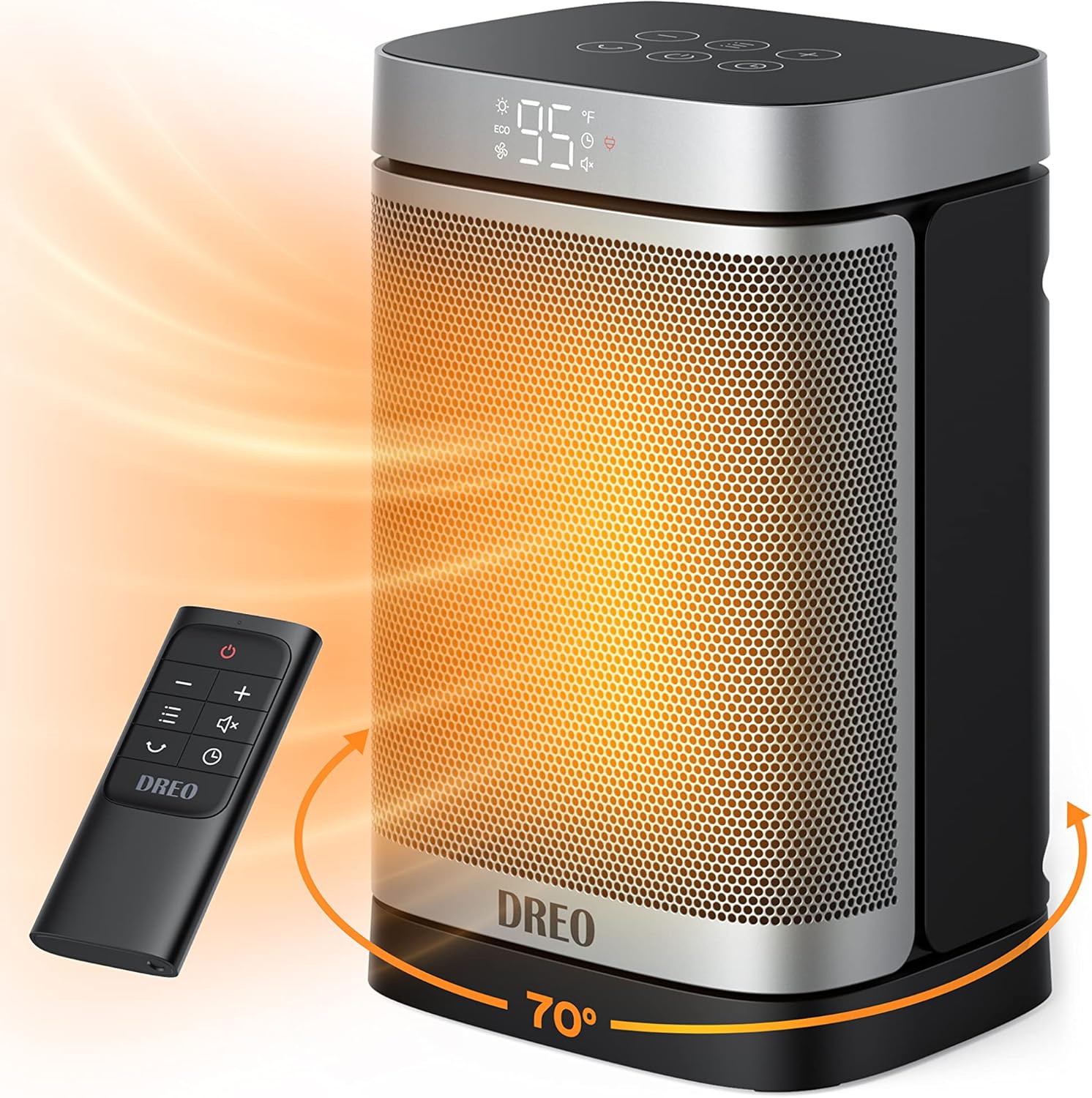
| Heat Output | 1500 watts |
|---|---|
| Heating Coverage | 200 sq.ft |
| Heating Element | PTC Ceramic |
| Oscillation | 70° |
| Timer | 1-12 H |
The DREO Atom One is a compact tower heater that uses PTC ceramic elements and up to 1500W to warm small to medium rooms quickly. It sits on the floor or a desk and offers a programmable digital thermostat from 41 to 95 °F, five fan/power modes including an ECO setting, 1–12 hour timer, and 70° oscillation to spread heat across a wider area. Practical touches include a detachable filter, LED control panel and a small remote for adjusting settings from across the room. Safety features are robust for the category, with ETL listing, tip-over and overheat protection and flame-retardant materials. Noise is lower than many tower heaters thanks to a brushless DC motor and aerodynamic blades, so it is suitable for bedrooms or home offices. The main compromises are the expected 1500W power ceiling, which limits rapid heating in very large rooms, and the unit's compact footprint that focuses warmth rather than whole-house heating. For a quiet, feature-rich personal heater the Atom One delivers solid performance and safety.
Best for: Buyers who prioritize a quiet, safety-focused heater with programmable controls for bedrooms or home offices and who value social proof and reliability when choosing appliances.
Less Ideal for: People needing to heat large open rooms, very cold garages, or whole-floor spaces should look at higher-capacity heaters or supplemental heating solutions.
- 1500W PTC ceramic heat for fast, even warming
- Programmable digital thermostat adjustable in 1°F increments
- 70° oscillation for wider room coverage
- Quiet operation using brushless DC motor and aerodynamic blades
- Remote control plus 1–12 hour timer for convenient hands-free use
- 1500W output may be insufficient for very large or poorly insulated rooms
- Compact design focuses heat locally rather than heating entire open-plan spaces
Verdict: A quiet, safety-minded 1500W tower heater with precise thermostat control and oscillation ideal for bedrooms and home offices.
GiveBest Portable Space Heater PTC-905

| Heat Output | 1500 watts |
|---|---|
| Heating Coverage | 200 sq.ft |
| Number of Speeds | 2 |
| Voltage | 120 volts_of_alternating_current |
| Max Temperature Setting | 158 °F |
The GiveBest PTC-905 is a small ceramic space heater built to warm single rooms without fuss. It offers 1500W and 750W heat modes plus a cool-fan setting, and an adjustable electronic thermostat that cycles the unit to keep a set temperature. In everyday use it sits on a desk or tabletop and heats nearby areas quickly thanks to PTC ceramic elements and a high-speed fan; the manufacturer claims coverage up to about 200 sq ft. Safety features include flame-retardant housing, automatic overheat shutoff, and tip-over protection that beeps and cuts power if knocked over. The unit is lightweight with a carry handle and a six-foot cord, so it is easy to move between bedroom, office, and bathroom. Noise levels are reported as low enough for sleeping or working, though the fan is audible at higher settings. If you need whole-house heating or exact temperature control for large rooms, a larger heater is required, but for quiet, portable spot heating this model is sensible and straightforward.
Best for: Buyers who prioritize a simple, safe, and quiet personal heater for a bedroom, home office, or small living area and prefer a low-risk, reliable product.
Less Ideal for: People who need to heat large open rooms or require precise climate control across multiple zones should choose a larger or whole-room heating solution.
- Two power modes (1500W/750W) plus a cool-fan option for year-round use
- Adjustable electronic thermostat for automatic temperature maintenance
- Multiple safety systems including overheat shutoff and tip-over protection
- Compact, lightweight design with carry handle and long power cord for flexible placement
- Fan becomes noticeable at higher heat settings
- Not designed to warm very large or open-plan spaces
Verdict: A compact, safety-focused ceramic heater that delivers quiet, effective spot heating for small rooms.
Choosing the Right Quiet Space Heater: Key Factors to Consider
Noise Level and Sound Signature
A heater marketed as quiet should list a noise rating or describe its sound signature. Noise matters because even modest mechanical sounds can disturb sleep or concentration in small rooms. Look for models with lower decibel ratings or consumer feedback emphasizing a steady, unobtrusive background sound rather than intermittent clicks or fan whines.
Consider how sound changes at different heat settings. Some heaters are near-silent on low but become noticeably louder at maximum output. If you plan to run the heater overnight or while working, prioritize models that maintain low noise across the range of typical settings.
Heating Output and Room Size
Check the heater's rated output and suggested coverage area to match the rooms you intend to heat. A quiet heater with insufficient output will need to run at higher settings, which can increase noise and shorten component life. Conversely, an overpowered unit in a small room may cycle frequently, creating temperature swings.
Understand the distinction between short-term blast heat and sustained background warmth. For bedrooms and offices, steady low-to-moderate output with good air distribution is usually better than short bursts of high heat that increase noise.
Thermostat Control and Temperature Consistency
A precise thermostat or digital temperature control helps maintain steady room temperature without frequent on-off cycles that can raise noise. Mechanical thermostats can be effective but sometimes lack fine control. Models with programmable settings or eco modes can reduce runtime and maintain quieter operation by avoiding constant high-power cycles.
Consistent temperature also affects comfort and perceived noise. When a room stays within a narrow temperature band, the heater rarely needs to switch power levels, reducing audible changes that can be distracting.
Safety Features and Certifications
Safety is essential for heaters intended for indoor, near-sleep use. Look for tip-over shutoff, overheat protection, and a cool-touch exterior to minimize burn and fire risk. Built-in automatic shutoffs triggered by high surface temperature or internal sensors add important protection.
Check for recognized safety certifications or testing claims and follow placement recommendations. Safety safeguards let you use a heater closer to beds or workstations with more confidence while maintaining quiet operation.
Energy Efficiency and Running Cost
Energy-efficient heaters deliver comparable warmth with less electricity, which matters for frequent or long-duration use. Features that improve efficiency include good insulation, ceramic or oil heat retention elements, programmable timers, and accurate thermostats that avoid excessive cycling.
Consider how efficiency affects the balance between noise and warmth. A more efficient model may run longer at lower settings and remain quieter, while an inefficient unit might need high power and create more audible output to reach the same comfort level.
Size, Placement, and Portability
The heater's footprint and weight determine where you can place it and how easily you can move it between rooms. Compact models fit better in tight bedroom or office spaces and are less likely to block walkways. Portable units with handles or caster wheels are useful if you move heating from room to room.
Placement affects perceived noise and heat distribution. A small, quiet heater placed on a bedside floor or under a desk can be effective, but ensure it has clearances required for safe airflow and does not blow directly onto soft furnishings.
Types of Quiet Space Heaters
Quiet space heaters use different technologies to reduce audible output while providing useful heat. Convection-style heaters warm the air gently and circulate it naturally, producing minimal mechanical noise. Radiant or infrared heaters warm objects and people directly, often operating with little to no fan noise. Ceramic elements with variable-speed fans can strike a balance by providing faster warm-up with moderate sound at higher settings.
Choosing the right type depends on how quickly you need warmth and whether you prioritize absolute silence. For bedrooms, passive convection and infrared styles tend to be the quietest during continuous use, while ceramic fan units may be better for rapidly warming a chilly room before bed or during breaks.
- Convection: Quietest steady heat, good for continuous background warmth
- Infrared/Radiant: Near-silent, warms people and objects directly
- Ceramic Fan: Faster warm-up, volume increases at high settings
Placement Tips to Minimize Noise and Maximize Comfort
Where you place a quiet heater affects both perceived noise and how evenly a room warms. Keep the heater on a stable, level surface away from soft surfaces that trap heat and block airflow. Positioning near the center of the room or under a desk can improve circulation without directing sound toward your head while sleeping or working.
Avoid placing a heater directly on carpeting if the manufacturer cautions against it, and maintain the recommended clearance from walls and furniture. Small adjustments to angle and distance often reduce reflected sound and improve comfort without changing the unit.
- Place on stable, level surfaces
- Maintain recommended clearances from walls and fabric
- Point away from sleeping or working positions when possible
Using Timers, Eco Modes, and Sleep Settings
Many quiet heaters include timers, programmable schedules, or sleep modes that reduce output overnight. These features can keep noise low by avoiding sudden power changes and by running the heater at the lowest effective setting for maintenance heat. Timers also let you preheat a room briefly then switch to a lower-maintenance mode that stays quieter.
Use eco modes to limit maximum power and allow the thermostat to modulate output. For overnight use, choose a setting that balances temperature stability and minimal cycling to preserve near-silent conditions.
- Use timers to preheat then switch to lower settings
- Enable sleep or eco modes for reduced cycling and noise
- Set thermostat slightly lower to avoid frequent power changes
Maintenance to Preserve Quiet Operation
Routine maintenance helps keep a heater quiet and reliable. Dust buildup in air inlets, fans, and element housings can increase noise and reduce airflow. Regularly clean grills and check fan blades for debris. For sealed or oil-filled units, follow manufacturer guidance for inspection and safe storage.
Address any new rattles or humming early. Loose panels, screws, or mounting brackets can generate noise that compromises a quiet heater's advantage. Simple tightening or cleaning often restores near-silent performance.
- Clean intake and exhaust grills regularly
- Inspect for loose panels or screws if new noises appear
- Follow storage and downtime recommendations to avoid component degradation
Safety and Best Practices for Overnight Use
When running a heater overnight, follow strict safety practices. Place the unit away from bedding, curtains, and other flammable materials. Ensure tip-over protection and overheat shutoff are enabled and functional. Avoid leaving extension cords under rugs or running cords where they might be pinched.
Consider placing the heater where it can maintain an even temperature without direct contact with people or objects. Combining proper placement with built-in safety features reduces risk and lets you enjoy quieter, uninterrupted warmth while sleeping.
- Keep clearances to prevent overheating soft materials
- Use certified outlets and avoid overloaded circuits
- Test safety shutoffs periodically
How We Chose the Best Quiet Space Heater
We prioritized measurable, practical criteria that matter for using a quiet space heater in everyday rooms. Primary evaluation metrics included sound output measured in decibels or reported noise characteristics, heating performance across small to medium rooms, and temperature consistency to avoid frequent cycles that can increase noise. Safety features such as tip-over shutoff, overheat protection, and cool-touch surfaces were required filters for inclusion. Energy efficiency and runtime or thermostat control were considered to assess operating cost and user convenience. Build quality and ease of placement, including footprint and mounting or carry options, were also part of the selection. We excluded heaters that lacked clear noise specifications, omitted basic safety protections, or were intended only for outdoor or industrial use. The final shortlist emphasizes a balance of quiet operation, effective warmth, and reliable safety.
Our full evaluation process is outlined in our review methodology.
FAQ
How quiet is a typical quiet space heater?
Quiet heaters often operate in a low-decibel range that is barely noticeable in a bedroom. Exact noise varies by technology and setting; many models remain near-silent on low but become louder at maximum power.
Will a quiet heater warm a medium-sized bedroom effectively?
Yes, if you choose a model with appropriate output for the room size. Check the rated coverage and prefer units with good thermostat control so the heater can maintain temperature without running at high, louder settings.
Are radiant heaters better for silent operation than fan heaters?
Radiant heaters are often quieter because they heat objects directly and do not require fans. However, they may feel less effective at warming room air quickly. Choose based on whether you want immediate personal warmth or even ambient heating.
Can I leave a quiet space heater running all night?
Many modern heaters include safety features designed for overnight use, such as tip-over and overheat shutoff. Still, follow manufacturer guidance, maintain required clearances, and use models with reliable safety protections for overnight operation.
How do I reduce noise from a fan-style heater?
Run the heater at lower settings, keep intake and exhaust openings clean, and place the unit on a solid, stable surface. Position the heater so sound is not reflected toward your head and enable sleep or eco modes if available.
Final Verdict
Prioritize a heater that matches your room size and offers low noise across the settings you use most. Focus on noise level, thermostat accuracy, and core safety features when choosing a quiet space heater, and accept modest tradeoffs between rapid warm-up and absolute silence. With the right balance of output, control, and protections, you can find a near-silent heater that provides steady, comfortable warmth for overnight use or focused work sessions.