
Note: This article contains affiliate links. If you click on these links and make a purchase, we may earn a small commission at no extra cost to you. This helps support our research and content. Read our full affiliate disclosure here.
If you need humidity control in a bedroom, office, or other small space without constant fan noise, choosing the right compact dehumidifier matters. A Quiet Small Dehumidifier can prevent mold, reduce musty odors, and protect furnishings while letting you sleep or work undisturbed. This guide covers six shortlisted options that prioritize low operational sound and effective moisture removal. We evaluated each candidate across real-world criteria that matter for small-room use, including noise performance, moisture capacity, and ease of upkeep. Read on to see which compact dehumidifiers meet common small-space needs and why they made the list.
Top Picks at a Glance
| Best Overall The best all-around choice for most situations | CLEVAST EF8974 Dehumidifier |  |
| Best Value The sweet spot between price and what you get | Erizolt CSK06 Dehumidifier |  |
| Best Budget The cheapest option that still gets the job done reliably | TABYIK 35oz Dehumidifier DH-CS01 |  |
| Top Rated A top-rated pick with lots of positive feedback | CLEVAST CL-DH04 Dehumidifier |  |
| Most Popular A crowd favorite that many people choose with confidence | Pro Breeze Mini Dehumidifier PB-02 |  |
| Best Seller A high-volume bestseller chosen again and again | BEDRED CT11 Dehumidifier |  |
CLEVAST EF8974 Dehumidifier

| Floor Area | 500 square_feet |
|---|---|
| Capacity | 68 fluid ounces |
| Dehumidification Capacity | 0.7 liters_per_day |
| Wattage | 72 watts |
| Other Special Features of the Product | Adjustable Humidity Control, Continuous Draining, Quiet Operation, Sleep Mode, Timer |
The CLEVAST EF8974 is a small, portable dehumidifier built for bedrooms, bathrooms, closets, RVs and other enclosed spaces up to about 500 sq ft. It uses dual semiconductor technology and a brushless DC motor to remove up to 0.7 liters (23 oz) per day under test conditions and offers two drainage options: a removable 68 oz tank or a continuous drain via the included hose. The touch panel and real-time humidity display let you set a target from 40 to 90% RH and the unit will maintain it automatically, while a sleep mode mutes lights and reduces noise to under 30 dB for nighttime use. A timer and auto shut-off when the tank is full add convenience, and features like a washable filter, UV-C and negative ion functions aim to improve air freshness. Expect modest daily capacity suited to small, damp areas rather than whole-house dehumidification, and note humidity readings can vary by a few percent depending on placement and airflow.
Best for: Buyers who want a quiet, portable dehumidifier for bedrooms or other small rooms and prioritize low noise and simple automatic humidity control.
Less Ideal for: People who need high-capacity moisture removal for basements, large damp rooms, or whole-house dehumidification should choose a larger, more powerful unit.
- Quiet operation with sleep mode reducing noise to under 30 dB for nighttime use
- Large 68 oz removable tank plus included drain hose for continuous draining
- Adjustable humidity control with real-time display and automatic maintenance
- Brushless DC motor and dual semiconductor system for efficient small-space moisture removal
- Low dehumidification capacity (about 0.7 L / 23 oz per day) limits use to small, moderately damp spaces
- Humidity sensor can vary by about ±5% depending on room conditions and placement
Verdict: If you need a low-noise, portable dehumidifier for a bedroom or small room, the EF8974 delivers quiet automatic humidity control with convenient tank or hose drainage.
Erizolt CSK06 Dehumidifier
| Tank Volume | 35 fluid ounces |
|---|---|
| Floor Area | 350 square_feet |
| Dehumidification Capacity | 0.48 liters_per_day |
| Operation Mode | Automatic |
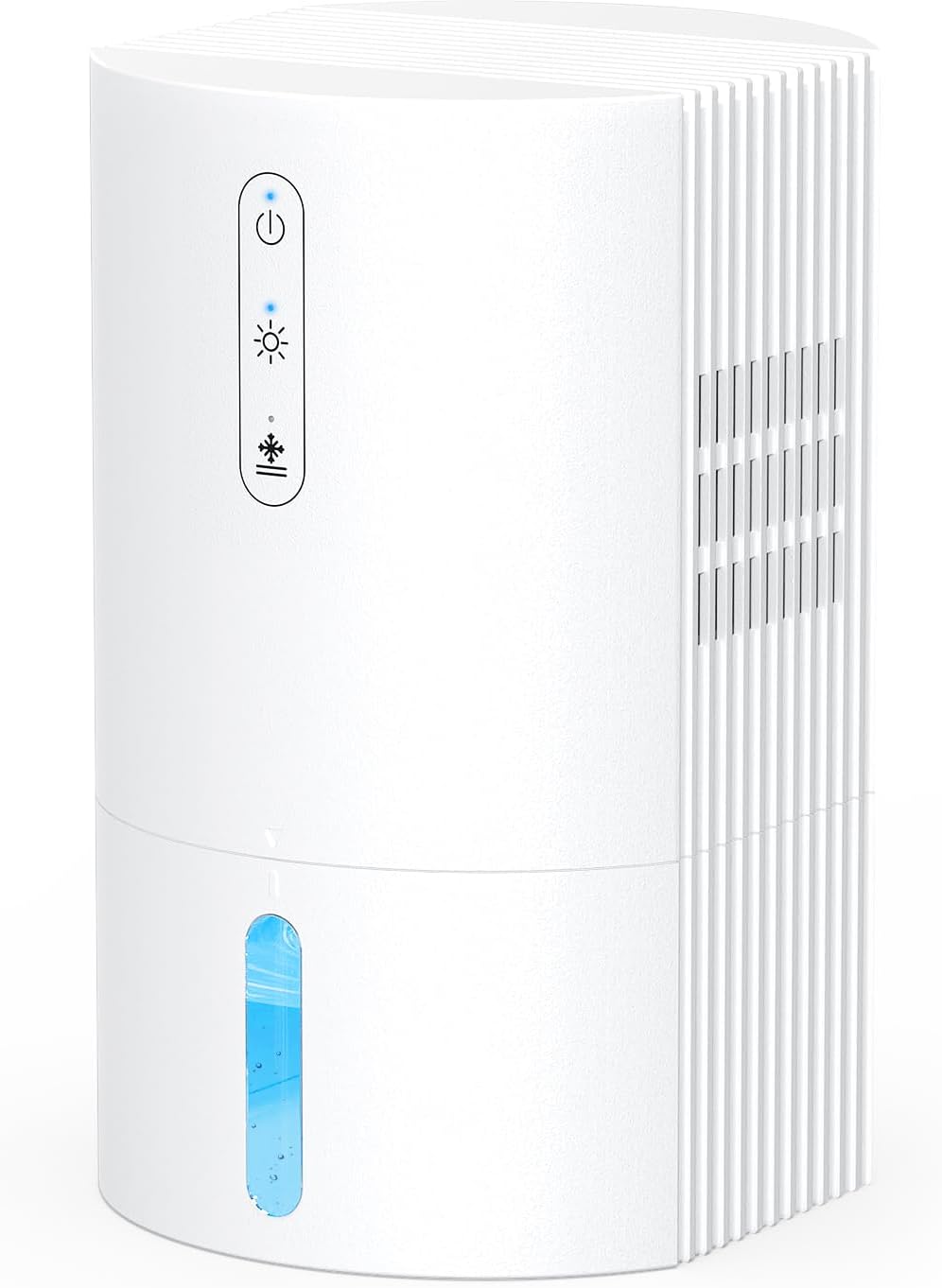
The Erizolt CSK06 is a small, energy-conscious dehumidifier built for bedrooms, bathrooms, closets and similar spaces up to about 350 sq ft. It collects moisture into a 35 oz tank and uses an automatic mode that handles daily operation with an auto shutoff when the tank is full and an auto defrost function for low-temperature use. The unit is notably quiet at roughly 25 dB, so it can run overnight without disturbing sleep, and low power draw means it can run for long stretches without a big impact on electricity. A clear tank window and an LED indicator make it simple to see when the reservoir needs emptying, and the compact plastic housing is easy to move. Limits include modest drying capacity—about 0.48 liters per day under the listed condition—so it is best for light to moderate humidity control rather than very damp basements or large open areas. The CSK06 is a convenient, low-noise option when you need steady moisture reduction in small rooms.
Best for: Buyers who prioritize a quiet, energy-efficient solution to reduce moisture in single rooms and want a portable, low-maintenance unit for daily use.
Less Ideal for: People who need rapid drying in very damp basements, whole-house coverage, or high-capacity continuous dehumidification should choose a larger compressor model instead.
- Very quiet operation (~25 dB) suitable for bedrooms and night use
- Automatic shutoff with visible tank window prevents overflows
- Auto defrost allows operation at lower temperatures
- Compact, lightweight design that is easy to move and place in small spaces
- Low energy use enabling prolonged continuous operation
- Low dehumidification capacity (about 0.48 L/day) limits use to small or moderately damp spaces
- Plastic construction may feel less durable than larger compressor units
Verdict: Choose the Erizolt CSK06 when you need a whisper-quiet, energy-sparing dehumidifier for everyday moisture control in a single small room.
TABYIK 35oz Dehumidifier DH-CS01

| Tank Volume | 1000 ml |
|---|---|
| Dehumidification Capacity | 0.45 liters_per_day |
| Wattage | 40 watts |
| Operation Mode | Continuous |
| Floor Area | 280 square_feet |
This compact TABYIK DH-CS01 is a small Peltier dehumidifier built for bedrooms, bathrooms, closets and RVs where low noise and portability matter. It operates continuously with a single-speed Peltier system that can collect up to about 16 oz (450 ml) per day under ideal warm, humid conditions, and stores moisture in a transparent 35 oz (1000 ml) tank with an auto shutoff when the tank nears full. The unit runs at roughly 28 dB, making it suitable for bedrooms or offices, and includes a separate 7-color light with on/off control for ambiance. Practical touches include a rear handle for carrying and a removable tank groove for easier emptying and cleaning. Because it uses a thermoelectric module rather than compressor technology, it is quieter and uses little power but is not intended for large, very damp spaces or rapid dehumidification. If you want a low-cost, low-noise solution for small areas, this unit delivers simple, hands-off operation; if you need heavy-duty moisture removal, a compressor dehumidifier will work faster.
Best for: Buyers on a tight budget who need a near-silent, portable dehumidifier for a single small room, closet, RV or bathroom and prioritize low noise and simplicity over high extraction rates.
Less Ideal for: People needing rapid moisture removal in basements or large, very damp spaces or those who require adjustable humidity control and higher capacity.
- Very quiet operation around 28 dB suitable for bedrooms and offices
- Portable, compact design with built-in handle for easy placement and moving
- Transparent 35 oz tank with auto shutoff prevents overflows and notifies when full
- Low power consumption, uses roughly under 1 kWh per day in typical small-room use
- Low daily extraction (about 16 oz/450 ml) which is slow for high-humidity or larger rooms
- Single-speed thermoelectric system limits performance compared with compressor units
Verdict: A budget-friendly, ultra-quiet portable dehumidifier that works well for single small rooms or RVs where low noise and simple operation are the top priorities.
CLEVAST CL-DH04 Dehumidifier
| Capacity | 30 fluid ounces |
|---|---|
| Dehumidification Capacity | 0.3 liters_per_day |
| Wattage | 27 watts |
| Air Flow Capacity | 2000 cubic_feet_per_hour |
| Number of Speeds | 2 |
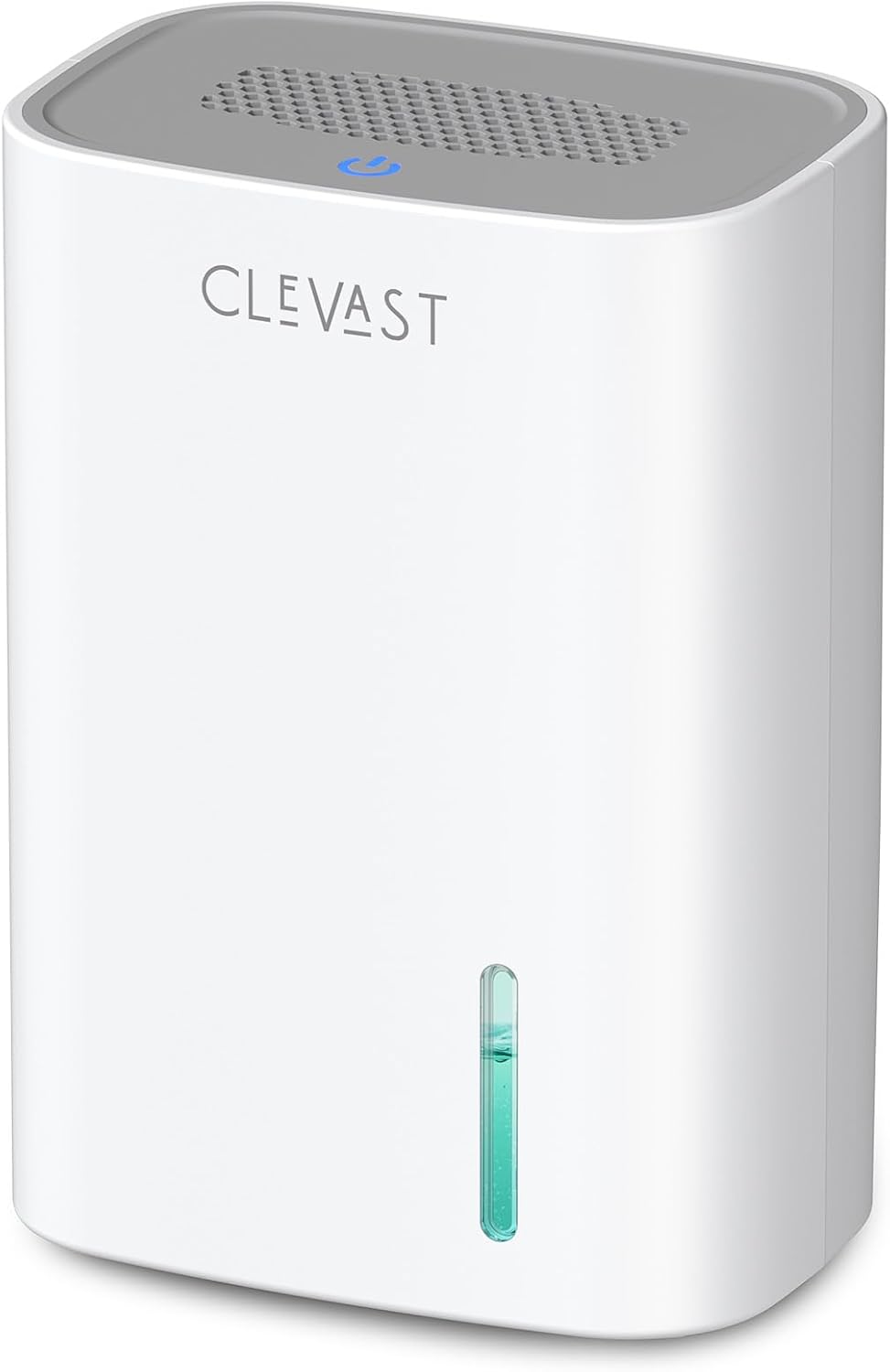
The CLEVAST CL-DH04 is a small, portable dehumidifier built for enclosed spaces like bedrooms, bathrooms, closets, and RVs. It uses semiconductor condensation to remove moisture without refrigerants and offers two fan speeds including a 24 dB quiet mode suitable for nighttime use. The unit has a 30 oz removable water tank with automatic shut-off and an indicator light, and it operates on about 0.55 kWh per day in typical use. Setup is simple with one-button control to switch between efficient and quiet modes, and the built-in handle makes it easy to move between rooms. Practical limits are its modest dehumidification rate (about 0.3 L/day under standard conditions, or up to roughly 10 oz/day in high-efficiency testing) and best performance only within the 68°F–86°F recommended temperature range, so it works best for small, enclosed areas rather than damp basements or large rooms. For buyers prioritizing low noise and straightforward, chemical-free moisture removal in small spaces, this unit delivers dependable, low-maintenance performance.
Best for: Buyers who want a reliable, low-noise dehumidifier for nightly use in small, enclosed rooms and who value simple, maintenance-light operation.
Less Ideal for: People needing heavy-duty moisture removal for basements, large rooms, or consistently cold environments should choose a higher-capacity or compressor-based unit instead.
- Very quiet operation at 24 dB suitable for bedrooms and nurseries
- Energy-efficient consumption (about 0.55 kWh per day)
- 30 oz removable tank with automatic shut-off prevents overflow
- Portable tabletop size with built-in carry handle for easy relocation
- Low dehumidification capacity best suited to small, enclosed spaces rather than large or very damp areas
- Performance drops outside recommended 68°F–86°F operating range
Verdict: If you need a dependable, ultra-quiet dehumidifier for a bedroom, bathroom, or small enclosed space, this compact CLEVAST model delivers low-noise, low-maintenance moisture control.
Pro Breeze Mini Dehumidifier PB-02

| Floor Area | 215 square_feet |
|---|---|
| Capacity | 16 fluid ounces |
| Tank Volume | 17 fluid ounces |
| Wattage | 21 watts |
| Dehumidification Capacity | 0.25 liters_per_day |
The Pro Breeze Mini Dehumidifier is a small, portable unit intended for single rooms such as bathrooms, bedrooms, closets, RVs and similar spaces. It uses thermoelectric Peltier cooling to run quietly and with low power draw while collecting moisture into a removable 16–17 ounce tank; the unit will auto shut off and light an indicator when the tank is full. Practical controls and continuous operation mode make it simple to run overnight or during the day to reduce window condensation and trapped humidity. Its low dehumidification rate (about 0.25 liters or roughly 9 ounces per day) and modest airflow mean it is best for spot treatment rather than whole-home drying, and it requires ambient temperatures above about 41°F to operate effectively. The inexpensive, lightweight design is easy to move and maintain, but buyers wanting fast moisture removal in larger areas will need a larger compressor-style dehumidifier.
Best for: Buyers who prioritize quiet, energy-efficient spot dehumidification for single small rooms and want a compact unit backed by a widely used product and customer feedback.
Less Ideal for: Owners who need to dry large rooms, handle severe dampness, or want rapid water extraction should choose a larger compressor dehumidifier instead.
- Very quiet Peltier operation suitable for bedrooms and offices
- Low power consumption for continuous use
- Auto shut-off with LED full-tank indicator for safe unattended operation
- Compact and lightweight, easy to move between small rooms
- Low daily extraction rate makes it unsuitable for large or very damp spaces
- Does not operate effectively below about 41°F
Verdict: A whisper-quiet, energy-light mini dehumidifier that is a practical choice for quiet spot treatment in single small rooms.
BEDRED CT11 Dehumidifier

| Floor Area | 1000 square_feet |
|---|---|
| Tank Volume | 95 fluid ounces |
| Capacity | 5.9 pounds |
| Operation Mode | Intermittent |
| Other Special Features of the Product | 7 Color Ambient Light, Automatic Shutoff, Sleep Mode |
The BEDRED CT11 is a compact thermoelectric dehumidifier intended to reduce humidity in small spaces such as bedrooms, bathrooms, and modest basements up to about 1000 sq ft. It uses semiconductor cooling rather than a compressor, so it runs quietly and is simple to operate with an intermittent operation mode and an automatic shutoff when the 95 oz tank fills. Sleep Mode turns off the lights and lowers noise for overnight use, and the seven-color ambient light gives an optional mood-lighting feature. Practical benefits include easy emptying from the included tank, portability thanks to a lightweight design, and low sound levels that suit living spaces. Important limitations are inherent to semiconductor units: lower capacity compared with compressor dehumidifiers, reduced performance in very cold or very damp basements, and a smaller tank that requires more frequent emptying in high-humidity conditions.
Best for: Buyers who prioritize quiet, low-maintenance dehumidification and want a compact unit that is easy to move and run in living spaces or small basements without frequent intervention.
Less Ideal for: People needing heavy-duty moisture control for large, cold, or very damp basements should choose a higher-capacity compressor dehumidifier instead.
- Quiet thermoelectric operation suitable for bedrooms and living rooms
- Automatic shutoff protects against overfill and simplifies unattended use
- 95 oz removable tank for straightforward water removal
- Sleep Mode and ambient light options for low‑noise nighttime use
- Compact and lightweight for easy placement or moving between rooms
- Semiconductor cooling gives lower moisture removal capacity than compressor models
- Performance drops in cold basement conditions and very high humidity areas
Verdict: Choose the BEDRED CT11 if you want a quiet, portable dehumidifier with auto‑shutoff and sleep‑friendly operation for small basements or living spaces.
Choosing the Right Quiet Small Dehumidifier: Key Factors to Consider
Noise Level and Operational Sound
Noise output is the defining factor for a quiet small dehumidifier because these units will often run in living rooms, bedrooms, and offices where background sound matters. Look for measured decibel ratings at low and medium fan speeds and pay attention to whether manufacturers provide both numbers. Operating noise is not only about peak fan roar; tonal characteristics—such as a high-pitched whine versus a low, steady hum—affect how noticeable a unit will be in a quiet room.
Consider how noise scales with performance. Some compact models increase fan speed dramatically once the humidistat calls for aggressive dehumidifying, so a unit that is whisper-quiet at idle may still become intrusive during heavy cycles. If you plan to run the dehumidifier overnight, prioritize steady low-dB performance and features like a sleep mode or adjustable fan curves.
Moisture Removal Rate
A small-room dehumidifier needs sufficient extraction capacity for the space's typical humidity load. Moisture removal rates are usually rated in pints or liters per 24 hours. For bedrooms and small offices, modest daily removal is often enough, but if the room is unusually damp or if laundry dries indoors, select a unit with a higher rated extraction to avoid long runtimes.
Removal rate affects both how quickly the unit reaches your target humidity and how often it cycles on and off. Undersized extraction can lead to continuous operation, which raises energy use and wear. Match the rated removal to your room size and expected humidity sources to balance quiet operation with effective control.
Water Handling: Tank Size and Drain Options
Tank capacity determines how often you need to empty the reservoir, and a larger tank usually means less frequent interruptions for maintenance. For small dehumidifiers, tank sizes are compact, so look for clear indicators like transparent windows and easy-grip handles that make emptying quick and clean. Many users prefer a continuous-drain or gravity-drain option to avoid daily emptying, but continuous-drain setups require stable placement near a drain point and a reliable hose connection.
Auto-shutoff on a full tank is standard, but check how the unit signals a full tank and whether the shutoff is reliable. Ease of removing, carrying, and reinstalling the tank matters in tight spaces where maneuverability is limited.
Energy Use and Operating Cost
Because small dehumidifiers may run for long periods, energy efficiency impacts running cost and heat output. Look for energy ratings or wattage figures and consider how efficiency changes with fan speed. A slightly higher initial extraction that finishes cycles faster can be more efficient than a low-extraction unit that runs continuously.
Also consider whether the unit uses features like automatic humidistats, timers, or eco modes that reduce unnecessary runtime. Lower heat rejection from the unit is beneficial in already-warm rooms; efficient compressors and intelligent controls can maintain dryness with less added heat.
Size, Placement, and Portability
Physical footprint is critical for small rooms. Measure the floor or shelf area where you plan to place the dehumidifier and confirm the unit's dimensions and clearance requirements. Some compact units are designed to tuck into narrow spaces or sit on a small cart. Weight and carry handles matter if you will move the unit between rooms or store it seasonally.
Placement affects both noise perception and airflow. A model with a front-facing intake and top discharge will behave differently in a corner than one with rear intake. Ensure the unit has feet or rubber pads to reduce vibration transfer to floors or furniture, which can amplify perceived noise.
Controls, Features, and Maintenance
Controls determine how easily you can set target humidity, schedule operation, and react to changing conditions. Intuitive, responsive controls with clear displays help fine-tune performance without fiddling. Features like washable filters, filter-change indicators, and easy-access panels reduce upkeep time and keep the unit running quietly over time.
Maintenance also includes the availability of replacement filters or parts and straightforward cleaning procedures for coils and condensate channels. A design that minimizes tools and exposes common maintenance points makes it more likely you will keep the dehumidifier in peak condition.
Where Quiet Matters Most
Small-room dehumidifiers are often placed in spaces where low noise is essential, such as bedrooms, nurseries, and home offices. In these settings, even modest fan noise can disrupt sleep or focus, so prioritize models with verified low-dB ratings at the speeds you plan to use most often.
Think beyond the spec sheet. Positioning and room acoustics influence perceived loudness. Placing a unit on a soft rug or using isolation pads can reduce vibration transfer and make an otherwise audible device feel quieter.
- Bedrooms and nurseries: prefer models with a dedicated sleep mode
- Home offices: choose steady low-noise output for conference calls
- Closets and storage areas: extraction capacity can be lower if noise is less critical
Sleep Modes, Timers, and Smart Controls
Features such as sleep modes, programmable timers, and simple humidity presets let you minimize noise during sensitive hours while maintaining air quality. Sleep modes typically reduce fan speed and dim displays to avoid disturbances.
Some compact units offer basic smart features like humidity-target scheduling or app-based controls. These can be useful for adjusting runtime remotely, but ensure any added smart functions do not introduce extra fan cycles that increase noise.
- Use timers to run the unit during daytime when noise is less critical
- Set humidistats to a realistic target (40 to 50 percent for many homes) to avoid frequent high-speed cycles
- Dim or disable display lights for overnight use
Placement Tips to Reduce Perceived Noise
Where you put a compact dehumidifier changes how loud it seems. Avoid tight enclosures that restrict airflow and force the fan to work harder. Place the unit on a stable, level surface and allow recommended clearances around intake and exhaust zones.
If possible, place the dehumidifier away from the head of a bed or the main seating area. Routing a drain hose to a remote drain can let you locate the unit in a less obtrusive corner without increasing maintenance frequency.
- Keep at least the manufacturer-recommended clearance for intake and exhaust
- Use vibration-isolating pads to cut floor-borne noise
- Avoid placing on hollow furniture that amplifies sound
Maintenance Habits That Keep Noise Low
Regular maintenance keeps a dehumidifier running smoothly and quietly. Clean or replace filters on the schedule recommended by the manufacturer to avoid restricted airflow and noisy strain on the fan and compressor.
Inspect the water tank and condensate pathways for blockages or buildup that can cause irregular operation. Tighten loose panels and feet; rattles and vibrations are common causes of perceived loudness and are often easy to fix.
- Rinse washable filters monthly in dusty environments
- Verify the drain hose is free of kinks for continuous-drain setups
- Check for loose screws or panels if you notice new noises
When Continuous Drain Beats a Tank
Continuous-drain operation is advantageous if you want truly hands-off performance and fewer tank-emptying interruptions. In small spaces, this can be especially useful if frequent emptying is impractical or if you plan to run the unit overnight.
Continuous drain requires a stable drain location at or below the unit's outlet or a pump accessory for uphill routing. Consider whether the installation constraints are compatible with your living space before opting for a continuous-drain model.
- Gravity drain is simplest but needs a lower drain point
- Pump-assisted drains lift installation flexibility but add complexity
- Ensure hose connections are secure to prevent leaks
How We Chose the Best Quiet Small Dehumidifier
We focused on products suited to small rooms and light to moderate humidity control needs, prioritizing measurable attributes that affect day-to-day use. Key evaluation criteria included steady-state noise levels at typical operating settings, moisture removal rate for small square footage, and tank capacity or continuous-drain options that reduce maintenance. We also considered energy efficiency for continuous or overnight use, physical footprint and portability for tight spaces, and control features such as adjustable humidistats and timers that let you tailor runtime. Models with excessively loud fans, unclear moisture ratings, or minimal warranty/support information were excluded. We did not include large-capacity or whole-house units because their operating profiles and noise tradeoffs differ from compact dehumidifiers. The final shortlist prioritizes low-noise operation without sacrificing reliable condensation performance, practical water management, and straightforward upkeep.
Our full evaluation process is outlined in our review methodology.
FAQ
How quiet is a typical small dehumidifier at night?
Many compact models operate in the mid-40s to low-50s decibel range on low settings, which is comparable to a quiet refrigerator hum. Actual perception depends on room acoustics and placement, so a unit rated in the low 40s is preferable for overnight use.
Will a quiet small dehumidifier handle a damp basement?
Small dehumidifiers are designed for bedrooms, closets, and small offices and may struggle with very damp basements. For persistent high-humidity areas, a unit with a higher extraction rate is usually needed to avoid continuous high-speed operation that increases noise.
Is continuous drain noisy compared with emptying a tank?
Continuous drain itself is quiet, though a poorly routed hose or an unstable drain connection can transmit noise or vibrations. Properly installed gravity drains and secure hose fittings minimize any added sound and reduce interruptions for emptying the tank.
How often should I clean the filter to keep noise down?
For typical home use, check and clean washable filters every one to three months. In dusty or high-pollen environments, monthly cleaning helps maintain airflow and prevents the fan from working harder and getting louder.
Do quiet dehumidifiers use different compressors or just slower fans?
Both approaches are used. Manufacturers may combine vibration-damped compressors with low-speed fans and insulated housings to reduce noise. The net result is quieter operation, but effectiveness depends on design and how the unit is used.
Final Verdict
For small rooms where low noise is a priority, balance measured sound levels with realistic moisture-removal capacity and convenient water-handling features. Prioritize units that offer low-dB performance at the fan speeds you will use most, and ensure tank size or continuous-drain options match your maintenance preferences. Also weigh energy efficiency and simple maintenance to keep operating noise minimal over time. With these tradeoffs in mind, you can select a compact dehumidifier that maintains comfort without disrupting sleep or daily activities.