
Note: This article contains affiliate links. If you click on these links and make a purchase, we may earn a small commission at no extra cost to you. This helps support our research and content. Read our full affiliate disclosure here.
A basement that stays damp or humid can damage finishes, encourage mold, and make the whole house feel musty. Choosing the right large-capacity dehumidifier for basements matters because these spaces often need higher extraction rates, continuous operation, and robust corrosion resistance compared with smaller room units. This guide shortlists the top options suited to basements, focusing on moisture removal performance, energy efficiency, drainage options, and durability for prolonged use. Below you will find the leading picks, followed by clear buying factors and practical advice to match a unit to your basement size and conditions.
Top Picks at a Glance
| Best Overall The best all-around choice for most situations | Waykar YDZ-150PM Dehumidifier |  |
| Best Quality Built to a higher standard if you want something more solid | Airzentti 155‑Pint Dehumidifier |  |
| Best Value The sweet spot between price and what you get | AEOCKY LEO-Lite 74 Pint Dehumidifier |  |
| Best Budget The cheapest option that still gets the job done reliably | AIRPLUS 70-Pint Dehumidifier |  |
| Top Rated A top-rated pick with lots of positive feedback | hOmeLabs 50 Pint Dehumidifier | 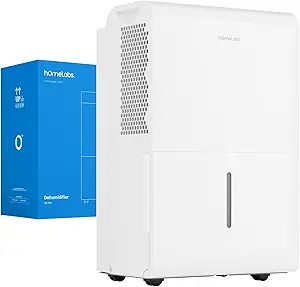 |
| Most Popular A crowd favorite that many people choose with confidence | MIONJO V3 Dehumidifier |  |
| Best Seller A high-volume bestseller chosen again and again | AEOCKY BOREAS-001 Dehumidifier |  |
Waykar YDZ-150PM Dehumidifier

| Capacity | 150 pints |
|---|---|
| Tank Volume | 1.85 gallons |
| Wattage | 520 watts |
| Air Flow Capacity | 212 cfm |
| Operation Mode | Auto, Continuous |
The Waykar YDZ-150PM is a high-capacity dehumidifier built for large basements and commercial rooms that need continuous moisture control. It removes up to 150 pints per day (tested at 95°F, 90% RH) and can cover areas up to about 7,000 sq ft, so it handles heavy damp conditions without constant emptying thanks to a 1.85 gallon tank and an included built-in pump that can lift water nearly 10 feet. Controls are simple with an intelligent touch panel, adjustable humidity setpoint, two fan speeds, a 24-hour timer and auto-restart after power loss. Practical features include auto-defrost, self-drying mode that reduces internal moisture buildup, washable filter, casters for movement and cord storage. Expect a fairly large, utilitarian unit that prioritizes capacity and continuous operation over compactness or ultra-quiet operation; the 520 W power draw and the 212 CFM airflow reflect its heavy-duty intent. For basement use the pump and multiple drainage modes make unattended operation straightforward, but the unit is physically substantial and best suited to permanent or semi-permanent placement.
Best for: Buyers who need a durable, high-capacity dehumidifier to control severe moisture in large basements or commercial rooms and who prioritize continuous unattended drainage and high daily extraction over compact size.
Less Ideal for: People looking for a lightweight, portable bedroom or small-room dehumidifier or those who need an ultra-quiet unit for living spaces.
- Very high moisture removal rate (150 pints/day) suitable for large, damp basements
- Built-in pump with up to 9.84 ft lift plus gravity drain hose for flexible unattended drainage
- Energy Star certified for lower energy use relative to capacity
- Self-drying and auto-defrost functions reduce maintenance and extend compressor life
- Washable filter, casters and cord storage improve everyday convenience
- Large and relatively heavy, so not ideal for frequent moving
- 520 W power draw means higher electrical consumption under heavy use compared with small-room models
Verdict: If you need a heavy-duty, Energy Star rated dehumidifier for a large basement that can run unattended with reliable pump drainage, this model delivers the capacity and features to get the job done.
Airzentti 155‑Pint Dehumidifier
| Capacity | 155 pints |
|---|---|
| Dehumidification Capacity | 73.5 liters_per_day |
| Air Flow Capacity | 220 cfm |
| Wattage | 860 watts |
| Floor Area | 7500 square_feet |
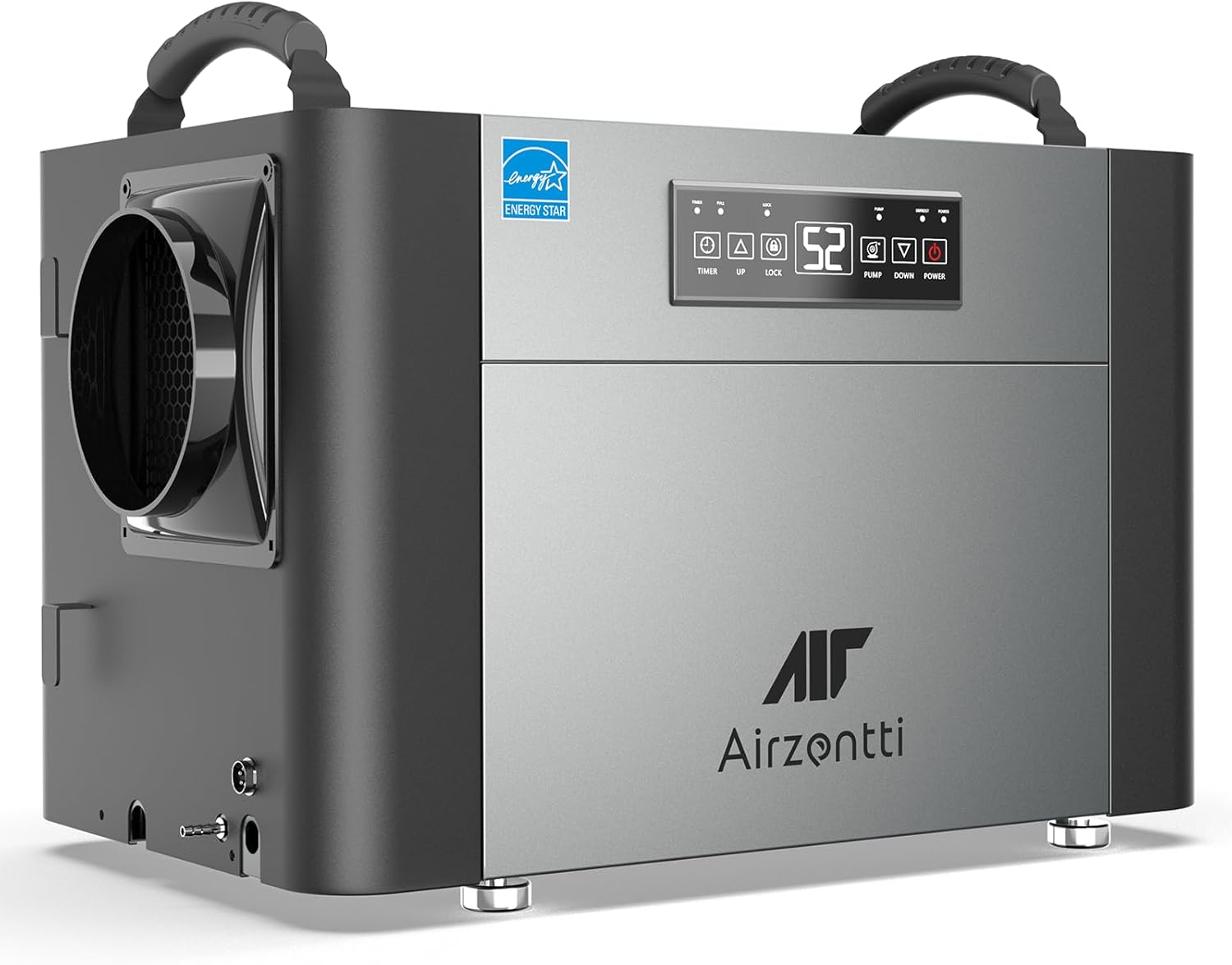
The Airzentti 155‑pint unit is a heavy‑duty dehumidifier built to remove large volumes of moisture from basements, crawl spaces, attics, and commercial areas. It delivers up to 155 pints capacity (73.5 L/day) with 220 CFM airflow and offers several run modes including continuous, pump drain, and timer‑controlled operation. The built‑in pump and included drain hose let you set it for unattended continuous draining or use the gravity drain for simpler installs, while auto defrost and auto restart protect operation in cooler conditions. The control panel includes humidity setpoints and a screen lock for remote or long‑term deployments. Practical benefits include Energy Star efficiency for lower running cost relative to output, a robust metal cabinet, and accessories like a duct collar and leveling feet for flexible placement. Tradeoffs are its commercial scale and weight that make it less convenient to move frequently, and the 860W power draw which is typical for this capacity but higher than smaller consumer units.
Best for: Buyers who prioritize high continuous dehumidification performance for large basements, crawl spaces, or restoration jobs and need a unit that can run unattended with pump drain capability.
Less Ideal for: People who need a lightweight, easily portable dehumidifier for occasional small rooms or infrequent use should consider smaller consumer models instead.
- Very high moisture removal rate (155 pints/73.5 L per day) suitable for large basements and water damage jobs
- Built‑in pump plus gravity drain option enables unattended continuous drainage and flexible installation
- Energy Star certified for relatively efficient operation given its large capacity
- Multiple operation modes, timer and humidity setpoint control allow precise humidity management
- Heavy and bulky for one‑person moves compared with consumer portable units
- High power draw (860 watts) when running at capacity
Verdict: If you need powerful, continuous dehumidification for a large basement or restoration job, this 155‑pint Airzentti with built‑in pump is a practical, performance‑focused choice.
AEOCKY LEO-Lite 74 Pint Dehumidifier

| Capacity | 74 pints per day |
|---|---|
| Tank Volume | 1.45 gallons |
| Floor Area | 4500 square_feet |
| Operation Mode | Auto |
| Other Special Features of the Product | Timer |
The AEOCKY LEO-Lite is a high-capacity compressor dehumidifier built for large, damp spaces like basements. It removes up to 74 pints per day under peak conditions and uses a rotary compressor and a 3+2 evaporator/condenser layout to prioritize efficiency while keeping noise low. Controls include an intelligent humidistat with fast humidity sensing, an auto mode and timer, plus power-off memory for automatic recovery after outages. A 1.45 gallon tank and included drain hose let you choose between emptying the tank or continuous drainage. The unit meets ENERGY STAR Version 6.0 efficiency standards, so it runs more economically than many older basement models and includes an auto-defrost system to keep working in cooler basement temperatures. It is fairly quiet at low speed and is aimed at continuous or near-continuous operation for moisture control. Trade-offs are its single-speed fan control and relatively large footprint compared with tiny portable units, so it is best where sustained extraction and energy savings outweigh simple portability.
Best for: Buyers who want an efficient, high-capacity dehumidifier to control persistent basement humidity and reduce energy use over long runtimes.
Less Ideal for: If you need a lightweight, highly portable unit for small rooms or infrequent use, a compact low-capacity dehumidifier is a better fit.
- High dehumidification capacity rated at 74 pints per day for heavy basement humidity
- ENERGY STAR Version 6.0 rating for improved seasonal energy efficiency
- Auto-defrost keeps the unit operating in cool basement temperatures
- Included drain hose plus 1.45 gallon tank enables continuous drain or manual emptying
- Quiet operation for its class thanks to rotary compressor and low fan noise
- Single speed setting limits fine-grained control of airflow and sound
- Relatively large and heavier than compact room dehumidifiers
Verdict: Choose the LEO-Lite when you need a quiet, energy-efficient, high-capacity dehumidifier built to run continuously in a basement.
AIRPLUS 70-Pint Dehumidifier

| Dehumidification Capacity | 70 pints_per_day |
|---|---|
| Floor Area | 4500 square_feet |
| Tank Volume | 2.8 liters |
| Operation Mode | Intermittent |
| Other Special Features of the Product | Adjustable Fan Speed, Adjustable Humidity Control, Automatic Shutoff, Continuous Drainage, Timer |
This AIRPLUS unit is a straightforward large-capacity dehumidifier aimed at basement and large-room use. It is rated to remove up to 70 pints per day under high-humidity test conditions and is specified for spaces up to 4,500 sq. ft., so it handles heavy moisture loads that basements commonly develop. Controls are simple five-button operation with adjustable humidity setpoint, fan speeds, a drying mode for clothes, and a continuous-drain option that lets you attach a hose for unattended operation; the tank also supports automatic shutoff when full. The unit includes an activated carbon/HEPA filter and a timer for scheduled on/off. Trade-offs are typical for this class: it is a high-capacity compressor dehumidifier so expect steady electrical draw and audible fan/compressor noise compared with small consumer units, and it is a basic, no-frills design rather than a feature-packed smart model. For the price-conscious buyer who needs raw extraction power and reliable continuous drainage, this model delivers sensible functionality without extras.
Best for: Buyers on a budget who need strong, reliable moisture removal for a damp basement or large room and prioritize extraction power and continuous drainage over smart features.
Less Ideal for: If you want a whisper-quiet, energy-minimizing unit with smart home integration or a very compact form factor, choose a lower-capacity or premium smart model instead.
- High removal capacity rated at 70 pints per day for heavy moisture problems
- Coverage claimed up to 4,500 sq. ft., suitable for basements and large rooms
- Continuous drainage option with included drain hose reduces manual emptying
- Adjustable humidity control, fan speeds, timer, and a drying mode add practical control
- Activated carbon/HEPA filtration reduces particulates and odors while running
- Likely louder and higher power draw than small room dehumidifiers due to high extraction capacity
- Design is utilitarian with no advanced smart connectivity or app control
Verdict: A cost-conscious choice for basements that need high-capacity moisture removal and reliable continuous drainage without paying for smart extras.
hOmeLabs 50 Pint Dehumidifier
| Dehumidification Capacity | 50 pints_per_day |
|---|---|
| Floor Area | 7000 square_feet |
| Tank Volume | 1.6 gallons |
| Wattage | 322 watts |
| Air Flow Capacity | 165 cfm |
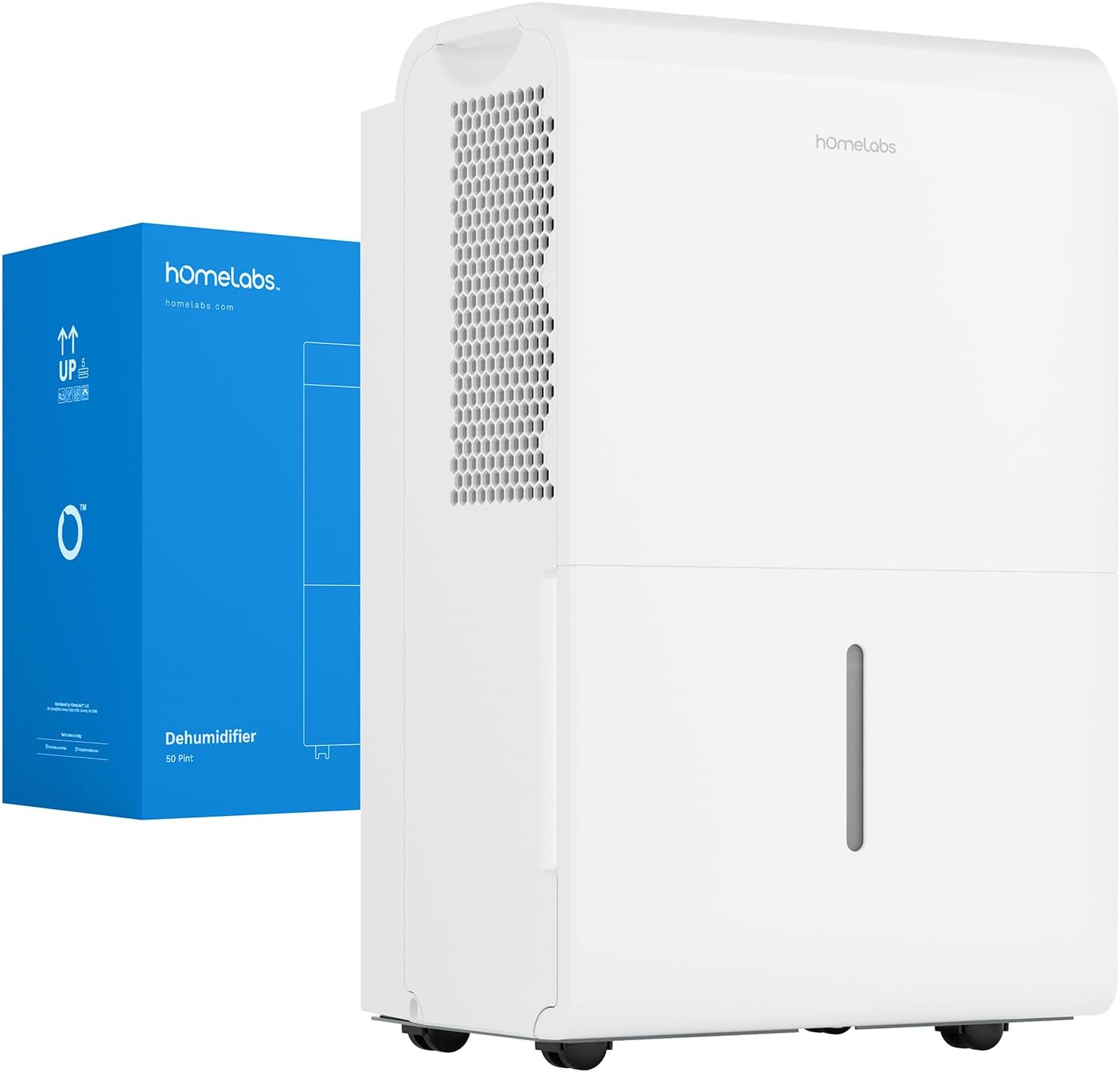
The hOmeLabs 50 Pint dehumidifier is built to remove moisture from large areas such as basements and open-plan spaces, rated to handle up to 7,000 sq ft and to extract 50 pints per day under standard conditions. It offers Wi‑Fi control for remote adjustments, a touch control panel, two fan speeds including a Turbo mode for faster drying, and a hose outlet for continuous drain so you can avoid frequent tank emptying. Practical user features include caster wheels and handles for portability, an automatic shutoff when the 1.6‑gallon tank is full, washable filter, and automatic defrost and restart for cooler environments. The unit draws 322 watts and moves a substantial airflow to accelerate dehumidification, but in very warm, high‑humidity extremes the manufacturer cites a higher maximum capacity at elevated test conditions. For basement use it delivers robust moisture control, though its size and 40‑pound mass mean placement and floor protection should be planned. If you want dependable, remotely managed humidity control for a damp basement, this model covers the basics well with few surprises.
Best for: Buyers who prioritize a reliable, hands‑off solution for persistent basement humidity and want remote control and continuous drainage options.
Less Ideal for: People who need an ultra‑compact or lightweight unit for small rooms or frequent transport between locations.
- Rated for large coverage up to 7,000 sq ft and 50 pints/day capacity under standard test conditions.
- Wi‑Fi remote control and touch panel let you monitor and adjust humidity without being next to the unit.
- Continuous drainage option via hose outlet reduces the need to empty the 1.6‑gallon tank manually.
- Automatic defrost, restart, and shutoff protect the unit and simplify unattended operation.
- Washable filter and caster wheels make maintenance and repositioning straightforward.
- Relatively heavy, so moving between floors or tight spaces can be awkward.
- Continuous drainage hose is not included, requiring an additional purchase for unattended use.
Verdict: A dependable large‑capacity dehumidifier with Wi‑Fi control and continuous drainage designed to manage damp basements reliably.
MIONJO V3 Dehumidifier

| Dehumidification Capacity | 80 pints_per_day |
|---|---|
| Capacity | 1.72 gallons |
| Operation Mode | Automatic |
| Other Special Features | Adjustable humidity 30%-80% / auto defrost / child lock / 24-hour timer |
| Energy Star | Certified |
The MIONJO V3 is a large-capacity compressor dehumidifier built for whole-basement duty and other high-humidity rooms. It is advertised to remove up to 80 pints per day and cover up to 4,500 sq ft, and it offers both a 1.72 gallon removable tank with auto shutoff and a continuous drainage option via included hose. Practical features include a 90 degree adjustable air outlet for targeted drying, humidity sensing with adjustable set points, auto-defrost and overload protection for continuous operation, and a washable filter with caster wheels for easy moving. Energy Star certification and a purported quiet operating level near 40 dB make it suitable for long runs without high energy cost or major noise disruption. The unit is relatively compact for its capacity but still requires periodic emptying if not plumbed to a drain, and like most compressor dehumidifiers its efficiency may drop in very cold basements without supplemental heat. For buyers who prioritize reliable moisture removal across large areas the V3 brings useful safety and auto controls, though installers should plan for drainage and occasional maintenance of the filter and coils.
Best for: Buyers who need steady, high-volume moisture removal for basements or large rooms and want a unit with safety features and clear operating feedback.
Less Ideal for: People seeking a small portable unit for occasional spot use or buyers who need a desiccant solution for very low-temperature spaces.
- High daily capacity (80 pints per day) suited for large basements and high-humidity spaces
- Energy Star certified for lower electricity use during extended operation
- Dual drainage: 1.72 gallon tank with auto shutoff plus included hose for continuous drain
- Auto-defrost and overload protection increase reliability during long run times
- 90° adjustable air outlet and caster wheels allow targeted drying and easy relocation
- Performance may decline in very cold environments typical of unheated basements
- Requires plumbing or regular emptying of the tank for nonstop use
Verdict: A powerful, Energy Star certified compressor dehumidifier built to handle large basements with continuous-drain and reliability features for long-term use.
AEOCKY BOREAS-001 Dehumidifier

| Dehumidification Capacity | 50 pints_per_day |
|---|---|
| Applicable Area | 3500 square_feet |
| Water Tank Capacity | 0.8 gallons |
| Wattage | 380 watts |
| Operation Mode | Continuous |
The AEOCKY BOREAS-001 is a small-footprint compressor dehumidifier meant for heavy residential use in rooms like basements, bedrooms, bathrooms, and RVs. It pulls up to 50 pints per day (measured at 95°F/95% RH) and is designed to run continuously via the included 2 m drain hose and garden-hose adapter, or collect water in its 0.8 gallon tank. Controls include adjustable humidity setpoints, a timer, child lock, and multiple fan speeds, while an ambient multicolor humidity light gives an at-a-glance readout. The unit emphasizes quiet operation—manufacturer noise figures are listed around 40 to 43 dB—so it can sit in living spaces without drawing attention. Build-quality notes include copper tubing and hydrophilic fins, plus an auto-defrost system for cooler basements. The trade-offs are its small tank relative to its extraction rate, which makes continuous drainage the practical choice in damp basements, and its listed capacity is under ideal conditions so real-world pints/day will vary with temperature and RH. For risk-averse buyers this model offers solid engineering and a long warranty to back continuous-use performance.
Best for: Buyers who prioritize dependable, well-engineered dehumidification and want a compact compressor unit that can run continuously in living areas or basements with a reliable warranty and quiet operation.
Less Ideal for: Those who need a very large onboard tank or a commercial-scale unit for exceptionally large or industrial basements should consider higher-capacity models with bigger tanks or pumps.
- High rated extraction capacity (50 pints/day at test conditions) for a compact unit
- Designed for continuous gravity drainage with included 2 m hose and garden-hose adapter
- Quiet operation with manufacturer-listed 40–43 dB range suitable for living spaces
- Auto-defrost and humidity-compensation control allow reliable performance in cool or changing environments
- Small 0.8 gallon tank fills quickly at high output, so manual emptying is impractical without a drain
- Pint/day figures are test-condition values and will be lower in typical basement conditions
Verdict: If you want quiet, factory-quality compressor performance in a compact machine for basement or home use and plan to use continuous drainage, the BOREAS-001 is a reliable choice.
Choosing the Right Large-Capacity Dehumidifier for Basements: Key Factors to Consider
Moisture Removal Capacity
Basements typically require higher daily extraction than living spaces. Look for a unit rated for the square footage and humidity load you actually have, considering that basements often include laundry rooms, sump pump areas, or storage that add moisture. A dehumidifier's published pint-per-day rating is a useful baseline, but you should also consider advertised capacity at lower temperatures since basements can be cool.
Choosing too small a unit means it will run continuously and struggle to reach the target humidity, increasing wear and energy use. A properly sized unit reaches the setpoint faster and cycles less, extending life and improving comfort.
Low-Temperature Operation
Basements are frequently cooler than living spaces, which affects dehumidifier performance because refrigerant-based systems lose efficiency as temperature drops. Check whether a unit is rated for low-temperature operation or has automatic defrost and low-ambient modes. These features prevent coil icing and maintain extraction when the room dips into cool ranges.
Without reliable low-temp performance, a dehumidifier may cycle off or ice up, reducing moisture removal and risking component stress. For cold basements, prioritize models designed to operate effectively at the temperatures you typically see.
Drainage and Run Modes
Basement units benefit most from flexible drainage options. Continuous gravity drainage, built-in pumps, or easy hookup for condensate lines reduce the need to empty a bucket and support long unattended runs. Also consider automatic restart after power loss and options for 24/7 operation.
If the basement location does not allow gravity drainage, an integrated condensate pump or pump-ready connection is valuable. Drainage design affects where the unit can be placed and how convenient long-term operation will be.
Energy Efficiency and Operating Cost
Basement dehumidifiers often run for many hours or days, so energy consumption becomes a practical cost and environmental factor. Look for models with efficient compressors, well-matched fans, and humidity-controlled operation that avoids needless runtime. Energy-efficient designs can significantly lower monthly electricity use when a unit runs continuously in a damp basement.
Consider features such as programmable humidistats, ECO modes, or timer functions that reduce runtime without sacrificing humidity control. Over the life of the unit, small efficiency gains compound into meaningful savings.
Durability and Serviceability
Basement environments expose appliances to dust, occasional splashes, and continual use, so build quality matters. Features like rust-resistant coils and chassis coatings, robust fan and compressor mounts, and accessible filters extend service life. Easy access to panels and replaceable filters or washable prefilters simplifies maintenance.
Units that are easier to service reduce downtime and repair costs. Check that controls and displays are legible and that replacement parts or professional service are reasonably obtainable for long-term ownership.
Noise and Placement Constraints
Although noise may be less of a concern in an unfinished basement, it matters if the space is finished, used as a living area, or if bedrooms are located above. Fan and compressor noise levels will affect placement choices and whether you need to install the unit behind doors or in a mechanical room.
Also evaluate footprint and mobility. A unit that is compact enough to fit near a window well or beside a furnace, but heavy enough to remain stable, offers installation flexibility. Consider vibration isolation or rubber feet to minimize transmitted noise to surrounding rooms.
Sizing Your Basement and Estimating Load
Measure the finished square footage and ceiling height to estimate the volume you need to dehumidify. Basements with exposed earth, sump pits, or unfinished walls typically have higher moisture loads than finished spaces with sealed drywall and flooring.
Account for specific moisture sources such as laundry, showers, or appliances. If the basement has intermittent high-moisture activities, bump the unit capacity up one size to avoid constant operation.
A practical approach is to calculate required pints per day based on the room condition—damp, very damp, or wet—and choose a unit with a rated capacity that meets or slightly exceeds that estimate.
- Finished basement: lower moisture load than unfinished
- Unfinished or wet basements: select higher capacity
- Include ceiling height in volume calculations
Placement and Airflow Considerations
Place the dehumidifier where airflow is unrestricted for the intake and exhaust. Avoid tight corners or cramped utility closets unless ducting or clearances are provided by the manufacturer.
Position the unit near a drain or install a condensate pump if gravity drainage is not possible. Keep several inches of clearance on all sides to allow service access and to reduce recirculation of discharged air.
- Avoid placing directly against walls
- Keep filters accessible for cleaning
- Locate near a floor drain or install a pump if needed
Maintenance Tasks to Keep Performance High
Regular maintenance preserves extraction efficiency and prevents odors. Clean or replace filters on the schedule recommended by the manufacturer and inspect coils for dust and debris. If a unit has a condensate pump, check the pump and discharge tubing periodically for clogs or wear.
Seasonally inspect the condensate lines and seals and verify the unit's automatic functions. For lower-temperature basements, confirm the defrost cycle functions correctly to prevent icing during cold spells.
- Clean washable prefilters monthly in dusty environments
- Inspect coils annually or if extraction falls off
- Test condensate pump and drain lines periodically
Common Installation Scenarios
If your basement has a utility sink or floor drain at a lower elevation than the dehumidifier, gravity drainage may be the simplest solution. For units placed above floor level or in finished basements without a nearby drain, choose a unit with a built-in pump or pump-ready configuration.
When the unit must sit in a finished area, consider isolation pads to minimize vibration transfer and check local codes for condensate disposal requirements if connecting to the home plumbing.
- Gravity drain when drain is below unit
- Use condensate pump where gravity drain is impossible
- Isolation pads reduce transmitted vibration
How Low Should You Set the Humidity?
For most basements, a target relative humidity of 45 to 50 percent balances moisture control with energy use. Targets below 40 percent are rarely necessary and can overwork the unit while drying out stored items that prefer moderate humidity.
Monitor conditions for several days after installation to confirm the setpoint prevents mustiness and mold without excessive runtime. Adjust slightly based on season, temperature, and what is stored in the space.
- 45 to 50 percent for general basement comfort
- Lower targets increase runtime and energy use
- Reassess during humid summer months and cool winters
How We Chose the Best Large-Capacity Dehumidifier for Basements
We focused on attributes that matter for prolonged basement use and excluded small, portable, or consumer-grade units that cannot sustain heavy daily extraction. Our selection emphasized measurable performance and real-world usability rather than marketing claims. Key evaluation criteria included continuous moisture removal capacity at typical basement temperatures, energy efficiency for long run times, and drainage and installation flexibility to support unattended operation. We also weighed durability features such as corrosion-resistant coils and condensate management, plus user-facing controls and ease of maintenance, since basements often require infrequent but straightforward upkeep. Units lacking reliable low-temperature performance or with no workable drain options were filtered out. Finally, we prioritized models with clear serviceability and accessible filters to reduce long-term operating headaches for basement owners.
Our full evaluation process is outlined in our review methodology.
FAQ
Can a large-capacity dehumidifier run continuously in a basement?
Yes. Many large-capacity units are designed for continuous operation and include features like automatic restart, continuous drain options, and timers. Ensure the unit has proper drainage and adequate ventilation to support long runtimes.
Will a dehumidifier work if my basement gets very cold in winter?
It depends. Refrigerant-based dehumidifiers lose efficiency as temperature drops and may ice up. Choose models rated for low-ambient operation or with automatic defrost if the basement regularly falls to cool temperatures.
Do I need a condensate pump for my basement dehumidifier?
A condensate pump is necessary when gravity drainage to a suitable drain is not possible. If the drain point is above the unit or out of reach, a built-in or external pump simplifies continuous operation.
How often should I clean the filter and coils?
Clean washable prefilters monthly in dusty basements and inspect condenser coils at least once per year. If extraction performance drops or airflow seems reduced, check and clean the coils and filters promptly.
Will a dehumidifier reduce basement odors and mold risk?
Yes. Lowering relative humidity helps slow mold growth and reduces musty odors. Combined with source control and ventilation, a properly sized dehumidifier is an effective part of mold prevention.
Final Verdict
For basements, prioritize extraction capacity at the temperatures you actually experience, reliable drainage options, and corrosion-resistant construction. Energy efficiency and ease of maintenance will determine long-term operating cost and convenience. Balance a slightly larger capacity against noise and footprint constraints so the unit does not run constantly. Choose a model that matches your basement size and moisture sources, offers workable drain handling, and is rated for the ambient conditions. That approach minimizes runtime, protects stored items and finishes, and keeps the space dry and usable with minimal intervention.