
Note: This article contains affiliate links. If you click on these links and make a purchase, we may earn a small commission at no extra cost to you. This helps support our research and content. Read our full affiliate disclosure here.
If you need steady humidity control without constant background noise, choosing a quiet whole-house dehumidifier matters. Excess moisture damages finishes and encourages mold, but loud equipment can make living spaces uncomfortable. This guide highlights seven shortlisted whole-house dehumidifiers selected for low operational sound, effective moisture removal, and reasonable running costs. We focus on real-world factors such as airflow, duct compatibility, energy use, and ease of maintenance to help you pick a system that keeps your home comfortable and quiet. Read on for a practical look at what to expect from the top quiet whole-house options and how they compare on the features that matter most.
Top Picks at a Glance
| Best Overall The best all-around choice for most situations | Waykar 120 Pint Dehumidifier CTH120A |  |
| Best Quality Built to a higher standard if you want something more solid | AprilAire E100 Dehumidifier |  |
| Best Value The sweet spot between price and what you get | Gasbye DryPrime-50 Dehumidifier |  |
| Best Budget The cheapest option that still gets the job done reliably | FreAire 54-Pint Dehumidifier D068B |  |
| Top Rated A top-rated pick with lots of positive feedback | Aprilaire E070 70-Pint Dehumidifier |  |
| Most Popular A crowd favorite that many people choose with confidence | hOmeLabs 50 Pint Dehumidifier | 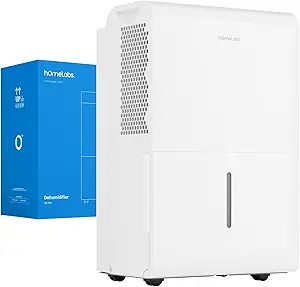 |
| Best Seller A high-volume bestseller chosen again and again | Waykar 80-Pint Dehumidifier JD025CE-80 |  |
Waykar 120 Pint Dehumidifier CTH120A

| Capacity | 120 pints |
|---|---|
| Tank Volume | 1.24 gallons |
| Wattage | 470 watts |
| Air Flow Capacity | 230 cfm |
| Operation Mode | Auto Comfort, Continuous, Standard |
The Waykar 120‑pint CTH120A is a high-capacity dehumidifier built to remove large volumes of moisture from basements and big rooms while keeping noise low. It offers Auto Comfort, Continuous, and Standard modes plus three fan speeds, and a smart Comfort Mode that adjusts target humidity based on measured temperature. Practical features include a 1.24‑gallon removable tank, an included 6.56 ft drain hose for continuous drainage, washable filter, and built-in wheels and handle for moving between spaces. Waykar cites a low‑noise design around 40 dB on low plus auto‑defrost and protections that support reliable continuous operation in cooler environments. The unit is Energy Star rated for 2025 standards and lists 470 W power with 230 CFM airflow, so it balances efficiency and performance for whole‑house or large basement use. Tradeoffs are typical for this capacity: the tank is modest compared with the daily extraction rate so long‑run continuous drainage is the practical choice, and the unit is relatively heavy for portable repositioning. For buyers prioritizing quiet, efficient moisture control in large spaces, this model covers the core needs well.
Best for: Buyers who want an energy‑efficient, quiet dehumidifier that can handle large basements or whole‑house spaces and prefer automated humidity control over manual tweaking.
Less Ideal for: People who need an ultra‑light portable unit for moving between small rooms or who will rely exclusively on the internal tank without access to continuous drainage.
- High 120‑pint/day capacity suitable for very damp basements and large rooms
- Energy Star 2025 compliance for improved energy efficiency
- Quiet low‑speed operation around 40 dB for bedrooms and living areas
- Smart Auto Comfort mode adapts humidity targets based on temperature
- Includes drain hose and supports continuous drainage for hands‑free operation
- Relatively small internal tank compared with 120‑pint capacity, so continuous drainage is needed for heavy use
- Unit weight makes frequent lifting or moving more cumbersome
Verdict: A quiet, energy‑efficient 120‑pint unit that automates humidity control and is built for large basements and whole‑house dehumidification.
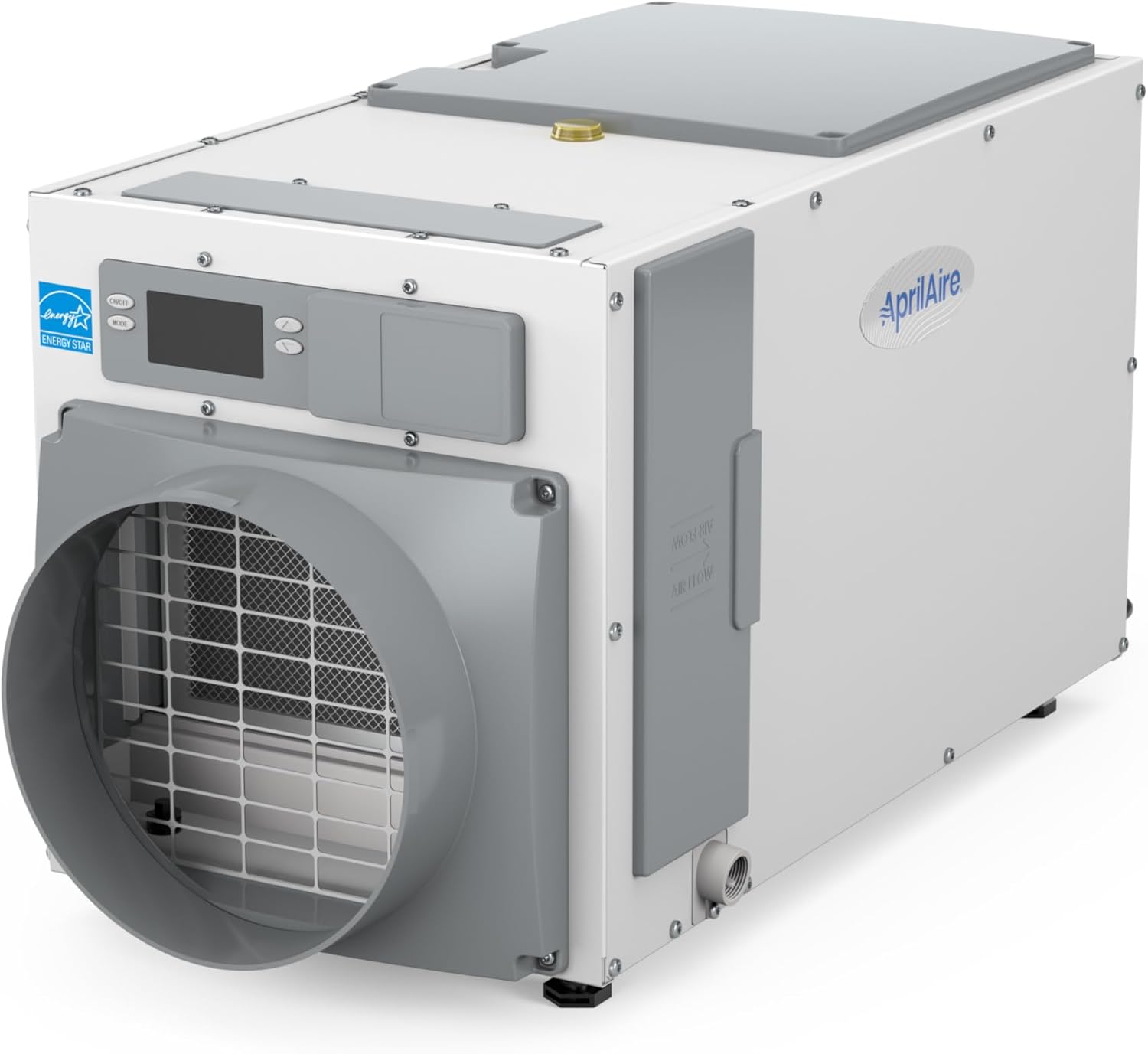
AprilAire E100 Dehumidifier
| Capacity | 100 pints per day |
|---|---|
| Floor Area | up to 5500 square_feet |
| Air Flow Capacity | 280 cfm |
| Wattage | 828 watts |
| Voltage | 120 volts |
The AprilAire E100 is a whole-home dehumidifier designed to remove up to 100 pints (15 gallons) of moisture per day and protect homes, basements, and sealed crawl spaces up to about 5,500 sq ft. It installs with duct collars for optional HVAC integration or can operate standalone using continuous drain or floor-drain placement, and the top or front-mount control makes setup and access straightforward. The unit runs a single-speed compressor with automatic on/off control tied to an RH set point, a digital display for easy monitoring, and washable MERV 8 filter media for low annual maintenance. Its corrosion-resistant aluminum coils and metal cabinet target durability for long service life and come backed by a five-year warranty. Energy Star Most Efficient certification means it delivers high moisture removal per watt compared with older whole-home units. Trade-offs are its single-speed operation, which limits fine-grained fan control for very quiet low-load running, and the physical size and weight typical of professional-grade systems that require a planned installation spot.
Best for: Buyers who prioritize high continuous moisture removal and proven, energy-efficient performance for whole-house or large basement applications where durability and integration with existing HVAC matter.
Less Ideal for: People looking for a compact, lightweight, ultra-quiet dehumidifier for small rooms or for portable, frequently moved units.
- High capacity removes up to 100 pints per day, suitable for large homes and damp basements
- Energy Star Most Efficient rating for lower energy use relative to capacity
- Ductable design with inlet/outlet collars allows integration with HVAC for whole-house coverage
- Durable construction with corrosion-resistant aluminum coils and a washable MERV 8 filter
- Multiple drainage options including continuous drain eliminate daily water handling
- Single-speed compressor and fan limit flexible low-noise, low-power operation
- Large, heavy cabinet requires a dedicated installation location and may need professional handling
Verdict: Choose the AprilAire E100 when you need robust, energy-efficient whole-house dehumidification with HVAC integration and long-term durability.
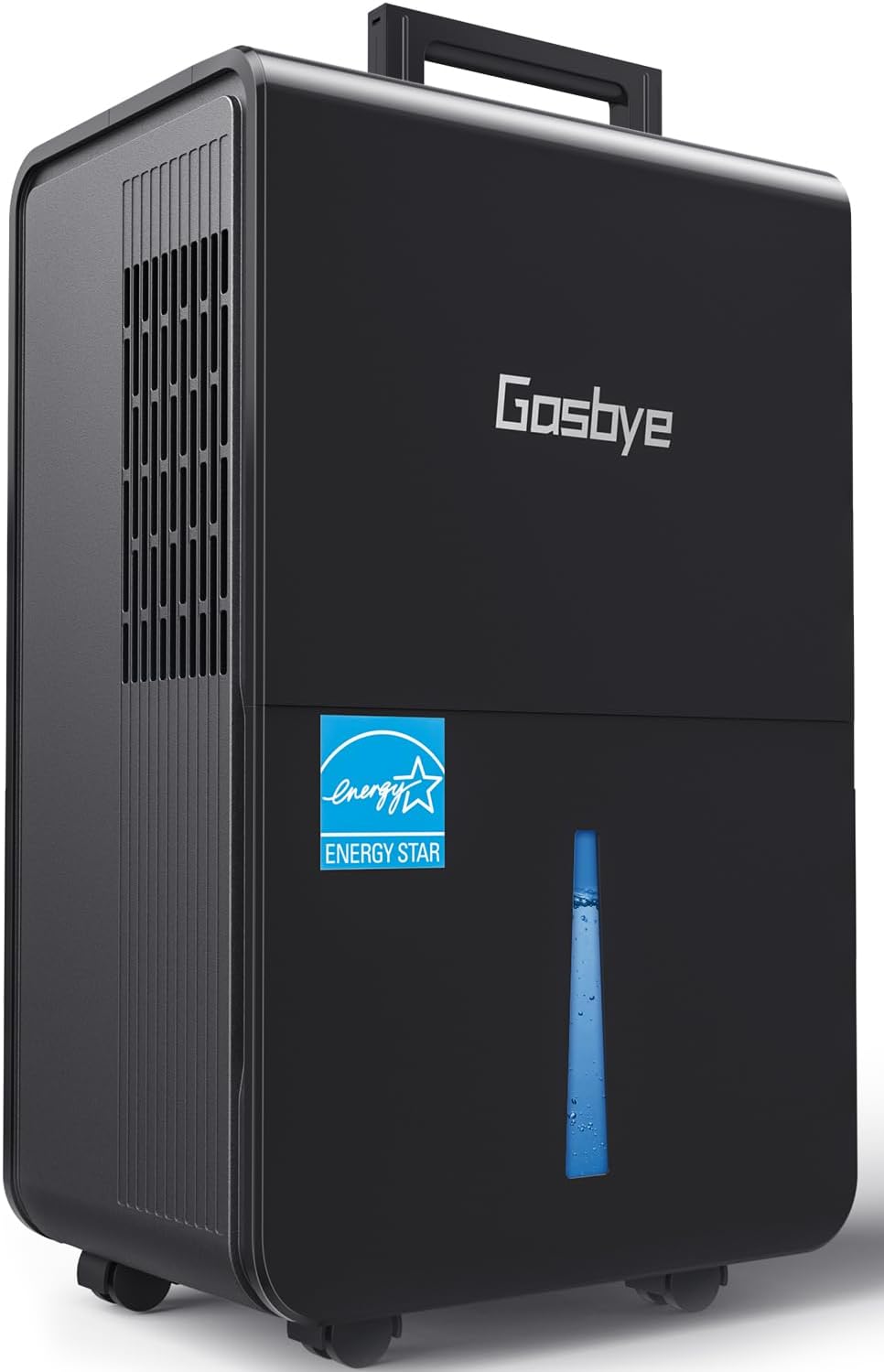
Gasbye DryPrime-50 Dehumidifier
| Capacity | 115 pints |
|---|---|
| Tank Volume | 1.72 gallons |
| Wattage | 500 watts |
| Operation Mode | Normal, Turbo, Comfort, Continuous |
| Air Flow Capacity | 12600 cubic_feet_per_hour |
The Gasbye DryPrime-50 is a heavy-duty compressor dehumidifier built for large spaces such as basements and big living areas. It delivers lab-tested capacities (up to 115 pints/day at 86°F/80% RH) and offers four operation modes including Normal, Turbo, Comfort, and Continuous, plus an automatic shutoff and auto-restart after power loss. Practical features include a 1.72 gallon removable tank, an included 5-foot drain hose and a threaded outlet for garden-hose connection to enable continuous gravity drainage. The unit uses reinforced copper tubing and a 500 W compressor, and runs at about 45 dB—quiet enough for shared living spaces though not ideal for bedrooms. Energy Star 2026 certification and smart humidity control that cycles the compressor around your setpoint help keep energy use lower than many noncertified models. The main compromises are its bulk and weight compared with compact units and the warm exhaust typical of compressor designs, which can slightly affect room temperature. For homeowners seeking a durable, efficient solution for large rooms, this is a solid practical choice.
Best for: Buyers who prioritize reliable, energy-efficient moisture control in large, shared spaces and want practical drainage and durability features rather than a lightweight, portable appliance.
Less Ideal for: People needing a small, ultra-portable dehumidifier for bedrooms or tight spaces, or those wanting a near-silent unit for sleeping areas.
- High tested dehumidification capacity with multi-condition performance figures
- Energy Star 2026 certification for improved energy efficiency
- Three drainage options including tank, short hose, and garden-hose outlet for continuous drain
- Reinforced copper tubing and heavier build aimed at durability
- Relatively quiet compressor operation around 45 dB suitable for living areas
- Large and heavier than compact models, limiting portability and placement options
- Compressor units emit warm exhaust which can raise ambient temperature slightly
Verdict: Choose the Gasbye DryPrime-50 when you need a durable, Energy Star certified dehumidifier that quietly handles high moisture loads in large spaces.
FreAire 54-Pint Dehumidifier D068B

| Dehumidification Capacity | 54 pints_per_day |
|---|---|
| Floor Area | 4500 square_feet |
| Capacity | 1.13 gallons |
| Number of Speeds | 2 |
| Operation Mode | Automatic |
The FreAire 54-pint D068B is built to remove moisture from large areas up to about 4,500 sq ft while running quietly for overnight use. It offers a clear front humidity readout and a sensitive sensor so you can monitor conditions without bending down, plus five operating modes and two fan speeds to match different rooms. Practical touches include a 1.13 gallon tank with full-tank auto shutoff, a supplied 3.28 ft drain hose for continuous drainage, washable filter, auto-defrost, child lock, 24-hour timer, and 360 degree wheels for easier repositioning. At a rated noise level near 30 dB in sleep mode it is suitable for bedrooms and basements where silence matters. The unit draws about 205W during operation, so it is comparatively efficient for a compressor dehumidifier but will still add to running costs in very damp climates. The included tank is moderate in size for a 54-pint unit, so users who do not use the drain hose may need to empty it often under heavy load.
Best for: Buyers who need a quiet, energy-aware dehumidifier for large spaces or basements and prefer easy monitoring and flexible drainage options while keeping upfront cost reasonable.
Less Ideal for: Those seeking a completely maintenance-free solution for very wet environments without any plumbing work or users who need an oversized reservoir for infrequent emptying.
- High 54-pint daily dehumidification capacity suitable for large rooms
- Front humidity display with a high-sensitivity sensor for easy monitoring
- Very quiet operation (around 30 dB) and sleep mode that turns off lights
- Includes drain hose for continuous drainage plus a 1.13 gal tank with auto shutoff
- Washable filter, auto-defrost, timer, child lock, and casters for convenience
- Tank capacity is relatively small compared with the unit’s daily removal rate if not using continuous drain
- Drain hose length (3.28 ft) may limit placement relative to a floor drain without additional tubing
Verdict: A quiet, feature-rich 54-pint unit that balances strong moisture removal and low noise, ideal for large rooms and basements on a budget-conscious buy.
Aprilaire E070 70-Pint Dehumidifier

| Capacity | 70 pints per day |
|---|---|
| Recommended Coverage | up to 2,800 square_feet |
| Air Flow Capacity | 200 cfm |
| Wattage | 696 watts |
| Voltage | 110 volts |
The Aprilaire E070 Pro bundle is a hard‑working whole-house dehumidifier intended for basements, crawl spaces, and larger rooms up to roughly 2,800 square feet. It removes up to 70 pints per day while offering automatic on/off control based on relative humidity, a digital display, and continuous draining so you can run it unattended. The unit includes practical accessories in the kit—drain hose, risers, two filters, and duct collars—so installation and maintenance are more straightforward. Rated for efficient operation, it draws about 696 watts and moves air at roughly 200 CFM for steady dehumidification without frequent cycling. Built-in protections such as automatic defrost and overheat protection help it tolerate colder or demanding locations, and the washable filter reduces replacement frequency. Trade-offs are its commercial-sized footprint and weight, which make it less portable than small consumer units, and it needs a drain or floor placement for continuous operation rather than relying on an internal bucket. For buyers prioritizing dependable, low-maintenance moisture control across a whole basement or home, the E070 bundle is a solid, professionally oriented option.
Best for: Buyers who value reliable, low-maintenance moisture control for a basement, crawl space, or whole home and want a professionally capable unit with included installation accessories.
Less Ideal for: People who need a lightweight, portable dehumidifier for small rooms or who cannot accommodate a continuous drain or fixed installation.
- High dehumidification capacity (70 pints per day) suitable for large basements and whole homes
- Automatic humidity-based on/off control and digital display for set-and-forget operation
- Continuous drain option and included drain hose eliminate emptying a reservoir
- Energy-efficient design for lower operating cost relative to conventional whole-house units
- Includes installation accessories (filters, risers, duct collars) so it is ready to install
- Large, heavier unit that is not convenient to move once placed
- Requires a drain or floor setup for continuous operation rather than using a portable tank
- No explicit noise rating provided despite article focus on quiet whole-house options
Verdict: A dependable, install-ready 70‑pint dehumidifier built for long-term whole‑house or basement moisture control.
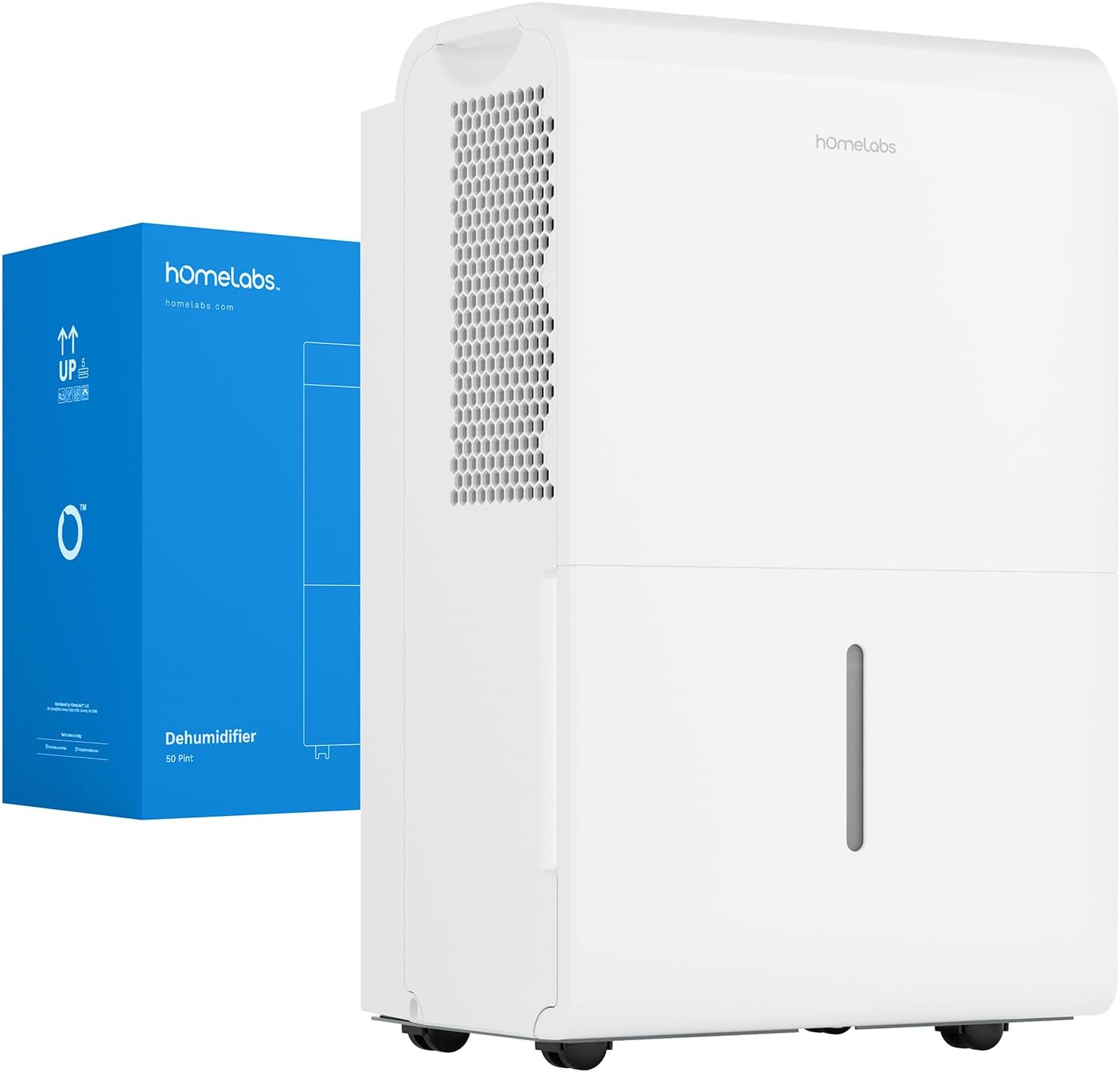
hOmeLabs 50 Pint Dehumidifier
| Dehumidification Capacity | 50 pints/day |
|---|---|
| Floor Area | 7000 square_feet |
| Wattage | 322 watts |
| Air Flow Capacity | 165 cfm |
| Operation Mode | Continuous |
The hOmeLabs 50 Pint dehumidifier is built for large residential spaces and steady moisture control. It pulls up to 50 pints per day (measured at 80°F/60% RH) and is rated to cover as much as 7,000 square feet, making it suitable for basements, open floor plans, or humid living areas. The unit includes Wi‑Fi for remote monitoring and control, a touch control panel, two fan speeds including a Turbo mode for faster drying, and both a removable tank and a hose outlet for continuous draining. Practical additions such as automatic shutoff, automatic restart after power loss, washable filter, and caster wheels make it easy to move and maintain. Trade-offs to consider are its relatively high wattage compared with small-room models and the need to provide your own drain hose for continuous operation. Noise is described as subdued for quiet activities, but larger-capacity dehumidifiers still produce audible fan noise at higher speeds. For buyers prioritizing quiet whole-house performance, placement and fan-speed use will affect perceived sound levels.
Best for: Buyers who prioritize reliable, large-area moisture removal and want remote control and practical maintenance features for whole-home or large-space use.
Less Ideal for: People looking for a near-silent unit for a small bedroom or those who need an ultra-low power, compact dehumidifier.
- High daily dehumidification capacity suitable for large spaces
- Wi‑Fi connectivity for remote monitoring and control
- Continuous drainage option via hose outlet plus removable tank for manual emptying
- Auto features including automatic shutoff and automatic restart after power loss
- Washable filter and caster wheels for easier maintenance and mobility
- Requires external hose for continuous drainage (hose not included)
- Higher power consumption compared with small-room dehumidifiers
Verdict: Choose this model if you need a Wi‑Fi–enabled, high-capacity dehumidifier built to remove moisture from large residential spaces while offering convenient drainage and maintenance features.
Waykar 80-Pint Dehumidifier JD025CE-80

| Dehumidification Capacity | 80 pints_per_day |
|---|---|
| Tank Volume | 2.5 gallons |
| Wattage | 270 watts |
| Air Flow Capacity | 165 cfm |
| Operation Mode | Continuous |
The Waykar 80-Pint Dehumidifier is built to handle large, damp areas such as basements by extracting up to 80 pints per day and offering both tank and continuous drain options. It is commonly used running continuously or on a timed schedule to bring basement humidity down to a selected setpoint between 30% and 80% relative humidity, and the 90° auto-swing helps spread airflow for more even drying. Practical features include an included drain hose and connector for gravity drainage, a washable removable filter, automatic defrost and overload protection for low-temperature reliability, and an Energy Star rating to keep running costs lower than noncertified units. At roughly 42 dB it is quieter than many similarly sized machines, making it reasonable for finished basements or nearby living areas. The unit is relatively heavy and targeted at larger spaces, so it is less convenient to move frequently, and the 1.14 gallon tank means emptying is still needed if you do not use continuous drainage. For buyers focused on dependable basement performance and energy efficiency, this model delivers strong moisture removal with sensible protections for extended operation.
Best for: Homeowners who need a reliable, high-capacity dehumidifier to control moisture in large basements and prefer proven features and energy efficiency over portability.
Less Ideal for: People looking for a lightweight, highly portable unit for small rooms or occasional use should consider smaller, easier-to-move models instead.
- High dehumidification capacity rated at 80 pints per day for large basements
- ENERGY STAR certification for better energy efficiency during extended use
- Multiple drainage options with included drain hose for continuous gravity drain
- Auto-defrost and overload protection improve reliability in cool basement conditions
- 90° auto-swing airflow and washable filter help distribute air and simplify maintenance
- Relatively heavy and sized for large spaces, so not ideal for frequent transport
- Water tank is modest at 1.14 gallons if continuous drainage is not used
Verdict: A powerful, Energy Star certified 80‑pint unit that reliably handles large basement humidity with continuous drain and protective auto-defrost features.
Choosing the Right Quiet Whole-House Dehumidifier: Key Factors to Consider
Operational Noise Level
Noise output is often the deciding factor for homeowners choosing a quiet whole-house dehumidifier. Decibel ratings measured at usable distances give an objective baseline, but real-life perception also depends on where the unit is installed. A blower inside a mechanical room or attic may be masked by structure, while a unit mounted near living spaces will be more noticeable. Consider both rated dBA at low and high fan speeds and whether the design includes vibration isolation or sound-dampening insulation.
Lower fan speeds reduce noise but also decrease airflow and dehumidification capacity, so check how performance changes across fan settings. If nighttime quiet is important, prioritize models with dedicated low-noise modes or night settings that cut fan speed and compressor activity without letting humidity rise excessively.
Moisture Removal Capacity
Capacity is typically rated as pints or liters removed per day and should match the conditioned volume and typical humidity load of your home. A system undersized for the space will run continuously and still fail to reach target relative humidity, while an oversized unit may short-cycle, increasing wear and noise. Assess capacity at realistic indoor temperature and humidity conditions, not only at idealized lab settings.
Also account for seasonal extremes. Homes in very humid climates or with chronic moisture issues need higher sustained removal, while milder climates can use lower-capacity units. When in doubt, choose a unit that offers some headroom so it does not run at full power continually.
Energy Efficiency
Running a whole-house dehumidifier can be a significant portion of annual energy use, so efficiency matters for operating cost and environmental impact. Look for how much moisture is removed per unit of energy consumed and whether the unit offers variable-speed fans or compressors that adapt output to demand. Features like smart humidistat control and programmable schedules also reduce runtime.
Energy efficiency also affects heat gain. Dehumidifiers expel some heat during operation, which can either offset heating in winter or add load to air conditioning in summer. Consider how the unit integrates with your HVAC to avoid unnecessary extra cooling work.
Ducting and Installation Compatibility
Whole-house installations often tie into existing HVAC ductwork or require dedicated supply and return runs. Confirm that the unit supports common duct sizes and has flexible installation orientations for basements, attics, or utility closets. Ease of electrical connection, condensate drainage options, and access for service should be part of your installation checklist.
Professional installation is often recommended for whole-house systems. Verify clearances and mounting options ahead of time and consider whether the system allows remote humidistat placement so you can control humidity from a representative living area rather than near the unit itself.
Serviceability and Maintenance
Long-term ownership depends on how easy the unit is to maintain. Check access to filters, coils, and the condensate drain, and whether routine tasks like filter cleaning and pan flushing are tool-free. Replaceable parts such as filters, isolation mounts, and control modules should be reasonably accessible so common service tasks do not require full disassembly.
Also consider the availability of diagnostics and whether the unit has features that simplify troubleshooting for technicians, such as error codes or removable control panels. Units designed for easy service reduce downtime and repair costs over the life of the system.
Controls and Humidity Management
Precise humidity control prevents over-drying and unnecessary runtime. Look for well-calibrated humidistats, programmable setpoints, and modes that integrate with existing HVAC controls. Smart or remote sensors can improve whole-home representation of humidity levels, especially in larger or multilevel homes.
Some systems offer adaptive algorithms that learn patterns and optimize runtime. If simplified control is important, check whether the unit supports basic manual control and straightforward overrides to avoid accidental misconfiguration.
Where to Install a Whole-House Unit for Lowest Noise
Placement greatly affects perceived sound. Locating the dehumidifier in a mechanical room, crawlspace, or attic can keep operating noise out of living areas, but account for duct runs and drainage when choosing the location. Mounting on vibration-isolating pads or brackets reduces structure-borne noise that travels into the house.
If the unit must be near occupied spaces, choose an installation that directs fan discharge away from bedrooms and uses flexible duct connectors to break vibration paths. Also evaluate access for maintenance so installers do not need to relocate the unit later.
- Prefer mechanical rooms or unoccupied attics when possible
- Use vibration isolation to limit structure-borne sound
- Plan duct routing to avoid pushing noise toward living areas
Balancing Quiet Operation and Moisture Control
Low-noise settings reduce fan speed and compressor activity, but that also lowers moisture removal. A quality system offers a broad operating range so you can run quiet at night and ramp up during high-humidity periods. Understand how each fan speed correlates with dehumidification capacity in practical conditions.
Consider using multiple control strategies such as night mode, humidity scheduling, and demand-based operation tied to a whole-home sensor to balance comfort and noise.
- Use night modes for lower noise during sleeping hours
- Allow temporary higher-speed operation when humidity spikes
- Employ remote or multiple sensors for representative control
Integrating with Your HVAC System
Whole-house dehumidifiers often work in tandem with the existing heating and cooling system. Proper airflow balance and duct integration prevent backpressure and ensure even distribution of drier air. When tied into the HVAC, coordinate fan runtimes and control logic so the dehumidifier does not fight the air handler.
Ask about interlock options and whether the dehumidifier can run independently of the HVAC fan, which can improve efficiency and reduce unnecessary noise from the main air handler.
- Verify duct sizing and static pressure compatibility
- Consider independent operation versus HVAC-integrated cycles
- Ensure representative sensor placement for whole-home control
Seasonal Use and Low-Temperature Performance
Some dehumidifiers lose efficiency in lower temperatures and may cycle differently in winter. If you need year-round control, check whether the unit maintains capacity at cooler basement or crawlspace temperatures and whether it includes frost protection for the coil. Low-temperature operation can also change sound characteristics as the compressor cycles.
Plan for seasonal adjustments to setpoints and expect maintenance needs to change with the seasons. For example, drainage strategies that work in summer may need winter-proofing in colder climates.
- Confirm rated capacity at lower ambient temperatures
- Look for coil frost protection in cool installations
- Adjust setpoints seasonally to avoid overuse
Practical Maintenance Tips to Keep Noise Low
Regular maintenance preserves both performance and quiet operation. Clean or replace filters per manufacturer guidance to avoid airflow restrictions that force fans to run harder and louder. Inspect and flush condensate pans and drains to prevent vibration and water-related noise.
Tighten mounts and check isolation pads periodically to prevent rattles. If you notice increased noise over time, a quick inspection often reveals loose panels, worn mounts, or clogged coils that are inexpensive to fix.
- Replace or clean filters on schedule
- Flush condensate pans and check drain lines
- Inspect vibration mounts and fasteners regularly
How We Chose the Best Quiet Whole-House Dehumidifier
We prioritized models that balance low acoustic output with durable moisture removal and simple installation. Key evaluation criteria included measured sound levels at typical operating modes, moisture removal capacity relative to home size, energy efficiency expressed as liters or pints per kilowatt-hour, airflow and ducting compatibility for whole-house integration, and serviceability including filter access and drain options. We also assessed build quality factors that affect longevity such as compressor and coil protection and whether the design allowed for isolation mounts or vibration dampening. For exclusions, we filtered out portable and single-room dehumidifiers, units lacking whole-house ducting support, and products with unclear or missing acoustic specifications. We excluded models with documented serviceability problems or poor replacement-part availability. The list favors systems that provide explicit decibel ratings, steady performance across a range of indoor temperatures, and practical maintenance access. These filters ensured the finalists are suited to homeowners who need quiet, reliable dehumidification for a full house rather than a single room.
Our full evaluation process is outlined in our review methodology.
FAQ
How quiet is a typical whole-house dehumidifier in dBA?
Typical whole-house units range widely, but quiet models often list low-speed sound levels substantially lower than high-speed ratings. Actual perception depends on placement and building acoustics, so compare manufacturer dBA ratings measured at a standard distance and consider installation location.
Will a whole-house dehumidifier make my HVAC noisier?
A correctly integrated dehumidifier should not make the HVAC noticeably louder. Poor ducting or control conflicts can cause the air handler to run more frequently. Use proper interlocks and duct design so the systems cooperate rather than create excess fan noise.
Can I use a whole-house dehumidifier year-round?
Often yes, but performance can drop in colder spaces. Choose a model rated to operate at the ambient temperatures you expect, and look for frost-protection features if it will run in cool basements or crawlspaces.
How much maintenance do whole-house dehumidifiers need?
Maintenance is generally straightforward and periodic. Common tasks include cleaning or replacing filters, clearing condensate drains, and inspecting mounts and coils. The frequency depends on usage and local air quality but is typically a few times per year.
Does a quieter unit cost more to operate?
Not necessarily. Noise and efficiency are separate design tradeoffs. Many quiet models use variable-speed fans or compressors that reduce noise and also lower energy use during light-load periods. Evaluate efficiency ratings and control features rather than assuming quiet equals higher operating cost.
Final Verdict
Choose a quiet whole-house dehumidifier by prioritizing measured noise levels, appropriate moisture removal capacity for your conditioned space, and energy efficiency. Ensure the unit integrates cleanly with existing ducting and offers straightforward maintenance access to preserve both quiet operation and long-term performance. Balance night-time comfort with the ability to increase output during humid spells, and verify installation options that reduce structure-borne noise. A thoughtful selection focusing on those tradeoffs will deliver comfortable humidity control with minimal disruption to household quiet. Prioritize installation location and serviceability as much as raw capacity to get the best quiet performance over the life of the system.