
Note: This article contains affiliate links. If you click on these links and make a purchase, we may earn a small commission at no extra cost to you. This helps support our research and content. Read our full affiliate disclosure here.
If you need reliable cooling without the usual compressor roar, picking the right Quiet Window Air Conditioner matters more than capacity alone. A poorly chosen unit can interrupt sleep, make home workspaces distracting, or run inefficiently for months. This guide covers the top shortlisted quiet window air conditioners that prioritize low decibel levels while still delivering solid cooling and reasonable energy use. We focus on real-world factors you can measure or compare, including noise output, cooling coverage, and installation practicality. Read on to understand the tradeoffs and which features matter most before you pick a unit.
Top Picks at a Glance
| Best Quality Built to a higher standard if you want something more solid | Hisense 8000 BTU Window AC |  |
| Best Value The sweet spot between price and what you get | Hykolity 12,000 BTU Inverter Window AC |  |
| Best Budget The cheapest option that still gets the job done reliably | ZAFRO U Shaped Window Air Conditioner |  |
| Most Popular A crowd favorite that many people choose with confidence | Midea U-Shaped 10,000 BTU AC |  |
| Best Seller A high-volume bestseller chosen again and again | GE Profile ClearView 10,300 BTU |  |
Hisense 8000 BTU Window AC

| Cooling Power | 8000 british thermal units |
|---|---|
| Noise | 37 db |
| Wattage | 700 watts |
| Floor Area | 350 square_feet |
| Control Method | App |
The Hisense 8,000 BTU UltraSlim is a performance-focused window AC that pairs inverter compression with a compact profile to cool rooms up to roughly 350 sq ft while running quieter and more efficiently than many conventional units. It uses inverter technology to adjust compressor speed for steadier temperatures and reduced energy use, and the ConnectLife app plus remote give full control from anywhere. Three operating modes (Cooling, Fan, Dehumidifier), four-way air direction, and a washable mesh filter make it versatile for bedrooms, living rooms, or home offices where consistent comfort and low noise matter. The unit lists a noise level around 37 dB and a reported 700 watts annual consumption, so it can be a good choice when you want strong cooling without a loud hum. Expect standard window AC limits though: installation requires a suitable window opening and the unit is heavier than portable alternatives, and advanced features are limited to app and remote controls rather than integrated voice hubs or multi-zone coordination.
Best for: Buyers who prioritize steady, efficient cooling and quiet operation in a single-room solution and want smart app control for remote adjustments.
Less Ideal for: People who need multi-room cooling, a lightweight portable option, or integrated voice assistant ecosystem features.
- Inverter compressor for steadier temperatures and improved energy efficiency
- Rated to cool up to 350 sq ft while operating at a relatively low 37 dB
- Wi-Fi ConnectLife app plus remote control for convenient remote operation
- Includes washable, removable mesh filter for simple maintenance
- Requires a compatible window and bracket for installation
- Unit is relatively heavy compared with portable air conditioners
Verdict: Choose this unit if you want a quiet, energy-efficient inverter window AC that delivers steady cooling and remote app control for a single room.
Hykolity 12,000 BTU Inverter Window AC

| Cooling Power | 12000 british thermal units |
|---|---|
| Noise | 32 db |
| Refrigerant | R-32 |
| Voltage | 115 volts |
| Wattage | 1190 |
This Hykolity inverter window AC uses an inverter compressor and smart controls to deliver steady, energy-efficient cooling for larger rooms. It pairs app, touch, and remote control so you can set temperatures, schedules, and modes from your phone or the included remote, and the unit supports 5 modes including Cool, Dry, Fan, Auto, and ECO for flexible everyday use. Notable features for bedroom or living-room installs are the claimed 32 dBA low-noise operation and an auto-swing function that spreads airflow for more even cooling. The inverter design and R-32 refrigerant lower energy use compared with basic window units, and the 24-hour timer and sleep mode help maintain comfort overnight. Important limits to note are the need for a compatible single or double-hung window within the stated width and height ranges and the typical challenges of DIY window AC installation; buyers should verify measurements and mounting before purchase. The unit also lists annual energy consumption figures buyers may want to compare to local models.
Best for: Buyers who prioritize low-noise, energy-efficient cooling for larger bedrooms or living spaces and want smart control options to optimize daily energy use and comfort.
Less Ideal for: People who need a portable or split-system solution, or those who cannot accommodate the required single/double-hung window dimensions should look elsewhere.
- Inverter compressor for more consistent temperatures and improved energy efficiency
- WiFi app control plus remote and touch panel for flexible operation
- Engineered for quiet operation with a low noise rating around 32 dBA
- Multiple modes (Cool, Dry, Fan, Auto, ECO) and 24-hour timer for versatile comfort management
- Cools areas up to about 550 sq ft with auto-swing for broader airflow distribution
- Requires a window opening that matches the specified range and careful DIY installation
- Annual energy consumption is provided but real-world use may vary depending on settings and climate
Verdict: If you want a quiet, smart, and energy-conscious 12,000 BTU window AC for larger rooms, this inverter model is a strong, practical choice.
ZAFRO U Shaped Window Air Conditioner

| Cooling Power | 12000 BTU |
|---|---|
| Noise | 32 db |
| Refrigerant | R-32 |
| Control Method | App, Remote, Touch, Voice |
| SEER | 16.3 |
The ZAFRO U Shaped Window Air Conditioner uses an inverter compressor and a U-shaped design that places the noisy components outside the window to keep indoor sound levels very low at about 32 dB. It cools medium to large rooms with a 12000 BTU ASHRAE rating (8100 BTU DOE) and includes modes for cooling, dehumidifying, fan, eco, and sleep, plus a built-in pump to route condensation outdoors. Controls are flexible: app, voice, remote, and a touch panel let you adjust temperature and schedules remotely, and the unit offers 4 fan speeds and 3D airflow for more even coverage. Practical features such as a washable mesh filter, child lock, window lock, and included installation kit simplify setup and maintenance. The inverter design and a SEER of 16.3 improve energy efficiency compared with fixed-speed units, but the unit is fairly heavy and requires a compatible single or double-hung window in the specified opening range, so plan for proper support and installation. For buyers prioritizing quiet operation and smart control, this model delivers strong real-world cooling with energy-savings benefits.
Best for: Buyers who want a whisper-quiet window AC with smart controls and good energy efficiency for bedrooms or living spaces where low indoor noise is a priority and remote management is useful.
Less Ideal for: People who need a lightweight, portable cooling solution or who cannot accommodate the specified single/double-hung window opening and support requirements.
- Very quiet indoor noise level around 32 dB thanks to U-shaped design
- Inverter compressor and SEER 16.3 for improved energy efficiency
- Multiple control methods including app, voice, remote, and touch
- Built-in condensate pump and dehumidify mode to manage moisture
- Washable mesh filter and included installation kit for easier upkeep
- Heavy and requires proper support for over-the-sill or saddle installation
- Rated cooling differs by standard (12000 BTU ASHRAE vs 8100 BTU DOE), so effective room size may vary
Verdict: Choose this unit if you want a quiet, energy-efficient window AC with smart app and voice controls for low-noise cooling in bedrooms and living rooms.
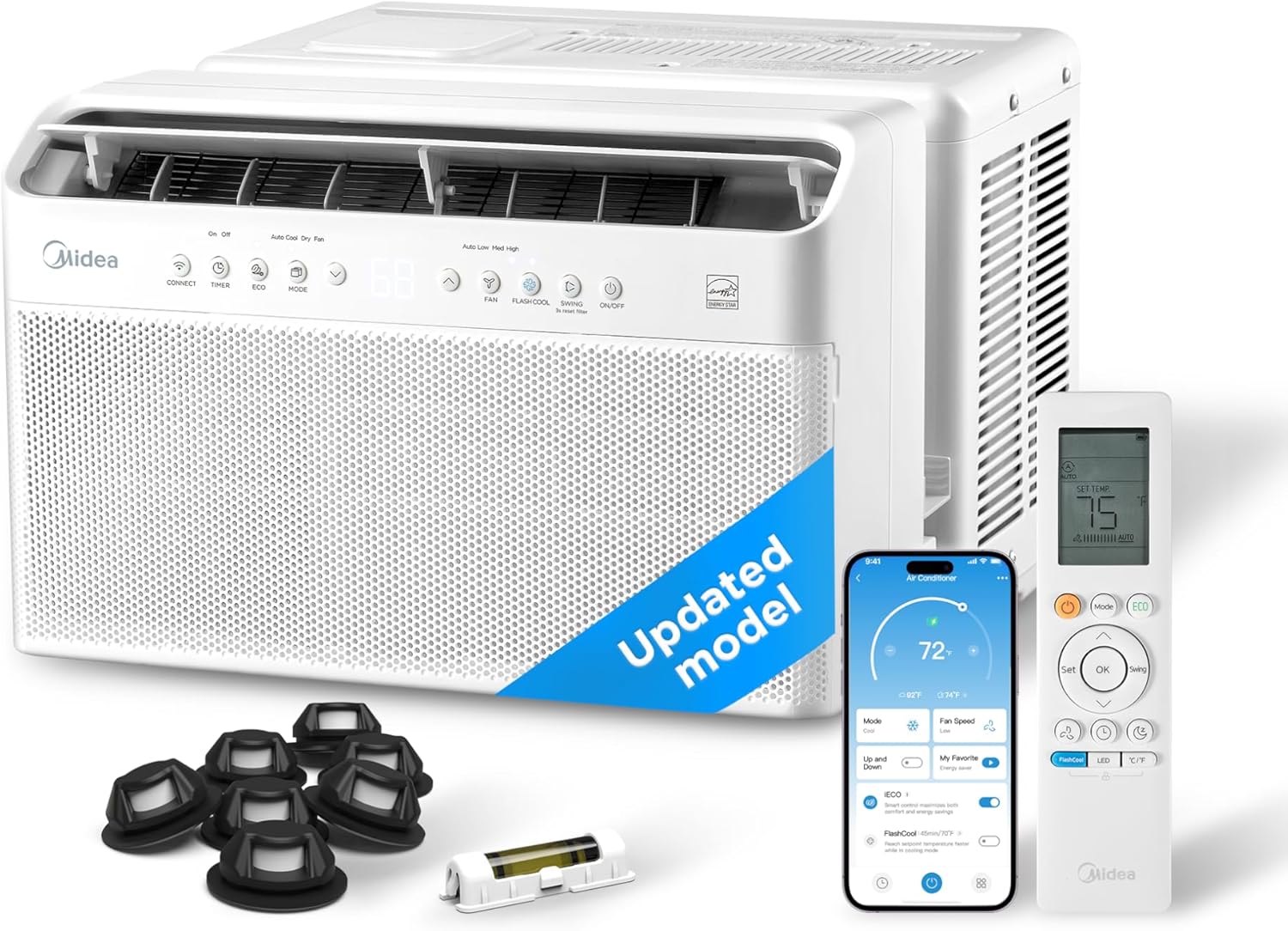
Midea U-Shaped 10,000 BTU AC
| Cooling Power | 10000 british thermal units |
|---|---|
| Floor Area | 450 square_feet |
| Noise | 32 db |
| Wattage | 890 watts |
| Control Method | App, Remote, Voice |
The Midea U-shaped 10,000 BTU inverter window AC is built around a low-noise, energy-efficient design intended for bedrooms and living rooms. Its U-shaped form lets you open the window while the unit is installed, and the inverter compressor keeps operation quiet (rated as low as 32 dB) while delivering rapid cooling across a 450 sq ft area. Smart features include Wi-Fi control via the vendor app plus Alexa and Google Assistant voice control, and the unit includes a remote and a quick-snap bracket for straightforward installation in single- or double-hung windows within the stated opening range. The AC uses R-32 refrigerant and a copper core with a rotary vane compressor, and the inverter motor reduces power draw to about 890 watts running. Practical benefits are notably quieter operation than traditional window units and meaningful energy savings from the DC inverter technology. Limitations to note are its weight and physical footprint which require a sturdy support and a compatible window opening, and while it cools large rooms it does not include a heat mode so it is strictly a cooling appliance.
Best for: Buyers who prioritize quiet, energy-efficient cooling and want smart controls and an installation that preserves an open window and view.
Less Ideal for: People who need a dual heat-and-cool unit or who cannot accommodate the unit's weight or window opening requirements.
- Very low noise operation down to 32 dB for quiet rooms
- U-shaped design allows the window to remain open for fresh air and a less obstructed view
- Wi-Fi, app, and voice control plus a physical remote give multiple convenient control options
- DC inverter system improves energy efficiency and reduces running power draw
- Requires a compatible window opening and sturdy support due to unit weight
- No heating function — cooling only
Verdict: Choose this unit if you want a quiet, energy-saving window AC with smart controls and a unique U-shaped install that keeps your window usable.
GE Profile ClearView 10,300 BTU

| Cooling Power | 10300 BTU |
|---|---|
| Floor Area | 450 square_feet |
| Noise | 40 db |
| Wattage | 900 watts |
| Refrigerant | R-32 |
The GE Profile ClearView is a 10,300 BTU inverter window air conditioner built for medium rooms up to about 450 square feet and aimed at quiet, energy-conscious cooling. It uses adaptive inverter technology and a rotary compressor to run at variable speeds, which helps reduce noise and improve efficiency versus fixed-speed units. The unit sits below the sill for a full window view, offers a flex-depth installation to fit a range of wall thicknesses, and includes a removable one-touch filter and a 24-hour timer for routine convenience. Controls include an app with SmartHQ connectivity plus a physical remote and touch controls, so you can schedule or adjust settings remotely. Practical benefits are low sound levels (around 40 dB), app-based scheduling and energy monitoring, and easier maintenance with a lift-out filter. Limitations to consider are its size and weight that require a sturdy double-hung window and the need to confirm local code for installation without a mounting bracket, plus a one-year limited warranty for peace-of-mind buyers.
Best for: A buyer who prioritizes quiet, reliable cooling and simple smart controls for a medium room and prefers a proven factory-quality window AC with easy filter access and app scheduling.
Less Ideal for: People who need a lightweight, portable solution or who want the highest possible seasonal efficiency ratings should consider other product types.
- Inverter compressor and variable-speed operation for quieter, more efficient cooling
- Built-in WiFi with SmartHQ app plus remote and touch controls for flexible control and scheduling
- Full-window design preserves outside view and lets the window open and close with the unit installed
- Industry-exclusive flex-depth fits a range of wall/window thicknesses for easier installation
- Removable one-touch lift-out filter and 24-hour timer simplify maintenance and daily use
- Heavy and relatively large, requiring a robust double-hung window and careful installation
- Only a one-year limited warranty
- SEER and annual energy figures are moderate compared with some higher-efficiency models
Verdict: Choose this model if you want a quiet, smart inverter window AC that balances low-noise operation with connected controls for medium-sized rooms.
Choosing the Right Quiet Window Air Conditioner: Key Factors to Consider
Sound Level and How It's Measured
Decibel ratings tell you how loud a unit is, but numbers alone do not capture perceived disturbance. Look for manufacturer sound ratings at multiple fan speeds and, when available, third-party measurements taken at relevant distances. A difference of just a few decibels can be noticeable in a quiet bedroom, so compare low- and medium-speed ratings specifically.
Also consider the sound profile: compressor hum, fan whine, and vibration each contribute differently to perceived annoyance. Units with variable-speed compressors or multi-speed fans tend to offer quieter low-power operation than single-speed designs. Verify whether manufacturers list separate sleeping or quiet modes and whether those modes reduce cooling capacity significantly.
Cooling Capacity Versus Room Size
Cooling capacity, typically expressed in BTUs, should match the room's square footage and typical heat load. Oversized units may cycle on and off frequently, which can produce louder start-up noise and reduced humidity control. Undersized units must run continuously at high speed, increasing both noise and wear.
Estimate your room's effective cooling load by accounting for ceiling height, sun exposure, and typical occupancy. Choose a unit whose published capacity aligns with that load while allowing low-speed operation to maintain quiet performance when full power is not necessary.
Energy Efficiency and Runtime Noise Tradeoffs
More efficient units generally cost less to operate and may run longer at lower power levels, which often lowers perceived noise. Look for energy efficiency indicators and features like variable-speed compressors or eco modes that modulate output to meet cooling demand quietly. However, highly efficient settings may reduce peak cooling power, so ensure the unit can still handle occasional high-heat periods without excessive noise spikes.
Consider estimated seasonal runtime and how that interacts with noise preferences. If you plan to run the air conditioner all night, prioritize steady low-noise performance and efficiency over short-term peak cooling.
Installation Quality and Vibration Isolation
Even a quiet unit can become noisy if improperly installed. Secure mounting, correct sealing around the window, and anti-vibration pads or brackets reduce rattles and structure-borne noise. Some designs include adjustable mounting rails or foam seals to simplify this process, while others require more custom shimming.
Plan for straightforward access to the unit for seasonal removal and maintenance. Check weight and mounting requirements relative to your window type. If the installer must make modifications to the window frame, expect the potential for added vibration unless isolation measures are used.
Control Options and User Modes
Control flexibility matters for balancing quietness and comfort. Units with multiple fan speeds, delay timers, sleep settings, and programmable thermostats let you tailor operation to nighttime or occupied hours. Remote controls and smartphone integration can help you adjust modes without getting up, reducing interruptions and allowing you to lower settings when quiet matters most.
Also consider whether the unit offers smooth step changes or abrupt power shifts. Gradual modulation generally maintains lower perceived noise compared with systems that cycle between off and full blast.
How Noise Ratings Translate to Real-World Sleep Quality
Decibel numbers provide a baseline, but how noise affects sleep depends on frequency, intermittency, and individual sensitivity. Continuous low-level white noise can be less disruptive than sporadic bangs or tonal compressor cycles. Look for units that list noise at the lowest fan setting; those numbers are the best proxy for nighttime disturbance.
Placement also changes perception. Installing the unit opposite the bed or using acoustic barriers in the window sill can lower perceived intrusiveness. Combine unit selection with setup tactics to get the best sleep outcome.
- Compare low-speed decibel ratings rather than only maximum values
- Avoid units with noticeable tonal hums at night
- Position the unit and bed to minimize direct sound path
Installation Checklist for Quiet Operation
Prepare a simple checklist before installation: confirm the window opening dimensions, ensure a firm sill, inspect for drafts around the frame, and gather anti-vibration materials. Secure mounting and proper sealing reduce both air leaks and vibration noise.
If a unit includes adjustable brackets, follow the manufacturer guidance to angle the unit slightly for drainage while maintaining a snug fit. Use foam or rubber isolation pads between metal surfaces to cut down on structure-borne noise.
- Verify window width and sill strength
- Use anti-vibration isolation pads or brackets
- Seal gaps with weatherstripping to reduce air noise
Maintaining Quiet Performance Over Time
Routine maintenance preserves both cooling efficiency and quiet operation. Clean or replace air filters regularly to avoid airflow restrictions that force the unit to run louder. Inspect and clean coils and fins seasonally to prevent fan and compressor strain.
Tighten mounting hardware after the first few weeks of operation since vibration can loosen screws. Address unusual noises early; persistent rattles or grinding sounds often signal loose parts or failing components that grow louder if ignored.
- Clean or replace filters every 1 to 3 months depending on use
- Schedule seasonal coil and fin cleaning
- Retighten mounting hardware and check seals annually
When to Prioritize Noise Over Peak Cooling
If the unit will be used primarily in a bedroom, nursery, or home office where quiet matters more than rapid temperature drop, prioritize lower low-speed dB ratings and control features that enable steady, gentle cooling. Expect longer cool-down times but fewer disruptive noise events.
For spaces that occasionally face extreme heat, choose a unit that balances a quiet low-speed profile with a verifiable high-power mode for short periods. That preserves comfort without making the quieter baseline compromise overly costly.
- Choose quieter units for bedrooms and study spaces
- Reserve higher-capacity but louder units for living rooms or garages
- Prefer models with an efficient high-power mode for heat waves
How We Chose the Best Quiet Window Air Conditioner
We shortlisted Window Air Conditioners that prioritize low operational noise without sacrificing core cooling performance. Selection began with products that publish measured sound levels and cooling capacity so we could evaluate noise relative to room size. We favored units with efficient energy use and modern controls because quieter compressors and variable-speed fans are most effective when paired with adaptive control systems. Evaluation criteria included documented noise levels in decibels at common fan settings, cooling capacity matched to sensible room square footage, energy efficiency and estimated runtime impact, installation and mounting simplicity for safe, vibration-free operation, and available control features such as variable fan speeds or sleep modes. Units lacking verifiable noise data or that required unusual structural modifications were excluded to favor practical, user-friendly options. We also filtered out products with limited warranty support or poor build quality indicators. The final choices balance measurable quiet performance, usable cooling coverage, energy considerations, and straightforward installation.
Our full evaluation process is outlined in our review methodology.
FAQ
How many decibels is acceptable for a bedroom air conditioner?
Acceptable levels vary by sensitivity, but many people find 40 to 50 dB at night to be reasonably quiet. Aim for documented low-speed ratings in this range and consider placement and insulation to reduce perceived noise.
Do quieter units use more energy?
Not necessarily. Quieter operation often comes from variable-speed compressors and efficient fans, which can use less energy by running longer at lower power. However, some quiet modes reduce cooling capacity, so efficiency depends on runtime and duty cycle.
Can installation reduce a noisy unit's sound?
Yes. Proper mounting, vibration isolation, and sealing around the window can significantly reduce rattles and structure-borne noise. Address installation quality before assuming the unit itself is the problem.
Will a window air conditioner bother light sleepers?
It often depends on the unit's low-speed sound profile and the sleeper's sensitivity. Light sleepers may prefer units with the lowest documented nighttime dB and smooth, continuous fan noise rather than those with frequent cycles or tonal compressor sounds.
How often should I clean a quiet window unit to keep it silent?
Clean or replace filters every 1 to 3 months and perform coil and fin cleaning at least once per season. Regular upkeep prevents airflow restrictions and mechanical strain that can increase noise over time.
Final Verdict
Choosing a quiet window air conditioner is a balance between measurable sound levels, appropriate cooling capacity, and practical installation. Prioritize verified low-speed noise figures and control features that let you modulate output for nighttime comfort. Factor in installation quality and routine maintenance to preserve quiet performance. For bedroom or home office use, select a unit that favors steady, low-noise operation paired with sufficient capacity for occasional heat spikes. That approach delivers comfortable cooling without frequent disruptive noise, letting you choose confidently based on the tradeoffs outlined above.