
Note: This article contains affiliate links. If you click on these links and make a purchase, we may earn a small commission at no extra cost to you. This helps support our research and content. Read our full affiliate disclosure here.
A refrigerator for garage use needs to do more than chill groceries. Garages face wider temperature swings, higher humidity, and tougher conditions than indoor kitchens, so you want a unit built to stay reliable in that specific environment. This guide shortlists the top refrigerators for garage use across practical designs and cooling systems. We evaluate each pick on the features that matter most for out-of-kitchen storage, including temperature range, insulation, and durability. Read on to see the strengths we considered and how each option fits different garage setups.
Top Picks at a Glance
| Best Overall The best all-around choice for most situations | BANGSON 7.0 Cu Ft Upright Freezer |  |
| Best Quality Built to a higher standard if you want something more solid | Summit SPR275OS2D 2-Drawer Refrigerator |  |
| Best Value The sweet spot between price and what you get | Frigidaire Retro 7.5 cu ft Refrigerator |  |
| Best Budget The cheapest option that still gets the job done reliably | Frigidaire Convertible Upright Freezer |  |
| Top Rated A top-rated pick with lots of positive feedback | Icyglee 4.5 CuFt Beverage Refrigerator |  |
| Most Popular A crowd favorite that many people choose with confidence | Upstreman 7.7 Cu.Ft. Refrigerator |  |
| Best Seller A high-volume bestseller chosen again and again | Frostorm BC-90 3.2 Cu Ft Mini Fridge |  |
BANGSON 7.0 Cu Ft Upright Freezer

| Capacity | 7 cubic feet |
|---|---|
| Wattage | 50 watts |
| Door Orientation | Reversible |
| Voltage | 110 volts |
| Installation Type | Freestanding |
This BANGSON upright freezer is a compact, convertible unit designed for extra food storage in kitchens, garages, or offices. It functions as either a freezer or a refrigerator with a selectable temperature range for freezing or chilling, and it ships freestanding with leveling feet and a reversible door for flexible placement. Inside you get five shelves and three pull-out drawers that help organize frozen items and keep produce separate, plus an ice tray and removable door seal for easier cleaning. At 50 watts it runs modestly and the built-in handle and stainless steel door give a more finished look than basic chest freezers. Expect straightforward mechanical temperature control rather than smart features, and note the unit is relatively tall and requires enough clearance for the door swing. For garage use it is practical where a moderate-capacity, convertible appliance is preferred over a large-capacity model.
Best for: Buyers who want a mid-size, versatile secondary freezer for a garage or small kitchen and value flexible storage and simple, reliable cooling.
Less Ideal for: People needing very large capacity frozen storage or precise digital temperature control should consider larger or feature-rich models instead.
- Convertible freezer-to-refrigerator mode for flexible use
- Multiple shelves and three drawers for organized storage
- Reversible door and leveling feet ease placement in garages or tight spaces
- Removable door seal and included ice tray simplify cleaning and basic use
- No smart controls or advanced temperature display
- Relatively tall footprint requires sufficient vertical clearance
Verdict: A practical mid-size convertible freezer that fits garage use when you want flexible freezer or fridge space without extra smart features.
Summit SPR275OS2D 2-Drawer Refrigerator

| Capacity | 4.83 cubic feet |
|---|---|
| Configuration | Wide 2-Drawer All-Refrigerator |
| Cooling Method | Compressor |
| Refrigerant | R600a |
| Installation Type | Counter In, Countertop, Outdoor |
The Summit SPR275OS2D is a compact 2-drawer refrigerator aimed at locations where shallow depth and durability matter, such as a garage or outdoor kitchen. It uses a compressor with R600a refrigerant and offers frost-free operation plus a digital thermostat for straightforward temperature control. The drawer layout and removable dividers make it easy to organize drinks, snacks, or meal prep items while the unit is panel-ready for a finished built-in look or usable freestanding. Weatherproof construction and ETL-S listing to NSF-7 standards mean it is built for harsher environments and commercial-style use, and features like a key lock, open-drawer alerts, and Sabbath mode add practical touches. Important limitations are its modest 4.83 cu ft capacity—suitable for supplemental storage but not as a primary household fridge—and a 1-star BEE rating indicating it is not optimized for maximum energy efficiency. For garages where durability and drawer access beat sheer capacity, this model performs well.
Best for: Buyers who need a durable, shallow-depth refrigerator for a garage, outdoor kitchen, or tight built-in spot and prioritize rugged construction and convenient drawer access over large capacity.
Less Ideal for: Anyone seeking a high-capacity primary refrigerator, the most energy-efficient long-term option, or a model for full household food storage should look elsewhere.
- Shallow 24-inch-depth design fits tight counter or garage spaces
- Weatherproof construction and ETL-S to NSF-7 standards for outdoor/commercial use
- Frost-free compressor cooling with digital thermostat for low-maintenance temperature control
- Drawer configuration with removable dividers for organized, easy access storage
- Panel-ready option allows for a built-in finished look
- Small 4.83 cu ft capacity limits how much food or drink you can store
- Rated 1 Star for BEE energy efficiency, so running costs may be higher than more efficient models
Verdict: Choose the Summit SPR275OS2D when you need a rugged, shallow two-drawer refrigerator for a garage or outdoor setup where durable, easy-access storage matters more than high capacity.
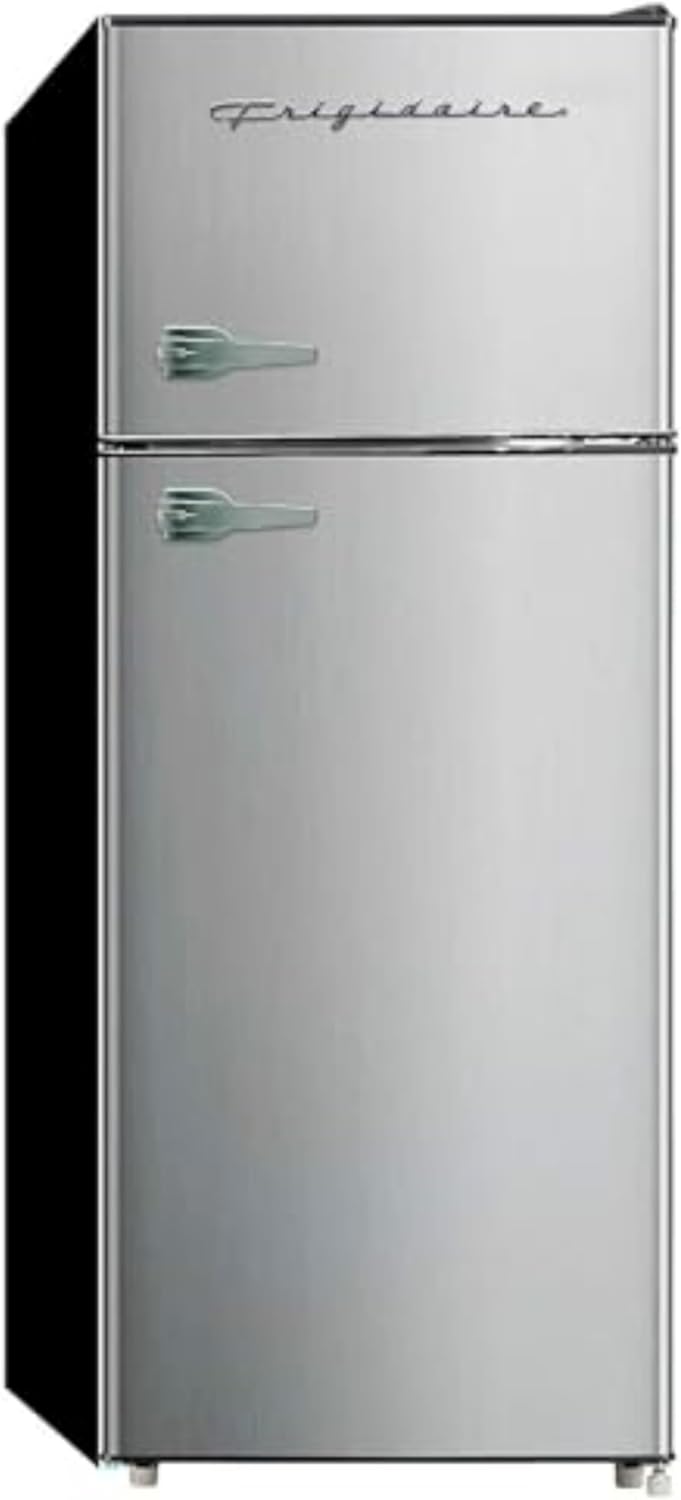
Frigidaire Retro 7.5 cu ft Refrigerator
| Capacity | 7.5 cubic feet |
|---|---|
| Freezer Capacity | 2 cubic feet |
| Defrost System Type | Manual |
| Power Source | Corded Electric |
| Configuration | Freezer-on-Top |
This Frigidaire two-door apartment-size refrigerator pairs a separate freezer with a 6 cu ft fresh food section to give practical, organized cold storage where floor space is limited. It uses a top-freezer compressor design with adjustable mechanical controls, removable glass shelves and a full-width door bin for tall bottles, so you can rearrange shelves for large containers or stackable items. The unit is freestanding with two front leveling legs and rear castors for easier placement and modest relocation in a garage or outbuilding. Manual defrost means you will need to defrost the freezer periodically, but it keeps the design simple and reduces electronics to fail. The stainless steel finish and chrome trim give it a finished look that fits a workshop or finished garage. Expect basic, quiet operation and straightforward maintenance, but do not rely on advanced temperature management features or built-in frost-free convenience.
Best for: Buyers who need a dependable, no-frills compact fridge for a garage, workshop, or secondary space and value straightforward storage flexibility and easy placement.
Less Ideal for: People who want a frost-free freezer, precise digital temperature control, or heavy-duty outdoor-rated refrigeration should look for a different model.
- Separate freezer compartment for frozen storage
- Removable glass shelves and adjustable layout for flexible organization
- Front leveling legs plus rear castors make positioning and modest moves easier
- Stainless steel finish and retro styling suit a finished garage or workshop
- Manual defrost freezer requires periodic maintenance
- No advanced temperature controls or frost-free feature
Verdict: A practical, space-efficient two-door fridge with flexible shelving and easy placement that suits garage or secondary-space use where simple, reliable cooling matters.
Frigidaire Convertible Upright Freezer

| Capacity | 7 cubic feet |
|---|---|
| Defrost System Type | Manual |
| Cooling Method | Compressor |
| Voltage | 110 volts |
This Frigidaire upright combines a compact footprint with a flexible convertible compartment so you can switch between refrigerator and freezer modes with a single click. It is intended for freestanding locations such as a garage, basement, dorm, or bar and uses a compressor cooling system with manual defrost. Inside you get four spill-proof glass shelves, a crisper drawer, and four door bins for everyday organization, plus reversible door hinges to suit tight spaces. Electronic controls make setting and holding a target temperature straightforward, and the stainless steel door gives a cleaner look that resists wear. Expect basic, functional performance rather than premium insulation or advanced energy-saving features since it is a budget-focused model with manual defrost and an annual energy use listed at about 200 kWh. Installation is simple because it is freestanding, but in very hot garage environments you may see reduced cooling efficiency compared with dedicated garage-rated units.
Best for: Buyers who need an affordable, flexible secondary refrigerator for a garage, basement, or rental where basic cold storage and simple controls matter more than premium efficiency.
Less Ideal for: People who need a heavy-duty garage-rated freezer for uninsulated or very hot spaces or users who prioritize lowest possible energy consumption and automatic defrost.
- Convertible freezer/fridge mode for flexible storage needs
- 7.0 cu ft capacity provides usable space for bulk items and beverages
- Reversible door and freestanding form factor fit tight or awkward locations
- Electronic temperature control for easy adjustments
- Removable spill-proof glass shelves and door bins simplify organization and cleaning
- Manual defrost requires periodic maintenance to remove ice buildup
- Not certified as a garage-rated model so performance may degrade in extreme ambient heat
Verdict: A budget-friendly, space-efficient convertible freezer/fridge that delivers straightforward cold storage for secondary locations like a garage.
Icyglee 4.5 CuFt Beverage Refrigerator

| Capacity | 4.5 cubic feet |
|---|---|
| Cooling Method | Compressor |
| Temperature Range | 32-61°F |
| Defrost System Type | Frost Free |
The Icyglee 4.5 cu ft beverage refrigerator is a freestanding cooler sized to hold many cans or bottles while offering direct temperature control and a quiet compressor. It is typically used as a dedicated drink fridge for a garage, home bar, or office, with adjustable shelving to fit cans or wine bottles and an LED display that sets temperatures between 32 and 61 degrees Fahrenheit. The compressor cooling and double-pane tempered glass door with an airtight seal help maintain steady internal temperatures and reduce humidity and light exposure, which matters when storing beer or wine. Installation is simple since the unit is freestanding and ETL listed, and the manufacturer recommends letting it rest 24 hours before first use. Expect relatively low operating noise under 40 dB, but like most compressor fridges it will draw more power than thermoelectric coolers and the interior layout can require shelf rearrangement for taller bottles. For a compact, reliable garage beverage fridge this model balances cold performance, capacity, and quiet operation.
Best for: Buyers who prioritize dependable, steady cooling for a dedicated drink fridge in places like a garage or home bar and want a compact unit that holds many cans while running quietly.
Less Ideal for: People who need an ultra-energy-efficient cooler or a built-in unit for cabinetry should consider other options.
- Large 4.5 cu ft capacity fits up to 145 cans or multiple wine bottles
- Compressor cooling with digital temperature control from 32 to 61°F for precise chilling
- Adjustable shelves let you configure space for cans or bottles
- Double-pane tempered glass door and airtight seal reduce light and humidity exposure
- Quiet operation under 40 dB suitable for shared spaces
- Compressor units typically use more power than thermoelectric alternatives
- Interior layout may need frequent shelf changes to fit taller items
Verdict: A roomy, compressor-cooled freestanding beverage fridge built for steady, quiet cooling that suits garage and bar use.
Upstreman 7.7 Cu.Ft. Refrigerator

| Capacity | 7.7 cubic feet |
|---|---|
| Freezer Capacity | 1.5 cubic feet |
| Defrost System Type | Manual Defrost |
| Voltage | 115 volts |
| Door Orientation | Reversible |
The Upstreman 7.7 cu ft refrigerator is a compact freestanding top-freezer unit designed for small spaces such as garages, apartments, or dorm rooms. It provides a 1.5 cu ft freezer and 6.2 cu ft fresh food compartment with two tempered glass shelves and a crisper drawer, and the shelves are removable to fit taller items. Temperature control is manual with five adjustable settings for both fresh and freezer zones, and an interior automatic light helps visibility. The compressor-based cooling and rotary scroll compressor offer quieter operation and modest energy use, and the door is reversible so you can fit it into a tight garage layout. Expect straightforward setup and basic performance rather than smart features or automatic defrost; the unit uses manual defrost which requires occasional maintenance to prevent ice buildup in the freezer. Noise levels are low enough for a work or garage environment, but this is a utilitarian refrigerator best suited to storing everyday food and drinks rather than precise temperature-sensitive items.
Best for: Buyers who prioritize proven performance and social-proof—those looking for a straightforward, quiet refrigerator with good capacity for a garage or small workspace and comfort from positive user feedback.
Less Ideal for: If you need precise temperature control, automatic defrost, or smart features for long-term food storage or specialty items, this basic model is not the best choice.
- Generous 7.7 cu ft capacity with separate freezer and fresh compartments
- Removable tempered glass shelves and crisper drawer for flexible organization
- Reversible door lets you position the unit to suit garage layout
- Quiet compressor operation suitable for nearby workspaces
- Simple five-setting thermostat is easy to adjust and maintain
- Manual defrost freezer requires periodic thawing and maintenance
- No advanced features such as digital controls, Wi-Fi, or automatic defrost
Verdict: A roomy, quiet, and practical top-freezer fridge that delivers reliable, no-frills cooling for garage or small-space use backed by solid user feedback.
Frostorm BC-90 3.2 Cu Ft Mini Fridge

| Capacity | 3.2 cubic feet |
|---|---|
| Freezer Capacity | 0.3 cubic feet |
| Defrost System Type | Automatic |
| Voltage | 115 |
| Door Orientation | Reversible |
The Frostorm BC-90 is a compact 3.2 cu ft upright refrigerator with a built-in 0.35 cu ft freezer compartment and a mechanical temperature dial for simple control. It is typically used as a secondary fridge for drinks, snacks, or short-term frozen items and works well where floor space is limited. Notable features include a reversible door for flexible placement, two adjustable glass shelves and door bins for organized storage, and ETL certification for basic safety. The internal freezer reaches typical ice-making temperatures and the unit uses an estimated 0.6 kWh per day, which keeps running costs low for continuous garage duty. Practical benefits include easy manual defrost and straightforward maintenance, plus a freestanding design that fits into tight corners. Limitations are its small freezer capacity and modest cooling power compared with full-size garage-rated models, so it is best for chilled beverages and occasional frozen items rather than long-term bulk freezing; the unit also lacks advanced temperature alarms or heavy-duty insulation found on appliances engineered specifically for extreme garage temperatures.
Best for: Buyers who want a reliable, low-cost secondary refrigerator for a garage, workshop, or small utility space and prioritize easy setup, energy efficiency, and simple controls over heavy-duty freezing performance.
Less Ideal for: People who need a garage appliance for deep or long-term freezing, or who require equipment rated for very hot or uninsulated garage environments should consider purpose-built garage refrigerators or chest freezers instead.
- Compact footprint fits tight spaces and corners
- Reversible door adds placement flexibility
- Adjustable glass shelves and door bins for organized storage
- Separate internal freezer suitable for ice and short-term frozen goods
- Relatively low daily energy use for continuous operation
- Freezer compartment is small and not intended for long-term frozen storage
- Not specified or rated for extreme garage temperatures
Verdict: A compact, energy-efficient secondary fridge that offers flexible placement and straightforward operation for garages where modest chilling and occasional freezing are needed.
Choosing the Right Refrigerator for Garage Use: Key Factors to Consider
Ambient Operating Range
A refrigerator for garage use must list an ambient operating temperature range that covers your garage's extremes. Garages can get much hotter in summer and colder in winter than living spaces, and units not rated for those conditions may fail to cool properly or cycle excessively.
Check the lowest and highest ambient temperatures the manufacturer specifies. If your garage regularly drops below freezing or climbs above typical indoor room temperature, choose a refrigerator with tested operation across that span to avoid compressor overwork or internal thawing.
Insulation and Door Seals
Thicker cabinet insulation and robust door gaskets reduce the influence of external temperature swings and improve temperature stability inside the compartment. Good seals also limit dust and moisture intrusion common in garage environments.
Inspect gasket design, magnetic sealing performance, and whether doors are gasketed on all edges. Reinforced insulation slows heat transfer, which means the compressor runs less often and maintains consistent temperatures even when ambient conditions change rapidly.
Compressor Type and Reliability
The compressor is the mechanical heart of any refrigerator and its design matters more when used in a garage. Units with compressors designed for continuous duty or with adaptive speed control handle variable ambient temps more gracefully than basic fixed-speed compressors.
Consider the expected duty cycle, whether the compressor has overload protection, and documented reliability features. A robust compressor reduces the chance of premature failure from frequent starts and stops that occur in hotter or colder garages.
Defrost System and Low-Temp Performance
Defrost strategy affects how a refrigerator behaves in cool environments. Some automatic defrost systems rely on regular warming cycles that can be counterproductive in a cold garage, while manual or intelligent defrost controls are often better suited to low ambient temperatures.
Understand how the model handles frost buildup and whether it has settings or modes tailored for garage installation. Reliable low-temp performance prevents frozen drains, stuck thermostats, and other issues that can arise in unheated spaces.
Durability Against Dust and Moisture
Garage installations expose equipment to dust, dirt, humidity, and occasional splashes. Components like condensers, fans, and control boards should be protected or easily serviceable to minimize failure risk.
Look for accessible condenser coils, protective covers for electronics, and simple service points. Units designed with washable or easily cleaned elements will last longer and require less intrusive maintenance in a garage setting.
Storage Layout and Capacity
How you plan to use the refrigerator in the garage affects which interior layout is best. Consider shelf adjustability, door bin capacity, and freezer compartment size if you store frozen goods. Taller shelving may be needed for drinks and bulk items, while removable drawers help with cleaning.
Flexible interiors allow you to adapt the unit for mixed uses such as beverage cooling, overflow grocery storage, or tool‑area items that need refrigeration. A design that balances usable volume with ease of access reduces the need to open the door frequently, helping temperature stability.
Installation Tips for Garage Placement
Proper placement extends service life and maintains performance. Position the refrigerator on a level, stable surface away from direct sun, space heaters, and machinery that emits heat. Allow manufacturer‑recommended clearance around the back and sides for airflow and to access service panels.
If your garage floor is uneven, use leveling feet or a platform to stabilize the unit. Elevating the refrigerator slightly can also protect the lower compressor area from occasional puddles. Make sure the door swing fits your intended location and leaves room for full access to shelves and drawers.
- Leave recommended clearance for ventilation and servicing
- Avoid locations near walls that get direct sunlight
- Stabilize on a flat surface or platform to prevent vibration
- Confirm door swing and clearance for full access
Power and Electrical Considerations
Garages sometimes have older wiring or circuits shared with power tools. Confirm the circuit amperage and avoid plugging the refrigerator into an overloaded circuit. Hardwired or dedicated circuits reduce the risk of nuisance trips and voltage drops.
Voltage fluctuations can stress the compressor. In areas with unreliable power, consider surge protection or a dedicated outlet with proper grounding to protect electronics and start relays.
- Use a dedicated circuit when possible
- Install surge protection for long compressor life
- Avoid extension cords or power strips
Seasonal Use and Winterizing Strategies
If your garage experiences long stretches of subfreezing temperatures, decide whether the refrigerator will stay installed year‑round or be winterized. Some models maintain internal temperatures even when ambient temps drop, while others should be emptied and powered down to prevent damage.
For seasonal shutdowns, remove perishable items, defrost and dry the interior, and leave the door slightly ajar to prevent odors. For units remaining in use, monitor internal temperatures and consider supplemental insulation or a thermostat-controlled heater if required by the manufacturer.
- Empty and thoroughly dry the unit before extended shutdown
- Consider a thermostat-controlled heater for extreme cold
- Monitor temperatures during temperature transitions
Common Maintenance Tasks in a Garage Environment
Regular maintenance reduces failures caused by dirt and grime. Clean condenser coils periodically to maintain airflow and cooling efficiency. Dust buildup increases compressor workload and can accelerate wear.
Inspect door gaskets and seals for cracks or compression loss and replace if they no longer seal tightly. Check drip pans and drains for blockages, especially after winter use, and keep humidity-prone areas ventilated to limit mold or mildew growth.
- Vacuum or brush condenser coils every 6 months
- Inspect and clean door gaskets regularly
- Clear drain lines and empty drip pans as needed
Adapting Interior Organization for Garage Use
Organize the fridge to minimize door openings and help maintain steady temperatures. Use clear bins or labeled shelves for categories like beverages, long-term frozen goods, and frequently accessed items. Placing commonly used items at eye level reduces the time the door stays open.
If you store beer kegs, large drink bottles, or bulk pantry items, choose removable shelving or sliding drawers to make loading and unloading easier. Consider using a thermometer to track internal temperatures in different areas of the unit.
- Group frequently used items at accessible heights
- Use removable shelves for bulky items
- Keep a thermometer inside to monitor temperature zones
How We Chose the Best Refrigerator for Garage Use
We focused on attributes that reliably predict long-term performance when a refrigerator is installed in a garage rather than a conditioned indoor space. Key evaluation criteria included the tested operating temperature range, robustness of insulation and sealing, compressor and cooling system design optimized for non‑climate‑controlled environments, energy efficiency under variable loads, storage layout and capacity for common garage uses, and build quality resisting dust, moisture, and vibration. We also considered ease of service and availability of garage‑appropriate mounting or leveling features to reduce failure risk in uneven spaces. Products were excluded if they lacked specifications about minimum or maximum ambient operating temperatures, used unsealed or minimally insulated cabinet designs, or relied solely on defrost strategies that are incompatible with low‑temperature settings. We prioritized units that balanced consistent internal temperatures with practical storage features and straightforward maintenance requirements.
Our full evaluation process is outlined in our review methodology.
FAQ
Can a regular indoor refrigerator work in my garage?
It depends on the model's specified ambient operating range. Some indoor units are not rated for the higher heat or lower cold found in garages and may cycle poorly or fail. Check the manufacturer's ambient temperature specifications before installing in a garage.
How do I know if a refrigerator is rated for garage use?
Look for an explicit ambient operating temperature range or a designation for garage or outdoor use in the technical specs. Manufacturers that rate units for garage use will list minimum and maximum acceptable surrounding temperatures.
What should I do if my garage gets extremely cold in winter?
If temperatures regularly fall below the unit's minimum rated ambient temperature, consider winterizing by emptying and powering down the refrigerator, or use a model rated to operate at lower temperatures. Some installations benefit from a small thermostat-controlled heater to keep electronics within acceptable ranges.
Does the freezer section need special attention in a garage?
Yes. Freezers can behave differently in fluctuating ambient temperatures. Frost buildup, inefficient defrost cycles, or overcooling are possible if the unit is outside its intended range. Verify defrost method and rated performance for low and high ambient conditions.
How often should I clean the condenser coils in a garage installation?
In a dusty garage environment, check and clean the condenser coils at least every six months. More frequent cleaning may be necessary if the area is particularly dirty or if you notice reduced cooling performance.
Are there electrical safety tips specific to garage refrigerators?
Yes. Use a properly grounded, dedicated outlet and avoid sharing the circuit with heavy tools. Consider surge protection to guard electronics and compressor start components against voltage spikes common in workshops.
Final Verdict
Choosing the right refrigerator for garage use comes down to matching the unit's technical limits to the realities of your garage. Prioritize a verified ambient operating range, solid insulation and seals, and a compressor design suited to the expected temperature swings. Balance interior layout and serviceability against those durability factors to find a model that fits how you will actually use it. If your garage sees extreme heat or cold, lean toward models explicitly rated for that environment or plan seasonal use and maintenance accordingly. Focusing on the core criteria discussed here will help you select a dependable garage refrigerator that minimizes surprises and delivers consistent cold storage.