
Note: This article contains affiliate links. If you click on these links and make a purchase, we may earn a small commission at no extra cost to you. This helps support our research and content. Read our full affiliate disclosure here.
If you spend long stretches on the road, a purpose-built refrigerator for semi trucks keeps food fresh, snacks accessible, and temperature-sensitive items safe during multi-day trips. Truck refrigerators must juggle limited space, irregular power sources, and demanding vibration and climate conditions that ordinary home units were not designed to handle. This guide highlights seven shortlisted options that meet those real-world needs and explains the evaluation criteria we used. Expect focused discussion of energy efficiency, mounting and power compatibility, interior organization, and durability so you can pick a unit that fits your cab and routine. Scroll to the product list for the top picks, then read the buying factors and FAQs to match a model to your truck and driving habits.
Top Picks at a Glance
| Best Overall The best all-around choice for most situations | BODEGA 53-Quart Dual-Zone Fridge |  |
| Best Quality Built to a higher standard if you want something more solid | Dometic CFX2 28 |  |
| Best Value The sweet spot between price and what you get | BougeRV E40 42-Quart Refrigerator |  |
| Best Budget The cheapest option that still gets the job done reliably | DEMULLER 45L Mini Fridge |  |
| Top Rated A top-rated pick with lots of positive feedback | Upstreman 3.2 Cu.Ft Mini Fridge BR321 |  |
| Most Popular A crowd favorite that many people choose with confidence | EUHOMY CF-55 59QT Portable Fridge |  |
| Best Seller A high-volume bestseller chosen again and again | BougeRV CR22 23-Quart Refrigerator |  |
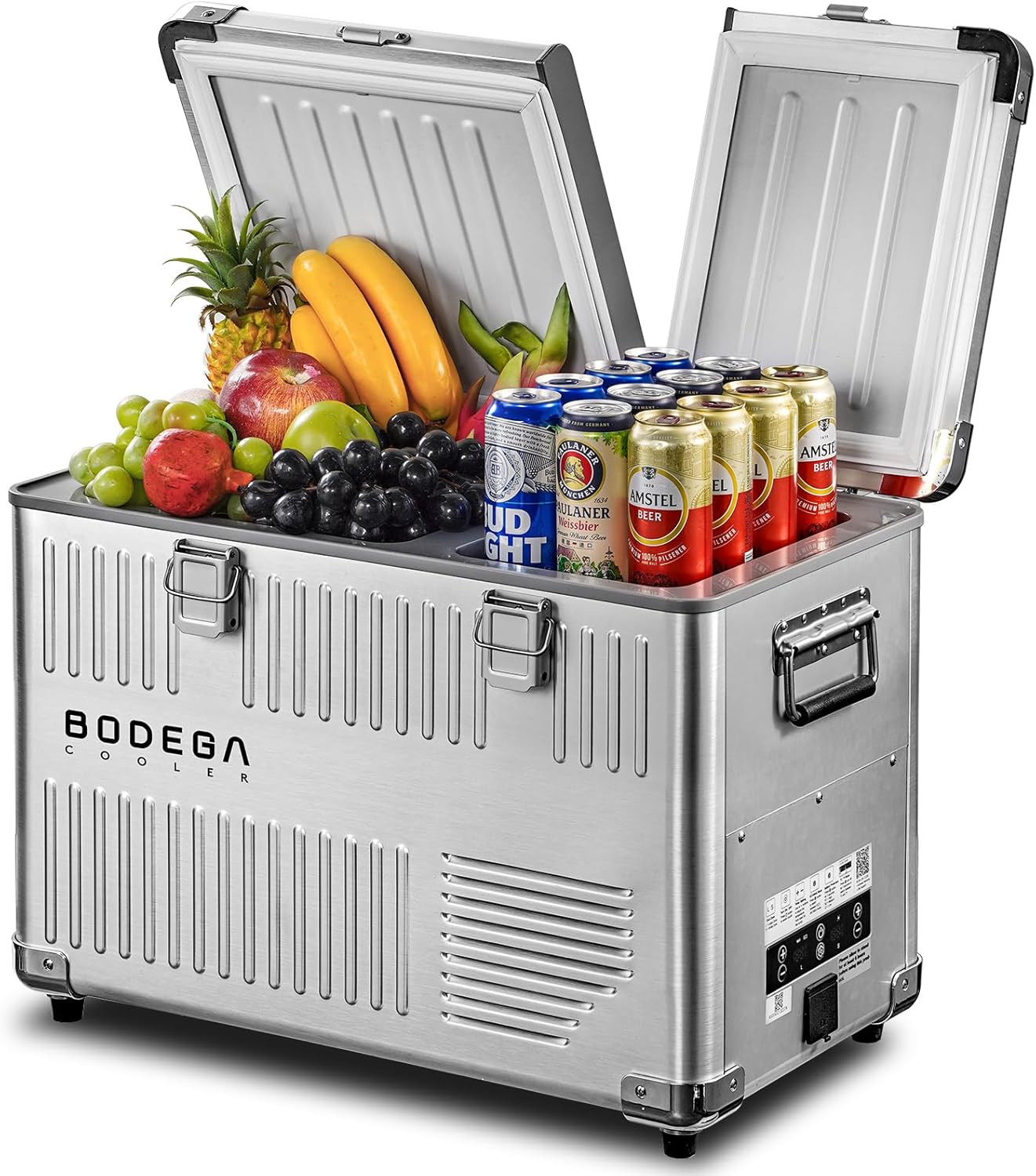
BODEGA 53-Quart Dual-Zone Fridge
| Capacity | 50 liters |
|---|---|
| Cooling Method | Compressor |
| Power Source | 12/24V DC, 110/240V AC |
| Temperature Range | -4°F to 68°F |
| Annual Energy Consumption | 0.9 kwh/24h |
The BODEGA 53‑Quart Dual‑Zone Fridge is a freestanding 2-door portable compressor refrigerator intended for road trips, RVs, trucks, and at-home backup cooling. It provides independent temperature control for each zone, letting you run one side as a refrigerator and the other as a freezer, and the rotary scroll compressor cools quickly from room temperature down to -4°F. The unit accepts 12/24V DC and 110/240V AC power, includes ECO and MAX modes to balance energy use and speed, and operates quietly with built-in battery protection to avoid draining a vehicle. Practical touches include aluminum door panels, an LED touch control panel, internal shelves, and a drain for easy cleaning. The fridge is large enough for dozens of cans or bottles and will replace ice coolers for multi-day trips, but it is a full-size portable unit so it requires secure mounting or stable placement in a cab and takes up significant space compared with small portable coolers. Annual energy consumption is low in ECO mode, but expect higher draw in MAX mode and when used as a freezer.
Best for: Drivers and van/RV owners who need a large, reliable on‑vehicle refrigerator that can hold mixed frozen and fresh food for extended trips while protecting vehicle battery.
Less Ideal for: People who need a compact, ultra-light cooler for short day trips or who have very limited in-cab storage space should consider smaller portable units instead.
- True dual-zone compressor with independent temperature control for simultaneous refrigeration and freezing
- Works on 12/24V DC and 110/240V AC so it can run in trucks, RVs, or at home
- Fast cooling performance down to -4°F and supports operation at tilt for rough roads
- Quiet operation with three-level battery protection to prevent vehicle battery drain
- Lightweight aluminum doors, internal shelves, and a drain make cleaning and daily use easier
- Full-size portable footprint requires significant space and secure mounting in a truck cab
- Higher power draw in MAX mode or when freezing compared with ECO mode
Verdict: Choose this fridge when you need a large, quiet dual-zone compressor refrigerator that runs from truck or home power and keeps mixed frozen and fresh food reliably cold on long trips.
Dometic CFX2 28

| Capacity | 28 liters |
|---|---|
| Temperature range | -7°F to 68°F (-22°C to 20°C) |
| Power inputs | 12/24V DC, 100–240V AC |
| Includes | DC cable, AC cable, removable wire baskets |
The Dometic CFX2 28 is a compressor-powered portable cooler that functions as either a fridge or freezer and is built for on-road and off-grid use. It runs from 12/24V DC or 100–240V AC, includes DC and AC cables, and uses an energy-efficient compressor to hold temperatures from -7°F to 68°F without ice. The top-loading 28 L chest fits about 36 cans or three 1.5 L bottles and has removable wire baskets for organization. A three-stage battery protection system helps avoid draining a vehicle battery, and Bluetooth connectivity plus a simple control panel lets you monitor and adjust temperature from a phone. Practical benefits include reliable, consistent cooling for long hauls, better usable space than ice-based coolers, and USB charging for small devices. Trade-offs are the absence of an internal battery—so it needs a power source—and the unit adds noticeable weight and bulk compared with soft coolers, which may matter for tight cab spaces.
Best for: Drivers and operators who need reliable, compressor-grade cooling on the road and prioritize consistent temperature control for perishables and beverages during multi-day trips.
Less Ideal for: People who need ultra-lightweight or foldable coolers for tight storage spaces or for users who require a self-contained unit with an internal battery.
- Compressor cooling with adjustable range from -7°F to 68°F for fridge or freezer use
- Multiple power options: 12/24V DC and 100–240V AC with included cables
- Three-stage battery protection to prevent vehicle battery drain
- Bluetooth app and front control panel for temperature monitoring and adjustments
- 28 L capacity with removable baskets for organized storage
- No built-in battery so it requires external power to run
- Relatively heavy and bulky compared with soft or passive coolers
Verdict: A rugged, compressor-driven 28 L portable cooler that delivers dependable fridge-or-freezer performance for drivers who prioritize temperature control on long hauls.
BougeRV E40 42-Quart Refrigerator

| Capacity | 42 quarts |
|---|---|
| Temp range | -4 to 50°F (-20 to 10°C) |
| Cooling method | Compressor |
| Power source | 12/24V DC, AC adapter |
| Noise level | 45 dB |
The BougeRV E40 is a compressor-based 42‑quart portable fridge built for trucks, RVs, and extended road trips where reliable cold storage is needed. It runs from 12/24V DC or AC adapter and uses ECO and MAX modes to balance power draw and cooling performance, with ECO running under about 45W. The single-chest layout cools quickly—manufacturer claims show a drop from 77°F to 32°F in 15 minutes and down to -4°F within an hour—so it can function as a refrigerator or a freezer. A built-in inverter and three-level battery protection help prevent vehicle battery drain, and the unit is relatively quiet at about 45dB, which matters in a sleeper cab. Practical touches include an electronic lock and a matte finish that resists scratches. Trade-offs are typical for chest-style portable fridges: no true dual-zone control and the single compartment means you must organize perishables manually, and the unit is moderately heavy for moving in and out of a truck cab.
Best for: Drivers and fleet operators who prioritize reliable, low-power vehicle refrigeration that can quickly make or keep frozen goods cold during multi-day routes.
Less Ideal for: Users who need separate temperature zones, frequent portable repositioning, or a very lightweight cooler for short day trips should consider other form factors.
- Large 42‑quart capacity suitable for multi-day trips or multiple occupants
- Compressor cooling that reaches freezer temps for flexible fridge/freezer use
- ECO and MAX modes to reduce power use or boost cooling when needed
- Three-level battery protection and built-in inverter for safer vehicle operation
- Relatively low noise level around 45dB for use in truck sleepers
- Single-chest design lacks independent temperature zones or shelving for separate items
- At about 32.7 pounds it is fairly heavy to lift and move without assistance
- Manual defrost means occasional maintenance to remove ice buildup
Verdict: A durable, truck-ready 42‑quart compressor fridge that delivers freeze-capable cooling with battery protection and low power draw, ideal for semi drivers needing dependable on-board refrigeration.
DEMULLER 45L Mini Fridge

| Capacity | 45 liters |
|---|---|
| Freezer Capacity | 0.8 cubic feet |
| Defrost System Type | Manual Defrost |
| Cooling Method | Compressor |
| Voltage | 110 volts |
This 45L DEMULLER mini fridge pairs a small top freezer with a 1.6 cu ft refrigerated compartment and a compressor cooling system designed for quick, efficient chilling. It is typically used as a personal or dorm fridge and in tight spaces; the unit fits into narrow spots and includes two removable shelves for flexible storage and two adjustable feet to stay level on uneven floors. The seven-position thermostat covers a wide range (about -0.4°F to 50°F) so you can dial in freezer or fridge temperatures, and the manual defrost design makes cleaning straightforward. The compressor claims quiet operation around 38 dB, which helps in confined cabins. Trade-offs are its limited total capacity and manual defrosting, which require occasional maintenance, and the basic control layout lacks digital precision. For someone needing a basic, compact refrigerated solution that cools reliably, this model delivers sensible features without extra complexity.
Best for: Drivers or owners looking for a no-frills, compact refrigerator to fit very tight spaces who prioritize reliable compressor cooling and simple mechanical controls over large capacity or digital features.
Less Ideal for: Anyone needing large-volume cold storage, full-size truck refrigeration, or automatic defrost and precise digital temperature control should look at larger or more feature-rich units.
- Compact two-door design with a separate 0.8 cu ft freezer for frozen storage
- Seven-step adjustable thermostat gives a wide temperature range for cooling control
- Removable shelves and adjustable feet increase storage flexibility and leveling
- Compressor cooling operates quietly (around 38 dB) and cools quickly
- Manual defrost requires periodic maintenance and is less convenient than auto-defrost
- Small overall capacity limits use to single-person or light refrigeration needs
Verdict: A compact, compressor-cooled mini fridge that delivers reliable cold storage for single-person or tight-space truck cabins without extra digital frills.
Upstreman 3.2 Cu.Ft Mini Fridge BR321

| Capacity | 3.2 cubic feet |
|---|---|
| Freezer Capacity | 0.3 cubic feet |
| Defrost System Type | Manual Defrost |
| Voltage | 115 volts |
| Annual Energy Consumption | 206 kwh |
This Upstreman BR321 is a straightforward compressor mini fridge aimed at compact, reliable cooling. It provides 3.2 cu ft of total capacity with a 0.3 cu ft freezer and two adjustable glass shelves, making it easy to organize drinks, perishables, and a few frozen items. The rotary scroll compressor and adjustable thermostat (32°F to 50°F) let you dial in cooling for different loads, while manual defrost and a tight door seal help maintain temperatures. The reversible door and adjustable feet simplify installation in tight or uneven spaces, and the unit is designed to run quietly at about 38 dB, which helps in sleeper cabs or quiet truck cabins. Energy use is modest and the ETL listing signals basic safety compliance, but manual defrost means occasional maintenance and the freezer is too small for ice packs or large frozen goods. If you need a simple, low-noise refrigerator that fits limited space and focuses on steady cooling rather than advanced features, this model delivers.
Best for: Drivers who prioritize a compact, dependable refrigerator that fits limited cabin space and provides steady, quiet cooling for drinks and perishable snacks.
Less Ideal for: Those who need large frozen storage, automated defrost, or advanced features like digital controls and alarms should consider larger or feature-rich alternatives.
- Compact 3.2 cu ft capacity with a dedicated 0.3 cu ft freezer for small frozen items
- Quiet operation around 38 dB suitable for sleeper cabins or quiet environments
- Adjustable thermostat with five temperature settings for flexible cooling
- Reversible door and leveling feet for flexible placement in tight or uneven spaces
- Compressor cooling with rotary scroll compressor for consistent temperature control
- Manual defrost requires periodic maintenance to remove frost
- Freezer is very small and cannot accommodate large frozen items or ice trays
Verdict: A compact, quiet, and reliable mini fridge that fits tight truck cabins and keeps perishables chilled without fuss.
EUHOMY CF-55 59QT Portable Fridge

| Capacity | 55 liters |
|---|---|
| Temp Range | -4°F to 68°F (-20°C to 20°C) |
| Power Source | AC/DC (12/24V DC, 100-240V AC) |
| Defrost System Type | Frost Free |
| Additional Features | App Control, ECO/MAX Modes, Battery Protection |
The EUHOMY CF-55 is a compressor-based portable refrigerator intended for road, RV, and home use that runs on 12/24V DC or 100–240V AC. It offers dual storage zones with a removable internal basket and an LCD control panel plus app/Bluetooth control for remote temperature adjustments. The compressor claims fast cooling from 68°F to 32°F in about 15 minutes and provides ECO and MAX modes to balance energy use and speed. For truck drivers the built-in three-level battery protection and reversible door make it practical for long trips while limiting vehicle battery drain, and the internal LED light and electronic lock add convenience and security. Trade-offs include its relatively large footprint and weight for a mobile fridge and the fact that the advertised fast-cooling time will depend on ambient conditions and initial load. Noise is described as low but the compressor will still run intermittently in MAX mode. Overall it is a feature-rich portable freezer/fridge option for semi-truck use when you need reliable cooling and battery safeguards.
Best for: Truck drivers and long-haul travelers who prioritize dependable cooling, remote control, and built-in battery safeguards for on-road food and drink storage.
Less Ideal for: People who need a very lightweight, ultra-compact cooler for occasional day trips or who cannot accommodate a larger, heavier unit in their vehicle.
- Runs on both 12/24V DC and 100–240V AC for versatile truck and home use
- Three-level battery protection to reduce risk of draining vehicle battery
- Dual-zone interior with removable basket for organized storage
- App/Bluetooth control and LCD panel let you monitor and change temps remotely
- ECO and MAX modes balance energy efficiency and rapid cooling
- Large physical size and weight make it less convenient to move frequently
- Fast-cooling claims depend on ambient temperature and load so real-world times vary
Verdict: A robust, truck-ready portable compressor fridge that pairs fast cooling and app control with built-in battery protection for safe long-haul use.
BougeRV CR22 23-Quart Refrigerator

| Capacity | 23 quarts |
|---|---|
| Cooling method | Compressor |
| Temperature range | -8°F to 50°F (-22°C to 10°C) |
| Power options | 12/24V DC and 110V AC |
| Noise level | ~45 dB |
The BougeRV CR22 is a compact 23‑quart compressor fridge built for road use in trucks, RVs, and overland vehicles. It runs off 12/24V DC or 110V AC and ships with both DC and AC power cords, so it can sit in a cab or be used at a campsite. The compressor design cools quickly—advertised 15 minutes from room temperature to about 32°F—and has an ECO mode that reduces power draw to roughly 45W in normal operation. Practical features for vehicle use include a 3‑level battery protection cutoff, low noise operation near 45 dB, a top‑opening chest layout and an electronic lock. The unit is freestanding and has manual defrost, so occasional thawing and cleaning are required. It is not inverter‑equipped, so it relies on direct DC/AC connections, and the internal capacity is small compared with full cab refrigerators. For semi truck drivers the CR22 delivers fast cooling, low power use, and battery safeguards, but expect to manage limited space and perform manual defrosting over time.
Best for: Truck drivers and road travelers who want a reliable, low‑power portable fridge with battery protection and quiet operation for keeping meals and perishables fresh on multi‑day routes.
Less Ideal for: Fleet operators or drivers who need large freezer capacity or hands‑off maintenance should consider larger dual‑zone or permanently installed truck refrigerators instead.
- Runs on 12/24V DC or 110V AC with included cords for versatile vehicle and campsite use
- Compressor cooling that reaches near‑freezer temperatures quickly for keeping food frozen or chilled
- Low average power consumption with an ECO mode suitable for long trips
- 3‑level battery protection prevents draining the vehicle battery
- Relatively quiet operation around 45 dB for sleeping in the cab
- Small 23‑quart capacity limits long-term storage or bulk grocery runs
- Manual defrost requires periodic maintenance to remove frost buildup
- No built‑in inverter means direct connection required to vehicle power or external power stations
Verdict: A compact, truck‑ready compressor fridge that cools fast, uses little power, and protects your vehicle battery, making it a sensible choice for cautious drivers who value reliability.
Choosing the Right Refrigerator for Semi Trucks: Key Factors to Consider
Power Source and Draw
A refrigerator for semi trucks must run efficiently on the truck electrical system, often 12V or 24V DC, or through an inverter. Knowing the continuous power draw at typical operating temperatures helps you estimate fuel or battery impact over long hauls. Lower wattage units reduce strain on alternators and batteries but may trade off cooling speed.
Also consider startup surge current. Compressors can draw significantly more power on startup than during steady state. Confirm that your truck's alternator and wiring can handle that surge and that available fuses and connectors match the unit's requirements.
Mounting, Vibration Resistance, and Fit
Cab space is limited and subject to constant vibration and movement. A truck refrigerator should include or support secure mounting options that tie into the cab or sleeper structure. Look for units with reinforced frames, vibration-damping mounts, or specific truck-mount kits designed to prevent loosening under road conditions.
Measure the installation footprint and door swing before choosing a model. Consider how the unit will be routed for power and whether it blocks access to storage areas or passageways. Proper mounting reduces noise, prevents premature seal wear, and helps maintain interior temperature stability.
Interior Layout and Usable Volume
Total capacity numbers can be misleading if shelf layout or door storage is impractical for on-road use. Assess usable volume by thinking about the items you carry: meal containers, milk jugs, frozen items, or medication. Adjustable shelving, removable drawers, and upright versus chest configurations change how efficiently you can pack the space.
Also evaluate how the interior layout affects cooling distribution. Tall, narrow compartments may need different airflow patterns than shallow, wide units. Good interior organization reduces time the door is open and helps maintain stable temperatures during stops.
Temperature Range and Control
Refrigerators for semi trucks should offer reliable, repeatable temperature control to handle hot summer days and cold nights. Look for accurate thermostats, digital controls, or external sensors that allow fine-tuning. Some units provide a freezer section or rapid-cool mode for loading chilled items quickly.
Consistent temperature across the compartment is important for food safety, especially when carrying perishables or medication. Consider whether the unit has insulated doors, tight sealing gaskets, and fan-assisted airflow to minimize hot spots.
Noise, Ventilation, and Heat Rejection
Compressor noise and heat rejection matter inside a small living space. Choose units designed to dissipate heat away from the cab interior and with quieter compressor or fan assemblies to avoid sleep disruption. Proper venting paths and clearances are necessary to maintain compressor efficiency and lifespan.
If the refrigerator is installed in a confined area, ensure adequate airflow around the condenser and consider noise-dampening mounting materials. Excessive heat buildup can force compressors to run longer, increasing power draw and wear.
Serviceability and Parts Access
When you are on the road, easy access to serviceable components reduces downtime. Prefer refrigerators with accessible filters, replaceable gaskets, and straightforward compressor or thermostat access without removing the entire unit. Clear wiring diagrams and standardized connectors also make roadside troubleshooting easier.
Availability of spare parts and clear maintenance instructions extend the useful life of the refrigerator and reduce the risk of long trips being interrupted by avoidable failures.
Choosing the Right Size for Your Cab
Picking the right size is about balancing usable capacity with the physical constraints of your cab and sleeper. Measure the installation area carefully, including clearance for door swing and ventilation. Remember that nominal capacity does not always translate to usable space because of shelf shapes and built-in compartments.
Think about what you typically carry on a trip. If you bring frozen items or large jugs, prioritize vertical clearance and removable shelves. For snacks and meal prep, smaller, better-organized interiors often perform better than a larger but poorly configured compartment.
- Measure width, depth, and height including door clearance
- Account for cable routing and ventilation space
- Prefer adjustable shelving for flexible packing
Installation Tips to Reduce Vibration and Noise
Use vibration-damping pads or rubber isolators when mounting to the cab or sleeper frame to reduce rattles and protect internal components. Follow manufacturer torque recommendations for bolts and check mounts after a few hundred miles to ensure they remain tight.
Route wiring away from sharp edges and moving parts, and secure all cables to prevent chafing. If the refrigerator produces noticeable noise at idle, small modifications like foam barriers that do not obstruct ventilation can reduce perceived noise without harming performance.
- Use lock washers or threadlocker on mounting hardware
- Inspect and retorque mounts after initial installation
- Keep condenser vents clear of debris and insulation
Power Management on Long Hauls
Plan for how the refrigerator will be powered during engine-off periods. If you rely on the truck battery, use low-draw models or add an auxiliary battery and isolator to protect starting power. Inverters add flexibility but increase system complexity and can introduce conversion losses.
Monitor actual power draw during a few typical trips to understand real-world consumption. Smart use habits like pre-cooling before disconnecting from shore power, minimizing door openings, and setting the thermostat one or two degrees higher can meaningfully extend runtime between charges.
- Consider auxiliary batteries or dual-battery systems
- Pre-cool when connected to external power
- Track amp draw during different operating modes
Cleaning and Odor Prevention
Routine cleaning prevents odors and bacterial buildup. Use removable liners or trays to catch spills and make cleaning easy. Periodically inspect door gaskets for cracks and replace them promptly to maintain a tight seal.
For longer trips or intermittent use, leave the door slightly ajar when the unit is powered down to avoid stale odors, or use small charcoal pouches designed for enclosed refrigeration spaces to absorb smells without affecting cooling components.
- Wipe down interiors with mild detergent and water
- Remove and dry trays before storage
- Replace worn gaskets to maintain seal integrity
Regulatory and Safety Considerations
When installing electrical equipment in a commercial vehicle, follow applicable wiring and safety regulations. Use properly rated fuses, circuit breakers, and wiring that match the refrigerator's current draw to avoid fire risk. Ensure any modifications do not impede emergency egress or violate vehicle code.
Securely fasten the unit to prevent movement during sudden stops. Loose appliances can become projectiles in a crash, so use manufacturer-recommended anchors and periodically inspect fasteners for corrosion or loosening.
- Use appropriately rated wiring and overcurrent protection
- Keep installation accessible for emergency inspections
- Follow vehicle-specific rules for electrical modifications
How We Chose the Best Refrigerator for Semi Trucks
We focused on characteristics that matter to drivers who need reliable cold storage inside a cab. Key evaluation criteria included energy consumption on DC power, secure mounting and vibration resistance, usable internal volume and layout, temperature range and control, and serviceability for on-road maintenance. We reviewed specifications and user-focused documentation to assess how each unit handles continuous-duty operation and heat buildup in confined spaces. We excluded household refrigerators and any units requiring full 120V AC mains without inverter or dedicated truck power options, since those are not practical for semi-truck use. Models that lacked clear mounting instructions, accessible replacement parts, or realistic power draw figures were also filtered out. The final shortlist prioritizes real-world installation fit, daily energy cost on typical truck electrical systems, and durable design features that reduce failures in mobile environments.
Our full evaluation process is outlined in our review methodology.
FAQ
Can a truck refrigerator run directly from my truck battery?
Usually yes, if the unit is designed for 12V or 24V DC operation and your battery and alternator can handle the continuous load. For long engine-off periods, an auxiliary battery or battery isolator is recommended to protect starting capacity.
How much space should I leave around the unit for ventilation?
Follow the manufacturer's recommended clearance, which commonly ranges from a few inches on the sides and more above the condenser area. Adequate airflow prevents overheating and maintains cooling efficiency, especially in confined cab spaces.
Are compressor-style truck refrigerators noisy?
Compressor models produce some noise and vibration, but units designed for vehicle use typically include quieter compressors and vibration mounts. Proper installation and isolation reduce perceived noise inside the sleeper.
Do these refrigerators need special maintenance?
Maintenance is typically basic: keep condenser vents clean, inspect and clean seals, and check electrical connections. Replacing worn gaskets and ensuring proper mounting reduces wear and preserves efficiency.
Can I use a chest-style refrigerator in a sleeper cab?
Chest-style units can be used if the cab layout and mounting options allow, but they usually require more vertical clearance to access contents and may have different cooling dynamics. Consider how you pack and retrieve items before choosing a chest design.
Final Verdict
Choosing the right refrigerator for semi trucks comes down to balancing energy use, secure mounting, and interior usability for the items you carry. Prioritize models that match your truck electrical system, offer mounting solutions that reduce vibration, and provide interior layouts suited to your typical food and supply load. Think through installation constraints and power management before selecting a unit. When you prioritize reliable temperature control, efficient power draw, and serviceable construction, you reduce the risk of failures on the road and ensure fresher food and supplies on long trips.