
Note: This article contains affiliate links. If you click on these links and make a purchase, we may earn a small commission at no extra cost to you. This helps support our research and content. Read our full affiliate disclosure here.
Picking the right refrigerator for a small family shapes daily routines more than you might expect. Limited kitchen space, modest weekly shopping trips, and the need to balance fresh and frozen storage make capacity and layout priorities. You want a unit that keeps food at safe temperatures, minimizes energy bills, and fits both your kitchen footprint and lifestyle. This guide shortlists the top refrigerators for small families, focusing on usable interior space, energy efficiency, and layout flexibility. Below we cover the evaluation criteria we used and provide practical advice to help you choose a model that fits school lunches, meal prep, and small-batch grocery runs. Read on for the shortlist and the decision factors that matter most.
Top Picks at a Glance
| Best Overall The best all-around choice for most situations | BANGSON 7.7 Cu Ft Refrigerator |  |
| Best Quality Built to a higher standard if you want something more solid | KoolMore Counter-Depth French Door Refrigerator |  |
| Best Value The sweet spot between price and what you get | EUHOMY Mini Fridge CRF006-31 3.2 Cu Ft |  |
| Best Budget The cheapest option that still gets the job done reliably | Anukis Retro 3.2 Cu Ft Refrigerator |  |
| Top Rated A top-rated pick with lots of positive feedback | Stopsad 3.2 Cu Ft Mini Fridge |  |
| Most Popular A crowd favorite that many people choose with confidence | Frigidaire Retro EFR751 7.5 cu ft |  |
| Best Seller A high-volume bestseller chosen again and again | Upstreman 7.7 Cu Ft Refrigerator |  |
BANGSON 7.7 Cu Ft Refrigerator

| Capacity | 7.7 cubic feet |
|---|---|
| Refrigerator Net Capacity | 6.21 cubic feet |
| Defrost System Type | Manual Defrost |
| Cooling Method | Compressor |
| Installation Type | Freestanding |
This apartment-size top-freezer fridge is built to serve small households that need sensible storage without a large footprint. It provides a 1.49 cu ft freezer and a 6.21 cu ft fresh-food compartment with removable glass shelves and a crisper drawer, so you can rearrange shelves to fit taller bottles or food containers. The five-level thermostat lets you tune temperatures for different loads, and reversible doors plus adjustable leveling legs help when fitting into tight kitchens or rentals. It is manually defrosted, and the unit ships with a defrost tool and ice tray; manual defrost requires occasional maintenance but keeps the appliance simpler internally. The compressor cooling and claimed 39 dB noise level mean it runs quietly for open-plan living and offices. Important limitations are the smaller total capacity compared with full-size models and the manual defrosting, which adds upkeep if you store frost-prone items frequently. For small families or couples looking for a compact everyday fridge, it balances usable storage and practical features at a space-conscious scale.
Best for: Buyers who need a space-saving, practical refrigerator for small families, apartments, or offices and prioritize adjustable storage and quiet everyday operation.
Less Ideal for: Large households or cooks who need extensive cold storage, rapid-freeze performance, or a frost-free model with minimal maintenance.
- Compact footprint fits apartments, offices, and small kitchens
- Removable glass shelves and crisper drawer allow flexible organization
- Five-level adjustable thermostat for tailored cooling
- Reversible doors and leveling legs simplify placement and installation
- Quiet operation rated around 39 dB suitable for shared spaces
- Manual defrost requires periodic user maintenance
- Smaller overall capacity than full-size refrigerators
Verdict: A compact, quiet top-freezer refrigerator that delivers flexible storage and straightforward cooling for small families in tight spaces.
KoolMore Counter-Depth French Door Refrigerator

| Capacity | 18.5 cubic feet |
|---|---|
| Freezer Capacity | 5.58 cubic feet |
| Configuration | French Door |
| Defrost System Type | Automatic |
| Refrigerant | R-600A |
This KoolMore counter-depth French door refrigerator is built to deliver usable storage and sensible temperature control for a small family. It places adjustable glass shelves, six door bins, and two refrigerator drawers within an 18.5 cubic foot interior while keeping a shallow, counter-aligned profile. The unit uses a compressor with a double-flow cooling approach and digital LED controls to maintain even temperatures, and the dual crispers include humidity control to extend produce life. The freezer provides two deep drawers that make organization easier than a single-door freezer, and the stainless-steel finish with pull handles fits contemporary kitchens. Expect reasonable energy performance given its Energy Star listing, but the compact form means less absolute shelf space than full-depth models and the 30-inch width could limit bulk item storage. Installation requires counter-depth planning and the built-in-style fit affects where it can go. For buyers who prioritize reliable cooling, produce freshness, and a streamlined kitchen look, this model balances features and footprint effectively.
Best for: Buyers who want strong cooling performance and produce preservation in a compact, counter-depth French-door layout for a small household and a contemporary kitchen.
Less Ideal for: Large families or cooks who need maximum internal volume or wide shelves for oversized platters should consider larger full-depth models instead.
- Counter-depth French door design integrates with standard counters for a built-in look
- 18.5 cu ft usable capacity with adjustable glass shelves and six door bins for flexible organization
- Double-flow cooling and digital temperature control promote even cooling and help preserve food
- Dual freezer drawers simplify organization and access compared with single-door freezers
- Energy Star rated for better energy efficiency than non-rated compact refrigerators
- Narrow 30-inch width and counter-depth footprint limit capacity for large or bulky items
- No detailed advanced features such as Wi-Fi or smart diagnostics listed
Verdict: Choose this refrigerator if you want reliable, even cooling and humidity-controlled produce storage in a counter-depth French-door design suited to small families.
EUHOMY Mini Fridge CRF006-31 3.2 Cu Ft
| Capacity | 3.2 cubic feet |
|---|---|
| Freezer Capacity | 0.96 cubic feet |
| Cooling Method | Compressor |
| Defrost System Type | Automatic |
| Voltage | 115 volts |
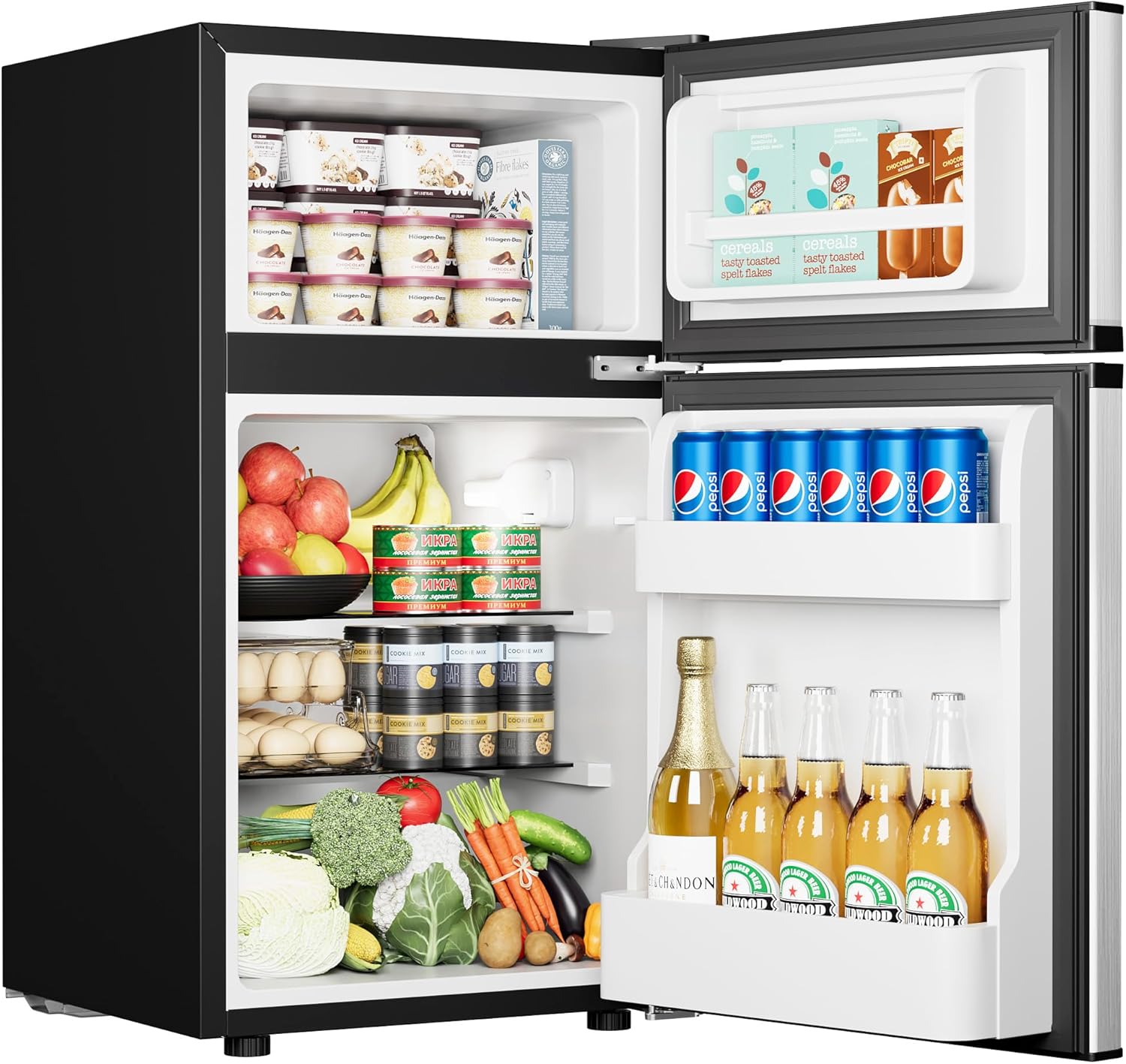
This EUHOMY mini fridge pairs a small refrigerator compartment with a 0.96 cu ft top freezer to give you both chilled storage and a place for frozen goods in a compact footprint. It uses a rotary scroll compressor with inverter support, which typically cools faster and runs quieter than thermoelectric units, making it suitable for kitchens, dorms, or small-family secondary use. Inside you get adjustable glass shelves, a crisper drawer and door shelves for bottles, plus an internal LED for visibility at night. The reversible door and adjustable feet make placement flexible in tight spaces. Energy use is moderate with the listing showing annual consumption and the unit meets UL specifications. Limitations are the modest overall capacity and freezer size, so it is best as a primary fridge for a small household with minimal frozen storage needs or as a convenient secondary fridge rather than a full-family workhorse.
Best for: Buyers who value a space-efficient refrigerator that offers both chilled and frozen storage for a small household or as a secondary unit and who prioritize quiet, reliable compressor cooling and flexible placement.
Less Ideal for: Those who need large freezer capacity for bulk frozen meals or a primary family refrigerator with extensive storage should consider larger models instead.
- Combined fridge and top freezer in one compact unit for mixed storage needs
- Compressor cooling with inverter and rotary_scroll compressor for efficient, relatively quiet cooling
- Adjustable glass shelves and a crisper drawer let you organize varied food and drink sizes
- Reversible door and adjustable feet increase placement flexibility in small spaces
- Built-in LED light improves visibility without opening the door for long periods
- Freezer capacity is under 1 cu ft which limits long-term frozen food storage
- Annual energy consumption is moderate compared with the most energy-efficient compact models
Verdict: A compact, compressor-cooled two-door mini fridge that delivers practical chilled and frozen storage for small families or as a convenient secondary refrigerator.
Anukis Retro 3.2 Cu Ft Refrigerator

| Capacity | 3.2 cubic feet |
|---|---|
| Freezer Capacity | 1.1 cubic feet |
| Cooling Method | Compressor |
| Defrost System Type | Manual |
| Power Source | Corded Electric |
The Anukis 3.2 cu ft retro refrigerator is a small freestanding fridge with a top freezer that suits tight kitchens, dorms, or secondary household use. It cools via a compressor and offers seven thermostat settings to dial refrigerator temperatures between roughly 32 and 50 F and freezer temperatures around 3 to -1 F. Interior LED lighting, two adjustable glass shelves, a vegetable drawer and door storage keep everyday items organized while the small freezer accepts ice trays and a few frozen items. Manual defrost and adjustable leveling legs keep the unit simple and serviceable, and the manufacturer recommends leaving it upright for 12 hours after transport. Expect modest energy use for its class but also the usual limitations of a mini fridge: limited shelf area, a shallow freezer, and manual defrosting instead of an auto system. For buyers prioritizing a retro look and compact, practical cooling, this model delivers straightforward performance without advanced features.
Best for: Buyers who need an affordable, space-saving primary fridge for a small family or a secondary unit for an apartment or basement and value simple, reliable cooling over bells and whistles.
Less Ideal for: Families who need significant freezer space, full-size capacity, or automatic defrosting should consider larger refrigerators instead.
- Compact footprint fits apartments, dorms, and small kitchens
- Seven-step adjustable thermostat for flexible temperature control
- Removable glass shelves and a drawer let you reconfigure storage
- Top freezer provides dedicated frozen storage separate from fridge
- LED interior light and door storage improve everyday usability
- Freezer is small and holds only limited frozen items
- Manual defrost requires occasional maintenance
- Annual energy consumption is moderate compared with high-efficiency full-size units
Verdict: A compact, budget-friendly mini refrigerator that gives small households practical refrigerated and frozen storage in a space-saving retro package.
Stopsad 3.2 Cu Ft Mini Fridge

| Capacity | 3.2 cubic feet |
|---|---|
| Freezer Capacity | 0.3 cubic feet |
| Cooling Method | Compressor |
| Defrost System Type | Automatic |
| Power Source | Corded Electric |
This Stopsad 3.2 cu ft mini fridge is a compact double-door refrigerator with a 0.3 cu ft freezer and a 2.9 cu ft refrigerator compartment, intended for dorms, offices, bedrooms, or small-family needs. It uses a compressor cooling method with an automatic defrost system and a three-position adjustable thermostat so you can set freezer and fridge temperatures to suit beverages, produce, or frozen treats. The unit includes two removable glass shelves, reversible doors, and bottom leveling legs to help placement on uneven floors. It is marketed as energy efficient with estimated low daily consumption and a quiet 38 dB operating noise, which makes it unobtrusive in living spaces. Practical limits are its modest overall capacity and compact footprint, which mean it will hold a week's basics for one or two people but is not a substitute for a full-size family refrigerator; installers should also allow 24 hours after moving before first use for optimal compressor performance. Build details such as plastic door material and a basic one-year warranty reflect its budget-oriented positioning.
Best for: Buyers who prioritize a reliable, space-saving refrigerator for light daily use in small homes or shared living spaces and who value quiet, energy-conscious operation.
Less Ideal for: Those needing large weekly grocery storage, full meal prep capacity, or heavy-duty long-term food preservation should consider a larger, full-size refrigerator instead.
- Double-door layout with a dedicated freezer section for frozen snacks and ice cream
- Adjustable three-position thermostat for flexible temperature control
- Removable glass shelves and reversible doors allow configurable storage and placement
- Energy-efficient compressor design and low noise operation suitable for bedrooms and quiet spaces
- Limited total capacity best suited to one to two people rather than larger families
- Plastic door construction suggests lower durability compared with higher-end models
Verdict: A compact, quiet, and energy-efficient mini fridge that reliably covers light refrigeration needs for small households or shared rooms.
Frigidaire Retro EFR751 7.5 cu ft
| Capacity | 7.5 cubic feet |
|---|---|
| Freezer Capacity | 2 cubic feet |
| Defrost System Type | Manual |
| Cooling Method | Compressor |
| Power | 120 volts |
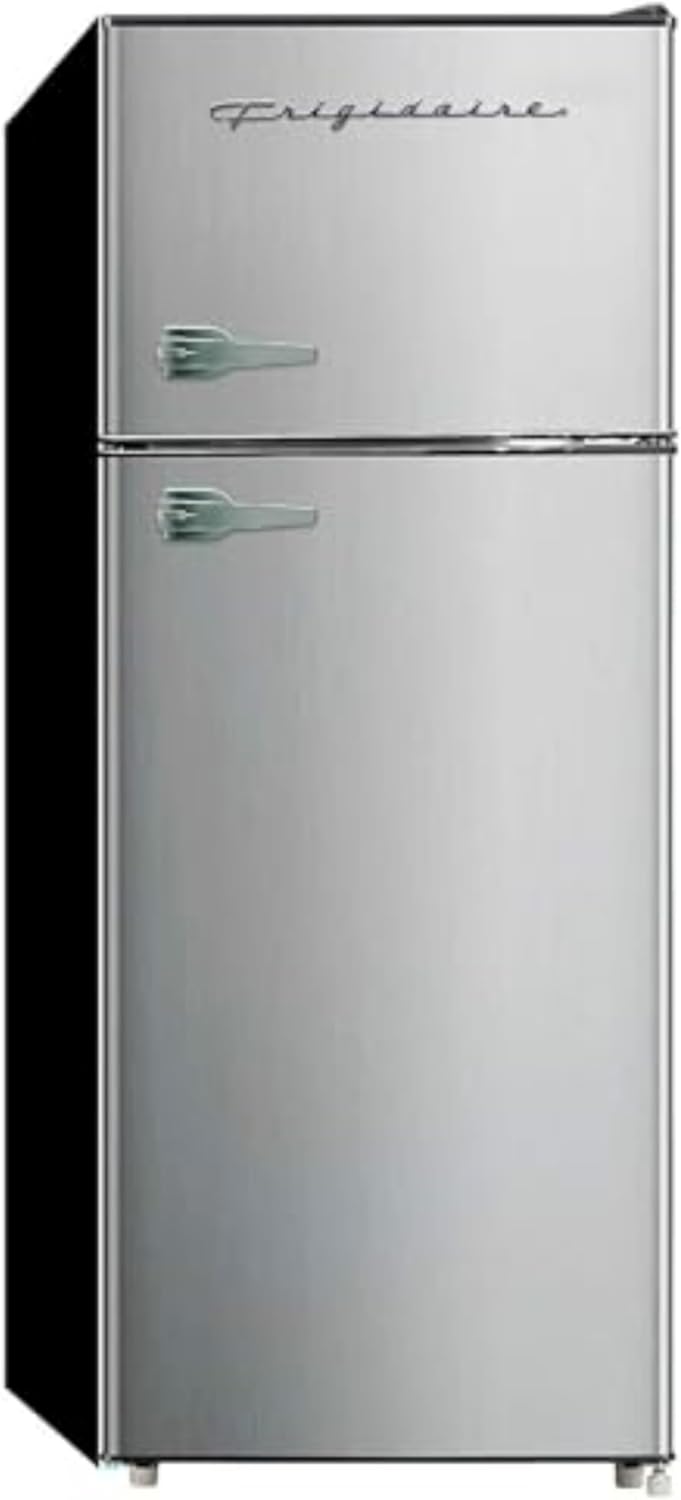
This Frigidaire two-door apartment refrigerator combines a vintage-inspired stainless finish with practical storage for smaller households. It offers 7.5 cu ft of total capacity with a separate top freezer, three adjustable glass shelves in the fridge, a transparent crisper, and clear door bins that make organizing groceries straightforward. The unit uses a compressor cooling system with mechanical controls and a manual defrost freezer, so operation is simple and reliable without fancy electronics. Castors and front leveling legs let you move and position the cabinet easily during installation or when rearranging a small kitchen. Important limitations are the manual-defrost freezer and the mid-range annual energy use, which mean more hands-on maintenance and higher running costs than modern frost-free, high-efficiency models. For everyday use it suits families who need a compact, roomy fridge footprint and value straightforward controls and classic styling over advanced features.
Best for: Buyers focused on proven, practical appliances who want a roomy compact refrigerator with simple controls and dependable cooling for everyday family use.
Less Ideal for: Shoppers who prioritize lowest possible energy bills or a frost-free freezer with minimal maintenance should consider other, more efficient models.
- Separate top freezer plus a 7.5 cu ft fridge offers clear separation of fresh and frozen storage
- Adjustable glass shelves and removable door bins allow flexible organization for groceries and bottles
- Reversible door hinge and rear castors make placement and installation adaptable for small spaces
- Simple mechanical controls and compressor cooling provide straightforward, dependable operation
- Freezer uses manual defrost which requires periodic maintenance to prevent ice build-up
- Annual energy consumption is relatively high compared with newer energy-efficient compact models
Verdict: A roomy, no-frills compact refrigerator that delivers dependable cooling and flexible storage for small families who prefer straightforward, proven appliances.
Upstreman 7.7 Cu Ft Refrigerator
| Capacity | 7.7 cubic feet |
|---|---|
| Freezer Capacity | 1.5 cubic feet |
| Defrost System Type | Manual Defrost |
| Cooling Method | Compressor |
| Door Orientation | Reversible |
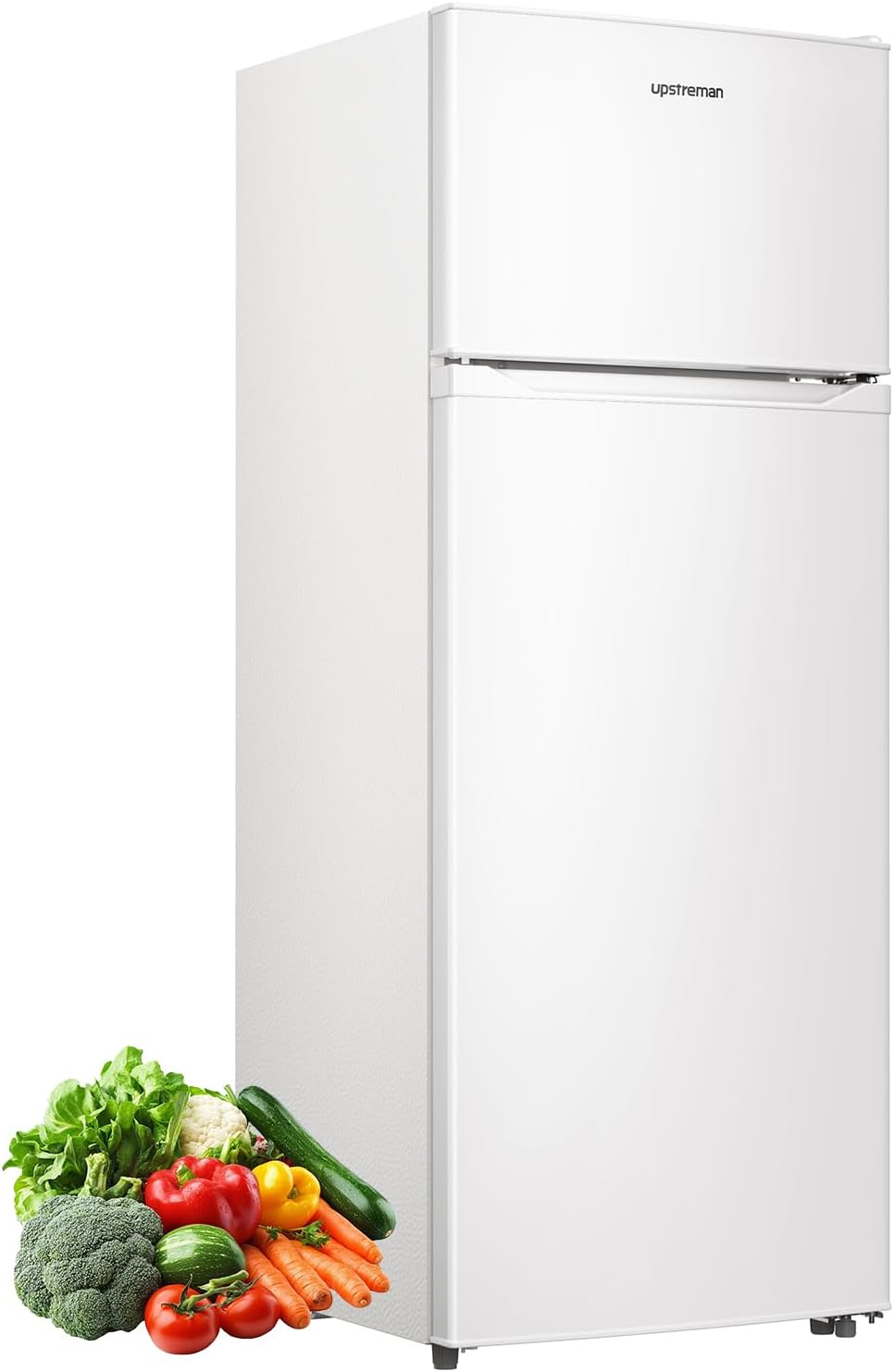
The Upstreman 7.7 cu ft refrigerator is a compact two-door fridge intended for apartments, dorms, or small-family kitchens where floor space is limited but storage matters. It pairs a 1.5 cu ft top freezer with a 6.2 cu ft fresh-food compartment, two tempered glass removable shelves, and a crisper drawer so you can reorganize shelves to fit taller items or groceries for several days. Temperature is set manually with five adjustable settings for both fresh and freezer zones, and an automatic interior light helps when loading. The unit uses a compressor cooling method designed to be energy efficient and runs quietly, which is helpful in open-plan living areas. Practical limitations include manual defrosting and no electronic controls or smart features, so expect some occasional maintenance and manual temperature tweaks. The reversible door and freestanding design make placement flexible, but buyers who need precise temperature control or a frost-free freezer should consider higher-end models instead.
Best for: Buyers wanting a straightforward, low-complexity refrigerator that maximizes storage in a small footprint and prioritizes quiet, energy-efficient daily use.
Less Ideal for: Households that need frost-free operation, precise digital temperature control, or large freezer capacity for bulk freezing.
- Compact footprint with relatively large 7.7 cu ft total capacity for small spaces
- Removable tempered glass shelves and crisper drawer allow flexible organization
- Reversible door and freestanding design support varied kitchen layouts
- Energy efficient compressor operation with low reported noise level
- Manual defrost freezer requires periodic maintenance to remove frost buildup
- No electronic thermostat or smart features for precise remote control
Verdict: A practical, quiet, and energy-efficient compact two-door refrigerator that gives small families useful storage without complex features.
Choosing the Right Refrigerator for Small Families: Key Factors to Consider
Usable Capacity Versus Rated Volume
Manufacturers report gross volume, but effective space depends on shelf layout, door bins, and compressor housing. For a small family, look for shelving arrangements that allow stacking of meal containers, upright storage for tall bottles, and wide drawers for produce. Consider how much of the stated capacity is actually convenient to use for everyday items.
If you primarily store fresh food rather than bulk frozen goods, prioritize fresh compartment usable height and adjustable shelves. Shelving that adjusts in small increments helps you adapt the interior to shifting needs, from baby food jars to pizza boxes. Remember that capacity needs change over time, so opt for a layout that can be reconfigured rather than a fixed arrangement.
Freezer Configuration and Accessibility
Freezer layout matters as much as freezer size. A drawer-style freezer provides easier access to frequently used items and reduces time with the door open, which helps maintain temperature and efficiency. Upright freezers with multiple shelves can be better for organized long-term storage but may hide smaller items in corners.
Think about how your household uses frozen foods. If you rely on ready meals and ice packs, easy-access drawers and clear bins reduce rummaging. If you freeze bulk items occasionally, a simple vertical shelf layout might suffice. Consider whether a split freezer arrangement or a bottom-mount freezer better suits your typical retrieval patterns.
Energy Use and Running Costs
Initial purchase cost is only part of ownership expense. Annual energy consumption varies widely across models and has a direct impact on utility bills. For small households, efficient compressors and good insulation can offer meaningful savings over the appliance lifetime. Look for clearly stated annual energy usage or efficiency ratings and compare models by that metric rather than only by sticker price.
Energy-efficient machines often include variable-speed compressors, better door seals, and smarter defrost cycles. These features help maintain steady temperatures with less cycling. If your kitchen is warm or you frequently open the door, prioritize insulation and efficient cooling to avoid higher running costs.
Interior Organization and Storage Flexibility
Adjustable shelving, convertible bins, and flexible door storage let you adapt the refrigerator to changing needs. For small families, look for features like split shelves, deli drawers, and dedicated produce drawers with humidity control. Clear bins improve visibility and reduce food waste by making items easy to find.
Well-designed door bins are particularly valuable in narrow kitchens since they increase usable storage without expanding external dimensions. Consider removable or modular elements that are dishwasher-safe for easier cleaning and maintenance.
Physical Fit and Installation Requirements
Measure the installation space carefully, including door swing and clearance for ventilation. Refrigerators need extra room at the back and sides for airflow and to allow door opening without obstruction. For apartments or small kitchens, narrower widths and shallower depths can be more practical even if they reduce gross capacity.
Also consider delivery and installation constraints like elevator dimensions or tight stairwells. Some models require a dedicated electrical circuit or specific outlet placement. Ensuring the unit can be moved into place and installed without modification will save time and cost.
Temperature Control and Food Safety
Precise temperature control keeps perishables safe and extends shelf life. Look for reliable temperature settings, a clear display, and the ability to isolate compartments for different storage needs. For small households that shop weekly, consistent cold performance prevents early spoilage and reduces waste.
Additional features like rapid-cool modes or independent zone controls are useful when you need to chill a lot of groceries quickly after a shopping trip. Avoid units with poor temperature consistency or large fluctuations when the door opens frequently.
Sizing Advice for Small Kitchens
When space is at a premium, focus on internal layout and footprint rather than raw liters or cubic feet. Narrower models with clever shelf arrangements can outperform wider units that waste space behind fixed components. Check the door swing direction and whether reversible doors are offered to ensure the unit fits your kitchen traffic patterns.
Depth matters as much as width. Counter-depth or shallow-depth refrigerators sit flush with cabinetry and free up aisle space. If you cook often in a compact kitchen, a shallower unit may improve workflow despite offering a bit less total volume.
- Measure width, depth, height, and door clearance before shopping
- Prefers units with reversible doors for more installation flexibility
- Consider counter-depth designs to maintain kitchen circulation
Organizing Food for Weekly Shopping
Small families often rely on a single weekly shopping trip. Plan your fridge layout to keep staples visible and accessible. Use clear bins or labeled sections for meal components and snacks so nothing gets lost at the back of shelves.
Designate zones for dairy, produce, ready-to-eat items, and leftovers. Pull-out drawers help keep produce crisp and make it easier to rotate perishable items before they spoil.
- Keep frequently used items at eye level
- Store raw meat on the lowest shelf to avoid cross-contamination
- Use stackable containers that fit shelf heights to maximize vertical space
Maintenance and Longevity
Regular cleaning of coils, door seals, and drip trays prolongs service life and maintains efficiency. Small households may neglect defrosting or clearing vents, which reduces cooling performance over time. Schedule simple monthly checks to remove spills and inspect seals.
Replacing water filters on schedule and cleaning removable bins prevents odors and bacterial buildup. Routine care is a low-cost way to extend the time between major repairs or replacement.
- Clean door gaskets and interior shelves monthly
- Vacuum condenser coils every 6 to 12 months if accessible
- Check temperature settings quarterly and adjust seasonally
Noise and Placement Considerations
In open-plan living spaces a refrigerator might be heard in work and leisure areas. Look for models with low decibel ratings and variable-speed compressors that reduce cycling noise. Placement away from seating and sleeping zones helps minimize disturbance.
Leveling and proper installation reduce vibration and rattles. Ensure the unit stands on a stable surface and that any adjacent cabinets do not amplify sound.
- Aim for the quietest model you can reasonably fit in your kitchen
- Leave a small gap between the fridge and cabinetry to prevent resonance
- Test door close and drawer slides during installation to catch issues early
Energy Tips for Small Households
Set temperatures to recommended ranges rather than very cold settings to save energy. Avoid leaving the door open while searching for items by organizing similar foods together. Use the fridge rather than a cooler for long-term cold storage to reduce repeated chill cycles from ice packs and coolers.
If you mostly use the fridge for fresh food, favor models with better fresh compartment efficiency over oversized freezers. Small households can also benefit from energy-saving modes and vacation settings when away for extended periods.
- Keep the fresh compartment between 37 and 40 degrees Fahrenheit
- Defrost manual-freeze models before ice buildup exceeds 1/4 inch
- Allow hot foods to cool before placing them in the fridge to reduce workload
How We Chose the Best Refrigerator for Small Families
We focused on features that matter most to households with two to four people. Our selection filters prioritized usable fresh and frozen capacity, energy consumption ratings, and interior organization that supports small-batch shopping and meal prep. Noise levels and reliability expectations were considered so the unit can live comfortably in open-plan or compact kitchens. We also looked for flexible shelving and door-storage options that maximize usable volume without increasing external footprint. Excluded from consideration were units designed primarily for single-person dorm or micro-kitchen use, and heavy-duty commercial machines intended for constant high-volume use. We did not include specialty refrigeration like wine coolers or outdoor units. Final selections were guided by measurable specs and real-world usability features: rated capacity and usable shelf height, annual energy usage, temperature control precision, layout flexibility, and noise output. These evaluation dimensions align directly with the scoring criteria used for each pick.
Our full evaluation process is outlined in our review methodology.
FAQ
What refrigerator capacity is best for a family of three?
A family of three typically needs a medium capacity unit that prioritizes usable fresh compartment space. Look for models that provide flexible shelving and drawers rather than focusing solely on a high gross volume number.
Is a bottom-freezer or top-freezer better for small families?
Bottom freezers put fresh food at eye level, which is convenient if you access refrigerated items more often. Top freezers can be more space efficient. The best choice depends on whether you use the fresh compartment or freezer more frequently.
How important is energy efficiency for a small household?
Energy efficiency impacts long-term operating costs and is especially important if the fridge runs constantly in a small home. Efficient compressors and good insulation reduce electricity use and can offset higher upfront costs over time.
Can I install a full-size refrigerator in a compact kitchen?
You can if you measure carefully and consider door swing and ventilation clearances. In many compact kitchens, a counter-depth or narrower model provides a better fit and keeps traffic flow open.
How often should I clean and maintain my refrigerator?
Perform light cleaning monthly, including wiping shelves and checking seals. Vacuum coils and inspect vents every 6 to 12 months. Regular maintenance prevents efficiency losses and extends service life.
Final Verdict
For small families, prioritize usable fresh capacity, flexible interior organization, and energy efficiency over the largest possible gross volume. Decide which compartment you use most often and choose a layout that makes those items easy to access while fitting your kitchen footprint. Balance the tradeoffs between freezer accessibility, noise, and running costs. With careful measurement and attention to the features discussed above, you can select a refrigerator that keeps food fresh, minimizes waste, and fits smoothly into your daily routine.