
Note: This article contains affiliate links. If you click on these links and make a purchase, we may earn a small commission at no extra cost to you. This helps support our research and content. Read our full affiliate disclosure here.
A reliable dehumidifier for basements can prevent musty odors, slowdown mold growth, and protect stored items and finished spaces. Basements are often the most humid areas in a home, and choosing equipment that can handle cooler temperatures, continuous operation, and larger volumes of air matters for long-term performance. This guide highlights the top shortlisted dehumidifiers built for basement use and explains the criteria we used to evaluate them. You will get clear guidance on capacity, energy use, and installation considerations so you can pick a model that keeps your basement consistently comfortable. Read on for the factors we tested and why each item made the list.
Top Picks at a Glance
| Best Overall The best all-around choice for most situations | Waykar 80-Pint Dehumidifier JD025CE-80 |  |
| Best Quality Built to a higher standard if you want something more solid | AEOCKY RHEA-002 Dehumidifier |  |
| Best Value The sweet spot between price and what you get | AEOCKY LEO-Lite 74 Pint Dehumidifier |  |
| Best Budget The cheapest option that still gets the job done reliably | HUMILABS 21-Pint Dehumidifier |  |
| Top Rated A top-rated pick with lots of positive feedback | hOmeLabs 50 Pint Dehumidifier | 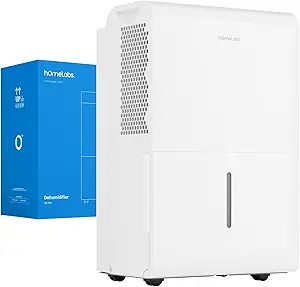 |
Waykar 80-Pint Dehumidifier JD025CE-80

| Dehumidification Capacity | 80 pints_per_day |
|---|---|
| Tank Volume | 2.5 gallons |
| Wattage | 270 watts |
| Air Flow Capacity | 165 cfm |
| Operation Mode | Continuous |
The Waykar 80-Pint Dehumidifier is built to handle large, damp areas such as basements by extracting up to 80 pints per day and offering both tank and continuous drain options. It is commonly used running continuously or on a timed schedule to bring basement humidity down to a selected setpoint between 30% and 80% relative humidity, and the 90° auto-swing helps spread airflow for more even drying. Practical features include an included drain hose and connector for gravity drainage, a washable removable filter, automatic defrost and overload protection for low-temperature reliability, and an Energy Star rating to keep running costs lower than noncertified units. At roughly 42 dB it is quieter than many similarly sized machines, making it reasonable for finished basements or nearby living areas. The unit is relatively heavy and targeted at larger spaces, so it is less convenient to move frequently, and the 1.14 gallon tank means emptying is still needed if you do not use continuous drainage. For buyers focused on dependable basement performance and energy efficiency, this model delivers strong moisture removal with sensible protections for extended operation.
Best for: Homeowners who need a reliable, high-capacity dehumidifier to control moisture in large basements and prefer proven features and energy efficiency over portability.
Less Ideal for: People looking for a lightweight, highly portable unit for small rooms or occasional use should consider smaller, easier-to-move models instead.
- High dehumidification capacity rated at 80 pints per day for large basements
- ENERGY STAR certification for better energy efficiency during extended use
- Multiple drainage options with included drain hose for continuous gravity drain
- Auto-defrost and overload protection improve reliability in cool basement conditions
- 90° auto-swing airflow and washable filter help distribute air and simplify maintenance
- Relatively heavy and sized for large spaces, so not ideal for frequent transport
- Water tank is modest at 1.14 gallons if continuous drainage is not used
Verdict: A powerful, Energy Star certified 80‑pint unit that reliably handles large basement humidity with continuous drain and protective auto-defrost features.
AEOCKY RHEA-002 Dehumidifier

| Capacity | 105 pints |
|---|---|
| Dehumidification Capacity | 100 pints_per_day |
| Tank Volume | 1.45 gallons |
| Wattage | 400 watts |
| Operation Mode | Auto Mode, Constant Humidity Mode, Continuous Mode, Smart Drying Mode, Sleep Mode |
The RHEA-002 is a performance-first compressor dehumidifier built to remove large volumes of moisture from basements and big rooms. It claims up to 105 pints per day under extreme conditions and continues to extract moisture effectively in cooler basement temperatures thanks to an automatic defrost system. Controls include adjustable humidity set points, multiple operation modes (auto, constant humidity, continuous, smart drying, and sleep), a child lock, timer and fan speed control, and it includes a drain hose and garden-hose adapter for continuous drainage. The unit emphasizes energy efficiency with an ENERGY STAR Most Efficient 2024 rating and a 400-watt power draw, which should reduce runtime costs compared with standard compressors. Practical benefits for basement use are robust coverage for very large spaces, quieter operation at low fan speeds, and precise humidity management to prevent dampness and mold. Trade-offs to consider are the large water tank relative to capacity and the physical size typical of high-capacity compressors, so it needs space and a stable placement for continuous drainage to avoid manual emptying.
Best for: Buyers who prioritize raw moisture removal and energy efficiency for large or very damp basements and want a durable, quiet compressor unit that can run continuously.
Less Ideal for: People needing a compact, ultra-portable or low-capacity unit for small rooms or occasional use should consider smaller thermoelectric or lower-capacity models instead.
- Very high reported dehumidification capacity (up to 105 pints/day) suitable for very damp basements
- ENERGY STAR Most Efficient 2024 certification for lower energy consumption versus typical units
- Automatic auto-defrost allows continued operation in cooler basement temperatures
- Multiple modes and precise humidity control for tailored, long-running basement use
- Includes drain hose and garden-hose adapter for continuous drainage
- Large-capacity compressor design requires significant floor space and a stable placement
- Water tank size requires use of continuous drain for heavy loads to avoid frequent emptying
Verdict: Choose the RHEA-002 when you need top-tier, energy-efficient moisture removal for large or problem basements and want continuous, quiet operation with precise humidity control.
AEOCKY LEO-Lite 74 Pint Dehumidifier

| Capacity | 74 pints per day |
|---|---|
| Tank Volume | 1.45 gallons |
| Floor Area | 4500 square_feet |
| Operation Mode | Auto |
| Other Special Features of the Product | Timer |
The AEOCKY LEO-Lite is a high-capacity compressor dehumidifier built for large, damp spaces like basements. It removes up to 74 pints per day under peak conditions and uses a rotary compressor and a 3+2 evaporator/condenser layout to prioritize efficiency while keeping noise low. Controls include an intelligent humidistat with fast humidity sensing, an auto mode and timer, plus power-off memory for automatic recovery after outages. A 1.45 gallon tank and included drain hose let you choose between emptying the tank or continuous drainage. The unit meets ENERGY STAR Version 6.0 efficiency standards, so it runs more economically than many older basement models and includes an auto-defrost system to keep working in cooler basement temperatures. It is fairly quiet at low speed and is aimed at continuous or near-continuous operation for moisture control. Trade-offs are its single-speed fan control and relatively large footprint compared with tiny portable units, so it is best where sustained extraction and energy savings outweigh simple portability.
Best for: Buyers who want an efficient, high-capacity dehumidifier to control persistent basement humidity and reduce energy use over long runtimes.
Less Ideal for: If you need a lightweight, highly portable unit for small rooms or infrequent use, a compact low-capacity dehumidifier is a better fit.
- High dehumidification capacity rated at 74 pints per day for heavy basement humidity
- ENERGY STAR Version 6.0 rating for improved seasonal energy efficiency
- Auto-defrost keeps the unit operating in cool basement temperatures
- Included drain hose plus 1.45 gallon tank enables continuous drain or manual emptying
- Quiet operation for its class thanks to rotary compressor and low fan noise
- Single speed setting limits fine-grained control of airflow and sound
- Relatively large and heavier than compact room dehumidifiers
Verdict: Choose the LEO-Lite when you need a quiet, energy-efficient, high-capacity dehumidifier built to run continuously in a basement.
HUMILABS 21-Pint Dehumidifier

| Dehumidification Capacity | 21 pints/day |
|---|---|
| Coverage | Up to 1,600 sq.ft |
| Wattage | 240 watts |
| Tank Volume | 0.37 gallons |
| Operation Modes | Comfort, Continuous, Standard |
This compact HUMILABS dehumidifier removes up to 21 pints of moisture per day and is built for everyday basement and room use. It offers three modes (Sleep, Dry, Auto) so you can run quietly at night, speed up laundry drying, or let the unit maintain a target humidity automatically. You get both a removable 1.7 L tank with full-auto shutoff and a supplied drain hose for continuous drainage when you need unattended operation. Practical controls include a top-mounted LED touch panel, a washable filter, child lock, timer and auto-restart after power loss. The unit emphasizes portability with a hidden handle and detachable caster wheels, and it runs on an energy-conscious 240 W compressor using R290 refrigerant. Expect a low-noise floor option (about 37 dB) that is suitable for sleeping areas, but note the 21-pint capacity is aimed at small-to-medium damp spaces rather than very large or extremely wet basements needing heavy commercial extraction.
Best for: Buyers who want a practical, energy-conscious dehumidifier for basements or large rooms that balances decent moisture removal with quiet operation and easy maintenance on a budget.
Less Ideal for: Homes with very large or severely waterlogged basements that require industrial-grade extraction or continuous high-capacity dehumidification.
- Removes up to 21 pints per day suitable for basements and large rooms
- Quiet sleep mode down to about 37 dB for bedroom or overnight use
- Dual drainage with included hose plus a removable tank and auto shutoff for flexible unattended operation
- Top LED touch panel, timer, child lock and washable filter make operation and maintenance straightforward
- Portable design with hidden handle and detachable caster wheels for easy relocation and storage
- 21-pint capacity and 0.37 gallon tank limit runtime between empty cycles in very damp environments
- 240 W compressor adequate for home use but not designed for heavy commercial dehumidification
Verdict: A budget-friendly, quiet 21-pint dehumidifier that delivers versatile drainage and modes for basement use without the cost or power of commercial units.
hOmeLabs 50 Pint Dehumidifier
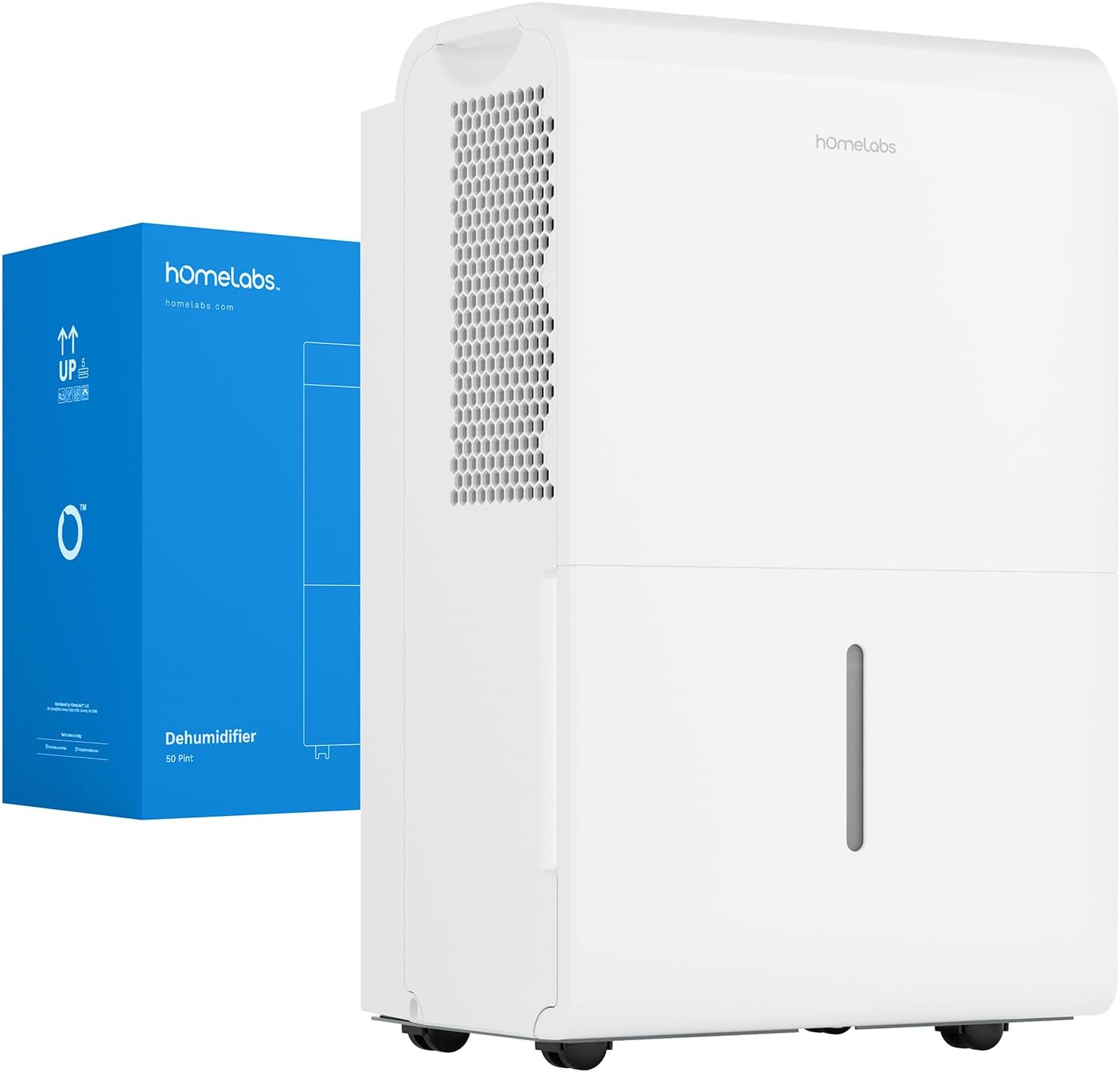
| Dehumidification Capacity | 50 pints per day |
|---|---|
| Floor Area | 7000 square_feet |
| Capacity | 1.6 gallons |
| Wattage | 322 watts |
| Air Flow Capacity | 165 cfm |
This hOmeLabs dehumidifier is built to remove moisture from large areas and is targeted at basements and other damp rooms. It can extract up to 50 pints per day under standard conditions and up to 120 pints at very high heat and humidity, and it offers continuous operation with an automatic shutoff when the 1.6‑gallon tank is full or the option to use a drain hose for uninterrupted use. The unit includes Wi‑Fi control for remote adjustments, a touch control panel, two fan speeds including a Turbo mode for faster removal, and a washable filter for simple maintenance. Practical touches like caster wheels, built‑in handles, automatic defrost and restart after power interruption make it straightforward to move and keep running in basement settings. The trade offs are typical for a high‑capacity condenser dehumidifier: it is a substantial appliance and consumes several hundred watts while running, and continuous drainage requires a hose and a suitable drain point. For buyers who want steady, hands‑off humidity control in a basement, this model delivers reliable, easy operation.
Best for: Buyers who prioritize steady, low‑maintenance humidity control in basement or large damp spaces and want features that keep the unit running reliably with minimal intervention.
Less Ideal for: People needing a lightweight, ultra‑compact dehumidifier for a single small room or those without access to a nearby drain for continuous operation.
- High removal capacity rated at 50 pints per day (up to 120 pints in extreme conditions)
- Wi‑Fi remote control and touch panel for convenient monitoring and adjustments
- Continuous drainage option plus 1.6‑gallon removable tank with auto shutoff
- Features for reliable operation including automatic defrost, automatic restart, and washable filter
- Portable design with wheels and handles for easy placement in basements
- Consumes several hundred watts during operation which increases energy use
- Relatively heavy and large compared with small room dehumidifiers
- Continuous drainage requires supplying a hose and drain location
Verdict: A high‑capacity, feature‑rich dehumidifier that provides dependable, low‑maintenance moisture control for basements and large damp spaces.
Choosing the Right Reliable Dehumidifier for Basements: Key Factors to Consider
Extraction Capacity
Extraction capacity measures how many pints of water a dehumidifier can remove from the air in 24 hours. For basements you will typically need higher-capacity units because these spaces are larger, cooler, and more prone to persistent humidity. Choosing a unit with adequate capacity prevents the machine from running constantly at maximum output, which can shorten component life and increase energy use.
When sizing a dehumidifier, consider the square footage, ceiling height, and how damp the space gets. A larger rated capacity also gives headroom during humid seasons and makes units better at reducing relative humidity quickly after events like heavy rain or a flood.
Performance at Low Ambient Temperatures
Basements are often colder than the rest of the house, and not all dehumidifiers maintain rated extraction at low temperatures. Look for models that specify performance or include features such as auto-defrost or low-temperature coils. These features keep the unit running efficiently when the room is near or below typical indoor temperatures.
Without proper low-temp performance, a dehumidifier can ice up, stop extracting effectively, or cycle excessively. That leads to inconsistent humidity control and may require manual defrosting or extra maintenance.
Drainage and Collection Options
How a dehumidifier handles condensate matters for convenience and suitability in a basement. Units with large removable buckets are fine for infrequent monitoring, but a basement often benefits from continuous drainage via a gravity drain or pump-assisted output. Continuous drainage reduces the need to empty a tank and supports long unattended runs.
Consider the layout of your basement and the nearest drain location. A built-in pump can route water to a higher drain point, while gravity-fed lines require the unit to be positioned below the drain. Also check for clear overflow sensors and easy-to-access fittings to simplify setup and winter storage.
Durability and Corrosion Resistance
Dehumidifiers in basements operate in damp environments where metal parts and coils are exposed to moisture for long periods. Durable construction, corrosion-resistant coatings, and robust casings extend service life and reduce the chance of refrigerant leaks or structural failure. Components like stainless fasteners, coated coils, and reinforced drain ports help the unit withstand continuous duty.
Durability also affects maintenance frequency. Heavier-duty units may cost more initially but can save time and repair costs by resisting rust and wear during regular operation.
Noise Level and Vibration
Basement dehumidifiers often run constantly or for long daily cycles, so noise and vibration are important for comfort. A quieter unit is preferable when the basement is adjacent to living spaces, used as a home office, or hosts a bedroom above. Look for models that list operational decibel levels and include vibration-dampening feet or internal mounting that reduces motor noise.
Beyond comfort, lower vibration also reduces wear on internal parts and prevents the unit from shifting position over time, which can affect drainage and stability.
Controls, Monitoring, and Serviceability
Ease of use and maintenance are important for equipment that may be checked infrequently. Look for clear digital humidity controls or reliable humidistats, programmable timers, and visible tank indicators. Removable wash filters and accessible panels make routine cleaning straightforward, which maintains airflow and extraction efficiency.
Also consider how easy it is to service components like coils, fans, and electrical controls. Units with modular parts or straightforward access reduce downtime and make repairs less costly when professional service is required.
Basement Sizing and Unit Selection
Matching a dehumidifier to your basement starts with an honest assessment of space and moisture load. Measure square footage, estimate ceiling height, and note whether the area is finished, partially finished, or used for storage. Basements with frequent water exposure or attached crawlspaces will need a higher-capacity unit than a rarely damp finished room.
After sizing, translate that requirement into a unit whose extraction capacity leaves headroom for peak humidity events. Avoid undersized machines that will run continuously, and remember that real-world extraction can be lower than rated values at cooler temperatures unless the unit is specified for low-temp operation.
- Measure floor area and ceiling height to estimate volume
- Factor in moisture sources like laundry, plumbing, and groundwater
- Choose capacity with extra headroom for peak conditions
Installation Tips for Reliable Operation
Placement affects performance. Position the unit centrally when possible, off the floor on a small platform or riser if flooding is a concern, and clear at least a foot of space around intake and exhaust. Avoid corners and tight enclosures that restrict airflow.
Ensure a proper drainage plan before installing. If using gravity drain, place the unit below the drain point and run a durable hose with a slight downward slope. When routing outdoors or across unfinished concrete, protect hoses from kinks and freezing if the basement gets cold in winter.
- Keep 12 inches clearance around the unit for airflow
- Use a pump or gravity drain depending on drain location
- Elevate the unit if the floor is prone to occasional flooding
Maintenance Routines That Extend Service Life
Regular maintenance keeps dehumidifiers running at rated performance. Clean or replace washable filters monthly during heavy use and inspect coils for dust buildup. Wipe down the tank and check seals around access panels to prevent leaks.
Schedule a seasonal inspection for units that run year-round. Check drain fittings, test auto-defrost cycles, and listen for unusual noises that signal fan or motor wear. Prompt attention to small issues helps avoid major repairs and preserves extraction efficiency.
- Clean filters monthly during peak use
- Inspect drain fittings and hoses periodically
- Run a seasonal check on defrost and electrical components
Energy Use and Operating Costs
While dehumidifiers provide clear benefits, energy consumption matters because basement units may run for long stretches. Look for models with energy-saving features such as auto-shutoff on reaching set humidity, low-power standby, or variable-speed fans. These features reduce runtime without sacrificing control.
Consider the expected duty cycle in your climate. In persistently humid regions a unit will run more often, which increases operating cost. Balancing extraction capacity against efficiency prevents oversizing that wastes electricity or undersizing that runs continuously.
- Prefer units with automatic humidity control and timers
- Estimate annual duty hours to forecast energy use
- Clean filters to maintain efficiency and airflow
Dehumidifier Safety and Winter Storage
Safety features such as overflow shutoff, grounded plugs, and tip-resistant housings reduce risk in basements that may be damp or subject to water intrusion. Verify appropriate electrical protection, especially when installing near laundry or sump pump systems.
If you plan to store the unit for winter, drain and dry the tank and hoses completely to prevent mold and freezing damage. Store in a dry place and run a brief cycle before redeployment to confirm everything functions normally.
- Confirm overflow protection and grounded power connections
- Drain and dry components before storage
- Test auto-defrost after storage to ensure low-temp reliability
How We Chose the Best Reliable Dehumidifier for Basements
We prioritized machines designed to perform reliably in basement environments rather than general-purpose household units. Selection began with products that specify dehumidification capacity at low ambient temperatures and include corrosion-resistant components for prolonged use in damp spaces. We also favored units with proven drainage options such as continuous drain ports and large detachable tanks to support both occasional and continuous operation. Concrete evaluation criteria included extraction rate at typical basement temperatures, energy efficiency during continuous cycles, build quality and materials resistant to rust and condensate damage, and serviceability including filter access and control simplicity. We excluded units intended only for small rooms or for short-term spot drying because they lack the capacity or durability required for full basement duty. The list also emphasizes units offering clear humidity controls and reliable safety features like auto-defrost and overflow protection. Finally, we considered noise levels during steady operation since basement equipment often runs continuously and may be located near living areas.
Our full evaluation process is outlined in our review methodology.
FAQ
How large a dehumidifier do I need for a finished basement?
It depends on square footage, ceiling height, and moisture level. For typical finished basements, choose a unit with enough daily extraction to reduce relative humidity below 50 percent, allowing extra capacity for occasional wet events.
Can I run a basement dehumidifier all year?
Often yes, especially in humid climates or unfinished basements. Continuous operation is fine if the unit is rated for low-temperature performance and has auto-defrost. Monitor energy use and adjust setpoints to balance comfort and cost.
Is a pumped drain necessary for a basement dehumidifier?
A pumped drain is necessary only if the nearest drain is located above the unit. If you can route a gravity drain to a lower floor drain or sump, a pump is not required. Pumps add convenience but also require occasional maintenance.
Will a dehumidifier prevent mold in my basement?
A dehumidifier reduces the relative humidity that supports mold growth, but it does not remove existing mold or correct active water leaks. Combine dehumidification with moisture control measures like fixing leaks, improving drainage, and increasing ventilation for best results.
What maintenance keeps a dehumidifier running well?
Regularly clean or replace filters, inspect and clear drain lines, and check for corrosion or unusual noises. Seasonal inspections of coils and controls help maintain extraction efficiency and avoid unexpected failures.
Final Verdict
Choosing a reliable dehumidifier for basements means balancing extraction capacity, low-temperature performance, and durable construction. Prioritize units that specify performance at cooler ambient conditions, offer practical drainage options, and include corrosion-resistant components for continuous operation. Decide based on the size and moisture profile of your space, and be prepared to maintain filters and drains to preserve efficiency. With the right priorities—capacity, durability, and serviceability—you can keep a basement dry and protected without constant intervention.