
Note: This article contains affiliate links. If you click on these links and make a purchase, we may earn a small commission at no extra cost to you. This helps support our research and content. Read our full affiliate disclosure here.
If your facility needs large-area floor care, selecting the right ride on floor scrubber changes how quickly and consistently floors get cleaned. You will care about runtime, scrubbing width, maneuverability, and how easy the machine is to maintain because they determine labor time and ongoing ownership effort. This guide covers six shortlisted ride on floor scrubbers that collectively represent the best options for commercial cleaning tasks. We evaluated machines on runtime, cleaning productivity, water and solution management, and serviceability to help you pick the one that fits your facility and staffing model. Read on for a concise breakdown of what matters and how to match a scrubber to your space.
Top Picks at a Glance
| Best Overall The best all-around choice for most situations | AIOLITH AF2225 22-Inch Floor Scrubber |  |
| Best Quality Built to a higher standard if you want something more solid | Dapper Supply Ride-On Floor Scrubber DP-RAFS1235 |  |
| Best Value The sweet spot between price and what you get | SUNMAX Ride-On Floor Scrubber RT70-Plus |  |
| Best Budget The cheapest option that still gets the job done reliably | TEXLIFT Ride-On Floor Scrubber US-TX-SCD22 | 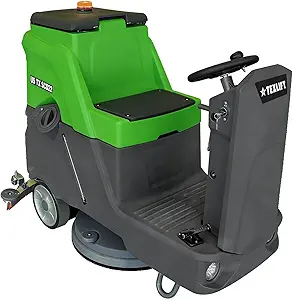 |
| Top Rated A top-rated pick with lots of positive feedback | Dapper Supply Ride-On Floor Scrubber |  |
| Most Popular A crowd favorite that many people choose with confidence | USA-Clean X26R Ride-On Scrubber |  |
AIOLITH AF2225 22-Inch Floor Scrubber

| Working Width | 22" |
|---|---|
| Solution Tank | 23 gal |
| Recovery Tank | 25 gal |
| Battery Type | 24V/100Ah lithium battery |
| Full Charging Time | 4 H |
The AIOLITH AF2225 is a micro ride-on floor scrubber that brings ride-on productivity into tighter spaces. It combines a 22" brush head with 88 lb brush pressure and a 550 W brush motor to deliver aggressive scrubbing on concrete, tile, sealed wood, and epoxy while a 500 W vacuum motor and angled squeegee recover water so floors are left dry in a single pass. Large 23-gallon solution and 25-gallon recovery tanks reduce refill/drain stops for long daily routes, and the included 24V/100Ah lithium battery offers maintenance-free operation with roughly 3.5–5 hours runtime and a 4-hour fast charge. The compact chassis and 48" turning radius make it usable in aisles, doorways, and elevators that larger ride-ons cannot access, and operator-facing features like LED headlights and simple controls keep training time short. Expect roughly 65–70 dB noise and a sturdy ABS body suited for frequent commercial use. Trade-offs include its substantial overall weight and size that require service access and storage planning, and it is overkill for very small facilities or occasional spot cleaning.
Best for: Facility managers who need a balance of cleaning power and maneuverability for daily routes across medium to large commercial spaces and want lower battery maintenance and longer cleaning runs.
Less Ideal for: Small businesses or janitorial teams that only need occasional spot cleaning or lack space and infrastructure to store and service a ride-on scrubber should consider lighter walk-behind units instead.
- Compact micro ride-on design for tight aisles and doorway/elevator compatibility
- High brush pressure and 550 W brush motor for deep scrubbing on multiple floor types
- Large 23 gal solution and 25 gal recovery tanks reduce refill interruptions
- 24V/100Ah lithium battery with maintenance-free operation and fast 4-hour charging
- Powerful vacuum and squeegee system that recovers water and leaves floors dry in one pass
- Heavy machine that needs adequate storage and lift/service planning
- Not suited for very small spaces or infrequent spot cleaning
Verdict: Choose the AF2225 when you need ride-on scrubber performance in tighter aisles with long run times and low battery maintenance.
Dapper Supply Ride-On Floor Scrubber DP-RAFS1235

| Power Source | Battery Powered |
|---|---|
| Speed | 6 miles_per_hour |
| Voltage | 24 volts_of_alternating_current |
| Maximum Power | 1200 watts |
This ride-on floor scrubber is built for large facilities that need continuous, high-output cleaning. It uses a 24V gel battery with about 5 hours runtime and an 8–10 hour charge window, letting operators cover wide areas without frequent refills thanks to a 38" scrubbing path and dual 46-gallon solution and 48-gallon recovery tanks. Twin 19" brushes driven at 180 RPM and a 48" squeegee provide aggressive scrubbing and effective water pickup, while a reported productivity of up to 84,000 sq ft per hour suits warehouses, retail floors, and large commercial spaces. The machine hits up to 6 mph and manages modest inclines, and its 70 dB operating level keeps noise down in occupied buildings. It is a heavy, aluminum-framed unit designed for durability and comes with a charger and replacement-part support. Important limits are its substantial weight and footprint, which require clear storage and transport plans, and the long recharge time if you need fully continuous operation across multiple shifts.
Best for: Buyers who prioritize high daily productivity and need a durable ride-on scrubber to cover large commercial or industrial floors with minimal downtime for refilling.
Less Ideal for: Small businesses, tight-storage sites, or operations that need frequent continuous multi-shift use without opportunity to recharge or swap batteries should consider smaller or battery-exchange options.
- Wide 38-inch cleaning path covers more floor per pass for faster area coverage
- Large dual tanks (46 gal solution, 48 gal recovery) reduce refill and dump interruptions
- Battery-powered with about 5 hours runtime supports long cleaning sessions without tethering
- Powerful dual 19-inch brushes and 48-inch squeegee deliver strong scrubbing and effective water pickup
- Relatively quiet 70 dB operation suitable for occupied commercial environments
- Heavy and large footprint requires appropriate storage and transport planning
- 8–10 hour recharge time limits immediate back-to-back shift use without spare batteries
Verdict: Choose this scrubber when you need a heavy-duty, high‑productivity ride‑on machine that covers large commercial floors efficiently.
SUNMAX Ride-On Floor Scrubber RT70-Plus

| Cleaning path | 22 inches |
|---|---|
| Squeegee width | 31 inches |
| Solution tank capacity | 18 gallons |
| Battery | 29.2V/100AH LiFePo4 |
| Charging time | 3.5 hours |
The SUNMAX RT70-Plus is a ride-on scrubber built to speed up routine cleaning in large facilities. It uses a 22-inch disk brush and a 31-inch squeegee to scrub and recover solution across wide swaths, and the dual 18.5-gallon solution and recovery tanks reduce refill frequency on long runs. A 29.2V/100AH LiFePo4 battery charges in about 3.5 hours and can run up to roughly five hours depending on duty cycle, letting crews cover extensive areas without frequent downtime. Controls are straightforward and the seated drive reduces operator fatigue for multi-hour shifts. The machine is engineered for commercial settings with a 0.7 HP brush motor, 200 RPM brush speed, and up to 48,000 sq ft per hour theoretical productivity. Practical limits include its weight and footprint, which make it a workshop-piece rather than something to move frequently between sites, and it requires basic maintenance of brushes, squeegee blades, and battery care. For facilities that need faster, more consistent cleaning than walk-behind units, this model delivers robust daily performance.
Best for: Facility managers who need to maximize daily cleaning output and reduce labor time in warehouses, schools, gyms, or retail spaces and prefer a durable ride-on machine that minimizes refill and charging interruptions.
Less Ideal for: Small businesses or locations with tight storage and frequent transport needs should consider smaller walk-behind scrubbers or portable alternatives.
- Wide 22-inch scrubbing path and 31-inch squeegee for fast coverage
- Large 18.5-gallon solution and recovery tanks reduce refill interruptions
- Fast-charging LiFePo4 battery with about 3.5-hour full charge and long run time
- Ride-on design reduces operator fatigue and speeds multi-hour cleaning
- Commercial-grade brush motor and brush pressure designed for consistent soil removal
- Heavy and bulky, not convenient for frequent transport between sites
- Requires regular maintenance of brushes, squeegee blades, and battery to retain performance
Verdict: Buy this if you need a durable ride-on scrubber that dramatically speeds cleaning of large indoor floors while reducing refill and downtime.
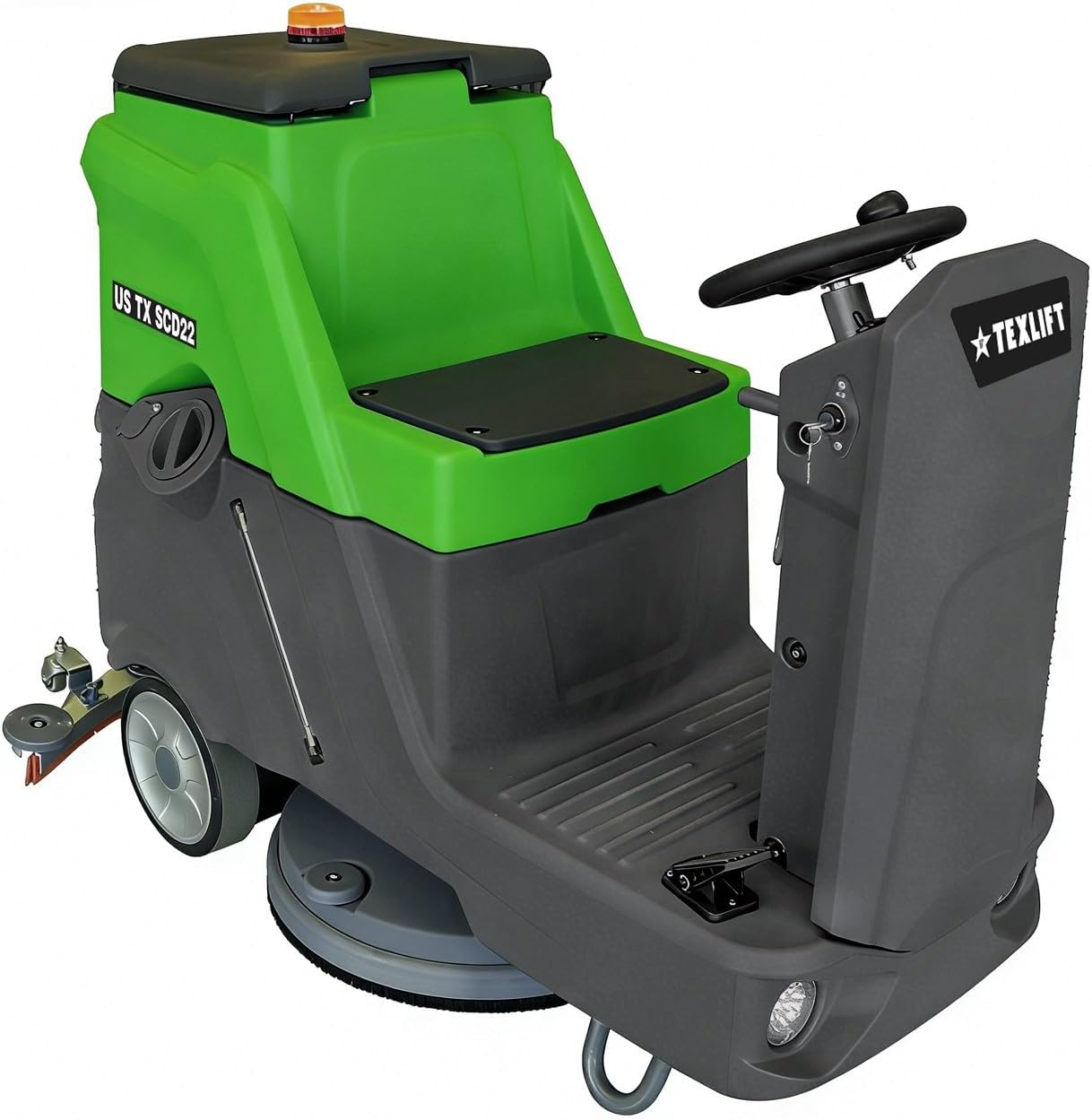
TEXLIFT Ride-On Floor Scrubber US-TX-SCD22
| Power Source | Battery Powered |
|---|---|
| System Voltage | 24V (2 × 12V / 100Ah) |
| Cleaning Path Width | 22 inch |
| Clean Water Tank | 21 gal |
| Dirty Water Tank | 24 gal |
The TEXLIFT US-TX-SCD22 is a ride-on scrubber dryer built for large indoor spaces where coverage and uptime matter. It scrubs and recovers in one pass using a 22-inch brush path, a wide 31-inch squeegee, and a powerful brush motor with strong brush pressure so floors are left clean and nearly dry immediately. The 24V battery system (two 12V/100Ah batteries) provides 2–4 hours of runtime and charges in 6–8 hours, letting crews work cord-free across warehouses, retail floors, gyms, and schools. Large 21-gallon clean and 24-gallon recovery tanks reduce refill and dump interruptions, and the machine claims up to about 62,431 sq ft/hr productivity at speeds up to 6 km/h. Practical benefits include low noise (≤60 dBA) for daytime cleaning and ride-on ergonomics to reduce operator fatigue. Important limitations for budget buyers are the machine weight and footprint that complicate delivery and storage and the need to budget for heavy batteries and periodic brush and squeegee replacement; charging time also means planning shifts around available runtime.
Best for: Facility or operations managers seeking a cost-conscious, productivity-focused ride-on scrubber for regular cleaning of large indoor areas who prioritize uptime and low-noise daytime operation.
Less Ideal for: Small businesses with limited storage, infrequent cleaning needs, or tight budgets for batteries and maintenance should consider smaller walk-behind models instead.
- Large clean (21 gal) and recovery (24 gal) tanks reduce refill and dump frequency
- Ride-on design and variable speed up to 6 km/h increase daily coverage and reduce operator fatigue
- Cordless 24V battery system enables emission-free, quiet operation suitable for occupied buildings
- Integrated scrub-and-recover one-pass cleaning with a wide squeegee speeds up floor maintenance
- Heavy and bulky, which makes delivery, storage, and maneuvering in tight backrooms more difficult
- Requires substantial battery investment and long charge time (6–8 hours) relative to runtime
Verdict: An efficient, low-noise ride-on scrubber that maximizes cleaning productivity for large indoor facilities while keeping operational costs reasonable for budget-focused buyers.
Dapper Supply Ride-On Floor Scrubber

| Power Source | Battery Powered |
|---|---|
| Speed | 200 rpm |
| Voltage | 110 volts_of_alternating_current |
| Material Type | Aluminum |
This ride-on floor scrubber is built for large commercial spaces and heavy daily use. It cleans with a 22-inch brush and a 31.5-inch squeegee, giving a wide coverage that helps reduce pass time on warehouses, malls, hospitals, and schools. The machine claims up to 48,400 sq ft per hour and uses a dual-tank system to separate clean solution and recovery fluid, so operators spend less time refilling and emptying. Battery runtime is listed at roughly 3 to 4 hours with a 7 to 8 hour recharge cycle, which suits multi-shift facilities if you can schedule charging between shifts. At about 60 dB it runs quietly enough for noise-sensitive environments, and safety features like front and rear lights plus a backup alarm aid visibility and on-site safety. The unit is aluminum-bodied for durability and handles inclines up to 20 degrees, but it is a heavy, full-size commercial machine that requires storage space and occasional maintenance. A one-year warranty and access to replacement parts support long-term reliability.
Best for: Facilities managers who need a durable, factory-quality ride-on scrubber that covers large areas efficiently and prioritizes dependable runtime and support.
Less Ideal for: Small businesses or occasional users who lack space for a full-size machine or do not need industrial-level productivity should consider smaller walk-behind models.
- Wide 22-inch scrub path and 31.5-inch squeegee cover large floor areas quickly
- High stated productivity up to 48,400 sq ft per hour for commercial schedules
- Battery runtime of 3–4 hours supports extended cleaning without cord management
- Quiet 60 dB operation suitable for noise-sensitive locations
- Built-in lights and backup alarm improve safety during operation
- 7–8 hour charge time requires planning or spare batteries for continuous use
- Large, heavy commercial unit needs significant storage and occasional maintenance
Verdict: Buy this scrubber if you need a robust, battery ride-on that reliably cleans very large commercial spaces with minimal passes.
USA-Clean X26R Ride-On Scrubber

| Power Source | Battery Powered |
|---|---|
| Tank Volume | 25 gallons |
| Solution Tank | 22 gallons |
| Maximum Pressure | 110 psi |
The X26R is a heavy-duty ride-on floor scrubber built to cover large commercial spaces quickly. It uses a 26-inch cleaning path with a cast aluminum squeegee and ride-on controls, so a single operator can clean wide aisles in warehouses, shopping centers, schools, or hotels. Large tanks (22-gallon solution, 25-gallon recovery) let operators work for extended periods between refills and emptying, and the battery power plus quiet operation make it suitable for daytime or low-noise environments. Ergonomic seating and a headlight improve operator comfort and visibility during longer shifts. The machine is factory-tested and supplied with batteries included, which reduces setup work, but its substantial weight and industrial size mean it is intended for commercial facilities rather than small businesses or home use. Expect routine maintenance and space for storage and charging in your facility when deploying this model.
Best for: Facility managers or cleaning crews who need a durable ride-on scrubber to cover large indoor commercial areas efficiently and prioritize uptime and operator comfort.
Less Ideal for: Small businesses, residences, or locations without space for charging, storage, and routine industrial maintenance should look at walk-behind or smaller scrubbers instead.
- Large 26-inch cleaning path covers wide areas quickly
- Big solution and recovery tanks (22 gal and 25 gal) reduce refill frequency
- Battery-powered for cord-free operation and quieter cleaning
- Ergonomic ride-on design with headlight improves operator comfort and visibility
- Very heavy and large, requiring dedicated storage and handling
- Designed for industrial/commercial sites, not suitable for small or residential spaces
Verdict: Buy this if you need a factory-tested, battery ride-on scrubber that covers large commercial floors with long run times and operator comfort in mind.
Choosing the Right Ride on Floor Scrubber: Key Factors to Consider
Battery Runtime and Recharge
Battery runtime directly affects how much floor area a ride on floor scrubber can cover before downtime. For larger facilities, longer runtime reduces the number of interruptions for recharging and allows a single operator to complete scheduled shifts more reliably.
Recharge time and charging method also matter because faster recharge or opportunity-charging capability can improve effective utilization. Consider whether your operation can support battery swap strategies or dedicated charging windows and whether the scrubber uses flooded lead-acid, AGM, or lithium batteries, since chemistry impacts lifecycle and maintenance needs.
Cleaning Width and Productivity
Scrubbing width determines the swath cleaned per pass and has a direct, calculable impact on square feet cleaned per hour. Wider decks cover more area but can make tight-space navigation harder.
Match deck width to the layout of your facility. Large open floor plans benefit from wider scrubbers, while facilities with aisles, columns, or frequent obstacles may gain better throughput from a narrower, more maneuverable machine.
Recovery System and Water Management
Recovery tank capacity and vacuum performance control how often an operator must stop to empty dirty water. A larger recovery tank reduces interruptions but adds weight and may affect handling.
Solution tank capacity and the precision of chemical dosing influence cleaning effectiveness and operating cost. Efficient water pickup and good squeegee design reduce streaking and speed up floor dry time, which is important for safety and minimizing rework.
Maneuverability and Operator Controls
A scrubber that is easy to steer and offers intuitive controls reduces operator training time and fatigue. Features such as tight turning radius, adjustable steering effort, and ergonomic seating matter for long shifts.
Consider visibility from the operator position and simple control layouts for on-the-fly adjustments of brush pressure, solution flow, and vacuum. Safety features like automatic parking brakes and emergency stop controls are important in busy environments.
Serviceability and Parts Access
Downtime erodes the productivity gains of a ride on scrubber, so ease of service is a practical buying consideration. Machines that allow quick access to batteries, pumps, motors, and squeegee components make routine maintenance faster and less likely to be postponed.
Check for modular components, common service parts, and clear indicators for wear items. Also consider the availability of replacement squeegees, brushes, and filters since those items wear with regular use and affect long-term operating cost.
Durability and Frame Construction
Build quality determines how well a scrubber withstands daily commercial use. A robust frame, corrosion-resistant tanks, and protected wiring reduce unexpected failures in harsh cleaning environments.
Heavier-duty construction can increase initial weight but usually correlates with longer service life and fewer repairs. Consider the expected duty cycle and match the machine build to your workload intensity.
Sizing the Machine to Your Facility
Estimate the square footage you need to cover per shift and then match that to expected runtime and cleaning width. Multiply scrubber swath width by practical travel speed to calculate theoretical coverage in square feet per hour, and then apply a 25 to 40 percent reduction to account for turns, obstacles, and transit time between zones.
For multi-shift operations, factor in charging windows or battery swap plans. Smaller facilities with frequent obstructions should prioritize maneuverability over maximum swath, while large warehouse floors typically favor wider decks and higher-capacity batteries.
- Calculate coverage: width x speed x efficiency factor
- Account for refill and recovery cycles when planning routes
- Prioritize narrower decks for tight aisles and wider decks for open areas
Operator Comfort and Safety Features
Comfortable seating, adjustable controls, and good visibility reduce operator fatigue and mistakes. For long shifts, look for ergonomic design elements such as suspension seats, simple instrument clusters, and easily reached levers or buttons.
Safety features to prioritize include automatic parking brakes, clear sightlines to the squeegee path, audible reverse warnings, and simple emergency stop controls. These features help protect both the operator and building occupants during operation.
- Ergonomic seat and control placement
- Clear operator visibility for squeegee and deck
- Basic active safety systems like parking brake and alarm
Maintenance Best Practices to Maximize Uptime
Establish a routine maintenance schedule that includes daily checks of squeegees, brush condition, battery water levels where applicable, and vacuum performance. Timely replacement of wear parts prevents performance degradation and protects floors from damage.
Keep a small inventory of common consumables such as squeegee blades, brushes, and filters to reduce downtime. Train operators to perform basic troubleshooting steps to avoid unnecessary service calls.
- Daily pre-operation checklist
- Inventory critical wear items
- Operator-level troubleshooting training
Transport, Storage, and Facility Integration
Consider access routes between storage and cleaning areas. Ride on scrubbers can be large and may require wide doorways or ramps for transport between levels. Plan storage so batteries can be charged safely and ventilation is adequate if using certain battery chemistries.
Think about routing to minimize travel across carpeted zones and sensitivity to thresholds or drains. Also plan for waste water disposal points that comply with local facility requirements.
- Measure door widths and storage clearances before purchase
- Design charging area with ventilation and safety equipment
- Plan dumping stations near typical cleaning routes
Upgrading Vs. Replacing Existing Equipment
If you already operate ride on scrubbers, assess whether upgrades to batteries, squeegees, or brush systems will meet current needs before replacing an entire machine. Upgrades can extend useful life and improve performance at lower cost.
However, if maintenance costs are rising and downtime is frequent, replacement may be more economical over the long term. Compare projected uptime and maintenance needs against the performance gains of a new machine.
- Evaluate upgradeable components first
- Compare expected maintenance savings to replacement cost
- Factor in newer battery or control technologies when replacing
How We Chose the Best Ride on Floor Scrubber
We shortlisted ride on floor scrubbers by focusing on the specifications and features that directly affect day-to-day commercial cleaning outcomes. Primary evaluation criteria included battery runtime and recharge characteristics because continuous run time dictates coverage per shift. We assessed scrubbing width and pad/brush system, which determine productivity measured as square feet per hour. Water and solution capacity plus recovery performance were examined to minimize refill and dump cycles during operation. We also evaluated maneuverability and turning radius for working in aisles and tight zones, plus operator ergonomics for fatigue reduction and safety features. Finally, ease of service and access to wear parts was considered to lower maintenance downtime. Excluded items were walk-behind scrubbers, handheld units, and floor polishers that do not offer ride-on operation. We filtered out machines that lack clear spec documentation on battery type, runtime, or recovery capacity. The final picks balance runtime, productivity, and serviceability so buyers can choose a machine based on real operational tradeoffs rather than promotional claims.
Our full evaluation process is outlined in our review methodology.
FAQ
How large of an area can a ride on floor scrubber clean in one shift?
Coverage depends on scrubber width, battery runtime, and operating speed. A realistic estimate comes from swath width times travel speed, reduced by 25 to 40 percent for turns and obstacles, and adjusted for refill and recovery time.
What maintenance tasks should operators do daily?
Daily checks typically include inspecting squeegee blades and brushes, verifying vacuum suction, checking recovery and solution tank levels, and ensuring batteries are at the correct charge or water level if applicable.
Are lithium battery scrubbers worth the investment?
Lithium batteries usually offer faster recharge and longer cycle life, which can increase uptime. Whether they are worth the investment depends on duty cycle, budget for upfront cost, and whether the facility can support the charging infrastructure.
How important is vacuum suction for recovery?
Strong vacuum suction is essential to leave floors dry and reduce rework. Poor vacuum performance can cause streaking and longer dry times, which affects safety and the overall cleaning schedule.
Can a ride on scrubber be used on textured or nonsealed floors?
Depends on the brush or pad selection and the machine's pressure settings. Some floor finishes and textures require specific brush types or lower pressure to avoid damage, so confirm compatibility with the floor finish before operation.
Final Verdict
Choose a ride on floor scrubber by matching runtime and scrubbing width to your facility layout and cleaning schedule. Prioritize battery performance and recovery capacity for larger areas, and give extra weight to maneuverability and operator ergonomics where aisles and obstacles are common. Balance serviceability and build quality against expected duty cycle to minimize downtime. With those tradeoffs in mind, you can confidently select a machine that reduces labor time and keeps floors consistently clean and safe.