
Note: This article contains affiliate links. If you click on these links and make a purchase, we may earn a small commission at no extra cost to you. This helps support our research and content. Read our full affiliate disclosure here.
If you manage a large home, a robot mop can cut routine floor maintenance down from hours to minutes. The right unit handles wide open areas and multiple rooms without constant intervention, delivering consistent wet cleaning across varied floor types. This guide shortlists the top robot mops for large homes and evaluates them on runtime, water tank capacity, mapping and navigation, and how well they maintain coverage on multiple surfaces. Below you will find the top picks that made the cut, followed by practical buying guidance to match a robot mop to your home layout and cleaning priorities.
Top Picks at a Glance
| Best Overall The best all-around choice for most situations | dreame X50 Ultra |  |
| Best Quality Built to a higher standard if you want something more solid | roborock Saros 20 |  |
| Best Value The sweet spot between price and what you get | iRobot Roomba 105 Combo |  |
| Best Budget The cheapest option that still gets the job done reliably | ILIFE A30 Pro Robot Vacuum |  |
| Top Rated A top-rated pick with lots of positive feedback | MAMNV D13S MAX Robot Vacuum |  |
| Most Popular A crowd favorite that many people choose with confidence | eufy C28 Robot Vacuum |  |
| Best Seller A high-volume bestseller chosen again and again | roborock Q10 S5+ |  |
dreame X50 Ultra

| Suction | 20,000Pa Vormax Suction |
|---|---|
| Battery Life | 180 minutes |
| Obstacle Clearance | 2.36 in ProLeap System |
| Low Clearance Fit | Fits as low as 3.5 in |
| Control | App, Remote, Voice |
The dreame X50 Ultra is a high-end robot vacuum and mop designed for comprehensive cleaning in larger homes. It combines a 20,000Pa Vormax suction motor with a Detangling DuoBrush and SideReach vacuuming to pick up pet hair, crumbs, and heavier debris, while mop extension and AceClean DryBoard handle hard-floor mopping and mop self-cleaning. Its ProLeap retractable legs let the robot clear door tracks and obstacles up to 2.36 in and VersaLift navigation lowers the unit to fit under low furniture, which helps it cover more floor area without getting stuck. Navigation uses 360° scanning and an AI camera to avoid many household objects and produce consistent maps, and the app, voice, and remote control options make scheduling and mode selection straightforward. Battery life is listed at 180 minutes, which supports larger floorplans but expect longer recharge times after heavy runs. The unit is sizable and comes with a maintenance base and consumables, so plan for dedicated floor space for the dock and occasional brush or pad replacement.
Best for: Buyers who need a capable, mostly hands-off cleaning solution for larger homes and varied floor types and who value strong suction, reliable mapping, and automated mop maintenance.
Less Ideal for: People with very small apartments or those who cannot accommodate a sizable base station or who require 5 GHz Wi‑Fi-only connectivity.
- Very strong 20,000Pa suction for deep pickup on hard floors and carpets
- Retractable legs let it cross high thresholds and clear door tracks without getting stuck
- MopExtend system plus self-cleaning base reduces manual mop maintenance
- Detangling DuoBrush and air-duct design minimize hair wrap for pet owners
- Long 180-minute battery life suitable for large homes and multi-room cleaning
- Large physical footprint and heavier base require dedicated space for the dock
- Only supports 2.4 GHz Wi‑Fi which limits modern network setups
Verdict: If you want a powerful, mapping robot that crosses thresholds, handles pet hair, and keeps its mop clean with minimal intervention, the X50 Ultra is built for large, mixed-floor homes.
roborock Saros 20

| Suction | 36,000 Pa |
|---|---|
| Battery Life | 180 minutes |
| Filter Type | Washable Filter |
| Noise Level | 55 db |
| Power Source | Battery Powered |
The roborock Saros 20 is built for heavy cleaning jobs: a 36,000 Pa digital motor, dual anti‑tangle system, and adaptive lift chassis let it pull deep debris from rugs and cross thresholds without getting stuck. It combines precise StarSight 3D navigation and an RGB camera to map rooms, avoid more than 300 obstacles, and plan efficient routes that reduce missed spots. The slim profile reaches under low furniture while FlexiArm extends brushes and the mop to cover edges and corners. The RockDock adds hands‑free maintenance with hot‑water mop washing, hot‑air drying, and long auto dust‑emptying intervals for less upkeep. For dark hardwood specifically, its mapping and edge cleaning help avoid repeated passes that can highlight streaks, though aggressive suction and mop use mean you should choose gentle water settings and test on finish‑sensitive areas first. Expect solid pet hair pickup and long runtimes, but factor in the dock footprint and occasional app setup tuning to get optimal schedules and mop pressure for delicate floors.
Best for: Buyers prioritizing raw cleaning performance and minimal intervention who want a robot that handles pet hair, deep dirt, and complex floor plans with powerful suction and advanced navigation.
Less Ideal for: Those who need an ultra-compact or budget robot, or users who prefer a barebones device without a large automated dock system taking permanent floor space.
- Very high suction (36,000 Pa) for deep dirt and pet hair removal
- Advanced 3D navigation and RGB camera reduce collisions and missed areas
- AdaptiLift chassis crosses high thresholds and cleans under low furniture
- RockDock offers hot‑water wash, hot‑air dry, and extended auto emptying for hands‑free maintenance
- FlexiArm side brush and mop reach edges and behind curtains for edge‑to‑edge cleaning
- Powerful suction and automated mopping may require conservative settings on finished hardwood to avoid excess moisture or visible streaking
- Large multifunction dock requires dedicated floor space for the full hands‑free benefits
Verdict: If top-tier suction, obstacle-aware navigation, and a hands‑free self‑cleaning dock are your priority for deep clean performance on hardwood, the Saros 20 delivers.
iRobot Roomba 105 Combo
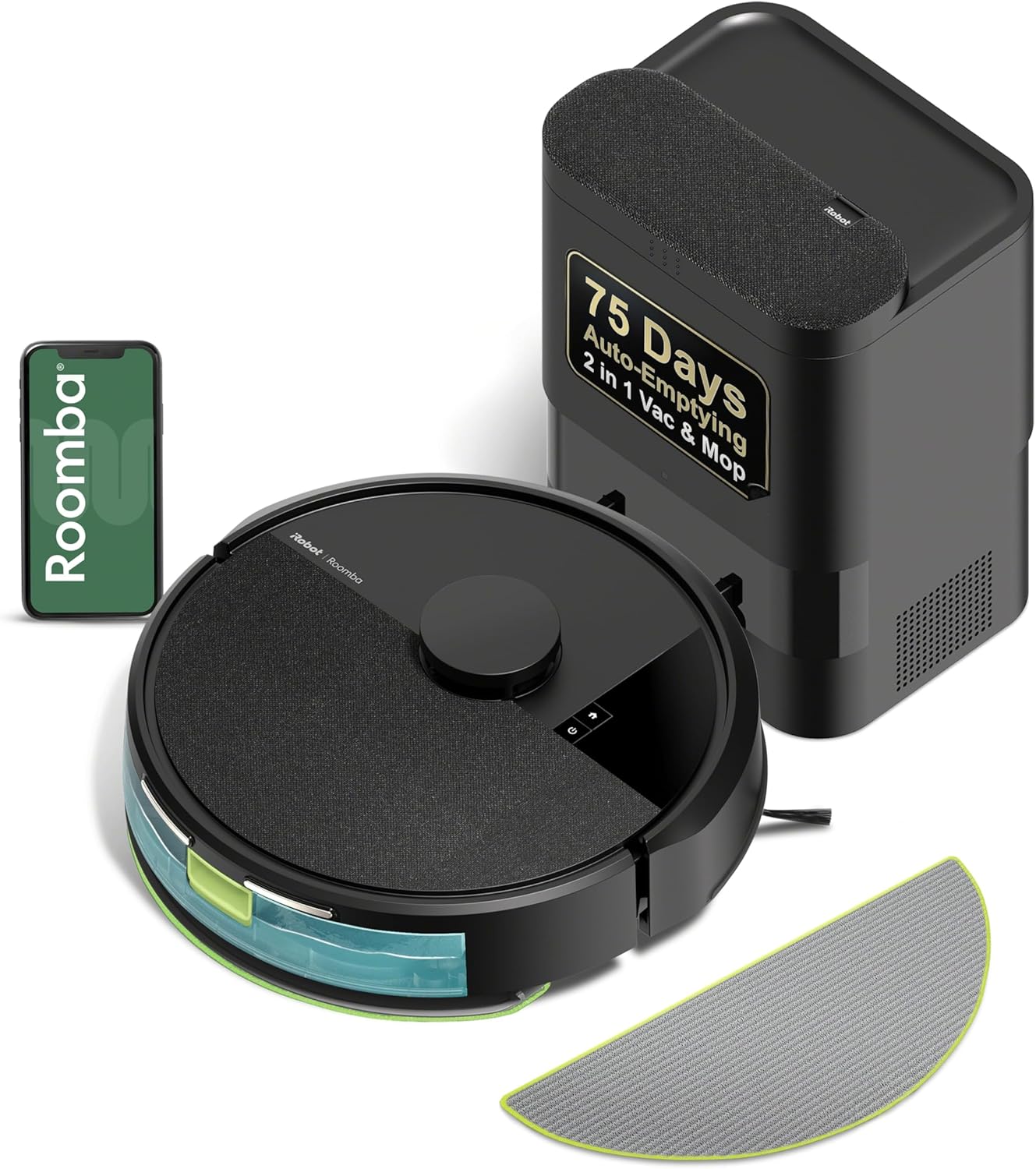
| Surface Recommendation | Carpet & Hard Floor |
|---|---|
| Battery Life | 100 minutes |
| Controller Type | App Control, Button Control, Voice Control |
| Filter Type | Cartridge |
The Roomba 105 Combo is a vacuum-and-mop robot built for regular home cleaning on carpets and hard floors, with ClearView LiDAR mapping, 3 cleaning modes, and a self-emptying AutoEmpty dock. In typical use you pick mop only, vacuum only, or vacuum-and-mop, schedule runs in the iRobot Home app or start with voice commands, and the robot maps rooms to avoid obstacles and stairs. Notable features include a 4-stage cleaning system with power-lifting suction and an edge-sweeping brush for better corner cleaning, a washable microfiber mop pad and a micro-pump that meters cleaning solution for controlled mopping, plus a dock that holds up to 75 days of debris in a disposable bag. Practical benefits for LVP floors are targeted wet cleaning with carpet detection so rugs stay dry, and LiDAR navigation for consistent coverage. Limitations to expect are routine maintenance like filter and brush cleaning, a 100-minute battery life that may need recharges for larger homes, and dependency on the companion app for advanced settings and map customization.
Best for: Buyers who want a mostly hands-off vacuum-and-mop robot that reliably cleans LVP and other hard floors and values documented performance and peer reviews when choosing a dependable, low-maintenance option.
Less Ideal for: People who need the longest possible run time for very large homes, want a mop dock that washes and dries pads, or who prefer fully bagless base stations.
- Self-emptying AutoEmpty dock holds up to 75 days of debris for low-touch maintenance.
- ClearView LiDAR mapping gives reliable room coverage and obstacle avoidance.
- Combined vacuum-and-mop modes with a micro-pump and washable microfiber pad let you control how much liquid is applied to hard floors.
- 70x power-lifting suction and an edge-sweeping brush improve pickup, including pet hair and edge debris.
- App and voice control with scheduling and keep-out zones simplify routine cleaning.
- Battery runtime is 100 minutes which may require mid-run recharges in larger homes.
- AutoEmpty uses disposable bags, adding ongoing consumable cost.
- Does not include heated pad washing or advanced self-washing dock features found on higher-end models.
Verdict: Choose the Roomba 105 Combo if you want a trustworthy LiDAR-mapped vacuum-and-mop with a hands-free AutoEmpty dock that keeps LVP clean with minimal daily effort.
ILIFE A30 Pro Robot Vacuum

| Battery Life | 150 minutes |
|---|---|
| Filter Type | Hepa |
| Capacity | 2.5 liters |
| Power Source | Battery Powered |
| Controller Type | App, Remote, Voice Control |
The ILIFE A30 Pro is a midrange self-emptying robot that combines vacuuming and mopping with LiDAR mapping for predictable, room-by-room cleaning. It uses a 2-in-1 on-board dustbin and water tank to run vacuum and mop simultaneously, and the included self-emptying base holds five 2.5L dust bags so the system can go for months without you emptying it. LiDAR navigation and multi-floor mapping create accurate maps and let you set no-go zones, schedules, and spot cleaning from the ILIFEClean app or via voice assistants. Suction modes range from quiet to a claimed 10000Pa max for heavier debris, and a HEPA filter helps capture fine dust. Practical limitations: the mop water capacity is modest, the 200ml tank means heavier mopping jobs need refills, and the app requires a 2.4GHz Wi-Fi network only. While performance on low-pile carpet and hard floors should be solid, very dense rugs or large homes may need multiple runs or manual touch-ups.
Best for: Buyers who want a low-maintenance cleaning routine and prioritize automated, scheduled whole-home cleaning with reliable mapping and occasional mopping included.
Less Ideal for: Homes that need heavy-duty mopping or very deep-cleaning of dense high-pile carpets should consider a dedicated wet-cleaner or a more powerful upright for spot jobs.
- Self-emptying base with five 2.5L dust bags for extended hands-free operation
- LiDAR navigation with multi-floor mapping and no-go zones for consistent coverage
- Vacuum and mop simultaneously with selectable suction and water levels
- HEPA filter and multiple suction modes for better dust and pet hair pickup
- Small onboard water tank limits continuous mopping time
- Max suction value is claimed and real-world results can vary
Verdict: If you want long stretches of hands-off floor care with reliable LiDAR mapping and a bagged self-emptying base, the A30 Pro delivers practical automation."}
MAMNV D13S MAX Robot Vacuum

| Max Suction Power | 11500Pa |
|---|---|
| Runtime | 160 mins |
| Dust Capacity (base) | 90-day dust bag |
| Filter Type | Foam, HEPA Triple-stage |
| Battery Type | Lithium Ion |
The MAMNV D13S MAX is a 3-in-1 robot that vacuums and mops in a single pass while using LiDAR mapping for planned, room-based cleaning. In everyday use it follows mapped routes, crosses low thresholds, and creates no-go zones from the app so it can target corners and high-traffic areas without repeatedly bumping into furniture. The unit offers strong 11,500 Pa suction and carpet auto-boost for embedded dirt and pet hair, and the washable mop pad plus simultaneous water tank and dustbin help keep hard floors tidy between deeper cleans. A self-emptying dock holds a large dust bag rated for up to 90 days of hands-free use, reducing how often you handle dirt. On the downside the listed noise level reaches about 70 dB and long hair can occasionally tangle the brush, so expect some maintenance on the rolling brush. For homes that need reliable, scheduled corner-to-corner cleaning the D13S MAX balances powerful suction, precise LiDAR navigation, and low-intervention operation.
Best for: People who prioritize dependable, low-touch cleaning and want a navigation-first robot that consistently follows mapped routes to hit corners and rooms with minimal intervention.
Less Ideal for: Buyers who need near-silent operation during daytime use or who prefer completely tangle-free brush systems without any manual maintenance.
- LiDAR mapping with multi-floor maps and no-go zones enables precise, room-based cleaning
- Strong 11,500 Pa suction with carpet auto-boost for lifting pet hair and embedded debris
- Self-emptying base with large dust bag supports up to 90 days of reduced maintenance
- Vacuum and mop simultaneously with a washable mop pad for mixed-surface cleaning
- Noise level is relatively high at around 70 dB during operation
- Long hair may occasionally tangle the rolling brush and require manual cleaning
Verdict: Choose the D13S MAX if you want a reliable, navigation-driven robot that powerfully vacuums and self-empties so corners and rooms stay clean with minimal hands-on upkeep.
eufy C28 Robot Vacuum

| Suction | 15,000 Pa |
|---|---|
| Battery Life | 140 minutes |
| Capacity | 3 liters |
| Filter Type | Washable |
The eufy C28 is a full-featured robot vacuum and mop designed to reduce hands-on maintenance. It uses LiDAR navigation to map rooms and avoid obstacles without cameras while its HydroJet roller mop spins and self-cleans into a separate dirty-water tank, and the included Omni station automatically empties dust into a 3 L container, refills and washes the mop, and dries it with hot air. In daily use it handles hard floors and short-pile carpet, boosts suction on carpets, and its zero-tangle DuoSpiral brush is built to manage pet hair without frequent brush cleaning. The unit reports long runtimes for multi-room jobs and can lift the mop on rugs to protect carpets. Practical limitations include the robot's overall size and weight for homes with very low clearances and the dependence on the docking station for the hands-free features to work as advertised. For buyers who prioritize low-maintenance cleaning and reliable navigation, the C28 delivers measurable time savings but it is best suited to households that can accommodate the Omni station footprint.
Best for: A cautious buyer who wants dependable mapping, strong suction, and near hands-off vacuuming and mopping with minimal daily maintenance.
Less Ideal for: Homes with very limited floor space for the docking station or users who need a compact robot that performs primarily without a large base station.
- 15,000 Pa suction with automatic carpet boost for stronger pickup on rugs
- All-in-one Omni station auto-empties dust, washes and hot-dries the mop, and collects wastewater for up to 75 days
- LiDAR navigation avoids obstacles using laser mapping without cameras to protect privacy
- Zero-tangle DuoSpiral roller reduces hair wrap and simplifies pet-hair maintenance
- Large station and robot size may be difficult to place in tight or low-clearance homes
- Hands-free features require the Omni station, so benefits are reduced if you only use the robot standalone
Verdict: Buy this if you want a privacy-safe LiDAR robot that combines strong suction with a station that largely automates emptying, mop washing, and drying for low-maintenance floor care.
roborock Q10 S5+

| Maximum Suction | 10,000 Pa |
|---|---|
| Capacity | 2.7 liters |
| Battery Life | 150 minutes |
| Filter Type | Washable |
| Noise Level | 65 db |
The roborock Q10 S5+ is a robot vacuum and mop combo built for low-touch, regular maintenance of mixed flooring. It navigates with 360° LiDAR mapping and ReactiveTech obstacle avoidance, so it plans efficient routes and avoids common household objects while supporting multi-level maps and no-go zones via the app. The unit pairs a 10,000 Pa suction system and smart carpet detection to boost suction on rugs and a dual anti-tangle brush setup to reduce hair clogs, which is helpful for pet homes. Its VibraRise 2.0 sonic mopping lifts and scrubs floors and can auto-lift the mop when carpet is detected. The included auto-empty dock holds a 2.7 L dust bag for extended hands-free operation, advertised up to about 70 days between bag changes. Battery runtime and app controls allow scheduled and voice-operated cleaning. Expect roughly moderate noise and a relatively large robot footprint that may limit access under very low furniture, and advanced features depend on using the app and 2.4 GHz Wi-Fi.
Best for: Buyers who prioritize low-maintenance, reliable cleaning backed by broad user adoption and want a robot that cleans floors and mops with strong suction and advanced navigation.
Less Ideal for: If you need an ultra-compact robot for very low-clearance furniture or want a model that runs without any networked app features, this is not the best fit.
- Strong 10,000 Pa suction for deep pickup on carpets and floors
- LiDAR mapping with multi-level maps and no-go zones for predictable navigation
- VibraRise sonic mopping that auto-lifts on carpet to protect rugs
- Large 2.7 L auto-empty dock reduces how often you need to empty the bin
- Dual anti-tangle brush design reduces hair snags and maintenance
- Relies on 2.4 GHz Wi‑Fi and the app for full feature set
- Noise level is moderate and may be noticeable during runs
Verdict: Choose the Q10 S5+ when you want a mostly hands-free robot that combines strong suction, LiDAR mapping, and auto-emptying for dependable weekly cleaning under $1,000.
Choosing the Right Robot Mop for Large Homes: Key Factors to Consider
Battery Life and Recharge Strategy
In a large home, a robot mop must run long enough to cover multiple rooms without constant recharging. Look beyond headline runtime and consider how the unit behaves when the battery runs low. Robots that automatically return to the dock, recharge partially, and resume cleaning with saved maps reduce the likelihood of unfinished jobs across wide floor plans.
Also evaluate the recharge time and whether the robot supports run-and-resume cycles. Faster recharge and reliable resumption matter because long recharge cycles or failure to resume will increase total cleaning time and require more frequent human intervention.
Mapping Accuracy and Room Management
Accurate mapping lets the robot divide a large home into logical zones and clean them sequentially. High-quality mapping reduces missed spots and prevents redundant passes across the same area. Look for features like multi-floor map storage, customizable no-go zones, and room grouping so you can schedule targeted cleaning for high-traffic areas.
Reliable room recognition also makes it easier to manage cleaning tasks in a large home where rooms vary in size and flooring. A robot that struggles to map open-plan spaces or that re-maps inconsistently will require more oversight and may leave coverage gaps.
Water Capacity and Delivery Control
Larger homes need robot mops with larger tanks or efficient water delivery so they can sustain wet cleaning across extended runs. A bigger tank reduces the number of refill stops during a job. Equally important is adjustable water flow so you can dial down moisture for delicate floors and increase it for stubborn dirt.
Consider how the robot meters water to the pad and whether it offers modes for light, medium, and intensive cleaning. Systems that over-wet tend to leave streaks and require extra drying time, while under-wetting may not remove soils effectively in a single pass.
Cleaning Coverage and Pattern Consistency
A robot mop for a large home needs to cover ground methodically rather than zigzagging randomly. Consistent cleaning patterns minimize missed strips and reduce repeat passes that waste battery. Evaluate reports of uniform coverage and whether the drive system maintains steady contact with the floor across thresholds and transitions.
Pay attention to how the robot handles corners, edges, and transitions between rooms. Good edge cleaning and reliable threshold negotiation mean fewer touch-ups after the autonomous cycle finishes.
Maintenance Needs and Consumable Lifespan
Maintenance becomes more noticeable in a large home because the robot will be used more often. Check how often pads, filters, or brushes must be replaced and how easy those parts are to clean. A design that minimizes tool use and allows quick pad swaps saves time when the unit is tasked with regular whole-house cycles.
Also consider how the unit signals maintenance needs and whether consumables are widely available. High-frequency replacement parts or complicated maintenance can negate the time savings of automation.
Scheduling Flexibility and App Control
A large home benefits from granular scheduling so different rooms can be cleaned at different times. Mobile app control that supports zone scheduling, spot cleaning, and staggered runs helps you minimize conflicts with daily routines. Integration with voice assistants or smart-home routines can further automate cleaning around occupants' schedules.
Check whether the app stores multiple cleaning maps and allows quick edits. The ability to run targeted cleanings for high-traffic areas while skipping less-used rooms reduces unnecessary runtime and conserves battery and water.
Planning Cleaning Routes for Bigger Floor Plans
Large homes require more deliberate route planning than small apartments. Instead of relying on random patterns, prioritize models that support mapped routes and room-by-room sequencing so the robot moves efficiently through open areas and tight corridors.
Use map-based scheduling to avoid excessive runs and to focus on high-traffic zones. When possible, divide very large floors into smaller scheduled jobs to reduce the chances of mid-run battery depletion.
- Schedule high-traffic zones more frequently than seldom-used rooms
- Start full-house jobs when the house is empty to avoid interruptions
- Use virtual boundaries to prevent the robot from entering cluttered storage or play areas
Managing Wet Cleaning Across Different Floor Types
Hard floors vary in porosity and finish, and a mop that works well on sealed tile may be too wet for softwood. Choose adjustable water settings and test on a small area first to find the optimal level for your floors.
When cleaning homes with mixed flooring, map rooms according to surface type and assign appropriate water flow or cleaning modes. This reduces the risk of over-wetting sensitive areas and keeps results consistent across the home.
- Use lighter moisture settings on hardwood and engineered wood
- Increase flow for ceramic tile or heavily soiled entryways
- Consider running vacuum cycles first if the robot supports combined suction and mopping
Maintenance Routines That Keep Large Homes Running Smoothly
Regular maintenance prevents downtime in larger homes where the robot is used more often. Establish a short weekly routine to rinse and dry pads, empty any debris containers, and check sensors for build-up.
Keep a small stock of consumables on hand to avoid service interruptions. Swapping pads and filters should be quick to preserve the convenience benefit of automation.
- Rinse microfiber pads after each heavy use and air-dry completely
- Inspect wheel housings and brushes monthly for hair tangles
- Follow manufacturer guidance for long-term storage if you reduce use seasonally
Integrating Robot Mops Into Smart Home Routines
In large homes, coordinating cleaning with other smart devices reduces conflicts. Use routines to pause cleaning during high-traffic times or to start runs after occupants leave for work. Linking the robot to door sensors or presence detection can automate sensible scheduling.
If your robot stores multiple maps, consider mapping each floor or major zone separately for easier control. Clear labeling of maps and rooms speeds up targeted schedules and reduces errors when issuing commands remotely.
- Create a morning routine that vacuums high-traffic floors and mops mid-day
- Pause mopping when guests are expected to avoid wet footprints
- Use notifications to confirm job completion across large areas
Troubleshooting Coverage Problems in Wide Areas
If you notice missed strips or inconsistent wetting, start by checking the map for unrecognized obstacles or incomplete boundaries. Re-run mapping in problem areas and clear movable obstructions that confuse navigation.
Also verify that water delivery components are clean and functioning. Clogged nozzles or saturated pads can change mop behavior and lead to streaking or reduced pickup efficiency.
- Rebuild maps after major furniture rearrangements
- Clean sensors and wheels if the robot frequently stalls
- Test different cleaning modes to find the best balance of coverage and drying time
How We Chose the Best Robot Mop for Large Homes
We focused on features and performance characteristics that matter most in large homes where coverage and autonomy are decisive. Primary evaluation criteria included battery life and recharge behavior, mapping accuracy and room-by-room navigation, water tank capacity and delivery control, and sustained cleaning coverage on hard floors. We also considered maintenance needs such as pad replacement and ease of refilling, plus obstacle handling for common household items that appear in bigger floor plans. Products were excluded if they lacked reliable multi-room mapping, had short documented runtimes that require frequent recharges for large areas, or offered insufficient water capacity for extended operation. We prioritized units with adjustable water output, robust navigation that reduces missed areas, and sensible maintenance requirements. The result is a set of options that balance long run times, consistent wet cleaning coverage, and practical upkeep demands for larger homes.
Our full evaluation process is outlined in our review methodology.
FAQ
How long should a robot mop run to clean a large home?
It often depends on floor area and layout, but aim for units with multi-hour runtimes or reliable run-and-resume capability. Robots that can recharge and continue typically handle larger homes more effectively than short-run models.
Can a robot mop handle hardwood and tile in the same pass?
Many robots let you adjust water flow by mapped room, enabling safe cleaning of both hardwood and tile during a single scheduled job. It usually depends on whether the model supports per-room settings and gentle moisture control.
How frequently will pads and filters need replacement in a big house?
Replacement cadence varies with usage, but higher-frequency cleaning in large homes accelerates wear. Expect more frequent pad laundering and periodic filter or pad replacement compared with light-use households.
Will furniture and thresholds disrupt coverage in a large home?
Thresholds and low furniture can interrupt a run, but robots with stronger obstacle negotiation and precise mapping manage transitions better. Clearing clutter and setting virtual boundaries for problem zones improves overall coverage.
Is a larger water tank always better for big homes?
A larger tank reduces refill stops, but water metering and efficient use matter too. A medium tank with precise delivery can outperform a large tank that over-wets or wastes water during long runs.
Final Verdict
For large homes, prioritize runtime, reliable mapping, and water capacity to minimize interruptions and deliver consistent wet cleaning. Expect tradeoffs between larger tanks and more frequent recharges, and choose robots that resume jobs after charging to avoid unfinished cycles. Focus on models that let you control water delivery and map rooms individually so you can tailor cleaning to different floor types and traffic levels. With those priorities in place, you can select a robot mop that reduces routine upkeep across wide floor plans and keeps floors consistently clean with minimal hands-on effort.