
Note: This article contains affiliate links. If you click on these links and make a purchase, we may earn a small commission at no extra cost to you. This helps support our research and content. Read our full affiliate disclosure here.
If you want to cut down on daily sweeping and manual mopping, a robot vacuum and mop combo can take a lot of routine floor care off your plate. These hybrid units pick up dust and debris, then follow with a damp mop cycle to tackle light soil on hard floors. Choosing the right combo matters because motor strength, navigation, and tank capacity all influence how well a unit cleans mixed surfaces and how often you need to refill or empty it. This guide shortlists the top picks in the category and explains the evaluation criteria we used, from run time and suction to mop effectiveness and app controls. Read on to find a combo that fits your home and cleaning habits before the product list below.
Top Picks at a Glance
| Best Overall The best all-around choice for most situations | roborock Qrevo S5V |  |
| Best Quality Built to a higher standard if you want something more solid | NARWAL Flow 2 |  |
| Best Value The sweet spot between price and what you get | Tikom G8000 Max Robot Vacuum |  |
| Best Budget The cheapest option that still gets the job done reliably | ILIFE V5s Plus Robot Vacuum |  |
| Top Rated A top-rated pick with lots of positive feedback | WSUANE D15S Max Robot Vacuum |  |
| Most Popular A crowd favorite that many people choose with confidence | iRobot Roomba 105 Combo |  |
| Best Seller A high-volume bestseller chosen again and again | roborock Q10 S5+ |  |
roborock Qrevo S5V

| Suction | 12,000Pa |
|---|---|
| Battery life | 180 minutes |
| Dust capacity | 2.7 liters |
| Filter type | Washable |
| Control | App, button, voice |
The roborock Qrevo S5V is a self-contained robot vacuum and mop designed to reduce hands-on floor care in medium to large homes. It vacuums with up to 12,000Pa HyperForce suction and uses a zero-tangle floating brush and side brush to pick up pet hair and embedded dirt, while its FlexiArm and dual spinning mop pads let it scrub edges and under furniture. PreciSense LiDAR builds multi-floor maps and the app lets you schedule room-by-room cleans, set no-go zones, and fine-tune 30-level water flow for different surfaces. The multifunctional dock adds convenience by auto-emptying dust, refilling water, self-washing and warm-air drying mops, and storing waste so you do less maintenance. Expect longer runtimes (up to 180 minutes) and responsive obstacle avoidance for cluttered homes, but be aware the system requires the Roborock app and 2.4 GHz Wi‑Fi for full functionality and the dock footprint is larger than a basic charging station. For buyers who want deep vacuuming plus automated mopping with minimal daily upkeep, this unit brings together powerful cleaning and advanced autonomy.
Best for: Buyers who want a powerful, low-maintenance robot that handles both vacuuming and mopping across multiple floors with smart mapping and customizable schedules.
Less Ideal for: People who need a compact dock footprint, prefer fully offline operation without app or Wi‑Fi, or only want a basic vacuum without mopping automation.
- Strong 12,000Pa suction for lifting embedded dirt and pet hair
- Zero-tangle main brush reduces hair wrap and maintenance
- All-in-one dock auto-empties dust and self-washes and dries mops
- PreciSense LiDAR and multi-floor mapping enable efficient, room-targeted cleaning
- Customizable app controls including 30 water levels and no-go zones
- Requires 2.4 GHz Wi‑Fi and the app for full feature access
- Dedicated dock is relatively large and adds to floor space occupied
Verdict: Choose the Qrevo S5V if you want a high-suction, multi-floor robot that combines powerful vacuuming with automated mop washing and drying to minimize hands-on maintenance.
NARWAL Flow 2

| Max suction | 31,000Pa |
|---|---|
| Mop capacity | 600 ml |
| Battery life | 275 minutes |
| Battery capacity | 7000 mAh |
| Control method | App |
The Narwal Flow 2 is a premium vacuum-and-mop robot designed for deep cleaning in homes with mixed hard floors and carpets. It combines 31,000Pa suction and a dual zero-tangle roller system for heavy debris and pet hair pickup while its FlowWash rolling track mop uses dual water tanks, 16 nozzles, hot-water washing, and a scraper to keep the mop fresh instead of spreading dirty water. The unit navigates with dual cameras and an AI VLM brain for object recognition and avoidance, and the smart light bar shows status at a glance. The full-cycle base handles self-emptying, refilling, hot-air drying, and a maintenance-friendly dirty water tank, which reduces hands-on upkeep. Battery capacity and runtime are built for large homes with a 7000mAh pack and long runtime. Trade-offs are the high cost and complex base that occupies more floor space than simple docks, and advanced features may require time in the app to tune. For buyers prioritizing strong cleaning performance and low manual mopping, Flow 2 delivers a powerful, largely autonomous solution.
Best for: Buyers who need best-in-class cleaning performance for mixed floors and pet hair and who value automated, low-maintenance mopping over a lower purchase price.
Less Ideal for: People with very small homes or limited floor space for a bulky base, or buyers who want a minimal, budget robot without advanced app configuration.
- Very strong 31,000Pa suction for deep pickup of debris and pet hair
- FlowWash rolling mop with dual tanks and hot-water washing keeps mop pads consistently clean
- Dual-camera AI object recognition reduces collisions and improves route decisions
- Full-cycle base provides self-emptying, auto refilling, and hot-air drying to cut maintenance
- Large, complex base requires significant floor space compared with simpler docks
- High upfront cost and additional setup/tuning in the app to optimize behavior
Verdict: Choose the Flow 2 if you want a high-performance, low-maintenance robot that combines powerful vacuuming with an automated self-cleaning mop for consistently cleaner hard floors.
Tikom G8000 Max Robot Vacuum

| Suction | 5000Pa |
|---|---|
| Battery Life | 150 minutes |
| Dustbin Capacity | 450 ml |
| Water Tank | 300 ml |
| Noise Level | 45 db |
The Tikom G8000 Max is a low-profile robot vacuum that combines strong suction with mopping to keep hard floors and low-pile carpets tidy with minimal user effort. In use it maps and navigates with anti-collision and anti-fall sensors, and supports app, remote, voice, and onboard button control so you can schedule cleanings and start runs from a phone or the included remote. Notable features include a 5000Pa suction motor for lifting pet hair and debris, a combined 450 ml dustbin plus 300 ml water tank for simultaneous vacuuming and mopping, and a runtime up to 150 minutes with automatic recharge. Its 3-inch height lets it access under furniture and the Zig-zag cleaning mode improves coverage on open floor areas. Limitations to keep in mind are that higher-pile carpets may not get deep cleaning compared with upright vacuums and mopping is best for maintenance rather than heavy wet cleaning; occasional emptying of the dustbin and refilling the water tank are still required. For routine hardwood maintenance the G8000 Max offers a practical balance of suction, run time, and smart controls.
Best for: Buyers who want a practical, time-saving floor care solution for hardwood and low-pile carpets and prioritize long runtime, reliable navigation, and flexible control options.
Less Ideal for: Households that need deep carpet extraction, heavy wet mopping, or commercial-grade cleaning should consider a dedicated upright or standalone mop system instead.
- Strong 5000Pa suction effective on hard floors and short-pile carpets
- Simultaneous vacuuming and mopping with combined dustbin and water tank saves time
- Long run time up to 150 minutes with auto-recharge for larger homes
- Slim 3-inch profile reaches under low furniture
- Multiple control options including app, remote, voice, and onboard button
- Mopping function is for light maintenance and not heavy wet cleaning
- May be less effective on high-pile carpets compared with full-size vacuums
Verdict: A slim, long-running robot that combines powerful suction and light mopping to keep hardwood floors clean with minimal hands-on work.
ILIFE V5s Plus Robot Vacuum

| Battery Life | 110 minutes |
|---|---|
| Capacity | 300 ml |
| Controller Type | App, Voice, Remote |
| Compatible Devices | Amazon Echo, Google Home |
| Form Factor | Robotic |
The ILIFE V5s Plus is a compact robot vacuum that combines vacuuming and mopping for everyday floor maintenance on hard floors and low-pile carpet. It offers five cleaning modes (auto, spot, edge, max and scheduled) selectable via remote, app or voice with Alexa and Google Assistant support, and it automatically returns to its charging base when the battery is low. The 300 ml water tank and simultaneous vacuum-and-mop function make it useful for light spills and routine damp cleaning, while a 2600 mAh battery delivers up to about 110 minutes per run—enough for small to medium homes. The unit is slim and quiet, so it fits under low furniture and runs without being intrusive. Limitations include modest suction compared with higher-end models and a relatively small water/dust capacity that means more frequent emptying for larger homes or heavy pet hair. For the price, it provides a sensible mix of automation and basic mopping capability for everyday upkeep.
Best for: Buyers on a tight budget who want automated vacuuming plus basic mopping for hard floors and low-pile carpet and prioritize hands-off, scheduled cleaning over maximum suction.
Less Ideal for: Homes that need heavy-duty pet hair management, deep-cleaning suction, or large-area mopping without frequent maintenance should consider more powerful or larger-capacity models.
- Two-in-one vacuum and mop with simultaneous operation for routine cleaning
- Multiple control options: app, remote, and voice assistants
- Long runtime up to 110 minutes with automatic return-to-charge
- Slim, quiet design that reaches under low furniture
- Relatively small 300 ml dust/water capacity requires frequent emptying on bigger homes
- Suction power is modest compared with higher-end robot vacuums
Verdict: A cost-conscious robot that adds simple mopping and smart controls to everyday floor upkeep without the premium suction or large tanks of higher-end models.
WSUANE D15S Max Robot Vacuum

| Suction | 10000Pa (max) |
|---|---|
| Dustbin Capacity | 3.5 liters |
| Navigation | dToF LIDAR |
| Runtime | Up to 160 minutes |
| Filter Type | Three-layer high-efficiency (washable) + filter cotton (not washable) |
The WSUANE D15S Max is a robot vacuum and mop combo built to minimize hands-on maintenance while still delivering strong cleaning performance. It uses dToF LIDAR to map large spaces, create multi-level maps, and let you set no-go zones from the app, while a 3.5 liter self-emptying dock holds several weeks of debris so you do not need to empty the bin frequently. Suction reaches up to 10,000Pa with multiple power modes and an Auto Boost that raises suction on carpets, and an anti-tangle roller blade helps cut through pet and human hair to reduce brush clogs. The unit offers long runtimes (up to 160 minutes in quiet mode) and standard smart features like app control and Google Home compatibility. Expect about 70 dB at higher power and a washable multi-layer filter with an additional non-washable filter cotton. The D15S Max is focused on convenience and mapping accuracy, but buyers should note the noise at higher power levels and that some filters or consumables may need periodic replacement despite the large dustbin.
Best for: Buyers who prioritize dependable, low-maintenance cleaning and accurate mapping for larger homes or pet households and want a robot that can run long sessions without frequent bin emptying.
Less Ideal for: People seeking the quietest possible machine for small apartments or users who prefer fully washable filter systems and minimal ongoing consumable replacements.
- Large 3.5L self-emptying dustbin reduces how often you need to touch dirt
- dToF LIDAR navigation enables precise mapping, no-go zones, and efficient pathing
- High peak suction up to 10,000Pa with Auto Boost for better carpet performance
- Anti-tangle roller with blade design helps prevent hair wrap and brush clogs
- Long runtime up to 160 minutes in quiet mode for larger cleaning sessions
- Noise level can reach around 70 dB on higher power settings
- Some filter components are not washable and will require periodic replacement
Verdict: If you want a hands-off robot that maps reliably, runs long, and minimizes bin emptying, the D15S Max is a practical, reliability-focused choice.
iRobot Roomba 105 Combo
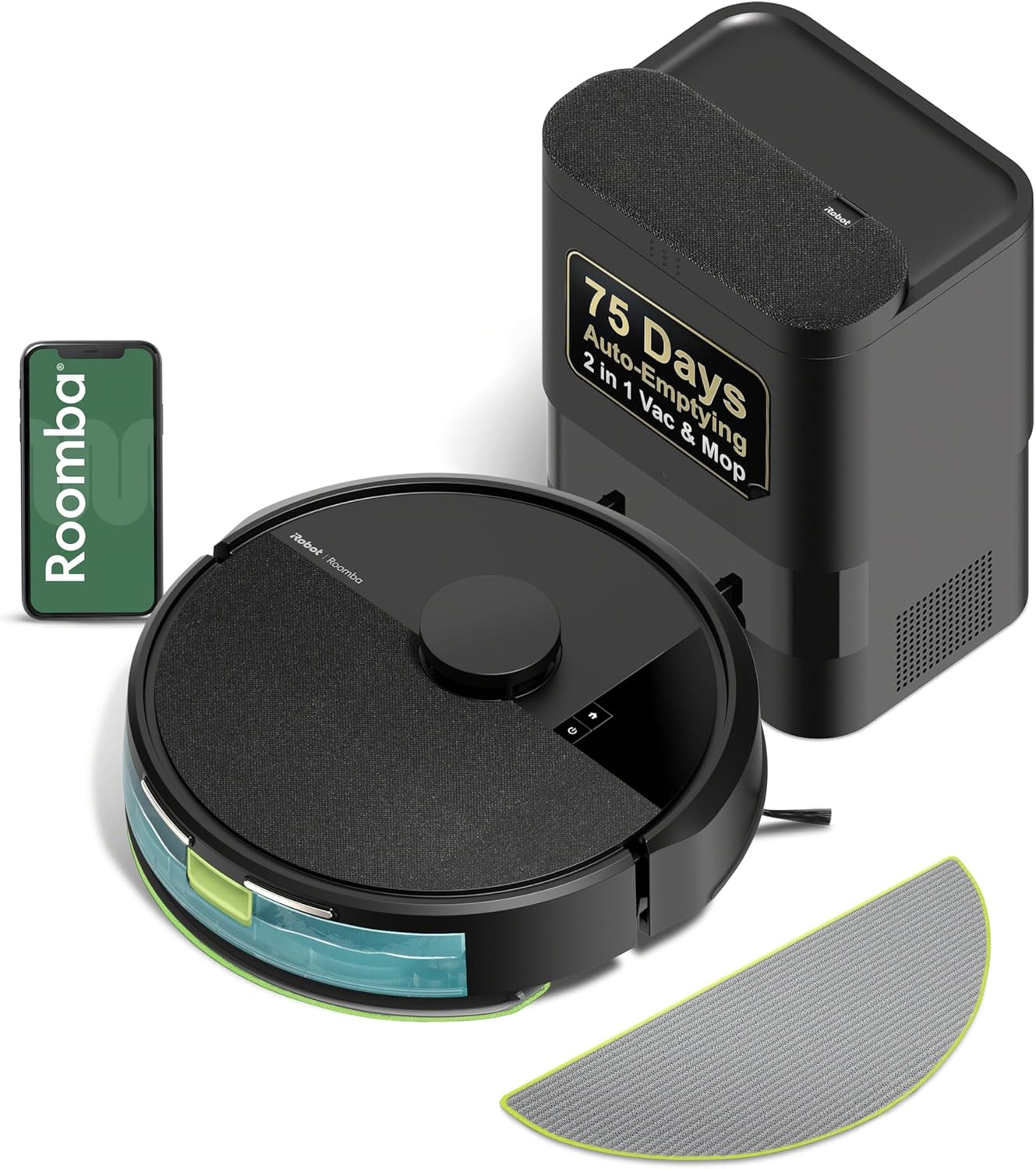
| Battery Life | 100 minutes |
|---|---|
| Surface Recommendation | Carpet & Hard Floor |
| Controller Type | App Control, Button Control, Voice Control |
| Other Special Features | LiDAR Navigation, Self-Emptying, Simultaneous Vacuuming & Mopping |
| Filter Type | Cartridge |
The Roomba 105 Combo pairs a 3-in-1 cleaning approach—vacuum, mop, or vacuum-and-mop—with ClearView LiDAR mapping and a hands-free AutoEmpty dock that holds up to 75 days of dirt. It uses a multi-surface brush, an edge-sweeping brush, and a microfiber mop pad with a micro-pump to control water flow and SmartScrub for deeper scrubbing on high-traffic spots. Setup and control work through the Roomba Home app, onboard buttons, or voice assistants, and mapping supports up to three saved maps and keep-out zones for targeted cleaning. In daily use the robot navigates reliably, avoids stairs, and detects carpets so rugs stay dry during mopping. Maintenance is standard for the category—emptying consumable bags on the dock, occasional brush cleaning, and periodic filter changes—while the included AutoEmpty dock reduces how often you handle debris. Limitations to note are the 100-minute battery runtime, which may require recharges for larger homes, and that advanced obstacle recognition features are more basic than higher-end models.
Best for: Buyers who want a dependable combo robot that reduces hands-on maintenance and offers proven mapping and mopping in everyday homes where social proof and reliability matter.
Less Ideal for: Large homes that need long continuous runtime or users seeking the most advanced obstacle recognition and premium navigation features should consider higher-tier models.
- Self-emptying AutoEmpty dock holds debris for up to 75 days, cutting down manual emptying
- ClearView LiDAR mapping creates precise maps and supports keep-out zones for targeted cleaning
- Combined vacuum and mop modes with micro-pump water control and SmartScrub for deeper scrubbing
- Multi-surface and edge-sweeping brushes improve pickup on carpets and along edges
- Battery life is limited to about 100 minutes, which may need mid-clean recharges in large homes
- Advanced obstacle recognition and premium navigation features are less sophisticated than flagship models
Verdict: Choose the Roomba 105 Combo if you want a proven vacuum-and-mop robot with LiDAR mapping and a self-emptying dock that minimizes daily upkeep.
roborock Q10 S5+

| Maximum Suction | 10,000 Pa |
|---|---|
| Capacity | 2.7 liters |
| Battery Life | 150 minutes |
| Filter Type | Washable |
| Noise Level | 65 db |
The roborock Q10 S5+ is a Robotic vacuum-and-mop designed to handle daily dirt, pet hair, and mixed-floor homes with minimal intervention. It navigates via 360° LiDAR to build multi-level maps and uses ReactiveTech obstacle avoidance to steer around clutter, while app and voice control let you schedule runs and set no-go zones. The included self-emptying dock holds a 2.7 L bag for roughly 70 days between maintenance cycles, and the motor delivers strong 10,000 Pa suction plus an ultrasonic smart carpet detection that increases power automatically. For mopping, the VibraRise 2.0 sonic system scrubs at high frequency and the mop module auto-lifts over carpets. Practical benefits include long runtime for larger homes, reduced hands-on maintenance thanks to the auto-empty station, and good pet-hair performance with the dual anti-tangle brush design. Expect typical robot limitations: it operates indoors only, still requires occasional brush and sensor cleaning, and noise is noticeable during heavy suction or mopping cycles. It also only supports 2.4 GHz Wi‑Fi, which may affect some network setups.
Best for: Buyers who value dependable, low-maintenance floor care and want a capable vacuum-and-mop that handles pet hair and multi-floor mapping with strong suction and a long self-emptying interval.
Less Ideal for: People who need an ultra-quiet machine, require 5 GHz Wi‑Fi support, or prefer a purely manual vacuum solution without app or dock automation.
- Strong 10,000 Pa suction for deep cleaning
- 70-day capacity self-emptying dock reduces hands-on maintenance
- LiDAR navigation with multi-level mapping and reliable obstacle avoidance
- VibraRise sonic mopping with auto-lift for carpet protection
- Dual anti-tangle brush design improves hair pickup and reduces jams
- Operates only on indoor surfaces and requires periodic manual cleaning of brushes and sensors
- Supports only 2.4 GHz Wi‑Fi which may limit connectivity options
- Noise level can be high on max suction or during emptying
Verdict: Choose the Q10 S5+ if you want a hands-off, pet-capable robot that pairs powerful suction and sonic mopping with a long-lasting self-emptying dock.
Choosing the Right Robot Vacuum and Mop Combos: Key Factors to Consider
Suction Power and Brush Design
Suction strength determines how well a robot lifts dirt from carpets and gathers fine dust on hard floors. Brush design matters because rolling brushes, side brushes, and specialized rubber treads interact differently with pet hair, crumbs, and long fibers. A model with stronger suction and a well-engineered brushroll will require fewer passes to achieve visible cleanliness.
Consider how brushes and suction work together: aggressive brushes can tangle hair, increasing upkeep, while too-gentle brushes leave debris behind. Look for designs that balance tangle resistance with enough agitation to dislodge stuck dirt without frequent maintenance.
Mop Method and Water Control
Robot mop systems vary from simple damp cloth pads to electronically controlled spray-and-wipe mechanisms. Water-control options affect how wet the mop pad gets and how effective the unit is on sticky spills versus light dust. Electronic dosing is useful in homes with mixed floor types because it prevents overwetting delicate wood while still loosening grime on tile.
Also think about mop pad materials and replacement frequency. Microfiber pads offer good pickup and are machine-washable, but the ease of removing and reinstalling pads and access to replacement parts will change long-term upkeep.
Battery Life and Recharge Behavior
Run time dictates how much floor area a single charge can cover before the robot must recharge. Larger homes or multi-room cleaning demands benefit from longer battery life and intelligent recharge-and-resume behavior so the robot can finish the job without manual intervention. Charging speed and battery longevity over months of use are also important considerations.
Beyond raw minutes, check whether the robot returns to base reliably and how it handles partial runs. Models that save their progress and resume where they left off reduce the chance of incomplete cleaning cycles in larger spaces.
Navigation Accuracy and Obstacle Handling
Effective mapping and navigation reduce missed spots, repeated passes, and collisions. Sensors, LIDAR, or camera-based systems help the robot build reliable floor maps, avoid falls, and maneuver around furniture. Accurate navigation also enables zone cleaning and virtual no-go lines, which are useful for protecting delicate areas or concentrating on high-traffic zones.
Good obstacle handling minimizes the chance of the robot snagging cords or becoming trapped under low furniture. Consider whether the navigation system supports multi-floor maps if you expect to move the unit between levels.
Dustbin and Water-Tank Capacity
Capacity affects how often you need to empty the dustbin and refill the water tank. Small bins and tanks can be fine for studio apartments or light use, but larger homes or households with pets typically need bigger capacities to avoid frequent interruptions. A larger dustbin is especially helpful when the robot is also sweeping pet hair.
Also consider whether the design makes emptying and refilling messy or straightforward. Removable bins and easily accessed water reservoirs reduce the friction of regular maintenance and make daily use more pleasant.
Maintenance, Consumables, and Long-Term Costs
Planned maintenance includes filter and brush replacements, mop-pad wear, and possible battery changes over several years. Check how often consumables need replacement and how easy they are to source. Models that require frequent proprietary parts can increase long-term ownership costs and downtime.
Think about cleaning accessibility for the robot itself. Tools and design choices that make it easy to clear tangles, clean sensors, and wash pads will reduce the time you spend on upkeep and extend the product's effective life.
How Mapping and Zoned Cleaning Change Daily Use
Advanced mapping features let you designate rooms and no-go zones so the robot focuses where you need it. That level of control saves time by preventing the unit from wasting cycles on low-priority spaces or repeatedly cleaning door thresholds.
Zoned cleaning is particularly helpful when you only want to mop high-traffic areas after a meal or vacuum a rug while avoiding a nearby spill-prone zone. The ability to edit and save maps in the app turns routine cleaning into a set-and-forget task.
- Save multiple floor plans for multi-level homes
- Draw virtual boundaries to protect fragile areas
- Schedule different modes by zone for targeted cleaning
Managing Pet Hair and High-Traffic Floors
Homes with pets or heavy foot traffic need models designed to handle hair and frequent soil. Look for brush systems that reduce tangling and a dustbin capacity that accommodates daily debris without constant emptying.
Some mop combos offer intensified suction or a special carpet-detection mode that raises the mop to avoid wetting rugs. These behaviors protect fabrics and let the robot switch between vacuuming and mopping automatically.
- Brushless or rubberized brush options reduce hair wrap
- Auto-raise mop features protect area rugs
- High-suction modes are useful for deep-clean passes
Routine Maintenance That Keeps Performance Consistent
Establish a simple maintenance schedule to preserve vacuum and mop performance. Regularly clearing the brushroll, washing mop pads, and replacing filters as recommended prevents reduced suction and streaking on floors.
Keep spare mop pads and filters on hand so the robot can be serviced quickly. A smooth refill and empty routine for tanks and bins reduces friction and helps the robot stay in regular use rather than sitting idle for cleanup tasks.
- Wipe sensors weekly to maintain navigation accuracy
- Wash or replace mop pads to avoid streaks
- Check brushrolls and remove hair to prevent tangles
Smart Home Integration and Scheduling Tips
Integration with voice assistants and home automation systems makes it easier to start or schedule cleanings without opening an app. Look for compatibility that matches your existing smart-home setup so the robot fits naturally into daily routines.
Use staggered schedules for vacuuming and mopping if you want fresh-floor results after work or before guests arrive. Combine zone scheduling with quiet hours to minimize disruption during sleep or important activities.
- Set recurring cleans for peak traffic times
- Use automation to avoid operating during quiet hours
- Combine notifications and map-based settings for targeted control
When to Use Mop-Only Vs Combined Cycles
Mop-only cycles are useful for quick touch-ups on hard floors when vacuuming is not necessary. Combined cycles that vacuum then mop are better for routine maintenance in mixed-floor homes because they remove loose debris before the mop passes.
For sticky spills or heavier soiling, plan a vacuum pass followed by a wet-mop setting with sufficient water control. Avoid running the mop over loose debris, since that can spread dirt rather than remove it.
- Use mop-only for light daily refreshes
- Run combined cycles for scheduled deep maintenance
- Pre-treat sticky spots before a mop pass if needed
How We Chose the Best Robot Vacuum and Mop Combos
We focused on features that directly affect everyday cleaning performance and convenience for robot vacuum and mop combos. Key evaluation criteria included suction and brush design for debris pickup, mop system effectiveness and water-control options, battery life and recharge behavior, navigation and obstacle avoidance, dustbin and water-tank capacities, and the quality of companion apps and automation features. We prioritized systems that balance strong vacuuming with practical mopping behavior rather than models that excel at only one task. For exclusions, we filtered out single-function robot vacuums and stand-alone mops, as well as experimental or prototype devices without broad retail availability. We also excluded units that lack basic mapping or obstacle detection because those limit real-world reliability. Our selection process emphasized repeatable cleaning results on both hard floors and low-pile carpets, plus maintenance requirements that are reasonable for typical households. Across shortlisted units we reviewed spec sheets, manufacturer-stated runtime and capacities, navigation tech, and user-focused features such as scheduling, zone control, and replaceable parts. The result is a set of picks that reflect practical tradeoffs between suction power, mop performance, upkeep frequency, and smart-home convenience.
Our full evaluation process is outlined in our review methodology.
FAQ
Can robot vacuum and mop combos safely clean wood floors?
Yes, many combos have adjustable water settings and mop-pad materials designed for sealed wood floors. Use the lowest safe moisture level recommended by the manufacturer and avoid overwetting to protect sensitive finishes.
How often do I need to empty the dustbin and refill the water tank?
It depends on home size and soil levels. Small apartments may need emptying and refilling every few cycles, while larger homes with pets may require daily attention. Larger-capacity bins and tanks extend the interval between maintenance.
Will the mop wet my area rugs or carpets?
Many models detect rugs and either avoid them during mop cycles or raise the mop module automatically. Check for explicit carpet-detection or mop-raise features if you have area rugs that must stay dry.
Are robot mop pads reusable and easy to clean?
Most mop pads are machine-washable microfiber and designed for multiple uses. Expect occasional replacements over time; choosing easily removable pads simplifies washing and speeds maintenance.
Do these combos require special cleaning solutions?
Some manufacturers recommend plain water or specific low-foam solutions to avoid damaging internal pumps. Avoid harsh chemicals that can leave residues or harm seals; consult the product guidance for acceptable fluids.
Final Verdict
When choosing a robot vacuum and mop combo, weigh how each unit balances vacuuming strength with mop control. Prioritize reliable navigation and sufficient battery life for your home size, and pick a mop system with adjustable water delivery if you have mixed floors. Consider maintenance demands, consumable availability, and how well the app supports zoning and scheduling. Focus on the tradeoffs that matter most to you: longer runtime and larger tanks reduce interruptions, while stronger suction improves carpet performance. With those priorities in mind you can select a combo that minimizes daily effort while keeping floors consistently clean.