
Note: This article contains affiliate links. If you click on these links and make a purchase, we may earn a small commission at no extra cost to you. This helps support our research and content. Read our full affiliate disclosure here.
Hardwood floors need different care than carpeted areas. You want a robot vacuum that removes dust, hair, and grit without scratching finishes or leaving residue. This guide looks at seven shortlisted robot vacuums built for hardwood floors and explains the tradeoffs that matter for daily maintenance and long-term floor health. We evaluated options based on how they balance suction, contact with the floor, navigation around furniture, and ease of maintenance. Read on to understand the features that matter and which attributes to prioritize for efficient, low-risk hardwood care.
Top Picks at a Glance
| Best Overall The best all-around choice for most situations | Shark Matrix Plus AV2630WA |  |
| Best Quality Built to a higher standard if you want something more solid | roborock Saros 10R |  |
| Best Value The sweet spot between price and what you get | Tikom G8000 Max Robot Vacuum |  |
| Best Budget The cheapest option that still gets the job done reliably | Lefant M210 Robot Vacuum |  |
| Top Rated A top-rated pick with lots of positive feedback | UMMUND T13S Robot Vacuum and Mop |  |
| Most Popular A crowd favorite that many people choose with confidence | eufy 11S Max Robot Vacuum |  |
| Best Seller A high-volume bestseller chosen again and again | roborock Q7 L5 Robot Vacuum |  |
Shark Matrix Plus AV2630WA

| Battery Life | 110 minutes |
|---|---|
| Filter Type | HEPA |
| Surface Recommendation | Carpets and Hardfloors |
| Control Method | App |
| Power Source | Battery Powered |
The Shark Matrix Plus AV2630WA is a 2-in-1 robot that vacuums and sonic-mops floors while returning to a HEPA self-empty base for hands-off maintenance. It maps rooms with 360° LiDAR and cleans in a precision grid pattern, taking multiple passes for deeper pickup on carpets and targeted sonic scrubbing on hard floors. The self-cleaning brushroll and strong suction help with pet hair, while app control lets you schedule cleanings, select rooms, and enable Matrix Mop zones for tougher stains. The base is bagless and can hold up to 45 days of debris, and the robot supports recharge-and-resume for long jobs. Trade-offs to expect are typical for robot mop hybrids: mopping is best for everyday grime and light stains rather than replacing a heavy-duty mop, and the system adds complexity compared with a simple vacuum-only robot. Battery runtime and performance can vary by home layout and settings, so larger or cluttered homes may see more frequent recharges or passes.
Best for: Buyers who want a low-maintenance, all-in-one robot that keeps hardwood and other hard floors swept and lightly scrubbed with minimal hands-on intervention.
Less Ideal for: People who need heavy-duty scrubbing for grout, deep stains, or industrial-strength floor restoration should choose a dedicated mop system or upright cleaner instead.
- Combined vacuum and sonic mopping for simultaneous dry and wet cleaning on hard floors
- Matrix Clean grid navigation for methodical, multi-pass coverage
- HEPA self-empty base holds up to 45 days of debris for low-maintenance operation
- Self-cleaning brushroll and strong suction effective at picking up pet hair
- App control with room selection, scheduling, and Matrix Mop targeted zones
- Mopping function is aimed at light stains and maintenance rather than deep grout or heavy soiling
- Robot performance and runtime depend on home layout and may require resumes for large areas
Verdict: Choose the Shark Matrix Plus when you want a self-emptying robot that reliably vacuums and sonic-mops hardwood for low-effort, everyday floor care.
roborock Saros 10R

| Suction | 22,000 Pa |
|---|---|
| Battery Life | 180 minutes |
| Filter Type | Washable |
| Noise Level | 65 db |
| Power Source | Battery Powered |
The roborock Saros 10R is a performance-focused robot vacuum and mop built to handle everyday dirt and pet hair on hard floors and low-pile carpets. It pairs powerful 22,000 Pa HyperForce suction with a Zero-Tangling DuoDivide brush and FlexiArm side brush to pick up hair without frequent brush cleaning, while the ultra-slim 3.14-inch body slips under low furniture to reach hidden dust. The multifunctional dock 4.0 automates maintenance with hot-water mop washing, hot-air drying, 60-day dust collection and auto refill features that greatly reduce hands-on upkeep. Navigation relies on the StarSight 2.0 system with 3D sensing and obstacle avoidance, which improves edge and cord handling and supports auto re-wash for high-traffic spots. For hardwood floors the mop functions and automatic mop lift when carpets are detected help avoid over-wetting. Trade-offs are the relatively loud 65 dB reported noise level during operation and a large, heavier docked system footprint, which may be more than needed for small homes.
Best for: Buyers who prioritize strong cleaning performance and low-maintenance operation on hard floors and have pets or long hair that require frequent deep pickup.
Less Ideal for: People living in very small apartments or who need a whisper-quiet machine for nighttime cleaning should consider smaller or quieter alternatives.
- Very strong 22,000 Pa suction for deep pickup on hardwood and low-pile carpets
- Zero-tangling main brush and omnidirectional wheels reduce hair maintenance
- Ultra-slim 3.14-inch profile reaches under low furniture and into tight spots
- Multifunctional dock automates mop washing, drying, and up to 60 days of dust collection
- 3D obstacle detection and advanced mapping improve edge cleaning and cord avoidance
- Noise level around 65 dB may be noticeable during cleaning
- Large multifunctional dock increases system footprint and setup complexity
Verdict: Choose the Saros 10R if you want top-tier suction and a hands-free docked system that keeps hardwood floors and pet hair under control with minimal daily effort.
Tikom G8000 Max Robot Vacuum

| Suction | 5000Pa |
|---|---|
| Battery Life | 150 minutes |
| Dustbin Capacity | 450 ml |
| Water Tank | 300 ml |
| Noise Level | 45 db |
The Tikom G8000 Max is a low-profile robot vacuum that combines strong suction with mopping to keep hard floors and low-pile carpets tidy with minimal user effort. In use it maps and navigates with anti-collision and anti-fall sensors, and supports app, remote, voice, and onboard button control so you can schedule cleanings and start runs from a phone or the included remote. Notable features include a 5000Pa suction motor for lifting pet hair and debris, a combined 450 ml dustbin plus 300 ml water tank for simultaneous vacuuming and mopping, and a runtime up to 150 minutes with automatic recharge. Its 3-inch height lets it access under furniture and the Zig-zag cleaning mode improves coverage on open floor areas. Limitations to keep in mind are that higher-pile carpets may not get deep cleaning compared with upright vacuums and mopping is best for maintenance rather than heavy wet cleaning; occasional emptying of the dustbin and refilling the water tank are still required. For routine hardwood maintenance the G8000 Max offers a practical balance of suction, run time, and smart controls.
Best for: Buyers who want a practical, time-saving floor care solution for hardwood and low-pile carpets and prioritize long runtime, reliable navigation, and flexible control options.
Less Ideal for: Households that need deep carpet extraction, heavy wet mopping, or commercial-grade cleaning should consider a dedicated upright or standalone mop system instead.
- Strong 5000Pa suction effective on hard floors and short-pile carpets
- Simultaneous vacuuming and mopping with combined dustbin and water tank saves time
- Long run time up to 150 minutes with auto-recharge for larger homes
- Slim 3-inch profile reaches under low furniture
- Multiple control options including app, remote, voice, and onboard button
- Mopping function is for light maintenance and not heavy wet cleaning
- May be less effective on high-pile carpets compared with full-size vacuums
Verdict: A slim, long-running robot that combines powerful suction and light mopping to keep hardwood floors clean with minimal hands-on work.
Lefant M210 Robot Vacuum

| Battery Life | 120 minutes |
|---|---|
| Capacity | 500 cubic centimeters |
| Filter Type | Cartridge |
| Compatible Devices | Amazon Echo, Google Home, Smartphones |
| Other Special Features of the Product | Anti-Fall, Auto-Docking, Obstacle Avoidance, Pet Hair Pick Up, Scheduling |
The Lefant M210 is a small, app-controlled robot vacuum aimed at regular upkeep on hardwood and other hard floors. Its low 3-inch profile slips under furniture, and a brushless suction port helps pick up pet hair without brush tangles. You can run scheduled cleans, pick from six modes including edge and spot, and control the unit via the Lefant app or Alexa/Google voice commands. The listed 120-minute runtime (quiet mode) covers mid-size rooms on a single charge, and the 500ml dustbin reduces how often you empty it. Navigation relies on infrared anti-collision and anti-drop sensors rather than LIDAR, so it follows zigzag or randomized patterns rather than tightly mapped routes; that makes coverage fine for open hardwood areas but less precise in cluttered rooms. Noise is moderate at about 52 dB and suction is tuned for surface dirt rather than deep carpet extraction. For buyers wanting a straightforward, affordable hardwood-focused cleaner, the M210 delivers solid basic performance, but expect simpler navigation and fewer advanced mapping features than higher-end models.
Best for: Buyers on a tight budget who need a dependable, easy-to-use robot for regular hardwood and low-pile cleaning and value app/voice scheduling over advanced mapping.
Less Ideal for: Homes that require precise room mapping, systematic multi-room navigation, or deep-cleaning on high-pile carpets should consider more advanced models.
- Slim profile fits under low furniture for hidden-dirt pickup
- Brushless suction port reduces hair tangles for pet owners
- App scheduling plus Alexa and Google voice control for hands-free operation
- 500ml dustbin and up to 120 minutes runtime support longer cleaning cycles
- Navigation uses infrared sensors and randomized or zigzag patterns rather than LIDAR mapping, so room coverage can be less efficient in cluttered spaces
- Suction and cleaning are optimized for hard floors and low-pile carpet, not deep-cleaning thick carpet
Verdict: If you want an affordable, compact robot that handles daily hardwood and pet hair cleaning with app and voice scheduling, the Lefant M210 is a practical pick.
UMMUND T13S Robot Vacuum and Mop

| Suction power | 8000Pa |
|---|---|
| Battery type | Lithium Ion |
| Battery life | 160 minutes (quiet mode) / 100 min (standard) / 70 min (max) |
| Control methods | App, Remote, Voice |
| Special features | Vacuuming & mopping, Anti-Collision, Auto Recharge |
The UMMUND T13S is a compact robot vacuum and mop designed for routine cleaning of hard floors and low-pile carpets. It combines separate water and dust tanks so it can vacuum and mop simultaneously, and offers four suction levels up to 8000Pa plus three cleaning modes (auto, spot, edge). You can control and schedule runs via the Tuya Smart app, remote, or voice assistants, and the unit returns to its dock to recharge automatically. Practical touches include infrared obstacle sensing, anti-fall protection, a slim 3.23 inch profile to reach under furniture, washable filter and dust box for easy maintenance, and side brushes for edge cleaning. Runtime varies by mode with up to around 160 minutes in quiet mode and a 2600mAh battery. Limitations to note are that mapping details are not emphasized in the listing so navigation may be more basic than higher-end mapped robots, and network setup requires 2.4GHz Wi-Fi or Bluetooth only. For hardwood and tile floors the T13S prioritizes reliable suction and simple upkeep over advanced mapping features.
Best for: Buyers who want a dependable, low-maintenance robot that keeps hardwood and tile floors clean with strong suction and simple app scheduling rather than advanced mapping features.
Less Ideal for: People who need precise multi-room mapping, virtual no-go zones, or high-end navigation controls should consider mapping-focused models instead.
- Separate water and dust tanks allow simultaneous vacuuming and mopping for real-floor cleaning in one pass
- Powerful maximum suction (8000Pa) with four suction levels for adjustable cleaning intensity
- App, remote, and voice control plus scheduling for convenient hands-off operation
- Slim low-profile design and obstacle/anti-fall sensors let it reach under furniture and avoid drops
- Washable dust box and filter simplify maintenance and reduce replacement frequency
- Listing does not emphasize advanced mapping so room-by-room mapping and precise navigation may be limited
- Supports only 2.4GHz Wi-Fi or Bluetooth for network setup, which may complicate some home networks
Verdict: A practical, reliability-minded robot that combines strong suction and simultaneous mopping to keep hardwood floors clean with minimal upkeep.
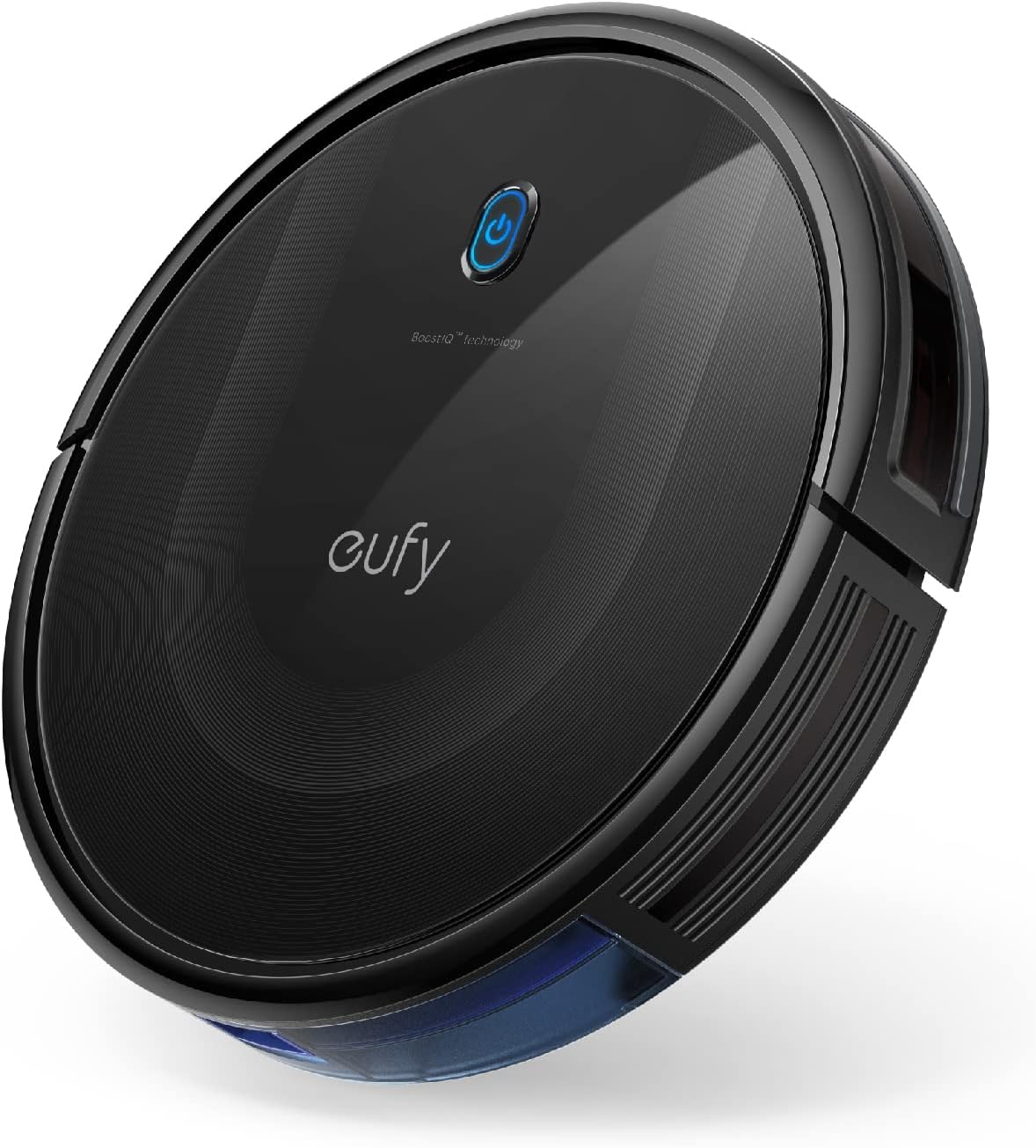
eufy 11S Max Robot Vacuum
| Surface Recommendation | Hard Floor & Tile & Medium carpet |
|---|---|
| Battery Life | 100 minutes |
| Suction Power | 2000 Pa |
| Capacity | 600 ml |
| Noise Level | 55 db |
The eufy 11S Max is a low-profile robot vacuum built to clean hard floors and medium-pile carpets without drawing attention. Its 2.85-inch slim body lets it slide under low furniture while 2000Pa suction and a 12.8-inch cleaning path pick up dust, crumbs, and pet hair. It runs up to 100 minutes on hardwood at a reported low 55 dB, and automatic return-to-base means it tops off battery without user intervention. Controls are simple: the included remote and onboard buttons let you start, stop, and switch modes quickly, though there is no Wi-Fi or app control. Practical touches include washable filters, drop-sensing and anti-collision sensors, and a 600 ml dust capacity that reduces how often you empty the bin. The trade-offs are straightforward: navigation is basic rather than lidar or map-based, so room coverage is more random and may miss tight corners, and the single-side-brush design can be less thorough along edges compared with dual-brush models. For routine, quiet cleaning of hardwood, the 11S Max balances strong suction and a slim profile in a simple, reliable package.
Best for: Buyers who prioritize a quiet, no-frills robot that cleans hardwood reliably and fits under low furniture will appreciate this model for regular maintenance cleaning.
Less Ideal for: If you want mapped cleaning, smartphone scheduling, or the most thorough edge-cleaning for complex floorplans, choose a model with advanced navigation and app control instead.
- Slim 2.85" profile reaches under low furniture
- Up to 100 minutes runtime for extended cleaning sessions
- Powerful 2000Pa suction for effective pickup on hard floors
- Quiet operation at about 55 dB suitable for daytime or evening use
- Large 600 ml dust capacity and washable filter lower maintenance frequency
- Random navigation rather than mapping can lead to uneven coverage
- No Wi‑Fi or smartphone app means limited scheduling and remote control options
Verdict: A slim, quiet robot with strong suction made for routine hardwood maintenance when you want reliable, no-frills cleaning.
roborock Q7 L5 Robot Vacuum

| Suction | 8,000 Pa |
|---|---|
| Navigation | LiDAR |
| Battery life | 150 minutes |
| Water tank capacity | 270 ml |
| Filter type | Washable |
The roborock Q7 L5 is a LiDAR-guided robot vacuum that vacuums and mops in a single run, using an integrated 270 ml water tank and up to 8,000 Pa suction to handle dust and pet hair on hard floors and low‑pile carpet. It maps rooms with multi-floor support and quick mapping so you can set scheduled cleans, no-go zones, and targeted room runs from the Roborock app or with voice assistants. Practical features include a dual anti-tangle brush system that reduces hair wrap, carpet boost that increases suction where needed, washable filters, and a child lock. For hardwood floors the precise navigation and along-floor-direction cleaning reduce repeated passes and the electronic water control offers three water levels to avoid over-wetting. Limitations to note are the combined dustbin/water-tank design which means you cannot refill water without handling the combo unit, and the robot requires a 2.4 GHz Wi‑Fi connection for full app features.
Best for: Buyers who prioritize reliable, predictable cleaning on hardwood and want a robot that follows precise maps, runs on a schedule, and minimizes hair-related maintenance.
Less Ideal for: People who need separate, large-capacity water or dust tanks for long runs without handling the unit frequently or who cannot provide a 2.4 GHz Wi‑Fi network.
- LiDAR mapping and multi-floor mapping for accurate, efficient coverage
- Strong 8,000 Pa suction with carpet boost for better pickup of dust and pet hair
- Dual anti-tangle brushes minimize hair wrap and maintenance
- Electronic water tank with three water levels lets you control mop moisture
- App control plus Alexa and Google Home compatibility for scheduled, hands-free operation
- Integrated dustbin and water tank is a single combo part, which adds steps when refilling or emptying
- Requires 2.4 GHz Wi‑Fi for app connectivity, which may need router changes for some homes
Verdict: A strong‑suction, LiDAR‑mapped vacuum‑and‑mop that reliably cleans hardwood with low hair maintenance and smart app controls.
Choosing the Right Robot Vacuum for Hardwood Floor: Key Factors to Consider
Suction Power and Adjustability
How strong the vacuum pulls air matters for removing fine dust and grit trapped in floor seams. Too much constant suction can push debris or make the unit work harder on thin rugs placed on wood. Adjustable suction modes let you switch between a gentle setting for daily dust control and a stronger mode for occasional deep cleaning.
Look for vacuums that offer multiple power levels or automatic adjustment based on detected debris. Automatic suction adjustment reduces the risk of surface stress while still providing enough force to capture heavier particles when needed.
Brush Type and Contact Material
The brush system is one of the main points of contact with the floor. Soft rubberized rollers or silicone brushes are less likely to scratch wood and do a better job wrapping and lifting hair without creating drag. Hard nylon bristles can be effective on textured floors but raise the risk of fine scratches on finished wood.
Consider machines that use nonabrasive materials and have a floating brush head that adjusts to slight surface variations. Brushless suction-only systems can be gentler but may struggle with embedded grit along floorboards, so balance brush aggressiveness with softness.
Wheel Design and Bumper Protection
Wheels should roll smoothly and use soft tread materials to avoid leaving marks on hardwood. Larger, shock-absorbing wheels navigate thresholds and transitions with less jostling, reducing the chance of scuffs. Bumpers and contact points should be padded to prevent impact marks on furniture and baseboards.
Inspect for shallow wheel treads and protective bumper trims in product specs. Units with corner-protecting housings and slow-contact bump behavior lower the risk of dents and finish damage over time.
Navigation and Mapping Accuracy
Good navigation reduces repeated passes over the same spot and decreases the chance of abrasive re-cleaning that can dull finishes. Accurate mapping also helps the robot avoid C-shaped or repetitive rubbing motions against walls and obstacles that might wear the finish.
Prioritize models with methodical room-mapping, obstacle recognition, and configurable no-go zones. Reliable mapping shortens cleaning time and ensures even coverage without excessive contact with sensitive areas.
Dust Containment and Filtration
How the robot captures and holds dust affects both indoor air quality and how often you need to empty the bin. A tightly sealed dust path and fine particle filtration keep airborne dust from being redistributed back onto wood surfaces or around the room. Larger bins reduce trip frequency, which is useful if you run the robot daily.
Choose units with HEPA-grade or comparable fine-particle filtration if allergies or dust sensitivity are concerns. Easy-to-empty, washable dust compartments simplify maintenance and reduce the chance of accidental spills when emptying.
Height, Clearance, and Threshold Handling
The robot's height determines whether it can fit under low-profile furniture without getting stuck or scraping. Clearance of the chassis and wheel articulation affect how it handles door thresholds, area rugs, and transitions between floor types. Poor clearance leads to the robot getting wedged or repeatedly bumping edges, which can damage both the robot and the floor.
Look for units with low-profile designs for under-furniture access, plus wheels and suspension calibrated to climb small thresholds without aggressive scraping. Adjustable ride height or soft leading edges are a plus for protecting finishes at transitions.
Daily Maintenance Routine for Hardwood Floors
A short daily routine keeps hardwood looking its best and reduces the need for aggressive cleans. Empty the robot's dust bin after heavy sessions and wipe sensors and brush rolls of hair and grit every few days to maintain suction performance.
Inspect wheels and bumpers weekly for trapped debris that can create scratches. Periodically check brush contact surfaces and replace rubberized rollers or filters per the manufacturer's recommended interval to maintain gentle floor contact.
- Empty bin when it reaches two-thirds full to avoid spills
- Wipe brushes and sensors with a soft cloth every 3 to 7 days
- Inspect wheels for grit and remove trapped particles
- Replace filters and rollers on the schedule recommended in the manual
Setting Up No-Go Zones and Virtual Barriers
Virtual barriers prevent the robot from repeatedly rubbing against delicate furniture or area rugs with raised edges. Use mapping features to draw out areas you want the robot to avoid, such as antique tables or high-sheen floor zones.
If the unit supports temporary barriers or magnetic strips, place them where the robot tends to get stuck or where repeated contact could cause wear. Configuring these zones early reduces unnecessary passes and protects vulnerable surfaces.
- Mark off high-gloss or recently refinished areas
- Protect heirloom furniture legs and fragile floor inlays
- Use virtual barriers for rooms where pets eat or shed heavily
Choosing Brush and Filter Replacements
Replacement parts keep the robot operating gently and effectively. When selecting replacement brushes, opt for soft, nonabrasive rollers or rubber fins rather than stiff-bristled beater bars. Replacing worn parts restores intended clearances and reduces drag that can scratch floors.
Filters should be replaced according to the maintenance schedule and after heavy dust events. Washable pre-filters help capture larger debris and extend the life of finer filters, but ensure they are fully dry before reinstallation.
- Keep a small stock of genuine or compatible soft rollers
- Follow manufacturer guidelines for filter replacement intervals
- Inspect replacements for rough edges before installing
When to Use Manual Cleaning Instead
Robot vacuums are excellent for daily upkeep but are not a full substitute for occasional manual care. Use a microfiber mop or soft-bristle broom for sticky spills, dried pet accidents, or to handle salt and grit tracked in during winter.
Deep cleaning should be done periodically with a method suited to your finish, and avoid running the robot immediately after wet cleaning to prevent picking up moisture that can harm internal components.
- Spot-treat sticky or wet messes manually before running the robot
- Perform a full manual clean every few months depending on traffic
- Never run the robot over wet floors or fresh wax
Protecting High-Traffic Zones
High-traffic areas accumulate grit and can accelerate finish wear. Increase cleaning frequency in entryways and hallways or add protective mats in non-sensitive spots to trap debris before it reaches wood surfaces. The robot can handle daily dust but will be more effective when coarse particles are minimized.
Consider running a focused cleaning pass in the morning after peak activity to prevent abrasive particles from being ground into the finish over the course of the day.
- Place entrance mats outside and inside doors when possible
- Vacuum high-traffic zones more frequently with the robot
- Sweep under heavy furniture where grit collects
How We Chose the Best Robot Vacuum for Hardwood Floor
We focused on features that directly affect hardwood-floor cleaning performance and floor safety. Primary evaluation criteria included suction control and airflow management to remove fine dust without gouging finishes; brush type and material to avoid abrasive contact; wheel and bumper design to minimize scuffs; navigation accuracy for efficient coverage and reduced bumping; and maintenance simplicity so filters and brushes can be kept clean without special tools. We excluded units that rely solely on hard-bristled, rotating beater bars or have documented issues with wheel marks. We also filtered out models lacking control over suction power or edge cleaning settings. Our shortlist emphasizes machines that offer adjustable suction, soft or rubberized brushes, predictable mapping, and easy part replacement. Each product was judged by how well it balances cleaning effectiveness with protecting hardwood surfaces and simplifying routine upkeep.
Our full evaluation process is outlined in our review methodology.
FAQ
Will a robot vacuum scratch my hardwood floors?
Most robot vacuums are designed to be safe on finished wood when used correctly. Scratches typically come from trapped grit or hard-bristled brushes, so regular maintenance and choosing models with soft rollers reduces the risk.
Can I run a robot vacuum on freshly refinished floors?
It depends on the finish cure time. Fresh finishes need time to harden before machine contact. If the finish is fully cured, use the gentlest settings and avoid aggressive brush modes until you are confident the surface is stable.
How often should I empty the dust bin on hardwood floors?
Empty the bin whenever it reaches about two-thirds full to avoid spills and maintain suction. For daily runs in dusty homes, emptying every one to three days is common; lower-traffic homes may need less frequent emptying.
Are robot vacuums effective at removing grit from floor seams?
Many models remove loose grit effectively, but deeply embedded particles may require occasional manual sweeping or a stronger, targeted vacuuming session. Adjustable suction and soft brushes help lift grit without causing surface damage.
Should I turn off side brushes on hardwood floors?
Side brushes help with edge cleaning but can sometimes scatter debris or catch on grout lines. If you notice scuffing or scattering near baseboards, try disabling side brushes or switching to a gentler cleaning mode.
Final Verdict
For hardwood floors, prioritize machines that balance adjustable suction with soft contact materials and accurate navigation. That combination reduces the chance of scuffs while keeping daily dust and pet hair under control. Routine maintenance, timely part replacement, and sensible use of virtual barriers will extend both floor finish life and the robot's effectiveness. Focus on the tradeoffs you are willing to accept: stronger suction for periodic deep cleans versus gentler daily settings for ongoing protection. With the right features and simple upkeep, a robot vacuum can be a low-effort way to maintain hardwood surfaces confidently.