
Note: This article contains affiliate links. If you click on these links and make a purchase, we may earn a small commission at no extra cost to you. This helps support our research and content. Read our full affiliate disclosure here.
If you live in a two-story home, a standard single-floor robot vacuum can leave one level under-cleaned or force you into constant manual transfers. A Robot Vacuum for 2 Story House should manage multiple floor plans, handle stairs safely, and deliver long battery life so you do not interrupt cycles mid-clean. This guide shortlists the top options that are designed or well-suited for multi-level homes and explains the tradeoffs to expect. Below you will find our curated picks and the practical criteria we used to evaluate them, including navigation reliability, battery endurance, and ease of moving between levels. Read on to match the right robot to your house layout and daily routine.
Top Picks at a Glance
| Best Overall The best all-around choice for most situations | dreame L40 Ultra Gen2 Robot Vacuum |  |
| Best Quality Built to a higher standard if you want something more solid | roborock Saros 20 |  |
| Best Value The sweet spot between price and what you get | ILIFE A30 Pro Robot Vacuum |  |
| Best Budget The cheapest option that still gets the job done reliably | ILIFE V2 Robot Vacuum |  |
| Top Rated A top-rated pick with lots of positive feedback | iRobot Roomba 105 Combo |  |
| Most Popular A crowd favorite that many people choose with confidence | roborock Q7 M5+ |  |
| Best Seller A high-volume bestseller chosen again and again | eufy C28 Robot Vacuum |  |
dreame L40 Ultra Gen2 Robot Vacuum

| Suction | 25,000 Pa |
|---|---|
| Battery Life | 231 minutes |
| Control Type | App, Voice, Remote |
| Special Features | Auto-empty, Mop Washing, Hot Air Drying |
The dreame L40 Ultra Gen2 is a robotic vacuum cleaner designed to handle hard floors and carpets with a mix of vacuuming and mopping automation. It pairs a high-suction motor (advertised at 25,000Pa) with five power levels and an extendable side brush and mop to reach corners and under furniture. The included All-in-One PowerDock performs auto-emptying, mop washing and hot air drying to reduce hands-on maintenance, and the dock supports optional auto-solution refill with a separately sold module. Navigation combines laser mapping, 3D obstacle sensing, multi-level maps and no-go zone setup for reliable routing across multiple floors. Battery runtime is long enough for larger homes, and control comes via the dreame app or voice assistants for scheduled or remote runs. Practical limits include the optional auto-solution feature requiring an extra purchase and the usual complexity of maintaining brushes, pads and dock consumables. For two-story homes expect to move the robot between floors rather than rely on a single dock per level unless you add a second base.
Best for: Buyers who want a high-performance, low-touch cleaning solution for a multiroom home and value strong suction, automated dock care, and reliable mapping over bargain options.
Less Ideal for: Homes that need a single unattended dock per floor without moving the robot, or buyers who want every convenience included without buying optional modules.
- Very strong suction with multiple power levels for carpets and hard floors
- All-in-one dock that auto-empties, washes and hot-dries the mop to cut maintenance time
- Advanced mapping and 3D obstacle avoidance for organized coverage across rooms and levels
- Long battery life allowing extended cleaning runs before recharging
- App and voice control with scheduling and no-go zone setup for hands-off operation
- Auto-solution refill requires purchasing an optional module to enable
- Maintaining brushes, pads and dock consumables still requires periodic user attention
Verdict: Choose the L40 Ultra Gen2 when you want high-power suction and a maintenance-reducing PowerDock to keep large, multiroom homes cleaner with minimal daily effort.
roborock Saros 20

| Suction | 36,000 Pa |
|---|---|
| Battery Life | 180 minutes |
| Filter Type | Washable Filter |
| Control Type | App, Remote, Voice |
| Noise Level | 55 db |
The roborock Saros 20 is a powerful robot vacuum and mop designed to handle pet hair, carpets, and hard floors with minimal intervention. It pairs a 36,000 Pa digital motor and dual anti‑tangle system for strong suction and reduced brush maintenance, while the ultra‑slim body (as low as 3.13 in) and AdaptiLift chassis let it cross thresholds and clean under low furniture. Navigation relies on StarSight 3D sensors and an RGB camera to map homes and avoid more than 300 obstacles, and the app supports SmartPlan learning, voice control, and room scheduling. The RockDock automates mop washing with hot water, drying, and up to 65 days of auto dust emptying for hands‑free upkeep. Practical limitations include a relatively high noise level and a large docking system footprint that may need dedicated space, and some advanced features depend on the app and Wi‑Fi. For multi‑level homes you will still need to move or remap between floors rather than expect full simultaneous multi‑floor autonomy.
Best for: Buyers who prioritize cleaning performance and automation for pet hair and deep dirt removal in a multiroom, multi‑level home and who value minimized hands‑on maintenance.
Less Ideal for: People who need an ultra‑quiet cleaner for night use or who cannot allocate space for a larger automated dock should consider simpler or smaller models.
- Very high suction power for deep dirt and pet hair removal (36,000 Pa motor).
- Advanced 3D navigation and obstacle recognition reduce missed spots and collisions.
- AdaptiLift chassis and slim profile let it cross high thresholds and clean under low furniture.
- RockDock provides automated mop washing, hot‑water cleaning, drying, and extended auto emptying for low maintenance.
- Docking system is sizeable and requires dedicated floor space.
- High suction and features can generate noticeable noise during operation.
Verdict: Choose the Saros 20 when raw suction, obstacle‑aware navigation, and a hands‑free self‑cleaning dock are the top priorities for maintaining a busy, pet‑friendly two‑story home.
ILIFE A30 Pro Robot Vacuum

| Battery Life | 150 minutes |
|---|---|
| Filter Type | Hepa |
| Capacity | 2.5 liters |
| Power Source | Battery Powered |
| Voltage | 110 volts |
The ILIFE A30 Pro combines a high-suction vacuum with a mop module and a self-emptying base to reduce hands-on maintenance for busy households. It uses LiDAR mapping and SLAM to create accurate floor plans, supports multi-floor mapping and no-go zones in the ILIFEClean app, and offers app, remote and voice control for scheduled or on-demand cleaning. The unit has four suction levels up to a claimed 10000Pa and a 150-minute runtime for longer runs, while the self-empty station uses 2.5L disposable dust bags to consolidate dirt for weeks at a time. The integrated 2-in-1 dustbin and 200ml water tank allow simultaneous vacuuming and mopping when desired. Practical limitations include a relatively small water tank for heavy mopping and the requirement for 2.4GHz Wi-Fi for app features, and using disposable bags adds ongoing consumable cost. For routine floor care, pet hair pickup, and multi-level homes that need reliable mapping and low-maintenance emptying, the A30 Pro is a functional option.
Best for: Buyers who want a low-maintenance robot that maps multiple floors and minimizes daily upkeep by automating dust disposal and scheduled cleaning.
Less Ideal for: Homes that need heavy, frequent mopping or users who prefer large refillable water tanks and zero disposable consumables.
- LiDAR navigation with SLAM for accurate mapping and room-specific cleaning
- Self-emptying base with 2.5L disposable bags for extended hands-free operation
- High claimed suction with four power modes to tackle pet hair and embedded dirt
- App, remote, and voice controls plus no-go zones and scheduling for flexible automation
- Small 200ml water reservoir limits mopping time and coverage per run
- Relies on 2.4GHz Wi-Fi for app features which may restrict some network setups
- Ongoing expense and waste from disposable dust bags
Verdict: If you prioritize mapping accuracy and long stretches of hands-free cleaning, the A30 Pro delivers with LiDAR navigation and a self-emptying base that cut down routine maintenance.
ILIFE V2 Robot Vacuum

| Battery Life | 120 minutes |
|---|---|
| Capacity | 300 ml |
| Filter Type | Sponge |
| Control Method | Remote |
| Noise Level | 69 db |
The ILIFE V2 is an entry-level robot vacuum built to keep hardwood and other hard floors tidy without a lot of fuss. Its 2.99-inch slim body fits under low furniture while a tangle-free suction port and sponge filter make it practical for homes with pet hair. You can run scheduled cleanings, switch between auto, spot and edge modes, or start jobs with the included remote control or the single-button on the unit. A 300 ml dustbin and up to 120 minutes of runtime let it cover medium rooms on one charge, and it will automatically return to the dock when the battery is low. Noise is noticeable at 69 dB and there is only one power level, so it lacks adjustable suction or app-based controls, but for straightforward floor maintenance on hardwood and low-pile carpet the V2 delivers solid value at an affordable price.
Best for: Buyers who want an affordable, no-frills robot to maintain hardwood and low-pile carpet cleanliness with simple controls and scheduled runs.
Less Ideal for: Those who need strong adjustable suction, smart app control, or advanced mapping for large or complex homes should consider higher-end models.
- Slim 2.99-inch profile cleans under low furniture
- Tangle-free suction port suited for pet hair
- 120 minutes runtime with automatic return-to-dock
- Multiple cleaning modes (auto, spot, edge) and simple remote control
- Single power level limits suction control for heavier debris
- No smartphone app or advanced navigation features
Verdict: A low-cost, slim robot vacuum that reliably maintains hardwood floors and handles pet hair for budget-focused buyers.
iRobot Roomba 105 Combo
| Battery Life | 100 minutes |
|---|---|
| Surface Recommendation | Carpet & Hard Floor |
| Filter Type | Cartridge |
| Control Method | App, Touch, Voice |
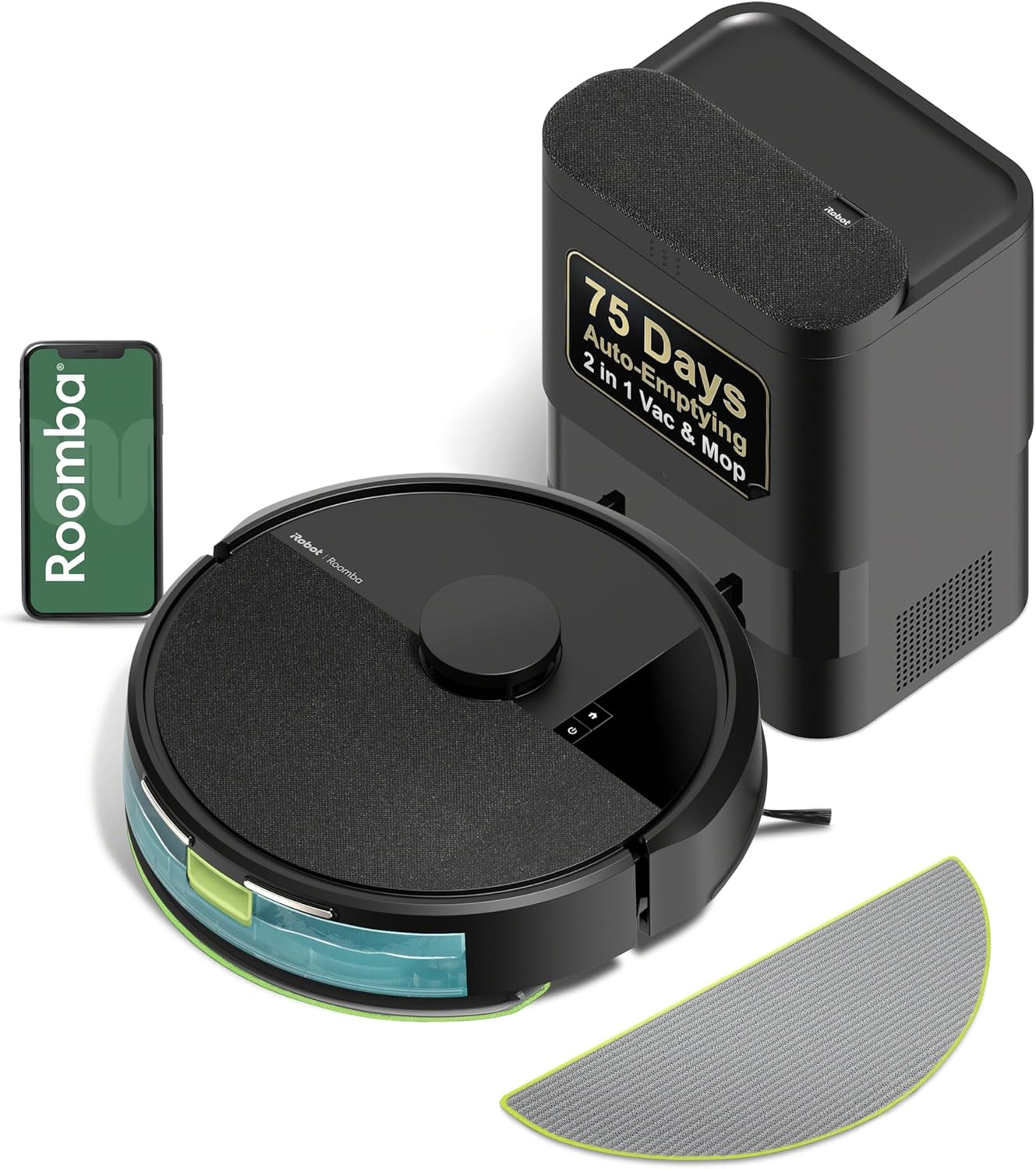
| Other Special Features of the Product | Self-Emptying, LiDAR Navigation, Simultaneous Vacuuming & Mopping |
The Roomba 105 Combo pairs a disc-shaped robot vacuum with a hands-free AutoEmpty dock to reduce routine maintenance in busy homes. It uses ClearView LiDAR mapping to scan and navigate rooms, offers three cleaning modes (vac, mop, or vac-and-mop), and automatically avoids carpet when mopping. The cleaning system combines power-lifting suction, an edge-sweeping brush and a multi-surface brush plus a washable microfiber mop pad and SmartScrub for deeper scrubbing on high-traffic spots. You control it with the iRobot Home app, voice assistants, or onboard buttons and can schedule room-targeted cleans and keep-out zones. Practical benefits include long unattended runtimes thanks to the dock that stores up to 75 days of debris and straightforward app-driven mapping that keeps coverage consistent across floors. Limitations to note are the 100-minute nominal battery runtime which may require mid-day recharges for large two-story homes and the reliance on a 2.4 GHz Wi-Fi network for setup and operation.
Best for: Buyers who prioritize low-maintenance, dependable cleaning automation and want a robot that maps reliably and minimizes how often they need to empty debris.
Less Ideal for: Homes that need long single-run runtime for very large floor plans or owners who prefer a robot with heated pad drying or fully automated pad-washing in the dock.
- AutoEmpty dock holds up to 75 days of debris to minimize hands-on emptying
- ClearView LiDAR mapping provides precise navigation and room mapping
- Combined vacuum-and-mop capability with SmartScrub for deeper scrubbing on hard floors
- Multiple control options including app, voice, and onboard buttons for flexible operation
- 100-minute stated battery life can be short for large or multi-level homes without return-to-dock recharges
- Mopping uses a microfiber pad and manual refill of the robot’s water/solution tank rather than an integrated reservoir system
Verdict: Choose the Roomba 105 Combo when you want reliable, low-touch cleaning with LiDAR mapping and a self-emptying dock to cut down on daily upkeep.
roborock Q7 M5+
| Suction | 10000Pa |
|---|---|
| Dust bag capacity | 2.7 liters |
| Battery life | 150 minutes |
| Navigation | PreciSense LiDAR |
| Noise level | 65 db |
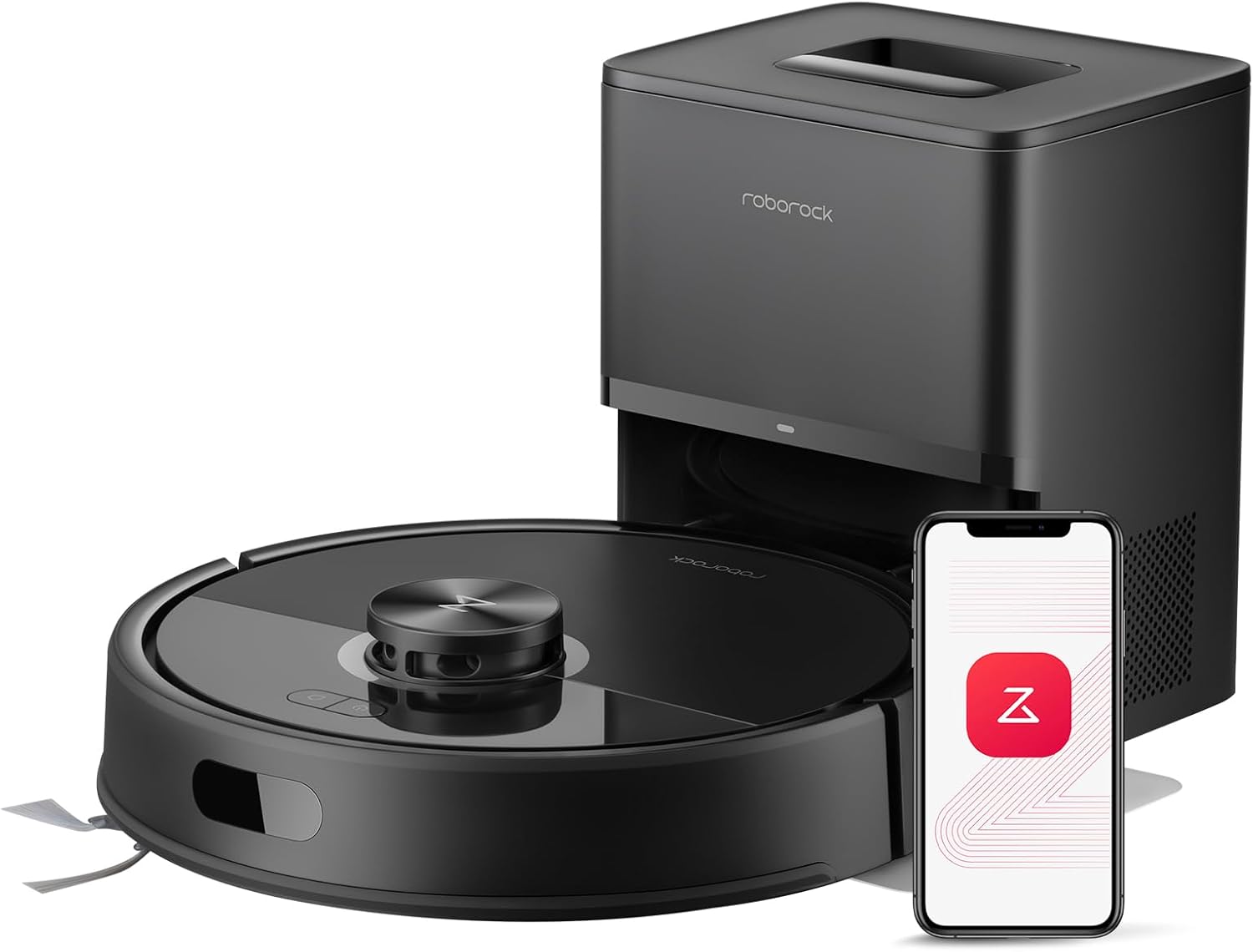
The roborock Q7 M5+ combines powerful suction, LiDAR mapping, and a self-emptying dock to reduce routine maintenance in multi-level homes. It uses PreciSense LiDAR for reliable mapping and multi-level memory, the Roborock app for scheduling and no-go zones, and a 2.7L sealed dust bag in the RockDock Plus for up to 7 to 9 weeks of hands-free emptying. The 10000Pa HyperForce suction and dual anti-tangle brush system target pet hair and debris across hard floors and carpets, while the electronic mop module offers three water-flow settings for light mopping tasks. Runtime is rated at about 150 minutes, which is typically enough to cover a single floor of a two-story house between charges, and the dock supports automatic emptying to cut down on daily upkeep. Limitations include a 65 dB noise level under load and app control that requires 2.4 GHz Wi-Fi, and the mop is better suited for maintenance rather than deep wet-cleaning of floors. For buyers wanting dependable navigation and minimal emptying, this model offers strong practical benefits with a few expected compromises for a robot of this class.
Best for: Buyers who prioritize low-maintenance, reliable navigation and strong suction for pet hair and mixed floors in a two-story home and want a robot that minimizes how often they intervene.
Less Ideal for: If you need a near-silent machine or expect the robot to perform heavy wet mopping, choose a model focused specifically on ultra-quiet operation or dedicated deep-mop systems instead.
- Very high suction power (10000Pa) for deep pick-up on carpets and edges
- Large 2.7L sealed dust bag in the auto-empty dock for up to 7–9 weeks of hands-free emptying
- PreciSense LiDAR navigation with smart mapping and no-go zone support for efficient multi-room cleaning
- Dual anti-tangle brush design reduces hair wrap from pets
- Mopping module is intended for light maintenance rather than heavy wet scrubbing
- App requires 2.4 GHz Wi-Fi which can limit connectivity options
Verdict: Choose the Q7 M5+ when you want powerful suction, LiDAR navigation, and a large auto-empty dock to keep a two-story home cleaner with minimal hands-on maintenance.
eufy C28 Robot Vacuum

| Max suction | 15,000 Pa |
|---|---|
| Battery life | 140 minutes |
| Dust bag capacity | 3 liters |
| Navigation | LiDAR |
The eufy C28 is a floor-care robot that vacuums and mops with minimal user intervention. It uses LiDAR navigation to map rooms and avoid small obstacles while a 15,000 Pa turbo suction motor lifts pet hair and debris from hard floors and short carpets. The HydroJet roller mop spins and self-cleans with a scraper and separated dirty-water tank, and the Omni all-in-one station auto-empties a 3 L dust bag, refills and washes the mop, then hot-dries it to cut mold risk for extended hands-free stretches. Battery life and a 140-minute run time make multi-room cleaning feasible on a two-story home when moved between floors, and the auto-lift feature raises the mop on carpets to prevent wetting. Practical limits include the need to relocate the base between levels for true hands-free cross-floor scheduling and that the included station and robot add bulk compared with stand-alone units. The washable filter and zero-tangle roller reduce maintenance, making this a sensible choice for busy households with pets.
Best for: Buyers who prioritize dependable, low-touch cleaning with strong pet-hair performance and automated maintenance routines for a multi-room home.
Less Ideal for: Homes that need fully autonomous multi-level scheduling without moving the base or users who need a very compact robot and station footprint.
- HydroJet self-cleaning roller mop with scraper keeps the mop cleaner during use
- All-in-one station auto-empties dust, washes and hot-dries the mop, and handles wastewater for up to 75 days
- 15,000 Pa suction boosts pickup on carpets and hard floors
- LiDAR navigation maps rooms and avoids small obstacles without using a camera
- Washable filter and zero-tangle roller reduce routine maintenance effort
- Station plus robot is relatively large and requires relocating between floors for multi-level fully autonomous use
- 48 to 75-day maintenance claim depends on usage and home debris levels
Verdict: If you want a hands-off vacuum-and-mop solution that minimizes daily maintenance—especially in pet households—the eufy C28 delivers powerful suction plus an automated station that largely runs itself.
Choosing the Right Robot Vacuum for 2 Story House: Key Factors to Consider
Navigation & Mapping Accuracy
Reliable navigation determines how consistently a robot vacuum cleans each level. In a two-story house you want mapping technology that recognizes distinct floor plans, preserves multiple saved maps, and follows efficient cleaning routes.
Poor mapping can lead to missed areas, repetitive passes in the same spot, or collisions that frustrate homeowners. Look for systems with LiDAR or advanced camera-based SLAM and an app that clearly displays maps and editable no-go zones.
Battery Capacity and Recharge Strategy
Battery life dictates whether a single charge can cover one or both floors. Longer runtimes let the robot finish larger rooms and reduce the need to carry it between levels.
Also consider recharge behavior: models that automatically return to base, recharge, and resume where they left off are much more convenient for multi-floor cleaning. Battery replacement ease and realistic runtime numbers under typical home conditions matter for long-term ownership.
Multi-Floor Map Management
Managing multiple saved maps is essential when each level has a different layout. Good multi-floor management allows the vacuum to store separate maps, name floors, and automatically switch maps based on where the base is placed or via manual controls in the app.
Without proper map management you will spend time re-mapping or manually guiding the robot whenever you change floors, negating much of the convenience benefit of automation.
Stair and Edge Safety
Stairs are the main safety concern in a two-story house. Effective cliff sensors and edge detection prevent accidental falls and damage.
Sensors should be reliable across varied lighting and floor materials. Additionally, the ability to set virtual barriers or no-go zones keeps the robot away from risky edges near stairwells or landing areas.
Cleaning Performance Across Surfaces
A two-story home often includes a mix of hardwood, tile, rugs, and carpet. Cleaning performance depends on suction, brush design, and how the robot adapts to surface transitions.
Look for adjustable suction or automatic surface detection to maximize pickup on carpets without wasting battery on bare floors. Effective edge cleaning and corner reach are also important for rooms with baseboards and stairs.
Maintenance and Consumables
Maintenance frequency affects the total cost of ownership and daily convenience. Check how easy it is to access and clean brushes, empty dustbins, and replace filters or rollers.
Robots that offer larger dustbins or hands-free emptying options reduce the number of interactions per week. Availability of replacement parts and clear maintenance intervals helps you plan upkeep for a two-story household.
Placing and Moving the Charging Base
Where you place the charging base determines how smoothly a robot vacuum can operate across two floors. If you only have a single base, plan its location near the primary traffic area on the level you want cleaned most often. For true hands-off multi-floor cleaning, consider a base placement strategy that makes switching easy: keep a second base or move the base between levels as needed.
When relocating the base, allow the robot to re-learn or confirm its map so it understands the new home base location. Some models auto-detect the base and switch maps; others require a manual selection in the app. Make small test runs after moving the base to confirm coverage and recharging behavior.
- Place the base on a flat surface with clearance on both sides for unobstructed docking.
- Avoid tight corners or enclosed cabinets that can confuse navigation.
- If you move a base between floors, trigger a mapping or positioning routine to update the saved map.
Setting Up No-Go Zones and Virtual Barriers
Virtual barriers let you protect stairwells and delicate zones without physical gates. Use the app to draw no-go boxes around landings, pet bowls, or fragile furniture that could cause repeated faults.
Some robots also support temporary exclusion areas for parties or renovations. Use these features to avoid unnecessary interruptions and reduce the chance of a run failing mid-clean.
- Create dedicated no-go zones near stair edges and high-traffic landing areas.
- Label saved floor maps clearly so you apply different barriers per level.
- Test barrier placements with short runs to verify the robot respects virtual limits.
Scheduling Strategies for Multi-Level Homes
Schedule cleaning by floor to match daily patterns. For example, set daytime runs on the main living level and evening runs for upstairs bedrooms. Staggered schedules reduce battery strain and make it easier to manage cross-floor tasks.
If you have a robot that supports room-level scheduling, create routines that clean high-traffic rooms more frequently and skip rarely used spaces. This targeted approach saves runtime and keeps key areas consistently tidy.
- Use shorter, more frequent runs on busy floors instead of long single sessions.
- Combine manual spot-cleaning with scheduled full-room passes for efficient coverage.
- Sync schedules with household routines to avoid the robot running during heavy foot traffic.
Handling Obstacles and Stairs During Operation
Keep stair edges and landing clutter-free to help cliff sensors do their job. Small objects, trailing cords, and loose rugs can confuse sensors and lead to unnecessary stops or navigation errors.
Teach family members to return charging bases to a consistent spot and to pick up toys or laundry left on stairs. Simple habit changes significantly reduce the risk of incidents and improve overall cleaning efficiency.
- Secure loose rugs and remove small objects from stair landings before scheduled runs.
- Use cord management to prevent tangles around base areas and thresholds.
- Inspect sensor areas if the robot repeatedly stops near edges; clean sensors according to the manual.
When to Use a Second Unit Versus Moving One Unit
A major convenience decision in two-story homes is whether to operate a single robot that you move between floors or to keep a unit on each floor. A second unit eliminates the need to carry a robot up and down but increases maintenance and initial setup time.
Moving one unit is cost-efficient but requires you to physically relocate the base or the robot. Consider family schedules and the time you realistically want to spend managing the device when deciding between these approaches.
- Two units: ideal for hands-off households with different cleaning needs per level.
- One unit: suitable for smaller homes or when budget and maintenance simplicity are priorities.
- If using one robot, pick a base location and schedule that minimizes how often you need to move it.
How We Chose the Best Robot Vacuum for 2 Story House
We evaluated candidates based on criteria that matter most in multi-level homes. Navigation reliability was a top filter: we prioritized systems that create accurate maps, avoid common obstacles, and return to saved home bases without frequent user intervention. Battery endurance and recharge behavior were critical because two floors often demand longer runtimes or effective partial-clean strategies. Suction and brush systems were assessed for mixed surfaces typical in homes with stairs and varied rooms, such as hardwood, tile, and medium-pile carpet. App features and multi-floor mapping support were required for inclusion; models without reliable multi-level map handling were excluded. Reliability and maintenance factors were considered next, including brush and filter access, scheduled cleaning flexibility, and how often routine upkeep is likely to be needed. We also filtered out devices that lack basic safety features for stairs or do not allow clear control over no-go zones. Finally, we weighted usability aspects such as voice and app integration and the clarity of on-device controls. The result is a list of options suited to different multi-level household priorities rather than a single “best” device for every home.
Our full evaluation process is outlined in our review methodology.
FAQ
Can a robot vacuum clean both floors without remapping?
It depends on the model. Many robots can store multiple maps and switch automatically, but some require manual map selection or remapping when you change floors. Check for explicit multi-floor map support before relying on automatic switching.
Is it better to have two robot vacuums for a two-story house?
Two units remove the need to carry a robot between floors and allow simultaneous cleanings, but they increase maintenance tasks like emptying bins and replacing consumables. Choose based on how hands-off you want the process to be and how often you can perform upkeep.
How do robot vacuums avoid falling down stairs?
Most robots use cliff and edge sensors that detect sudden drops and stop the unit from moving forward. These sensors can be affected by lighting and surface reflections, so regular sensor cleaning and careful placement near landings help maintain reliability.
Will a robot vacuum climb stairs to clean the upper level?
No. Consumer robot vacuums cannot climb stairs. They rely on being carried or moved to the other level or on having a second charging base placed upstairs to operate independently on both floors.
How often should I empty the dustbin in a multi-floor cleaning routine?
Frequency varies with home size and debris levels, but in a two-story house you will likely need to empty more often than in a single-floor home. Empty the bin after large runs or when the app indicates fullness to keep suction performance consistent.
Final Verdict
For two-story homes, prioritize navigation that reliably handles multiple maps, long battery life, and features that prevent stair-related incidents. Decide whether a second unit is worth the added convenience or if you prefer the simplicity of moving one robot between floors. Balance cleaning performance with maintenance needs to find a setup that fits your household routine. Focus on the tradeoffs described above—mapping, runtime, and upkeep—and choose the configuration that minimizes daily friction so your home stays consistently cleaner with less hands-on effort.