
Note: This article contains affiliate links. If you click on these links and make a purchase, we may earn a small commission at no extra cost to you. This helps support our research and content. Read our full affiliate disclosure here.
If you have dark wood, tile, or laminate, choosing a robot vacuum that can reliably see and clean low-contrast surfaces matters. Many robot vacuums struggle with navigation sensors and cliff detection on very dark floors, which leads to missed spots, false cliff warnings, and erratic paths. This guide covers seven carefully shortlisted robot vacuums for dark floors that address those problems through sensor tuning, mapping stability, and suction design. You will find options selected for consistent navigation accuracy, good debris pickup on low-contrast surfaces, and everyday usability. Below we summarize how each pick performs against the factors that matter most when running a robot vacuum on darker flooring, then explain the evaluation criteria and practical setup tips to get the best results.
Top Picks at a Glance
| Best Overall The best all-around choice for most situations | roborock Q10 S5+ |  |
| Best Quality Built to a higher standard if you want something more solid | eufy Omni S2 Robot Vacuum |  |
| Best Value The sweet spot between price and what you get | dreame D30 Ultra CE |  |
| Best Budget The cheapest option that still gets the job done reliably | ILIFE V5s Plus |  |
| Top Rated A top-rated pick with lots of positive feedback | iRobot Roomba 105 Combo |  |
| Most Popular A crowd favorite that many people choose with confidence | roborock Q7 L5 Robot Vacuum |  |
| Best Seller A high-volume bestseller chosen again and again | eufy C28 Robot Vacuum & Mop |  |
roborock Q10 S5+

| Maximum Suction | 10,000Pa |
|---|---|
| Capacity | 2.7 liters |
| Battery Life | 150 minutes |
| Filter Type | Washable |
The roborock Q10 S5+ combines strong suction, a 2.7 L self-emptying dock, and an active mopping system to handle everyday dirt and pet hair across hard floors and carpets. It uses LiDAR mapping and ReactiveTech obstacle avoidance to build detailed maps and navigate around furniture, while multi-level mapping and app controls let you set no-go zones and scheduled runs. The VibraRise 2.0 mopping module applies sonic scrubbing and lifts automatically over carpet, and ultrasonic carpet detection raises the mop to avoid wetting rugs. The included washable filter and dual anti-tangle brush design reduce routine maintenance, and a 150-minute battery life supports longer jobs between charges. Noise and suction settings are adjustable through the app, but the docked system and advanced sensors add complexity compared with simpler models. For dark floors the strong suction and mop scrubbing help remove visible dust and streaks, though you should check mapping and no-go settings to avoid marks from repeated mop passes in high-traffic zones.
Best for: Buyers who want a balanced, feature-rich robot that handles vacuuming and mopping automatically and reduces hands-on maintenance in medium to large homes.
Less Ideal for: People who prefer a very simple, lightweight robot with minimal setup or those who need an ultra-quiet machine for constant daytime running.
- Powerful 10,000 Pa suction lifts embedded dirt and pet hair
- 2.7 L self-emptying dock supports up to about 70 days of hands-free emptying
- LiDAR navigation with multi-level mapping enables precise room mapping and efficient routes
- VibraRise 2.0 sonic mopping with automatic lift avoids wetting carpets while scrubbing floors
- Advanced features and docked system increase setup and maintenance complexity
- Noise level can be noticeable during high-suction or emptying cycles
Verdict: A strong all-rounder that pairs high suction and sonic mopping with self-emptying convenience for hands-off cleaning on dark floors.
eufy Omni S2 Robot Vacuum

| Max suction | 30,000 Pa |
|---|---|
| Battery life | 150 minutes |
| Filtration | AirClean 5-Layer (E11), washable |
| Noise level | 59 db |
| Control | App, Voice, Button |
The eufy Omni S2 is a hybrid robot vacuum and real-time self-cleaning mop built for heavy-duty floor maintenance. It delivers very strong AeroTurbo suction (30,000 Pa) for deep carpet extraction and uses HydroJet 2.0 plus electrolyzed hot water to mop and sterilize hard floors during the run. The included UniClean station automates dust emptying for up to 68 days and washes and dries the mop with hot water and air, which reduces hands-on maintenance. Navigation relies on 3D MatrixEye and a CleanMind AI system to map rooms, avoid small obstacles, and handle thresholds while providing corner-to-edge coverage. Filtration is a multi-cone 5-layer E11 system and the brush design claims zero hair tangles, which helps sustain suction in pet or long-hair homes. Trade-offs are size and complexity: the system is large and the dock and integrated detergent/electrolyzer add installation and upkeep steps compared with a simple robot vacuum, and full automation requires a 2.4 GHz Wi-Fi setup.
Best for: Buyers who prioritize cleaning performance and automation on mixed surfaces and want a robot that deep-cleans carpets and sanitizes dark hard floors with minimal daily intervention.
Less Ideal for: People who need a compact, simple robot for small apartments or who prefer minimal setup and fewer dock-mounted systems.
- Very high suction power for deep carpet cleaning (30,000 Pa).
- HydroJet 2.0 plus electrolyzed hot water provides in-run mop cleaning and claimed 99.99% germ removal on hard floors.
- UniClean auto-clean station self-empties dust up to 68 days and washes/dries the mop to cut routine maintenance.
- 3D MatrixEye navigation and CleanMind AI map rooms, avoid small obstacles, and enable targeted room scheduling.
- Large unit and docking station require significant floor space and may be bulky in tight homes.
- Full feature set depends on dock functions and Wi-Fi setup, adding installation steps compared with basic robots.
Verdict: If you want top-tier suction plus a self-cleaning mop and automated dock for thorough, low-touch cleaning of dark floors, the Omni S2 delivers.
dreame D30 Ultra CE

| Suction | 25,000Pa |
|---|---|
| Dust capacity | 3.2 liters |
| Battery life | 180 minutes |
| Control method | App, Voice |
| Special features | Auto Dust Empty & Mop Cleaning |
The dreame D30 Ultra CE is a high‑suction robot vacuum that combines vacuuming and powered mopping with a multifunction base that auto‑empties, washes and dries mop pads, and performs periodic maintenance tasks. It is typically used as a set‑and‑forget floor care hub: you map rooms in the app, schedule zone cleans or pet modes, and the robot handles dust disposal into a 3.2L bag while the base self-cleans the mops and dries them to limit odors. Key features are 25,000Pa suction with five power levels, a DuoScrub mopping system with 20 spray nozzles and a 0.41in mop lift for carpets, smart obstacle avoidance and mapping, and long run times for larger homes. For dark floors specifically, the fixed LDS navigation and obstacle sensors perform reliably in dim light so the robot maintains coverage without relying on visible-contrast cues. Expect quieter, low‑touch maintenance and strong pickup of pet hair and debris, but note the system is sized with a large base station and requires 2.4 GHz Wi‑Fi; the unit is designed for indoor use and may be overkill for very small apartments.
Best for: Buyers who want to minimize hands‑on upkeep and prioritize strong vacuuming plus powered mopping for whole‑home cleaning on dark floors, and who value configurable schedules and smart maps.
Less Ideal for: Those with very small living spaces or without room for a large base station, or users who need dual‑band Wi‑Fi support and simpler, compact vacuums.
- Very strong 25,000Pa suction with five power levels for stubborn debris
- All-in-one base that auto empties, washes and hot‑air dries mop pads for low maintenance
- Large 3.2L dust bag and 100‑day auto empty capability reduce how often you touch dirt
- DuoScrub mopping plus automatic mop lift protects carpets and improves mopping effectiveness
- App and voice control with mapping, no‑go zones, and pet/carpet modes for targeted cleaning
- Only supports 2.4 GHz Wi‑Fi which may limit some network setups
- Large base station requires significant floor space and may not fit tight corners
Verdict: If you want a low‑touch, high‑suction robot that combines powerful vacuuming with automated mop washing and drying, the D30 Ultra CE is a strong choice for maintaining dark floors with minimal effort.
ILIFE V5s Plus

| Battery Life | 110 minutes |
|---|---|
| Capacity | 300 ml |
| Controller Type | App, Voice, Remote Control |
| Compatible Devices | Amazon Echo, Google Home |
The ILIFE V5s Plus is a slim robotic vacuum that combines vacuuming and mopping for routine floor care, controlled via remote, app, or voice assistants. It offers five cleaning modes including spot and edge, a 300 ml water/dust capacity, and up to 110 minutes runtime so it can handle daily cleaning sessions across hard floors and low-pile carpet. The unit navigates with basic sensors to avoid drops and reduce collisions and returns to its charging base automatically when the battery runs low. Practical strengths are its compact height for reaching under furniture, scheduled cleaning for hands-off maintenance, and app and voice integration for remote starts. Limitations include modest suction compared with higher-end models and a simple navigation system that may miss tight corners or require occasional unsticking around clutter. The mop function is suitable for light spills and surface cleaning but not heavy scrubbing. For buyers on a budget who want a combined vacuum-and-mop that works well on hard surfaces and dark floors with minimal setup, this is a sensible choice.
Best for: Buyers prioritizing an affordable, no-frills robot that maintains hard floors and light carpets with easy remote or voice control and scheduled cleaning.
Less Ideal for: People who need powerful deep-clean suction, advanced obstacle/mapping navigation, or heavy-duty mopping performance.
- 2-in-1 vacuum and mop combo for regular surface cleaning
- App, remote, and voice control for convenient hands-off operation
- Slim profile fits under low furniture and baseboards
- Up to 110 minutes runtime with automatic return-to-charge
- Multiple cleaning modes including spot, edge, and scheduled cleaning
- Navigation uses basic sensors rather than advanced mapping so coverage can be uneven
- Suction and mop capacity are modest compared with premium models
Verdict: A budget-friendly vacuum-and-mop that reliably keeps hard floors tidy with simple app and voice controls.
iRobot Roomba 105 Combo
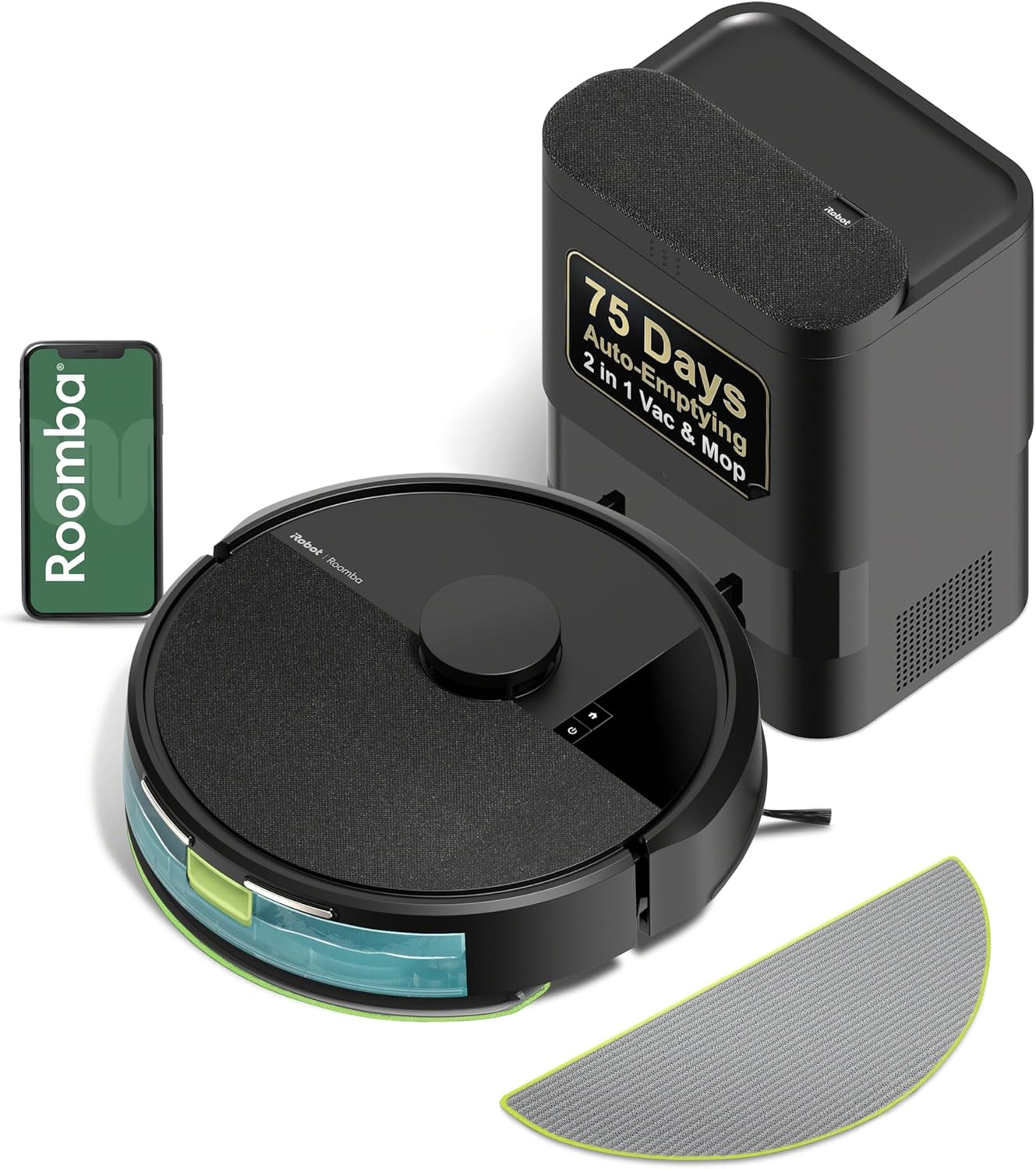
| Battery Life | 100 minutes |
|---|---|
| Surface Recommendation | Carpet & Hard Floor |
| Other Special Features | LiDAR Navigation, Self-Emptying, Simultaneous Vacuuming & Mopping |
| Controller Type | App Control, Button Control, Voice Control |
| Filter Type | Cartridge |
The Roomba 105 Combo pairs a Roomba robot with an AutoEmpty dock to reduce hands-on maintenance for weeks at a time while offering vacuum-and-mop cleaning for hard floors. It maps rooms with ClearView LiDAR, navigates around obstacles, and detects rugs to avoid mopping carpets automatically, so you can schedule or run spot cleans from the app or with voice commands. The cleaning system combines intense suction, an edge-sweeping brush and a microfiber mop pad with a micro-pump that meters water for uniform mopping and a SmartScrub option for deeper scrubbing in high-traffic areas. The AutoEmpty dock holds up to 75 days of debris in a disposable bag, which greatly cuts down on frequent bin emptying. Expect routine maintenance like brush cleaning and filter changes every few months, and battery run time around 100 minutes can limit coverage on very large homes without recharging. For dark floors the mop plus suction leaves a consistent finish, but you should avoid using on rugs while mopping since it smartly steers clear of carpeted areas.
Best for: Buyers who prioritize dependable, low-touch cleaning routines and want a robot that reliably maps and avoids carpets while keeping hard floors consistently clean with minimal daily upkeep.
Less Ideal for: People who need very long single-run runtimes for large homes or who prefer a fully bagless, non-disposable dust containment system.
- AutoEmpty dock holds up to 75 days of debris for low-maintenance use
- ClearView LiDAR mapping provides precise navigation and room mapping
- Combined vacuum and microfiber mopping with metered water and SmartScrub for deeper cleaning
- App, button, and voice control let you schedule and start cleans easily
- Around 100 minutes battery life may not cover very large homes on a single run
- Uses disposable bags for the AutoEmpty dock which require replacement over time
Verdict: Choose this Roomba if you want a low-maintenance, self-emptying robot that reliably vacuums and mops hard floors while mapping and avoiding carpets.
roborock Q7 L5 Robot Vacuum

| Suction | 8,000 Pa |
|---|---|
| Navigation | LiDAR |
| Battery life | 150 minutes |
| Water tank capacity | 270 ml |
| Filter type | Washable |
The roborock Q7 L5 is a LiDAR-guided robot vacuum that vacuums and mops in a single run, using an integrated 270 ml water tank and up to 8,000 Pa suction to handle dust and pet hair on hard floors and low‑pile carpet. It maps rooms with multi-floor support and quick mapping so you can set scheduled cleans, no-go zones, and targeted room runs from the Roborock app or with voice assistants. Practical features include a dual anti-tangle brush system that reduces hair wrap, carpet boost that increases suction where needed, washable filters, and a child lock. For hardwood floors the precise navigation and along-floor-direction cleaning reduce repeated passes and the electronic water control offers three water levels to avoid over-wetting. Limitations to note are the combined dustbin/water-tank design which means you cannot refill water without handling the combo unit, and the robot requires a 2.4 GHz Wi‑Fi connection for full app features.
Best for: Buyers who prioritize reliable, predictable cleaning on hardwood and want a robot that follows precise maps, runs on a schedule, and minimizes hair-related maintenance.
Less Ideal for: People who need separate, large-capacity water or dust tanks for long runs without handling the unit frequently or who cannot provide a 2.4 GHz Wi‑Fi network.
- LiDAR mapping and multi-floor mapping for accurate, efficient coverage
- Strong 8,000 Pa suction with carpet boost for better pickup of dust and pet hair
- Dual anti-tangle brushes minimize hair wrap and maintenance
- Electronic water tank with three water levels lets you control mop moisture
- App control plus Alexa and Google Home compatibility for scheduled, hands-free operation
- Integrated dustbin and water tank is a single combo part, which adds steps when refilling or emptying
- Requires 2.4 GHz Wi‑Fi for app connectivity, which may need router changes for some homes
Verdict: A strong‑suction, LiDAR‑mapped vacuum‑and‑mop that reliably cleans hardwood with low hair maintenance and smart app controls.
eufy C28 Robot Vacuum & Mop

| Suction | 15,000 Pa |
|---|---|
| Mop system | HydroJet roller mop |
| Capacity | 3 liters |
| Battery life | 140 minutes |
| Navigation | LiDAR |
The eufy C28 is a full-featured robot vacuum and mop designed for regular floor care with minimal intervention. It uses LiDAR navigation to map rooms and avoid obstacles while a 15,000 Pa turbo suction lifts dust, pet hair, and debris from hard floors and short carpets, and the HydroJet roller mop provides continuous self-cleaning to remove marks and paw prints. The included Omni station auto-empties dust into a 3 liter reservoir, refills and washes the mop, and hot-dries components to reduce odors and mold risk, so you can run weeks of cleaning without touching the robot. App and voice control let you schedule cleans and tailor zones, and washable filters cut long-term replacement costs. Trade-offs to consider are the size and weight of the base unit and robot, which require a dedicated spot, and that advanced features like hot drying and mop washing mean more moving parts that could need occasional service. For dark floors the strong suction and mop system help remove visible streaks and hair, though you should keep an eye on settings to avoid leaving streaks if using too much cleaning solution.
Best for: Buyers who want near hands-free, reliable floor cleaning on hard and dark floors and value privacy-safe navigation and long intervals between maintenance.
Less Ideal for: People who need a compact, lightweight robot for tight storage spaces or those who prefer the simplest possible robot without an advanced service station.
- 15,000 Pa turbo suction effective on hard floors and short carpets
- HydroJet self-cleaning roller mop that scrubs and prevents marks
- All-in-one Omni station auto-empties, auto-washes mop, refills tank, and hot-dries to reduce maintenance
- LiDAR navigation with obstacle avoidance for reliable mapping without cameras
- Washable filter and app/voice control for flexible scheduling and lower ongoing costs
- Omni station and robot are relatively large and need dedicated floor space
- More complex station features increase the number of components that may require service over time
Verdict: If you want a privacy-minded, heavy-duty robot that vacuums and self-washes its mop with long hands-free intervals, the eufy C28 is a strong choice for dark floors.
Choosing the Right Robot Vacuum for Dark Floors: Key Factors to Consider
Navigation System and Sensor Types
Dark floors change how optical and infrared sensors perceive edges and obstacles. Robots with multiple redundant sensors or LIDAR-style mapping typically handle low-contrast surfaces better because they do not rely solely on reflected light. Sensor placement also matters; units that keep cliff sensors recessed or shielded are less likely to trigger false positives on glossy or very dark finishes.
When assessing navigation, consider whether the robot creates a consistent floor map and can follow repeatable paths. Reliable mapping reduces missed spots and prevents the robot from getting stuck in corners where visual cues are minimal.
Cliff Detection and False Positive Avoidance
A robot that mistakes a very dark floor for a drop-off will stop and back away frequently, which interrupts cleaning and wastes battery. Look for devices with proven cliff detector performance on low-reflectivity surfaces or with adjustable sensitivity settings so you can tune detection for your flooring.
Also consider whether the robot can learn and adapt after initial runs. Some systems will calibrate to floor darkness during setup or offer firmware updates that improve cliff detection behavior; that adaptability can be especially valuable on very dark or high-gloss floors.
Suction, Brush Design, and Debris Pickup
Dark floors can hide fine dust and pet hair more easily, so suction power and brush engineering become more important than appearance-based detection. A stronger airflow and a well-designed main brush helix or rubberized bristles will agitate and lift particles rather than smear them across the surface.
Consider how the edge brush interacts with baseboard gaps and whether the robot offers different cleaning modes for concentrated suction in high-traffic areas. Filtration and dustbin capacity also matter because fine debris on hard floors can fill small bins quickly.
Battery Life and Area Coverage
Robots that need to recharge mid-clean can leave patches of floor unvacuumed if they do not return to the exact spot. For medium to large homes with extensive dark-floor areas, prioritize longer runtime or dependable resume-and-return behavior so cleaning completes in a single session.
Battery chemistry impacts long-term capacity too. If you run daily cycles on large dark-floor zones, choose a unit with efficient pathing and a battery size rated to handle your typical square footage without multiple interruptions.
Software, Mapping Flexibility, and Updates
Good mapping software lets you set no-go zones, schedule targeted cleanings, and refine room boundaries. On dark floors, where physical checkpoints and visual beacons are limited, software assists like virtual walls and multi-floor mapping keep the robot focused and prevent repeated errors.
Check whether the manufacturer regularly issues firmware updates and whether the app allows sensitivity adjustments for sensors. Software that supports manual map editing means you can correct mapping mistakes made during early runs on low-contrast surfaces.
Ease Of Maintenance and Long-Term Reliability
Robots used on dark hard floors will still need routine care: cleaning cliff sensors, untangling hair from brushes, and emptying the dustbin. Choose models with accessible brush compartments and clear maintenance indicators so upkeep is quick and painless.
Filters and replaceable parts should be easy to source and swap. A design that minimizes frequent sensor obstructions and has simple user-accessible brushes reduces the chance of degraded performance over months of regular use.
Why Dark Floors Challenge Robot Vacuums
Very dark or glossy floors absorb more light and change the signal returned to optical sensors. That can confuse cliff sensors, which are often tuned for mid-tone surfaces, and make obstacles harder to distinguish from the floor itself. Random navigation robots tend to show this problem most vividly because they lack consistent mapping context.
Additionally, dust and debris contrast differently on dark floors, so some dirt may be harder for downward-facing cameras to detect. That makes mechanical pickup and suction more important than camera-based dirt detection when your primary floor surfaces are dark.
- Lower reflectivity can trigger false cliff warnings
- Visual dirt detection is less reliable on dark surfaces
- Path consistency and mechanical pickup reduce missed spots
Setup Tips To Improve Performance On Dark Floors
Position lighting so the robot's sensors have consistent ambient illumination during cleaning. Avoid sharp shadows and direct glare that can create false edges. If your robot has an initial calibration routine, run it in the room where you plan to use the device so it can adapt before full cleaning cycles.
Clean cliff sensors and bumper areas weekly during the first month of use to remove dust that can skew readings. If the app supports sensitivity settings or an initial mapping run, use those tools to let the robot learn the floor characteristics rather than relying solely on default behavior.
- Run a dedicated mapping or calibration pass before everyday cleaning
- Keep cliff sensors free of dust and residue
- Use consistent overhead lighting during cleaning when possible
When To Prefer LIDAR or Multi-Sensor Systems
If your home has large expanses of dark flooring, prefer robots with LIDAR or multi-sensor navigation because they are less dependent on reflected light. These systems build geometric maps and can localize the robot even when visual contrast is low, producing more efficient cleaning paths and fewer false-positives.
Multi-sensor robots also tend to recover better from unexpected obstacles and complete coverage more predictably than those with only camera-based navigation on dark surfaces.
- LIDAR reduces reliance on floor reflectivity
- Redundant sensors improve obstacle and cliff detection
- Better mapping yields fewer missed zones and repeat cleaning
Practical Maintenance Routines
Create a short weekly maintenance checklist: empty the dustbin, inspect and clean the main brush and side brushes, and wipe cliff sensors with a soft cloth. For homes with a lot of pet hair, check brush bearings and hair wrap points more often to avoid traction loss.
Replace filters on the schedule recommended by the manufacturer and keep spare side brushes available. Regular upkeep prevents small issues from becoming performance problems, which is especially important when sensors are already challenged by dark surfaces.
- Weekly: empty bin, clean brushes, wipe sensors
- Monthly: inspect bearings and replace filters as needed
- Have spare small parts on hand for quick swaps
Adapting Cleaning Habits for Dark Floors
Running the robot during consistent daylight hours or under steady overhead lighting helps sensors perform more reliably. If your robot supports scheduled runs, set them for times when lighting is predictable. For spot-cleaning busy entryways, use targeted cleaning zones rather than whole-home cycles to concentrate suction where it is needed.
Consider running a higher-suction mode for high-traffic periods and a quieter mode for daily maintenance. This balance preserves battery life while ensuring deep pickup when necessary.
- Schedule runs during consistent lighting
- Use spot or boosted modes for heavy-traffic areas
- Balance runtime and suction by mixing modes
How We Chose the Best Robot Vacuum for Dark Floors
We prioritized real-world behaviors that make a robot vacuum dependable on dark floors rather than headline specs alone. Our selection criteria emphasized navigation system design and sensor reliability because these determine whether a unit can map and clean low-contrast surfaces without frequent false cliff detections. We also weighed suction and brush design to ensure small and large debris are picked up despite darker backgrounds that can hide material visually. Battery runtime and recharge behavior were considered to match typical home sizes so a robot can finish runs on larger floor plans. Ease of setup and maintenance was included because frequent sensor cleaning or fiddly calibration negates good hardware. Noise and daily usability factors influence whether the vacuum will actually be used regularly on hard floors. Finally, we excluded models whose manufacturers explicitly list poor performance or known sensor failures on very dark surfaces, and we did not include devices that lack mapping or have only basic random navigation because those approaches usually worsen coverage on dark floors. The result is a group of units that balance reliable detection, cleaning mechanics, and practical upkeep for darker flooring environments.
Our full evaluation process is outlined in our review methodology.
FAQ
Will a robot vacuum scratch or damage dark wood floors?
Most robots designed for hard floors are safe when used properly. Avoid abrasive cleaners on the wheels and ensure side brushes are intact. Regularly check wheel treads and keep floors free of sand and grit that can cause micro-abrasions.
How do I reduce false cliff detections on a very dark floor?
Try increasing ambient lighting during cleaning and running an initial calibration or mapping pass if available. Clean the cliff sensors and check whether the app allows lowering sensitivity. Placing small reflective markers near real drop-offs is usually not necessary and can be risky.
Are camera-based robots worse on dark floors than LIDAR models?
Camera-based systems can struggle more on low-contrast surfaces because they rely on visual features. LIDAR and multi-sensor systems generally perform better in those conditions, but good software tuning and sensor redundancy can make camera-based robots acceptable for many homes.
How often should I clean sensors and brushes when using the robot on dark floors?
Inspect and clean cliff sensors and the main brush weekly during the first month, then adjust frequency based on performance. Homes with pets or heavy foot traffic often need more frequent maintenance to keep sensors and brushes operating well.
Will firmware updates improve dark-floor performance?
Often they can. Manufacturers release firmware that refines sensor thresholds and navigation algorithms. Check for updates during setup and periodically thereafter to benefit from improved cliff detection and mapping behavior.
Final Verdict
When choosing a robot vacuum for dark floors, prioritize reliable navigation and cliff detection first, then look at suction and brush design to ensure real pickup of hidden debris. Battery life and software flexibility determine whether the robot can complete jobs and adapt to your layout, while easy maintenance keeps performance steady over time. Focus on models that offer multi-sensor navigation or proven calibration options, and be prepared to do a short setup and regular upkeep. With the right combination of sensor reliability and mechanical pickup, you can have a robot that cleans dark floors effectively and consistently.