
Note: This article contains affiliate links. If you click on these links and make a purchase, we may earn a small commission at no extra cost to you. This helps support our research and content. Read our full affiliate disclosure here.
If you have multiple flooring types and small thresholds between rooms, a robot vacuum that handles floor transitions reliably will save you time and reduce interruptions. Choosing the right robot vacuum matters because some units struggle with carpet edges, rugs, or door thresholds and can get stuck or lose suction during climbs. This guide narrows the field to seven top contenders that excel at crossing transitions while keeping cleaning consistent across hard floors, rugs, and low rises. We shortlisted options that balance clearance, traction, and navigation intelligence, and we evaluate each against practical, real-world criteria so you can pick a unit that fits your home layout and cleaning routine.
Top Picks at a Glance
| Best Overall The best all-around choice for most situations | iRobot Roomba 105 Vac |  |
| Best Quality Built to a higher standard if you want something more solid | roborock Saros 20 |  |
| Best Value The sweet spot between price and what you get | ILIFE A30s Robot Vacuum |  |
| Best Budget The cheapest option that still gets the job done reliably | ILIFE V2 Robot Vacuum |  |
| Top Rated A top-rated pick with lots of positive feedback | WSUANE D15S Max Robot Vacuum |  |
| Most Popular A crowd favorite that many people choose with confidence | iRobot Roomba 105 Combo |  |
| Best Seller A high-volume bestseller chosen again and again | roborock Q10 S5+ |  |
iRobot Roomba 105 Vac

| Surface Recommendation | Carpet & Hard Floor |
|---|---|
| Battery Life | 200 minutes |
| Other Special Features of the Product | Anti-Fall, Bagless, Dirt Detection Sensor, Eco Mode, LiDAR Navigation |
| Controller Type | App Control, Button Control, Voice Control |
| Filter Type | Cartridge |
The Roomba 105 Vac is a home-oriented robot vacuum that uses ClearView LiDAR to map rooms and navigate in neat rows while avoiding obstacles and stairs. It offers four suction levels and a 3-stage cleaning system with a multi-surface brush and edge-sweeping bristle to pull dirt from carpets and hard floors, plus spot-cleaning for concentrated messes. Setup and control happen through the Roomba Home app, on-device buttons, or voice assistants, and the robot returns to its dock to recharge and resume cleaning. Practical benefits include customizable room scheduling, keep-out zones in the app, and long runtime supported by a lithium-ion battery. Limitations to note are the lack of an auto-empty base and that higher suction levels may require more frequent maintenance like brush and filter cleaning; taller furniture clearance and very high-pile carpets could still challenge a compact robot of this size. For households focused on consistent day-to-day floor care and smooth transitions between hard floors and low to medium-pile carpets, this model covers the essentials without premium extras.
Best for: Buyers who want reliable, app-driven daily cleaning that handles both hard floors and low to medium-pile carpets with predictable navigation and simple controls.
Less Ideal for: People who want a fully hands-off system with auto-emptying or those with very high-pile carpeting, large homes requiring advanced obstacle recognition, or specialized deep-clean needs.
- ClearView LiDAR mapping for efficient room coverage and obstacle avoidance
- Four suction power levels let you match cleaning intensity to the mess
- App and voice control with scheduling and keep-out zone options
- Multi-stage cleaning with edge-sweeping brush improves corner and edge pickup
- No hands-free auto-empty docking base included
- May need more frequent brush and filter maintenance at higher suction settings
Verdict: A straightforward, app-controlled robot that uses LiDAR mapping and adjustable suction to reliably maintain mixed hard floor and carpeted homes without premium extras.
roborock Saros 20

| Suction | 36,000 Pa |
|---|---|
| Threshold clearance | 3.46 in double-layer |
| Minimum height clearance | As low as 3.13 inch |
| Battery life | 180 minutes |
| Filter type | Washable Filter |
The roborock Saros 20 is a high-performance robot vacuum and mop designed to handle mixed flooring and frequent transitions. It uses StarSight 3D navigation and an RGB camera to map rooms and detect over 300 common obstacles, which reduces interruptions and improves coverage. The AdaptiLift Chassis raises the body to climb double-layer thresholds up to 3.46 inches while its slim 3.13-inch height lets it reach under low furniture. A 36,000 Pa digital motor provides strong suction for pulling dirt and pet hair from carpets and gaps, and a dual anti-tangle system limits brush clogs. The RockDock auto-dock offers heated water washing and hot-air drying for the mop plus extended auto-emptying and self-maintenance to minimize hands-on care. Typical use is scheduled whole-home cleaning via the Roborock app or voice commands, with SmartPlan adapting routes over time. Expect excellent transition handling and edge cleaning, though the unit is relatively large and heavier than some alternatives and relies on the app for advanced setup and customization.
Best for: Buyers who prioritize strong cleaning performance and reliable floor-to-floor transitions and want a largely hands-off, app-driven robot that climbs high thresholds and cleans under low furniture.
Less Ideal for: People who need an ultra-light, minimalist robot for very small apartments or who prefer a simple plug-and-play device without app setup or advanced docking features.
- AdaptiLift Chassis climbs double-layer thresholds up to 3.46 inches for uninterrupted cleaning across rooms.
- StarSight 3D navigation with RGB camera recognizes many obstacles for fewer stops and more complete coverage.
- Very high 36,000 Pa suction power for deep carpet and gap cleaning.
- Slim 3.13-inch profile reaches under low furniture to remove hidden dust and pet hair.
- RockDock auto-dock provides hot-water wash, hot-air drying, and extended auto-emptying for hands-free maintenance.
- Relatively heavy and larger footprint compared with ultra-compact robot vacuums.
- Advanced features depend on the app and initial mapping for best results.
- High suction and complex dock may increase maintenance complexity if service is needed.
Verdict: Choose the Saros 20 when you need a performance-focused robot that reliably climbs high thresholds and delivers powerful, hands-free cleaning across mixed floors.
ILIFE A30s Robot Vacuum

| Max Suction | 10000 Pa |
|---|---|
| Battery Life | 150 minutes |
| Dustbin Capacity | 450 ml |
| Navigation | LiDAR (SLAM) |
| Connectivity | 2.4GHz WiFi, App, Alexa, Google Assistant |
The ILIFE A30s is a navigation-first robot vacuum that uses LiDAR mapping and SLAM to plan efficient cleaning paths while delivering strong suction for pickup on both hard floors and carpets. You control it with the ILIFE Clean app (2.4GHz WiFi), a simple included remote, or voice commands through Alexa or Google Assistant, and the app supports no-go zones, room-specific runs, schedules, and suction adjustments. Practical additions for pet households include a dual anti-tangle brush and a 450 ml dustbin capacity, and the unit runs up to 150 minutes between charges with automatic return-to-dock recharge. Noise is listed around 72 dB and the vacuum is vacuum-only, so it does not mop. For floor transitions the LiDAR mapping and planned routes reduce missed edges and improve pathing across mixed surfaces, but the unit has only two power levels and may require manual help with very high thresholds or deep-pile rugs. Regular upkeep of the cartridge filter and brushes keeps performance steady.
Best for: Buyers who want a mapping-focused robot that reliably navigates mixed hard floors and low- to medium-pile carpets and value strong suction and pet-hair handling in everyday cleaning routines.
Less Ideal for: If you need a combined vacuum-and-mop solution or you rely on very quiet operation during daytime cleaning, this model is not the best choice.
- LiDAR navigation with SLAM for accurate mapping and efficient cleaning paths
- High maximum suction (up to 10,000Pa) for lifting dirt and pet hair from carpets and hard floors
- App control with no-go zones, room scheduling, and suction adjustment
- Dual anti-tangle brush designed to reduce hair wrap for pet households
- Long runtime up to 150 minutes and automatic recharge
- Vacuum-only design with no mopping capability
- Only two listed power levels, which may limit fine-grained suction control
- Noise level around 72 dB may be noticeable during cleaning
Verdict: Choose the A30s if you want LiDAR mapping and strong suction to keep mixed-floor homes and pet areas consistently cleaner with minimal supervision.
ILIFE V2 Robot Vacuum

| Battery Life | 120 minutes |
|---|---|
| Capacity | 300 ml |
| Filter Type | Sponge |
| Control Method | Remote |
| Noise Level | 69 db |
The ILIFE V2 is an entry-level robot vacuum built to keep hardwood and other hard floors tidy without a lot of fuss. Its 2.99-inch slim body fits under low furniture while a tangle-free suction port and sponge filter make it practical for homes with pet hair. You can run scheduled cleanings, switch between auto, spot and edge modes, or start jobs with the included remote control or the single-button on the unit. A 300 ml dustbin and up to 120 minutes of runtime let it cover medium rooms on one charge, and it will automatically return to the dock when the battery is low. Noise is noticeable at 69 dB and there is only one power level, so it lacks adjustable suction or app-based controls, but for straightforward floor maintenance on hardwood and low-pile carpet the V2 delivers solid value at an affordable price.
Best for: Buyers who want an affordable, no-frills robot to maintain hardwood and low-pile carpet cleanliness with simple controls and scheduled runs.
Less Ideal for: Those who need strong adjustable suction, smart app control, or advanced mapping for large or complex homes should consider higher-end models.
- Slim 2.99-inch profile cleans under low furniture
- Tangle-free suction port suited for pet hair
- 120 minutes runtime with automatic return-to-dock
- Multiple cleaning modes (auto, spot, edge) and simple remote control
- Single power level limits suction control for heavier debris
- No smartphone app or advanced navigation features
Verdict: A low-cost, slim robot vacuum that reliably maintains hardwood floors and handles pet hair for budget-focused buyers.
WSUANE D15S Max Robot Vacuum

| Suction | 10000Pa (max) with Auto Boost |
|---|---|
| Dustbin Capacity | 3.5 liters (self-emptying station) |
| Navigation | dToF LiDAR mapping with no-go zones |
| Battery Runtime | Up to 160 minutes (Quiet Level) |
The WSUANE D15S Max is a LIDAR-guided robot vacuum and mop built to handle hard floors and carpets while minimizing hands-on maintenance. It maps rooms with dToF LiDAR for precise routing and lets you set no-go zones and targeted cleaning through the app, so it navigates thresholds and transitions predictably. The 10,000Pa brushless motor and four suction levels (including Auto Boost for carpets) provide strong pickup for pet hair and debris, while a blade-equipped roller reduces hair tangles. The included 3.5L self-emptying dock stores weeks of dirt for low-intervention use, and the 3200mAh battery delivers up to 160 minutes in quiet mode for larger spaces. Practical trade-offs are typical for feature-rich models: the unit lists a 70 dB noise level at higher powers and the hair-cutting function works only after runs, so very heavy tangles may still need occasional manual attention. For homes with a mix of floor types and pets, the D15S Max focuses on reliable mapping and long unattended runtimes to keep floors consistently clean.
Best for: Buyers who prioritize hands-off, reliable cleaning across mixed floor surfaces and want strong mapping and long unattended runtime to minimize daily maintenance.
Less Ideal for: People who need an ultra-quiet unit for frequent night cleaning or those who prefer immediate, manual brush-maintenance workflows.
- Accurate dToF LiDAR mapping with no-go zone support for consistent navigation across thresholds
- Very high peak suction (10,000Pa) plus Auto Boost for better carpet performance
- 3.5L self-emptying station reduces how often you touch dust for extended hands-off operation
- Anti-tangle, blade-equipped roller brush designed to cut hair and limit brush maintenance
- Long runtime up to 160 minutes in quiet mode for cleaning larger areas on a single charge
- Noise can reach about 70 dB on higher suction settings
- Hair-cutting mechanism activates after cleaning so stubborn tangles may require follow-up maintenance
Verdict: Choose the D15S Max if you want a hands-off robot that reliably maps floor transitions and runs long enough to clean large, mixed-floor homes with pets.
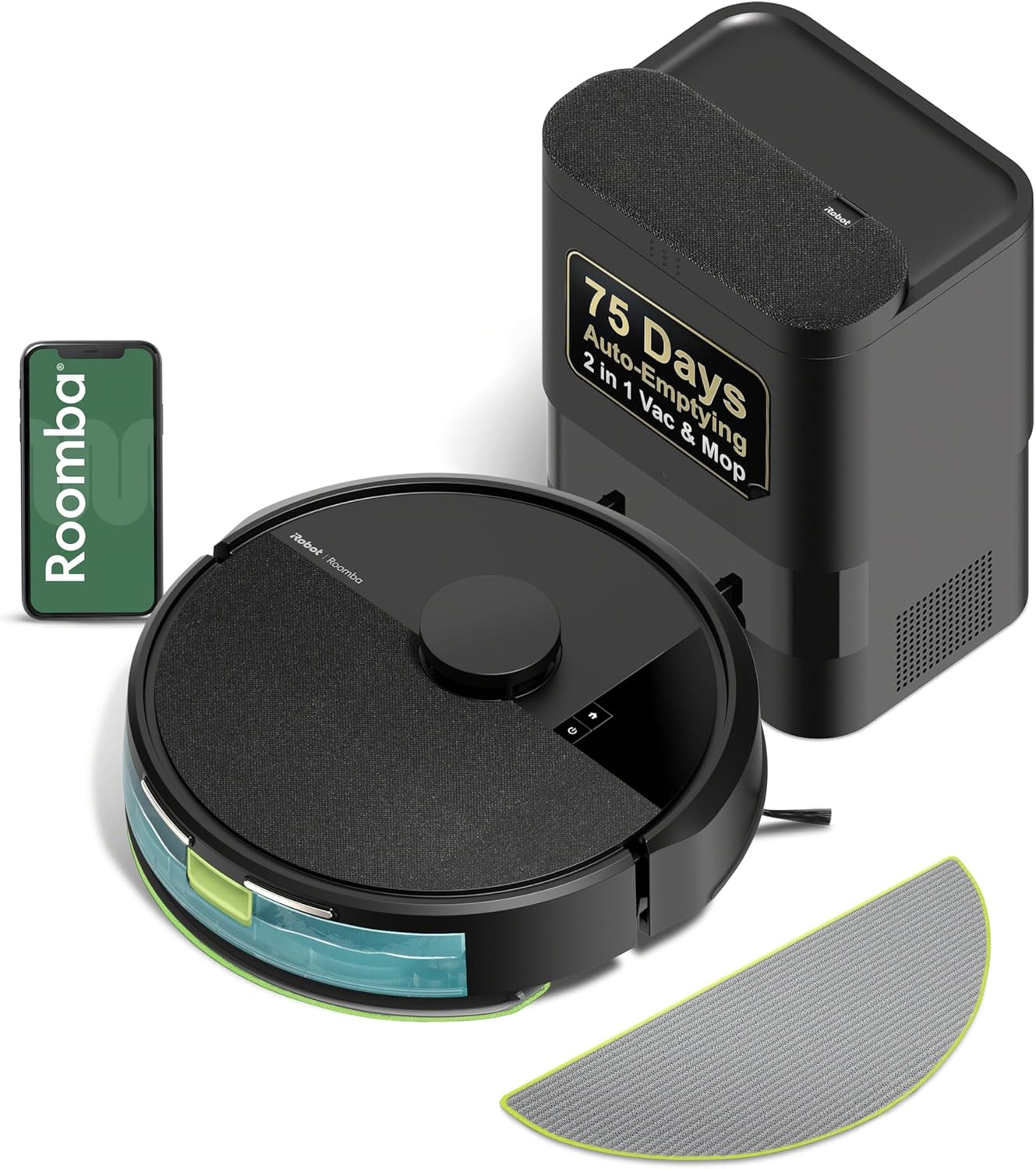
iRobot Roomba 105 Combo
| Battery Life | 100 minutes |
|---|---|
| Surface Recommendation | Carpet & Hard Floor |
| Control Method | App, Touch, Voice |
| Filter Type | Cartridge |
The Roomba 105 Combo is a disc-shaped robot that vacuums and mops in a single run while using ClearView LiDAR to map and navigate rooms. It offers three cleaning modes — vacuum, mop, or vacuum-and-mop — and automatically avoids carpet when mopping so rugs stay dry. iRobot combines a multi-surface brush, an edge-sweeping brush, and a microfiber mop pad driven by a micro-pump for controlled water flow and optional SmartScrub deeper scrubbing. The included AutoEmpty dock holds debris in a replaceable bag rated up to 75 days, which reduces how often you handle dirt and allergens. Setup, scheduling, and keep-out zones are managed through the Roomba Home app or voice assistants, and run time is listed at about 100 minutes per charge. Trade-offs to note are that mop pads are reusable but need periodic washing, mapping may require an initial learning run, and the unit relies on a 2.4 GHz Wi-Fi connection for app features. For homes with frequent floor transitions, the ClearView LiDAR and obstacle avoidance help the robot find thresholds, but very high or irregular thresholds may still require manual assistance.
Best for: Buyers who want a low-touch cleaning routine that handles both vacuuming and mopping while relying on proven navigation and a hands-free emptying dock to reduce day-to-day maintenance.
Less Ideal for: Customers needing the longest possible runtime for very large homes or households with unusually tall, uneven thresholds that require manual assistance during transitions.
- Combined vacuum-and-mop operation with automatic carpet avoidance during mopping
- ClearView LiDAR mapping for consistent navigation and room-level scheduling
- AutoEmpty dock stores up to 75 days of debris to minimize handling and allergen exposure
- Multi-surface brush plus edge-sweeping design improves cleaning along baseboards and transitions
- App and voice control with customizable cleaning passes and keep-out zones
- 100-minute battery life may require recharges for very large homes
- Mop pads and filters need regular maintenance and occasional replacement
Verdict: Choose the Roomba 105 Combo when you want mapped, automated vacuum-and-mop cleaning with a self-emptying dock to minimize how often you touch dirt.
roborock Q10 S5+

| Maximum Suction | 10,000Pa |
|---|---|
| Battery Life | 150 minutes |
| Capacity | 2.7 liters |
| Filter Type | Washable |
| Noise Level | 65 db |
The roborock Q10 S5+ combines a powerful 10,000 Pa suction system with a VibraRise 2.0 sonic mopping module and a 2.7 L self-emptying dock to minimize hands-on maintenance. It maps rooms with PreciseSense LiDAR for repeatable routes and multi-level mapping, and ReactiveTech structured-light obstacle avoidance helps it navigate cluttered spaces. The VibraRise mopping scrubs at high frequency and the unit auto-lifts the mop and raises suction when it detects carpet so transitions between hard floors and rugs are handled without manual intervention. App and voice control let you schedule cleanings, set no-go zones, and choose emptying modes, while the washable filter and dual anti-tangle brush design reduce routine upkeep. Expect typical runtime up to 150 minutes and a noise level around 65 dB during operation. The main compromises are the reliance on 2.4 GHz Wi-Fi for smart features and the fairly large dock and robot footprint, which may need dedicated space in a smaller home.
Best for: Buyers who want a low-maintenance, reliable robot that handles mixed hard-floor and carpeted homes with minimal intervention and strong pet-hair performance.
Less Ideal for: Small apartments where floor space for a large self-empty dock is limited or for users who need 5 GHz Wi-Fi compatibility for smart features.
- Very strong 10,000 Pa suction for deep cleaning carpets and pet hair
- Large 2.7 L auto-empty dust bag provides extended hands-free intervals
- VibraRise sonic mopping with auto-lift protects carpets during transitions
- LiDAR mapping and multi-level maps create reliable, repeatable routes
- Dual anti-tangle brush and washable filter reduce maintenance needs
- Requires 2.4 GHz Wi-Fi for app features
- Dock and robot are relatively large and need floor space
Verdict: If you want a mostly hands-free vacuum that confidently manages transitions between hard floors and carpets while minimizing maintenance, the Q10 S5+ is a strong choice.
Choosing the Right Robot Vacuum for Floor Transitions: Key Factors to Consider
Threshold Height and Angle
Not all thresholds are the same height or profile. Low flat transitions between laminate and tile behave differently from raised door saddles or thick rug edges. Measure the typical rise in your home and note whether the edge has a beveled angle or a sharp lip.
A robot vacuum with limited climbing clearance may pass over a low, beveled seam easily but will struggle with a square-edged threshold that presents a short, steep climb. Understanding the exact geometry of transitions in your home helps you choose a model with the wheel travel and clearance needed to cross them reliably.
Wheel Size, Travel, and Suspension
Wheel diameter and the amount of vertical travel a drive assembly provides determine whether a robot can lift itself up over a threshold. Larger wheels and more suspension travel help the unit bridge rises without scraping the chassis or spinning in place.
Look for robots with flexible or spring-loaded wheel mounts and independent wheel articulation. These features let one wheel climb while the other maintains traction, reducing the chance of getting wedged. In homes with frequent small rises, this can be more important than raw suction power.
Drive Torque and Traction
Climbing requires torque more than speed. A robot with higher torque in its drive motors resists wheel slip and can push up onto rugs and low thresholds even under load. Traction patterns on the wheels also matter; rubberized treads or segmented grips shed debris and maintain contact with both hard floors and textile edges.
If your home has thick-pile rugs or sticky thresholds, prioritize models with evidence of higher torque and durable treads rather than those optimized only for smooth floors.
Navigation Strategy and Edge Detection
Robots use a variety of sensors and mapping strategies to approach transitions. Simpler units may bump into edges and attempt to climb blindly, while more advanced robots map threshold locations and angle their approach to minimize snagging. Optical cliff sensors, bump sensors with compliance, and lidar or camera-based mapping all change how a robot negotiates borders.
A model that plans approach angles will often skirt a high edge instead of attempting a head-on climb, reducing the chance of getting stuck. Consider how the robot senses obstacles and whether it supports no-go lines or virtual barriers if you need to prevent access to problematic thresholds.
Brush and Suction Design for Mixed Surfaces
Brushes and suction need to perform consistently when the robot transitions between hard floors and rugs. Aggressive brush rolls can snag on rug fringes or change the vacuum's effective height, while low-profile brushes may underperform on carpets.
Seek designs that keep a steady airflow path during changes in floor height and use multi-surface brush systems or rubberized extractors that deter hair wrap. Consistent suction prevents reductions in cleaning efficacy at the moment of transition.
Battery Management and Return-to-Base Behavior
Crossing transitions can temporarily increase load and reduce runtime. Robots that monitor battery draw and adapt their cleaning pattern maintain coverage while still having enough charge to return to base. Some units pause after difficult climbs to reorient and then proceed, which can preserve energy and reduce repeated attempts that drain the battery.
If your home layout requires many short climbs, prioritize models with adaptive battery management and predictable docking behavior so the robot can finish cycles without repeated interruptions.
How Floor Types Change Transition Demands
Hard floors, low-pile rugs, and thick carpets each present different mechanical and traction challenges. Hard floors are easy to roll over but can offer low friction for climbing, while rugs add a compliant surface that can deform under the robot and hide edges.
Understanding which surfaces make up your traffic paths helps you pick a robot with the right combination of wheel grip, motor torque, and brush design to handle the most common transitions in your home.
- Tile and laminate: low friction, benefit from larger wheel diameter.
- Low-pile area rugs: require steady brush engagement and moderate torque.
- High-pile rugs and mats: need higher torque and greater wheel travel.
Preparing Your Home for Better Passage
Small adjustments can significantly reduce failures at thresholds. Remove loose throw rugs from doorways, tuck or trim fringe, and add low-profile transition strips where the rise is greatest. Even a shallow chamfer on the lip of a raised threshold can make a big difference.
For persistent trouble spots, consider setting virtual no-go zones or blocking access until you can modify the threshold. These interventions are inexpensive compared with frequent rescues or the risk of damage from repeated impacts.
- Trim rug edges and secure loose backing.
- Install low-profile transition strips where appropriate.
- Use no-go lines to keep the robot away from problematic thresholds.
Setting Up and Testing Transition Performance
When you first set up a robot vacuum, run a short test circuit that includes every type of threshold in your home. Watch how it approaches edges, whether it pauses before climbing, and if any wheels lose traction. These observations tell you whether the robot will need map adjustments or physical changes to the thresholds.
If the robot repeatedly fails at the same spot, try changing the approach by moving furniture or temporarily widening the entry angle. Some mapping systems let you teach the robot preferred paths which can reduce problematic head-on climbs.
- Include each flooring transition in a single test run.
- Note the approach angle and whether the robot repositions.
- Adjust furniture or set virtual barriers as needed.
When to Consider Professional Threshold Modifications
If your home has very high or abrupt thresholds, DIY fixes may not be sufficient. A professional can install tapered transition strips, replace door saddles, or reframe thresholds to reduce rise. These changes provide a permanent mechanical solution that benefits all wheeled devices, not just the vacuum.
Consider professional work when you have historic flooring or code constraints that limit simple trim solutions. The investment can eliminate repeated interruptions and extend the life of your cleaning equipment by preventing impacts and jams.
- Tapered transition strips for large rises.
- Reframing door thresholds to reduce lip height.
- Consult a flooring professional for code or structural concerns.
Maintenance Tips to Preserve Transition Capability
Regular upkeep keeps wheels, treads, and brushes in condition to cross thresholds. Clean wheel wells of hair and debris, inspect treads for wear, and replace brushes per the manufacturer cadence. A robot with gummed-up wheels or wrapped hair will lose torque and fail climbs it otherwise could manage.
Also keep sensors clean. Dust or smudges on cliff sensors or cameras can misreport edges and lead to aborted climbs or collisions. A quick weekly check of critical parts prevents many transition issues before they occur.
- Remove hair from wheel wells and brush rolls weekly.
- Wipe sensors and charging contacts regularly.
- Replace worn treads or brush components promptly.
How We Chose the Best Robot Vacuum for Floor Transitions
We focused on attributes that directly affect a robot vacuum's ability to cross thresholds and maintain consistent cleaning across mixed-floor homes. Key evaluation dimensions included wheel travel and obstacle-climbing clearance, traction and drive torque, navigation and obstacle sensing, and brush/suction design that resists hair tangles and maintains airflow during elevation changes. We also considered battery runtime during mixed-surface cycles and docking reliability after interrupted runs. For inclusion, each unit had to demonstrate, on paper or in user reports, features that target transition performance such as multi-surface wheels, active suspension or flexible bumper geometry, and navigation systems that plan approach angles to edges. We excluded devices lacking any documented threshold-climb capability or those limited to single-surface use. We did not consider brand loyalty or price as primary filters; instead we prioritized real-world metrics and design choices that reduce stalling, loss of suction, and repeated manual interventions in homes with multiple floor types.
Our full evaluation process is outlined in our review methodology.
FAQ
How high of a threshold can a typical robot vacuum cross?
It depends on wheel diameter, travel, and torque. Many consumer models handle rises under about 1/2 inch reliably, while models designed for transitions can manage higher thresholds. Check product specifications for climb clearance and user reports for real-world performance.
Will a robot vacuum get stuck on rug edges or door saddles?
Often it depends on the edge profile and the robot's wheel design. Sharp, square edges and high pile rugs are common trouble spots. Preventive steps like trimming fringe, using transition strips, or setting no-go zones reduce the chance of getting stuck.
Do mapping and navigation features help with transitions?
Yes, mapping systems that plan approach angles and detect obstacles can reduce failed climbs by steering the robot to safer crossing points. However, good physical hardware such as wheels and torque remains essential for successful transitions.
How can I test a robot vacuum's transition ability before relying on it?
Run a short test cycle that includes every threshold in your home and observe climbs and reattempts. Note whether the robot pauses, repositions, or aborts an attempt. This practical test is the best indicator of real-world performance for your specific thresholds.
Does adding a transition strip help robot vacuums?
Yes. Tapered transition strips smooth abrupt rises and provide a gentler slope for wheels to climb. They are an effective, low-cost way to make many existing robots function better across thresholds.
Final Verdict
When choosing a robot vacuum for floor transitions, prioritize mechanical capability and navigation intelligence over any single spec. Look for larger wheel diameter, generous wheel travel, and evidence of sufficient drive torque paired with mapping or sensor systems that approach edges intelligently. Be realistic about tradeoffs: high-climb hardware may add cost or slightly more maintenance, while lighter units may require home modifications to work reliably. Focus on the specific threshold profiles in your home and match a robot whose climbing and traction features address those challenges. With the right combination of hardware, setup, and simple home adjustments, you can get consistent, uninterrupted cleaning across mixed-floor homes.