
Note: This article contains affiliate links. If you click on these links and make a purchase, we may earn a small commission at no extra cost to you. This helps support our research and content. Read our full affiliate disclosure here.
If you have luxury vinyl plank flooring, choosing the right robot vacuum matters because aggressive brushes or high suction at close range can dull finishes or leave streaks. You want a machine that lifts dust and debris without scuffing or creating swirl marks, and that negotiates seams, thresholds, and furniture without snagging. This guide narrows the field to six top robot vacuums chosen for their floor-friendly cleaning, suction modulation, and gentle brush systems. We evaluated models that balance effective pickup with safe contact and smooth navigation. Below you will find our shortlisted picks followed by the criteria we used and practical guidance to match a vacuum to your rooms and care routine.
Top Picks at a Glance
| Best Quality Built to a higher standard if you want something more solid | roborock Saros 20 |  |
| Best Value The sweet spot between price and what you get | roborock Q7 L5 Robot Vacuum |  |
| Best Budget The cheapest option that still gets the job done reliably | ILIFE V5s Plus Robot Vacuum |  |
| Top Rated A top-rated pick with lots of positive feedback | WSUANE D15S Max Robot Vacuum |  |
| Most Popular A crowd favorite that many people choose with confidence | iRobot Roomba 105 Combo |  |
| Best Seller A high-volume bestseller chosen again and again | eufy 11S Max Robot Vacuum |  |
roborock Saros 20

| Suction | 36,000 Pa |
|---|---|
| Battery Life | 180 minutes |
| Filter Type | Washable Filter |
| Control | App, Remote, Voice |
| Noise Level | 55 db |
The roborock Saros 20 is built for heavy cleaning cycles on mixed floors where performance matters most. It pairs a 36,000 Pa digital motor with a slim 3.13" profile so it can both pull deep dirt from gaps and slide under low furniture, while AdaptiLift raises the body to climb multi‑layer thresholds without losing suction. StarSight 3D sensors and an RGB camera map rooms in real time and avoid more than 300 obstacles for fewer interruptions, and FlexiArm extends brushes and the mop to reach edges and behind curtains. The included RockDock automates mop washing with very hot water, hot‑air drying, and up to 65 days of auto dust emptying for mostly hands‑free upkeep. In practice this delivers strong pet hair and carpet performance plus precise edge cleaning on hard floors, though the system is large and its docked ecosystem requires space and occasional maintenance of brushes and filters. App control, voice commands, and SmartPlan learning make scheduling and zone control straightforward for ongoing use.
Best for: Buyers who prioritize cleaning power and complete coverage on mixed floors and want a near‑hands‑free routine for pet hair and frequent messes.
Less Ideal for: People with very small homes or limited storage for a large docking base, or those who prefer a minimal, no‑dock robot setup.
- Extremely strong 36,000 Pa suction for deep pickup on LVP and carpets
- Slim 3.13" clearance plus lift chassis to clean under furniture and cross thresholds
- Advanced 3D navigation and RGB camera to avoid obstacles and improve coverage
- RockDock automated wash, hot‑air drying, and long auto‑empty intervals reduce hands‑on maintenance
- FlexiArm side brush and mop extension for better edge and corner cleaning
- Large dock and robot footprint requires dedicated floor space
- High suction and advanced systems can need periodic maintenance of brushes and filters
Verdict: Choose the Saros 20 when you want top-tier suction, smart navigation, and an automated dock that keeps luxury vinyl plank and carpets consistently clean with minimal daily effort.
roborock Q7 L5 Robot Vacuum

| Suction | 8,000 Pa |
|---|---|
| Navigation | LiDAR |
| Battery life | 150 minutes |
| Water tank capacity | 270 ml |
| Filter type | Washable |
The roborock Q7 L5 is a LiDAR-guided robot vacuum that vacuums and mops in a single run, using an integrated 270 ml water tank and up to 8,000 Pa suction to handle dust and pet hair on hard floors and low‑pile carpet. It maps rooms with multi-floor support and quick mapping so you can set scheduled cleans, no-go zones, and targeted room runs from the Roborock app or with voice assistants. Practical features include a dual anti-tangle brush system that reduces hair wrap, carpet boost that increases suction where needed, washable filters, and a child lock. For hardwood floors the precise navigation and along-floor-direction cleaning reduce repeated passes and the electronic water control offers three water levels to avoid over-wetting. Limitations to note are the combined dustbin/water-tank design which means you cannot refill water without handling the combo unit, and the robot requires a 2.4 GHz Wi‑Fi connection for full app features.
Best for: Buyers who prioritize reliable, predictable cleaning on hardwood and want a robot that follows precise maps, runs on a schedule, and minimizes hair-related maintenance.
Less Ideal for: People who need separate, large-capacity water or dust tanks for long runs without handling the unit frequently or who cannot provide a 2.4 GHz Wi‑Fi network.
- LiDAR mapping and multi-floor mapping for accurate, efficient coverage
- Strong 8,000 Pa suction with carpet boost for better pickup of dust and pet hair
- Dual anti-tangle brushes minimize hair wrap and maintenance
- Electronic water tank with three water levels lets you control mop moisture
- App control plus Alexa and Google Home compatibility for scheduled, hands-free operation
- Integrated dustbin and water tank is a single combo part, which adds steps when refilling or emptying
- Requires 2.4 GHz Wi‑Fi for app connectivity, which may need router changes for some homes
Verdict: A strong‑suction, LiDAR‑mapped vacuum‑and‑mop that reliably cleans hardwood with low hair maintenance and smart app controls.
ILIFE V5s Plus Robot Vacuum

| Battery Life | 110 minutes |
|---|---|
| Capacity | 300 ml |
| Controller Type | App, Voice, Remote |
| Compatible Devices | Amazon Echo, Google Home |
The ILIFE V5s Plus is a budget-friendly robot that combines vacuuming and mopping for everyday floor care. It runs up to 110 minutes per charge and returns to its dock automatically, making it suitable for regular maintenance on luxury vinyl plank and similar hard floors. Five cleaning modes, app and remote control, and voice assistant compatibility give flexible scheduling and easy spot or edge cleaning. The 300 ml water tank and simultaneous vacuum-and-mop capability let you handle light spills and surface grime without swapping devices, while cartridge filtration keeps dust contained. Expect basic navigation and obstacle sensing rather than advanced mapping, so it may follow a more random path and take longer in complex room layouts. Suction and brush design are tuned for pet hair and low-pile surfaces but are not intended for deep carpet cleaning. For the price, it delivers practical automation for frequent surface cleaning with a few limitations on route efficiency and heavy-duty suction.
Best for: Homeowners who want an affordable, no-frills robot to maintain luxury vinyl plank floors with regular light vacuuming and occasional mopping and who prioritize ease of use over high-end navigation.
Less Ideal for: People seeking precise room mapping, heavy deep-cleaning power for thick carpets, or a large-capacity robot that needs infrequent emptying should consider higher-tier models.
- 2-in-1 vacuum and mop cleans hard floors and light spills without swapping tools
- App, remote, and voice control enable scheduling and hands-off operation
- 110-minute runtime covers most small to medium rooms on a single charge
- Compact, low-profile design fits under low furniture and reaches edges with edge mode
- Navigation is basic gyro/random style rather than advanced mapped cleaning which can be less efficient in complex rooms
- 300 ml tank and dustbin require frequent refills/emptying in larger homes
Verdict: A cost-conscious pick that delivers basic vacuuming and mopping automation to keep luxury vinyl plank floors tidy with minimal fuss.
WSUANE D15S Max Robot Vacuum

| Suction power | 10000Pa |
|---|---|
| Dustbin capacity | 3.5 liters |
| Navigation | dToF LiDAR |
| Filter type | Three-layer high-efficiency (washable) + filter cotton |
| Battery runtime | Up to 160 minutes (quiet mode) |
The WSUANE D15S Max is a robot vacuum and mop designed for low-maintenance floor care in larger homes and pet households. It uses dToF LiDAR mapping and multiple sensors to build accurate maps, set no-go zones, and avoid drops or collisions, while an app lets you schedule and target areas. Suction ranges up to 10,000Pa with Auto Boost for carpets and four power modes to balance runtime and performance. The included anti-tangle roller with blade design helps cut hair to reduce brush jams, and the 3.5L self-emptying base is sized to hold several weeks of debris for hands-off operation. Battery endurance varies by mode with up to 160 minutes in quiet mode and automatic return-to-charge when needed. Practical limits include a reported 70 dB noise level at higher powers and a relatively tall chassis that may be unable to reach very low-clearance furniture; the mop function is present but not described as independent heavy-duty mopping. For vinyl plank floors the combination of precise mapping, suction control, and anti-tangle brush makes it effective at removing pet hair and dust while minimizing interruptions.
Best for: Buyers who prioritize consistent, low-maintenance cleaning for pet-friendly homes and want a robot that reliably maps and empties itself so they can spend less time on routine upkeep.
Less Ideal for: People seeking a near-silent machine for noise-sensitive environments or those who need an intensive wet-mopping solution should consider alternatives.
- Large 3.5L self-emptying dustbin reduces how often you need to empty the base
- dToF LiDAR and multiple sensors deliver precise mapping and reliable navigation for larger homes
- Up to 10,000Pa suction with Auto Boost handles embedded dirt and pet hair
- Anti-tangle roller with blade design reduces brush jams from long hair
- App control with no-go zone support enables targeted, scheduled cleaning
- Noise can reach about 70 dB at higher suction levels
- Mop capability is basic and not presented as a heavy scrubbing solution
Verdict: Choose the D15S Max when you want a reliable, hands-off vacuum that maps accurately and holds weeks of dirt so busy or pet-owning households get consistent clean floors with minimal intervention.
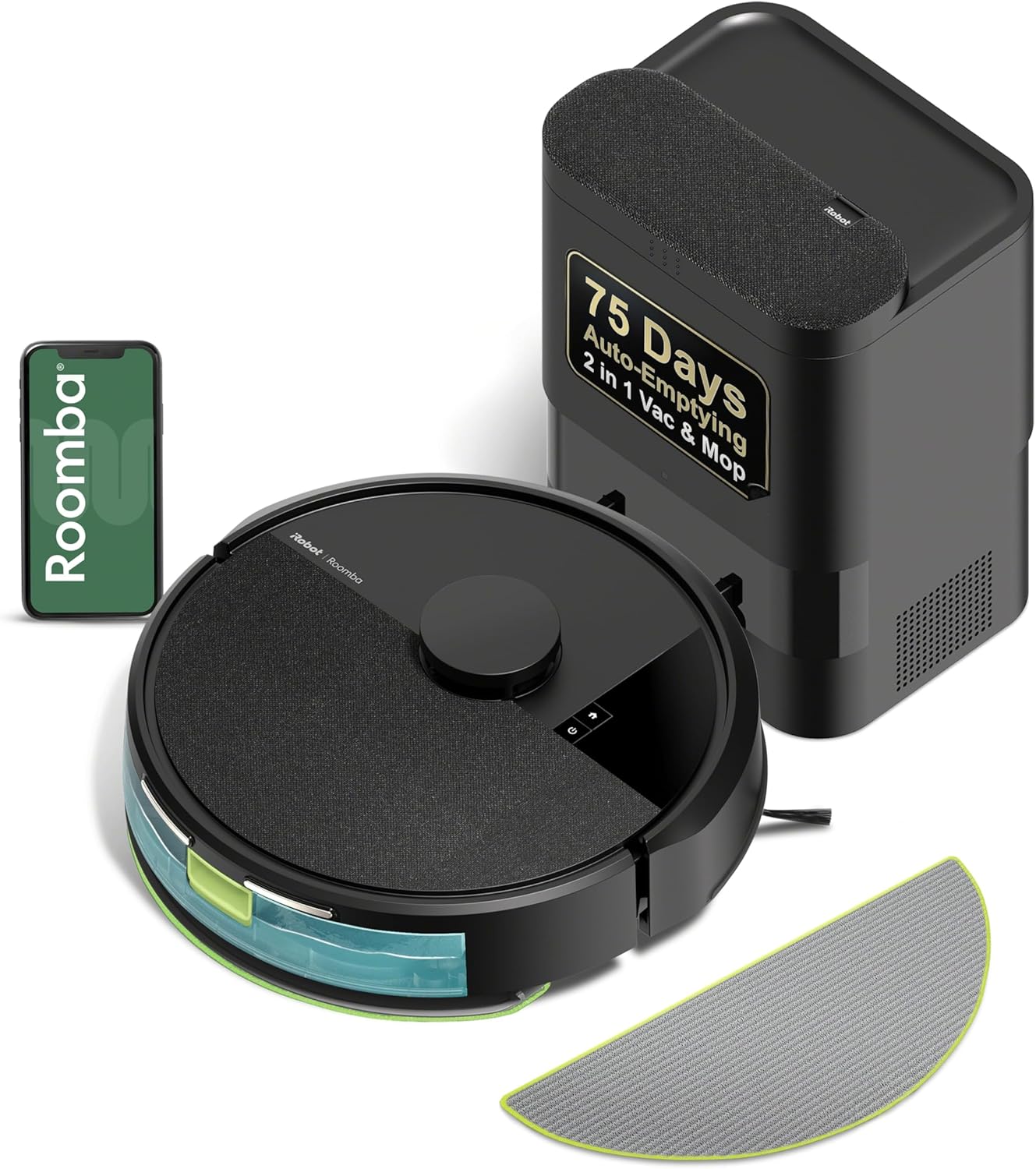
iRobot Roomba 105 Combo
| Surface Recommendation | Carpet & Hard Floor |
|---|---|
| Battery Life | 100 minutes |
| Filter Type | Cartridge |
| Controller Type | App Control, Button Control, Voice Control |
| Other Special Features of the Product | Self-Emptying, LiDAR Navigation, Simultaneous Vacuuming & Mopping |
The Roomba 105 Combo is a vacuum-and-mop robot designed to handle everyday wet and dry cleaning on hard floors and carpets. It uses ClearView LiDAR to map spaces, avoid obstacles and stairs, and offers three cleaning modes: vacuum, mop, or vacuum-and-mop together. The unit combines a multi-surface brush and an edge-sweeping brush with 70x stronger suction to lift dirt, while a microfiber mop pad and a micro-pump deliver controlled water or solution for deeper scrubbing in high-traffic areas. The included AutoEmpty dock collects debris into a sealed bag that can hold up to 75 days of dirt, reducing how often you touch the dust. You control scheduling and room targeting through the Roomba Home App or voice assistants. Practical limits include about 100 minutes of battery life per charge, and while the robot detects and avoids carpets when mopping, it is not a replacement for intensive spot-cleaning or heavy-soil areas; routine brush and filter maintenance is still required. For luxury vinyl plank, the gentle microfiber pad and adjustable water flow help prevent over-wetting while maintaining cleaning performance.
Best for: Buyers who want a reliable, low-touch robot to maintain hard floors like luxury vinyl plank with proven navigation and a sealed self-emptying dock for worry-free routine cleaning.
Less Ideal for: Not the best choice for homes needing long continuous runtime for very large floorplans or for users who need industrial-grade scrubbing or heavy wet extraction.
- AutoEmpty dock holds debris for up to 75 days, reducing manual emptying
- ClearView LiDAR mapping for efficient navigation and room targeting
- Combined vacuum and mop modes with controlled water delivery and SmartScrub for deeper scrubbing
- 70x stronger suction and multi-surface brushes improve edge and carpet pickup
- App and voice control with scheduling and keep-out zone support
- Battery runtime listed at about 100 minutes may require mid-day recharges in larger homes
- Mopping uses a microfiber pad rather than powered spinning pads, so it is better for light spills than heavy scrubbing tasks
Verdict: Choose the Roomba 105 Combo if you want LiDAR-guided vacuuming and gentle, controlled mopping on luxury vinyl plank with a hands-off AutoEmpty dock that minimizes maintenance.
eufy 11S Max Robot Vacuum

| Surface Recommendation | Hard Floor & Tile & Medium carpet |
|---|---|
| Battery Life | 100 minutes |
| Suction Power | 2000 Pa |
| Capacity | 600 ml |
| Noise Level | 55 db |
The eufy 11S Max is a low-profile robot vacuum built to clean hard floors and medium-pile carpets without drawing attention. Its 2.85-inch slim body lets it slide under low furniture while 2000Pa suction and a 12.8-inch cleaning path pick up dust, crumbs, and pet hair. It runs up to 100 minutes on hardwood at a reported low 55 dB, and automatic return-to-base means it tops off battery without user intervention. Controls are simple: the included remote and onboard buttons let you start, stop, and switch modes quickly, though there is no Wi-Fi or app control. Practical touches include washable filters, drop-sensing and anti-collision sensors, and a 600 ml dust capacity that reduces how often you empty the bin. The trade-offs are straightforward: navigation is basic rather than lidar or map-based, so room coverage is more random and may miss tight corners, and the single-side-brush design can be less thorough along edges compared with dual-brush models. For routine, quiet cleaning of hardwood, the 11S Max balances strong suction and a slim profile in a simple, reliable package.
Best for: Buyers who prioritize a quiet, no-frills robot that cleans hardwood reliably and fits under low furniture will appreciate this model for regular maintenance cleaning.
Less Ideal for: If you want mapped cleaning, smartphone scheduling, or the most thorough edge-cleaning for complex floorplans, choose a model with advanced navigation and app control instead.
- Slim 2.85" profile reaches under low furniture
- Up to 100 minutes runtime for extended cleaning sessions
- Powerful 2000Pa suction for effective pickup on hard floors
- Quiet operation at about 55 dB suitable for daytime or evening use
- Large 600 ml dust capacity and washable filter lower maintenance frequency
- Random navigation rather than mapping can lead to uneven coverage
- No Wi‑Fi or smartphone app means limited scheduling and remote control options
Verdict: A slim, quiet robot with strong suction made for routine hardwood maintenance when you want reliable, no-frills cleaning.
Choosing the Right Robot Vacuum for Luxury Vinyl Plank: Key Factors to Consider
Suction Modulation and Power Settings
Luxury vinyl plank benefits from vacuums that let you reduce suction for smooth finish protection while still removing debris. Adjustable suction or floor-specific modes let the robot drop power on delicate surfaces to avoid lifting finish or pulling on edges.
Higher suction is useful on area rugs and in corners, but it can press cutters or stiff brushes harder into plank seams. Look for machines that offer automatic surface sensing or user-selected low-power modes so you can match cleaning intensity to the floor type.
Brush Type and Floor-Head Design
Brushless roller heads or soft rubberized rollers are gentler on vinyl planks than stiff bristle brushes. Soft rollers pick up fine dust and larger debris while reducing the risk of micro-scratches and swirl marks.
Also consider whether the head can be fully lifted or disabled when moving from hard floor to carpet. Removable, easy-to-clean brush modules reduce the chance that trapped grit will become an abrasive against your flooring.
Wheel Construction and Suspension
Wheels are the only parts that touch the floor continuously during navigation, so their material and tread pattern matter. Soft, rubberized wheels distribute weight more evenly and minimize marking. Look for designs with some suspension or compliance to absorb small bumps rather than scraping the floor.
Hard plastic casters can leave marks or pick up debris in their rims that later abrades the surface. Models with sealed bearings and easily cleaned wheel wells help prevent grit buildup that causes long-term wear.
Navigation and Mapping Precision
Accurate navigation reduces repeated passes in the same spot and minimizes collisions with baseboards and furniture legs. Consistent pathing and reliable mapping let the robot cover spaces efficiently without dragging wheels over the same seams or edges repeatedly.
Robots that support zone cleaning or no-go lines allow you to target high-traffic areas while avoiding delicate thresholds or threshold-mounted trim pieces that might catch.
Dust Bin Design and Filtration
A tightly sealed dust bin and effective filters limit dust re-deposition on floor surfaces. Fine dust can settle back onto vinyl and, when combined with foot traffic, act like sandpaper. Larger, easy-to-empty bins make maintenance quicker and reduce the chance of spills during emptying.
HEPA or high-efficiency filters are beneficial for trapping allergens and fine particulates that would otherwise become airborne and resettle. Also check how accessible the filters are for regular cleaning or replacement.
Mop Compatibility and Moisture Control
Some robot vacuums offer light mopping or damp-pad attachments. For luxury vinyl plank, moisture control is critical because excessive water can seep into seams and cause swelling or adhesive issues. Machines that use only lightly damp pads and offer adjustable water flow are preferable.
If you plan to use mopping features, choose robots that allow you to limit moisture application, use single-direction wipe patterns, or disengage the mop motor to avoid over-wetting. Easy-to-replace pads and washable materials also make routine care simpler.
How Robot Vacuums Interact with Luxury Vinyl Plank
Robot vacuums contact flooring through rollers, brushes, and wheels, and each interface affects luxury vinyl differently. Soft rollers and brushless heads reduce friction and the chance of micro-scratches, while wheel material and suspension influence whether a unit will leave marks or ride smoothly over seams.
Understanding these interactions helps you set expectations for cleaning frequency and maintenance routines. Regularly inspecting wheels and brush compartments for trapped grit and replacing disposable pads prevents long-term abrasion.
- Soft rollers minimize surface abrasion
- Wheel material impacts marking and tread wear
- Brushless or rubberized heads reduce swirl marks
Setting Up a Robot Vacuum for Vinyl Plank Floors
Position the charging dock on a flat area and clear typical travel paths of small objects and cords. Use mapping features to define no-go zones around delicate thresholds, rugs with grippers, or threshold-mounted trim.
Start with the lowest suction or a dedicated hard-floor mode for initial runs, then monitor results. Increase suction only where needed, such as near entryways or in pet areas, and schedule regular maintenance to remove trapped grit from rollers and wheel housings.
- Use mapping to avoid thresholds and fragile trim
- Begin with low-power runs to test for marking
- Inspect wheels and rollers weekly during the first month
Maintaining Finish and Preventing Marks
Routine care extends beyond vacuum selection. Sweep or dust-mop high-traffic areas to remove coarser grit that can grind into the floor under robot wheels. Wiping up spills promptly prevents moisture from reaching seams and adhesives.
When visible marks appear, inspect the robot for trapped debris, clean the wheels and brushes, and consider applying furniture pads under legs that commonly come into contact with the robot. Rotate cleaning intensity across weeks to avoid repeatedly treating the same spot with high suction.
- Pre-clean large grit to reduce abrasion
- Clean wheels and rollers on a schedule
- Alternate suction levels to avoid repeated stress
Using Zone Cleaning and Scheduling Effectively
Zone cleaning lets you focus vacuuming power where it matters while keeping delicate areas protected. Create smaller, frequent cleaning zones in entryways or pet areas and avoid scheduling intense passes over rooms with decorative thresholds.
Staggering full-house cleans with targeted spot cleans keeps overall wear low. Shorter, more frequent runs tend to be gentler than infrequent deep cleaning cycles because they remove dirt before it becomes abrasive.
- Prefer shorter, frequent cleans over long deep cycles
- Use virtual boundaries to protect thresholds
- Schedule high-suction passes only where necessary
When to Consider Professional Care or Repairs
If your luxury vinyl shows signs of surface degradation beyond scuffs, such as lifting or seam separation, consult a flooring professional. Robot vacuums can be part of a healthy maintenance plan but will not correct installation or adhesive failures.
For persistent marking that does not respond to cleaning the robot, review the robot's wheel treads for damage and consider replacing worn components. Manufacturer service can address mechanical wear that contributes to surface damage.
- Seek professional advice for seam or adhesion issues
- Replace damaged wheels or rollers promptly
- Track cleaning patterns if marks reappear in the same spots
How We Chose the Best Robot Vacuum for Luxury Vinyl Plank
We focused on attributes that matter for cleaning luxury vinyl plank: controlled suction, soft-roll or brushless floor heads, navigation accuracy, and low-impact wheels and suspension. We examined spec sheets and manufacturer guidance to confirm each candidate supports adjustable suction modes or has dedicated hard-floor settings. Noise and run-time were considered because longer, quieter runs often reduce abrasive passes on the same area. Durability and ease of maintenance were key filters. We prioritized models with easy-to-clean dust bins and brush assemblies so owners can remove grit that would otherwise abrade plank surfaces. Filtering and dust containment were assessed to limit re-depositing fine dust onto floors. We excluded vacuums that rely on stiff nylon main brushes or have documented reports of hard-surface scuffing. Practical usability factors were included: mapping and navigation precision to avoid repeated collisions, threshold crossing capability suitable for typical vinyl plank transitions, and available floor-specific cleaning modes. We also considered accessory support for occasional wet mopping pads that use minimal moisture. The end result is a shortlist of units that balance safe floor contact with real dirt pickup performance.
Our full evaluation process is outlined in our review methodology.
FAQ
Will a robot vacuum scratch luxury vinyl plank?
Most modern robot vacuums will not scratch if they use soft rollers and rubberized wheels, and if grit is removed regularly. Scratches are more likely when hard debris or trapped grit is present, so maintenance and pre-cleaning reduce risk.
Can I use the robot's mopping feature on vinyl plank?
Light damp mopping is usually safe if the robot controls moisture and uses minimal water. Avoid aggressive wet mopping cycles that leave standing water, and follow the floor manufacturer's guidance on moisture exposure.
How often should I run a robot vacuum on luxury vinyl?
Frequent short runs are better for vinyl plank because they prevent buildup of abrasive grit. Depending on traffic, 3 to 5 short cycles per week often keeps floors clean without excessive wear.
Do wheel marks mean the robot is unsuitable?
Not necessarily. Wheel marks often indicate trapped debris or hard plastic wheels. Cleaning wheel wells, switching to softer wheel covers if available, and adjusting paths can usually eliminate marking.
Should I turn off edge-cleaning brushes on vinyl floors?
Edge brushes can be safe, but stiff or spun brushes that protrude strongly may cause streaks on finished plank surfaces. If you see marking along baseboards, consider disabling side brushes or choosing a gentler setting.
Final Verdict
Choose a robot vacuum that balances effective pickup with gentle contact: prioritize adjustable suction, soft rollers or brushless heads, and rubberized wheel designs. Accurate navigation and good dust containment reduce unnecessary passes and limit abrasive grit, which protects finishes over time. Accept tradeoffs that match your home: if you have many rugs you may need higher suction occasionally, but for mostly hard floors favor machines with floor-specific modes and easy maintenance. With the right settings and routine care, a robot vacuum can keep luxury vinyl plank looking its best without accelerating wear.