
Note: This article contains affiliate links. If you click on these links and make a purchase, we may earn a small commission at no extra cost to you. This helps support our research and content. Read our full affiliate disclosure here.
If you have low pile carpet, picking the right robot vacuum matters for day-to-day cleanliness and long-term floor care. Low pile fibers hide less dirt than looped or high-pile rugs, but they also demand machines that combine steady suction with brush systems that avoid tangling or scattering debris. This guide shortlists the top robot vacuums suited to low pile carpet and explains the tradeoffs between raw suction, brush design, and run-time. Below you will find our top picks for low pile carpet, plus clear evaluation criteria and practical buying guidance to help you choose the best fit for your home.
Top Picks at a Glance
| Best Overall The best all-around choice for most situations | roborock Q10 S5+ |  |
| Best Quality Built to a higher standard if you want something more solid | dreame L40 Ultra Gen2 |  |
| Best Value The sweet spot between price and what you get | ROPVACNIC S1 Robot Vacuum |  |
| Best Budget The cheapest option that still gets the job done reliably | Lefant M210 Robot Vacuum |  |
| Top Rated A top-rated pick with lots of positive feedback | Vyzzle E20 Robot Vacuum |  |
| Most Popular A crowd favorite that many people choose with confidence | iRobot Roomba 105 Vac |  |
| Best Seller A high-volume bestseller chosen again and again | eufy 11S Max Robot Vacuum |  |
roborock Q10 S5+

| Maximum Suction | 10,000 Pa |
|---|---|
| Capacity | 2.7 liters |
| Battery Life | 150 minutes |
| Filter Type | Washable |
| Control Method | App, Voice |
The roborock Q10 S5+ combines a 10,000 Pa HyperForce motor with LiDAR mapping and ReactiveTech obstacle avoidance to deliver thorough, automated cleaning on hard floors and low-pile carpet. It uses a VibraRise 2.0 sonic mopping module for scrubbing and an auto-lift feature that raises the mop over carpets while ultrasonic carpet detection triggers extra suction for deeper dirt removal. The included self-emptying dock holds a 2.7 L dust bag for up to around 70 days of low-maintenance use, and the washable filter plus dual anti-tangle brush design reduce hair clogs and upkeep. Control options include the Roborock app, scheduling, voice assistants, and adjustable emptying and mopping modes, which make it flexible for mixed-floor homes. Expect about 150 minutes of runtime on a charge, and note noise can reach the mid 60s dB during high-power cycles and the unit is optimized for indoor use with only 2.4 GHz Wi-Fi support. For buyers wanting strong suction, reliable mapping, and a low-maintenance dock, this model delivers practical convenience; very thick high-pile rugs or exclusively carpeted homes may see less benefit from the mop features.
Best for: Buyers who want a low-maintenance, high-suction robot that reliably cleans mixed floors and reduces hands-on dust emptying, especially in homes with pets and low-pile carpets.
Less Ideal for: Homes that are mostly thick, high-pile carpet where a more carpet-focused upright or specialized cleaner would perform better, or users who need 5 GHz Wi-Fi compatibility.
- Powerful 10,000 Pa suction for deep cleaning on low-pile carpet and hard floors
- Large 2.7 L self-emptying dock reduces how often you touch dust for many weeks
- LiDAR navigation with multi-level mapping provides precise, repeatable cleaning paths
- VibraRise 2.0 sonic mopping plus auto-lift and ultrasonic carpet detection prevent wetting carpets
- Dual anti-tangle brush design and washable filter lower maintenance for pet hair households
- Noise can be noticeable at higher power levels (around 65 dB)
- Only supports 2.4 GHz Wi-Fi, which may limit connectivity options in some networks
Verdict: Choose the Q10 S5+ if you want a powerful, low-maintenance robot that maps precisely and handles pet hair and low-pile carpet with minimal hands-on work.
dreame L40 Ultra Gen2

| Suction | 25,000 Pa |
|---|---|
| Battery Life | 231 minutes |
| Control Type | App, Voice, Remote |
| Filter Type | Foam |
The dreame L40 Ultra Gen2 is built around strong suction and an autonomous dock to reduce hands‑on maintenance. With up to 25,000Pa and five suction levels, it tackles dirt on hard floors and low‑pile carpets while offering targeted carpet modes and a mop that lifts for carpet transitions. The robot uses 3D + laser mapping and RGB AI obstacle avoidance to create multi‑level maps, set no‑go zones, and avoid common trip hazards. The PowerDock handles auto‑emptying, mop washing and hot air drying to keep the robot ready between runs, and an optional auto‑solution refill can further automate mopping. Runtime in Quiet Mode is lengthy (reported 231 minutes) and app plus voice control let you schedule and tweak suction or carpet behavior. Tradeoffs include added complexity and likely higher maintenance cost for dock consumables and the optional auto‑solution module sold separately, and real‑world performance on thicker carpets will be less effective than on low pile. For buyers focused on powerful suction and reduced upkeep, it delivers a very capable, autonomous cleaning system.
Best for: Buyers who prioritize strong suction, advanced navigation, and a mostly hands‑off cleaning routine for low‑pile carpets and hard floors.
Less Ideal for: People who want a simple, low‑cost robot without a complex dock ecosystem or those with predominantly high‑pile rugs where suction gains are limited.
- Very high suction power with five adjustable levels for deep cleaning on low‑pile carpet and hard floors
- Comprehensive self‑cleaning dock that auto‑empties, washes and hot‑air dries the mop and robot
- Advanced 3D + laser mapping and RGB AI obstacle avoidance for reliable navigation and multi‑level mapping
- Long reported runtime for large coverage and app plus voice control for scheduling and custom modes
- Optional auto‑solution refill module is sold separately to enable automatic mopping refills
- All‑in‑one dock and consumables add ongoing maintenance complexity and potential replacement costs
Verdict: If you want maximum suction and an automated docked cleaning system that minimizes daily upkeep on low‑pile carpet, the L40 Ultra Gen2 is a top performance pick.
ROPVACNIC S1 Robot Vacuum
| Suction | 5200Pa |
|---|---|
| Battery Life | 120 minutes |
| Filter Type | Multi-layer Optimized High-Efficiency Filtration |
| Control | App, Remote, Voice |
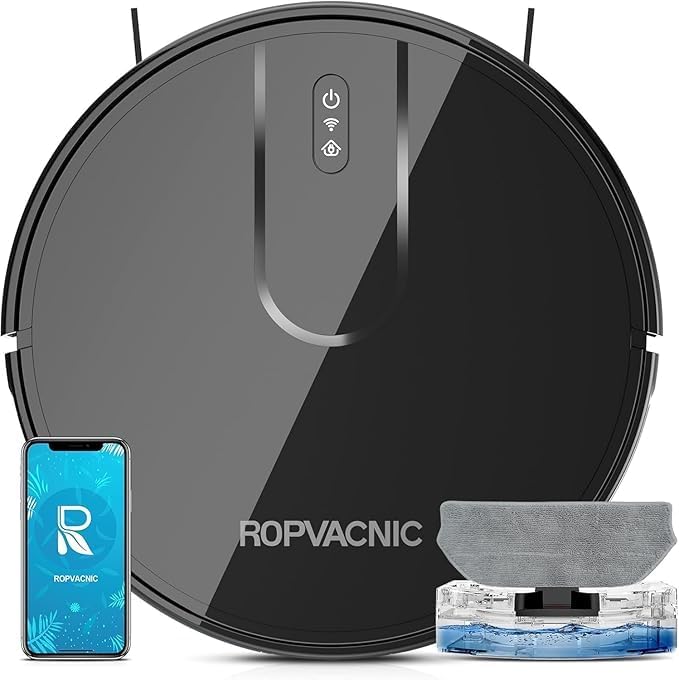
The ROPVACNIC S1 is a 2-in-1 robot vacuum and electric mop designed for everyday floor upkeep on hard floors and low-pile carpets. It uses a 5200Pa suction system with a three-point cleaning approach and dual side brushes to pick up dust, crumbs, and pet hair while a controlled water tank and mop plate handle light mopping tasks with four adjustable water levels. Navigation relies on an advanced sensing system for obstacle avoidance and automatic return-to-dock charging when battery drops below 20%, and you can schedule or control runs via the companion app, remote, or voice assistants. The 4400mAh battery supports up to 120 minutes between charges, which is enough for medium to large single-level homes. Practical benefits include a no-entanglement design for pet hair and a spare HEPA filter in the box, but the compact low-profile form and mop function mean it is best for maintenance cleaning rather than heavy wet scrubbing or deep-cleaning thick carpets. Setup and app control make it easy to tailor schedules and suction intensity, though occasional edge or corner debris may need a spot pass with a manual tool.
Best for: Buyers who want a practical, automated floor-care tool that combines suction and light mopping for mixed hard floors and low-pile carpet and value easy scheduling and hands-off operation.
Less Ideal for: Homes that need intensive wet scrubbing, heavy-duty carpet deep cleaning, or solutions for high-pile rugs should consider more specialized machines.
- Strong 5200Pa suction and three-point cleaning system for effective pickup on low-pile carpet
- Adjustable electric mopping with four water levels for light wet cleaning
- Advanced obstacle sensing and automatic return-to-dock charging
- 120-minute runtime from a 4400mAh battery for extended cleaning sessions
- Multiple control options including app, remote, and voice assistants
- Mopping is intended for light maintenance and not heavy stain removal
- Compact design may struggle with very thick or high-pile carpets
Verdict: A dependable combo vacuum-mop that delivers strong suction and hands-off scheduling for efficient maintenance cleaning on low-pile carpet and hard floors.
Lefant M210 Robot Vacuum

| Battery Life | 120 minutes |
|---|---|
| Capacity | 500 cubic centimeters |
| Filter Type | Cartridge |
| Compatible Devices | Amazon Echo, Google Home, Smartphones |
| Other Special Features of the Product | Anti-Fall, Auto-Docking, Obstacle Avoidance, Pet Hair Pick Up, Scheduling |
The Lefant M210 is a small, app-controlled robot vacuum aimed at regular upkeep on hardwood and other hard floors. Its low 3-inch profile slips under furniture, and a brushless suction port helps pick up pet hair without brush tangles. You can run scheduled cleans, pick from six modes including edge and spot, and control the unit via the Lefant app or Alexa/Google voice commands. The listed 120-minute runtime (quiet mode) covers mid-size rooms on a single charge, and the 500ml dustbin reduces how often you empty it. Navigation relies on infrared anti-collision and anti-drop sensors rather than LIDAR, so it follows zigzag or randomized patterns rather than tightly mapped routes; that makes coverage fine for open hardwood areas but less precise in cluttered rooms. Noise is moderate at about 52 dB and suction is tuned for surface dirt rather than deep carpet extraction. For buyers wanting a straightforward, affordable hardwood-focused cleaner, the M210 delivers solid basic performance, but expect simpler navigation and fewer advanced mapping features than higher-end models.
Best for: Buyers on a tight budget who need a dependable, easy-to-use robot for regular hardwood and low-pile cleaning and value app/voice scheduling over advanced mapping.
Less Ideal for: Homes that require precise room mapping, systematic multi-room navigation, or deep-cleaning on high-pile carpets should consider more advanced models.
- Slim profile fits under low furniture for hidden-dirt pickup
- Brushless suction port reduces hair tangles for pet owners
- App scheduling plus Alexa and Google voice control for hands-free operation
- 500ml dustbin and up to 120 minutes runtime support longer cleaning cycles
- Navigation uses infrared sensors and randomized or zigzag patterns rather than LIDAR mapping, so room coverage can be less efficient in cluttered spaces
- Suction and cleaning are optimized for hard floors and low-pile carpet, not deep-cleaning thick carpet
Verdict: If you want an affordable, compact robot that handles daily hardwood and pet hair cleaning with app and voice scheduling, the Lefant M210 is a practical pick.
Vyzzle E20 Robot Vacuum

| Maximum Suction | 8000 centimeters |
|---|---|
| Battery Life | 150 minutes |
| Noise Level | 45 db |
| Controller Type | App Control, Voice Control |
| Power Source | Battery Powered |
The Vyzzle E20 is a self-emptying robot vacuum and mop built for routine floor care in homes with both hard floors and low-pile carpet. It uses 360° LiDAR mapping and SLAM to create accurate room maps, supports virtual no-go and no-mop zones, and can be controlled from an app or with Alexa/Google voice commands. Practical features include adjustable suction levels with a Smart Carpet Boost, three water-flow settings for mopping, and a 3.5 L dust bag in the dock that claims up to 60 days of hands-free emptying. Runtime with Quiet Mode is listed up to 180 minutes and the unit will recharge and resume cleaning when needed, which is useful for multi-room runs. For daily maintenance it handles pet hair and crumbs well and the included spare brush and HEPA filter make upkeep straightforward. Limitations to note are that mop mode requires careful zone setup to avoid carpets and some advanced users may prefer more detailed accessory or repair info, but the E20 focuses on dependable navigation and low-touch operation for regular cleaning cycles.
Best for: Buyers who prioritize hands-off, consistent cleaning and dependable navigation for everyday upkeep of low-pile carpet and mixed floors will appreciate this model.
Less Ideal for: Users seeking specialized deep-cleaning features for high-pile carpet or those who want a fully integrated automatic mop that handles carpets without configuration should consider other options.
- LiDAR plus SLAM mapping for accurate room maps and reliable navigation
- Self-emptying dock with 3.5 L dust bag for extended hands-free operation
- Multiple suction levels with Smart Carpet Boost for better performance on low-pile carpet
- App scheduling, virtual no-go/no-mop zones, and voice control for flexible automation
- Long quiet-mode runtime and auto recharge and resume for whole-home cleaning sessions
- Mop function needs careful zone setup to avoid carpeting and is not fully automatic across mixed floors
- Manufacturer-provided accessory and repair information is limited compared with some mainstream brands
Verdict: Choose the Vyzzle E20 when you want a low-maintenance, LiDAR-mapped robot that reliably keeps low-pile carpet and hard floors clean with long runtime and a hands-free self-emptying dock.
iRobot Roomba 105 Vac

| Battery Life | 200 minutes |
|---|---|
| Other Special Features of the Product | Anti-Fall, Bagless, Dirt Detection Sensor, Eco Mode, LiDAR Navigation |
| Controller Type | App Control, Button Control, Voice Control |
| Filter Type | Cartridge |
| Power Source | Battery Powered |
The Roomba 105 Vac is a straightforward robot vacuum that maps rooms with ClearView LiDAR and cleans using a 3-stage system with a Multi-Surface bristle brush and edge-sweeping tool. It is designed for routine floor care on carpets and hard floors and offers four suction levels so you can boost power for soiled areas or run quieter, lower-power sessions. The 200-minute battery life and automatic return-to-dock recharge let it cover larger cleaning jobs and resume where it left off. Control options include the iRobot Home app, onboard buttons, and common voice assistants, and the app supports room-targeted schedules and keep-out zones created from the LiDAR map. Maintenance is typical for a robot vacuum: emptying the bin, cleaning brushes, and replacing the cartridge filter periodically. Limitations include a modest cleaning path and a design focused on vacuuming rather than mopping or hands-free bin emptying, so it is best for households that want reliable vacuum-only automation rather than advanced hybrid features.
Best for: Buyers who want a proven, easy-to-use vacuum that reliably maintains low-pile carpets and hard floors with smart mapping and familiar app and voice controls.
Less Ideal for: Homes that need mopping, very deep-pile carpet cleaning, or those who expect multi-week hands-free emptying without accessory docks.
- ClearView LiDAR mapping for efficient room navigation and obstacle avoidance
- Four suction power levels to match light maintenance or deeper carpet cleaning
- Long 200-minute battery life with auto-return and resume
- App, voice, and button controls for flexible scheduling and targeted cleaning
- No hands-free auto-empty dock included
- Focused on vacuuming only with no integrated mopping function
- Relatively narrow cleaning path compared with larger robot models
Verdict: Choose the Roomba 105 Vac if you want a reliable, LiDAR-mapped robot that keeps low-pile carpets and hard floors consistently maintained with simple app and voice control.
eufy 11S Max Robot Vacuum
| Surface Recommendation | Hard Floor & Tile & Medium carpet |
|---|---|
| Battery Life | 100 minutes |
| Suction Power | 2000 Pa |
| Capacity | 600 ml |
| Noise Level | 55 db |
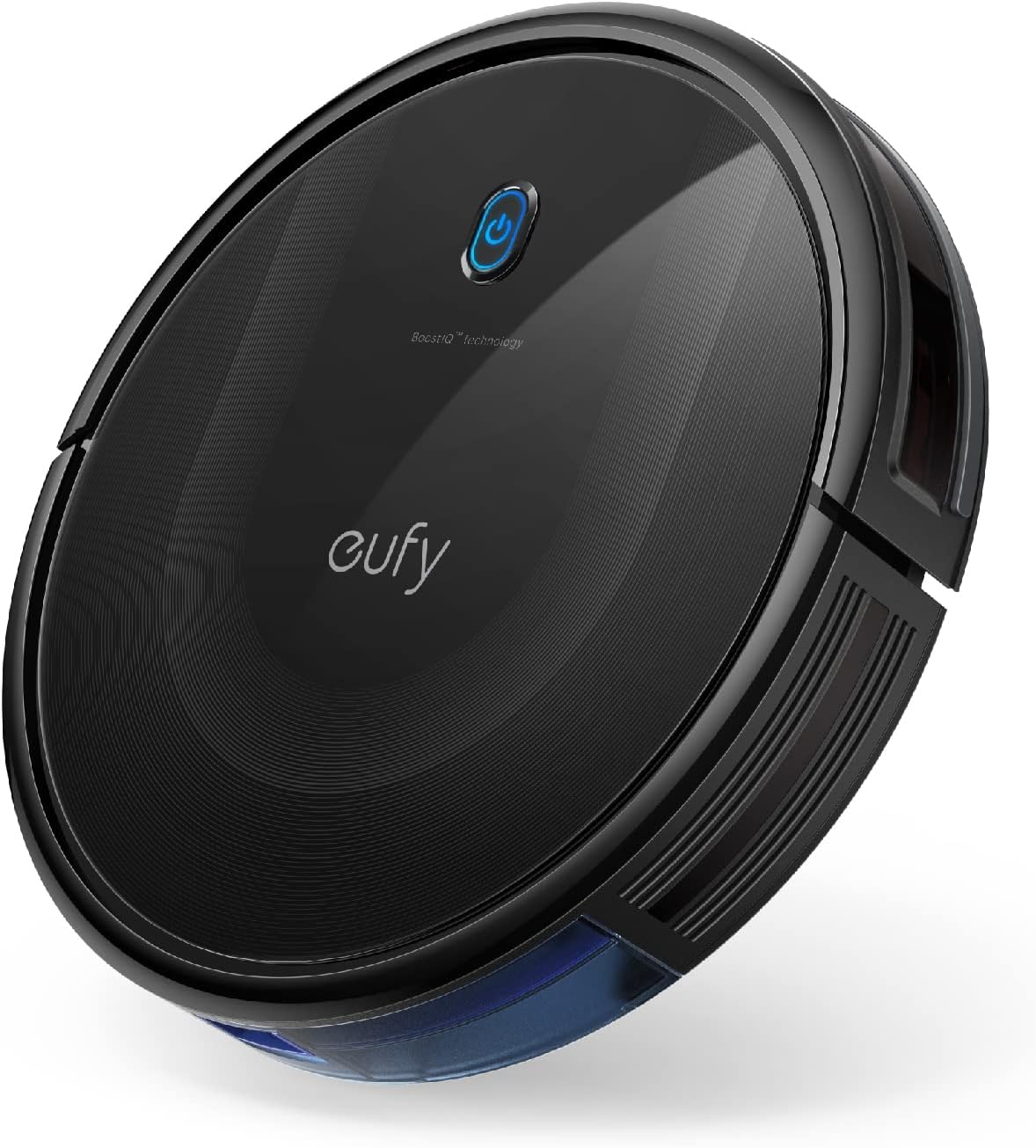
The eufy 11S Max is a low-profile robot vacuum built to clean hard floors and medium-pile carpets without drawing attention. Its 2.85-inch slim body lets it slide under low furniture while 2000Pa suction and a 12.8-inch cleaning path pick up dust, crumbs, and pet hair. It runs up to 100 minutes on hardwood at a reported low 55 dB, and automatic return-to-base means it tops off battery without user intervention. Controls are simple: the included remote and onboard buttons let you start, stop, and switch modes quickly, though there is no Wi-Fi or app control. Practical touches include washable filters, drop-sensing and anti-collision sensors, and a 600 ml dust capacity that reduces how often you empty the bin. The trade-offs are straightforward: navigation is basic rather than lidar or map-based, so room coverage is more random and may miss tight corners, and the single-side-brush design can be less thorough along edges compared with dual-brush models. For routine, quiet cleaning of hardwood, the 11S Max balances strong suction and a slim profile in a simple, reliable package.
Best for: Buyers who prioritize a quiet, no-frills robot that cleans hardwood reliably and fits under low furniture will appreciate this model for regular maintenance cleaning.
Less Ideal for: If you want mapped cleaning, smartphone scheduling, or the most thorough edge-cleaning for complex floorplans, choose a model with advanced navigation and app control instead.
- Slim 2.85" profile reaches under low furniture
- Up to 100 minutes runtime for extended cleaning sessions
- Powerful 2000Pa suction for effective pickup on hard floors
- Quiet operation at about 55 dB suitable for daytime or evening use
- Large 600 ml dust capacity and washable filter lower maintenance frequency
- Random navigation rather than mapping can lead to uneven coverage
- No Wi‑Fi or smartphone app means limited scheduling and remote control options
Verdict: A slim, quiet robot with strong suction made for routine hardwood maintenance when you want reliable, no-frills cleaning.
Choosing the Right Robot Vacuum for Low Pile Carpet: Key Factors to Consider
Suction Power and Airflow
Suction strength is the primary factor for extracting fine dust and embedded particles from low pile carpet. Look beyond a single "power" number and pay attention to airflow and how the device channels suction through the dustpath.
Higher airflow helps lift debris from short fibers and carry it into the dustbin, while inadequate airflow often leaves a thin film of dust. For low pile carpet, consistent suction across the run is more important than short bursts of peak power because cleaning sessions tend to be frequent and focused on wide coverage rather than deep agitation.
Brush-Roll Design
Brush-roll type affects how a robot interacts with low pile fibers. Many manufacturers offer multi-surface brushes, rubberized rollers, or soft bristle designs that are less likely to scatter debris or tangle with hair.
For short carpets, choose a brush that makes contact without digging into fibers, and prioritize designs that resist hair wrap. Detachable brush assemblies that are easy to clean reduce downtime and keep performance steady over time.
Navigation and Mapping
Reliable navigation ensures the robot covers the entire floor and avoids repeatedly cleaning the same spots while missing others. Mapping features let the robot plan efficient routes and return to missed areas, which is useful when you want regular maintenance cleaning of carpeted rooms.
Look for obstacle detection that prevents the device from getting stuck on thresholds or furniture legs. Consistent coverage reduces the need for manual follow-up vacuuming and helps maintain an even appearance on low pile carpets.
Battery Life and Recharge Behavior
Battery capacity governs how much continuous floor area a robot can cover between charges. If your home has multiple carpeted rooms, longer runtime or automatic recharge-and-resume capabilities are important.
Short-pile carpets are often found in larger living spaces, so robots that can return to base, recharge, and resume without losing mapping data make whole-home cleaning practical. Consider how long a full job will take versus the robot's run time to avoid partial clean cycles.
Dustbin Capacity and Filtration
Dustbin size determines how often you must empty the unit, and filtration affects indoor air quality after vacuuming. Larger bins reduce interruption for emptying, especially in homes with pets or higher dust loads.
High-efficiency filters and sealed pathways trap fine particles rather than expelling them back into the air. For low pile carpet, which releases fine dust easily, good filtration helps control allergens and keeps the machine operating efficiently between filter servicing.
Maintenance and Accessibility
Routine upkeep—clearing brush-roll hair, cleaning filters, and emptying the bin—has an outsized effect on long-term performance. If maintenance is time-consuming, many users will defer it, which degrades suction and increases tangles.
Choose a robot with user-friendly access panels, washable filters, and modular parts that can be replaced without tools. Clear maintenance indicators and simple cleaning procedures make it more likely the machine will perform optimally on low pile carpet over months and years.
How Brush Types Affect Low Pile Cleaning
Different brush types interact with low pile carpet in distinct ways. Soft rubber rollers tend to sweep debris into the suction path without combing fibers, while stiff bristles can agitate dust but also push it sideways if not matched with proper suction.
Consider units that let you switch cleaning modes or that have mixed brush designs combining rubber and soft bristles. Those configurations can offer balanced agitation and pickup without increasing fiber wear or scattering fine dust.
- Rubber rollers: good for lifting debris without hair wrap
- Soft bristles: gentle on fibers, best when paired with strong suction
- Combo brushes: blend agitation and containment for consistent pickup
Room Layouts and Placement Tips
Furniture arrangement and floor transitions influence a robot's effectiveness. Low pile carpet near thresholds, rugs, or furniture legs can confuse some navigation systems, causing incomplete passes or stuck robots.
Place the charging base in an open area and clear narrow passages before scheduled runs. If the robot supports virtual boundaries, use them to block off zones where it tends to snag or where cords are present.
- Keep cords bundled and out of robot paths
- Avoid small rugs with fringe that can tangle brushes
- Use virtual boundaries to exclude problematic areas
Noise and Scheduling for Daily Use
Noise level matters for daily maintenance cleaning. Frequent runs are less disruptive if the robot is relatively quiet, especially in open-concept homes where carpeted areas connect to living spaces.
Schedule runs during times when occupants are out or less sensitive to background noise. Many robots offer quiet modes that trade some suction for lower sound levels while still providing acceptable cleaning for low pile surfaces.
- Quiet modes reduce noise but may lower suction
- Nighttime scheduling works if the robot's docking area is isolated
- Frequent short runs can maintain cleanliness with lower noise impact
Pet Hair Considerations on Short Carpets
Pet hair behaves differently on low pile carpet than on longer rugs. Short fibers do not hide hair as easily, but hair can still wrap around brush-rolls and clog intake ports.
Look for robots with brush-roll designs that resist hair wrap, and consider models with higher bin capacities if shedding is heavy. Regularly clearing the brush and filter will keep suction strong and reduce the frequency of manual touch-ups.
- Brush covers that open easily speed hair removal
- Higher-capacity bins reduce emptying frequency
- Strong filtration helps manage dander and fine pet particles
Surface Transitions and Threshold Handling
Many homes mix low pile carpet with hard floors or small rugs. The robot's ability to cross small thresholds and adjust suction or brush height affects how seamlessly it cleans multiple surfaces in one pass.
Prefer robots with adaptive drive systems or explicit carpet boost features that increase suction when carpet is detected. That ensures consistent pick-up without requiring separate runs for carpeted rooms.
- Carpet detection can trigger suction boost automatically
- Low-profile drive systems cross most thresholds smoothly
- Manual mode selection works if automatic detection is unreliable
How We Chose the Best Robot Vacuum for Low Pile Carpet
We prioritized characteristics that materially affect performance on low pile carpet and everyday ownership. Core evaluation criteria included suction strength and airflow, brush-roll design and agitation suitability for short fibers, navigation and mapping accuracy for consistent coverage, battery life and recharge behavior for full-home cleaning, and maintenance needs such as filter access and tangle-prone parts. We also considered noise levels because louder units can make frequent cleaning disruptive. Units were excluded if they lacked explicit modes or brush designs aimed at carpeted surfaces, had poor navigation features that cause missed areas, or required impractical maintenance for typical household schedules. Our process focused on specs and documented features relevant to low pile carpet, manufacturer maintenance guidance, and real-world usability signals rather than brand prominence. The chosen set represents machines that balance cleaning effectiveness, reliability, and manageable upkeep for homes with low pile carpeting.
Our full evaluation process is outlined in our review methodology.
FAQ
Can a robot vacuum actually clean low pile carpet well?
Often, yes. Modern robots with sufficient suction and appropriate brush-rolls can maintain low pile carpets effectively for daily debris and dust. Deep-down embedded dirt may still require occasional manual vacuuming with a full-size unit.
How often should I run a robot on low pile carpet?
It depends on activity and pet presence, but many households benefit from daily to every-other-day runs to prevent dust buildup. Frequent short cycles are usually more effective for low pile carpet than infrequent long sessions.
Do brush-rolls damage low pile carpet?
Usually not. Soft or rubberized brush-rolls are designed to contact fibers without pulling or fraying them. Avoid overly aggressive stiff brushes and monitor the carpet after initial use to ensure no unwanted wear occurs.
Is carpet detection important for low pile carpet?
Yes, carpet detection helps the robot adjust suction or cleaning behavior when moving from hard floors to carpeted areas. Automatic boost ensures better pickup on carpet without wasting battery on hard floors.
How much maintenance will these robots require on low pile carpet?
Maintenance is moderate. Plan to empty the bin regularly, clean the main brush every few runs if there is hair, and rinse or replace filters as recommended. Machines with accessible brush housings reduce time spent on upkeep.
Final Verdict
When choosing a robot vacuum for low pile carpet, prioritize steady suction and a brush-roll design that lifts dust without scattering fibers. Strong navigation and sufficient battery life matter for consistent whole-room coverage, while accessible maintenance and effective filtration keep performance reliable over time. Balance features against how you use the space: if you run the robot frequently, favor quieter models and easy-maintenance designs; if you clean less often, choose higher suction and larger bin capacity. Focusing on these tradeoffs will help you pick a robot that keeps your low pile carpet looking and feeling clean with minimal fuss.