
Note: This article contains affiliate links. If you click on these links and make a purchase, we may earn a small commission at no extra cost to you. This helps support our research and content. Read our full affiliate disclosure here.
Living in a small apartment or home does not mean sacrificing a clean floor. A Robot Vacuum for Small Spaces makes daily upkeep simple by fitting into tight corners, storing in compact spots, and running frequent short cleaning cycles without getting in the way. In this guide we narrowed the field to the top short-list options that prioritize footprint, maneuverability, and suction suited to smaller rooms. Below you will find our top picks and why they matter, along with the decision factors we used to evaluate them and practical tips for getting the most from a compact robot vacuum.
Top Picks at a Glance
| Best Quality Built to a higher standard if you want something more solid | roborock Q7 L5 Robot Vacuum |  |
| Best Value The sweet spot between price and what you get | Lefant M210P Robot Vacuum |  |
| Best Budget The cheapest option that still gets the job done reliably | ILIFE V2 Robot Vacuum |  |
| Top Rated A top-rated pick with lots of positive feedback | ROPVACNIC S1 Robot Vacuum & Mop |  |
| Most Popular A crowd favorite that many people choose with confidence | iRobot Roomba 105 Vac |  |
| Best Seller A high-volume bestseller chosen again and again | eufy 11S Max Robot Vacuum |  |
roborock Q7 L5 Robot Vacuum

| Suction | 8,000 Pa |
|---|---|
| Navigation | LiDAR |
| Battery life | 150 minutes |
| Water tank capacity | 270 ml |
| Filter type | Washable |
The roborock Q7 L5 is a LiDAR-guided robot vacuum that vacuums and mops in a single run, using an integrated 270 ml water tank and up to 8,000 Pa suction to handle dust and pet hair on hard floors and low‑pile carpet. It maps rooms with multi-floor support and quick mapping so you can set scheduled cleans, no-go zones, and targeted room runs from the Roborock app or with voice assistants. Practical features include a dual anti-tangle brush system that reduces hair wrap, carpet boost that increases suction where needed, washable filters, and a child lock. For hardwood floors the precise navigation and along-floor-direction cleaning reduce repeated passes and the electronic water control offers three water levels to avoid over-wetting. Limitations to note are the combined dustbin/water-tank design which means you cannot refill water without handling the combo unit, and the robot requires a 2.4 GHz Wi‑Fi connection for full app features.
Best for: Buyers who prioritize reliable, predictable cleaning on hardwood and want a robot that follows precise maps, runs on a schedule, and minimizes hair-related maintenance.
Less Ideal for: People who need separate, large-capacity water or dust tanks for long runs without handling the unit frequently or who cannot provide a 2.4 GHz Wi‑Fi network.
- LiDAR mapping and multi-floor mapping for accurate, efficient coverage
- Strong 8,000 Pa suction with carpet boost for better pickup of dust and pet hair
- Dual anti-tangle brushes minimize hair wrap and maintenance
- Electronic water tank with three water levels lets you control mop moisture
- App control plus Alexa and Google Home compatibility for scheduled, hands-free operation
- Integrated dustbin and water tank is a single combo part, which adds steps when refilling or emptying
- Requires 2.4 GHz Wi‑Fi for app connectivity, which may need router changes for some homes
Verdict: A strong‑suction, LiDAR‑mapped vacuum‑and‑mop that reliably cleans hardwood with low hair maintenance and smart app controls.
Lefant M210P Robot Vacuum

| Capacity | 500 ml |
|---|---|
| Battery Type | Lithium Ion |
| Battery Life | 200 mins runtime |
| Power Levels | 6 |
| Control Method | App, Remote, Touch, Voice |
The Lefant M210P is a slim robot vacuum aimed at efficient daily cleaning in small spaces. It uses a brushless suction port and tangle-resistant brushes to pick up pet hair and debris from hard floors and low-pile carpet, and the 500 ml dustbin reduces how often you need to empty it. The unit is controlled by the Lefant app plus voice assistants, letting you schedule runs, adjust one of six suction levels and select modes like edge, spot, and zigzag; it also automatically returns to its dock to recharge. Noise is kept low (advertised ≤55 dB), so it can run while people or pets rest, and the 200-minute runtime suits multi-room passes in compact homes. Navigation relies on upgraded infrared sensors for collision and fall avoidance rather than LIDAR, so pathing is simple and fine for uncluttered apartments but not as precise for complex layouts. The slim 2.99-inch profile helps it reach under low furniture, though buyers should note it is intended for hard floors and low-pile carpets rather than thick rugs. Setup requires a 2.4 GHz Wi-Fi network for app features.
Best for: Buyers optimizing cleaning time and floor coverage in small apartments or homes who want a quiet, app-driven robot that handles pet hair without frequent maintenance.
Less Ideal for: Homes with extensive high-pile carpeting, large multi-room layouts requiring precise mapping, or users who need advanced LIDAR-based navigation features.
- Ultra-slim 2.99-inch profile for cleaning under low furniture
- Long 200-minute runtime for extended cleaning sessions
- Tangle-resistant brush system and brushless suction port for pet hair
- App and voice control with scheduling and adjustable suction levels
- Relatively quiet operation around or below 55 dB
- Navigation uses infrared sensors rather than LIDAR so mapping and route precision are limited
- Not recommended for high-pile carpets or very complex floorplans
Verdict: A slim, quiet, long-running robot vacuum that efficiently tackles pet hair and day-to-day messes in small spaces.
ILIFE V2 Robot Vacuum

| Battery Life | 120 minutes |
|---|---|
| Capacity | 300 ml |
| Filter Type | Sponge |
| Control Method | Remote |
| Noise Level | 69 db |
The ILIFE V2 is an entry-level robot vacuum built to keep hardwood and other hard floors tidy without a lot of fuss. Its 2.99-inch slim body fits under low furniture while a tangle-free suction port and sponge filter make it practical for homes with pet hair. You can run scheduled cleanings, switch between auto, spot and edge modes, or start jobs with the included remote control or the single-button on the unit. A 300 ml dustbin and up to 120 minutes of runtime let it cover medium rooms on one charge, and it will automatically return to the dock when the battery is low. Noise is noticeable at 69 dB and there is only one power level, so it lacks adjustable suction or app-based controls, but for straightforward floor maintenance on hardwood and low-pile carpet the V2 delivers solid value at an affordable price.
Best for: Buyers who want an affordable, no-frills robot to maintain hardwood and low-pile carpet cleanliness with simple controls and scheduled runs.
Less Ideal for: Those who need strong adjustable suction, smart app control, or advanced mapping for large or complex homes should consider higher-end models.
- Slim 2.99-inch profile cleans under low furniture
- Tangle-free suction port suited for pet hair
- 120 minutes runtime with automatic return-to-dock
- Multiple cleaning modes (auto, spot, edge) and simple remote control
- Single power level limits suction control for heavier debris
- No smartphone app or advanced navigation features
Verdict: A low-cost, slim robot vacuum that reliably maintains hardwood floors and handles pet hair for budget-focused buyers.
ROPVACNIC S1 Robot Vacuum & Mop
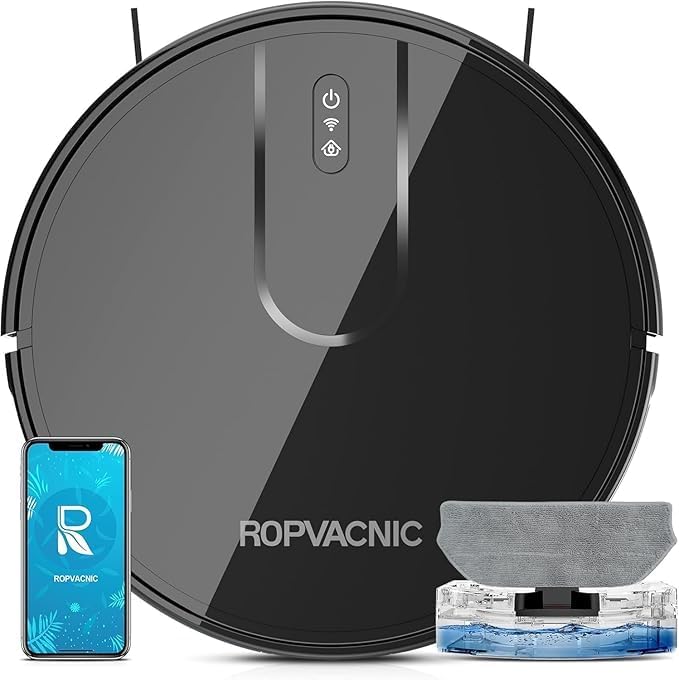
| Suction | 5200Pa |
|---|---|
| Battery Life | 120 minutes |
| Battery Type | Lithium Ion |
| Form Factor | round |
| Compatible Devices | Amazon Echo, Google Home, Smartphones |
The ROPVACNIC S1 is a 2-in-1 robot vacuum and mop designed for everyday floor care in small homes and apartments. It combines a 5200Pa suction motor with a powered mopping system that offers four water-intensity settings, so you can switch between light maintenance and more thorough damp mopping. Navigation relies on a smart sensing system and advanced obstacle avoidance so the round 12" unit can move under low furniture and return to its dock to recharge automatically when battery falls below 20%. You control cleaning schedules, suction level, and mop intensity from the app or by voice through Alexa or Google Assistant, and the included remote and touch controls provide alternatives. Practical benefits include a HEPA-style multi-layer filter, pet-hair oriented brush design to reduce tangles, and a 4400mAh battery promising around 120 minutes of runtime for typical small-space runs. Expect limitations typical of compact round robots: reduced corner reach compared with a D-shape model, a modest three power levels instead of fully variable suction, and the mop is best for light damp cleaning rather than heavy scrubbing or deep stain removal.
Best for: Someone who needs a dependable, app-controlled floor cleaner for a small home or apartment and values automatic routines, pet-hair handling, and low-clearance navigation.
Less Ideal for: Homes that require heavy-duty scrubbing, frequent deep stain removal, or users who need precise corner cleaning and full manual control over suction settings.
- Combined vacuum and electronically controlled mopping with four-stage water adjustment
- Strong 5200Pa suction suitable for crumbs and pet hair on hard floors and low-pile carpet
- App, remote, touchpad, and voice control for flexible scheduling and hands-free operation
- Long runtime around 120 minutes from a 4400mAh battery and automatic self-charging
- Multi-layer HEPA-style filtration and no-entanglement brush design tailored for pet owners
- Round form limits cleaning right up against corners compared with D-shaped robots
- Only three named power levels rather than continuously variable suction control
Verdict: A compact, reliability-focused robot that combines strong suction and controlled mopping for hands-off cleaning in small spaces.
iRobot Roomba 105 Vac

| Surface Recommendation | Carpet & Hard Floor |
|---|---|
| Battery Life | 200 minutes |
| Other Special Features of the Product | Anti-Fall, Bagless, Dirt Detection Sensor, Eco Mode, LiDAR Navigation |
| Controller Type | App Control, Button Control, Voice Control |
| Filter Type | Cartridge |
The Roomba 105 Vac is a compact, app-controlled robot vacuum designed to handle carpets and hard floors in smaller homes and apartments. It uses ClearView LiDAR to map rooms and navigate in neat rows while edge and multi-surface brushes work with a 3-stage system and strong suction to pick up dust, debris, and pet hair. You can schedule targeted cleans, choose from four suction levels, run spot cleaning, and send commands via the Roomba Home App or voice assistants. The battery life and automatic return-to-dock behavior let it cover multiple rooms before recharging, and LiDAR plus cliff sensors reduce the chance of collisions or falls. Practical limits include a modest cleaning path width and basic accessory bundle — it ships with a dock and filter only — so heavy-duty homes with very large areas or lots of stairs may need a higher-end model with auto-empty or wider brushes. For small spaces this model balances reliable navigation and simple app control without unnecessary extras.
Best for: Buyers who want a dependable, easy-to-use robot vacuum that reliably cleans small apartments or compact homes and prioritizes straightforward mapping and app control over premium extras.
Less Ideal for: Homes that need heavy-duty debris pickup across very large square footage or users seeking an auto-emptying base and extensive accessory bundles.
- ClearView LiDAR mapping provides efficient, room-by-room navigation and obstacle avoidance
- Four suction power levels and a 3-stage cleaning system for targeted cleaning intensity
- App and voice control let you schedule cleans and run spot cleaning remotely
- Long battery life with automatic return-to-dock and resume for multi-room coverage
- No hands-free auto-empty dock included
- Limited included accessories beyond the docking station and filter
Verdict: If you need a compact, reliable robot vacuum with precise LiDAR navigation and simple app or voice control for small spaces, the Roomba 105 is a practical, low-friction choice.
eufy 11S Max Robot Vacuum
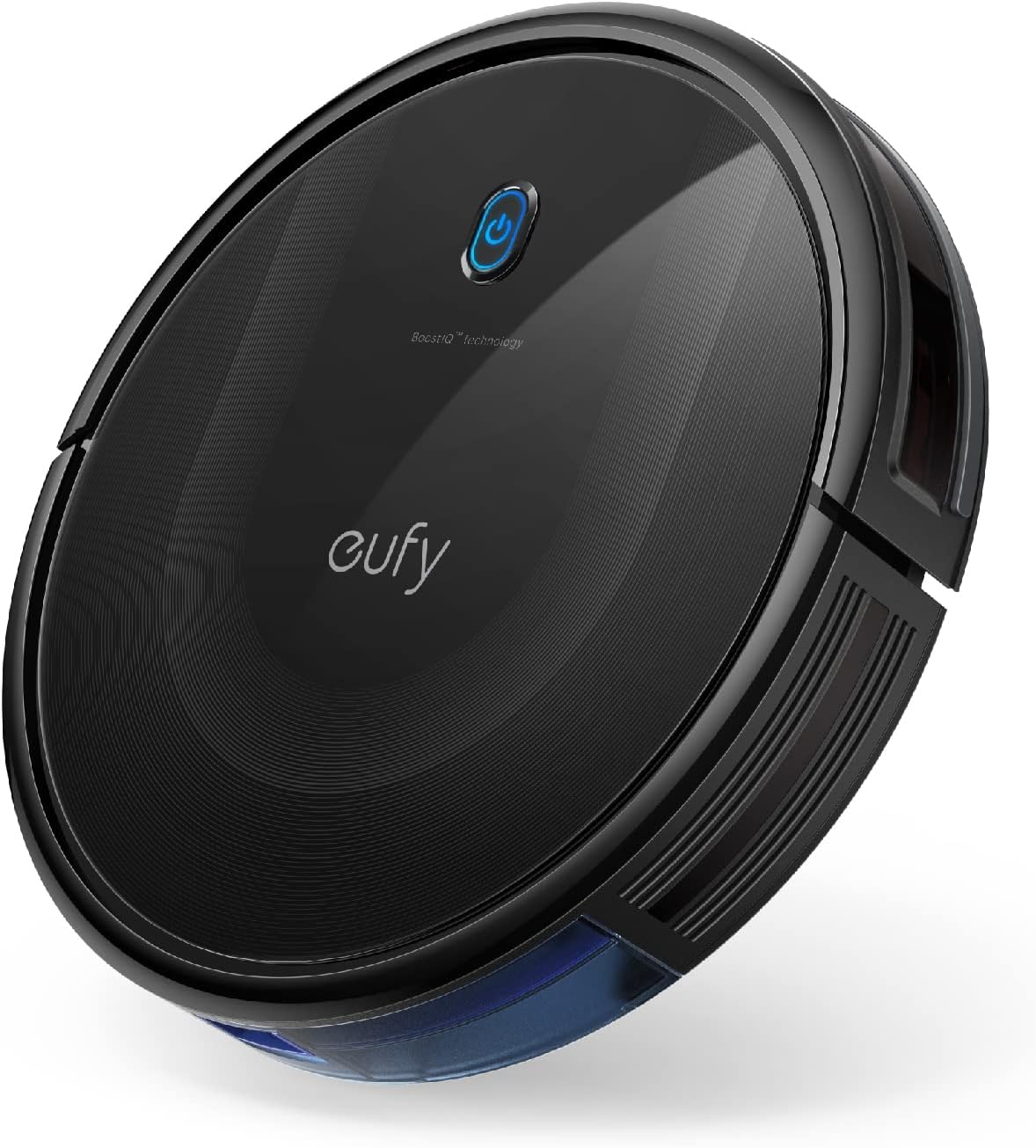
| Surface Recommendation | Hard Floor & Tile & Medium carpet |
|---|---|
| Battery Life | 100 minutes |
| Suction Power | 2000 Pa |
| Capacity | 600 ml |
| Noise Level | 55 db |
The eufy 11S Max is a low-profile robot vacuum built to clean hard floors and medium-pile carpets without drawing attention. Its 2.85-inch slim body lets it slide under low furniture while 2000Pa suction and a 12.8-inch cleaning path pick up dust, crumbs, and pet hair. It runs up to 100 minutes on hardwood at a reported low 55 dB, and automatic return-to-base means it tops off battery without user intervention. Controls are simple: the included remote and onboard buttons let you start, stop, and switch modes quickly, though there is no Wi-Fi or app control. Practical touches include washable filters, drop-sensing and anti-collision sensors, and a 600 ml dust capacity that reduces how often you empty the bin. The trade-offs are straightforward: navigation is basic rather than lidar or map-based, so room coverage is more random and may miss tight corners, and the single-side-brush design can be less thorough along edges compared with dual-brush models. For routine, quiet cleaning of hardwood, the 11S Max balances strong suction and a slim profile in a simple, reliable package.
Best for: Buyers who prioritize a quiet, no-frills robot that cleans hardwood reliably and fits under low furniture will appreciate this model for regular maintenance cleaning.
Less Ideal for: If you want mapped cleaning, smartphone scheduling, or the most thorough edge-cleaning for complex floorplans, choose a model with advanced navigation and app control instead.
- Slim 2.85" profile reaches under low furniture
- Up to 100 minutes runtime for extended cleaning sessions
- Powerful 2000Pa suction for effective pickup on hard floors
- Quiet operation at about 55 dB suitable for daytime or evening use
- Large 600 ml dust capacity and washable filter lower maintenance frequency
- Random navigation rather than mapping can lead to uneven coverage
- No Wi‑Fi or smartphone app means limited scheduling and remote control options
Verdict: A slim, quiet robot with strong suction made for routine hardwood maintenance when you want reliable, no-frills cleaning.
Choosing the Right Robot Vacuum for Small Spaces: Key Factors to Consider
Physical Size and Height
A robot vacuum for small spaces needs a small physical footprint and a low profile to navigate and store easily. Smaller diameter units can pass between chair legs and clean narrow aisles, while a low height allows the vacuum to reach under sofas, beds, and cabinets where dust accumulates.
If the unit is too tall or wide it will miss under-furniture zones or become difficult to tuck away when not in use. Consider the actual dimensions and compare them against common clearance heights and storage areas in your home before choosing.
Navigation Intelligence
Smart navigation matters more in tight floor plans because the robot will encounter more turns, obstacles, and furniture edges per square foot. Look for mapping, room recognition, and obstacle-avoidance capabilities that let the vacuum plan efficient paths instead of repeatedly rebounding off objects.
Good navigation reduces missed spots and decreases the need for manual rescue when the unit gets stuck. In small spaces, mapping features also let you set no-go lines or restricted zones so the vacuum avoids fragile or cluttered areas.
Suction Power and Brush Design
Suction strength and the type of brushroll directly affect how well a robot vacuum picks up debris on both hard floors and low-pile rugs common in apartments. In compact living spaces, crumbs, pet hair, and tracked-in dirt tend to concentrate in small areas, so effective pickup in a single pass is important.
Brush design matters for edges and corners. Side brushes help sweep debris toward the intake, but overly aggressive brushes can scatter material in tight rooms. Choose a balance that cleans well without creating extra work.
Battery Life and Charging Behavior
While large homes need long runtimes, small spaces benefit from robots that support frequent, short clean cycles and quick recharges. A unit with moderate runtime but fast recharge can complete multiple daily passes to keep dust at bay.
Also consider whether the robot returns reliably to the dock, how long it takes to resume a job after charging, and any automatic recharge-and-resume features that reduce the need for supervision.
Maintenance and Consumables
Ease of emptying the dustbin, replacing filters, and accessing the brush area matters for owners who want minimal upkeep. In small dwellings the bin will fill faster relative to the number of runs, especially if you have pets, so a simple emptying process and widely available filters make ownership easier.
Sturdy brush bearings, tool-free access to the brushroll, and washable filters reduce time spent on maintenance and keep performance consistent over months of use.
App Controls and Scheduling
App control and scheduling are useful for tight-living environments because they let you run short cleaning cycles on demand without moving furniture. Look for reliable remote control, easy-to-set schedules, and simple room- or zone-based cleaning options.
Additional features like scheduled quiet hours, cleaning summaries, and voice integration can improve convenience. However, ensure the core navigation and suction work well before prioritizing advanced app features.
Why Small-Space Robots Differ From Standard Models
Robots designed for small spaces emphasize compact dimensions and maneuverability over long runtime or oversized dustbins. They are tuned to navigate tighter furniture layouts and complete shorter, more frequent cleaning cycles so they do not need large battery packs.
These differences mean you should expect tradeoffs: a smaller bin that requires more frequent emptying, or slightly lower maximum suction in favor of quieter operation and longer brush life. The net effect is a device that integrates into a compact home with less disruption.
- Smaller diameter and lower profile for tighter passages
- Optimized mapping for dense furniture arrangements
- Design tradeoffs focused on convenience rather than maximum run time
Preparing a Small Home for Robot Cleaning
Clearing floor clutter and securing loose cords makes robotic cleaning far more effective in small homes. Create simple paths by tucking chairs under tables, rolling up small rugs that can snag, and using cable organizers to prevent entanglement.
Use simple room boundaries or low thresholds to keep the robot out of delicate zones. If you have a narrow entryway or a cluster of small items, consider temporarily blocking the area during initial runs so the robot can build a reliable map.
- Remove small objects and secure cords
- Tuck furniture to widen narrow gaps
- Use temporary barriers for fragile areas during mapping
Best Placement for Docking and Storage
Place the charging dock along a clear stretch of wall with a few feet of open space on either side so the robot can locate and align with it easily. In small homes this may mean placing the dock in a hallway or the edge of a room where it does not block walkways.
If storage space is limited, consider a low-profile dock or a corner placement that allows the vacuum to nestle beside furniture. Avoid placing the dock behind bulky items or inside cabinets where signal and access are restricted.
- Keep dock in open area with clearance on both sides
- Avoid wedging the dock into tight recesses
- Choose a location that is convenient for daily access and maintenance
Scheduling Strategies for Tighter Living Areas
Short, frequent cleaning cycles usually outperform long runs in small spaces. Schedule brief daily or alternate-day cleanings to keep debris from accumulating in corners and high-traffic zones. This approach reduces bin overload and keeps surfaces consistently tidy.
Time cleaning for when rooms are least occupied to avoid interference and reduce audible distraction. If your robot supports room-based schedules, prioritize entryways and dining areas that tend to get dirty faster.
- Use short daily runs rather than occasional long sessions
- Schedule during low-usage hours
- Prioritize high-traffic zones with targeted schedules
Handling Rugs, Thresholds, and Carpet Edges
Small apartments often use area rugs and thresholds that can be tricky for compact robots. Check the robot's clearance and climbing capability for rug edges and low thresholds. Very shaggy rugs may be unsuitable for small robots with modest suction and small wheels.
If you have multiple rug heights, consider using rug strips or low-profile threshold ramps to ease transitions. For delicate rug edges, set restricted zones or use manual spot cleaning to prevent repeated snagging.
- Verify climb height for rug edges and thresholds
- Avoid high-pile or shag rugs that can tangle brushes
- Use low ramps or restrict zones for problem transitions
How We Chose the Best Robot Vacuum for Small Spaces
We focused on attributes that matter most when a footprint and maneuverability are critical. Our editorial filters prioritized compact physical size and low-profile designs to ensure the units can operate under low furniture and fit into small storage areas. Navigation and obstacle handling were emphasized so the robots can efficiently clean around tight furniture layouts without frequent manual intervention. Suction performance and brush system effectiveness were evaluated with an eye toward mixed-floor homes where carpet edges and hard floors coexist. Battery runtime and recharge behavior were assessed relative to typical small-space cleaning patterns, favoring options that complete multiple short runs rather than long single sessions. Maintenance and filter access were considered because owners of small dwellings often prefer low-upkeep appliances. We excluded large, full-size models and units designed primarily for wide-open floor plans. We also filtered out devices that rely exclusively on manual spot-cleaning modes or have poor navigation logs. The result is a shortlist of compact, capable robot vacuums that balance suction, mapping, and daily convenience for small-space living.
Our full evaluation process is outlined in our review methodology.
FAQ
Will a small robot vacuum fit under my couch or bed?
Often it will if you check the robot's height against your furniture clearance. Measure the lowest point under the furniture and compare it to the robot's stated profile to confirm fit.
How often will I need to empty the dustbin in a small apartment?
That depends on foot traffic and pets. In many small homes the bin may need emptying after every few runs, especially if you schedule daily cleanings or have pets that shed frequently.
Can a compact robot handle pet hair in a small space?
Many compact robots handle moderate pet hair well, but extreme shedding can require more frequent emptying and brush maintenance. Look for brushes and filtration designed to resist tangles for the best results.
Are navigation features necessary in a small home?
Navigation features are helpful because tight spaces have more obstacles per square foot. Mapping and obstacle avoidance reduce missed spots and lower the chance the robot gets stuck, which is particularly useful when space is limited.
Should I use virtual boundaries or physical barriers in a small layout?
Either can work. Virtual boundaries are convenient if the robot and app support them. Physical barriers are a simple fallback for robots without mapping and can be useful during initial mapping runs.
Final Verdict
For small spaces, prioritize a compact footprint, reliable navigation, and an effective brush and suction combination that cleans mixed floors without frequent snagging. Expect tradeoffs such as smaller dustbins and moderate runtime, but plan for short, frequent cleaning cycles and easy maintenance to keep performance consistent. Choose a robot that fits your furniture clearances, returns reliably to its dock, and offers simple maintenance access. Focus on the specific factors outlined here to find a compact robot vacuum that integrates smoothly into your living space and minimizes hands-on effort.