
Note: This article contains affiliate links. If you click on these links and make a purchase, we may earn a small commission at no extra cost to you. This helps support our research and content. Read our full affiliate disclosure here.
If you want a dependable automated cleaning solution without overspending, picking the right robot vacuum matters for everyday upkeep and long-term convenience. You need a machine that actually picks up dirt in corners, navigates around furniture, and fits your home layout and maintenance routine. This guide lists seven shortlisted robot vacuums under $1,000 that perform well across real-world tasks and different floor types. We evaluated each option for core cleaning power, navigation accuracy, battery life, and upkeep needs so you can compare relevant tradeoffs quickly. Read on to see which features matter most and which devices are best suited to your home and habits.
Top Picks at a Glance
| Best Overall The best all-around choice for most situations | iRobot Roomba 105 Vac |  |
| Best Quality Built to a higher standard if you want something more solid | dreame L40 Ultra Gen2 |  |
| Best Value The sweet spot between price and what you get | Tikom G8000 Max Robot Vacuum |  |
| Best Budget The cheapest option that still gets the job done reliably | ILIFE V2 Robot Vacuum |  |
| Top Rated A top-rated pick with lots of positive feedback | roborock Qrevo S5V |  |
| Most Popular A crowd favorite that many people choose with confidence | roborock Q10 S5+ |  |
| Best Seller A high-volume bestseller chosen again and again | eufy 11S Max Robot Vacuum |  |
iRobot Roomba 105 Vac

| Surface Recommendation | Carpet & Hard Floor |
|---|---|
| Battery Life | 200 minutes |
| Controller Type | App Control, Button Control, Voice Control |
| Filter Type | Cartridge |
| Power Source | Battery Powered |
The Roomba 105 Vac is a straightforward robot vacuum that uses ClearView LiDAR to map rooms and navigate in neat rows while avoiding stairs and common obstacles. It cleans carpets and hard floors with a 3-stage system that combines a bristle main brush, an edge-sweeping brush, and what iRobot calls 70x more power-lifting suction compared with older 600-series models; you can pick from four suction levels to balance runtime and cleaning intensity. The unit pairs with the Roomba Home App for scheduled and targeted room cleans and also supports voice start via Alexa, Siri, or Google Assistant. It returns to its dock automatically to recharge and resumes cleaning where it left off. Practical limitations include a modest cleaning path width and basic included accessories; expect routine maintenance like brush and filter cleaning and periodic filter replacement. For buyers wanting reliable mapping, straightforward app control, and good suction in a budget-friendly package, this Roomba covers everyday needs without extra mopping or auto-empty features.
Best for: Buyers who want a reliable, app-controlled robot that maps spaces accurately and delivers strong suction for everyday carpet and hard-floor cleaning without premium extras.
Less Ideal for: Avoid this model if you need integrated mopping, an auto-emptying dock, or the fastest possible coverage for very large homes.
- ClearView LiDAR mapping for efficient, room-by-room navigation
- Four suction power levels to adjust cleaning intensity and battery use
- Works with smartphone app and voice assistants for scheduled or on-demand cleaning
- Automatic return-to-dock and resume after recharge for uninterrupted routines
- Does not include hands-free auto-empty base or mopping capability
- Cleaning path is relatively narrow which may increase run time on large rooms
Verdict: A budget-friendly Roomba that pairs accurate LiDAR mapping with strong, adjustable suction for straightforward, reliable daily cleaning.
dreame L40 Ultra Gen2

| Suction | 25,000 Pa |
|---|---|
| Battery Life | 231 minutes |
| Control | App, Voice, Remote |
| Special Features | Auto-empty, Hot Air Drying, Mop Washing, Obstacle Avoidance |
The dreame L40 Ultra Gen2 combines very strong suction with a multi-function mopping system and an autonomous dock to reduce hands-on maintenance. It delivers up to 25,000 Pa suction across five power levels, extends a side brush and mop to reach corners, and supports customized carpet modes and a 10.5 mm mop lift for avoiding carpets. The PowerDock handles emptying, mop washing, hot air drying, and offers a 100-day auto-empty claim to keep the robot ready between maintenance sessions. Navigation uses laser mapping plus 3D obstacle avoidance so it maps rooms, avoids shoes and small obstacles, and supports multi-level maps and no-go zones via the app and voice assistants. Battery runtime is long enough for large areas in quiet mode, and the optional auto-solution dispenser can enable auto-refill for mopping. Trade-offs are its dependency on 2.4 GHz Wi-Fi and optional accessories for some conveniences, and the dock and features add complexity compared with simpler models.
Best for: Buyers who prioritize raw cleaning power and autonomous maintenance and want a robot that aggressively tackles hard floors, corners, and high-traffic pet areas with minimal daily intervention.
Less Ideal for: People who want the simplest, lowest-cost robot or who need 5 GHz Wi-Fi support and an out-of-the-box full mopping solution without buying extras.
- Very high suction (up to 25,000 Pa) with five power levels for deep cleaning
- All-in-one dock that auto-empties, washes and dries the mop to reduce manual upkeep
- Advanced navigation with 3D obstacle avoidance and multi-level mapping for reliable routing
- Extended side brush and mop lift allow cleaning into corners and protect carpets during mopping
- Long battery runtime suitable for cleaning larger floor areas in a single run
- Auto-solution dispenser for full mopping automation is sold separately
- Requires 2.4 GHz Wi-Fi which limits network options
Verdict: If you want top-tier suction plus a self-cleaning dock that minimizes hands-on maintenance, the L40 Ultra Gen2 is a performance-focused choice under $1,000.
Tikom G8000 Max Robot Vacuum

| Suction | 5000Pa |
|---|---|
| Battery Life | 150 minutes |
| Dustbin Capacity | 450 ml |
| Water Tank | 300 ml |
| Noise Level | 45 db |
The Tikom G8000 Max is a low-profile robot vacuum that combines strong suction with mopping to keep hard floors and low-pile carpets tidy with minimal user effort. In use it maps and navigates with anti-collision and anti-fall sensors, and supports app, remote, voice, and onboard button control so you can schedule cleanings and start runs from a phone or the included remote. Notable features include a 5000Pa suction motor for lifting pet hair and debris, a combined 450 ml dustbin plus 300 ml water tank for simultaneous vacuuming and mopping, and a runtime up to 150 minutes with automatic recharge. Its 3-inch height lets it access under furniture and the Zig-zag cleaning mode improves coverage on open floor areas. Limitations to keep in mind are that higher-pile carpets may not get deep cleaning compared with upright vacuums and mopping is best for maintenance rather than heavy wet cleaning; occasional emptying of the dustbin and refilling the water tank are still required. For routine hardwood maintenance the G8000 Max offers a practical balance of suction, run time, and smart controls.
Best for: Buyers who want a practical, time-saving floor care solution for hardwood and low-pile carpets and prioritize long runtime, reliable navigation, and flexible control options.
Less Ideal for: Households that need deep carpet extraction, heavy wet mopping, or commercial-grade cleaning should consider a dedicated upright or standalone mop system instead.
- Strong 5000Pa suction effective on hard floors and short-pile carpets
- Simultaneous vacuuming and mopping with combined dustbin and water tank saves time
- Long run time up to 150 minutes with auto-recharge for larger homes
- Slim 3-inch profile reaches under low furniture
- Multiple control options including app, remote, voice, and onboard button
- Mopping function is for light maintenance and not heavy wet cleaning
- May be less effective on high-pile carpets compared with full-size vacuums
Verdict: A slim, long-running robot that combines powerful suction and light mopping to keep hardwood floors clean with minimal hands-on work.
ILIFE V2 Robot Vacuum

| Battery Life | 120 minutes |
|---|---|
| Capacity | 300 ml |
| Filter Type | Sponge |
| Control Method | Remote |
| Noise Level | 69 db |
The ILIFE V2 is an entry-level robot vacuum built to keep hardwood and other hard floors tidy without a lot of fuss. Its 2.99-inch slim body fits under low furniture while a tangle-free suction port and sponge filter make it practical for homes with pet hair. You can run scheduled cleanings, switch between auto, spot and edge modes, or start jobs with the included remote control or the single-button on the unit. A 300 ml dustbin and up to 120 minutes of runtime let it cover medium rooms on one charge, and it will automatically return to the dock when the battery is low. Noise is noticeable at 69 dB and there is only one power level, so it lacks adjustable suction or app-based controls, but for straightforward floor maintenance on hardwood and low-pile carpet the V2 delivers solid value at an affordable price.
Best for: Buyers who want an affordable, no-frills robot to maintain hardwood and low-pile carpet cleanliness with simple controls and scheduled runs.
Less Ideal for: Those who need strong adjustable suction, smart app control, or advanced mapping for large or complex homes should consider higher-end models.
- Slim 2.99-inch profile cleans under low furniture
- Tangle-free suction port suited for pet hair
- 120 minutes runtime with automatic return-to-dock
- Multiple cleaning modes (auto, spot, edge) and simple remote control
- Single power level limits suction control for heavier debris
- No smartphone app or advanced navigation features
Verdict: A low-cost, slim robot vacuum that reliably maintains hardwood floors and handles pet hair for budget-focused buyers.
roborock Qrevo S5V

| Suction | 12,000Pa |
|---|---|
| Battery Life | 180 minutes |
| Dust Capacity | 2.7 liters |
| Filter Type | Washable |
| Noise Level | 64 db |
The roborock Qrevo S5V combines strong suction with integrated mopping and a multifunction dock to reduce hands-on maintenance. It uses PreciSense LiDAR and reactive obstacle sensing to map up to four floors, plan efficient routes, and avoid cables or toys, while the Zero-Tangle brush and DuoDivide brush help keep pet hair moving into the dustbin. The included dock self-empties the robot, refills the water tank, self-washes and warm-air dries the mops, and stores debris for many weeks, which cuts down routine chores. App control provides 30 suction/water levels, room targeting, no-go zones, and scheduling, and voice assistants are supported. Battery life is rated up to 180 minutes for long runs, but noise can reach about 64 dB and the unit is relatively large and heavy compared with simpler models. The system only supports 2.4 GHz Wi-Fi and the dock and consumables add to the overall footprint, so it is best where storage space and dock access are convenient.
Best for: Buyers who prioritize a reliable, low-maintenance cleaning system that consistently handles pet hair and multi-floor homes with accurate mapping and automated dock functions.
Less Ideal for: People with very small homes or limited storage who cannot accommodate a large dock, or users who need dual-band Wi-Fi support or ultra-quiet operation.
- Powerful 12,000Pa suction that lifts embedded dirt and pet hair.
- All-in-one dock auto-empties, refills, washes, and warm-air dries mops to minimize maintenance.
- Zero-Tangle brush and side brush design reduce hair wrap and improve pet-hair handling.
- PreciSense LiDAR and multi-floor mapping create accurate maps and reliable navigation.
- App control with detailed customization, room targeting, and scheduling.
- Supports only 2.4 GHz Wi-Fi, limiting network options.
- Noise level around 64 dB may be noticeable during high-power cleaning.
- Larger, heavier unit and dock require dedicated floor space.
Verdict: Choose the Qrevo S5V if you want a robust, low-maintenance robot that combines strong vacuuming, reliable mapping, and an automated dock to minimize hands-on upkeep.
roborock Q10 S5+

| Maximum Suction | 10,000 Pa |
|---|---|
| Capacity | 2.7 liters |
| Battery Life | 150 minutes |
| Filter Type | Washable |
| Noise Level | 65 db |
The roborock Q10 S5+ is a robot vacuum and mop combo built for low-touch, regular maintenance of mixed flooring. It navigates with 360° LiDAR mapping and ReactiveTech obstacle avoidance, so it plans efficient routes and avoids common household objects while supporting multi-level maps and no-go zones via the app. The unit pairs a 10,000 Pa suction system and smart carpet detection to boost suction on rugs and a dual anti-tangle brush setup to reduce hair clogs, which is helpful for pet homes. Its VibraRise 2.0 sonic mopping lifts and scrubs floors and can auto-lift the mop when carpet is detected. The included auto-empty dock holds a 2.7 L dust bag for extended hands-free operation, advertised up to about 70 days between bag changes. Battery runtime and app controls allow scheduled and voice-operated cleaning. Expect roughly moderate noise and a relatively large robot footprint that may limit access under very low furniture, and advanced features depend on using the app and 2.4 GHz Wi-Fi.
Best for: Buyers who prioritize low-maintenance, reliable cleaning backed by broad user adoption and want a robot that cleans floors and mops with strong suction and advanced navigation.
Less Ideal for: If you need an ultra-compact robot for very low-clearance furniture or want a model that runs without any networked app features, this is not the best fit.
- Strong 10,000 Pa suction for deep pickup on carpets and floors
- LiDAR mapping with multi-level maps and no-go zones for predictable navigation
- VibraRise sonic mopping that auto-lifts on carpet to protect rugs
- Large 2.7 L auto-empty dock reduces how often you need to empty the bin
- Dual anti-tangle brush design reduces hair snags and maintenance
- Relies on 2.4 GHz Wi‑Fi and the app for full feature set
- Noise level is moderate and may be noticeable during runs
Verdict: Choose the Q10 S5+ when you want a mostly hands-free robot that combines strong suction, LiDAR mapping, and auto-emptying for dependable weekly cleaning under $1,000.
eufy 11S Max Robot Vacuum
| Surface Recommendation | Hard Floor & Tile & Medium carpet |
|---|---|
| Battery Life | 100 minutes |
| Suction Power | 2000 Pa |
| Capacity | 600 ml |
| Noise Level | 55 db |
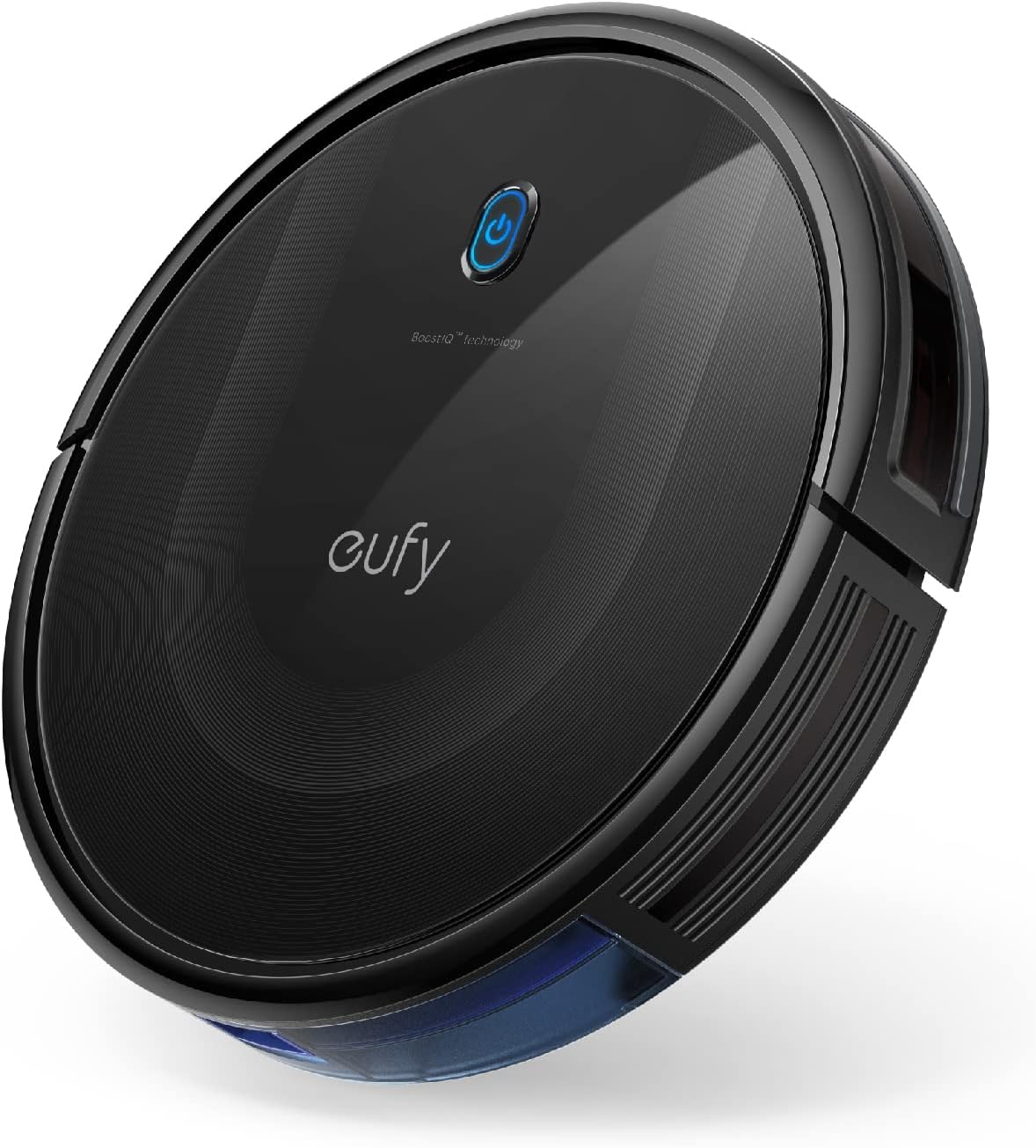
The eufy 11S Max is a low-profile robot vacuum built to clean hard floors and medium-pile carpets without drawing attention. Its 2.85-inch slim body lets it slide under low furniture while 2000Pa suction and a 12.8-inch cleaning path pick up dust, crumbs, and pet hair. It runs up to 100 minutes on hardwood at a reported low 55 dB, and automatic return-to-base means it tops off battery without user intervention. Controls are simple: the included remote and onboard buttons let you start, stop, and switch modes quickly, though there is no Wi-Fi or app control. Practical touches include washable filters, drop-sensing and anti-collision sensors, and a 600 ml dust capacity that reduces how often you empty the bin. The trade-offs are straightforward: navigation is basic rather than lidar or map-based, so room coverage is more random and may miss tight corners, and the single-side-brush design can be less thorough along edges compared with dual-brush models. For routine, quiet cleaning of hardwood, the 11S Max balances strong suction and a slim profile in a simple, reliable package.
Best for: Buyers who prioritize a quiet, no-frills robot that cleans hardwood reliably and fits under low furniture will appreciate this model for regular maintenance cleaning.
Less Ideal for: If you want mapped cleaning, smartphone scheduling, or the most thorough edge-cleaning for complex floorplans, choose a model with advanced navigation and app control instead.
- Slim 2.85" profile reaches under low furniture
- Up to 100 minutes runtime for extended cleaning sessions
- Powerful 2000Pa suction for effective pickup on hard floors
- Quiet operation at about 55 dB suitable for daytime or evening use
- Large 600 ml dust capacity and washable filter lower maintenance frequency
- Random navigation rather than mapping can lead to uneven coverage
- No Wi‑Fi or smartphone app means limited scheduling and remote control options
Verdict: A slim, quiet robot with strong suction made for routine hardwood maintenance when you want reliable, no-frills cleaning.
Choosing the Right Robot Vacuum: Key Factors to Consider
Suction Power and Brush System
Suction strength determines how well a robot vacuum lifts settled dust and pet hair from both hard floors and carpeting. Look beyond peak airflow numbers and consider whether the unit combines a motorized main brush, side brushes, and a sealed path to the dustbin. Brush design affects how hair wraps and how often you need to cut and remove tangles. A balanced system will let the robot loosen debris with brushes while powerful suction transports the particles into the dustbin.
For mixed-floor homes, variable suction or mode presets help prevent scattering debris on hard floors while still reaching deep into carpet piles. If you have pets, prioritize brush designs and filtration that reduce hair buildup on rollers and inside air channels.
Navigation, Mapping, and Obstacle Handling
How a robot navigates determines cleaning thoroughness and how often it gets stuck. Laser or visual mapping systems let the vacuum build and save floor plans, which improves coverage and enables no-go zones. Reliable obstacle detection reduces interruptions and prevents furniture bumps. Mapping features also let you run targeted cleaning sessions in specific rooms rather than whole-home cycles, which is useful for spot messes.
Consider whether the vacuum supports multi-floor maps and how it behaves around thresholds, rugs, and chair legs. Units that recover from interruptions and resume cleaning where they left off reduce the need for supervision.
Battery Capacity and Real-World Coverage
Battery life affects whether a single run can cover your main living area or if the robot needs to recharge mid-clean. Look for run-time estimates tied to real cleaning modes rather than idealized lab numbers. Recharge-and-resume capability matters for larger homes because it allows the vacuum to return to the dock, recharge, and continue where it stopped.
Also consider how battery life changes under high-suction modes and whether the manufacturer provides easy battery replacement options for long-term ownership. Practical coverage depends on both runtime and the unit's navigation efficiency.
Filtration and Dustbin Capacity
Filtration impacts indoor air quality, especially for allergy sufferers and pet owners. HEPA-style or fine particle filters trap smaller allergens that can be recirculated during cleaning. Dustbin size determines how often you need to empty the robot between runs; smaller bins mean more frequent emptying, which can defeat the convenience of automation.
Some robots include automatic dirt disposal bases that collect multiple runs of debris, which reduces hands-on maintenance. If you have heavy shedding animals or a lot of tracked-in dirt, prioritize larger dustbins or a reliable auto-empty solution.
Maintenance, Parts Availability, and Upkeep
Routine upkeep—cleaning brushes, replacing filters, and occasionally swapping rollers—keeps performance consistent over time. Check how easily you can remove and clean the main brush and whether the side brushes are clip-on for quick replacement. Filter replacements should be straightforward and commonly available.
Longevity also depends on how often consumables must be replaced and how accessible those parts are. A model with a slightly higher upfront convenience and easy maintenance often costs less in time and frustration over several years.
How Navigation Changes Daily Cleaning
Navigation quality is one of the biggest practical differences between robot vacuums. A unit that follows a methodical path covers floors more evenly and avoids repeated missed spots. Mapping features let you create virtual boundaries and schedule room-specific cleans so the robot acts more like an autonomous member of the household routine.
Poor navigation can result in repeated collisions, missed corners, and longer run times. For homes with many obstacles or open-concept spaces, prioritize mapping accuracy and obstacle avoidance rather than raw suction alone.
- Mapping enables room-based scheduling and targeted spot cleaning
- Good obstacle detection reduces manual interventions
- Resume-after-recharge helps finish large-area cleans
Balancing Suction and Runtime
High-suction modes clean more deeply but drain the battery faster. For everyday maintenance, a mid-level setting with optimized brush engagement often produces the best balance of coverage and battery life. Identify whether the vacuum automatically adjusts suction based on floor type, which can improve efficiency across mixed surfaces.
If your home requires deep cleans frequently—because of pets or heavy foot traffic—look for longer run times or a model with a fast recharge cycle to ensure full coverage without excessive interruptions.
- Automatic suction adjustment can extend runtime
- Consider recharge-and-resume for larger floor plans
- Use scheduled low-power runs for daily upkeep
App Features and Integrations Worth Using
The mobile app and smart-home integrations determine how conveniently you can schedule, monitor, and fine-tune cleaning. Useful app features include custom no-go zones, selective room cleaning, and simple firmware updates. Voice control can be handy but is secondary to reliable scheduling and mapping tools.
Prioritize an interface that makes it easy to name rooms, review cleaning history, and manage maintenance reminders. A well-designed app reduces the time you spend babysitting the device and improves overall value.
- Look for easy map editing and saved cleaning routines
- Maintenance reminders help keep performance consistent
- Firmware updates can improve navigation and reliability over time
Dealing With Pet Hair and High-Traffic Areas
Homes with pets or frequent tracked-in dirt require stronger brush-and-suction systems and larger dustbins. Regular emptying schedules and quick brush cleaning reduce performance loss from hair wrapping. Some robot vacuums provide focused pet modes or tangle-resistant brush designs.
Also consider where high-traffic dirt accumulates—near entrances and in living areas—and use room-specific schedules or booster modes to keep those zones tidier without running the vacuum continuously.
- Tangle-resistant brushes ease maintenance for pet owners
- Larger bins or auto-empty bases reduce empty frequency
- Spot-clean scheduling helps manage entryway messes
Real-World Considerations for Multi-Room Homes
Multi-room and multi-level homes pose additional demands for mapping, navigation, and battery management. Multi-floor map support makes it easy to switch cleaning profiles between levels. Threshold detection and ramp handling matter for homes with many doorways or area rugs.
If stair edges or drop-offs are present, ensure the robot has reliable cliff sensors. For larger homes, prioritize models that support room-by-room scheduling and can resume after recharging to complete a job.
- Multi-floor mapping simplifies routine cleaning across levels
- Cliff sensors and threshold handling reduce mishaps
- Room-based schedules target cleaning to the busiest areas
How We Chose the Best Robot Vacuum
Our selection process prioritized real-world usability for homes where spending under $1,000 is a requirement. We evaluated units across several specific, measurable dimensions: suction power and dirt removal on hard floors and carpets, navigation and mapping accuracy in furnished layouts, battery life and recharge/run management for typical home sizes, and long-term upkeep including filter and brush maintenance. We also looked at app and scheduling features because reliable automation is central to a robot vacuum's value. We excluded entry-level models lacking mapping or basic obstacle avoidance, and we filtered out specialty units that only mop or only perform one narrow task. We favored products with clear specification data and documented user experience signals for durability. The verdicts reflect comparative performance on the listed criteria rather than subjective brand perception, and we emphasized machines that balance strong cleaning metrics with reasonable maintenance demands.
Our full evaluation process is outlined in our review methodology.
FAQ
How often should I empty the dustbin on a robot vacuum?
It depends on bin size and household dirt levels. For average homes, emptying after two to three runs is common. If you have pets or heavy debris, expect to empty after every run or consider an auto-empty base to reduce frequency.
Can robot vacuums handle thick carpets and rugs?
Many units manage low- to medium-pile carpets well, but very thick or high-pile rugs can reduce brush contact and airflow. Choose a model with adjustable suction or a motorized brush roll designed for deeper cleaning if thick carpets are common in your home.
Will a robot vacuum get stuck under furniture?
Some robots still snag on low-clearance furniture or complex chair legs. Good navigation and object detection reduce this risk. Measure the clearance under furniture and compare it to the robot's height to minimize surprises.
Do robot vacuums damage floors or rugs?
Most robot vacuums are safe on sealed hard floors and typical area rugs. Soft bristles and controlled suction prevent scratching, but thin or delicate rugs with loose fibers could be disturbed. Use gentle modes or exclude sensitive areas with virtual no-go zones.
How long do robot vacuum batteries typically last before replacement?
Battery longevity varies by usage patterns and charging cycles, but many last several years under regular use. Heavy daily cleaning and frequent deep-suction runs shorten lifespan. Models with user-replaceable batteries simplify long-term ownership.
Final Verdict
Choosing the right robot vacuum under $1,000 means balancing suction, navigation, and upkeep to match your home's layout and dirt load. Prioritize reliable mapping and sufficient battery life if you have a larger or multi-room home, and favor brush and filtration choices that reduce maintenance for pet owners. Ultimately, pick the machine that best fits how you plan to use it daily: modest suction with excellent navigation can outperform a raw-power-first unit in routine upkeep, while stronger suction is worth it if deep cleaning is a frequent need.