
Note: This article contains affiliate links. If you click on these links and make a purchase, we may earn a small commission at no extra cost to you. This helps support our research and content. Read our full affiliate disclosure here.
If you want to spend less time scrubbing floors and more time doing other things, a robotic floor scrubber can automate routine wet cleaning for hard surfaces. Choosing the right unit matters because run time, water and detergent capacity, and cleaning path design determine how effectively a robot covers open rooms, avoids leaving streaks, and handles grout or textured floors. This guide shortlists seven top-rated Robotic Floor Scrubbers for home and light-commercial use and explains the practical features that matter. We evaluated runtime, tank design, agitation method, and navigation to help you pick a model that fits your space and cleaning habits.
Top Picks at a Glance
| Best Overall The best all-around choice for most situations | roborock QV 35A Robot Vacuum |  |
| Best Quality Built to a higher standard if you want something more solid | Purilitzs Automatic Floor Scrubber Robot |  |
| Best Value The sweet spot between price and what you get | Tikom L8000 Pro Robot Vacuum |  |
| Best Budget The cheapest option that still gets the job done reliably | ILIFE V5s Plus Robot Vacuum |  |
| Top Rated A top-rated pick with lots of positive feedback | MONSGA MR7 Pro Robot Vacuum |  |
| Most Popular A crowd favorite that many people choose with confidence | Tikom G8000 Max Robot Vacuum |  |
| Best Seller A high-volume bestseller chosen again and again | Shark AI Ultra AV2501S |  |
roborock QV 35A Robot Vacuum

| Maximum Suction | 8000 Pa |
|---|---|
| Capacity | 2.7 liters |
| Battery Life | 180 minutes |
| Control Method | App, Voice |
| Filter Type | Washable |
The roborock QV 35A is a full-featured robot vacuum and mop designed for hands-off cleaning in multi-surface homes. It uses PreciSense LiDAR mapping plus Reactive Tech obstacle avoidance to build accurate maps and steer around furniture, cords, and shoes while remembering up to four floor plans. The unit combines a vacuum with dual spinning mops and a 10 mm lift so it can mop hard floors and avoid soaking low-pile carpet. The multifunction dock automatically empties dust into a sealed 2.7 L bag, refills water, washes and dries mop pads, and stores waste for several weeks of use, which reduces maintenance. App and voice control let you set no-go zones, schedules, and suction levels, and washable filters keep running costs lower. Expect about three hours of runtime on a charge and relatively quiet operation reported near 64 dB. The practical trade-offs are its complexity and size: the all-in-one dock needs space and dirty-water maintenance, and advanced features require occasional app interaction to keep maps and refill/clean cycles running smoothly.
Best for: Someone who prioritizes reliable obstacle avoidance and wants a largely hands-free vacuuming and mopping system that reduces daily upkeep and supports smart-home controls.
Less Ideal for: Buyers with very tight storage space for a large docking station or those who want a minimal, no-app simple robot with only basic vacuuming functions.
- LiDAR navigation plus Reactive Tech for reliable obstacle avoidance and accurate multi-floor mapping
- All-in-one dock that self-empties, refills water, and washes and dries mop pads for low-touch maintenance
- Dual spinning mops with adjustable water levels and a 10 mm lift for safe transitions between hard floors and low-pile carpet
- Washable filter and app/voice control with no-go zones and scheduling for tailored, cost-effective operation
- All-in-one dock requires a sizable footprint and regular cleaning of the dirty-water tank
- Advanced features and setup depend on the app and 2.4 GHz Wi-Fi, which may add initial configuration time
Verdict: Choose the QV 35A if you want a smart LiDAR robot that reliably avoids obstacles and largely automates emptying, mopping, and maintenance for low-effort whole-home cleaning.
Purilitzs Automatic Floor Scrubber Robot

| Cleaning Path Width | 13 inches |
|---|---|
| Capacity | 0.8 gallons |
| Battery Type | Lithium Ion |
| Lithium Battery Voltage | 25.6 volts |
| Form Factor | Robotic |
The Purilitzs Automatic Floor Scrubber Robot is a commercial-grade autonomous scrubber designed to clean hard surfaces like tile, marble, hardwood, laminate, and vinyl. It runs on a 25.6 V lithium-ion battery and uses a 13-inch cleaning path with a 0.8 gallon water tank to scrub, dispense water, and dry floors in one pass. Navigation is app-enabled and also supports remote control, scheduled programming and obstacle avoidance so the unit can work hands-free in lobbies, hallways, and other high-traffic spaces. Filtration includes foam and HEPA pre-filters for capturing fine dust kicked up during scrubbing. Practical benefits include reduced labor for routine floor maintenance, consistent coverage from AI navigation, and quick return-to-service thanks to the integrated drying function. Limits to consider are the modest water capacity that may need refilling on very large areas and the lack of detailed runtime per charge in the listing, which means planning for recharges or multiple units in continuous commercial use.
Best for: Facility managers and small commercial operators who prioritize reliable, performance-focused automated floor cleaning to cut labor and keep hard-floor areas ready for traffic.
Less Ideal for: Homes or very small businesses that only need occasional spot cleaning or where storage and charging logistics make a dedicated commercial scrubber impractical.
- Autonomous AI navigation with obstacle avoidance for consistent, hands-free cleaning
- Combined scrubbing and drying in one pass reduces downtime for foot traffic
- App control, remote, and scheduled programming for flexible operation
- HEPA and foam filtration to capture fine dust during scrubbing
- 13-inch cleaning path covers wide swaths for faster area cleaning
- 0.8 gallon tank may require frequent refills on very large commercial floors
- Listing does not specify runtime per charge, so continuous coverage planning is unclear
Verdict: A performance-oriented autonomous floor scrubber that delivers hands-free scrubbing and drying for commercial hard floors, ideal for reducing routine cleaning labor.
Tikom L8000 Pro Robot Vacuum

| Suction | 6000 Pa |
|---|---|
| Navigation | LiDAR |
| Dustbin Capacity | 450 ml |
| Battery Life | 150 minutes |
| Filter Type | Hepa Filter |
The Tikom L8000 Pro is a budget-friendly robot vacuum that combines LiDAR mapping, strong suction, and a mopping option to handle daily dirt, pet hair, and light carpet cleaning. It builds a map of your home using LiDAR, saves up to five maps, and supports no-go and no-mop zones via the app for targeted cleaning; it also works with Alexa and Google Home. Suction ramps up automatically on carpets and the 6000 Pa rating plus a 450 ml dustbin help reduce trips to the trash, while the 300 ml water tank enables paired mopping passes. Runtime reaches about 150 minutes in quiet mode and the robot will return to charge and resume cleaning where it left off. Practical benefits include Hepa filtration for finer dust capture and relatively quiet operation at low power. Limitations to note are only two power levels rather than more granular control, and some buyers may prefer larger water capacity or more advanced app features found on higher-priced models.
Best for: Buyers who prioritize dependable, hands-off cleaning on a budget and want reliable navigation and resume behavior for daily upkeep in multiroom homes.
Less Ideal for: Households that need highly customizable power presets, very large continuous mopping capacity, or advanced app integrations found on premium models should consider higher-end options.
- LiDAR navigation with smart mapping and ability to store up to five maps
- Strong 6000 Pa suction that boosts on carpets for deeper cleaning
- Combined vacuum and mop with separate dustbin (450 ml) and water tank (300 ml)
- Long runtime around 150 minutes with automatic return and resume
- Hepa filter and relatively low noise in quiet mode (~45 dB)
- Only two power levels limit fine-tuning between quiet and max modes
- Water tank and dustbin sizes are adequate but not large for very big homes
Verdict: A reliable, well‑navigating robot vacuum with strong suction and mopping capability that delivers dependable daily cleaning on a budget.
ILIFE V5s Plus Robot Vacuum

| Battery Life | 110 minutes |
|---|---|
| Capacity | 300 ml |
| Controller Type | App Control, Voice Control, Remote Control |
| Compatible Devices | Amazon Echo, Google Home |
The ILIFE V5s Plus is a slim 2-in-1 robot that vacuums and mops while offering app, remote and voice control for scheduled cleaning. It runs up to 110 minutes per charge and automatically returns to its charging dock when the battery is low, making it suitable for daily maintenance across small to medium rooms. The unit provides five cleaning modes including auto, spot, edge and max for adjustable suction and targeted passes, and its 300 ml tanks handle both dust and water for light mopping tasks. Practical benefits include a low profile that reaches under furniture, compatibility with Alexa and Google Assistant, and sensor suites that reduce falls and collisions. Limitations are a modest suction level compared with higher-end models, a relatively small water/dust capacity that requires frequent emptying for larger homes, and simpler navigation that may miss complex path optimization on cluttered carpets. For its price point the V5s Plus delivers consistent, hands-off upkeep rather than deep clean performance on thick carpeted surfaces.
Best for: Buyers looking for an affordable, no-frills robot that keeps hard floors and low-pile carpet tidy with minimal setup and smart-home control.
Less Ideal for: Homes that need powerful deep-cleaning on thick or high-pile carpets or large houses where longer runtimes and larger dust/water capacity are required.
- 2-in-1 vacuum and mop combination for quick maintenance of floors and light spills
- 110-minute runtime with automatic self-charging for largely unsupervised cleaning cycles
- Multiple cleaning modes and scheduling via app, remote or voice for flexible operation
- Slim profile and sensors help the robot reach under furniture and avoid drops or collisions
- Smaller 300 ml tanks and dustbin need more frequent emptying during larger jobs
- Navigation is basic compared with lidar or advanced mapping systems, so pathing can be inefficient on cluttered layouts
Verdict: A budget-friendly robot that combines vacuuming and light mopping with smart controls to keep small-to-medium homes tidy without breaking the bank.
MONSGA MR7 Pro Robot Vacuum

| Suction | 8000Pa |
|---|---|
| Battery Life | 160 minutes |
| Dust Bag Capacity | 4 liters |
| Filter Type | HEPA |
| Control Type | App, Remote, Button, Voice |
The MONSGA MR7 Pro is a round robot vacuum and mop combo built for hands-off cleaning in multiroom homes. It uses LiDAR navigation to create precise maps and can store up to five floor plans, letting you set no-go zones, schedule runs, and target spot or area cleans from the app or with voice commands. In use it combines an 8000Pa suction system with a dual anti-tangle brush design and a rubber main roller to handle pet hair and debris on hard floors and carpets, while an attached mop and 460ml water tank let it mop between vacuuming passes without frequent refills. The included auto-empty station holds a 4L dust bag for up to 90 days of reduced maintenance, and a 160-minute runtime plus recharge-and-resume covers larger homes. Practical limits include a 3.5 inch low profile that may struggle with high-threshold transitions and a 2.4GHz-only Wi-Fi requirement for smart features, but the MR7 Pro delivers systematic cleaning, strong suction, and easy scheduling for everyday floor care on concrete and other hard surfaces.
Best for: Buyers who want a low-maintenance, high-suction robot that maps multiple floors and reduces daily chores with automatic emptying and combined vacuum-and-mop cleaning.
Less Ideal for: Homes that require frequent heavy-duty stair-to-floor transitions, very thick-pile carpets, or those that need 5GHz Wi‑Fi smart integrations.
- Powerful 8000Pa suction for deep debris pickup on hard floors and rugs
- LiDAR navigation with multi-floor mapping and precise no-go zones
- Large 4L auto-empty dust bag reduces how often you need to empty the bin
- Dual anti-tangle brush system and rubber main roller handle pet hair better than single-brush designs
- 460ml water tank and mop function let it mop while vacuuming to reduce extra passes
- Smart features require 2.4GHz Wi-Fi, which limits some network setups
- Low-profile design may have trouble climbing high thresholds or thick rugs
Verdict: Choose the MR7 Pro if you want a LiDAR-mapped, self-emptying robot that pairs strong suction with mop capability to keep concrete and other hard floors consistently clean.
Tikom G8000 Max Robot Vacuum

| Suction | 5000Pa |
|---|---|
| Battery Life | 150 minutes |
| Dustbin Capacity | 450 ml |
| Water Tank | 300 ml |
| Noise Level | 45 db |
The Tikom G8000 Max is a low-profile robot vacuum that combines strong suction with mopping to keep hard floors and low-pile carpets tidy with minimal user effort. In use it maps and navigates with anti-collision and anti-fall sensors, and supports app, remote, voice, and onboard button control so you can schedule cleanings and start runs from a phone or the included remote. Notable features include a 5000Pa suction motor for lifting pet hair and debris, a combined 450 ml dustbin plus 300 ml water tank for simultaneous vacuuming and mopping, and a runtime up to 150 minutes with automatic recharge. Its 3-inch height lets it access under furniture and the Zig-zag cleaning mode improves coverage on open floor areas. Limitations to keep in mind are that higher-pile carpets may not get deep cleaning compared with upright vacuums and mopping is best for maintenance rather than heavy wet cleaning; occasional emptying of the dustbin and refilling the water tank are still required. For routine hardwood maintenance the G8000 Max offers a practical balance of suction, run time, and smart controls.
Best for: Buyers who want a practical, time-saving floor care solution for hardwood and low-pile carpets and prioritize long runtime, reliable navigation, and flexible control options.
Less Ideal for: Households that need deep carpet extraction, heavy wet mopping, or commercial-grade cleaning should consider a dedicated upright or standalone mop system instead.
- Strong 5000Pa suction effective on hard floors and short-pile carpets
- Simultaneous vacuuming and mopping with combined dustbin and water tank saves time
- Long run time up to 150 minutes with auto-recharge for larger homes
- Slim 3-inch profile reaches under low furniture
- Multiple control options including app, remote, voice, and onboard button
- Mopping function is for light maintenance and not heavy wet cleaning
- May be less effective on high-pile carpets compared with full-size vacuums
Verdict: A slim, long-running robot that combines powerful suction and light mopping to keep hardwood floors clean with minimal hands-on work.
Shark AI Ultra AV2501S
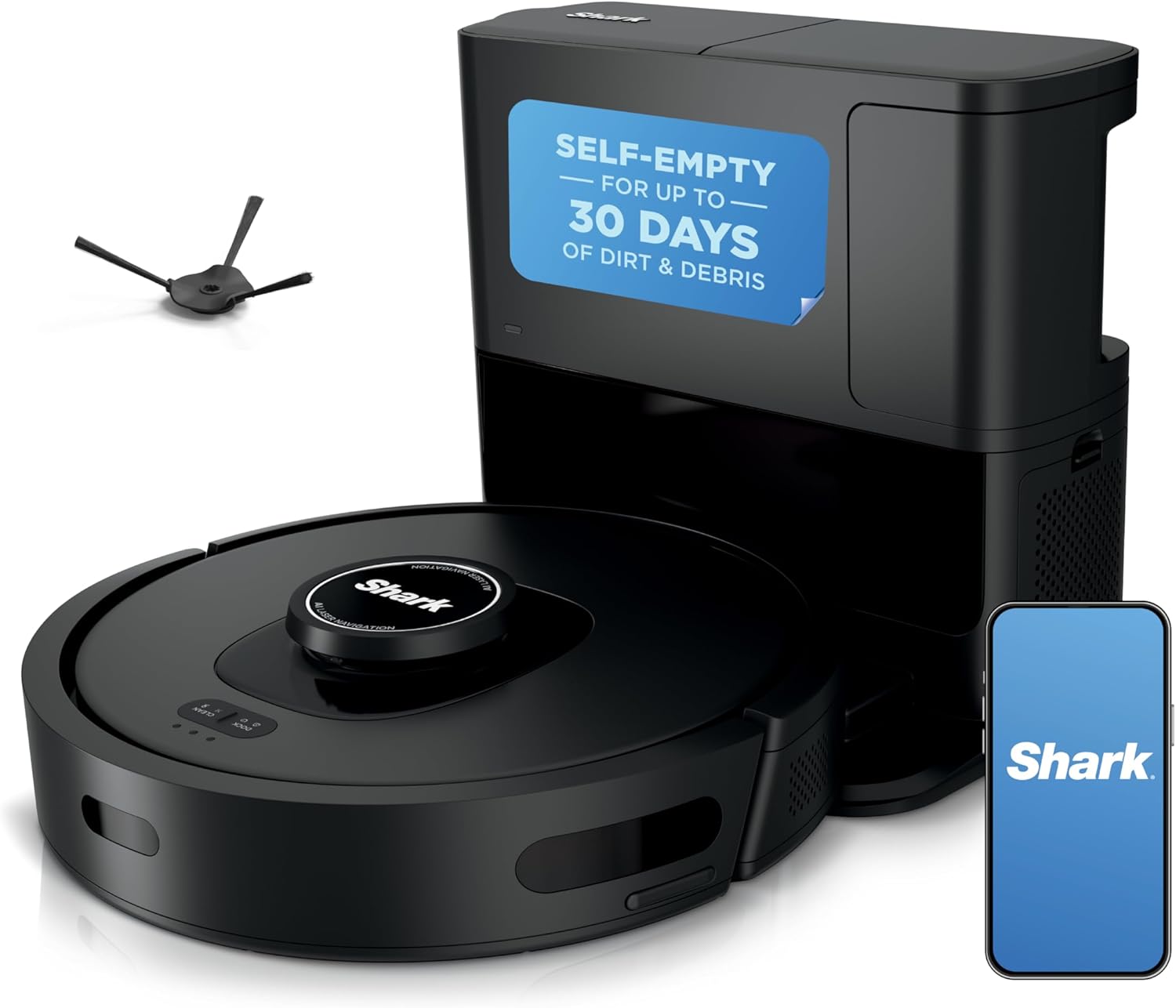
| Battery Life | 120 minutes |
|---|---|
| Control Method | Voice |
| Compatible Devices | Amazon Alexa, Google Home |
| Other Special Features of the Product | Bagless, Pet Hair Pick Up, Self-Cleaning Brushroll, Self-Emptying |
| Surface Recommendation | Carpets & Hard Floors |
The Shark AI Ultra AV2501S is a feature-packed robot vacuum that combines 360° LiDAR home mapping with Matrix Clean navigation to methodically clean carpets and hard floors, making it a strong choice for area rugs. It uses a self-cleaning brushroll and powerful suction to lift pet hair and embedded debris while the bagless self-emptying base holds up to 30 days of dirt for low-maintenance use. Runtime of up to 120 minutes plus Recharge and Resume helps it cover larger spaces and return to finish jobs, and the SharkClean app with Alexa and Google compatibility makes scheduling and targeted zone cleaning straightforward. Practical limitations include a single-speed setting and a foam filter rather than multiple filter stages, which may be less ideal for households needing very fine particle capture beyond HEPA in the base. The robot's methodical grid passes are good for deep cleaning rugs, though very high-pile or loosely woven area rugs should be checked for compatibility before regular use.
Best for: Buyers who want a hands-off, thorough cleaner for mixed floors and area rugs and prioritize reliable pet-hair pickup and automated dirt disposal.
Less Ideal for: Users who need fine-grain control over suction levels for very delicate or specialty rugs or who require multi-stage filtration on the robot itself.
- Matrix Clean navigation with 360° LiDAR produces methodical, repeat passes over rugs for deeper cleaning
- Self-cleaning brushroll reduces hair wrap and keeps suction consistent on pet hair
- Bagless self-emptying base holds up to 30 days of debris for low-maintenance operation
- Up to 120 minutes runtime with Recharge and Resume covers larger homes and finishes interrupted runs
- App control plus Alexa and Google compatibility for scheduling, zone targeting, and voice starts
- Only one listed cleaning speed limits control over suction intensity for delicate rugs
- Foam filter in the robot requires relying on the base HEPA for higher-level allergen capture
Verdict: Choose the Shark AI Ultra if you want a mostly hands-off robot that maps precisely and reliably lifts pet hair and dirt from area rugs while auto-emptying for minimal upkeep.
Choosing the Right Robotic Floor Scrubber: Key Factors to Consider
Battery Life And Recharge Time
Battery capacity determines how much contiguous floor your robotic scrubber can cover in one run. Longer runtime is important for covering larger open-plan areas without pausing for recharge. Faster recharge cycles or the ability to resume cleaning from the last location reduce total wall-clock cleaning time and improve convenience.
Consider the typical size of rooms you want cleaned on a single pass. Units with shorter runtimes are still useful in small apartments but will interrupt cleaning in larger homes. Also check whether the robot can automatically return to its dock, recharge, and resume where it left off to avoid missed zones.
Water And Detergent Tank Design
Tank capacity affects how often you must stop and refill during a cleaning session. Larger tanks reduce interruptions for bigger spaces, but they can add weight and bulk. A well-designed tank makes filling and emptying simple and minimizes spills and contact with dirty water.
Separating clean and dirty water reservoirs, when available, prevents redepositing soil and simplifies disposal. The ease of accessing and removing tanks for rinsing and maintenance is a practical factor that influences long-term satisfaction with a robotic scrubber.
Cleaning Mechanism And Surface Compatibility
Different scrub systems work better on different surfaces. Rotating brushes or scrub pads offer mechanical agitation to loosen stuck-on grime, while microfiber pads are gentler and can reduce streaking on sealed floors. Some machines combine agitation with suction to collect loosened soil into a separate tank.
Match the cleaning mechanism to your floors. Hard, sealed surfaces tolerate more aggressive scrubbing, while delicate finishes or unsealed grout may need softer methods. Also consider replaceable parts such as brushes and pads and how readily available those consumables are.
Navigation, Mapping, And Coverage Patterns
Efficient path planning determines whether the robot cleans in straight, edge-to-edge lanes or wanders in inefficient patterns. Mapping features let the device learn room layouts, avoid no-go zones, and complete jobs with minimal overlap and missed areas.
Advanced navigation helps with obstacle negotiation, detecting furniture legs, and avoiding steps. If you have irregular room shapes, many obstacles, or multi-room layouts, prioritize a model with mapping and room-select cleaning to reduce wasted battery and runtime.
Maintenance And Consumables
Routine upkeep affects long-term performance and cost. Consider how often brushes, pads, filters, and seals need replacement and how easy they are to access. Machines that allow tool-free part swaps and simple tank cleaning will save time and frustration.
Also check whether the robot has clear indicators for clogs, low water, or brush wear. Good documentation and straightforward disassembly make seasonal deep-cleaning and component replacement easier.
Noise Level And Daily Use Practicalities
Noise matters if you plan to run a robotic scrubber while you are at home. Some units are noticeably louder during agitation or suction cycles, which can be disruptive in small living spaces. Quieter machines enable daytime operation with less disturbance.
Other practicalities include scheduling flexibility, whether the device supports app-based control or physical buttons, and how it handles threshold crossings between rooms. These user-experience details influence how regularly you will use the robot and how seamless it feels to integrate into your cleaning routine.
Which Floors Work Best With Robotic Scrubbers
Robotic scrubbers are designed primarily for sealed hard floors such as tile, sealed wood, laminate, and vinyl. These surfaces tolerate moisture and mechanical agitation without damage when the correct cleaning method and solution are used. Textured tile or grout can be more challenging and may require multiple passes or a model with stronger agitation to remove embedded dirt.
- Sealed hardwood: gentle microfiber pads and low-moisture settings prevent swelling or finish damage.
- Ceramic and porcelain tile: tolerate stronger scrubbing; mechanical brushes work well.
- Vinyl and laminate: use lower-moisture modes and soft pads to avoid seam swelling.
Setting Up A Robotic Scrubber For Best Results
Position the charging dock in an open area with a clear approach path so the robot can reliably find home. Remove small obstacles like loose rugs, toys, and low cords from the work area to minimize interruptions. Pre-sweeping or vacuuming to remove loose debris improves wet-cleaning effectiveness because dry grit can scratch pads and reduce contact with stuck-on soil.
Many models offer area or room scheduling. Start with a short test run to observe how the robot navigates and whether it misses corners or edges. Adjust furniture placement slightly if the robot repeatedly misses the same spots.
- Clear thresholds and doorway transitions so the robot can cross between rooms.
- Pre-clean heavily soiled zones manually if you expect caked-on grime.
- Use manufacturer-recommended cleaning solution concentrations to avoid residue.
Daily Upkeep And Troubleshooting Tips
Empty and rinse tanks after each cleaning session to prevent odor and bacterial growth. Remove and inspect brushes and pads regularly for hair buildup and replace consumables when performance drops. Periodically check sensors and charging contacts and wipe them with a soft cloth to maintain reliable navigation and docking.
If you notice streaking or poor pickup, verify pad alignment, ensure tanks are filled correctly, and run a diagnostics or calibration routine if the device supports it. For recurring navigation problems, re-run the mapping sequence or reset the map to clear obstacles that the robot mislearned.
- Wipe sensors and charging contacts weekly.
- Soak microfibre pads per care instructions to restore absorbency.
- Keep spare pads and basic tools on hand for quicker maintenance.
Using Scheduling And Zones To Reduce Hands-On Time
Use scheduling to run wet-cleaning during low-traffic times, such as overnight or while you are out. If mapping is available, create no-go zones around delicate furniture or rugs to prevent accidental wetting. Room-by-room scheduling lets you stagger cleaning across the day so each area gets a fresh scrub without pushing battery limits.
Combine vacuuming and wet-scrubbing routines on alternating days to maintain floors without overworking any single component. Proper scheduling reduces the need for manual spot cleaning and keeps floors consistently cleaner.
- Schedule tough rooms when you are away to avoid interference.
- Combine light daily scrubs with deeper weekly passes for high-traffic areas.
- Set virtual boundaries around rugs and electronics.
How We Chose the Best Robotic Floor Scrubber
We prioritized objective, buyer-relevant criteria that predict real-world cleaning performance and uptime. First, battery runtime and recharge behavior were essential because they determine whether a single charge can finish your usual area. Second, water and detergent capacity plus refill convenience were evaluated since small tanks mean frequent interruptions during larger jobs. Third, cleaning mechanics such as rotating brushes, mopping pads, or combined scrub-and-suction mechanisms were considered for how they affect soil removal and streaking. Fourth, navigation and mapping capabilities were assessed for coverage efficiency and obstacle handling in furnished homes. We excluded devices that are strictly vacuum-only or that do not provide an integrated wet-cleaning mode. Units with poor documentation about tank access, brush replacement, or battery specifications were also removed from consideration. The final selections balance runtime, cleaning system design, and ease of maintenance to match real household and light-commercial cleaning scenarios.
Our full evaluation process is outlined in our review methodology.
FAQ
Can a robotic floor scrubber replace mopping by hand?
Often a robotic scrubber can handle routine maintenance and keep floors consistently cleaner, but it may not replace targeted, intensive scrubbing for stubborn stains. For heavily soiled spots or grout restoration, occasional manual intervention is usually necessary.
How often should I empty and clean the tanks?
Usually you should empty and rinse tanks after each cleaning session to prevent odor and buildup. If you run multiple consecutive sessions, check and replace dirty water sooner to avoid redistributing soil.
Are robotic scrubbers safe on hardwood floors?
They are safe on sealed hardwood when you use low-moisture settings and soft pads. Avoid using excess water or abrasive brushes on unsealed or oil-finished floors to prevent swelling and finish damage.
Do robotic scrubbers work on textured tile and grout?
They can improve surface cleanliness, but textured tile and grout often require stronger mechanical action or multiple passes to remove embedded soil. Look for models with adjustable agitation for the best results.
How noisy are robotic floor scrubbers during operation?
Noise levels vary. Machines with suction and strong agitation are usually louder, while simple pad-only scrubbers run more quietly. Check runtime and scheduling options if noise is a concern.
What routine maintenance keeps performance optimal?
Regularly rinse tanks, clear brushes and pads of hair and debris, wipe sensors and charging contacts, and replace consumables per the recommended intervals to maintain cleaning effectiveness and navigation reliability.
Final Verdict
Prioritize the features that match your home and cleaning habits when choosing a robotic floor scrubber. If you have larger open areas, battery life and mapping capabilities matter most. For homes with textured tile or frequent heavy soil, focus on the cleaning mechanism and tank design for multiple passes and effective soil capture. Balance runtime, tank capacity, and maintenance convenience to find a model that reduces hands-on work without creating new chores. With those tradeoffs in mind, you can confidently pick a robotic scrubber that keeps floors cleaner with minimal effort.