
Note: This article contains affiliate links. If you click on these links and make a purchase, we may earn a small commission at no extra cost to you. This helps support our research and content. Read our full affiliate disclosure here.
When cold weather shrinks your usable living space, a safe space heater can make a room comfortable without risking household safety. You want dependable heat delivery, but safety features like tip-over shutoff, overheat protection, and cool-to-touch surfaces are equally important for daily use around pets or family. This guide covers seven shortlisted safe space heaters that represent the most practical, safety-forward options in the category. We evaluate each on safety systems, energy use, and real-world usability so you can pick a heater that fits your room size and routines. Read on for the decision points that matter and a concise look at which models match common needs.
Top Picks at a Glance
| Best Overall The best all-around choice for most situations | Lasko Ceramic Tower Heater 751320 |  |
| Best Quality Built to a higher standard if you want something more solid | Dr. Infrared Heater DR-968 |  |
| Best Value The sweet spot between price and what you get | Amazon Basics Ceramic Space Heater |  |
| Best Budget The cheapest option that still gets the job done reliably | Amazon Basics Ceramic Mini Heater |  |
| Top Rated A top-rated pick with lots of positive feedback | DREO Space Heater HSH006 |  |
| Most Popular A crowd favorite that many people choose with confidence | GiveBest Portable Space Heater PTC-905 |  |
| Best Seller A high-volume bestseller chosen again and again | Mr. Heater Portable Buddy F232000 |  |
Lasko Ceramic Tower Heater 751320

| Heat Output | 1500 watts |
|---|---|
| Heating Element | Ceramic |
| Heat Settings | 2 |
| Timer | 7-hour |
| Voltage | 110 volts |
The Lasko Ceramic Tower Heater 751320 is a slim, portable electric heater designed to warm small to medium rooms. It uses a 1500-watt ceramic element and widespread oscillation to circulate warm air, and an electronic programmable thermostat lets the unit maintain a chosen temperature rather than running full blast. Controls are straightforward on the unit and via the included multi-function remote, and the seven-hour auto-off timer adds convenience for timed heating sessions. Built-in safety features such as overheat protection, cool-touch housing, and ETL listing make it suitable for bedrooms and living spaces, and the integrated handle makes it easy to move between rooms. Limitations include only two heat settings and no explicit tip-over switch on this model, so placement and supervision matter in homes with pets or small children. The unit performs well as a supplemental heater and is best used to boost comfort in occupied rooms rather than as a primary heat source for very large or poorly insulated spaces.
Best for: Buyers who want an easy-to-use, safe supplemental heater for bedrooms or living rooms that offers programmable controls and remote operation for everyday comfort.
Less Ideal for: People needing a primary heat source for very large or poorly insulated spaces or households that require many precise heat levels should look elsewhere.
- 1500W ceramic element provides quick, effective warmth for small to medium rooms
- Widespread oscillation helps distribute heat more evenly across a room
- Electronic programmable thermostat and 7-hour timer allow temperature control and scheduled runs
- Includes multi-function remote with onboard storage for convenient adjustments
- Built-in safety features include overheat protection and cool-touch housing
- Only two heat settings limit granular power control
- No tip-over switch listed for this specific model, increasing need for cautious placement
Verdict: A compact, safety-minded ceramic tower heater that delivers reliable supplemental warmth with convenient remote and timer controls.
Dr. Infrared Heater DR-968

| Wattage | 1500 Watts |
|---|---|
| Heating Coverage | 576 square feet |
| Number of Speeds | 3 |
| Voltage | 120 |
| Temperature Range | 50 °F to 85 °F |
The Dr. Infrared Heater DR-968 uses a dual heating system—infrared quartz plus a PTC element—and a high-velocity low-noise blower to move warm air across a room quickly while keeping sound low. It is designed for freestanding indoor use in bedrooms, living rooms, home offices and similar spaces and offers Auto, Low (1000W) and High (1500W) modes with a programmable thermostat and 12-hour timer. Notable conveniences include caster wheels, an IR remote, a long cord and safety measures such as tip-over protection and overheat auto shutoff; the unit is UL certified. In practice the heater produces steady radiant warmth that feels fast because it heats objects as well as air, and the auto energy-saving mode cycles between power levels to hold a set temperature without constant full-power use. The unit is relatively heavy for a portable heater and requires the initial manual power-on before the remote will work, and it does not include humidification or oscillation on this model, so heat distribution relies on the blower and placement. For buyers prioritizing safe, efficient, and fast heating in medium to large rooms, this heater delivers predictable performance.
Best for: Buyers who want a performance-first portable heater that heats rooms quickly and safely and who prioritize reliable temperature control and certification over ultra-lightweight design.
Less Ideal for: If you need a very lightweight carry-between-rooms heater or require built-in humidification or oscillation, this model is not the best match.
- Dual heating system (infrared quartz + PTC) for faster, more efficient warmth than single-element heaters
- UL certification and built-in safety features including tip-over and overheat auto shutoff
- Quiet high-pressure blower that improves heat distribution without much noise
- Remote control, electronic thermostat and timer for convenient temperature management
- Caster wheels and a long 72-inch cord make placement and moving easier
- Heavier than many portable heaters which makes lifting awkward despite wheels
- Remote control requires turning the unit on manually first due to safety design
- No built-in humidifier or oscillation on this model, so distribution depends on blower and placement
Verdict: Choose the DR-968 when you want a UL-certified, performance-oriented portable heater that delivers fast, efficient radiant warmth with strong safety features.
Amazon Basics Ceramic Space Heater

| Heat Output | 1500 watts |
|---|---|
| Number of Speeds | 3 |
| Power Source | Corded Electric |
| Voltage | 120 volts |
| Max Temperature Setting | 130 °F |
This compact ceramic space heater delivers quick, focused warmth for small rooms and workspaces using a 1500W convection/infrared element and simple three-setting controls (High, Low, Fan Only). It is typically placed on a desk or floor to warm a home office, bedroom, or living area; the adjustable thermostat and rapid ceramic heating mean you feel heat within minutes without a complicated setup. Notable safety features include tip-over and overheat protection plus a power indicator light, which make it a sensible choice for everyday use where safety matters. At roughly 3 pounds it is easy to move between rooms, and the fan-only mode helps circulate air when you do not need heat. Limitations are its non-oscillating design, which focuses heat directionally rather than spreading it broadly, and the recommendation to avoid very moist rooms means it is not suited for bathrooms or laundry areas.
Best for: Buyers seeking a straightforward, safe, and portable heater to quickly warm a small room or home workspace while prioritizing dependable safety features and easy controls.
Less Ideal for: People who need to heat large open rooms evenly or who require a heater rated for humid environments should consider larger or specialized units instead.
- 1500W ceramic element provides fast, effective heating for small spaces
- Built-in tip-over and overheat protection for safer unattended use
- Three settings including fan-only for simple control and air circulation
- Lightweight and portable for easy room-to-room use
- No oscillation limits how evenly it distributes heat across larger rooms
- Not recommended for use in high-humidity areas such as bathrooms
Verdict: A compact, safety-focused personal heater that reliably delivers fast warmth for small rooms and home workspaces.
Amazon Basics Ceramic Mini Heater
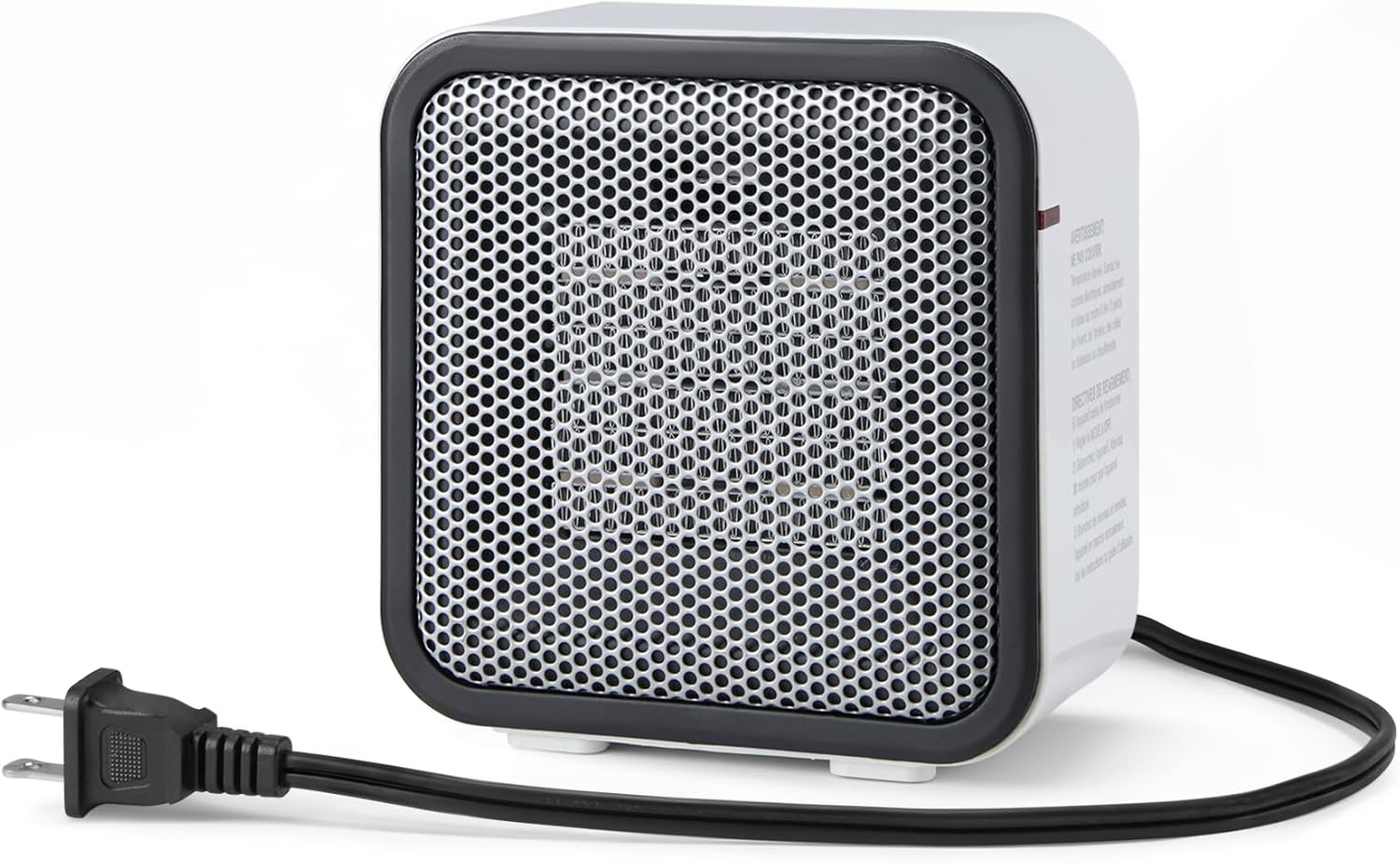
| Heat Output | 500 watts |
|---|---|
| Heating Method | Convection |
| Heating Coverage | 107.6 square feet |
| Power Source | Corded Electric |
| Voltage | 120 volts |
This compact Amazon Basics ceramic heater delivers quick, localized warmth for desks, bedside tables, or small home office spaces. At 500 watts it uses ceramic coils and convection to produce heat within seconds while running quietly enough for work or sleep. The unit is lightweight and very portable, so you can move it between rooms without effort, and its small footprint makes it easy to tuck onto narrow surfaces. Safety features include tip-over protection that cuts power if the heater is knocked over, an important plus for cluttered desks or shared spaces. Limitations are straightforward: 500 watts is intended for personal zones rather than whole rooms, and there is only a single heat setting so you cannot fine-tune output. For buyers wanting an affordable, safe personal heater the design and safety features are sensible, but those needing stronger or adjustable heat should look at higher-output models.
Best for: Buyers looking for an inexpensive, no-frills personal heater to warm a desk, bedside, or small home office who prioritize portability and basic safety features.
Less Ideal for: People who need to heat larger rooms or want adjustable temperature controls and multiple power settings.
- Compact, portable design easy to move and place on small surfaces
- Ceramic heating element provides fast warm-up for personal spaces
- Built-in tip-over protection for safer tabletop use
- Quiet operation suitable for office or bedside use
- Single fixed heat output with no adjustable settings
- Designed for small areas only, not for heating whole rooms
Verdict: A simple, budget-friendly personal heater that delivers fast, safe warmth for small spaces.
DREO Space Heater HSH006

| Heat Output | 1500 watts |
|---|---|
| Heating Element | PTC Ceramic |
| Heating Coverage | 200 sq.ft |
| Number of Speeds | 4 |
| Min-Max Temperature | 41 °F – 95 °F |
This DREO tower heater delivers fast, forced-air warmth using a 1500W PTC ceramic element and an adjustable thermostat that ranges from 41 to 95°F in 1°F increments. It is designed for indoor rooms up to about 200 sq ft and offers multiple heat modes, an ECO setting, fan-only mode, a 12-hour timer, and a remote for convenient control. Safety is a clear focus with ETL listing, tip-over detection, overheat protection, flame retardant material, and a child lock, which makes it suitable for bedrooms and home offices. The brushless DC motor and winglet fan design aim to keep noise low (about 34 dB) so it can run at night without disturbing sleep. On the downside it is a space-limited tower heater intended for single-room use and relies on forced-air rather than radiant heat, so it warms the air rather than surfaces. Expect modest airflow footprint compared with larger heaters and standard corded power only.
Best for: Someone who prioritizes safe, quiet, controllable heating for a bedroom or home office and wants precise thermostat control and built-in safety features.
Less Ideal for: People looking to heat large or open-plan spaces or those who prefer radiant or oil-filled heaters that warm surfaces and retain heat longer.
- 1500W PTC ceramic element for quick warm-up and consistent heat output
- Precise thermostat with 1°F increments from 41 to 95°F for accurate temperature control
- Multiple safety features including ETL listing, tip-over detection, overheat protection, and child lock
- Quiet brushless DC motor and winglet fan design that reduces noise to around 34 dB
- Remote control and 12-hour timer for convenient hands-free operation
- Designed for single-room coverage (about 200 sq ft) so not suited for heating large open areas
- Forced-air design warms room air rather than surfaces, so heat may feel less immediate in large spaces
Verdict: A safety-first, quiet 1500W tower heater that gives precise thermostat control and useful safety protections for single-room heating.
GiveBest Portable Space Heater PTC-905

| Heat output | 1500 watts |
|---|---|
| Heating coverage | 200 sq.ft |
| Number of speeds | 2 |
| Voltage | 120 volts_of_alternating_current |
| Max temperature setting | 158 °F |
The GiveBest PTC-905 is a small ceramic space heater designed to warm individual rooms quickly and safely. It offers two heat modes (1500W and 750W) plus a cool fan setting, and an adjustable electronic thermostat that cycles the unit on and off to maintain a preset temperature. The heater uses PTC ceramic elements and a high-speed fan to push warm air across a room up to about 200 sq ft, and its compact footprint and carry handle make it easy to move between a bedroom, office, or bathroom. Safety is emphasized with V0 flame-retardant housing, automatic overheat shutoff, and tip-over protection that cuts power and sounds an alert if the unit is knocked over. Practical limits include its small size — it is intended for spot heating rather than whole-home heating — and a basic two-speed control rather than fine-grain heat modulation. Noise is reported as low during operation, so it is suitable for sleeping or working. For buyers who want a simple, safety-focused personal heater, this model covers the essentials without extra smart features.
Best for: Buyers who prioritize proven safety features and straightforward operation for spot heating small to medium rooms and want reassurance from many user reviews and a familiar, no-frills design.
Less Ideal for: People seeking whole-home heating, advanced digital controls, smart connectivity, or a quiet ultra-low-profile bedroom heater should consider other options.
- Two heat settings (1500W and 750W) plus cool fan for year-round use.
- Electronic thermostat that cycles to hold a preset temperature.
- Multiple safety features including overheat shutoff, tip-over protection, and flame-retardant housing.
- Compact, lightweight design with an integrated carry handle for easy portability.
- Rated to heat rooms up to about 200 sq ft, covering most bedrooms and small offices.
- Basic controls with only two heat speeds and no digital display or remote on this model.
- Not intended as a primary heater for large open areas or whole-house heating.
Verdict: A compact, safety-focused personal heater that delivers quick spot warming with simple controls and robust shutoff protections.
Mr. Heater Portable Buddy F232000

| Heat Output | 9000 BTU |
|---|---|
| Heating Coverage | 225 sq. ft. |
| Fuel Type | Propane |
| Number of Speeds | 2 |
| Included Components | Piezo Igniter, Portable Buddy Heater |
The Mr. Heater Portable Buddy is a compact, pedestal-style propane heater built to warm small to medium spaces with radiant heat. It connects to a 1 lb. propane cylinder (and can work with a 20 lb. tank using accessories) and offers two heat settings that produce 4,000 or 9,000 BTU, which the manufacturer says will heat roughly 225 square feet. Typical use cases are quick spot heating on patios, in garages, or near a campsite where a portable source of warmth is needed. Practical features include an easy-grip handle, a swivel regulator for cylinder connection, and an included piezo igniter for push-button start. Safety systems include an oxygen depletion sensor, thermal shut-off, and tip-over switch, making it better suited for risk-averse buyers who want extra protections. Limitations are inherent to propane radiant heaters: run time depends on cylinder size (about three hours on high from a 1 lb. bottle), it produces open radiant heat rather than forced warm air, and it requires proper ventilation and safe placement for indoor use despite safety cutoffs.
Best for: Buyers who prioritize simple, transportable heat with factory safety systems for occasional indoor or outdoor use and want a heater that is easy to move and operate.
Less Ideal for: People who need continuous whole-room heating for long periods or who prefer electric, ducted, or thermostat-controlled forced-air systems for steady background heat.
- Compact, portable pedestal design with easy-grip handle for transport
- Two heat settings (4,000 and 9,000 BTU) for adjustable output
- Multiple built-in safety features including oxygen depletion sensor, thermal shut-off, and tip-over switch
- Swivel regulator and piezo igniter for quick connection and simple startup
- Runs on propane so you must manage fuel cylinders and ventilation
- Short runtime from a 1 lb cylinder on high heat compared with larger tank heaters
Verdict: A compact, safety-focused portable propane heater that gives adjustable radiant warmth for spot heating in indoor or outdoor settings.
Choosing the Right Safe Space Heater: Key Factors to Consider
Built-in Safety Controls
Look for explicit automatic protections such as tip-over shutoff, overheat cutoff, and thermal fuses. These systems reduce the chance of fire if a heater is knocked over or if internal temperatures climb too high.
The presence, responsiveness, and redundancy of safety controls should influence your choice more than cosmetic features. Units with multiple independent safety safeguards provide better protection in real-world scenarios where power surges, blockages, or accidental bumps can occur.
Heating Method and Surface Temperature
Different heating technologies produce different surface temperatures and airflow patterns. Convection and oil-filled radiators tend to run cooler to the touch and provide steady, passive warmth. Ceramic and fan-forced heaters can deliver rapid heat but may have hotter external grills.
If you need a heater for a bedroom, near kids, or in a tight space, prefer designs with guarded elements and cool exterior surfaces. Consider how the method affects how quickly a room reaches comfort and whether the unit maintains lower external temperatures during operation.
Energy Use and Power Ratings
Check the wattage and any variable power settings. Higher wattage equals faster heat but increases energy consumption. Adjustable power levels and thermostatic control help match output to the room size and lower running costs.
For frequent use, a heater with an efficient heat delivery pattern and a reliable thermostat will save energy over time. Also evaluate whether the unit has eco or low-power modes that limit consumption while keeping a comfortable ambient temperature.
Room Size and Heat Placement
Match the heater's output to the specific room you want to warm. Small, enclosed rooms need less power than open-plan spaces. Placement matters: locate the heater where airflow is unobstructed and away from flammable materials.
Consider whether you need a compact portable unit for spot heating or a larger, low-profile radiator for continuous background warmth. Proper placement reduces runtime and improves safety by minimizing contact with fabrics and furniture.
Controls, Timers, and Smart Features
User-friendly controls let you set temperatures and schedules without guesswork. Timers and programmable thermostats reduce runtime and the risk of leaving a heater on unattended for long periods.
Some safe heaters include remote controls, simple mechanical dials, or basic digital displays. Choose the interface that matches your household: tactile knobs for quick adjustments or programmable features for automated, energy-conscious operation.
Maintenance and Durability
Routine maintenance is minimal for most electric space heaters, but design choices affect long-term reliability. Units with sealed heating elements and durable casings resist dust ingress and mechanical wear better than cheaply made products.
Consider how easy it is to clean air intakes and whether the manufacturer provides clear guidance on maintenance intervals. A sturdier construction reduces the likelihood of wiring issues or structural failures that could undermine safety features.
Sizing Your Heater to the Room
Estimate heating needs by considering room volume and insulation. A compact heater might be fine for a small bedroom, while a living area with open circulation may need higher sustained output. Remember that higher wattage raises energy use, so balance capacity with efficiency.
- Measure the room in square feet and factor ceiling height for volume.
- Place the heater centrally if possible, or near the main seating area for spot warming.
- Avoid placing the heater under fabrics or close to curtains to reduce fire risk.
Placement and Clearance Best Practices
Correct placement minimizes hazards and improves heating effectiveness. Keep an explicit clearance around the unit and position it on a stable, level floor away from high-traffic paths to reduce tip-over risk.
- Maintain at least the manufacturer-recommended clearance from walls and furniture.
- Do not block air intakes or outlets with rugs or boxes.
- Avoid using extension cords unless the product specifically allows them; a direct outlet reduces overheating risk.
Using Thermostats and Timers Efficiently
A reliable thermostat prevents overshooting room temperature and reduces runtime. Using the timer or scheduling features helps ensure the heater runs only when needed, lowering energy use and exposure time.
- Set a modest target temperature rather than maximum heat to save power.
- Program the heater to warm the room shortly before occupancy instead of running continuously.
- Use lower overnight settings and consider combining with blankets or targeted insulation to maintain comfort.
Safety Around Children and Pets
Homes with children or pets require added precautions. Choose units with cool exteriors, guarded grills, and tip-over protection to reduce the chance of burns or ignition from curious hands or bumps.
- Keep heaters out of reach and behind barriers if necessary.
- Supervise pets around active units and avoid placing treats or toys nearby.
- Prefer models with multiple safety cutoffs to guard against accidental misuse.
Common Misuses and How to Avoid Them
Improper use raises the risk of fire or damage. Frequent mistakes include placing heaters near flammable materials, plugging into undersized outlets, or leaving units unattended for extended periods.
- Do not run heaters on high-power settings continuously for days.
- Avoid placing items on top of heaters or using them to dry clothing.
- Regularly inspect cords and plugs for damage and discontinue use if you find fraying.
How We Chose the Best Safe Space Heater
Our editorial selection focused on safety-driven, practical performance for everyday room heating. We prioritized units that combine verified safety systems with usable heat delivery and reasonable operating costs. Key dimensions we used to include or exclude heaters were actual safety safeguards, measurable energy performance, and suitability for typical indoor spaces. Concrete evaluation criteria included automatic shutoff mechanisms (tip-over and overheat), the presence and effectiveness of cool-to-touch surfaces and guarded heating elements, measured or rated power draw and heat output for energy efficiency, and user-focused features such as thermostats, timers, and controls that reduce misuse. We also considered build quality and venting design as they relate to fire risk and durability. We excluded any unit lacking essential automatic safety cutoffs or with ambiguous safety documentation. Very specialized commercial heaters and devices without household-focused controls were not considered. The final shortlist balances protective features with everyday usability, endurance, and predictable operating costs.
Our full evaluation process is outlined in our review methodology.
FAQ
Are space heaters safe to use overnight?
Using a safe space heater overnight can be acceptable if it has certified automatic shutoffs and a reliable thermostat. Still, minimize risk by placing it on a stable surface, keeping clearances, and using timer or low-power settings rather than leaving it at maximum.
Can I use a space heater in a bathroom?
Bathrooms are high-risk because of moisture. Only use heaters explicitly rated for bathroom use and follow clearance and splash-resistance guidance. Keep the unit away from direct water sources and outlets designed for wet locations.
Do ceramic heaters pose a burn risk?
Ceramic heaters can produce hot grilles but many modern designs include guarded outlets and cool-touch housings. The burn risk depends on surface temperature and protective design, so choose units with guarded elements for homes with children.
How much power does a typical safe space heater use?
Most household space heaters range from a few hundred watts on low settings to around 1500 watts at maximum. Energy use varies with power setting, runtime, and thermostat control; using lower settings and timers reduces total consumption.
Is it okay to run a heater on an extension cord?
Using an extension cord is generally discouraged because it can overheat if undersized. If absolutely necessary, use a heavy-duty cord rated for the heater's amperage and avoid loose connections. A direct wall outlet is safer.
Final Verdict
Prioritize safety systems, appropriate output, and user controls when choosing a safe space heater. Balance how quickly you need a room to warm with surface temperatures and automatic protections to reduce risk in daily use. Focus on heaters with redundant shutoffs, reliable thermostats, and durable construction for the best combination of safety and efficiency. With those tradeoffs in mind, you can select a unit that provides steady warmth while minimizing exposure to hazards.