
Note: This article contains affiliate links. If you click on these links and make a purchase, we may earn a small commission at no extra cost to you. This helps support our research and content. Read our full affiliate disclosure here.
If you cook frequently with high heat and sealed-pressure methods, choosing a safe stovetop pressure cooker matters for both results and peace of mind. The right cooker reduces the risk of accidents, releases pressure predictably, and holds up to repeated use in a busy kitchen. This guide covers six top picks shortlisted for safety-focused home cooks, with attention to the mechanisms and materials that actually prevent overpressure, lid failures, and accidental openings. We evaluated safety systems, construction quality, and everyday usability to help you pick a stovetop pressure cooker that fits your routine and keeps your kitchen secure. Read on for the key factors that informed our selections and practical tips for safe use.
Top Picks at a Glance
| Best Overall The best all-around choice for most situations | KOBACH 8QT Pressure Cooker |  |
| Best Quality Built to a higher standard if you want something more solid | Kuhn Rikon DUROMATIC 5L |  |
| Best Value The sweet spot between price and what you get | Universal Ultra 6.3-Quart Pressure Cooker |  |
| Best Budget The cheapest option that still gets the job done reliably | IMUSA 7-Quart Pressure Cooker |  |
| Most Popular A crowd favorite that many people choose with confidence | Presto 6-Quart Stainless Steel Pressure Cooker |  |
| Best Seller A high-volume bestseller chosen again and again | T-fal Clipso 6.3 Quart Pressure Cooker |  |
KOBACH 8QT Pressure Cooker

| Capacity | 8 quarts |
|---|---|
| Material | Stainless steel |
| Maximum pressure | Up to 17 PSI |
| Special Features | Dishwasher Safe, Induction Compatible Base |
The KOBACH 8QT pressure cooker is a family-sized stainless steel stovetop cooker that speeds up braises, stews, soups, and tougher cuts of meat by using up to 17 PSI and a composite induction-compatible base. It is built for everyday stovetop use on gas, induction, and ceramic ranges and features a toothless, one-hand locking lid that stands upright for cleaner handling. Safety is emphasized with multiple release channels including a pressure relief valve, swing-type steam exhaust, a safety locking valve and a backup safety valve to prevent overpressure. Interior water level markings and a thickened bottom aim to reduce sticking and help hit consistent results, while dual side handles make lifting easier. The cooker is dishwasher-safe for easier cleanup but its mechanical controls and manual operation mean you need to monitor venting and follow fill guidelines to avoid overflow when making soups or porridge. For cooks who want a robust, safety-focused stovetop unit for family meals, this model delivers reliable performance though it lacks electric automation.
Best for: Buyers who want a reliable, safety-focused stovetop pressure cooker for family-sized meals and value sturdy stainless construction and simple mechanical controls.
Less Ideal for: People seeking an electric, set-and-forget pressure cooker with digital presets or those who prefer very small-capacity units for solo cooking.
- Multiple redundant safety valves and a swing-type exhaust for controlled steam release
- One-handed toothless lid that locks securely and stands upright for cleaner handling
- Composite bottom compatible with induction, gas, and ceramic stovetops
- Interior water level markings and thickened bottom promote even heating and easier results
- Dishwasher-safe stainless steel construction for easier cleaning
- Manual controls require attentive venting and monitoring during use
- No electric or programmable features for hands-off pressure cooking
Verdict: A large, stovetop-only stainless steel pressure cooker built around layered safety features and one-handed lid convenience for family cooking.
Kuhn Rikon DUROMATIC 5L

| Capacity | 5 liters |
|---|---|
| Material | 18/10 stainless steel |
| Operation Mode | Manual |
| Controller Type | Mechanical knob |
| Voltage | 220 volts |
The Kuhn Rikon DUROMATIC 5L is a performance-focused stovetop pressure cooker designed to speed up everyday cooking while keeping safety front and center. It uses a Superthermic aluminum sandwich base for fast, even heat and is compatible with all cooktops including induction, so it heats quickly and maintains stable pressure for consistent results. The mechanical control and integrated lid-locking system plus four independent steam release mechanisms give reliable pressure management and safe depressurizing. Practical touches like internal capacity markings, ergonomic side handles, a trivet, and a Quick Cuisine cookbook make it convenient for batch cooking, grains, stews, and braises. Because it is heavy-gauge stainless steel made in Switzerland, expect solid durability and good heat retention, though the weight can make it less nimble than thinner models. The manual control means you need to monitor heat rather than rely on automatic electronics, which is fine for cooks who value precision but may be less convenient for those wanting set-and-forget operation.
Best for: Buyers who prioritize fast, consistent stovetop performance and strong built-in safety when cooking grains, stews, and batch meals and who prefer a durable, precision-focused tool over electronic convenience.
Less Ideal for: People who want lightweight, ultra-portable cookware or fully automated, hands-off electric pressure cooking should consider other styles instead.
- Superthermic aluminum sandwich base for fast, even heating and induction compatibility
- Integrated lid-locking mechanism and four steam release systems for robust safety
- 18/10 stainless steel construction built in Switzerland for long-term durability
- Includes trivet, internal capacity markings, and a cookbook for practical everyday use
- Manual mechanical control requires active heat management rather than automatic pressure settings
- Relatively heavy construction can be less convenient for frequent lifting or storage
Verdict: Choose the DUROMATIC 5L if you want a heavy-duty, induction-ready stovetop cooker that delivers fast, consistent results with strong factory-quality safety features.
Universal Ultra 6.3-Quart Pressure Cooker

| Capacity | 6.3 quarts |
|---|---|
| Material | Aluminum |
| Special Features | Electric and gas stovetop compatible |
| Operation Mode | Manual |
This Universal Ultra pressure cooker is a straightforward stovetop pot for family-size meals that emphasizes safety and everyday usability. Made from anti-rust aluminum, it heats quickly and evenly and the 6.3-quart capacity handles soups, stews, beans, rice, and meat for several servings. The unit includes a layered safety system with external sealing, pressure control valves, a safety vent, and locking handles that reduce the risk of accidental opening under pressure. It works on gas, electric, and glass-ceramic ranges and is dishwasher-safe for easier cleanup, though it is not induction compatible. Because it is aluminum the cooker is lightweight and responsive but requires some care to avoid warping on very high heat and will not work on induction cooktops. For home cooks who want a dependable, safety-focused stovetop pressure cooker for everyday family meals, this model is a practical choice.
Best for: Home cooks focused on practical, safe everyday cooking who want a lightweight stovetop pressure cooker for family-sized meals and easy cleaning.
Less Ideal for: People who need induction compatibility or prefer heavier stainless steel pressure cookers designed for very high-heat or commercial use should consider other options.
- Five-layer safety system with external sealing, pressure control valves, safety vent, and locking handles
- Lightweight aluminum construction for fast, even heating
- 6.3-quart capacity suitable for family meals up to about seven servings
- Compatible with gas, electric, and glass-ceramic stovetops and dishwasher-safe for easier cleanup
- Not compatible with induction cooktops
- Aluminum construction can be less durable under very high, unattended heat compared with stainless options
Verdict: A safety-focused, family-size stovetop pressure cooker that delivers fast, even heating and easy cleanup for practical home use.
IMUSA 7-Quart Pressure Cooker
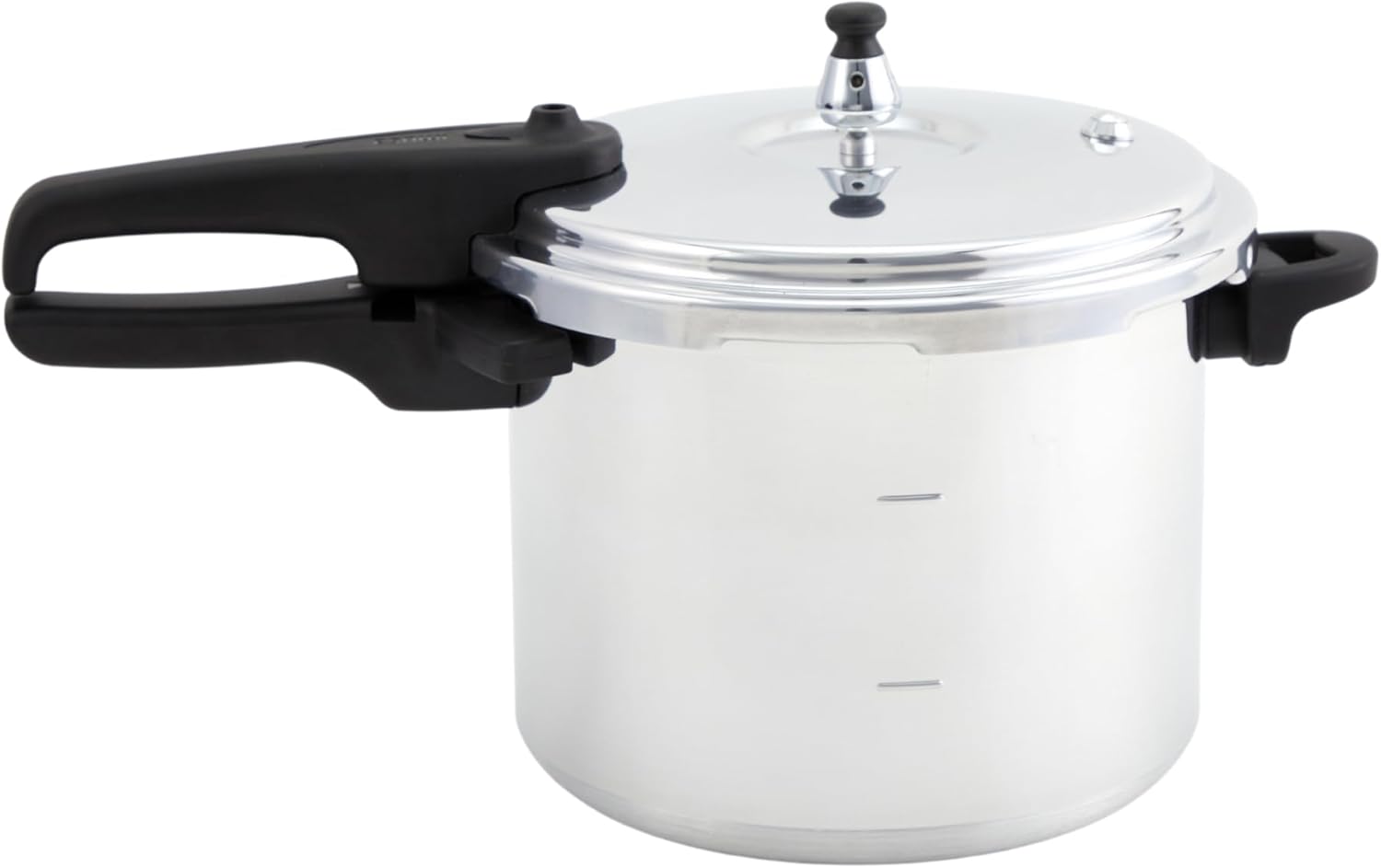
| Capacity | 7 quarts |
|---|---|
| Material | Aluminum |
| Special Features | Locking Lid |
| Operation Mode | Automatic |
The IMUSA 7-Quart Pressure Cooker is a straightforward stovetop cooker built from polished aluminum to deliver even heat and faster cooking for large family meals. It locks safely with an outer lid and includes a pressure regulator that maintains cooking pressure automatically plus safety valves to help prevent risky openings. The cooker has cool-touch side and helper handles for easier lifting and carrying when full, and its 7-quart capacity is good for soups, beans, stews, and tenderizing larger cuts of meat. Because it is aluminum with a natural interior finish it is lightweight and conducts heat quickly, but it will require careful use on high heat to avoid discoloration and may not have the longevity of thicker stainless models. Overall, it is a practical, no-frills choice if you want a safe, fast stovetop pressure cooker for everyday home cooking.
Best for: Buyers seeking an affordable, roomy stovetop pressure cooker that speeds up home cooking and emphasizes basic safety features and ease of handling.
Less Ideal for: Users who want heavy-duty stainless steel construction, induction compatibility, or specialty finishes should consider other models.
- Automatic pressure regulator and safety valves for safer pressure control
- Large 7-quart capacity suitable for family-sized meals
- Cool-touch side handle and helper handle for safer handling and transport
- Polished aluminum construction offers quick, even heat distribution
- Aluminum construction can discolor and may be less durable than heavier stainless steel options
- No nonstick or enamel interior coating which may require more careful cleaning and maintenance
Verdict: A budget-friendly, safety-focused stovetop pressure cooker that delivers fast, family-sized cooking without frills.
Presto 6-Quart Stainless Steel Pressure Cooker
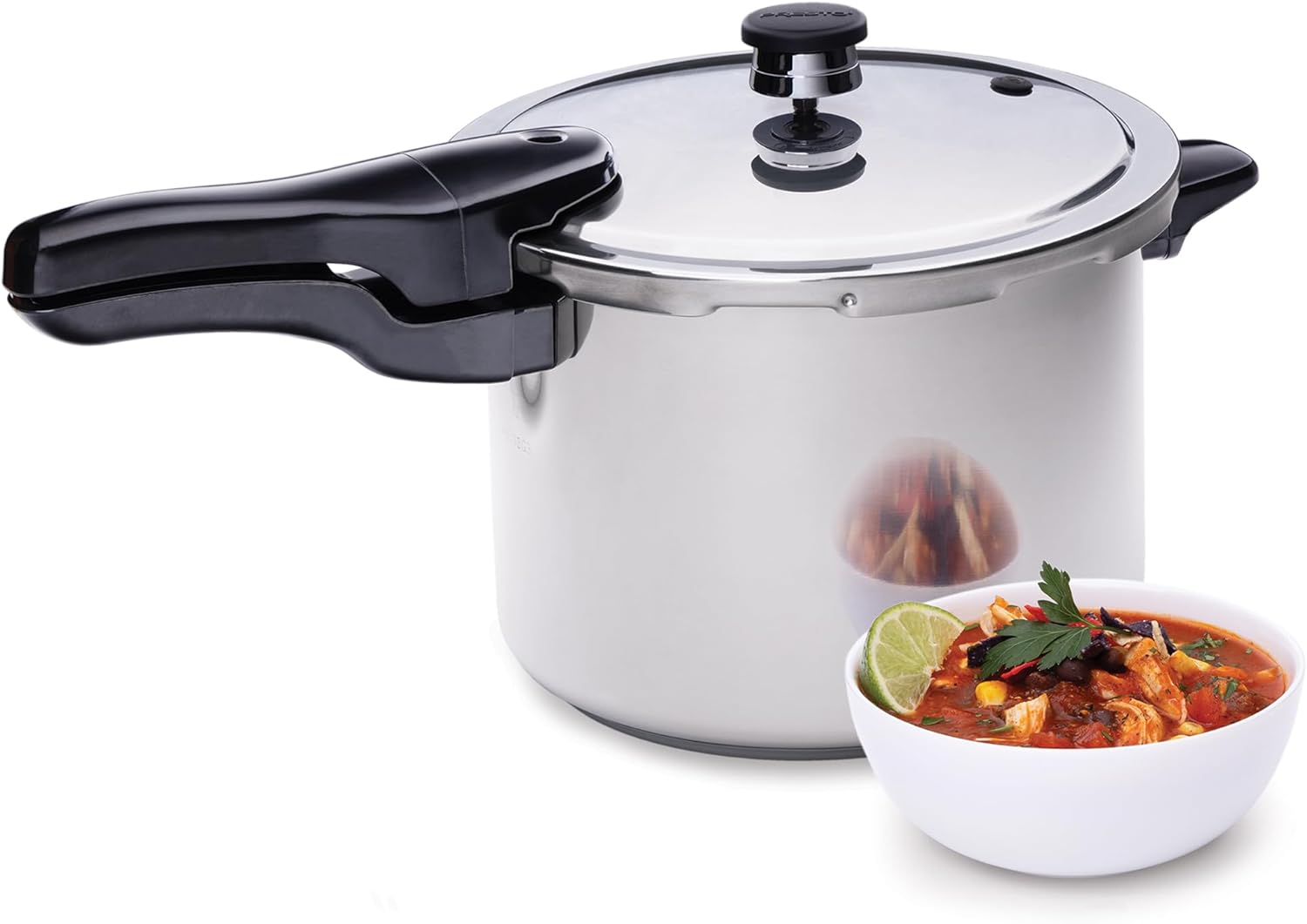
| Capacity | 6 quarts |
|---|---|
| Special Features | Dishwasher Safe, Induction Compatible Base, Locking Lid |
| Wattage | 1000 watts |
| Control Method | Touch |
| Voltage | 220 volts |
The Presto 6-quart stainless steel pressure cooker is a traditional stovetop cooker built for fast, reliable results. It uses a pressure regulator and an inner sealing ring to maintain proper cooking pressure, and a locking cover indicator that prevents the lid from being opened while the pot is pressurized. The tri-clad base — aluminum between stainless steel layers — promotes even heat distribution on gas, electric, smooth-top and induction ranges. Included accessories and extras like a helper handle, cooking rack and a 64-page recipe booklet make it easy to start using, and most components are dishwasher safe after removing the sealing ring and overpressure plug. Safety features include a pop-up pressure indicator, an overpressure plug that vents if pressure builds excessively, and a simple steam release for controlled depressurization. Limitations are the manual nature of stovetop control versus electric models and the need to follow maintenance steps (clean the vent and remove the sealing ring) to keep safety parts functioning properly.
Best for: Buyers who prioritize proven stovetop safety features and reliable performance and want a durable stainless steel cooker with clear mechanical safety indicators.
Less Ideal for: People who want programmable, set-and-forget electric pressure cooking or those who prefer very large-capacity units for big families.
- Clear cover lock indicator and pop-up pressure regulator improve safe operation.
- Tri-clad base gives more even, consistent heating across stovetops including induction.
- Includes useful extras: cooking rack, helper handle, and a 64-page recipe/instruction booklet.
- Most parts are dishwasher safe after removing the sealing ring and overpressure plug.
- Requires manual monitoring and stove control rather than automated electric programming.
- Sealing ring and vent require routine removal and cleaning to maintain safety and performance.
Verdict: Choose this Presto 6-quart if you want a durable, safety-focused stovetop pressure cooker with even heating and simple mechanical controls.
T-fal Clipso 6.3 Quart Pressure Cooker

| Capacity | 6.3 quarts |
|---|---|
| Material | Stainless steel |
| Control Method | Touch |
| Operation Mode | Manual |
| Compatibility | All stovetops including induction |
The T-fal Clipso 6.3 Qt is a stovetop pressure cooker built for everyday family cooking and meal prep. It uses a one-hand opening system and a secure lock to prevent the lid from opening while under pressure, and the adjustable steam-release valve gives you practical control when finishing dishes. Its stainless steel body with an encapsulated base is compatible with all cooktops including induction and helps distribute heat evenly for soups, stews, grains, and braised meats. The pot comes with a steam basket and recipe booklet for multi-level cooking and quicker meal planning, and the main pot is dishwasher safe for easier cleanup once the gasket and valve are removed. The primary compromises are that control is manual rather than electronic, so learning to manage pressure and release timings takes a few uses, and the unit is heavier than simple saucepans, which may be noticeable when handling full loads. For buyers who prioritize reliable safety features and solid construction, this model is a straightforward, dependable choice.
Best for: Buyers who want a solid, safety-focused stovetop pressure cooker for family meals and value proven mechanical safety features over electronic automation.
Less Ideal for: Users who need fully automated, digital pressure programs or a very lightweight pot for frequent single-handed lifting should consider other formats.
- One-hand opening and secure locking system reduces risk when releasing pressure
- Adjustable steam-release valve provides fine control over pressure release
- Stainless steel construction with encapsulated base for even heating and induction compatibility
- Includes steam basket and recipe booklet for multi-level cooking and meal planning
- Dishwasher-safe pot simplifies cleanup after removing gasket and valve
- Manual operation requires learning pressure and release timing
- Heavier pot weight can be awkward when full
Verdict: Choose the T-fal Clipso 6.3 Qt when you want a well-built, safety-oriented stovetop pressure cooker that reliably handles family-sized meals.
Choosing the Right Safe Stovetop Pressure Cooker: Key Factors to Consider
Safety Mechanisms
A pressure cooker's safety systems are the single most important factor for buyers focused on secure operation. Multiple redundant features such as mechanical lid locks, spring- or weight-based pressure regulators, and automatic pressure-release paths reduce the chance of a catastrophic failure. A visible pressure indicator that cannot be manually depressed is useful for confirming when it is safe to open the lid.
Evaluate how many independent safeguards the cooker offers and whether those systems are passive (operate without user action) or require steps you might forget under stress. Systems that vent excess pressure automatically and prevent lid opening until pressure is fully released are preferable for less experienced cooks.
Build And Materials
Construction quality affects both safety and longevity. Thicker gauge stainless steel resists warping under repeated heating cycles, maintains a reliable seal, and tolerates the clamping forces used by locking lids. Look for cookware-grade stainless with secure spot-welded or riveted handles that do not loosen easily.
Avoid thin materials that flex under pressure because deformation can compromise the sealing gasket and safety valves. Corrosion-resistant finishes and high-quality rivets or welds in the lid area reduce the chance of failure over years of use.
Pressure Control And Predictability
How a pressure cooker reaches and maintains set pressure determines cooking results and safety. Weight-based regulators and sealed spring valves behave differently during boiling and depressurizing. Choose a system you can control predictably: some offer multiple pressure settings while others rely on a single weighted regulator.
Predictability matters when adapting recipes or using ingredient-heavy loads that produce a lot of foam or starch. A cooker that stalls or over-pressurizes under a heavy load poses safety risks and can lead to messy, dangerous venting events.
Ease Of Use
A safe cooker is only safe when a user can operate it correctly. Clear markings, an easy-to-align lid, and a straightforward locking motion reduce user error. Handles that provide good leverage and stay cool to the touch lower the chance of accidental slips when checking or moving the pot.
Sensible vent placement that keeps steam away from hands and counters also improves daily safety. If a unit requires a complex sequence to depressurize, that increases the risk of user mistakes when you are in a hurry.
Maintenance And Gasket Access
Regular gasket inspection and replacement are essential to long-term safety. Choose a cooker with an easily removable, replaceable gasket and clear guidance on replacement intervals. Some designs allow the gasket to be changed without specialized tools, which encourages routine upkeep.
Also consider how easy it is to clean around valves and vent channels. Trapped food or scale buildup can impair safety valves and cause unpredictable pressure behavior, so designs that minimize crevices and permit thorough cleaning will stay safer over time.
Capacity And Fit With Kitchen Routines
The capacity you choose affects both cooking efficiency and safety. Overfilling a pressure cooker is a common cause of blocked valves and foaming that can lead to dangerous venting. Select a capacity that matches your typical batch size with headroom for expansion, especially when cooking starchy foods or beans.
Also think about stovetop fit and weight when full. A very large, heavy cooker may be harder to maneuver safely when hot. Consider whether you will lift the cooker to strain food or prefer to use a separate insert to keep handling minimal.
How Pressure Release Types Affect Safety
Pressure cookers typically use one of three pressure-control approaches: weighted regulators, spring-loaded valves, or engineered slide vents. Each method behaves differently during both pressurizing and depressurizing phases, and that behavior affects how predictable and manageable steam release is in a home kitchen.
Weighted regulators tend to vent continuously at a set pressure and are simple to maintain, but they can discharge steam for longer periods. Spring-loaded valves often seal until a specific internal pressure is reached and then rapidly release excess pressure, which can be controlled more finely but requires clean valve surfaces.
When evaluating safety, consider where the steam is directed during release and how much user intervention is required. A design that channels steam away from hands and counters and allows for controlled, manual quick releases can be safer for experienced cooks, while automatic or passive venting systems reduce the need for active management.
- Weighted regulators: simple but continuous venting
- Spring valves: precise thresholds, sensitive to debris
- Slide vents: user-controlled, require careful operation
Maintaining Seals And Valves For Long-Term Safety
Routine maintenance keeps safety systems functioning. Inspect the sealing ring before every use for cracks or compression set. Replace the gasket on the schedule recommended by the manufacturer or sooner if you notice hardening or leaks.
Clean valve assemblies after cooking sticky or starchy foods to prevent clogging. Periodic boiling of a solution to remove scale can preserve valve movement. Design features that make these tasks easy will encourage consistent upkeep and reduce the chance of failure.
- Check gasket flexibility and replace when brittle
- Clear vent channels after foamy or starchy cooking
- Test pressure indicators periodically for proper movement
Choosing The Right Capacity And Accessory Use
Match capacity to typical meal sizes and choose internal accessories that keep handling to a minimum. Inserts and steam baskets let you cook multiple items without filling the pot to the brim, lowering the risk of foaming and blocked vents. If you usually cook for two, a very large cooker will often be underfilled, which wastes energy and can make heat distribution less even.
Consider whether you want detachable accessories that fit easily inside the cooker or ones that require extra handling. Practical accessories improve safety by reducing the need to lift a heavy, hot pot to strain or remove food.
- Use inserts to avoid overfilling
- Prefer accessories that reduce lifting and handling
- Choose capacity with headroom for foaming foods
Practical Safety Habits For Daily Use
Even the safest design requires good habits. Always vent according to the recipe and verify the pressure indicator before attempting to open the lid. Avoid forcing the lid when the indicator shows pressure is present. Place the cooker on a heat-tolerant surface for cooling, and keep children and pets away during steam release.
If a recipe yields a lot of foam, pause the heat and allow gentle pressure reduction before switching to a rapid release. Use long-handled tools and protective gloves when adjusting vents. These routines reduce the chance of scalding and accidental lid release.
- Verify pressure indicator before opening
- Use controlled venting for foamy loads
- Keep steam path clear and away from hands
Common Misconceptions About Stovetop Pressure Cookers
Many people assume modern stovetop pressure cookers are dangerously unstable, but contemporary designs include multiple redundant safeties that prevent unintended opening or overpressure. Misuse and poor maintenance are more common causes of incidents than inherent design flaws.
Another misconception is that weight-based regulators are inherently less safe than spring valves. Each system has tradeoffs in predictability, maintenance needs, and steam behavior. Selecting a cooker with accessible valve components and clear user instructions mitigates most risks associated with either system.
- Safety depends on design plus proper maintenance
- Different vent systems have different tradeoffs
- User technique matters as much as hardware
How We Chose the Best Safe Stovetop Pressure Cooker
We prioritized measurable safety and durability features that directly affect user risk and long-term reliability. Core evaluation criteria included the number and type of built-in safety mechanisms, the materials and thickness of the vessel and lid, and the predictability and adjustability of pressure control. We also assessed ease of use features that reduce user error, such as intuitive lid-locking systems, clear pressure indicators, and simple venting procedures. Practical durability tests included evaluating the robustness of handles, hinge points, and sealing components in simulated repeated-use scenarios. We excluded products that relied solely on single-point safety vents or had vague manufacturer safety claims without clear mechanisms. Final considerations included how straightforward routine maintenance and gasket replacement are, and whether the cooker's design minimized trapped food and pressure-related wear. These filters produced a shortlist of models that demonstrably reduce common pressure-cooking hazards while remaining practical for daily kitchen use.
Our full evaluation process is outlined in our review methodology.
FAQ
How often should I replace the gasket on a stovetop pressure cooker?
Gaskets should be inspected before each use and generally replaced every 12 to 18 months under normal home use. Replace sooner if the ring shows cracks, hardening, or compressed areas that prevent a tight seal.
Is one pressure release method safer than another?
Not categorically. Weighted regulators are simple and durable while spring or valve systems offer finer control but demand cleaner valve surfaces. Safety depends on how well the system is maintained and how predictable the steam path is.
Can I use a stovetop pressure cooker on any burner size?
You should match the cooker base to the burner size to ensure even heating and reduce the chance of warping. Using an oversized burner on a small-base cooker concentrates heat on the base edges and can stress the cookware over time.
What should I do if the cooker vents foam into the valve?
Stop heating, allow pressure to fall naturally, and then safely depressurize according to the manufacturer's instructions. Clean the valve and vent channel thoroughly before the next use to prevent repeated blockages.
Are extra safety features hard to use for beginners?
Most modern safety features are designed to be intuitive, such as lid locks and visible pressure indicators. Beginners benefit from reading the manual and practicing with water to understand venting behavior before cooking food.
Final Verdict
When safety is the primary concern, prioritize multiple redundant safety mechanisms, robust construction, and easy access for gasket and valve maintenance. Balance capacity with the size of your typical batches to avoid overfilling and blocked vents. Also consider how the pressure control method matches your cooking style and how straightforward the venting and cleaning procedures are. With those priorities in place, you can confidently choose a stovetop pressure cooker that delivers reliable, quick results with lower risk and manageable upkeep.