
Note: This article contains affiliate links. If you click on these links and make a purchase, we may earn a small commission at no extra cost to you. This helps support our research and content. Read our full affiliate disclosure here.
If you need nonstop video capture, selecting the right security camera for continuous recording matters more than picking the fanciest feature set. Continuous recording imposes consistent demands on storage, network bandwidth, power, and heat management, so the best options focus on durability and predictable data handling rather than occasional motion clips. This guide shortlists the top models built for round-the-clock capture and evaluates them on the most relevant technical tradeoffs. Below you will find concise evaluations of seven top picks chosen for steady recording, storage flexibility, and long-term reliability. Read on to compare the key attributes that will determine real-world performance for continuous surveillance.
Top Picks at a Glance
| Best Overall The best all-around choice for most situations | ANNKE 8CH DVR 8-Camera Kit |  |
| Best Quality Built to a higher standard if you want something more solid | REOLINK RLK8-520D4 5MP System |  |
| Best Value The sweet spot between price and what you get | Kasa Smart KC420WS 2K Outdoor Camera |  |
| Best Budget The cheapest option that still gets the job done reliably | Cinnado 2K Indoor Security Camera |  |
| Top Rated A top-rated pick with lots of positive feedback | REOLINK RLC-1224A 12MP Dome |  |
| Most Popular A crowd favorite that many people choose with confidence | Wyze Cam v4 |  |
| Best Seller A high-volume bestseller chosen again and again | TP-Link Tapo C100 Indoor Camera |  |
ANNKE 8CH DVR 8-Camera Kit

| Connectivity Technology | Wired |
|---|---|
| Video Capture Resolution | 1080p |
| Number of Channels | 8 |
| Memory Storage Capacity | 1 TB |
| Night Vision Range | 100 feet |
This ANNKE 8-channel kit bundles eight weatherproof 1080p bullet cameras with an 8CH DVR that includes a preinstalled 1TB hard drive for continuous local recording. It records true 1080p video and supports H.265+ compression to stretch storage life while live viewing runs at 1080p@30fps and recording at 1080p@15fps. The system adds AI human and vehicle detection to cut down false alarms, plus a dual-light design that switches between color night vision and IR black-and-white for better nighttime detail. Setup is typical for wired BNC systems: run power and BNC cables to each camera, connect to the DVR and monitor via HDMI or VGA, then use ANNKE Vision for remote viewing and playback. The DVR works without internet for local recording and supports up to 10TB drives if you need longer retention. Limitations to note are the included cameras are 1080p rather than native 3K, and being a wired analog system it requires cable routing and power management during installation.
Best for: Buyers who want a single, ready-to-run wired kit for reliable round-the-clock local recording and who value fewer false alerts and color-capable night footage.
Less Ideal for: Those who need a wireless or completely camera-less cloud-only solution or who cannot route cables easily around a property.
- Complete kit with eight cameras and preinstalled 1TB HDD for immediate 24/7 recording
- AI human and vehicle detection reduces false motion alerts and speeds up searching recorded events
- H.265+ compression extends recording time and lowers bandwidth use
- Dual-light cameras provide full-color night vision plus IR for longer low-light detail
- IP67 weatherproof rating makes cameras suitable for outdoor installation
- Cameras included are 1080p rather than true 3K despite DVR 3K support
- Wired BNC system requires running cables and multiple power adapters during install
Verdict: A full wired 8-camera kit that delivers dependable 24/7 local recording with AI detection and color-capable night vision for buyers who want a balanced, all-in-one surveillance solution.
REOLINK RLK8-520D4 5MP System
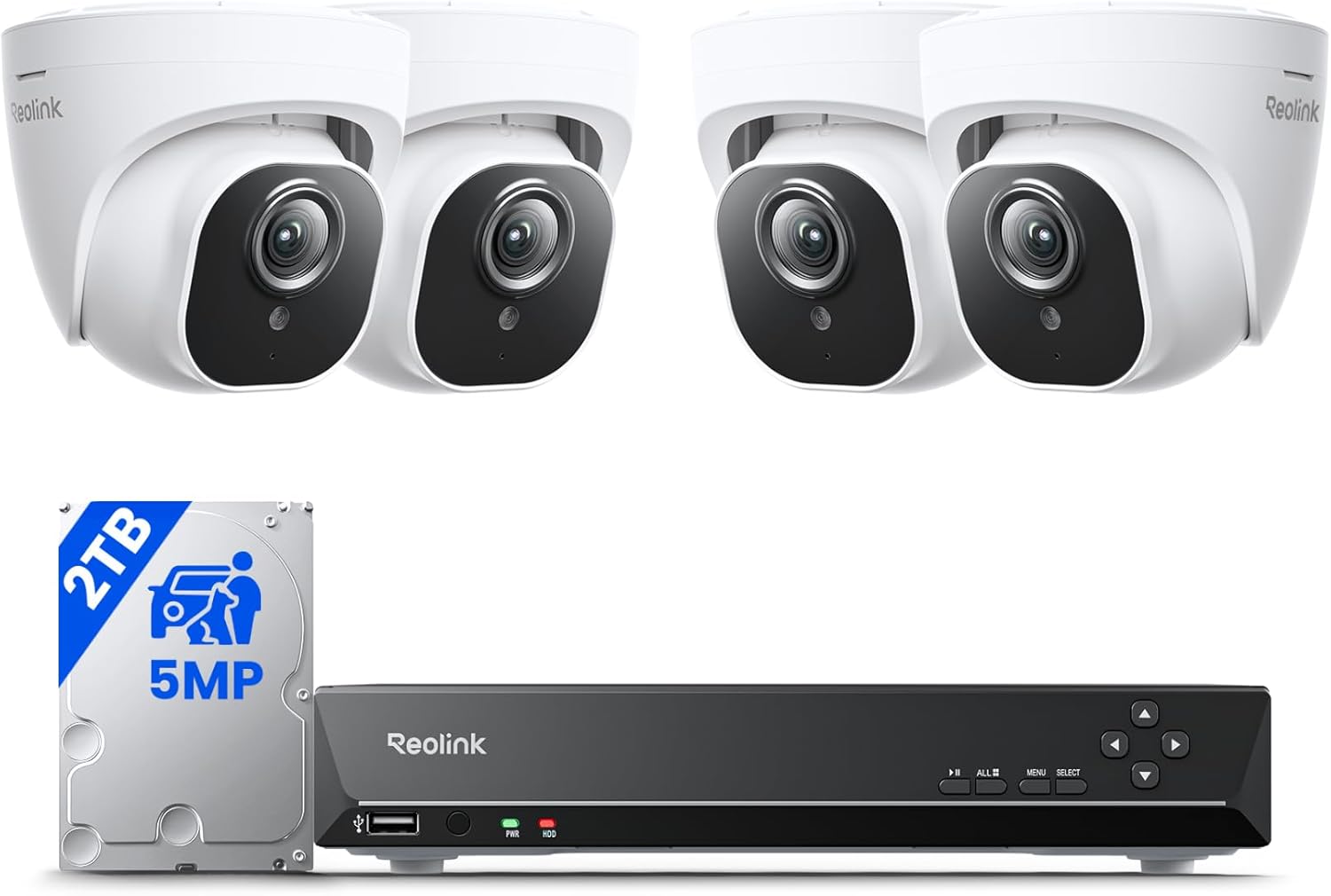
| Video Capture Resolution | 5MP (2560 × 1920) |
|---|---|
| Number of Channels | 8 |
| Memory Storage Capacity | 2 TB |
| Night Vision Range | 100 feet |
| Frame Rate | 25fps |
This REOLINK kit pairs four 5MP PoE dome cameras with an 8-channel NVR that includes a 2TB HDD for always-on local recording. The cameras deliver 5MP 25fps footage with a fixed 4.0mm lens and about an 80 degree horizontal field of view, and IR night vision reaches roughly 100 feet for usable low-light detail. Setup is straightforward: plug each camera into the NVR over Ethernet for power and video, then use the Reolink apps or client software for live view, playback, and alerts. Smart person/vehicle/pet detection and customizable motion zones reduce false alarms and make continuous recording more manageable by flagging relevant events. The system supports HDMI/VGA outputs, USB mouse control, and remote access from iOS, Android, Windows, or Mac. Important limits to note are that the NVR is designed to work only with Reolink cameras and the cameras have fixed lenses with a modest 80 degree view that may require additional units for wide coverage. For continuous, reliable local recording with solid night performance and intelligent alerts, this kit is well suited to performance-minded users.
Best for: Buyers who prioritize continuous, local recording with high-resolution footage and want a performance-focused wired PoE solution that minimizes false alarms through smarter detection.
Less Ideal for: Users seeking a multi-brand multi-vendor setup or a single ultra-wide camera solution; those who need motorized/zoom lenses or third-party camera compatibility should look elsewhere.
- 5MP cameras at 25fps provide clear, detailed daytime and playback footage
- Pre-installed 2TB HDD enables continuous 24/7 local recording out of the box
- PoE design combines power and data over one cable for simpler installation
- Person, vehicle, and pet detection plus customizable motion zones reduce false alerts
- NVR only supports Reolink cameras so third-party cameras cannot be added
- Fixed 4.0mm lenses and 80° horizontal field of view may require more cameras for full coverage
Verdict: A performance-oriented PoE kit for continuous local recording that pairs 5MP cameras, intelligent detection, and a ready-to-use 2TB NVR for reliable 24/7 surveillance.
Kasa Smart KC420WS 2K Outdoor Camera

| Video Capture Resolution | 1440P, 1080P, 4MP |
|---|---|
| Night Vision Range | 98 feet |
| Waterproof Rating | IP65 |
| Power Source | Corded Electric |
| Memory Storage Capacity | 256 GB |
The Kasa Smart KC420WS is an outdoor wired dome camera built for continuous monitoring and practical home security use. It captures 2K/4MP video and pairs a starlight sensor with dual spotlights to deliver color night vision up to about 98 feet, which helps keep footage clear in low light. The camera supports 24/7 recording to local microSD storage (up to 256 GB) or optional cloud subscription for longer history, and its corded power ensures uninterrupted operation for continuous recording. Motion and person detection plus customizable activity zones reduce false alerts and send instant notifications, and the built-in microphone, speaker, and siren allow two-way talk and a deterrent tone. The unit is IP65 rated for outdoor weather resistance and integrates with Alexa and Google Assistant for simple streaming. Important trade-offs are that it is not battery powered so it needs a nearby outlet or wiring and it relies on Wi-Fi connectivity, which means network reliability is critical for remote viewing and cloud features.
Best for: Buyers who prioritize reliable continuous outdoor recording and clear day/night footage and want a camera that minimizes false alerts while offering local storage options.
Less Ideal for: Those seeking a wireless, battery-operated camera for locations without power access or users who cannot guarantee stable Wi-Fi connectivity for remote access.
- High-resolution 2K/4MP video for clear detail capture and improved identification
- Color night vision with dual spotlights plus starlight sensor extends useful nighttime detail to about 98 ft
- Supports continuous local recording up to 256 GB microSD and optional cloud history
- AI person detection and custom activity zones cut down on irrelevant motion alerts
- Built-in two-way audio and a siren provide communication and an active deterrent
- Requires wired power so it needs a nearby outlet or professional wiring for some placements
- Depends on Wi-Fi for remote viewing and cloud features, so outages affect access
Verdict: Choose the KC420WS when you need weatherproof 24/7 outdoor surveillance with high-resolution continuous recording and effective night visibility.
Cinnado 2K Indoor Security Camera

| Resolution | 2K |
|---|---|
| Wi-Fi | 2.4 GHz only |
| Local storage | microSD up to 128 GB |
| Night vision | 4 × 940 nm IR lights |
| Audio | Two-way |
The Cinnado 2K Indoor Security Camera is a wired dome camera designed for continuous home monitoring of pets, babies, and living spaces. It delivers 2K resolution video and motorized pan/tilt control so you can scan a room from the phone app for full coverage, and four 940 nm IR LEDs provide usable night vision. The camera supports motion detection with push alerts and an audible siren and saves short clips automatically on the app when activity is detected. For continuous recording you can install an SD card up to 128 GB or opt into encrypted cloud storage with a 30-day trial, which is handy for 24/7 capture without a separate NVR. Two-way audio and multi-user sharing make it practical for checking in on family or pets, and Alexa/Google Assistant compatibility simplifies viewing. Limitations to note are that it is a wired unit that requires a 2.4 GHz Wi-Fi connection and the SD card is sold separately, so plan wiring and local storage capacity if you want uninterrupted long-term recording.
Best for: Buyers who want an affordable, always-on indoor camera for continuous recording and remote monitoring of pets, children, or common rooms and who can accommodate a wired installation near home Wi-Fi.
Less Ideal for: People who need a battery-powered or truly wireless camera for remote locations or those who cannot use 2.4 GHz Wi-Fi or prefer an out-of-the-box cloud-only subscription without local storage.
- 2K resolution with motorized pan and tilt for wide room coverage
- Supports continuous local recording via microSD up to 128 GB
- Night vision using 940 nm IR lights for low-light monitoring
- Motion detection with push alerts and built-in siren for active alerts
- Two-way audio and multi-user sharing for remote interaction
- Requires wired power and 2.4 GHz Wi-Fi so placement is limited by cable and network
- MicroSD card not included so continuous recording needs additional purchase
Verdict: A budget-friendly wired indoor camera built for 24/7 local or cloud recording with 2K video and motorized pan/tilt coverage.
REOLINK RLC-1224A 12MP Dome

| Video Capture Resolution | 12MP (4512×2512) at 20fps |
|---|---|
| Video Compression Format | H.265 |
| Night Vision | Color Night Vision (700 lm spotlight) |
| Power Source | Power over Ethernet (IEEE 802.3af) |
| Storage | microSD up to 512 GB |
The RLC-1224A is a wired PoE outdoor dome camera designed for continuous, high-resolution surveillance. It captures 12MP video at 20fps using H.265 compression, which reduces bandwidth and storage needs while keeping detailed footage for long-term recording. The camera includes a built-in spotlight delivering 700 lumens for full-color night video and an integrated mic and speaker for two-way talk and deterrence. Smart detection classifies people, vehicles, and pets and lets you set motion zones and alert delays to cut down on false alarms. Installation is straightforward with Power over Ethernet, and the camera supports up to 512GB microSD and Reolink NVR recording for around-the-clock capture without subscription fees. Practical limitations are its wired PoE requirement, which means you need an Ethernet run or PoE injector/switch, and the 20fps cap may be less fluid than higher-frame models in very fast-motion scenes. The metal IP67 housing and H.265 codec make it well suited to reliable, continuous outdoor recording setups.
Best for: Buyers who need a robust outdoor camera for continuous, local recording and want high-resolution, subscription-free footage with reliable wired connectivity.
Less Ideal for: People who cannot run Ethernet to camera locations or who need wireless battery-powered options for temporary or mobile installations.
- High 12MP resolution for detailed footage
- H.265 compression reduces bandwidth and storage for long recordings
- 700 lm spotlight enables color night vision and deterrence
- PoE power and Ethernet connectivity for stable, continuous operation
- Built-in mic and speaker support two-way talk
- Requires wired PoE installation or separate PoE equipment
- Maximum 20fps may show less smooth motion in very fast scenes
Verdict: A high-resolution PoE dome camera built for dependable, subscription-free 24/7 recording with efficient H.265 storage and color night vision.
Wyze Cam v4

| Video Capture Resolution | 2k (2560×1440) |
|---|---|
| Viewing Angle | 120 degrees |
| Night Vision | Color night vision with 100 ft range |
| Storage | Micro SD up to 512 GB |
| Waterproof Rating | IP65 |
The Wyze Cam v4 is a compact indoor/outdoor security camera aimed at everyday home monitoring where continuous recording and clear detail matter. It records up to 2.5K QHD (2560×1440) video with a 120° field of view and supports microSD local storage up to 512 GB for weeks of continuous footage without a subscription. The camera offers enhanced color night vision via a Starlight sensor and a 72-lumen motion-activated spotlight, plus a 99 dB siren for active deterrence. Two-way audio and integrations with Alexa, Google Assistant and IFTTT make it practical as a baby, pet or porch camera, while configurable activity zones and sensitivity controls help reduce false alerts. Setup is simple with Bluetooth pairing and a magnetic stand for freestanding or wall mounting. Expect reliable day/night detail for nearby faces and packages, but distant license plates or very far details may not be readable and continuous recording depends on a properly sized microSD card and stable 2.4 GHz Wi-Fi placement. For buyers focused on continuous local recording and clear overnight footage, this is a strong, budget-friendly option.
Best for: Buyers who want dependable, local continuous recording and clear day/night video for porches, driveways, or indoor monitoring and who value evidence-quality footage without mandatory cloud fees.
Less Ideal for: Users who need long-range license-plate capture, cameras that run on battery power, or those who cannot provide a stable 2.4 GHz Wi-Fi connection for continuous streams.
- 2.5K QHD video with 120° field of view for clearer detail than 1080p cameras
- Enhanced color night vision plus a 72-lumen motion-activated spotlight for usable nighttime footage
- Supports local microSD recording up to 512 GB for continuous, subscription-free video
- IP65 weather resistance for outdoor mounting in a range of conditions
- Two-way audio and smart assistant integrations for remote interaction and ecosystem fit
- Requires 2.4 GHz Wi-Fi and good signal for reliable continuous recording
- Reading distant license plates or very far details is not guaranteed despite 2.5K resolution
Verdict: Choose the Wyze Cam v4 if you want budget-friendly, continuous local recording with strong day/night clarity and active deterrence features.
TP-Link Tapo C100 Indoor Camera

| Video Capture Resolution | 1080p |
|---|---|
| Night Vision Range | 30 feet |
| Field Of View | 110 degrees |
| Wireless Technology | 2.4GHz Wi‑Fi |
| Memory Storage Capacity | 128 GB |
The Tapo C100 is a basic indoor security camera aimed at steady home surveillance and monitoring. It streams 1080p video over 2.4 GHz Wi‑Fi, sends motion/person/baby‑cry alerts to your phone, and supports two‑way audio plus a built‑in siren for remote interaction or deterrence. Night vision reaches up to about 30 feet, and the 110° field of view covers most small rooms. For continuous recording the camera can save footage locally to a microSD card (up to 512 GB) or use Tapo Care cloud subscription for 30‑day history and extra features like motion tracking. Setup and app controls are straightforward and voice support for Alexa and Google Assistant makes viewing on smart displays easy. Limitations include a modest 15 fps frame rate and reliance on 2.4 GHz Wi‑Fi, which can affect responsiveness in congested networks, and the camera is designed for indoor use only so it will not withstand outdoor conditions. For risk‑averse users wanting simple, reliable in‑home monitoring with local storage as an option, the Tapo C100 is a practical choice.
Best for: Buyers who prioritize reliable, straightforward home monitoring with options for local continuous recording and easy app control will appreciate this camera.
Less Ideal for: Customers who need high‑frame‑rate video for fast action capture, outdoor weatherproof surveillance, or dual‑band Wi‑Fi support should look elsewhere.
- 1080p HD video with up to 30 ft night vision for clear day/night monitoring
- Supports local microSD storage up to 512 GB for continuous recording without subscription
- Two‑way audio and built‑in siren allow remote communication and deterrence
- Motion, person, and baby‑cry alerts via app help filter notifications
- Works with Alexa and Google Assistant for easy viewing on smart displays
- Maximum frame rate is 15 fps which is lower than many modern cameras
- Only connects on 2.4 GHz Wi‑Fi which may be slower or more congested in some homes
- Intended for indoor use only and not weather resistant
Verdict: Choose the Tapo C100 when you want a simple, voice‑enabled indoor camera that supports local continuous recording for steady, low‑risk home surveillance.
Choosing the Right Security Camera for Continuous Recording: Key Factors to Consider
Storage Capacity and Overwrite Policies
Continuous recording generates large volumes of footage daily. Look for cameras that document expected storage use at common resolutions and bitrates so you can plan capacity. Devices that support cyclic or loop recording let the camera overwrite the oldest footage when storage fills, which is essential unless you maintain a very large archive.
Also consider where the video is stored. Local storage options such as SD cards or network-attached storage boxes keep data on your premises and avoid recurring cloud fees, but they require clear overwrite controls and reliable file system management to prevent corruption during long writes.
Compression, Bitrate, and Video Quality
The codec and bitrate determine how much storage continuous footage consumes and how usable the video is for identification. Cameras that offer efficient modern codecs and adjustable bitrate allow you to balance disk use against image clarity. When the camera streams non-stop, a modest increase in bitrate multiplies into large daily storage growth, so settings you choose have long-term cost and management implications.
Also check whether quality settings are preserved under continuous mode. Some devices reduce frame rate or increase compression when running nonstop to limit heat and storage demands, which affects forensic usefulness.
Power Delivery and Heat Management
A camera designed for 24/7 operation needs a stable power source and adequate thermal design. Hardwired power over Ethernet or a consistent AC supply is preferable to battery solutions because batteries are not suited for constant capture. Heat buildup shortens component life and can trigger thermal throttling that reduces recording performance.
Review whether the camera includes passive or active cooling considerations, recommended ambient temperature ranges, and protections that prevent data loss during brief power interruptions. Cameras with graceful shutdown or protected write caches reduce the chance of corrupted recordings.
Network Capacity and Reliability
Continuous streaming consumes consistent upload bandwidth when you record to a remote server or cloud service, and it can congest local networks if multiple cameras run simultaneously. Verify the camera's supported bitrates, protocols, and ability to manage retransmission or packet loss. Devices that support local recording reduce dependency on external bandwidth but still require reliable LAN throughput.
Also consider whether the camera supports configurable frame rates, adaptive bitrate, or multicast/RTSP streams for integration with local recorders. These features let you tune performance to match network constraints while preserving usable footage.
Recording Management and Retrieval Tools
Continuous footage is only valuable if you can find and extract relevant clips efficiently. Look for cameras that provide robust timeline interfaces, timestamped indexing, and reliable export formats. Integration with third-party recorders or native support for standardized streams makes it easier to centralize footage from multiple cameras.
Additionally, consider how metadata is handled. Cameras that embed accurate timestamps and support time synchronization protocols simplify event correlation across devices, which is essential in multi-camera continuous deployments.
Maintenance, Firmware Updates, and Longevity
A device that runs nonstop requires a maintenance plan and ongoing firmware support. Check whether the manufacturer provides regular firmware updates that address security and stability issues. Devices with accessible diagnostics and remote health reporting make it easier to identify failing drives, degraded sensors, or network problems before they cause data loss.
Also evaluate the practical ease of replacing storage media and the expected lifecycle of components under continuous use so you can budget for periodic maintenance.
Sizing Storage for Continuous Recording
Estimate daily storage by multiplying the chosen resolution, frame rate, and bitrate by 24 hours. Manufacturers sometimes publish typical bitrates for each resolution; use those figures for realistic planning. Remember that higher-quality footage exponentially increases storage, and multi-camera setups multiply requirements.
Plan for retention needs. If you must keep 30 days of continuous footage, calculate the total and add overhead for file system growth and metadata. Consider a tiered approach where the highest-resolution stream is retained for a short period while a lower-bitrate archive is kept longer.
- Use a conservative bitrate estimate rather than the peak advertised value
- Factor in audio tracks and metadata if those are recorded
- Add at least 10 to 20 percent headroom for file fragmentation and system logs
Local Recording Vs Network Video Recorders
Local recording on an SD card or internal drive simplifies bandwidth demands and keeps footage on-site. However, onboard storage can be limited and is vulnerable if the device is tampered with. Choose devices that support reliable cyclic recording and provide easy removal or duplication of the storage medium.
Network Video Recorders centralize storage and simplify management for multiple cameras. They offer larger capacity and more advanced retrieval tools, but they require a stable LAN and a suitable ingress point for each camera stream. When planning a continuous system, factor in the NVR's ingestion capacity and disk redundancy options.
- Local storage is lower complexity but offers limited retention
- NVRs scale better for multi-camera continuous deployments
- Ensure the recorder supports the camera stream protocols and bitrates
Optimizing Bandwidth for 24/7 Streams
If cameras upload to a remote server, ensure your internet connection can sustain the combined outbound bitrate. Use adaptive bitrate or lower frame rates when possible to reduce strain. For local networks, separate surveillance traffic on its own VLAN or wired segment to avoid interference with household or business traffic.
Consider dual-stream configurations where one stream records at high quality locally while a secondary low-bitrate stream is used for remote monitoring or mobile viewing.
- Provision enough upstream capacity for all cameras plus overhead
- Prefer wired connections for sustained reliability
- Use QoS or VLANs to prioritize camera traffic on busy networks
Ensuring Data Integrity and Easy Retrieval
Continuous write workloads can expose weaknesses in storage reliability. Use journaling file systems or recorders with RAID support to reduce the risk of corruption. Make sure export formats are standard and easily playable on common software so you can share clips with authorities if needed.
Regularly test restores from backup or archived footage to confirm your retention strategy actually preserves usable video. Periodic checks catch failing media before it causes permanent data loss.
- Prefer recorders with automatic disk health alerts
- Schedule routine exports of critical footage
- Keep a secure copy off-site for essential evidence
Power Considerations for Uninterrupted Recording
Continuous systems need reliable power delivery. For wired cameras, Power over Ethernet reduces point-of-failure power supplies by centralizing power through a managed switch with UPS support. For AC-powered devices, place them on a backup power circuit or an uninterruptible power supply that can support graceful shutdowns.
Plan for surge protection and environmental factors that may affect power stability. A brief power interruption should not corrupt recordings if the system can close files cleanly or buffer data temporarily.
- Use UPS on any central recorder or switch
- Avoid relying on battery-only solutions for continuous capture
- Implement surge protection for all outdoor feeds
How We Chose the Best Security Camera for Continuous Recording
We prioritized cameras designed to sustain continuous recording without frequent failures or excessive maintenance. Our selection filters emphasized devices with proven hardware reliability, robust thermal and power designs, and flexible recording options that suit 24/7 use. We also required support for multiple storage strategies, such as local network-attached storage, onboard loop recording, or platform-provided continuous recording plans. Network and bandwidth handling was a separate filter since continuous streams place constant load on local networks. We looked for clear documentation of bitrates and compression profiles so owners can estimate storage needs. Excluded from the shortlist were cameras marketed primarily for intermittent, battery-operated use or those lacking any practical local-recording capability. We also omitted models with unclear firmware update policies or insufficient information about heat tolerance under continuous operation. The criteria that mattered most were storage flexibility, sustained video quality at set bitrates, network stability under constant streaming, and hardware durability for 24/7 operation. These dimensions align with the scoring metrics used across the evaluations.
Our full evaluation process is outlined in our review methodology.
FAQ
How much storage do I need for continuous recording?
Storage depends on resolution, frame rate, and compression. Use the camera's typical bitrate estimates and multiply by 24 hours, then by the number of days you want to retain. Add headroom for metadata and system logs.
Can continuous recording run on an SD card?
Yes, many cameras support SD card loop recording, but cards wear out faster under constant writes. For long-term retention or higher resolutions, networked storage or NVRs are usually more reliable.
Will continuous recording overload my home network?
It can if upstream bandwidth or LAN capacity is limited. Use wired connections where possible, lower bitrates, or separate surveillance traffic on its own network segment to avoid congestion.
How do I protect footage from being deleted or stolen?
Combine local and off-site storage, use recorders with disk redundancy, and secure physical access to devices. Regularly export critical clips and maintain a secure backup to protect against tampering or hardware failure.
Does continuous recording shorten the camera lifespan?
Continuous operation increases wear on components and storage media. Choosing devices rated for 24/7 use, ensuring proper cooling, and following maintenance schedules reduces the risk of premature failure.
Final Verdict
Prioritize storage planning, heat and power management, and network capacity when choosing a security camera for continuous recording. The most important tradeoffs are between image quality and long-term storage costs, and between local retention and remote accessibility. Focus on devices and recording setups that provide clear retention controls, robust file integrity, and predictable network behavior. With those priorities in place, you can build a continuous recording system that meets retention needs while minimizing maintenance and data loss risk.