
Note: This article contains affiliate links. If you click on these links and make a purchase, we may earn a small commission at no extra cost to you. This helps support our research and content. Read our full affiliate disclosure here.
Choosing the right security camera for home can make a big difference in how effectively you detect intrusions, monitor deliveries, and check on kids or pets. You want devices that offer clear daytime and nighttime video, reliable motion detection, and straightforward installation that fits your routine. This guide presents seven shortlisted security cameras for home use, selected for practical everyday performance. We evaluated image quality, motion-detection accuracy, connectivity options, and ease of setup to help you find the right fit. Read on for what matters and how each feature affects real-world use.
Top Picks at a Glance
| Best Overall The best all-around choice for most situations | eufy SoloCam S340 |  |
| Best Quality Built to a higher standard if you want something more solid | REOLINK RLK8-1200B4 12MP Kit |  |
| Best Value The sweet spot between price and what you get | REOLINK RLC-520A 5MP Dome |  |
| Best Budget The cheapest option that still gets the job done reliably | TP-Link Tapo C100 1080p Camera |  |
| Top Rated A top-rated pick with lots of positive feedback | Ring Outdoor Cam (Stick Up Cam) Battery |  |
| Most Popular A crowd favorite that many people choose with confidence | Blink Outdoor 4 3-Camera Kit |  |
| Best Seller A high-volume bestseller chosen again and again | Blink Mini 2K+ Indoor Camera |  |
eufy SoloCam S340

| Video Capture Resolution | 3K |
|---|---|
| Effective Video Resolution | 2160 |
| Power Source | Solar Powered, battery powered |
| Battery Power | 10000 milliamp_hours |
| Memory Storage Capacity | 128 GB |
The eufy SoloCam S340 is an outdoor battery camera that combines a dual-lens 3K main feed with a secondary lens and an 8x hybrid zoom to capture detailed footage up to about 40 feet. It mounts on a wall or ceiling, offers 360° pan-and-tilt coverage to eliminate blind spots, and uses AI motion detection and tracking so the camera follows moving subjects rather than just recording fixed zones. A removable solar panel extends run time and the 10,000 mAh battery can last up to around three months under moderate use, while built-in 8GB storage avoids mandatory cloud subscriptions. Night performance includes color night vision and two IR LEDs for low-light capture, and the camera connects over Wi-Fi with Alexa control. Trade-offs are that battery cameras cannot do true 24/7 continuous recording and solar charging performance depends on sun exposure and placement, so truly constant recording or shaded installs may require additional planning. For everyday home security the S340 offers strong image quality, flexible placement, and low ongoing costs.
Best for: Homeowners who want a high-resolution, low-maintenance outdoor camera that covers wide areas without recurring cloud fees and who can mount it where it gets good sun for solar charging.
Less Ideal for: Users who need always-on 24/7 recording or who must install cameras in shaded locations with little direct sunlight.
- High-detail 3K video with dual-lens setup and 8x hybrid zoom for clearer identification
- 360° pan-and-tilt eliminates blind spots for comprehensive area coverage
- Removable solar panel plus large 10,000 mAh battery reduces maintenance and charging
- Built-in 8GB local storage and no required monthly subscription
- AI detection and motion tracking that follow subjects and reduce irrelevant alerts
- Cannot support true 24/7 continuous recording on battery power
- Solar charging performance varies with sunlight exposure and mounting location
Verdict: Choose the SoloCam S340 if you want a solar-extendable, 3K pan-and-tilt camera that delivers wide coverage and local storage without monthly fees.
REOLINK RLK8-1200B4 12MP Kit

| Video Capture Resolution | 12MP (4512×2512) @20 FPS |
|---|---|
| Number of Channels | 8 (expandable) |
| Memory Storage Capacity | 2 TB built-in HDD |
| Night Vision Range | 100 feet |
| Connectivity Technology | Wired PoE (RJ45) |
The REOLINK RLK8-1200B4 kit pairs an 8-channel PoE NVR with four 12MP fixed-lens PoE cameras to deliver high-resolution, always-on surveillance for a home. Cameras connect over RJ45 PoE, so they receive power and video through a single Ethernet run and record directly to the included 2TB HDD in the RLN8-410 recorder. The system records at 12MP up to 20 FPS, offers full-color spotlight night vision plus IR, and supports two-way talk for remote audio interaction. Smart detection reduces nuisance alerts by identifying people, vehicles, and pets, and the NVR exposes HDMI/VGA outputs and multiple USB ports for local viewing and backups. Practical benefits include robust weatherproof housings for outdoor use, encrypted local storage that works without internet, and expandable channel capacity through the NVR. Limits to consider are that the cameras are designed to work only with Reolink PoE NVRs, the frame rate is capped at 20 FPS at full resolution, and advanced integrations like Alexa or ONVIF are not supported for this kit, so it is best when you want a closed, high-resolution Reolink system rather than an open multi-vendor setup.
Best for: Buyers who prioritize image detail and reliable local recording for home security and want a single-vendor, performance-focused PoE system that minimizes false alerts.
Less Ideal for: Users who need a multi-vendor, ONVIF-compatible system or who require very high frame rates for fast-motion capture across many cameras.
- Ultra-high 12MP resolution for detailed images at 4512×2512 (useful for license plates and faces)
- PoE connectivity simplifies installation by combining power and data over Ethernet
- Built-in 2TB HDD NVR with HDMI/VGA outputs for continuous local recording and direct monitor connection
- Full-color spotlight night vision plus IR for usable color footage at night and motion-activated deterrence
- Smart human/vehicle/pet detection reduces false alarms and streamlines monitoring
- Cameras and NVR are closed to other-brand PoE cameras, so you cannot mix third-party models
- Maximum frame rate is 20 FPS at 12MP which is lower than some high-frame-rate systems
- No ONVIF/third-party smart home integration for this kit, limiting ecosystem flexibility
Verdict: Choose this kit when you want a high-resolution, Reolink PoE NVR system that prioritizes image clarity and reliable local recording for home security.
REOLINK RLC-520A 5MP Dome

| Video Capture Resolution | 5 MP |
|---|---|
| Frame Rate | 25fps |
| Night Vision Range | 100 feet |
| Power Source | Power Over Ethernet |
| Waterproof Rating | IP67 |
The REOLINK RLC-520A is a wired PoE outdoor dome camera designed for reliable home security. It captures 5MP video at 25fps with a fixed 4.0mm lens and an 80 degree horizontal field of view, and records continuously or on motion to a microSD card, Reolink NVR, FTP, or NAS. Setup is straightforward with Power over Ethernet, so one cable carries power and data for stable connections; Reolink software and NVRs unlock smart detection and playback features. The camera uses CMOS sensor tech with 3D-DNR and IR to provide night vision to about 100 feet and supports color night vision in certain conditions. Notable conveniences include person/vehicle/animal detection to reduce false alerts, push/email notifications with snapshots, and up to 12 simultaneous user streams. Limitations include the need for PoE switch/injector or a Reolink NVR for some smart features and the absence of stated third-party NVR support, which narrows integration choices for users who prefer other systems.
Best for: Buyers who want a practical, stable wired outdoor camera that prioritizes clear daytime/nighttime footage and reliable local recording without complex cloud subscriptions.
Less Ideal for: Users seeking broad third-party NVR compatibility or a wide‑angle/adjustable zoom camera for covering very large areas with a single unit.
- High-resolution 5MP at 25fps for clearer detail than 1080p cameras
- PoE power and data over a single Ethernet cable for simpler, more reliable outdoor installs
- Smart detection filters (person/vehicle/animal) to cut down false alarms
- Night vision up to 100 ft with 3D-DNR for usable low-light images
- Flexible local recording to microSD, Reolink NVR, FTP, or NAS
- No official support for third-party NVRs which limits integration options
- Fixed lens and 80 degree horizontal view may require multiple cameras to cover wide areas
Verdict: A dependable PoE outdoor camera that delivers crisp 5MP footage and smart detections for buyers focused on practical, locally recorded home security.
TP-Link Tapo C100 1080p Camera

| Video Capture Resolution | 1080p |
|---|---|
| Night Vision Range | 30 feet |
| Wireless Technology | 2.4GHz Wi-Fi |
| Frame Rate | 15 frames_per_second |
| Storage | microSD up to 512 GB / Tapo Care cloud |
The Tapo C100 is an affordable indoor security camera that records 1080p video and sends motion, person, or baby-crying alerts to your phone over 2.4 GHz Wi-Fi. It is typically wall- or shelf-mounted and used for baby monitoring, pet checks, and basic home security; the camera streams live, supports two-way audio with a built-in siren to deter intruders, and shows clear night vision up to about 30 feet. The camera stores footage locally on a microSD card (sold separately) or via Tapo Care cloud subscription, and the Tapo app supports scheduling, multiple-camera grid view, and custom activity zones so you only get the alerts you want. Setup is simple and voice integration with Alexa and Google Assistant lets you view the feed on compatible displays. Limitations for buyers include a 2.4 GHz-only connection and a modest 15 fps frame rate, so very fast motion may look less smooth compared with higher-end models, and continuous cloud storage requires an extra subscription.
Best for: Homeowners looking for an inexpensive, no-frills indoor camera to monitor babies, pets, or living spaces and who prioritize straightforward setup and local storage options.
Less Ideal for: People who need outdoor-rated or battery-powered cameras, or who require high-frame-rate or professional-grade surveillance features.
- 1080p HD video with night vision up to 30 feet for clear indoor monitoring
- Two-way audio plus built-in siren for remote interaction and deterrence
- Supports local microSD storage up to 512 GB and optional cloud subscription
- Easy setup and app features like activity zones, scheduling, and multi-view
- Works with Alexa and Google Assistant for voice viewing on smart displays
- Only connects to 2.4 GHz Wi-Fi and records at 15 fps, which can make fast motion less smooth
- Corded power source requires an outlet near the mounting location
Verdict: A budget-friendly indoor security camera that covers basic monitoring needs with 1080p day/night video, two-way audio, and local storage support.
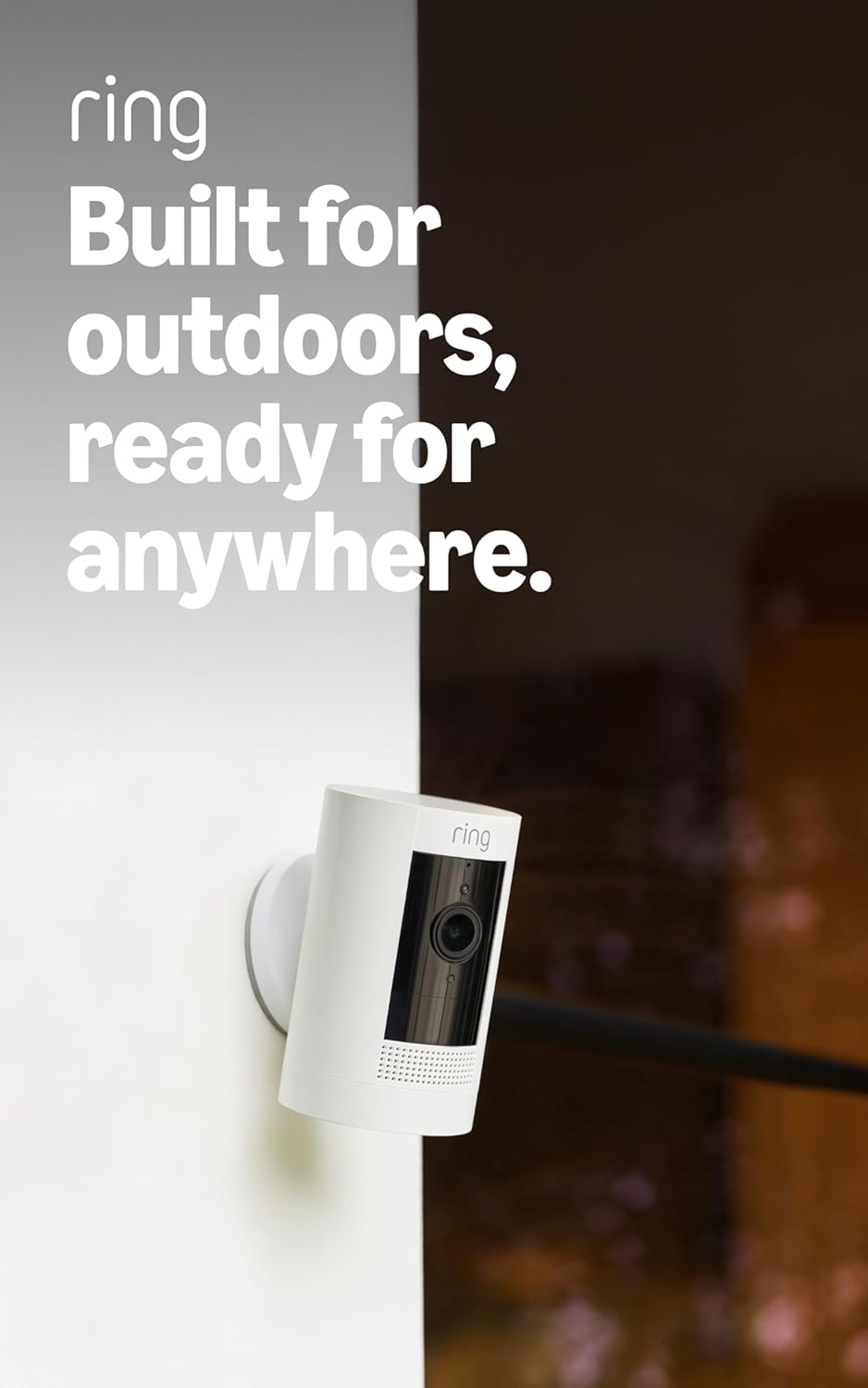
Ring Outdoor Cam (Stick Up Cam) Battery
| Power | Rechargeable battery |
|---|---|
| Connectivity | Wi-Fi |
| Night Vision | Color night vision |
| Smart Home | Works with Alexa |
The Ring Outdoor Cam (Stick Up Cam) Battery is a weather-resistant, battery-powered security camera designed for flexible placement around a home or small business. It provides live view and two-way talk through the Ring app so you can see and speak with visitors in real time, and color night vision helps identify activity after dark. The unit mounts on a flat surface or wall using the included bracket and runs off a rechargeable battery pack for wire-free installation. Motion alerts and optional cloud recording via a Ring Protect subscription let you review events and receive intelligent notifications, and the camera integrates with Alexa for voice alerts and Echo Show video. Practical limitations include reliance on Wi-Fi for live monitoring and cloud features, and some advanced features require a paid subscription. For buyers who prioritize straightforward, weatherproof coverage with easy installation, the camera delivers reliable day-to-day monitoring and simple smart-home integration.
Best for: Homeowners looking for a dependable, easy-to-install outdoor camera that provides straightforward monitoring, real-time alerts, and smart-home integration without running power cables.
Less Ideal for: People who need entirely local storage and offline operation or who lack reliable Wi-Fi should consider alternatives with wired power and local recording options.
- Battery-powered for flexible, wire-free placement
- Weather-resistant design suitable for outdoor use
- Live view and two-way talk through the Ring app
- Color night vision for improved low-light identification
- Works with Alexa for hands-free alerts and Echo Show playback
- Some useful features such as cloud recording require a paid Ring Protect subscription
- Performance depends on home Wi-Fi strength for live view and alerts
Verdict: A weatherproof, battery-powered outdoor camera that delivers reliable, easy-to-install home monitoring with live view and Alexa integration.
Blink Outdoor 4 3-Camera Kit

| Video resolution | 1080p HD |
|---|---|
| Night vision | Infrared night vision |
| Audio | Two-way audio |
| Power | AA Energizer lithium batteries (included) |
The Blink Outdoor 4 three-camera kit is a straightforward wireless security system designed for basic home monitoring. Each camera streams 1080p HD live view, supports infrared night vision, and includes two-way audio for quick checks and short conversations. Setup is simple: mount the cameras, insert the included AA Energizer lithium batteries, and connect the Sync Module Core to manage the group. Blink highlights long runtime, claiming up to two years of battery life under typical use, which reduces maintenance for most home deployments. Motion detection with dual-zone alerts helps cut down false alarms, and optional person detection is available with a subscription. The kit does not include local storage with the Sync Module Core, so cloud recording or an upgraded Sync Module is needed to retain clips locally, which adds cost and complexity. Integration with Alexa enables voice control and multi-camera live view for supported devices. This system is best for users who want a low-maintenance, easy-to-install outdoor kit and are comfortable using cloud storage or buying an upgraded hub for local backup.
Best for: Buyers who prioritize easy installation and long battery life for outdoor surveillance and who want a well-known, widely used kit with straightforward cloud-based recording options.
Less Ideal for: Users who need local storage out of the box, advanced on-device analytics without subscriptions, or professional-grade surveillance features should consider other systems.
- Wireless setup with included Sync Module Core simplifies multi-camera management
- 1080p HD video with infrared night vision for clear day and night monitoring
- Included AA Energizer lithium batteries and advertised two-year battery life reduce frequent battery changes
- Dual-zone enhanced motion detection helps reduce unnecessary alerts
- Two-way audio and Alexa integration allow remote interaction and voice control
- Sync Module Core does not provide local storage for recorded clips without an upgraded Sync Module
- Person detection requires a subscription for the advanced CV alerts
Verdict: Choose this kit if you want a simple, low-maintenance outdoor camera system with 1080p video and very long battery life for routine home monitoring.
Blink Mini 2K+ Indoor Camera

| Video resolution | 2K |
|---|---|
| Zoom | Up to 4x |
| Package | 2 cameras |
The Blink Mini 2K+ is a small plug-in indoor security camera designed for straightforward home monitoring. It records sharper 2K video with up to 4x zoom, provides improved audio with two-way talk and noise cancellation, and offers basic smart detection features when paired with a Blink subscription. Setup is simple: plug in, mount using the included kit or place on a shelf, and connect to your Wi-Fi network for live view and motion alerts. The system integrates with Alexa for voice control and can act as a chime for a Blink doorbell. Storage relies on Blink cloud plans (with a free 30-day trial) unless you add Blink-compatible local storage options, so continuous local recording is not built in. The camera is intended for indoor use unless you buy an optional weather-resistant power adapter, and advanced person or vehicle detection requires subscription activation. For everyday home monitoring where ease of use and clear video matter, the Mini 2K+ delivers practical performance with a minimal footprint.
Best for: Buyers who prioritize an easy-to-install, reliable indoor camera with clear video and simple smart home integration and who prefer a low-friction setup over complex systems.
Less Ideal for: Users who need built-in local continuous recording, fully weatherproof outdoor cameras, or advanced analytics without a subscription should consider other options.
- 2K video resolution with up to 4x zoom for clearer, more detailed footage
- Improved two-way audio with noise cancellation for clearer conversations
- Plug-in design with included mounting kit makes setup fast and flexible
- Works with Alexa for voice control and doorbell chime integration
- Cloud storage and advanced detection features require a paid Blink subscription
- Not weatherproof out of the box without an optional adapter for outdoor use
Verdict: A compact, easy-to-use indoor camera that delivers clearer 2K video and simple Alexa integration for buyers who want straightforward home monitoring.
Choosing the Right Security Camera for Home: Key Factors to Consider
Image Resolution and Low-Light Performance
Higher resolution gives clearer detail for identifying faces, license plates, and small events, especially at a distance. Consider whether you need 1080p, 2K, or 4K based on how far the camera will be from typical subjects. Keep in mind that higher resolution increases bandwidth and storage demands.
Low-light performance and integrated infrared illumination determine how useful night footage will be. Look for cameras with proven low-light sensors or built-in IR that produce usable black-and-white footage in darkness. Good low-light performance reduces blind spots after sunset and helps with accurate motion detection at night.
Motion Detection and False-Alarm Management
Motion detection is the primary trigger for alerts and recordings, so accuracy matters. Cameras that let you adjust sensitivity, create activity zones, or apply person-only detection reduce nuisance alerts from pets, branches, or passing cars. This saves battery life on wireless units and reduces clutter in your event timeline.
Also consider whether the system supports customizable schedules or integration with other sensors to avoid alerts during expected activity. The better the false-alarm controls, the more usable the camera will be for daily monitoring without constant interruptions.
Power Options and Placement Flexibility
Powering a camera shapes where you can place it. Hardwired or PoE cameras offer continuous power and are ideal for permanent exterior coverage, but they need wiring during installation. Battery-powered cameras provide flexible positioning and simpler installs, though they require periodic recharging and may have shorter recording windows during frequent events.
Consider whether the location has nearby power or whether you want a temporary setup you can move seasonally. Weatherproof ratings for outdoor placement also interact with power choices, since extreme temperatures can affect battery life and electronics longevity.
Connectivity, Bandwidth, and Latency
A camera's connection to your home network affects live view responsiveness, event upload reliability, and remote access. Wi-Fi cameras are easier to install but can suffer in congested networks or at greater distances from the router. Dual-band support and strong antennas help maintain a stable link.
For high-resolution continuous recording or multiple cameras, plan for the bandwidth and consider wired Ethernet or mesh network extensions. Low latency aids live monitoring and two-way audio interactions, while robust reconnection behavior reduces missed events during brief outages.
Storage Options and Privacy Controls
Decide between local storage, cloud subscriptions, or a hybrid approach. Local storage via SD cards or NVRs keeps footage on-site and avoids recurring fees, but it can be vulnerable to theft unless mirrored elsewhere. Cloud storage simplifies off-site retention and central access but often involves subscription costs and privacy tradeoffs.
Also review how the camera handles encryption, user access controls, and data retention policies. The ability to manage who can view live feeds and downloads is essential for household privacy and safe sharing of footage when needed.
Durability and Weather Resistance
For outdoor cameras, resistance to rain, dust, and temperature swings directly impacts lifespan and reliability. Look at the camera's ingress protection rating and whether it has corrosion-resistant mounts for coastal environments. Durable housings and sealed connectors reduce maintenance and the chance of water-related failures.
Indoor cameras benefit from good build quality too, especially in high-use locations. Robust mounting hardware and tamper-resistant designs help prevent accidental knocks or intentional interference.
Choosing Between Indoor and Outdoor Models
Decide first whether you need cameras for indoor rooms or exterior coverage. Indoor models often prioritize compact size, two-way audio, and easy plug-in power, while outdoor models emphasize weatherproof housings, extended temperature range, and brighter IR or spotlight illumination.
If you want continuous monitoring of entryways from inside, an indoor camera mounted near a window can work, but direct outdoor placement is usually better for clear sightlines. For porches and yards, plan mounts that keep the camera sheltered from extreme angles of rain and direct sun to maintain image clarity over time.
- Indoor: compact, easier setup, good for monitoring living spaces and nurseries
- Outdoor: weatherproof, wider field of view, designed for entrances and yard coverage
- Hybrid setups let you combine cameras to cover both inside activity and approach paths
Installation Tips and Common Pitfalls
Before installing, map the viewing angles you need and test placement with a temporary mount or stand. Check Wi-Fi signal strength at the planned location and bring power as needed. For battery-powered units, orient the camera to minimize direct sun on the battery housing and to avoid frequent false triggers.
Common pitfalls include mounting too high for useful facial recognition, failing to secure cabling against weather or tampering, and overlooking routine maintenance like cleaning lenses. Take time during setup to configure activity zones and notification schedules so alerts are meaningful from day one.
- Test live view at the installation height before final mounting
- Ensure the camera can be reached for periodic maintenance or battery changes
- Use appropriate anchors and a gasketed connection for exterior wiring
Network Considerations for Multiple Cameras
If you plan to run several cameras, consider how each unit's resolution and frame rate will affect your home network. High-resolution continuous streams multiply bandwidth needs and can saturate a single router. Stagger motion-only recording or lower frame rates to reduce load when many cameras are active.
Segmenting cameras on a separate VLAN or guest network can help with security and reduce interference with general household devices. If Wi-Fi is marginal, run Ethernet or use a mesh system with wired backhaul to maintain consistent performance.
- Estimate upstream bandwidth needs based on number of cameras and streaming settings
- Prefer wired connections for fixed exterior cameras when possible
- Use QoS or network partitioning to prioritize camera uplink during busy periods
Privacy, Legal, and Placement Guidelines
Respect privacy by angling cameras to cover your property and common access points while avoiding neighbors' private spaces or public rights-of-way where local laws restrict surveillance. In many places recording audio requires additional consent, so check local regulations before enabling two-way or ambient audio capture.
Use account-level security, strong passwords, and two-factor authentication when available. Regularly review camera firmware updates and privacy settings to keep remote access secure and to ensure stored footage is protected from unauthorized access.
- Disable audio recording if you do not need it or if local rules prohibit it
- Limit account access and change default passwords during setup
- Keep firmware current to patch security vulnerabilities
How We Chose the Best Security Camera for Home
We focused on practical, measurable attributes that affect daily home monitoring. Our selection filtered for units that provide consistent video resolution and low-light performance, dependable motion detection with configurable alerts, and stable network connectivity options suitable for typical home Wi-Fi setups. We also prioritized cameras with straightforward installation and mounting flexibility so they can cover common entry points and living spaces, plus reasonable local or cloud storage options to retain important footage. Excluded from consideration were novelty devices lacking sustained firmware support, experimental prototypes, and cameras that require extensive pro-level networking to function. We avoided entries that relied solely on proprietary ecosystems with no standard connectivity. Core evaluation criteria included image clarity in varied lighting, motion-detection accuracy and false-alarm resistance, connectivity and latency, ease of installation and user interface, and storage/privacy controls. These dimensions drove our shortlist and are reflected in the scoring metrics used for each product.
Our full evaluation process is outlined in our review methodology.
FAQ
Do I need wired power for reliable outdoor monitoring?
Wired power provides continuous operation and is generally more reliable for outdoor monitoring, especially in cold climates where batteries drain faster. Battery cameras are convenient for flexible placement but require recharging or swapping and can miss events during low battery.
How much storage do typical home security cameras need?
Storage depends on resolution, frame rate, and whether recording is continuous or event-triggered. Motion-only recording greatly reduces storage needs. Many users find 24 to 72 hours of retained footage sufficient for routine monitoring, but priorities vary with coverage and legal considerations.
Can security cameras work on a slow home internet connection?
Cameras can function on slower connections if you limit upload bandwidth by lowering resolution or using event-based recording. Continuous high-resolution streams may not be feasible. For remote viewing, expect some latency and occasional quality drops on constrained networks.
Is cloud storage safer than local storage?
Cloud storage offers off-site redundancy and easier access but typically involves ongoing fees and reliance on a third party for data retention. Local storage keeps footage on your premises and avoids subscriptions but can be lost if the camera or storage device is stolen or damaged.
Should cameras be placed high or low for best identification?
Mount cameras at a height that balances field of view and facial detail. Too high can make faces too small to identify, while too low may be vulnerable to tampering. Around eight to ten feet is a common compromise for entrance coverage.
Final Verdict
Prioritize the features that match how you will use security cameras for home monitoring. If clear identification is your main goal, favor stronger image quality and good night vision. If you need flexible placement, weigh battery operation and simple mounting. For multiple-camera setups, plan network capacity and storage strategy before buying. Balance motion-detection controls, privacy options, and installation needs when choosing. Focusing on those tradeoffs will help you pick a camera that reliably protects the areas that matter most and minimizes nuisance alerts.