
Note: This article contains affiliate links. If you click on these links and make a purchase, we may earn a small commission at no extra cost to you. This helps support our research and content. Read our full affiliate disclosure here.
If you are just learning to maintain knives, a guided sharpening system can make the difference between a scary trial-and-error session and a quick, repeatable edge tune-up. Sharpening systems for beginners provide controlled angles and secure blade support so you can develop a reliable technique without damaging blades. This guide collects seven top sharpening systems for beginners that prioritize ease of setup, safety, and consistent edge results. Below we cover the practical features that matter for first-time sharpeners, how each shortlisted option performs on those dimensions, and what to watch for depending on the types of knives you own.
Top Picks at a Glance
| Best Overall The best all-around choice for most situations | Work Sharp Precision Adjust Elite |  |
| Best Quality Built to a higher standard if you want something more solid | KME Precision Knife Sharpener |  |
| Best Value The sweet spot between price and what you get | Work Sharp Precision Adjust Sharpener |  |
| Best Budget The cheapest option that still gets the job done reliably | KEENBEST 400/1000 Grit Whetstone |  |
| Top Rated A top-rated pick with lots of positive feedback | AccuSharp Knife Sharpener ACCU-001C |  |
| Most Popular A crowd favorite that many people choose with confidence | Sharp Pebble 1000/6000 Whetstone |  |
| Best Seller A high-volume bestseller chosen again and again | KITCHELLENCE 3-Stage Knife Sharpener |  |
Work Sharp Precision Adjust Elite

| Included components | Leather strop, ceramic rod for serrations |
|---|---|
| Angle range | 15° to 30° |
| Abrasives | 320-grit and 600-grit diamond plates |
| Material type | Plastic, Stainless Steel |
The Work Sharp Precision Adjust Elite is a benchtop guided sharpening system designed to put professional edges on kitchen, hunting, and everyday carry knives at home. You clamp the knife into the guide, set an angle between 15 and 30 degrees and run the blade across the included coarse and fine diamond plates, then refine with the ceramic finishing rod and leather strop; a conical ceramic rod and tri-brasive attachment handle serrations and curved blades. That guided mechanism removes guesswork, so beginners can consistently reproduce common edge angles, while the range of abrasives and strop let more experienced users progress from stock repair to a polished edge. The unit is relatively compact and arrives as a complete kit ready to use, but it is a bench-style system so it takes a bit of workspace and is not as portable as small pocket sharpeners. If you want a straightforward, repeatable way to sharpen a wide variety of knives at home, this system covers the bases without needing professional services.
Best for: Buyers who want an easy-to-learn, repeatable sharpening setup that handles kitchen knives, hunting blades, and pocket knives without paying for professional sharpening.
Less Ideal for: If you need a tiny, travel-ready sharpener or a tool-free one-pass pull-through solution, choose a more portable or simpler model instead.
- Guided angle system covers 15°–30° for consistent, repeatable edges
- Includes coarse and fine diamond plates plus ceramic rod and leather strop for full sharpening progression
- Dedicated conical ceramic rod and tri-brasive attachment let you restore serrated and curved blades
- Complete kit ready to use out of the box
- Bench system requires a stable workspace and is less portable than compact sharpeners
- Takes some setup time to clamp blades and change attachments compared with pull-through models
Verdict: A complete guided bench sharpener that makes professional-quality, repeatable edges accessible to beginners and hobbyists.
KME Precision Knife Sharpener

| Grit Type | Extra Fine,Extra-coarse,Coarse,Fine |
|---|---|
| Material Type | Wood |
The KME Precision Knife Sharpener is a manual, rod-guided system that gives repeatable, performance-focused edge work for kitchen and field knives. Setup uses a rotating neoprene-lined clamp and a spherical bearing guide rod that holds angles steady while you run the included 1 x 4 inch diamond hones through the stroke. The kit ships with four grits from extra-coarse (140) to extra-fine (1500), a small water bottle, cleaning cloth and a hard-sided case so you can go from very dull to razor sharp without buying extra stones. Continuous angle adjustment from 17 to 30 degrees in single-degree marks makes dialing in scales like chef or utility edges straightforward, and the quick-change stone holder plus marked clamp depth lines speed repeat sharpening and touch-ups. The system is compact and portable, so it works well at home or in the field, but it is a hands-on tool that requires some technique and time compared with guided pull-through sharpeners or powered stones.
Best for: Someone focused on achieving precise, high-performance edges who is willing to learn a guided manual system and wants a portable kit that covers a full grit progression.
Less Ideal for: Buyers seeking a quick, zero-skill solution or a powered sharpener for high-volume kitchen work should consider simpler guided sharpeners or electric systems instead.
- Rod-guided design and spherical bearing keep a consistent sharpening angle
- Includes four diamond hones (140, 300, 600, 1500) to cover full grit progression
- Continuous angle adjustment marked in single-degree increments for precision
- Portable kit with neoprene-lined clamp and hard carry case for field use
- Manual operation requires practice and time to get fast, repeatable results
- Smaller 1 x 4 inch stones may need more passes on very large blades
Verdict: A compact, precision-guided sharpening system that delivers professional-level edges for buyers who want full control over angle and grit progression.
Work Sharp Precision Adjust Sharpener

| Included components | 320 & 600 grit tri-brasive, diamond, fine ceramic, angle chassis, base, knife clamp |
|---|---|
| Adjustable angle range | 15-30 degrees (1-degree increments) |
| Material Type | Acrylic, Ceramic, Neoprene, Plastic, Steel |
| Manufacturer Warranty Description | 3 YEAR |
The Work Sharp Precision Adjust is a benchtop guided sharpening system that makes manual knife sharpening more consistent and user-friendly. You mount a blade in the v-block clamp, set the sharpening angle from 15 to 30 degrees in 1-degree steps, and run the included tri-brasive rod (coarse diamond, finer diamond, and fine ceramic) across the edge using the guided slide. That guided chassis and angle indexing remove much of the guesswork beginners struggle with and let you reprofiling a dull edge or polishing to a refined finish. The kit includes a stable base and a knife clamp so thin kitchen blades and pocket knives can be sharpened safely and repeatably. Because it is a manual guided system, sharpening takes more time and technique than an electric pull-through, and it requires some setup and practice to master consistent strokes, but the adjustable angles and multiple abrasives give real control over edge geometry and finish. For someone who wants a step up from stones or pull-throughs, it delivers controllable, repeatable results without needing advanced freehand skill.
Best for: Buyers who prioritize consistent, repeatable sharpening and want a guided system that teaches good technique while letting them control edge angle and finish.
Less Ideal for: If you need a fast, grab-and-sharpen electric tool or a compact field sharpener for outdoor use, this benchtop guided system is not the best choice.
- Angle-adjustable chassis with 1-degree increments for precise, repeatable edge geometry
- Tri-brasive rod (coarse diamond, fine diamond, fine ceramic) covers heavy sharpening through polishing
- Bench-mounted clamp and guided slide improve safety and consistency for beginners
- Includes a stable benchtop base and necessary accessories out of the box
- Manual guided system requires setup and practice and is slower than electric sharpeners
- Not a fully portable field solution due to benchtop base and assembly
Verdict: A guided benchtop system that gives beginners precise, repeatable control over angle and edge finish so they can sharpen confidently and learn proper technique.
KEENBEST 400/1000 Grit Whetstone

| Grits | 400 / 1000 |
|---|---|
| Material Type | Stone |
| Requires | Water (soak 10–15 minutes) |
This two-sided whetstone gives beginners a straightforward, budget-friendly way to restore and refine kitchen knives. The coarse 400 grit repairs nicks and re-establishes a working edge while the 1000 grit smooths and polishes it to a usable finish. Made from silicon carbide (white corundum), it works with water rather than oil: soak the stone 10–15 minutes before use and add water during sharpening to keep the surface lubricated and reduce clogging. The package includes a basic non-slip rubber base and a short user guide, which helps novices learn proper angles and strokes. Because the stone is small and light it is easy to handle and store, but it will remove metal reasonably quickly so beginners should practice on less valuable blades first. This set does not include a honing guide or angle jig, so maintaining a consistent edge depends on user technique, and very high-finish or razor edges may require finer grits beyond 1000.
Best for: Buyers who want an inexpensive, all-in-one whetstone to learn sharpening fundamentals and restore dull kitchen knives without specialty fluids.
Less Ideal for: Users seeking a complete sharpening workstation with angle guides or those who need ultra-fine finishing grits for professional razor edges should look elsewhere.
- Two grits (400/1000) cover repair and basic polishing steps.
- Silicon carbide construction cuts metal quickly for fast results.
- Water-ready design eliminates need for oil and is simple to use.
- Includes non-slip rubber base and beginner user guide for safer sharpening.
- No angle guide or accessories to guarantee consistent sharpening angles.
- 1000 grit tops out for basic polishing and will not produce very fine razor edges.
Verdict: A low-cost, two-grit water whetstone that gives beginners the basic tools to repair and polish dull knives and learn sharpening technique.
AccuSharp Knife Sharpener ACCU-001C

| Material Type | Acrylonitrile Butadiene Styrene |
|---|---|
| Grit Type | Coarse |
| Included Components | Sharpener |
The AccuSharp ACCU-001C is a simple pull-through sharpener designed to restore and hone a wide range of kitchen and outdoor knives in seconds. You pull the blade through the diamond-honed tungsten carbide slot while holding the ergonomic handle and the built-in guard keeps fingers back, making it easy for beginners to get a consistent edge. The carbide blades are reversible for longer life and the unit is low-maintenance — it cleans with soap and water and is reportedly dishwasher safe. Expect fast results for dull chef, paring, cleaver, and some serrated blades, though it does the initial reshaping and quick touch-ups rather than fine polished bevels that a stone or guided systems produce. Its compact size makes it handy in a drawer or for taking to the grill, and users report years of service before blade replacement. If you want a no-fuss, reliable way to bring knives back to usable sharpness without learning stropping or whetstone technique, this delivers.
Best for: Buyers who prioritize a dependable, low-skill sharpening solution for everyday kitchen and outdoor knives and want fast, repeatable results without learning whetstone technique.
Less Ideal for: Users seeking professional-level micro-bevel polishing, custom edge angles, or who prefer a sharpening system for frequent precision knife restoration.
- Diamond-honed tungsten carbide blades sharpen quickly and are reversible for extended life
- Ergonomic handle and full-length guard make sharpening safe and easy for beginners
- Compact, low-maintenance design cleans with soap and water and is dishwasher safe
- Works on a wide range of straight and some serrated knives for fast touch-ups
- Pull-through carbide sharpening does not produce the refined polished edge of stones or guided systems
Verdict: A reliable, beginner-friendly pull-through sharpener that quickly restores usable edges with minimal fuss.
Sharp Pebble 1000/6000 Whetstone

| Grit | 1000/6000 |
|---|---|
| Material Type | Corundum |
| No Oil Required | Yes |
| Included Components | Angle guide, bamboo base, instructions, ebook |
This Sharp Pebble whetstone is a beginner-friendly sharpening kit built around a two-sided 1000/6000 grit waterstone. The coarse 1000 side repairs dull or slightly damaged edges while the 6000 side polishes to a fine, razor-ready finish. It ships with a non-slip bamboo base and an angle guide that holds the blade at a consistent angle, which removes much of the guesswork for first-time sharpeners. Because it is a waterstone made from corundum, no oil is required and the stone cuts reasonably fast and produces a clean edge. Practical benefits include a compact footprint that fits most kitchen setups and included instructions plus online support and an ebook to speed learning. Limitations are that mastering even guided whetstone technique still takes a bit of practice to avoid over-raising the bevel, and the kit does not include a flattening stone for long-term maintenance of the stone surface. For those who want a reliable, well-reviewed starter whetstone that mimics professional results, this kit is a solid choice; users who expect instant perfection without practice may still prefer powered sharpeners.
Best for: Buyers who want a proven, taught path to learning whetstone sharpening and value social proof and guidance during the learning curve.
Less Ideal for: People who need instant, maintenance-free edges with no practice or those who prefer electric sharpeners for speed and simplicity.
- Dual 1000/6000 grit covers edge repair and polishing without buying extra stones
- Included angle guide simplifies maintaining a consistent sharpening angle
- Bamboo non-slip base keeps the stone stable during use
- Waterstone composition requires no oil and cuts cleanly
- Comes with instructions and an ebook for beginners
- No flattening/lapping stone included for restoring a worn or dished surface
- Takes practice to get consistently thin microbevels despite the angle guide
Verdict: A well-supported dual-grit whetstone kit that makes learning manual sharpening straightforward and delivers professional-quality edges for beginners.
KITCHELLENCE 3-Stage Knife Sharpener
| Material Type | Plastic |
|---|---|
| Included Components | Yes |
| Item Weight | 180 g |
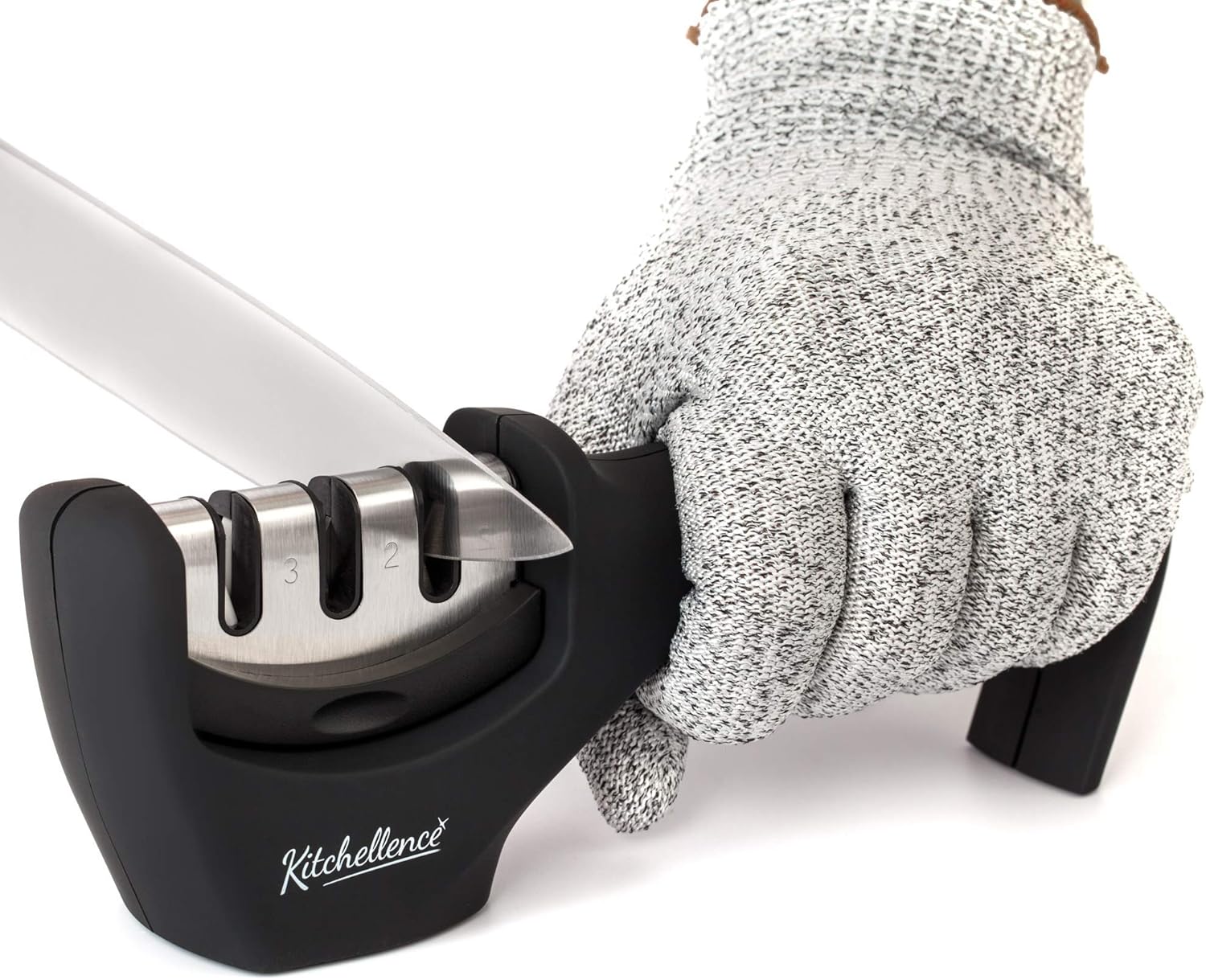
This compact 3-stage sharpener is designed to take dull or slightly damaged kitchen knives back to working condition with a simple pull-through process. The first diamond rod straightens damaged edges, the second slot re-establishes the V-shaped bevel, and the third fine slot polishes and refines the edge, so you can use it on everyday chef, utility, and paring knives. Its molded ABS body and non-slip base provide stable hand-held use and the ergonomic handle works for left- and right-handed users, which makes routine touch-ups quick and low-effort. The included cut-resistant glove is a practical safety addition for beginners who are still gaining confidence. Limitations are typical of pull-through systems: it is best for minor repairs and edge maintenance rather than heavy re-profiling of very damaged or high-end premium steels, and aggressive use can remove metal faster than guided guided-angle systems. For a risk-averse home cook wanting fast, predictable sharpening without technical setup, this kit is a sensible entry-level option.
Best for: Home cooks who want a straightforward, low-risk way to restore and maintain common kitchen knives without learning complex techniques.
Less Ideal for: Knife enthusiasts seeking precise angle control, professional users, or owners of very hard or specialty steels who need dedicated sharpening systems.
- Three-step system (diamond rod, mid-stage sharpener, fine polish) covers repair through finishing
- Ergonomic handle and non-slip base for stable use by left- or right-handed users
- Includes a cut-resistant glove to improve safety for less experienced sharpeners
- Durable ABS construction for everyday kitchen use
- Not suitable for heavy re-profiling or restoring severely damaged high-end blades
- Pull-through design can remove material faster than angle-guided systems if overused
Verdict: A safe, no-fuss three-stage pull-through sharpener that lets beginners quickly repair and polish everyday kitchen knives.
Choosing the Right Sharpening System Knife Sharpener for Beginners: Key Factors to Consider
Angle Control
Consistent angle control determines the geometry of the cutting edge and how long that edge will hold before dulling. For beginners, fixed or easy-to-set angle guides are essential because small angle errors compound each pass and change cutting performance.
Look for systems that clearly mark angles or lock in common knife angles so you can reproduce the same setting across multiple sessions. Systems that allow incremental adjustments are helpful if you plan to sharpen a variety of knives, but complexity should not come at the cost of stability for your first setups.
Blade Holding and Safety
Secure blade retention prevents movement during sharpening and reduces the chance of uneven removal or accidental contact. Clamps, V-blocks, or dedicated jig-style holders that cradle the blade with non-marring pads are best for beginners.
Safety features such as finger guards, stable bases, and tensioned clamps reduce slippage. A system that clearly separates the abrasive path from your hands makes it easier to focus on controlled strokes rather than on managing the blade.
Abrasive Selection and Progression
A good beginner system should include a sensible progression of abrasive grits so you can move from repairing chips to polishing a keen edge. Coarse stones or plates remove metal quickly, while medium and fine abrasives refine the bevel and produce a sharp, useful edge.
Having both a coarse starting grit and a fine finishing option in the kit minimizes additional purchases and ensures you can complete the full edge-building process. Some systems use replaceable stones, while others have fixed plates; consider replacement availability and compatibility.
Ergonomics and Learning Curve
Ergonomics affect how comfortable and consistent your sharpening sessions will be. For beginners, systems with a stable base, comfortable handles, or guided rod paths make repetitive strokes easier and less fatiguing.
The learning curve should be gentle: clear instructions, simple assembly, and intuitive operation help you practice without frustration. Systems with visual guides or tactile stops reduce guesswork and speed up skill acquisition.
Maintenance and Longevity
A sharpening system that is easy to maintain will stay accurate and safe over time. Consider how abrasives are cleaned and whether stones need flattening, replacement, or special storage. Durable frame materials resist bending or warping, which preserves angle accuracy.
Accessories such as spare stones, clamp pads, or base feet should be available if you plan long-term use. A system that stays stable and serviceable prevents common beginner setbacks like wobble or uneven wear.
Why a Guided System Helps Beginners
Guided sharpening systems constrain the motion or angle so you concentrate on consistent pressure and stroke length rather than guessing the correct bevel. This reduces early mistakes that can remove too much material or create irregular edges. For novices, that predictability translates to faster skill development and safer practice.
Because the system enforces angle and holds the blade, it is also easier to follow a documented grit progression. You can repair a nick with a coarse abrasive, re-establish the bevel with a medium grit, and polish to a fine edge without changing technique—only the abrasive. That repeatability is the main reason beginners get usable results quickly.
- Reduces angle guessing and human error
- Makes grit progression straightforward
- Improves safety by stabilizing the blade
Types of Abrasives You'll Encounter
Beginner-friendly systems use a mix of diamond plates, ceramic stones, or bonded abrasives. Diamond plates cut fast and are very long lasting, while ceramic and water stones can produce a finer polish. Some kits include leather strops or ultra-fine finishing options to remove burrs and raise a keen edge.
Each abrasive type behaves differently under pressure and with different steels. Diamond is low-maintenance and good for hard steels, but it can feel aggressive. Water and ceramic stones require more attention to surface condition but can deliver a delicate polish when used correctly.
- Diamond plates: durable, fast-cutting
- Ceramic/water stones: finer finish, require care
- Leather strops: final polish and burr removal
Setting Up and Using a Sharpening System
Start by reading the system manual to confirm clamp orientation and angle presets. Mount the blade securely and perform a few gentle test strokes on a lower grit to ensure the blade does not shift. Keep consistent, light pressure and the same stroke length on each pass.
Work through grits from coarse to fine and check the edge periodically for evenness. Use a burr check to confirm you have established a new bevel before moving to the next finer abrasive. Finish with a stropping step if the system includes a leather option to remove the burr and refine the cutting edge.
- Assemble with the blade clamped and perpendicular to the base
- Use consistent light pressure and repeatable strokes
- Progress through abrasives and verify burr formation
Common Beginner Mistakes and How to Avoid Them
Applying excessive pressure is one of the most common errors. Heavy force can remove metal too quickly and change the intended bevel angle. Instead, let the abrasive do the cutting and maintain steady, even passes.
Another frequent mistake is skipping grits. Trying to jump from a very coarse repair grit directly to a polishing grit leaves a rough bevel that never sharpens properly. Move gradually through the grit progression to restore the geometry before polishing.
- Do not press too hard; moderate pressure is more consistent
- Follow grit progression; do not skip necessary steps
- Check blade alignment often during setup
Caring for Your System and Stones
Keep abrasive surfaces flat and clean. Diamond plates can be washed and wiped, while water stones may need soaking and occasional flattening with a lapping plate. Remove metal filings and grit after each session to prolong abrasive life.
Store the system components in a dry place and check clamps, screws, and any moving parts for loosening. Replacing worn clamp pads or agitation-prone feet early avoids stability problems that affect sharpening results.
- Clean abrasives after each use
- Flatten water stones periodically
- Inspect and tighten hardware as needed
How We Chose the Best Sharpening System Knife Sharpener for Beginners
We started with products designed to let novices establish and reproduce precise edge angles with minimal risk. Key evaluation criteria included angle control, clamp or blade-holding security, abrasive variety and progression, ergonomics and safety, and the system's learning curve. We prioritized systems that shipped with a logically ordered set of abrasives or stones that let a beginner progress from coarse repair to fine polishing without requiring additional purchases. We excluded single-stone methods and non-guided approaches that require a lot of hand skill to get repeatable results because they do not match the beginner-focused scope. We also filtered out systems that mandate frequent accessory purchases to reach a finished edge. In short, the list favors systems that lower user error through clear angle guides, stable blade retention, gradual grit progression, and straightforward maintenance. These are the dimensions that meaningfully affect how quickly someone new to sharpening can achieve safe, consistent edges.
Our full evaluation process is outlined in our review methodology.
FAQ
How often should a beginner sharpen their knives with a system?
It depends on use. Light home use may need maintenance every few months, while frequent cooks might touch up every few weeks. Use a honing rod between sessions and sharpen when the blade no longer slices cleanly.
Can a guided system damage thin or delicate blades?
Guided systems themselves are not inherently damaging, but using too coarse an abrasive or excessive pressure can remove too much metal. Choose milder grits and lighter pressure for thin blades and proceed slowly.
Do I need special oils or water for these systems?
That depends on the abrasive type. Water stones require water, some ceramic stones recommend light oil, and diamond plates can be used dry or with water for lubrication and debris removal. Follow the system's care guidelines.
Is clamping my knife safe for all blade shapes?
Most clamping jig systems handle straight-edged blades and many common profiles, but very thick or unusually shaped blades may not seat securely. Ensure the clamp pads are non-marring and that the blade sits flat before sharpening.
Will a beginner system work on serrated knives?
Not usually. Serrations need specialized sharpening tools or individual tooth sharpening. A guided flat-bevel system is intended for plain edges and will not restore serrations properly.
Final Verdict
For beginners, prioritize systems that deliver clear angle control, secure blade holding, and a sensible abrasive progression. Those three tradeoffs determine how quickly you will get consistent results and how safe the process will feel. If you value low maintenance, choose durable abrasives and a stable frame. If you have a variety of knives, favor systems with adjustable but simple angle presets. Overall, a guided sharpening system that reduces variables is the best path to building confidence and producing repeatable edges.