
Note: This article contains affiliate links. If you click on these links and make a purchase, we may earn a small commission at no extra cost to you. This helps support our research and content. Read our full affiliate disclosure here.
If indoor smoke — from cooking, wildfire haze, or tobacco — is a recurring problem, a compact air cleaner can make a noticeable difference in your home. A small air purifier for smoke focuses on removing fine particles and odor-causing gases while fitting on a shelf or nightstand. Choosing the right unit matters because performance varies by filtration type, CADR for smoke-sized particles, and how intrusive the fan and indicator lights are in everyday rooms. This guide shortlists the top small air purifiers for smoke and explains the evaluation criteria we used, from particle capture to noise and maintenance. Read on to find a compact option that balances clean-air performance with the convenience you need for bedrooms, apartments, and small living areas.
Top Picks at a Glance
| Best Overall The best all-around choice for most situations | GermGuardian AC4825E 22" Tower |  |
| Best Quality Built to a higher standard if you want something more solid | BLUEAIR Blue Pure 511i Max |  |
| Best Value The sweet spot between price and what you get | VOOPNU H13 HEPA Air Purifier DH-JH12 |  |
| Best Budget The cheapest option that still gets the job done reliably | MEGAWISE Home Air Purifier EPI810 |  |
| Best Seller A high-volume bestseller chosen again and again | Levoit Core Mini-P |  |
GermGuardian AC4825E 22" Tower

| Model | AC4825E |
|---|---|
| Room coverage (turnover) | 153 sq. ft. every 12.5 minutes; up to 743 sq. ft. hourly |
| Filter type | True HEPA with activated carbon pre-filter |
| Fan speeds | Three (includes sleep mode) |
The GermGuardian AC4825E is a compact tower air purifier that combines a True HEPA filter, activated carbon pre-filter, and optional UV-C sanitizer to tackle allergens, odors, and some airborne microbes. It is typically placed in bedrooms, offices, or kitchens where it circulates air for spaces ranging from about 153 sq ft (frequent turnover) to claims up to 743 sq ft for hourly circulation. Practical controls let you pick among three fan speeds including a quiet sleep mode for nighttime use, and the carbon pre-filter helps reduce cooking and pet smells. The unit is compatible with GermGuardian replacement Filter B cartridges and UV-C bulbs for straightforward maintenance. Expect effective removal of dust, pollen, and pet dander down to 0.1 microns passing through the filter, though the UV-C option is supplemental rather than a standalone sterilizer. Size and single-outlet design make it easy to move, but in very large open spaces you may need multiple units or a higher-capacity model for faster smoke clearance.
Best for: Buyers who want a reliable, space-saving purifier for bedrooms, small living areas, or kitchens that cuts allergens and common odors while offering a quiet night mode.
Less Ideal for: People needing rapid heavy smoke clearance in very large open spaces or whole-house filtration should consider higher-capacity or multiple-unit solutions.
- True HEPA filter captures 99.97% of particles down to 0.1 microns when air passes through the filter media
- Activated carbon pre-filter reduces common household odors from cooking and pets
- Three fan speeds including a quiet sleep mode for night use
- Optional UV-C light for additional airborne particle reduction
- Compact tower design is easy to move and fits small rooms and bedrooms
- Coverage claims (up to 743 sq ft hourly) may be optimistic for rapid smoke removal in larger or open-plan areas
- UV-C function is supplemental and not a replacement for filtration or professional disinfection
Verdict: A compact, well-rounded tower purifier that effectively reduces smoke-related particles, allergens, and odors in small rooms while offering quiet operation and easy filter maintenance.
BLUEAIR Blue Pure 511i Max

| Filtration technology | HEPASilent (mechanical + electrostatic) |
|---|---|
| Particle size captured | Down to 0.1 microns |
| Room cleaning rate | Up to 1,138 sq ft per hour (237 sq ft in ~12.5 min) |
| Noise level | As low as 19 dB |
The Blue Pure 511i Max is a smart, performance-focused air purifier built for bedrooms, small living spaces, and apartments where fast removal of smoke and fine particles matters. It combines mechanical and electrostatic filtration in Blueair's HEPASilent system to capture particles down to 0.1 microns and claims to clean up to 1,138 sq ft in one hour while refreshing a typical bedroom-sized area in under 15 minutes. Smart sensors drive an automatic fan response when air quality worsens and the mobile app provides remote monitoring, schedules, and filter reminders. Notable real-world benefits include very quiet low-speed operation—reported as low as 19 dB—and a 360° intake in a compact Scandinavian design that fits unobtrusively in bedrooms or home offices. Expect strong particle removal including smoke, pet dander, pollen, and dust, with consistent automatic adjustments during pollution events. Limitations are typical for small-room units: peak performance depends on placement and run time, and while effective on particles and some odors, it does not replace whole-house ventilation or specialized odor/chemical scrubbers.
Best for: Buyers who prioritize fast, measurable particle removal and quiet, automatic operation in bedrooms or small living spaces and want smart monitoring to react to smoke and pollution events.
Less Ideal for: People seeking whole-house air treatment or heavy chemical/odor removal should consider larger systems or units with dedicated gas-phase filters instead.
- HEPASilent dual filtration that captures particles down to 0.1 microns for effective smoke and allergen removal
- Cleans small rooms quickly with stated coverage up to 1,138 sq ft per hour and 237 sq ft in about 12.5 minutes
- Very quiet operation at low settings (around 19 dB) suitable for bedrooms and nurseries
- Built-in air quality sensors with automatic fan speed adjustment and app control for remote monitoring and scheduling
- Compact 360° intake design that fits easily in small spaces
- Does not address whole-house ventilation so multiple units or longer run times may be needed for larger homes
- While effective on particles and smoke, it is not a substitute for specialized gas/odor filtration for strong chemical smells
Verdict: If you need a quiet, fast small-room purifier that reliably removes smoke and fine particles and adapts automatically to air quality, the Blue Pure 511i Max delivers strong performance.
VOOPNU H13 HEPA Air Purifier DH-JH12

| Filter | H13 True HEPA 3-stage |
|---|---|
| Coverage | Cleans 250 ft² every 15 minutes (up to 1,076 ft²/hr) |
| Noise level | 22 dB (low) |
| Model number | DH-JH12 |
The VOOPNU DH-JH12 is a small, user-friendly air purifier that uses an H13 True HEPA three-stage filter and 360 degree intake to capture fine particles and common smoke pollutants. It is intended for continuous use and the manufacturer reports lab-tested coverage of roughly 250 ft² every 15 minutes, making it suitable for bedrooms, kitchens, and small living rooms where smoke or odors are a concern. Controls are simple and the unit runs quietly down to about 22 dB, so it will not disturb sleep while running overnight. There is an essential oil tray if you want light fragrance, and the purifier carries multiple safety and efficiency certifications. Practical buyers should note the purifier is very compact and best applied to single rooms rather than whole-house cleaning, and replacement filters are recommended every few months depending on use. For smoke control in small spaces this model balances effective H13 filtration, low noise, and easy operation.
Best for: Buyers who prioritize straightforward, quiet smoke and particle removal in bedrooms or small living areas and value easy setup and low-noise operation.
Less Ideal for: Homes that need to clean large open-plan spaces or entire apartments should choose a larger, higher-CADR unit instead.
- H13 True HEPA three-stage filter captures 99.97% of fine particles including smoke and pollen
- Compact footprint that fits on a desk or nightstand while covering about 250 ft² every 15 minutes
- Very quiet operation down to 22 dB, suitable for overnight use
- 360 degree air intake for consistent room circulation
- Simple controls and built-in essential oil tray for optional scenting
- Designed for single-room use and not powerful enough for whole-house purification
- Small size means more frequent filter replacements in smoky or high-pollution environments
Verdict: A quiet, compact H13 HEPA purifier that delivers practical smoke and particle removal for single rooms without complex setup.
MEGAWISE Home Air Purifier EPI810

| Coverage | Up to 215 sq ft |
|---|---|
| Filtration | True HEPA (99.97% at 0.3 μm) |
| Fan speeds | 6 speeds |
| Noise | <25 dB (Sleep Mode) |
The MEGAWISE EPI810 is a small, portable air purifier built around a True HEPA filter that captures 99.97% of particles down to 0.3 microns, which helps with wildfire smoke, dust, and pet dander. It pushes air in a 360-degree pattern and is rated for spaces up to about 215 square feet, making it suitable for bedrooms, nurseries, and home offices. You can choose from six fan speeds and engage a near-silent sleep mode below 25 dB for nighttime use, and the unit adds a negative-ion option for extra cleaning. The filter is washable, which lowers ongoing costs and simplifies maintenance, and a replacement indicator helps you know when to service it. On the downside the purifier is compact and best for single rooms rather than whole-home coverage, and the negative-ion feature may concern buyers who prefer filtration-only systems. For its size and feature set it delivers practical smoke and odor reduction where a budget-friendly, easy-to-maintain unit is needed.
Best for: Someone shopping on a tight budget who needs an effective, easy-to-maintain purifier for a bedroom or home office and prioritizes quiet nighttime operation and washable filters to cut ongoing costs.
Less Ideal for: Households needing whole-house coverage or high airflow for very large open spaces should choose a larger, higher-CADR unit instead.
- True HEPA filtration removes 99.97% of particles down to 0.3 microns
- Rated to refresh air in rooms up to 215 sq ft with 360-degree airflow
- Six fan speeds plus a near-silent sleep mode under 25 dB
- Washable filter reduces replacement costs and simplifies maintenance
- Designed for single-room use and not suitable for whole-home purification
- Includes a negative-ion feature that some buyers avoid or prefer disabled
Verdict: A budget-friendly, compact HEPA purifier that quietly handles smoke and odors in single rooms while keeping operating costs low with a washable filter.
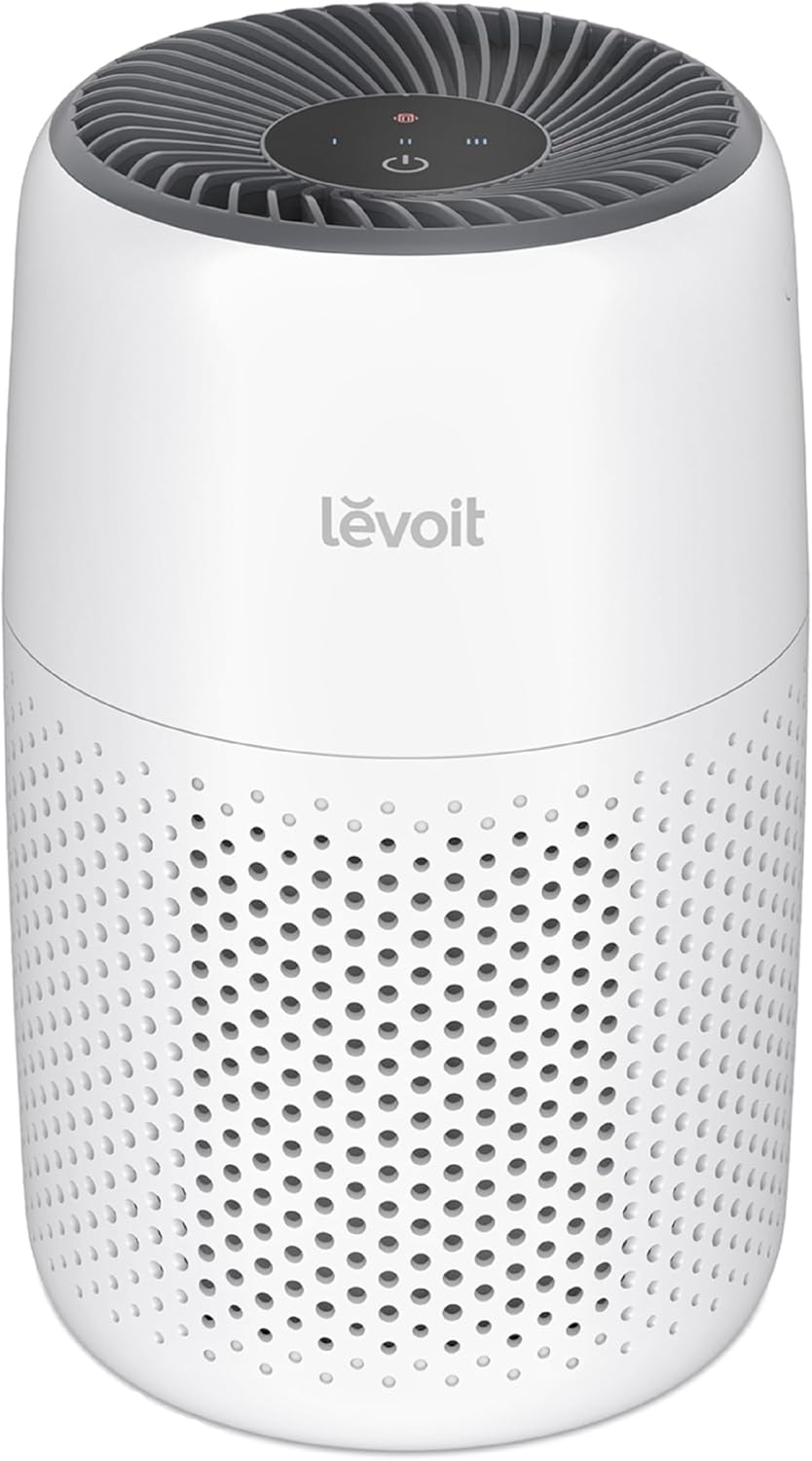
Levoit Core Mini-P
| Rated Power | 7W |
|---|---|
| Noise Level | 27-45 dB |
| Particle Retention Size | 0.3 micron |
| Model number | LAP-C161-WUS |
The Levoit Core Mini-P is a small, plug-in style air purifier intended for bedrooms, offices, or desktops where space is limited and quiet operation matters. It uses a pre-filter and main filter to capture lint, hair, pet dander, smoke and fine airborne particles, and includes a fragrance sponge for light aromatherapy. The unit is AHAM-verified for performance and runs at a low rated power (7W), producing sound levels listed between 27 and 45 dB so it can sit near a bed or workspace without being intrusive. Controls include a sleep mode and an auto-off display to limit disturbances overnight, and the adapter stores inside the unit for a tidy setup. Limitations are its compact coverage: it is designed for small areas and will not replace a larger room purifier for whole-room smoke removal, and the aromatherapy feature requires strict dosing to avoid overflow or damage. Replacement filters are required to maintain performance over time.
Best for: Buyers who want a low-noise, easy-to-place purifier for a bedroom or small office and value tested, dependable particle removal over high coverage area.
Less Ideal for: People needing heavy-duty smoke removal for large rooms or whole-home coverage should choose a higher-capacity purifier designed for larger square footage.
- AHAM-verified performance for reliable particle removal
- Compact, desktop-friendly design with internal adapter storage
- Very low power draw (7W) and quiet operation suitable for bedrooms
- Includes fragrance sponge for optional light aromatherapy
- Small unit intended for single-room or desk use, not whole-house smoke filtration
- Aromatherapy reservoir can be overfilled and may damage plastic if misused
Verdict: A reliable, ultra-quiet small-room purifier that delivers tested particle removal and fits neatly on a desk or nightstand.
Choosing the Right Small Air Purifier for Smoke: Key Factors to Consider
Filtration Efficiency for Fine Particles
Smoke is dominated by very small particles, often in the PM2.5 and ultrafine range. A purifier that uses a true HEPA filter rated to capture 99.97% of particles at 0.3 microns or better will remove the bulk of smoke particulates, which directly reduces visible haze and lowers inhalable pollution.
When shopping, confirm the filtration standard rather than trusting broad marketing terms. Higher capture efficiency shortens the time the air remains smoky after an event, but effectiveness also depends on airflow and room size.
Activated Carbon Capacity and Gas-Phase Adsorption
Particles carry most of smoke's health risk, but odors and volatile organic compounds (VOCs) from combustion are gas-phase problems that require substantial activated carbon or other sorbents. The volume and type of carbon, plus contact time, determine how well a small purifier reduces lingering smells and chemical odors.
For persistent odor or chemical components of smoke, choose units that specify carbon weight or describe dedicated odor-adsorption stages. Thin or token carbon layers often have limited real-world impact.
Airflow and Room Coverage (CADR)
A purifier's airflow determines how quickly it can lower pollutant concentrations in a given space. CADR ratings or manufacturer room-size guidance give practical insight into expected performance. For small rooms and bedrooms, a unit rated to cycle the room air several times per hour at a low or medium fan setting will control smoke without needing max-speed operation.
Consider the typical room volume where you expect smoke issues and choose a purifier with a capacity that comfortably exceeds that volume to allow for real-world placement and obstructions.
Noise and Usability During Continuous Operation
Because smoke events can last hours or reoccur frequently, many people run purifiers continuously. Noise becomes a major factor for bedrooms, home offices, or shared living spaces. Look for measured decibel levels at typical fan speeds and features such as night mode or low-light operation.
Controls, auto sensors, and intuitive indicators also affect daily usability. A small purifier with sensible default settings and quiet low-speed performance will be used more consistently, increasing overall effectiveness.
Filter Life, Replacement Cost, and Accessibility
Long-term cost and ease of maintenance influence whether a purifier remains effective over time. Replacement filters are consumables; check expected service life based on hours of use and local smoke exposure frequency. Filter cost and availability can vary widely and should factor into the total ownership decision.
Easy-to-replace filters, clear replacement indicators, and common filter sizes reduce headaches and ensure that you keep the unit operating at intended performance.
Where Small Purifiers Work Best
Small air purifiers perform well in confined spaces where a single unit can circulate most of the room air rapidly. Bedrooms, small living rooms, home offices, and kitchenettes are ideal because the purifier can deliver multiple air changes per hour without needing high fan speeds. In these settings, compact units are also easier to place near pollutant sources, such as a window or the room wall that faces outdoor smoke infiltration.
- Best for rooms up to the unit's rated square footage
- Good for spot-cleaning smoke sources like nearby cooking or a window with smoke intake
- Less effective as the only solution for whole-house smoke events without multiple units or HVAC integration
Placement Tips for Smoke Control
Correct placement improves a purifier's practical performance. Position the unit away from obstructions and at a height that encourages circulation, such as on a dresser, shelf, or small table. Avoid tucking a purifier into a corner or behind furniture because that reduces intake and short-circuits airflow.
Placing the purifier closer to the likely smoke source or to the room's airflow path can help capture pollutants before they spread. For homes with outdoor smoke infiltration, set the unit near the entry point where smoke tends to enter to intercept particles effectively.
- Leave at least several inches of clearance on intake and exhaust sides
- Keep the unit running continuously during smoke events
- Avoid placing directly under air vents that can push smoke away from the purifier
Running and Scheduling Strategies
To balance performance and noise, run purifiers on a higher fan speed temporarily during peak smoke events, then step down to a quiet continuous setting once concentrations decline. Many units include auto modes that rely on a particle sensor to adjust fan speed; these can conserve filter life and reduce noise compared with manual constant high-speed operation.
For bedrooms, enable night mode or a low-speed schedule overnight and run a higher refresh cycle in the evening when smoke exposure is more likely. During known poor-air-quality days, run the purifier continuously and close external doors and windows to reduce the load on the unit.
- Use higher speed for 15 to 60 minutes after a smoke event, then revert to low
- Consider using a second small unit in an adjacent room for better whole-room coverage
- Keep windows and doors closed during active smoke periods
Sensors and Smart Features to Watch For
Particle sensors, air-quality indicators, and timed scheduling can improve real-world performance by making it easier to set and forget a purifier. A reliable particle sensor helps auto modes react to smoke spikes, while a clear numeric or color indicator shows current conditions at a glance.
Some smart features add convenience, such as app control or voice assistant integration, but prioritize core sensing and reliable auto-behavior. Overly sensitive sensors that cause frequent fan shifts can be annoying, while sluggish sensors may allow smoke to linger longer than necessary.
- Prefer visible particle indicators or numeric readouts for smoke events
- Auto mode with responsive sensors reduces manual intervention
- Remote control and scheduling are useful but not essential for core smoke removal
How We Chose the Best Small Air Purifier for Smoke
We evaluated small air purifiers for smoke using practical, measurable filters that reflect real-world indoor air concerns. First, we prioritized particulate capture at the PM2.5 and submicron level since smoke contains very fine particles that drive health effects and visible haze. Second, we assessed filtration stages and media types, including true HEPA efficiency and activated carbon quantity, because combined particle and gas removal determines how effectively a unit reduces both smoke particles and odors. Third, we examined clean air delivery metrics appropriate to small rooms, focusing on CADR or equivalent room-size ratings and how quickly a unit cycles air at common fan speeds. Fourth, we considered noise output across fan settings so the purifier can run continuously in bedrooms or workspaces without disruption. Fifth, we looked at maintenance factors: filter replacement frequency, cost, and ease of access. Finally, we excluded large tower machines or units with unproven filtration claims, such as ionizers-only devices, to keep the list focused on compact purifiers with verifiable particulate and gas removal performance.
Our full evaluation process is outlined in our review methodology.
FAQ
Will a small air purifier remove wildfire smoke from my home?
Often, a properly rated small purifier can substantially reduce smoke in a single room by capturing fine particles and reducing odors. Effectiveness depends on the purifier's particle filtration efficiency, CADR relative to room size, and whether windows and doors are sealed to limit fresh smoke entry.
How often should I change filters if I use the purifier for smoke?
Filter life depends on smoke levels and runtime, but heavy smoke exposure can shorten service life to a few months. Check the manufacturer's recommended hours and inspect filters visually; frequent smoke means replacing filters more often than with typical urban dust levels.
Are particle sensors accurate for detecting smoke?
Many particle sensors detect spikes in fine particulate matter and are useful for smoke events, though accuracy varies. Sensors calibrated to PM2.5 and that show numeric values give more useful feedback than simple color indicators.
Can I run a small purifier 24/7 during long smoke events?
Yes, running a purifier continuously is usually recommended during prolonged smoke exposure to maintain lower particle concentrations. Choose a unit with quiet low-speed performance and factor in filter replacement cadence when running 24/7.
Do ionizers or ozone generators help with smoke?
Ionizers and ozone-producing devices are not recommended as primary smoke control solutions because they do not reliably remove particles or odors the way HEPA plus activated carbon filtration does. Some ionizers also produce ozone, which can be harmful at elevated levels.
Final Verdict
When choosing a small air purifier for smoke, prioritize effective particulate capture at PM2.5 levels and meaningful activated carbon for odor and VOC reduction. Match the purifier's CADR or room coverage to the intended space so the unit can cycle the air multiple times per hour without constant high-speed operation. Also weigh noise performance and filter maintenance to ensure the unit is usable continuously during smoke events. By focusing on filtration efficiency, airflow capacity, and ongoing upkeep, you can select a compact purifier that meaningfully reduces smoke and odor in small rooms.