
Note: This article contains affiliate links. If you click on these links and make a purchase, we may earn a small commission at no extra cost to you. This helps support our research and content. Read our full affiliate disclosure here.
A robot vacuum for garages has to do more than tidy bare floors. In garage and workshop environments you face tougher debris, fluctuating temperatures, and coarse surfaces that can quickly wear down a consumer machine. Choosing the right unit matters because a model built for garage conditions will save you time, avoid repeated clogs, and extend service life. This guide lists our seven shortlisted robot vacuums for garages, each selected for a mix of suction, durability, navigation, and ease of maintenance. Below we explain how we evaluated candidates and what to consider so you can pick the best fit for your workspace.
Top Picks at a Glance
| Best Overall The best all-around choice for most situations | iRobot Roomba 105 Combo |  |
| Best Quality Built to a higher standard if you want something more solid | roborock Saros Z70 |  |
| Best Value The sweet spot between price and what you get | eufy X10 Pro Omni |  |
| Best Budget The cheapest option that still gets the job done reliably | Lefant M210 Robot Vacuum |  |
| Top Rated A top-rated pick with lots of positive feedback | WSUANE D15S Max Robot Vacuum |  |
| Most Popular A crowd favorite that many people choose with confidence | Shark Matrix Clean AV2511AE |  |
| Best Seller A high-volume bestseller chosen again and again | roborock Q10 S5+ |  |
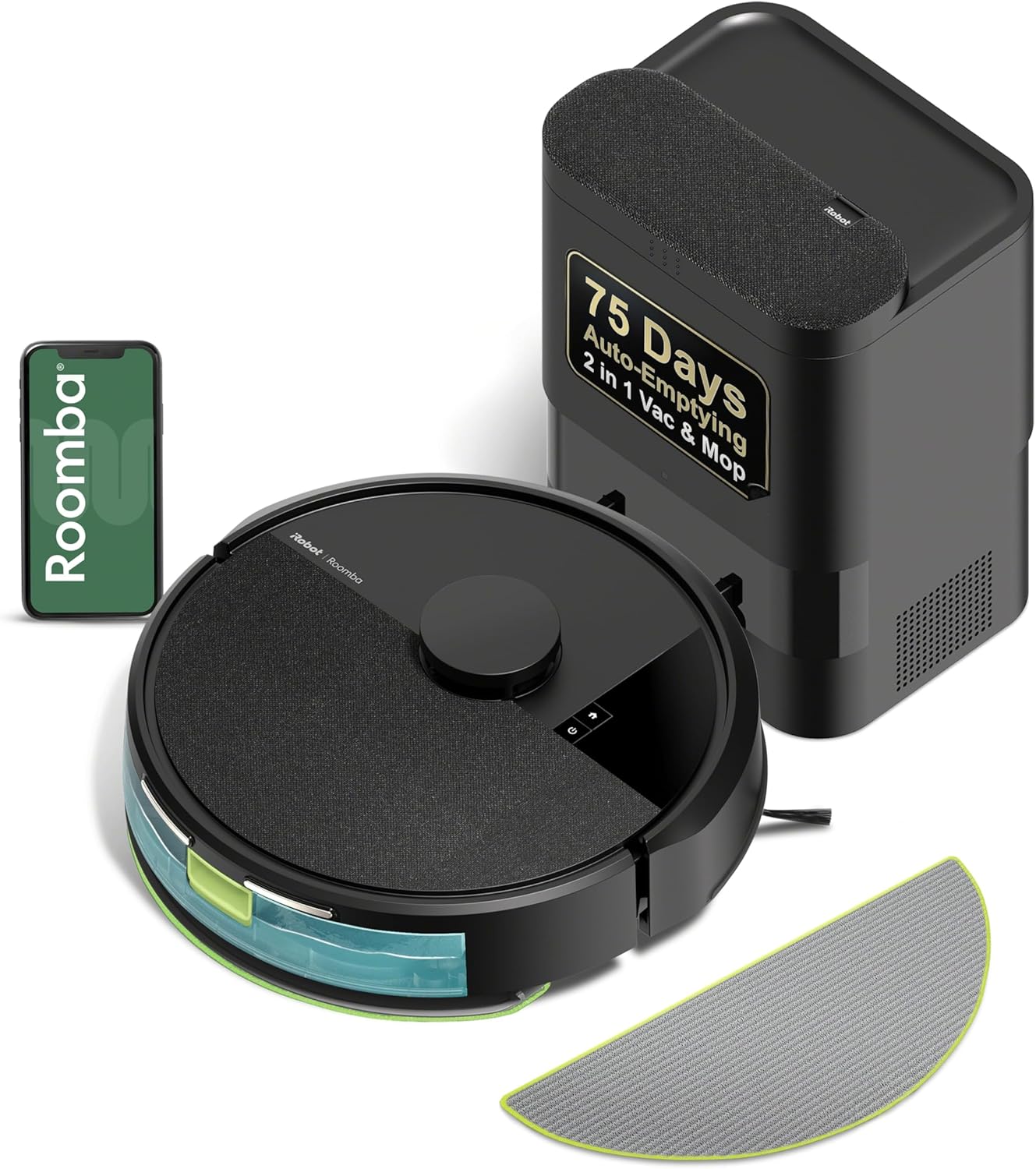
iRobot Roomba 105 Combo
| Surface Recommendation | Carpet & Hard Floor |
|---|---|
| Battery Life | 100 minutes |
| Controller Type | App Control, Button Control, Voice Control |
| Other Special Features of the Product | Self-Emptying, LiDAR Navigation, Simultaneous Vacuuming & Mopping |
The Roomba 105 Combo is a self-emptying robot vacuum and mop designed to handle routine wet and dry floor cleaning with minimal intervention. It uses ClearView LiDAR mapping to navigate and avoid obstacles while offering three modes: vacuum, mop, or vacuum-and-mop. The unit combines intense power-lifting suction, an edge-sweeping brush and a multi-surface brush for general debris pickup, plus a microfiber mop pad with a micro-pump for controlled water flow and SmartScrub boosted scrubbing in high-traffic spots. The included AutoEmpty dock captures debris in a replaceable bag for up to 75 days, cutting down on frequent dustbin handling. Setup and scheduling are managed through the Roomba Home App or voice assistants, and the robot detects carpets to avoid wetting rugs during mopping. Important limitations for a garage use case are its 100-minute battery life and disc-shaped form factor, which may struggle with large uneven thresholds, thick workshop debris, or heavy dust and gravel that are common in garages. Routine maintenance like filter and brush cleaning is still required to keep performance steady.
Best for: Buyers who want a low-maintenance, all-in-one robot that keeps hard floors tidy with hands-off debris disposal and app-driven scheduling.
Less Ideal for: People who need a robot for rough, dusty, gravel-strewn, or large single-charge garage floors should look at purpose-built shop vacuums or heavy-duty floor cleaners instead.
- Self-emptying AutoEmpty dock holds up to 75 days of debris to reduce hands-on emptying
- ClearView LiDAR mapping for efficient navigation and obstacle avoidance
- Combined vacuum and mop modes with controlled water delivery and SmartScrub for deeper scrubbing
- Multi-surface brush plus edge-sweeping brush improves pickup along walls and corners
- App and voice control for scheduling and custom cleaning passes
- 100-minute run time may be short for large single-level garage floors
- Disc form and sensors are not optimized for heavy coarse debris like gravel or wet mud
- Not designed for outdoor use or very uneven surfaces common in many garages
Verdict: A convenient, low-touch vacuum-and-mop combo with LiDAR navigation and a 75-day AutoEmpty dock that suits regular indoor hard-floor cleaning needs.
roborock Saros Z70

| Battery Life | 180 minutes |
|---|---|
| Controller Type | App Control, Voice Control |
| Filter Type | Washable Filter |
| Cleaning Path Width | 9.84 inches |
| Power Source | Battery Powered |
The Saros Z70 is a feature-packed robotic cleaner built for heavy-duty floor care and hands-off maintenance. It combines 22,000Pa suction, a tangle-resistant main brush, and dual spinning mops with an AdaptiLift chassis so the unit vacuums carpets, hard floors, and climbs modest thresholds while lifting its mop on rugs. Navigation uses dual cameras, StarSight 3D mapping, and VertiBeam avoidance to spot and route around obstacles; the OmniGrip mechanical arm can move or pick up small items to clear the robot's path. The multifunctional dock handles hot-water mop washing, warm-air drying, auto detergent dispensing, and up to weeks of automatic dust emptying for low upkeep. In a garage setting the Z70's powerful suction, ability to cross thresholds up to 4 cm, and hot-water mop cycle make it useful for removing tracked-in dirt, sawdust, and light grease when run on hard concrete or sealed floors. Expect a larger footprint and greater maintenance complexity than simpler models, and be mindful the arm and camera systems are best suited to indoor, relatively cluttered environments rather than dusty, heavily soiled workshop corners.
Best for: A performance-focused buyer who wants a near‑autonomous, capability-rich robot to keep a finished garage or work area routinely clean with minimal intervention.
Less Ideal for: People who need a simple, rugged cleaner for industrial or very dirty unsealed garage floors should consider a purpose-built shop vacuum instead.
- Very strong 22,000Pa suction for deep pickup on hard floors
- OmniGrip arm and object recognition reduce manual pre-cleaning by moving small obstacles
- Multifunction dock with hot-water wash, warm dry, and automatic dust emptying minimizes hands-on maintenance
- Advanced 3D navigation and lateral obstacle avoidance improve route efficiency in cluttered spaces
- AdaptiLift chassis and threshold climbing let it transition over raised garage door seals
- Complex dock and mechanical arm increase service and setup considerations compared with basic robot vacuums
- Not designed for extremely dirty, unsealed workshop areas where heavy debris and liquids are common
Verdict: Choose the Saros Z70 if you want a high-performance, low-touch robot that combines very strong suction, advanced obstacle handling, and a self-maintaining dock to keep a finished garage floor consistently clean.
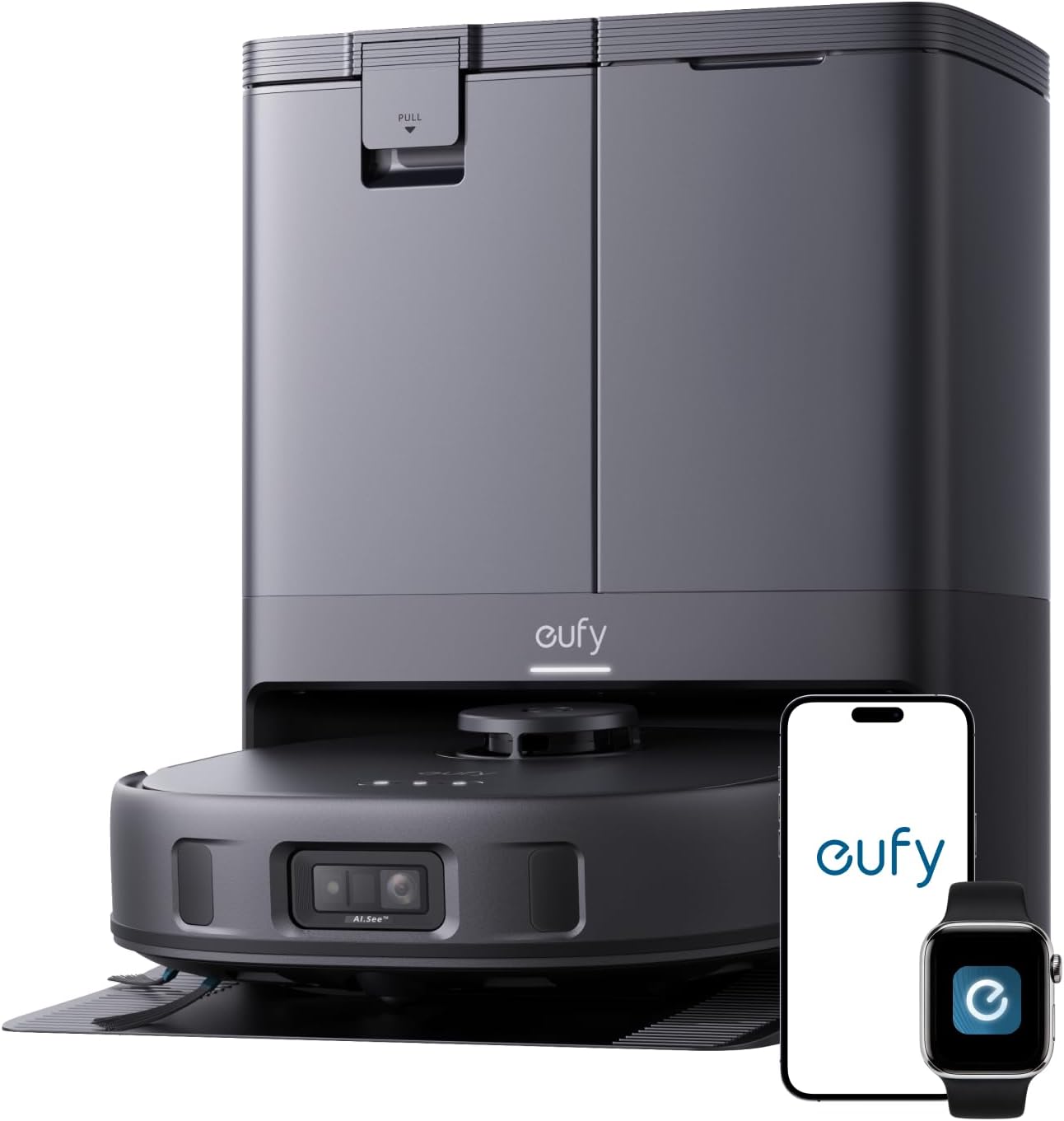
eufy X10 Pro Omni
| Battery Life | 173 minutes |
|---|---|
| Power Source | Battery Powered |
| Capacity | 2.5 liters |
| Filter Type | Washable |
| Compatible Devices | Amazon Echo, Google Home, Smartphones, Tablets |
The eufy X10 Pro Omni is a high-end robot vacuum and mop that automates most of the maintenance work with an all-in-one station that self-empties, self-washes mop pads, and dries them with heated air. It pairs app, voice, and remote controls with iPath laser navigation and AI obstacle avoidance to map rooms, avoid cords and toys, and schedule room-by-room cleaning. The unit offers up to 173 minutes of battery life, a pro-detangling roller for pet hair, and a powerful 8,000 Pa suction mode for deep cleaning carpets and hard floors. Practical benefits include reduced hands-on upkeep thanks to the 2.5 L dust bag and 3 L water tank at the station, and washable filters for lower consumable cost. Important limitations are the 220-volt listing and 2.4 GHz Wi-Fi requirement, which may need attention for certain garages or regional power setups, and the 60 dB noise level which can be noticeable during operation. The X10 Pro Omni is best when you want near hands-free whole-floor care and strong suction without daily intervention.
Best for: Buyers who prioritize reducing hands-on cleaning and want a stationed robot that handles emptying, washing, and drying with dependable navigation and strong suction.
Less Ideal for: People who need a compact, ultra-quiet unit for small spaces or those who cannot accommodate the station’s power or 2.4 GHz Wi-Fi requirements.
- All-in-one station self-empties, self-washes, and self-dries mop pads to minimize manual maintenance
- Strong 8,000 Pa suction that tackles embedded dirt on carpets and upholstery
- AI obstacle avoidance with iPath laser navigation reduces collisions and missed areas
- Long runtime (173 minutes) suitable for larger floor areas between charges
- Washable filter and pro-detangling brush reduce consumable and hair-tangling issues
- Station and robot require matching regional voltage and use 2.4 GHz Wi-Fi only
- Noise level around 60 dB can be intrusive in quiet spaces
- Higher-capability station increases footprint compared with simple docking bases
Verdict: If you want a near hands-free robot that vacuums, mops, and largely maintains itself while delivering strong suction and smart navigation, the eufy X10 Pro Omni is a top choice.
Lefant M210 Robot Vacuum

| Battery Life | 120 minutes |
|---|---|
| Capacity | 500 cubic centimeters |
| Filter Type | Cartridge |
| Compatible Devices | Amazon Echo, Google Home, Smartphones |
| Other Special Features of the Product | Anti-Fall, Auto-Docking, Obstacle Avoidance, Pet Hair Pick Up, Scheduling |
The Lefant M210 is a small, app-controlled robot vacuum aimed at regular upkeep on hardwood and other hard floors. Its low 3-inch profile slips under furniture, and a brushless suction port helps pick up pet hair without brush tangles. You can run scheduled cleans, pick from six modes including edge and spot, and control the unit via the Lefant app or Alexa/Google voice commands. The listed 120-minute runtime (quiet mode) covers mid-size rooms on a single charge, and the 500ml dustbin reduces how often you empty it. Navigation relies on infrared anti-collision and anti-drop sensors rather than LIDAR, so it follows zigzag or randomized patterns rather than tightly mapped routes; that makes coverage fine for open hardwood areas but less precise in cluttered rooms. Noise is moderate at about 52 dB and suction is tuned for surface dirt rather than deep carpet extraction. For buyers wanting a straightforward, affordable hardwood-focused cleaner, the M210 delivers solid basic performance, but expect simpler navigation and fewer advanced mapping features than higher-end models.
Best for: Buyers on a tight budget who need a dependable, easy-to-use robot for regular hardwood and low-pile cleaning and value app/voice scheduling over advanced mapping.
Less Ideal for: Homes that require precise room mapping, systematic multi-room navigation, or deep-cleaning on high-pile carpets should consider more advanced models.
- Slim profile fits under low furniture for hidden-dirt pickup
- Brushless suction port reduces hair tangles for pet owners
- App scheduling plus Alexa and Google voice control for hands-free operation
- 500ml dustbin and up to 120 minutes runtime support longer cleaning cycles
- Navigation uses infrared sensors and randomized or zigzag patterns rather than LIDAR mapping, so room coverage can be less efficient in cluttered spaces
- Suction and cleaning are optimized for hard floors and low-pile carpet, not deep-cleaning thick carpet
Verdict: If you want an affordable, compact robot that handles daily hardwood and pet hair cleaning with app and voice scheduling, the Lefant M210 is a practical pick.
WSUANE D15S Max Robot Vacuum

| Suction | Up to 10000Pa |
|---|---|
| Dustbin Capacity | 3.5 liters |
| Navigation | dToF LIDAR |
| Battery Runtime | Up to 160 minutes |
| Filter Type | Three-layer high-efficiency (washable) + filter cotton |
The WSUANE D15S Max is a robot vacuum and mop that focuses on extended hands-off operation and powerful suction for routine floor care. It uses dToF LIDAR to build accurate maps and supports app control and no-go zones, so you can set scheduled runs and keep it out of specific areas. The 3.5 liter self-emptying station is designed to hold many cycles so you do not need to empty the bin frequently, and the unit offers multiple suction modes up to 10000Pa plus an Auto Boost for carpets. Practical features for busy homes include a washable three-layer filter, anti-tangle blade-equipped roller to reduce hair clogs, and multi-surface cleaning for hard floors and carpets. Trade-offs to consider are the listed 70 dB noise level at higher power and the need for app setup to access mapping features; very large garages with heavy debris may still require spot cleaning or a higher-clearance utility vacuum. For routine, scheduled garage maintenance the D15S Max delivers strong suction and reliable navigation with minimal daily intervention.
Best for: Buyers who prioritize dependable, low-maintenance cleaning cycles and accurate mapping for scheduled upkeep will appreciate this model for routine garage floor care.
Less Ideal for: People who need a rugged utility vacuum for heavy soiling, wet messes, or large debris in a garage should look for a shop-vac style solution instead.
- Large 3.5L self-emptying dustbin reduces how often you must empty the base
- dToF LIDAR mapping and multi-level maps allow precise navigation and custom no-go zones
- High peak suction (up to 10000Pa) and Auto Boost for better carpet pickup
- Anti-tangle blade roller helps prevent hair and pet-fur clogs during runs
- App control with Google Home compatibility enables scheduled cleaning and remote management
- Noise can reach about 70 dB on higher power settings
- Self-emptying system and mapping require initial setup and occasional maintenance
- Not designed for very heavy garage debris like large dirt piles or wet messes
Verdict: Choose the D15S Max if you want a reliable, high-suction robot that handles scheduled, low-touch garage cleaning with precise LIDAR mapping.
Shark Matrix Clean AV2511AE

| Battery Life | 120 minutes |
|---|---|
| Power Source | Battery Powered |
| Capacity | 0.27 gallons |
| Compatible Devices | Amazon Alexa, Google Assistant |
| Filter Type | Cartridge |
The Shark Matrix Clean AV2511AE is a robot vacuum and mop designed for hands-off whole-home cleaning with features that focus on convenience and pet hair control. It navigates using 360° LiDAR mapping and follows a Matrix Clean grid to take multiple passes over messes, while a self-cleaning brushroll and strong suction tackle embedded dirt and pet fur on carpets and hard floors. The included XL bagless base holds up to 60 days of debris so you rarely need to interact with the bin, and app and voice control let you schedule, target rooms, and start spot or full cleans remotely. Battery management supports recharge-and-resume so larger areas are covered without manual intervention. For garage use this model offers robust suction and obstacle avoidance, but its mop function and LiDAR navigation are optimized for indoor floor surfaces and may be less useful in very dirty, wet, or uneven garage floors; also the unit is relatively heavy to move between spaces. If you want an automated, low-touch cleaner that keeps floors tidy with minimal maintenance, this Shark delivers dependable performance in typical residential settings.
Best for: Buyers who prioritize a low-maintenance, automated cleaning routine and want reliable pet-hair pickup and long stretches between bin emptying.
Less Ideal for: People needing a dedicated heavy-duty garage cleaner for wet, oily, or very uneven concrete floors should consider purpose-built floor cleaners instead.
- Self-emptying bagless base holds up to 60 days of debris for low maintenance.
- LiDAR home mapping and Matrix Clean grid pattern improve coverage and navigation accuracy.
- Strong suction and self-cleaning brushroll designed to capture pet hair and embedded dirt.
- App and voice control let you schedule, target rooms, and operate hands-free.
- Mop function and navigation are optimized for indoor smooth floors and not intended for heavily soiled or uneven garage surfaces.
- Unit is relatively heavy to carry between locations compared with slimmer robot models.
Verdict: Choose the Shark Matrix Clean AV2511AE when you want a hands-off robot that uses LiDAR mapping and a 60-day self-empty base to minimize upkeep while keeping floors consistently clean.
roborock Q10 S5+

| Maximum Suction | 10,000 Pa |
|---|---|
| Capacity | 2.7 liters |
| Battery Life | 150 minutes |
| Filter Type | Washable |
| Noise Level | 65 db |
The roborock Q10 S5+ combines strong suction, intelligent navigation, and a 2.7 L self-emptying dock to minimize maintenance for busy households. It uses 360° LiDAR mapping and ReactiveTech obstacle avoidance to create accurate multi-level maps and avoid clutter while the app and voice controls let you schedule cleaning, set no-go zones, and choose mopping modes. The VibraRise 2.0 sonic mopping module scrubs floors and the unit lifts automatically over carpets, while ultrasonic carpet detection triggers extra suction where needed. In practice the 10,000 Pa suction and dual anti-tangle brush design make short work of pet hair and embedded dirt, and the large dust bag promises up to about 70 days between emptying in typical use. Limitations include a reported noise level around 65 dB and the unit only supports 2.4 GHz Wi-Fi, which may matter on congested networks. For garage use, expect good debris pickup on hard concrete and tiled floors but be mindful of very uneven surfaces, loose debris piles, or heavy liquids that exceed a mop module's intended use.
Best for: Buyers who prioritize a low-maintenance, reliable cleaning solution that handles pet hair and mixed hard floors with smart navigation and long intervals between dock emptying.
Less Ideal for: People who need a workhorse for very uneven garage floors, heavy wet messes, or large piles of debris that require a commercial wet/dry vacuum.
- 10,000 Pa suction effectively lifts embedded dirt and pet hair
- 2.7 L self-emptying dock reduces hands-on maintenance for weeks
- LiDAR navigation with multi-level mapping provides precise, repeatable cleaning paths
- VibraRise sonic mopping and auto mop lift let it scrub hard floors and avoid wetting carpets
- Dual anti-tangle brush design lowers brush maintenance when cleaning pet hair
- Noise level around 65 dB may be noticeable during runs
- Only 2.4 GHz Wi-Fi supported, limiting connectivity options on some networks
Verdict: Choose the Q10 S5+ if you want a smart, largely hands-free robot that combines strong suction, effective mopping, and a large self-emptying dock for low-maintenance floor care.
Choosing the Right Robot Vacuum for Garages: Key Factors to Consider
Suction and Debris Handling
Garages collect a wide range of debris from fine dust and sawdust to gravel, metal shavings, and pet hair. Strong suction and wide, sturdy brushrolls reduce the number of passes needed and lower the chance of particles being pushed around rather than collected.
Look for models with adjustable suction or a boosted cleaning mode so you can target heavy debris zones without wasting battery on empty concrete. Brush design matters too: tangle-resistant or mixed-fiber rolls handle hair and fine dust, while rubberized flaps and side brushes help pick up larger particles at edges and corners.
Wheel and Chassis Durability
Garage floors are often uneven, cracked, or littered with small obstacles. Robust wheels with higher ground clearance and reinforced suspension protect the drive system and help the vacuum traverse thresholds and textured concrete.
A reinforced chassis, metal or thick plastic wheel housings, and protective bumpers increase long-term reliability. Consider models with replaceable wheel assemblies and simple access to the drive train so you can service or swap worn parts after heavy use.
Filtration and Dust Containment
Fine particulates like sawdust and brake dust can pass through poor filters and recontaminate the air. High-efficiency filters or sealed dust canisters reduce airborne dust and protect internal components from buildup.
Choose vacuums with washable pre-filters and easily emptied, wide-mouth dustbins to avoid clouding the workspace during maintenance. For workshops where fine particulate is common, filtration quality is as important as suction because clogged motors and sensors will shorten the unit's lifespan.
Battery Life and Coverage
Garages can be large open spaces or connected to long driveways that increase cleaning area. Longer runtime or efficient cleaning patterns reduce the need for manual intervention and improve coverage per charge.
Check reported run times at higher power settings, and prefer units that can resume cleaning after returning to the charger. Quick-charge features are useful if you need frequent top-ups between jobs.
Navigation and Boundary Control
Precise navigation is less about mapping delicate rooms and more about staying out of work zones, tool piles, or wet areas. Reliable boundary options such as virtual walls, magnetic strips, or simple manual no-go zones let you protect sensitive areas.
Sensors should detect drops, cords, and small obstacles to avoid entanglement. For many garages, a simple, predictable cleaning pattern is preferable to complex room mapping that can be confused by large open areas and metallic reflections.
Ease of Maintenance
Frequent exposure to gritty debris and pet hair increases the maintenance burden. Tools and features that make maintenance quick will keep the vacuum usable: easily removable brushrolls, simple dustbin dumping, and clear access to filters and wheels.
Availability of spare brushes, filters, and replacement wheels is important if you plan frequent use. Models with clear maintenance indicators and tool-free access speed up routine cleaning and reduce downtime.
Preparing Your Garage for Robot Vacuum Use
Before you run a robot vacuum in a garage, do a quick sweep to remove large debris, nails, screws, and anything that could damage brushes or clog the intake. Pick up obvious trip hazards and load-bearing items so the robot can navigate without getting stuck.
Designate work zones you do not want the vacuum to enter. Use physical barriers or a boundary system provided by the vacuum to protect wet areas, tool benches, or partially assembled projects.
- Clear loose metal fragments and nails from floors first.
- Secure or tuck away cords and hoses to avoid entanglement.
- Use a coarse pre-sweep for heavy accumulations before running the robot.
Best Practices for Ongoing Garage Cleaning
Set a cleaning schedule based on how frequently you use the space and the types of debris produced. High-traffic or woodworking areas may need daily or every-other-day cleaning, while lightly used garages can be on a weekly cycle.
Rotate deeper manual cleaning and robot runs. Periodic manual vacuuming or sweeping removes the largest particles that wear the robot's drive and brushes, while the robot maintains cleanliness in between manual sessions.
- Empty the dustbin after heavy-duty runs rather than waiting for full indicators.
- Inspect wheels and brushrolls weekly for trapped shards or wrapped hair.
- Store the charging base away from the workbench to avoid accidental knocks.
Handling Specialized Debris
Different types of debris require different approaches. Fine dust and sawdust are best managed with high-filtration systems and frequent filter cleaning to prevent clogs. Larger particles like pebbles or metal shavings benefit from a model with wide intake and strong suction.
If you expect wet spills or oily residues, avoid running the robot until the area is dry and cleaned manually. Most robot vacuums are not designed to handle liquids and exposure can damage internal components.
- Use a stiff brush to remove embedded dirt from textured concrete.
- Sweep up large flakes or metal shards before robot cleaning.
- Replace or clean filters immediately after heavy dust exposure.
Where Robot Vacuums Struggle in Garage Environments
Robots are not a complete replacement for manual cleaning when it comes to heavy, near-instant accumulations of rubble, standing water, or sticky residues. They excel at regular maintenance and fine debris capture, but you should plan periodic deep cleaning with a shop vacuum or broom for coarse, bulky messes.
Low-clearance obstacles, tall thresholds, and steps remain common failure points. If your garage has uneven transitions or ramps, choose a unit with higher clearance or be prepared to block problem areas.
- Do not rely on a robot to pick up large metal pieces or screws without a prior sweep.
- Avoid running robots in garages immediately after projects that leave heavy particulate clouds.
Maintenance Schedule for Garage Use
Create a simple maintenance routine to keep a robot vacuum reliable. After each heavy run empty the dustbin and check the intake area. Weekly checks should include brushroll inspection and wheel cleaning, while monthly tasks can cover filter washing or replacement and battery inspection.
Keep a small kit of spare brushes, filters, and basic tools in the garage so you can perform fast service without searching for parts. Tracking hours of use helps predict when consumables will need replacing.
- Daily: Quick dustbin empty after heavy debris runs.
- Weekly: Brushroll and wheel inspection and cleaning.
- Monthly: Filter cleaning or replacement and visual battery check.
How We Chose the Best Robot Vacuum for Garages
We prioritized specifications and features that matter specifically in garage settings. Key evaluation criteria included suction power and debris handling, undercarriage and wheel durability for rough surfaces, filtration and dust containment for sawdust or fine particulates, navigation or boundary control for open concrete areas, and maintenance accessibility for frequent cleaning and brush replacement. We also considered battery runtime and charging behavior since garages may be larger or lack frequent recharging opportunities, plus the robustness of sensors and bump guards to withstand incidental contacts with tools and storage. We excluded lightweight, low-suction consumer-only models and devices with fragile wheels or paper-thin dustbins that are unsuited to coarse debris. Editorial filters applied: spec verification, manufacturer-stated durability features, user-reported issues related to clogging or wheel failure, and documented maintenance needs. The end result is a list of machines that meet the functional demands of garage floors while keeping upkeep and reliability in mind.
Our full evaluation process is outlined in our review methodology.
FAQ
Can I run a robot vacuum on rough concrete floors?
Often yes, but it depends on the model's wheel size and ground clearance. Look for reinforced wheels and suspension; very rough or broken concrete may still limit traction and increase wear.
Will a robot vacuum pick up metal shavings or nails?
Robots can handle small metal pieces if they are swept into a concentrated area, but sharp objects risk damaging brushes and the intake. It is safer to remove nails and large metal shards manually before running the robot.
How do I prevent a robot vacuum from entering certain work zones?
Use the vacuum's virtual boundary tools, magnetic strips, or physical barriers to block areas. For garages, physical barriers are often the most reliable against drafts, reflections, or sensor confusion.
Is filtration important for a garage robot vacuum?
Yes. Fine particulates like sawdust can clog motors and increase airborne dust. Models with better seals and higher-grade filters reduce recontamination and protect internal parts.
How often will consumables like brushes and filters need replacement?
It depends on usage and debris type. In a busy workshop they may need replacement every few months, while lighter garage use may allow six months or longer. Regular inspection reveals wear before failure.
Can a robot vacuum operate in colder garage temperatures?
Many consumer vacuums tolerate moderate temperature ranges, but very cold environments can reduce battery performance. If your garage drops below typical indoor temps frequently, expect shorter run times and check the manufacturer's recommended operating range.
Final Verdict
For garage cleaning, prioritize suction, durable wheels, and robust filtration. These features determine how well a robot vacuum handles coarse debris, dust, and the rigors of a workshop environment. Be realistic about tradeoffs: the most rugged units may be heavier and require more maintenance but will last longer under heavy use. Choose a model that matches your garage size and debris profile, and plan for regular upkeep so the vacuum remains effective. With the right priorities, a robot vacuum can greatly reduce day-to-day floor cleaning while you reserve manual tools for heavy-duty jobs.