
Note: This article contains affiliate links. If you click on these links and make a purchase, we may earn a small commission at no extra cost to you. This helps support our research and content. Read our full affiliate disclosure here.
If you need extra frozen storage but lack room for a full-size unit, a small deep freezer can be a practical solution. These compact freezers fit in garages, utility closets, apartments, or tiny kitchens while still offering reliable cold storage for bulk buys, prepared meals, and seasonal harvests. Choosing the right model matters because usable capacity, power draw, and temperature stability directly affect how much food you can store safely and how much it will cost to run. This guide highlights seven shortlisted small deep freezers that represent common buyer needs. We evaluate each option on capacity, energy use, temperature control, and durability so you can match a compact freezer to your space and storage habits. Read on for the criteria we used and what to consider before you pick one.
Top Picks at a Glance
| Best Overall The best all-around choice for most situations | Whynter CUF-110B Mini Freezer |  |
| Best Quality Built to a higher standard if you want something more solid | DEMULLER 3.5 cu ft Chest Freezer |  |
| Best Value The sweet spot between price and what you get | Frigidaire Chest Freezer 2.0 Cu Ft |  |
| Best Budget The cheapest option that still gets the job done reliably | Climate Choice 3.5 Cu.Ft Chest Freezer |  |
| Top Rated A top-rated pick with lots of positive feedback | Kismile 3.2 Cu Ft Chest Freezer |  |
| Most Popular A crowd favorite that many people choose with confidence | BLACK+DECKER 2.0 Cu. Ft. Chest Freezer |  |
| Best Seller A high-volume bestseller chosen again and again | BODACIOUS 5.0 Cu Ft Chest Freezer |  |
Whynter CUF-110B Mini Freezer

| Capacity | 1.1 cubic feet |
|---|---|
| Wattage | 79 watts |
| Door Orientation | Reversible |
| Number Of Shelves | 1 |
| Installation Type | Freestanding |
The Whynter CUF-110B is a small upright freezer designed for tight spaces like dorms, offices, garages, and basements. It provides a dedicated freezing compartment with a mechanical thermostat that can be set between about -11 and 10.4°F and uses a fan-circulated compressor to keep temperatures consistent across the single removable slide-out wire shelf. The unit is ENERGY STAR rated and draws modest power (listed at 79 watts), which helps limit operating cost in continuous-use scenarios. A recessed handle and reversible door make placement flexible, and the cylinder lock with two keys offers secure storage for items you want to protect. Manual defrosting is required, so occasional thaw cycles are needed to maintain performance, and the 1.1 cu ft capacity is best for frozen essentials, ice cream, or small bulk items rather than long-term family storage. For buyers who prioritize reliability, compact footprint, and a locking door, this model covers the basics without extra frills.
Best for: Buyers who want a simple, dependable locked freezer for small-space needs and who value energy efficiency and a secure door over extra features.
Less Ideal for: Those needing large-capacity or multi-zone freezing for family-sized meal prep or users who want fully automatic defrost and advanced temperature controls.
- Compact upright design fits small spaces and maximizes vertical storage
- ENERGY STAR rated for lower energy consumption during continuous use
- Reversible door and recessed handle for flexible placement
- Cylinder door lock with two keys provides secure storage
- Requires manual defrosting rather than an auto-defrost system
- Small 1.1 cu ft capacity limits how much you can store
Verdict: A compact, energy-efficient locked mini freezer that delivers secure, no-nonsense cold storage for small spaces.
DEMULLER 3.5 cu ft Chest Freezer

| Capacity | 3.5 cubic feet |
|---|---|
| Wattage | 70 watts |
| Voltage | 110 volts |
| Door Orientation | Top |
| Number Of Shelves | 1 |
The DEMULLER 3.5 cu ft chest freezer is a compact standalone unit that gives you adjustable, low-temperature storage in tight spaces like apartments, dorms, or garages. It uses an electronic temperature panel with a digital display to set temperatures from -15°F to 41°F in 1°F increments, which lets you switch between rapid-freeze and refrigerator-like settings depending on what you store. The interior includes a removable storage basket to keep smaller items accessible and a D-shaped cooling tube design intended to improve cooling consistency. Manual defrosting and a side drain hole simplify meltwater removal, and the manufacturer rates the compressor as quiet, under 38 dB, so it is suitable where noise matters. Trade-offs are its compact internal dimensions, which limit how many bulk items you can freeze at once, and the manual defrost requirement instead of frost-free convenience. For buyers prioritizing precise temperature control and efficient cooling in a small footprint, this freezer delivers practical performance without unnecessary complexity.
Best for: Buyers who need reliable low-temperature performance and precise temperature control in a compact footprint, such as those with limited space who still want the flexibility to rapid-freeze meats or store frozen goods long-term.
Less Ideal for: Users who regularly freeze large volumes, full-size grocery hauls, or want a frost-free, low-maintenance freezer should consider larger or automatic-defrost models instead.
- Digital temperature display with 1°F precision for accurate freezing and rapid-freeze options
- Compact 3.5 cu ft footprint fits apartments, dorms, garages, and other small spaces
- D-shaped cooling tubes designed to surround the cabinet for more even and efficient cooling
- Removable storage basket keeps small items organized and easy to access
- Quiet operation (advertised under 38 dB) suitable for shared or quiet spaces
- Manual defrost only, so occasional thawing and draining are required
- Small internal volume limits large-batch or bulk freezing needs
Verdict: Choose this compact chest freezer when you want precise, performance-focused freezing in a small space.
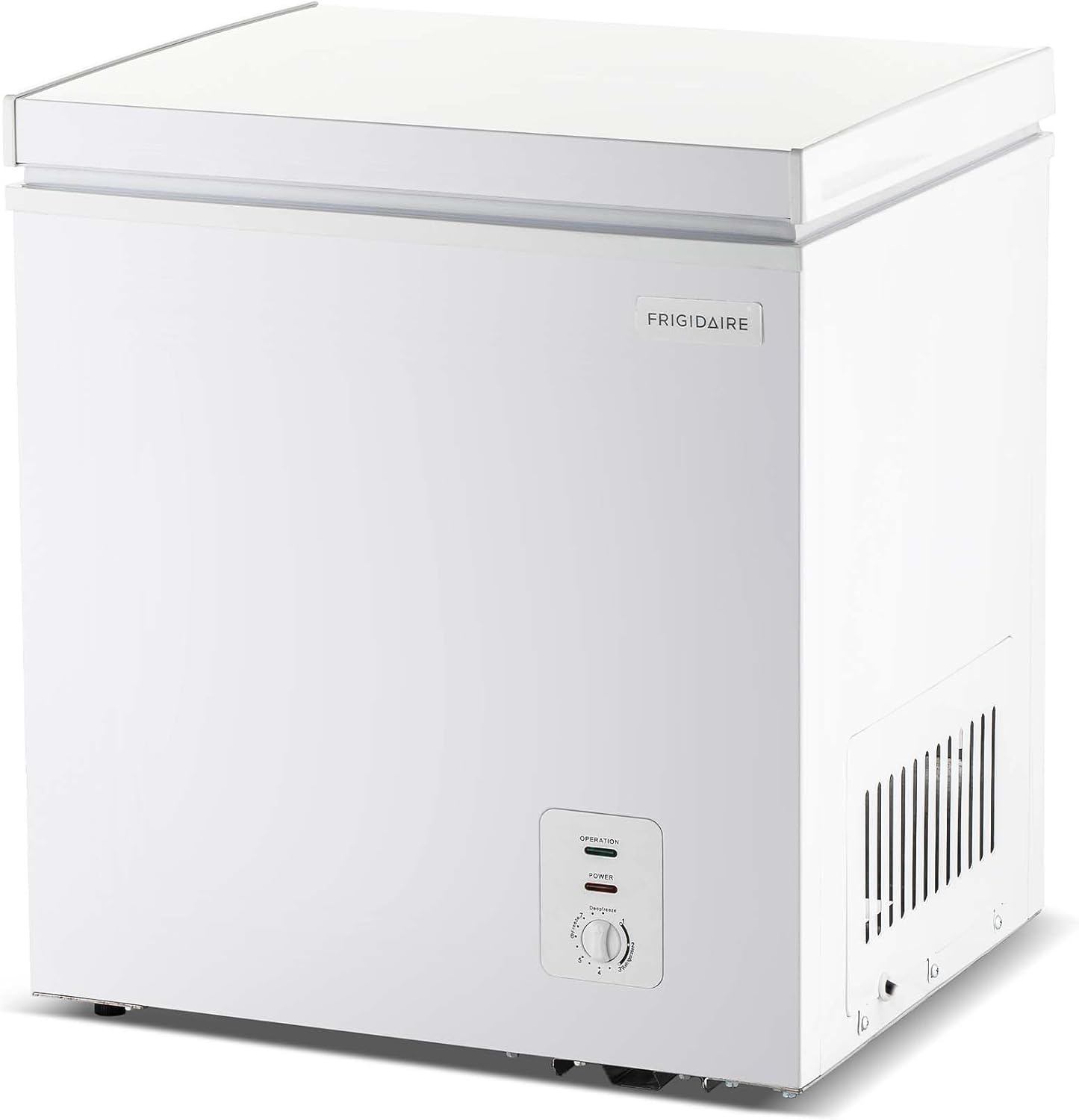
Frigidaire Chest Freezer 2.0 Cu Ft
| Capacity | 2.1 cubic feet |
|---|---|
| Wattage | 300 watts |
| Voltage | 120 volts |
| Number Of Shelves | 1 |
| Installation Type | Freestanding |
This compact Frigidaire chest freezer is designed to add low-footprint frozen storage in a garage, basement, or small kitchen. It uses a top-opening lid with a removable vinyl-coated wire basket to keep small items accessible while the larger interior stores bulkier packages. Temperature is set by an external adjustable thermostat and a compressor-on indicator lets you confirm operation at a glance. Practical touches include adjustable feet for leveling and an easy-access defrost drain to make manual defrosting and cleaning less messy. The unit is uncomplicated mechanically, so it is energy efficient for its size but requires manual defrosting and periodic maintenance. With roughly 2.1 cubic feet of space and a single shelf/basket layout, it is best for households needing extra overflow storage rather than full-time replacement for a full-size freezer.
Best for: Buyers who need a reliable, no-frills secondary freezer to add organized frozen storage in tight spaces and value simple controls and easy maintenance.
Less Ideal for: Those who want a frost-free or large-capacity freezer for whole-home long-term storage or who need multiple compartments and advanced features.
- Compact footprint delivers extra frozen storage in small spaces
- Adjustable exterior thermostat for simple temperature control
- Removable vinyl-coated wire basket keeps small items organized
- Easy-access defrost drain speeds manual defrosting and cleaning
- Manual defrost design requires periodic draining and maintenance
- Limited total capacity and single-compartment layout restricts organized long-term storage
Verdict: A practical, space-saving chest freezer that adds usable frozen storage with simple controls and easy-to-clean features.
Climate Choice 3.5 Cu.Ft Chest Freezer

| Capacity | 4.2 cubic feet |
|---|---|
| Wattage | 58 watts |
| Voltage | 115 volts |
| Installation Type | Freestanding |
This compact Climate Choice chest freezer is designed to add extra frozen storage where space and budget are limited. It uses a top‑opening door and a removable wire basket to keep frequently used items accessible while the lower cavity stores bulkier packages. Temperature is adjustable across several settings, letting you tailor the interior from deep‑freeze to near‑freezer temps, and a bottom drain simplifies manual defrost and cleanup. The unit runs quietly and is energy efficient for its size, so it works well in apartments, offices, garages, and dorms. Construction includes side handles for moving and a stainless steel door for a more durable finish. Limitations are typical for small chest freezers: there is no shelving for tall items, manual defrosting is required, and capacity is modest compared with upright or full‑size freezers, so it is best used as supplemental storage rather than a primary freezer for a large household.
Best for: Buyers on a tight budget who need extra frozen storage in small spaces and prefer a simple, energy‑efficient appliance they can tuck into a garage, apartment, or office.
Less Ideal for: Large families or anyone needing to store many oversized or tall items as a primary freezer should choose a larger upright or full‑size chest model instead.
- Compact footprint fits small spaces like apartments or dorm rooms
- Adjustable temperature control with multiple settings for flexible storage
- Removable storage basket keeps frequently used items within easy reach
- Quiet, energy-efficient operation reduces running costs
- Top-opening design and side handles make loading and moving straightforward
- Manual defrost requires periodic draining and takes time to maintain
- Limited internal organization for tall or bulky items
Verdict: A budget‑friendly, compact chest freezer that delivers quiet, energy‑efficient supplemental frozen storage for small spaces.
Kismile 3.2 Cu Ft Chest Freezer

| Capacity | 3.2 cubic feet |
|---|---|
| Door Orientation | Top |
| Number Of Shelves | 1 |
| Installation Type | Freestanding |
This Kismile chest freezer is a space-conscious deep freezer aimed at households that need extra frozen storage without a large appliance footprint. It delivers adjustable temperature control across seven settings (about 6.8°F to -7.6°F) so you can switch between normal freezing and deeper freeze modes, and the two removable baskets make organizing small items like frozen meals, breast milk, or ice packs simple. The balanced hinge door holds at several angles for easier loading and the built-in drain speeds defrost cleanups. The unit uses a low-energy compressor and claims noise under 40 dB, which makes it suitable for kitchens, dorms, or offices where quiet operation matters. Expect straightforward, utilitarian performance rather than luxury features: there is no digital readout or auto-defrost, and the temperature range is modest compared with larger freezers. For buyers focused on dependable everyday freezing in a compact footprint, this model is a practical, efficient choice.
Best for: Buyers who prioritize a reliable, compact secondary freezer for everyday frozen storage and quiet operation in small spaces.
Less Ideal for: Households needing very low-temperature deep freezing for long-term bulk storage or users who want digital controls and advanced features.
- Compact 3.2 cu ft capacity fits small kitchens, dorms, and offices
- Seven-step adjustable thermostat for flexible freezing needs
- Two removable baskets for organized storage of smaller items
- Balanced hinge door that holds open at multiple angles for easy loading
- Energy-efficient compressor with low noise operation (under 40 dB)
- No digital temperature display or precise temperature readout
- Limited minimum temperature compared with larger deep freezers
Verdict: A compact, energy-efficient chest freezer that delivers dependable everyday freezing and quiet operation for small spaces.
BLACK+DECKER 2.0 Cu. Ft. Chest Freezer

| Capacity | 2 cubic feet |
|---|---|
| Voltage | 115 volts |
| Number Of Shelves | 1 |
This BLACK+DECKER 2.0 cu. ft. chest freezer is a small, straightforward deep freezer intended as extra cold storage for a kitchen, garage, or basement. It holds up to about 70 pounds of food and uses a top-hinged lid with a removable wire basket to keep frequently used items accessible. Temperature is adjusted with an external mechanical dial offering seven settings and an indicator light so you can change settings without opening the lid. Maintenance is manual defrost with a built-in drain to make thawing and cleanup easier, and the unit uses R600a refrigerant. The simple controls and compact footprint make it easy to place in tight spaces, though it lacks features like auto-defrost, digital controls, or interior lighting. Expect basic, reliable freezing performance suitable for extra storage rather than advanced temperature management or showpiece design.
Best for: Buyers who want a simple, space-saving secondary freezer for extra meats, ice cream, or bulk purchases and prefer a proven, easy-to-use design backed by lots of user feedback.
Less Ideal for: If you need precise digital temperature control, auto-defrost convenience, or a display-grade appliance, this basic compact chest freezer is not the best choice.
- Compact 2.0 cu. ft. capacity holds up to about 70 lbs. of frozen food
- External mechanical temperature dial with 7 settings and indicator light
- Removable storage basket for easier organization and access
- Manual defrost with easy-access drain simplifies cleaning and maintenance
- No auto-defrost or digital temperature controls for precise monitoring
- No interior lighting or advanced organizational features
Verdict: A no-frills, compact chest freezer that reliably adds affordable extra frozen storage in small spaces.
BODACIOUS 5.0 Cu Ft Chest Freezer

| Capacity | 5 cubic feet |
|---|---|
| Wattage | 58 watts |
| Voltage | 110 volts |
| Installation Type | Countertop, Freestanding |
| Specification Met | ETL |
The BODACIOUS 5.0 Cu Ft chest freezer is a compact top-opening deep freezer suited to apartments, garages, or small kitchens where space and noise matter. It provides straightforward chest-style storage with one removable shelf/basket and a fast-freeze function for preserving fresh meat, seafood, and prepared meals. Notable features include an ultra-quiet compressor operating under 40 dB, low daily energy use (about 0.36 kWh/24h), a built-in drain for easy defrosting and cleaning, and ETL specification compliance. Installation is simple since it is freestanding or countertop-ready and runs on standard 110V power. Practical benefits are substantial usable volume in a small footprint and modest running costs, making it convenient for small households, backups, or light commercial use. Limitations include the chest orientation, which requires bending to access items and can be less space-efficient in very tight vertical spaces, and the basic control set with no advanced temperature display or alarms. For buyers focused on quiet, economical freezing in a small package, this freezer delivers reliable basic performance.
Best for: Buyers who want a quiet, energy-efficient small deep freezer for everyday food storage or as a secondary unit and who prefer a simple, reliable appliance over advanced features.
Less Ideal for: People needing a tall upright freezer with easy front access, precise digital controls or alarm monitoring should look at other styles.
- Ultra-quiet operation under 40 dB suitable for living areas
- Low energy consumption (~0.36 kWh per 24 hours) for cheap running costs
- Fast-freeze function helps preserve freshness of meats and produce
- Compact footprint provides 5.0 cu ft storage without taking much floor space
- Built-in drain and removable basket make cleaning and organization easier
- Chest design requires bending and deeper searches for items at the bottom
- Controls are basic with no digital temperature readout or alarm features
Verdict: A quiet, energy-frugal 5.0 cu ft chest freezer that gives dependable frozen storage in a compact footprint.
Choosing the Right Small Deep Freezer: Key Factors to Consider
Usable Capacity Vs Footprint
Check the interior usable capacity, not just the nominal liter or cubic-foot rating. Floor plan, basket configuration, and the presence of internal dividers affect how much practical storage you get. A seemingly small difference in listed capacity can translate to a big difference in how many flat containers, large bags, or frozen turkeys will fit.
Also measure the installation footprint, including required clearance for lid swing or ventilation. For tight spaces, consider models with reversible lids or top clearance-friendly designs. Make sure the unit you choose actually fits where you intend to place it with a few inches of breathing room around it for proper airflow.
Energy Use and Running Cost
Small deep freezers vary in annual energy consumption depending on compressor efficiency, insulation thickness, and control strategy. Lower energy draw reduces monthly running costs and is especially important if the freezer will run in an unconditioned space like a garage where it works harder.
Look at energy usage figures and energy-efficiency ratings where available. Consider whether the unit includes eco or power-saving modes and how well it maintains temperature with minimal compressor cycling. Over the lifetime of the appliance, modest differences in wattage can add up to meaningful savings.
Temperature Control and Recovery
Stable temperatures are critical for food safety and long-term preservation. Evaluate how precisely a freezer holds set temperatures and how quickly it recovers after the lid has been opened or after a big load of unfrozen items is added. Faster recovery reduces the time food spends in the danger zone and helps prevent partial thawing.
Digital controls and temperature alarms help you monitor conditions, but good mechanical thermostats with consistent performance can also be effective. Consider whether the unit offers a fast-freeze or quick-freeze function when you need to add a large batch of groceries.
Defrosting, Maintenance, and Drainage
Maintenance effort affects long-term ownership satisfaction. Manual-defrost chest freezers usually require periodic thawing and water drainage. Check whether the model includes a conveniently located drain spout and whether the interior finish allows easy ice removal.
Some compact freezers offer auto-defrost cycles, which reduce maintenance but may slightly increase energy use and raise interior humidity. Think about how much time you are willing to spend on defrosting and whether the model's maintenance features align with your habits.
Noise, Location, and Ventilation
Noise and vibration matter when the freezer will sit near living spaces. Compressors and fans produce audible sound that can be more noticeable in small homes. Review decibel ratings if provided and consider placement options that minimize disturbance.
Proper ventilation is essential for efficient operation and longevity. Plan for enough clearance around vents and avoid enclosing the unit tightly in a closet or alcove unless the model is specifically designed for that installation. Vibration isolation feet or a solid, level base help reduce noise transmission.
Durability and Warranty Support
A compact freezer should last many years with reasonable care. Inspect build features such as lid gasket quality, hinge robustness, and corrosion-resistant interiors for units that may be used in damp or seasonal spaces. Thicker insulation and a sturdy body reduce wear from frequent temperature cycles.
Warranty terms and the availability of replacement parts or service should factor into the decision. A longer or more comprehensive warranty can offset concerns about repair costs and signal better confidence from the manufacturer.
Chest Vs Upright Compact Freezers
Small deep freezers come in chest and upright formats, and each has tradeoffs. Chest-style units typically offer better cold retention, simpler mechanics, and a more open interior for large or awkward items. Upright models provide shelving and easier visibility but may lose more cold when opened.
For limited spaces, chest freezers often make sense because their top-opening design concentrates cold at the bottom and reduces air exchange. Uprights can be a better fit if you prioritize organization and frequent access to a variety of smaller packages.
- Chest: better temperature stability, larger single-volume storage
- Upright: easier access, vertical shelving, smaller footprint for deep installations
Placement Tips for Tight Spaces
Measure the intended location carefully, accounting for lid swing, ventilation clearance, and service access. Allow a few inches of space behind and above the unit for proper airflow. If the freezer will be placed on an uneven surface, use shims or a level base to prevent vibration and ensure the lid seals correctly.
Avoid placing a freezer directly against an exterior wall in freezing climates without blocking airflow. If the space gets very cold seasonally, check whether the model is rated for low-ambient operation, since compressors designed only for conditioned indoor spaces may struggle in cold garages.
- Keep vents unobstructed
- Provide a level, vibration-free base
- Allow clearance for lid opening and service access
Organizing a Small Deep Freezer Efficiently
Use baskets, dividers, and flat containers to maximize vertical and horizontal space. Group items by type and use clear labeling and dates so you do not need to rummage through the whole freezer. In chest freezers, shallow baskets at the top give fast access to frequently used items while heavier or long-term items can sit below.
Portioning foods into stackable, uniform containers or vacuum-sealed bags increases usable capacity and helps maintain even temperatures by reducing air pockets.
- Top baskets for daily items
- Flat, stackable containers for efficient stacking
- Label and date everything for rotation
Operating in Hot or Cold Environments
Ambient temperature affects compressor workload. In hot areas the compressor runs more and energy use increases. In cold garages some compressors may not cycle correctly, leading to poor cooling. Choose a model with an operating temperature range that matches where you will keep it.
If you expect wide seasonal swings, prioritize models with proven controllers and a robust compressor that can handle variable ambient conditions without excessive wear.
- Check ambient operating range
- Consider insulation thickness for hot environments
- Look for robust compressor control for cold locations
Safety and Food-Quality Considerations
Keep an appliance thermometer inside to verify set temperature and watch for temperature drift. A safe long-term freezer temperature is at or below 0 degrees Fahrenheit for most frozen foods. Temperature alarms or Wi-Fi monitoring can alert you to power loss or wide deviations.
Rotate stock and use a clear labeling system to avoid long-forgotten items. If power outages are common, select a freezer with good thermal mass and insulation that slows temperature rise during outages.
- Use a thermometer to monitor interior temperature
- Label and rotate supplies
- Consider alarm or monitoring options for critical storage
How We Chose the Best Small Deep Freezer
We focused on compact chest-style and upright small deep freezers that fit in limited spaces while still providing meaningful frozen capacity. Selection criteria emphasized real-world performance measures buyers can verify from spec sheets and user experience: usable interior capacity, steady temperature control and recovery, measured energy consumption and efficiency ratings, build quality and insulation, and practical features such as shelving, baskets, and lid sealing. We also considered how easy units are to service, drain, or defrost and whether they include useful controls or alarm indicators. Excluded from consideration were units that lack sufficient documentation for capacity or energy use, models intended solely for medical or laboratory use, and products without basic safety certifications. Our goal was to surface compact freezers that balance storage efficiency, operating cost, and reliability for household use. The labeled evaluation dimensions reflect the specs and real-world behaviors most likely to affect daily ownership.
Our full evaluation process is outlined in our review methodology.
FAQ
How much space do I need around a small deep freezer for ventilation?
Most compact freezers need a few inches of clearance behind and above for proper airflow. Check the manufacturer's installation recommendations, but plan at minimum 2 to 4 inches behind the unit and a few inches above for lid clearance.
Are chest-style small deep freezers more energy-efficient than uprights?
Chest models often have better cold retention because cold air does not spill out as readily when opened, which can lead to lower energy use in practice. However, specific efficiency depends on insulation, compressor design, and seals, so compare energy figures when available.
Can I use a small deep freezer in an unheated garage?
You can, but check the unit's ambient operating range. Some compact freezers are designed for conditioned indoor use only and may not maintain temperature or may cycle improperly in very cold spaces. Choose a model rated for low-ambient conditions if the garage gets very cold.
How often should I defrost a manual-defrost small deep freezer?
Defrost frequency depends on humidity and usage but typically every six months or when frost buildup reaches about a quarter-inch. More frequent door openings or storing warm items can accelerate frost accumulation and require earlier defrosting.
What is the best way to organize a small deep freezer for easy access?
Use shallow top baskets for items you need often and stackable, flat containers for long-term storage. Group similar items together, label packages with dates, and keep a simple inventory list to minimize time spent hunting for items.
Final Verdict
Choose a small deep freezer by balancing usable capacity, energy consumption, and how you plan to access stored items. Prioritize models with sufficient usable interior space and insulation for your storage needs, while keeping an eye on documented energy use and operating range for your install location. Also consider maintenance features like drainage and defrosting style, plus noise and ventilation requirements. Decide which tradeoffs you can accept: better temperature stability and lower energy use often come with chest-style designs, while uprights can improve access and organization. Match the unit to your space, routine, and expected load to pick a compact freezer that will serve reliably for years.