
Note: This article contains affiliate links. If you click on these links and make a purchase, we may earn a small commission at no extra cost to you. This helps support our research and content. Read our full affiliate disclosure here.
A small dehumidifier for small rooms can make an oversized difference in comfort, mold prevention, and indoor air quality. In tight spaces like bedrooms, bathrooms, home offices, or dorm rooms, the right compact unit reduces humidity without dominating the room or adding disruptive noise. This guide covers seven shortlisted small dehumidifiers chosen for performance in compact spaces. We evaluate practical factors such as moisture removal capacity, noise levels, energy efficiency, ease of maintenance, and fit for small-room layouts so you can pick an option that suits your daily routine. Read on to see which features matter most for small-room use and which units meet those needs.
Top Picks at a Glance
| Best Overall The best all-around choice for most situations | AlohaAir Small Dehumidifier DH001 |  |
| Best Quality Built to a higher standard if you want something more solid | Tenergy Sorbi 1000ml Dehumidifier |  |
| Best Value The sweet spot between price and what you get | hOmeLabs Compact Dehumidifier HME020018N |  |
| Best Budget The cheapest option that still gets the job done reliably | Eva-Dry Mini Dehumidifier E-333 |  |
| Top Rated A top-rated pick with lots of positive feedback | Remington Mini Dehumidifier |  |
| Most Popular A crowd favorite that many people choose with confidence | TABYIK 35oz Dehumidifier DH-CS01 |  |
| Best Seller A high-volume bestseller chosen again and again | Pro Breeze Mini Dehumidifier PB-02 |  |
AlohaAir Small Dehumidifier DH001

| Water removal per day | 280 ml/day |
|---|---|
| Tank capacity | 1000 ml (34 oz) |
| Noise level | 35 dB |
| Recommended coverage | 200 sq ft |
The AlohaAir DH001 is a small, portable dehumidifier aimed at bedrooms, bathrooms, closets and RVs where space and noise matter. It removes up to about 280 ml of water per day and stores it in a transparent 1000 ml (34 oz) tank that is easy to remove and clean, while an auto shutoff stops operation when the tank is full. The unit is lightweight with a built-in handle, runs quietly at roughly 35 dB and includes a separate 7-color night light you can disable. It works best in warm, humid conditions within its recommended operating range and is intended for compact areas up to roughly 200 sq ft; performance will be limited in large or very damp rooms. The DH001 is simple to use and energy efficient for light-duty moisture control, but buyers expecting heavy-duty dehumidification or continuous drain functionality will need a larger model or a different design.
Best for: Buyers who want a quiet, easy-to-move dehumidifier for small rooms, bathrooms or RVs and prioritize low noise and simple maintenance over high extraction capacity.
Less Ideal for: People who need heavy-duty humidity control for large basements or persistently damp rooms or who require a unit with continuous drainage or advanced humidity controls.
- Compact and portable with a built-in handle for easy placement and transport
- Transparent 1000 ml tank with groove design makes emptying and cleaning straightforward
- Very quiet operation (~35 dB) suitable for bedrooms and RVs
- Auto shutoff and full-tank indicator provide basic safety and convenience
- Low daily energy use while removing modest moisture (about 280 ml/day)
- Limited extraction rate suitable only for small, lightly humid spaces
- No continuous drain option for unattended long-term use
Verdict: Choose the AlohaAir DH001 when you need a quiet, portable dehumidifier that handles light moisture control in small rooms with minimal fuss.
Tenergy Sorbi 1000ml Dehumidifier

| Tank Capacity | 1000 ml |
|---|---|
| Dehumidification Capacity | 0.75 liters_per_day |
| Floor Area | 200 square_feet |
| Wattage | 45 watts |
| Filter | H13 HEPA filter |
The Tenergy Sorbi combines a small, portable dehumidifier with a true H13 HEPA air purifier, making it a two-in-one option for bathrooms, closets, and small offices. It uses Peltier (thermoelectric) technology to remove up to 750 ml (0.75 L) of moisture per day under the right conditions and stores collected water in a 1000 ml removable tank with an automatic shutoff and water-full indicator. Touch controls let you switch fan speeds and run the purifier and dehumidifier simultaneously, while ETL and CARB certifications and a 45 W maximum power draw keep operation straightforward and energy modest. The unit is notably quiet in typical use, so it can run in sleeping or working spaces without distraction. Limitations include modest daily removal capacity—it is designed for small spaces and will not keep up in damp basements or large, very humid rooms—and the Peltier approach performs poorly below 50°F, so colder areas will see reduced effectiveness. Filter replacement every six months is recommended if you use the purifier function heavily.
Best for: Buyers who need a compact, quiet unit to reduce humidity and clean air in small rooms and prioritize a combined purifier/dehumidifier over raw extraction power.
Less Ideal for: People needing high-capacity moisture removal for basements, large rooms, or persistently damp environments should choose a larger compressor dehumidifier instead.
- Two-in-one design with H13 true HEPA filtration plus dehumidification
- Portable 1 L removable water tank with automatic shutoff and water-full indicator
- Low power draw (45 W) suitable for continuous use in small rooms
- Quiet operation (about 35–42 dB) for bedrooms or offices
- ETL and CARB certified for safety and emissions
- Low dehumidification rate (0.75 L/day) unsuited to large or very damp spaces
- Single fan speed limits control granularity
- Peltier technology loses effectiveness below 50°F
Verdict: Choose the Sorbi when you want a quiet, portable dehumidifier that also provides true HEPA air filtration for small rooms.
hOmeLabs Compact Dehumidifier HME020018N

| Floor Area | 150 square_feet |
|---|---|
| Tank Volume | 500 ml |
| Dehumidification Capacity | 9 pints_per_day |
| Wattage | 22.5 watts |
| Operation Mode | Continuous |
This small hOmeLabs dehumidifier is a plug-in, thermoelectric (Peltier) unit built for enclosed spaces such as bathrooms, closets, small offices and RVs. It runs continuously on its included ETL-certified adapter and collects moisture in a removable 16-ounce (500 ml) tank, extracting roughly 9 ounces (about 250 ml) per day under typical conditions. The unit is lightweight and quiet thanks to Peltier technology, and it has an automatic shutoff plus an LED indicator when the tank is full. Because it uses low wattage (around 22.5–25W) it is energy efficient and easy to leave running overnight. Expect modest dehumidification performance suitable for maintaining comfort and preventing dampness in small areas rather than drying very humid rooms or basements; the Peltier system is less powerful than compressor models and will be slower at extraction in warm, very humid conditions. The compact size and simple operation make it convenient for spot use and moving between rooms.
Best for: Buyers who want an inexpensive, low-power dehumidifier to manage mild humidity in small, enclosed spaces and prefer a lightweight, quiet unit that is easy to move and operate.
Less Ideal for: People needing to dry large rooms, basements, or seriously damp spaces should choose a larger compressor dehumidifier with higher extraction capacity.
- Compact footprint fits small spaces and is easy to move
- Very quiet operation using thermoelectric Peltier technology
- Energy efficient low-wattage adapter suitable for overnight use
- Automatic shutoff and LED tank-full indicator for safe unattended operation
- Low daily extraction rate limits use to small rooms or light moisture issues
- Thermoelectric design is less effective than compressor units in very humid conditions
Verdict: A compact, whisper-quiet, energy-efficient pick for controlling mild humidity in single small rooms.
Eva-Dry Mini Dehumidifier E-333

| Floor Area | 333 square_feet |
|---|---|
| Capacity | 6 ounces |
| Dehumidification Capacity | 0.38 pints_per_day |
| Operation Mode | Continuous |
| Wattage | 22.5 |
The Eva-Dry E-333 is a cordless, renewable mini dehumidifier that uses crystallized silica gel beads to capture moisture without pumps, compressors, or drains. It is sized for small areas such as closets, bathrooms, cars, gun safes, and cabinets where continuous electric dehumidifiers are unnecessary. The unit holds about 4 to 6 ounces of moisture and will typically run 20 to 30 days between recharges depending on humidity, with an indicator that changes color when it needs refreshing. Because it is battery-free and plug-free you simply hang or place it where needed, then recharge the beads in an oven or per instructions to restore absorbency for long-term use. Practical benefits include zero operating noise, no risk of leaks, and low maintenance compared with electrical models. Important limitations are its very low daily extraction rate and small capacity, so it cannot replace powered dehumidifiers in damp rooms or larger spaces and requires periodic recharging rather than continuous draining.
Best for: Buyers who need an inexpensive, low-maintenance way to control humidity in compact spaces and prefer a cordless, renewable solution over electric dehumidifiers.
Less Ideal for: People dealing with persistent high humidity in full rooms, basements, or large areas that need continuous, higher-capacity dehumidification should choose a powered dehumidifier instead.
- Fully cordless and renewable—no batteries or continuous power required
- Compact, lightweight design fits closets, cars, and small compartments
- Color-change indicator shows when recharging is needed
- Leak-free silica gel operation eliminates drip trays or hoses
- Very low extraction rate and small tank capacity not suitable for large or very damp spaces
- Requires periodic recharging rather than continuous automatic operation
Verdict: A very affordable, maintenance-light option for keeping small, enclosed spaces dry without power or noise.
Remington Mini Dehumidifier
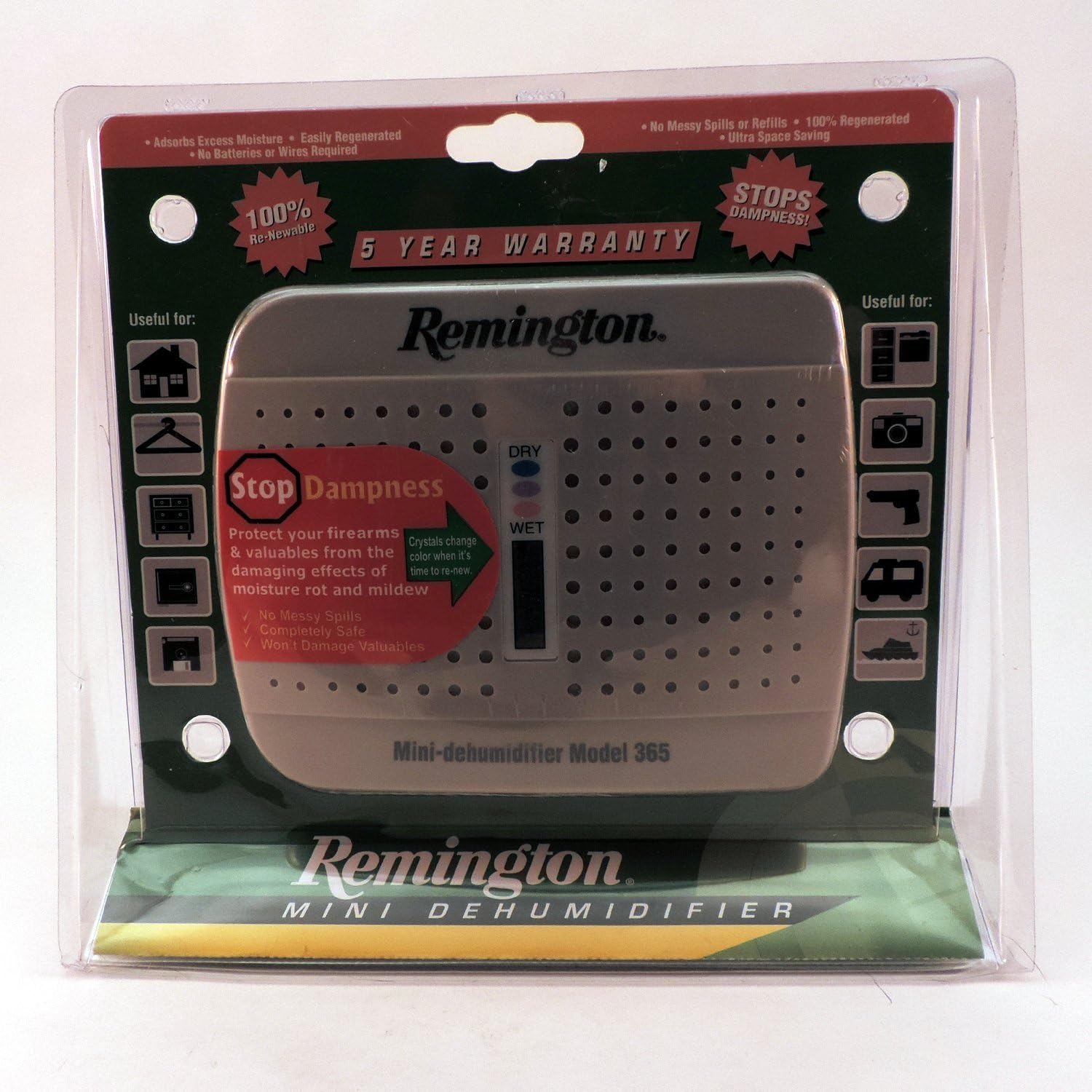
| Item model number | 19950 |
|---|---|
| Manufacturer | Remington Accessories |
| Product Dimensions | 9 x 8.5 x 3 inches |
| ASIN | B0028M3YU6 |
The Remington Mini Dehumidifier is a self-contained, battery-free moisture absorber intended for small, enclosed spaces like gun safes, closets, or small cabinets. It uses a rechargeable desiccant pack that the product says protects for up to 60 days between recharges and includes an indicator window to show when recharging is needed. Because it needs no cords, it is easy to place where outlets are unavailable and is portable at roughly the size of a small book. Recharging is described as taking only a few hours, which keeps downtime short. Practical benefits include quiet operation, no chemicals to handle during regular use, and a simple visible charge indicator so you know when to refresh it. Important limitations are its capacity for only small volumes of air and the need to periodically recharge the unit; it is not intended to dehumidify whole rooms or large spaces and will not replace an electric dehumidifier for high-moisture environments.
Best for: Buyers who prioritize dependable, low-maintenance moisture protection for small, enclosed storage like safes, closets, or electronics cabinets and want a compact, cordless solution.
Less Ideal for: People trying to control humidity in bedrooms, living rooms, basements, or any open area where a larger electric dehumidifier is needed.
- Cordless, self-contained design for placement inside safes or cabinets
- Visible indicator window that shows when recharge is needed
- Up to 60 days of protection per recharge in typical small enclosed spaces
- Short recharge time of a few hours limits downtime
- Designed for very small, enclosed spaces and not effective for whole rooms
- Requires periodic recharging rather than continuous plug-in operation
Verdict: A simple, rechargeable, cord-free moisture protector made for reliably keeping small enclosed spaces dry.
TABYIK 35oz Dehumidifier DH-CS01

| Tank Volume | 1000 ml |
|---|---|
| Dehumidification Capacity | 0.45 liters_per_day |
| Floor Area | 280 square_feet |
| Wattage | 40 watts |
| Noise Level | 28 dB |
The TABYIK 35oz DH-CS01 is a small, Peltier dehumidifier intended for bedrooms, bathrooms, closets and other confined spaces. It runs continuously on a single-speed Peltier module and can collect up to about 16 oz (450 ml) in 24 hours under warm, very humid conditions, routing moisture into a 1000 ml transparent tank that is easy to remove and empty. Operation is quiet at around 28 dB and the unit includes a multi-color night light with a separate control and an auto shutoff that stops the unit and flashes a light when the tank reaches roughly 700–800 ml. Because it uses a thermoelectric design it consumes very little power (advertised under 1 kWh per day) and is lightweight with a built-in handle for portability. Limitations are the single-speed operation and modest daily dehumidification rate, which make it suitable only for small, already somewhat damp spaces rather than basements or large, continuously wet rooms. The unit needs regular cleaning of the rear intake filter to maintain airflow.
Best for: Buyers who prioritize quiet, low-energy operation and want a portable, easy-to-use unit for a small bedroom, bathroom, RV or closet where modest moisture removal is sufficient.
Less Ideal for: People needing rapid moisture removal in large rooms, basements, or persistently wet spaces should choose a larger compressor dehumidifier with higher daily capacity.
- Compact, lightweight design with built-in handle for easy placement and portability
- Very quiet operation (~28 dB) suitable for bedrooms and offices
- Large transparent 1000 ml tank with easy-remove groove and auto shutoff for safe unattended use
- Low power consumption typical of Peltier dehumidifiers, under 1 kWh per day
- Simple one-button operation and separate light control make it user friendly
- Maximum dehumidification rate is low (~0.45 L/day), so it is ineffective for large or very damp areas
- Single fan/speed limits control over performance and drying speed
Verdict: Choose this compact, ultra-quiet, low-energy dehumidifier when you need easy, portable moisture control for a small room or closet.
Pro Breeze Mini Dehumidifier PB-02

| Floor Area | 215 square_feet |
|---|---|
| Capacity | 16 fluid ounces |
| Tank Volume | 17 fluid ounces |
| Wattage | 21 watts |
| Dehumidification Capacity | 0.25 liters_per_day |
The Pro Breeze PB-02 is a small, portable dehumidifier built for bedrooms, bathrooms, closets, RVs and other compact spaces. It uses thermoelectric (Peltier) cooling to run quietly and with very low power consumption, so you can leave it running overnight or in occupied rooms without distracting noise or large energy bills. The unit collects moisture into a removable 16–17 ounce tank and has an auto shut-off plus LED indicator when the tank is full, which prevents overflow. It is simple to use and move between rooms thanks to its light weight and compact footprint. Practical limits are its modest extraction rate of roughly 0.25 liters (about 9 ounces) per day and its recommended operating temperature range; it will not perform well at near-freezing temperatures. For anyone needing continuous, whole-house dehumidification this is too small, but for spot treatment of damp corners, small rooms, and enclosed spaces it offers an efficient, quiet solution.
Best for: Buyers who prioritize a quiet, energy-frugal unit to control modest humidity in single small rooms, closets, or RVs and prefer a simple, low-risk appliance with auto shut-off.
Less Ideal for: People who need rapid dehumidification for large spaces, whole-house coverage, or heavy moisture problems should choose a larger compressor dehumidifier instead.
- Very low power draw for continuous use
- Whisper-quiet Peltier operation suitable for bedrooms
- Auto shut-off with LED indicator prevents overflow
- Compact and lightweight for easy relocation between rooms
- Low daily extraction capacity suitable only for small, localized humidity issues
- Does not operate effectively at low temperatures near or below 41°F
Verdict: A quiet, energy-efficient mini dehumidifier that is ideal for small rooms and spot dehumidifying where simplicity and low operating cost are the top priorities.
Choosing the Right Small Dehumidifier for Small Rooms: Key Factors to Consider
Moisture Removal Capacity
Moisture removal capacity determines how quickly a small dehumidifier lowers relative humidity in a confined space. Look for units rated for the square footage or cubage of your specific room and consider real-world extraction at typical room temperatures rather than ideal lab conditions. A unit that is too small will run constantly without reaching target humidity, while an oversized unit can short-cycle, wasting energy and causing uneven humidity control.
For small rooms, modest daily extraction is usually sufficient, but high-capacity numbers can be helpful in very damp basements or moisture-prone bathrooms. Balance capacity with run-time behavior to ensure steady humidity control without excessive noise or energy use.
Noise Level
Noise is a primary concern when the dehumidifier will operate in bedrooms, home offices, or nurseries. Check manufacturer decibel ratings and, when possible, look for independent measurements of sound at a typical operating distance. Lower noise often means reduced fan speed or better sound insulation, both of which can affect extraction rate.
If you need an unobtrusive unit for nighttime use, prioritize models with quiet modes or low-speed settings. Keep in mind that very quiet operation may reduce moisture removal speed, so consider whether overnight slow extraction meets your humidity goals.
Energy Efficiency
Energy efficiency affects the ongoing cost of running a dehumidifier, especially if it operates many hours per day. Look at power draw at typical operating modes and any energy-saving features such as auto-shutoff at set humidity, programmable timers, or eco modes. Higher efficiency often results from balanced compressor and fan control rather than raw extraction numbers alone.
For small-room use, a unit that can maintain target humidity with minimal cycling will usually offer the best efficiency. Consider how the device will run in your climate and whether you need continuous dehumidification or only occasional use after showers or rainy days.
Tank Size and Drainage Options
Tank size determines how frequently you need to empty collected water, which is an important convenience factor in small rooms where emptying the bucket frequently can be a hassle. Some small dehumidifiers sacrifice tank size for compactness, so weigh tank capacity against footprint and intended usage pattern.
Continuous drain options let you bypass manual emptying when a nearby drain or sink is available. Look for clear, simple tank removal and a reliable float or sensor mechanism to prevent spills. Ease of emptying and indicator lights enhance day-to-day usability.
Footprint and Placement Flexibility
Physical size and shape determine where the unit can sit without blocking walkways or looking out of place. Compact units are easier to tuck into corners, on shelves, or beneath window sills, but internal component trade-offs can affect extraction and noise. Consider vertical versus horizontal designs based on available space.
Also check for caster wheels, handles, or lightweight construction if you plan to move the unit between rooms. A slim profile or stackable-in-cupboard design can be a decisive factor when floor space is at a premium.
Ease of Use and Maintenance
Simple controls, clear indicators, and easy-to-clean filters reduce the time you spend managing the dehumidifier. Intuitive humidity setpoints, readable displays, and programmable timers make operation straightforward. Filters that slide out without tools and washable surfaces extend the interval between service tasks.
Regular maintenance includes cleaning the tank and filter to prevent odors and mold growth. A unit designed for easy access and clearly documented maintenance steps will be less of a chore in daily life and will perform consistently over time.
Where Small Dehumidifiers Work Best
Compact dehumidifiers are designed for confined spaces where localized moisture control is more effective than conditioning the entire home. Typical small-room applications include bedrooms, bathrooms, closets, home offices, and small finished basements where humidity builds up from showers, drying laundry, or poor ventilation.
These units excel when you need targeted humidity control to prevent mold, reduce musty odors, and protect belongings. They are not meant to replace whole-house systems but are a practical option when budget, space, or installation constraints rule out larger equipment.
- Ideal for single rooms up to the manufacturer's recommended square footage
- Best used where portable or temporary moisture control is needed
- Helpful in spaces lacking mechanical ventilation
Placement Tips to Maximize Performance
Where you place a small dehumidifier affects extraction effectiveness and noise perception. Position the unit centrally in the room or along an interior wall to encourage even airflow. Avoid wedging the intake or exhaust against furniture or curtains, and leave at least a few inches of clearance as recommended by the manufacturer.
If you plan to run a continuous drain, position the unit close to a floor drain, sink, or laundry tub and route the hose with a gentle slope. For bedrooms, place the unit on a stable surface that minimizes vibration transmission to the floor to reduce perceived noise.
- Keep at least 6 to 12 inches of clearance from walls and obstructions
- Avoid placing directly on carpet if it blocks intake vents
- Use an elevated stable surface if floors amplify noise
Seasonal Use and Climate Considerations
Climate and seasonal changes influence how often you need a dehumidifier. In warm, humid months you may run the unit daily, while in cool weather extraction rates drop and electrical efficiency can change. Some models perform poorly at lower temperatures, so check the operating temperature range if you plan to use the unit in cooler rooms or basements.
For year-round use, choose a model rated to handle typical winter and summer indoor conditions in your area. If you only need intermittent dehumidification—for example during laundry or after showers—look for quick-start features and responsive humidity control rather than continuous heavy-duty extraction.
- Verify the operating temperature range for basement or near-window placement
- Expect lower extraction at cool temperatures
- Use automatic humidity controls to reduce runtime during low-humidity periods
Maintenance Best Practices
Regular maintenance keeps a small dehumidifier working efficiently and prevents mold growth in the collection tank. Empty and rinse the water reservoir as recommended, clean or replace filters on the schedule suggested by the manufacturer, and wipe down accessible surfaces to remove dust buildup.
Inspect hoses and connections for continuous drain setups to avoid slow leaks or blockages. Store the unit in a dry place during off-seasons and run a brief cycle before long-term storage to ensure internal components are dry.
- Empty and dry the tank after periods of heavy use
- Clean washable filters monthly in dusty environments
- Check continuous drain hoses for kinks or clogs
Noise Management Strategies
If noise is a primary concern, choose models with lower fan speeds or a dedicated quiet mode. Strategic placement can also reduce perceived noise: placing the unit on a soft pad or lifting it slightly off the floor can damp vibrations. Running the dehumidifier at night on a lower setting typically provides adequate overnight control with minimal disturbance.
Remember that even quiet models will generate some sound when actively removing moisture. Use humidity setpoints and timers to limit high-speed operation to periods when you are away or can tolerate modest noise.
- Use low/quiet modes during sleep hours
- Place on vibration-damping mats if floors amplify sound
- Limit high-speed operation to peak humidity periods
How We Chose the Best Small Dehumidifier for Small Rooms
We focused on the characteristics that matter most for small-room dehumidification. Primary evaluation criteria included measured moisture removal capacity at typical indoor temperatures, operational noise in decibels, and energy consumption to reflect running cost and suitability for continuous use in occupied rooms. We also assessed tank capacity and drainage options to gauge how often users need to empty the unit or set up continuous drain. Ease of use and maintenance were weighed, including control simplicity, filter access, and how straightforward condensate handling is. Finally, build footprint and portability were considered so units fit small spaces and can be moved between rooms. We excluded larger whole-house systems and units rated for medium or large rooms because they do not perform efficiently in confined spaces and can cycle unpredictably. We also excluded specialty devices that rely solely on desiccants rather than compressor-based dehumidification since those have different performance envelopes in warm, humid indoor conditions. The final list reflects devices that balance extraction rate, low-noise operation, energy efficiency, and user-friendly maintenance for typical small-room scenarios.
Our full evaluation process is outlined in our review methodology.
FAQ
How big of a dehumidifier do I need for a small bedroom?
For a small bedroom, a compact unit rated for the room's square footage is sufficient. Focus on the unit's removal rate at typical indoor temperatures and choose one that can maintain your target relative humidity without running constantly.
Can I run a small dehumidifier all night in a bedroom?
Yes. Many small dehumidifiers offer quiet modes and programmable humidity setpoints that make overnight operation practical. Choose a model with low noise output and energy-saving features for continuous or nightly use.
Is a continuous drain necessary for a small-room dehumidifier?
A continuous drain is convenient but not always necessary. If you use the unit in a room without easy drain access, a larger tank and easy-empty design can reduce the frequency of manual emptying. Continuous drain is useful when the unit runs many hours or is placed near a sink or floor drain.
How often should I clean the filter on a small dehumidifier?
Filter cleaning frequency depends on dust levels and use. In typical home environments, check the filter monthly and wash or replace it according to the manufacturer's guidance to maintain airflow and efficiency.
Will a small dehumidifier reduce mold and mildew?
Lowering indoor relative humidity makes conditions less favorable for mold and mildew growth. A properly sized small dehumidifier can help control humidity in a specific room and reduce the risk of mold when used alongside good ventilation and prompt remediation of existing moisture sources.
Final Verdict
When choosing a small dehumidifier for small rooms, prioritize the extraction rate that matches your room size, low noise for occupied spaces, and energy efficiency for continuous use. Consider tank capacity and drainage options for convenience, and favor designs that fit your available footprint and are easy to maintain. Tradeoffs are common: quieter and smaller units may remove moisture more slowly, while faster extraction often means more noise or larger tanks. Decide which factors matter most for your routine, and pick a unit that balances those priorities so you get reliable humidity control without unnecessary complexity.