
Note: This article contains affiliate links. If you click on these links and make a purchase, we may earn a small commission at no extra cost to you. This helps support our research and content. Read our full affiliate disclosure here.
If you live in a small household, have limited kitchen space, or want a compact backup for busy weeknights, choosing the right small electric pressure cooker matters. Small units save counter space while still delivering the fast, hands-off cooking that makes pressure cooking attractive. In this guide we shortlisted the top five small electric pressure cookers available today and evaluated them across the features that most affect daily use. You will find options optimized for fast weeknight stews, rice and grains, and small-batch meal prep. The picks below are the top contenders based on cooking performance, ease of cleaning, and practical controls.
Top Picks at a Glance
| Best Value The sweet spot between price and what you get | Fullwill Electric Pressure Cooker 3-Quart |  |
| Best Budget The cheapest option that still gets the job done reliably | NEWBULIG 3-Quart Pressure Cooker |  |
| Top Rated A top-rated pick with lots of positive feedback | carori 3-Quart Electric Pressure Cooker |  |
| Most Popular A crowd favorite that many people choose with confidence | Instant Pot RIO Mini 4-Quart |  |
| Best Seller A high-volume bestseller chosen again and again | Instant Pot Duo Mini 3-Qt |  |
Fullwill Electric Pressure Cooker 3-Quart
| Capacity | 3 quarts |
|---|---|
| Wattage | 700 watts |
| Control Method | Push Button, Touch |
| Voltage | 120 volts |
| Special Features | 9 Appliances in 1; Automatic Shut‑Off; Keep Warm |
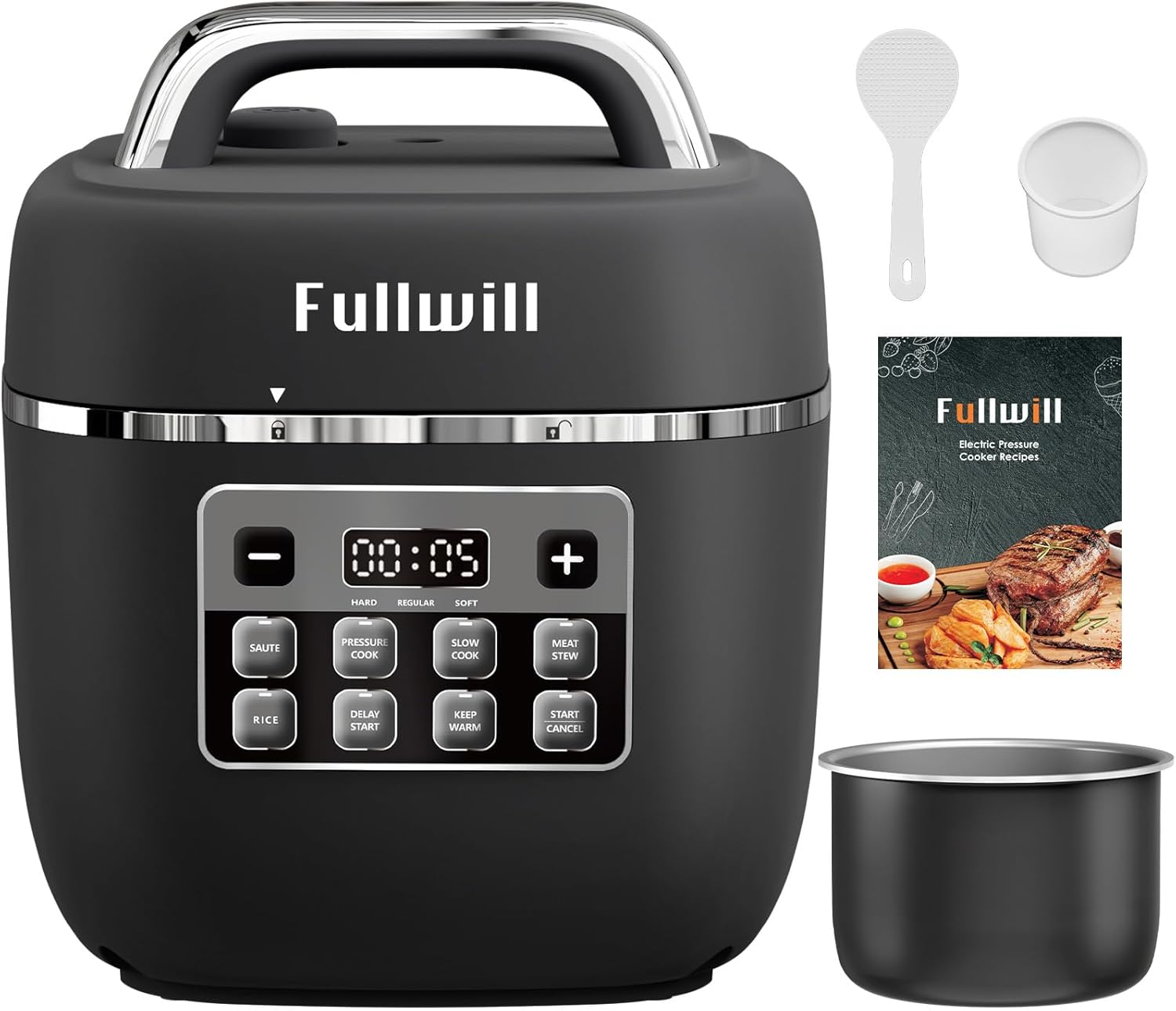
The Fullwill 3‑quart electric pressure cooker is a small, all‑in‑one countertop cooker aimed at everyday meals for one to three people. It offers pressure cook, slow cook, sauté, rice, simmer and keep‑warm programs plus a delay‑start timer, so you can brown ingredients on the unit then finish a stew or rice dish under pressure without extra pots. The 700W heater and automatic controls make it straightforward to use; safety features include lid locking and overheat protection. The removable ceramic nonstick inner pot and dishwasher‑safe parts simplify cleanup, and the included rice scoop, measuring cup and recipe book help new users get started. Because it is a 3‑quart model it is best for smaller portions and will not replace a large family cooker, and its lower wattage means slightly longer cook times than higher‑power units for very dense stews. Still, for singles, couples, or small kitchens it delivers versatile cooking with easy maintenance and sensible safety features.
Best for: Buyers who prioritize a compact, easy‑to‑use multi‑cooker for everyday small‑batch meals and want straightforward controls and easy cleanup.
Less Ideal for: Not a good fit for households that regularly cook large portions, batch‑cook for meal prep, or need the fastest possible pressure‑up times.
- Compact 3‑quart size fits small kitchens and minimizes food waste
- Multiple preset functions (pressure, slow cook, sauté, rice, simmer, keep warm) for one‑pot meals
- Delay start and keep‑warm let you schedule meals and hold them at serving temperature
- Ceramic nonstick inner pot is easy to clean and marketed as PFOA‑free
- Built‑in safety features including lid lock and overheat protection
- Small capacity limits batch cooking or feeding larger families
- 700W power may take slightly longer to reach pressure compared with higher‑watt models
Verdict: A compact, safety‑focused 3‑quart multi‑cooker that simplifies small‑batch cooking with easy cleanup and programmable timing.
NEWBULIG 3-Quart Pressure Cooker

| Capacity | 3 quarts |
|---|---|
| Wattage | 700 watts |
| Controller Type | Digital |
| Operation Mode | Automatic |
The NEWBULIG 3-quart electric pressure cooker is a countertop multi-cooker aimed at small households and solo cooks. It offers ten smart presets — rice, meat, stew, yogurt, canning, steam and more — that simplify one-touch cooking, plus a 24-hour delay start and automatic keep-warm so meals can be timed around your day. The 700-watt unit uses high-pressure technology to cut traditional cook times substantially, and the stainless steel exterior with a ceramic nonstick inner pot makes cleanup easier while keeping food from sticking. Safety is addressed with integrated pressure release valves and heat sensors. Practical limits are its small 3-quart capacity, which is best for 1 to 2 servings, and the lower wattage means longer time to reach pressure compared with higher-power models; it also lacks advanced connectivity or a large preset library. For buyers who need a simple, space-saving cooker that replaces stovetop pots and slow cookers for everyday meals, it performs well.
Best for: Buyers looking for an affordable, space-saving multi-cooker to make everyday meals for one or two people with simple preset controls and minimal fuss.
Less Ideal for: Families who regularly cook large batches or anyone who needs fast high-watt pressure cooking or advanced smart features should consider larger or higher-powered alternatives.
- Ten one-touch cooking presets for common dishes
- Compact 3-quart capacity fits small kitchens and households
- Ceramic nonstick inner pot for easier food release and cleaning
- 24-hour delay start and automatic keep-warm for meal timing
- Triple safety features including pressure release valves and heat sensors
- Small capacity limits batch size to about one to two servings
- 700-watt power is modest and can take longer to reach full pressure
Verdict: A budget-friendly, compact pressure cooker that delivers convenient one-touch cooking and easy cleanup for small households.
carori 3-Quart Electric Pressure Cooker

| Capacity | 3 quarts |
|---|---|
| Wattage | 700 watts |
| Control Method | Touch |
| Operation Mode | Automatic |
| Voltage | 120 volts |
The carori 3-quart electric pressure cooker is a compact multi-cooker aimed at small households and kitchens where counter space matters. It offers eight preset functions including sauté, pressure cook, slow cook, rice, and a 24-hour delay start so you can schedule meals in advance; controls are touch and push-button for simple one-press operation. The 700-watt unit uses a food-grade ceramic nonstick inner pot that is dishwasher-safe, which makes cleanup straightforward, and the included accessories (steam rack, rice spoon, measuring cup) cover everyday needs. The cooker emphasizes safety with more than 10 protections such as a locking lid, safety float, pressure control, and overheat protection, which is reassuring for routine use. Because it is a 3-quart model it excels at singles or couples but is too small for large families or batch-cooking. Expect faster cooking than stovetop methods, but limited capacity means planning multiple batches for bigger meals.
Best for: Buyers who prioritize a dependable, easy-to-use small cooker for daily meals in apartments, dorms, or two-person households and who value built-in safety and simple controls.
Less Ideal for: Those who regularly cook for families of four or more, need large-capacity batch cooking, or require high-power, commercial-style performance.
- Compact 3-quart size saves counter space and fits small households
- Eight one-touch programs including delay start for flexible meal timing
- Ceramic nonstick inner pot is food-grade and dishwasher-safe for easy cleanup
- Multiple safety features including locking lid, pressure control, and overheat protection
- 700-watt power and 3-quart capacity limit large-batch cooking and may require multiple cycles for bigger meals
Verdict: A reliable, space-saving 3-quart cooker that gives small households simple, safe, one-touch pressure cooking with easy cleanup.
Instant Pot RIO Mini 4-Quart

| Capacity | 4 quarts |
|---|---|
| Wattage | 800 watts |
| Control Method | Touch |
| Operation Mode | Automatic |
The Instant Pot RIO Mini 4-Quart packs seven cooking functions into a small footprint, making it a practical choice for singles, students, or small families. It pressure cooks, slow cooks, sautés, steams, makes rice and yogurt, and keeps food warm, and the 800-watt motor brings meals up to 70 percent faster than traditional slow cooking. The stainless steel inner pot is dishwasher-safe for easier cleanup and the included steam rack and condensation collector extend its versatility. Controls are a mix of touch and a mechanical knob, with a progress indicator that shows cooking status at a glance and an auto-sealing locking lid plus multiple safety protections for worry-free use. The main compromises are the 4-quart capacity, which limits batch cooking or large roasts, and the lower wattage compared with full-size models, which may lengthen some high-heat tasks. For everyday small-batch meals and quick weeknight dishes the RIO Mini delivers solid performance with minimal counter space impact.
Best for: Buyers who want a proven, compact multi-cooker with clear user feedback and built-in safety features for everyday small-batch cooking.
Less Ideal for: Anyone who regularly cooks large roasts, big family meals, or needs high-power, full-size pressure cooker performance should consider a larger unit.
- Seven cooking functions cover most everyday recipes in one compact unit
- 4-quart stainless steel pot is dishwasher-safe for easy cleanup
- Auto-sealing lid and multiple safety features reduce user risk during pressure cooking
- Progress indicator and simple controls make status and programming easy to follow
- 4-quart capacity is small for batch cooking or larger families
- 800-watt power is lower than full-size cookers, so some tasks can take longer
Verdict: A compact, safety-minded multi-cooker that reliably handles everyday small-batch meals with straightforward controls and easy cleanup.
Instant Pot Duo Mini 3-Qt

| Capacity | 3 quarts |
|---|---|
| Wattage | 700 watts |
| Control Method | Touch |
| Material | Stainless steel |
| Voltage | 120 volts |
The Instant Pot Duo Mini 3‑Qt is a small, user-friendly multi-cooker aimed at kitchens short on space or for one- to two-person households. It offers seven cooking functions with 11 one-touch smart programs so you can pressure cook, slow cook, steam, make rice, sauté, and even do yogurt with minimal babysitting. The stainless steel inner pot with tri‑ply bottom lets you sear ingredients before pressure cooking, and the dishwasher-safe lid and pot make cleanup straightforward. Safety features are robust, including overheat protection and a sealed lid lock, which helps reassure cautious buyers. At 700 watts it cooks much faster than traditional slow methods, and the included steamer rack expands what you can do in the smaller cavity. Limitations are inherent to the size: the 3‑quart capacity is best for singles, couples, or side dishes rather than family meals, and its power is lower than larger models so very large or dense roasts may take longer under pressure or not fit at all.
Best for: Buyers who prioritize reliable, easy-to-use small appliances and want a safe, compact cooker for everyday meals, side dishes, or single-person households.
Less Ideal for: Those who regularly cook for large families, need to prepare whole roasts or big batch meals, or want the fastest possible pressure-cook times should consider larger-capacity units.
- Seven cooking functions and 11 one-touch programs for versatile, hands-off cooking
- Stainless steel inner pot with tri-ply bottom allows searing and even heat distribution
- Dishwasher-safe lid and inner pot simplify cleanup
- Multiple built-in safety mechanisms including lid lock and overheat protection
- Compact footprint suited to small kitchens or limited counter space
- 3‑quart capacity limits meals to singles, couples, or side dishes
- Lower wattage than full-size models can mean longer cook times for dense foods
Verdict: A compact, safety-focused multi-cooker ideal for risk-averse buyers who want a reliable small appliance for everyday meals.
Choosing the Right Small Electric Pressure Cooker: Key Factors to Consider
Capacity and Real-World Yield
Small electric pressure cookers are marketed by liter or quart size, but usable yield depends on pot shape and cooking style. A unit listed at three quarts may hold enough liquid for stews and soups for two people, but bulky ingredients can reduce practical capacity. Consider whether you will mostly make single-pot meals, grains, or batch-cook for freezing, and choose a size that leaves headroom to avoid overfilling.
Also factor in the maximum fill line for pressure cooking. Many recipes expand during cooking, so staying below the recommended fill level is important for safety and even cooking. For flexibility, pick a small unit that still allows a modest batch for leftovers without stretching the pot to its limits.
Cooking Performance and Heat Distribution
How quickly the cooker reaches pressure and how consistently it maintains temperature affect texture and timing. Faster ramp-up reduces total cook time and is useful for quick grains and tender cuts. Even heat distribution helps avoid hot spots that can scorch thick sauces or cause unevenly cooked rice.
Evaluate whether the cooker has a reliable pressure regulator and whether it offers multiple pressure levels. Multiple levels improve control for delicate foods versus robust braising. For small units, efficient heating elements and a snug lid seal are particularly important because there is less thermal mass than in full-size models.
Inner Pot Material and Durability
Inner pot construction influences heat transfer, sticking, and long-term durability. Stainless steel pots are durable, nonreactive, and work with many utensils, while nonstick-coated pots make cleanup easier but require gentler care to avoid scratching. Some small units include removable nonstick pot inserts that are dishwasher safe, simplifying maintenance.
Think about whether you will brown ingredients directly in the pot or prefer to sear separately. If you often deglaze after searing, a stainless or heavy-gauge pot may perform better long-term. If cleanup is a primary concern, a high-quality nonstick with a strong coating can save time, but expect to use nonabrasive utensils.
User Interface and Preset Programs
Controls should be clear and suited to quick meal prep. Large, labeled buttons or a simple dial shorten the learning curve. Preset programs for rice, soup, beans, and meat can speed routine cooking, but manual pressure and time adjustment is useful for more experienced cooks who want precise results.
Pay attention to audible signals, countdown displays, and whether the cooker offers a delayed start or keep-warm function. In small kitchens you may prefer straightforward one-touch presets and a predictable countdown rather than a complex, multi-screen menu.
Safety Features and Venting
Because pressure and steam are involved, safety features are essential, especially in compact units where steam release is close to counters. Look for secure locking lids, clearly marked pressure valves, and reliable overpressure release designs. A controlled steam release option or quick-release mechanism that vents away from the front helps prevent accidental burns.
Also consider the ease of inspecting and replacing seals or gaskets. Over time these components wear and affect pressure retention. A cooker with accessible and replaceable seals will stay reliable longer and is easier to service at home.
Maintenance and Long-Term Upkeep
Maintenance needs influence the long-term ownership experience. Dishwasher-safe inner pots, removable lids, and simple valve components reduce the time spent on upkeep. Parts that trap food or are difficult to disassemble often produce odors or require more frequent deep cleaning.
Consider whether replacement parts such as sealing rings are easy to obtain and whether the unit's design minimizes hard-to-clean crevices. Regular inspection and cleaning of valves and seals extend the life of the cooker and keep performance consistent.
How Much Counter Space Will It Take?
Small electric pressure cookers are meant to be compact, but footprints vary. Measure the unit's external diameter and height, and compare that to the intended storage or countertop spot. Remember to allow room above the lid for venting and for comfortable access to the control panel.
Consider vertical clearance too. If you store the cooker under a shelf, make sure the height includes the lid and any handles. For countertop use, a compact footprint that still offers a tall, narrow pot may be preferable for recipes needing more headroom.
- Measure both footprint and height before buying
- Allow extra space for steam venting and lid handling
- Think about storage location when not in use
Small-Batch Meal Ideas That Work Best
Small electric pressure cookers excel at grains, legumes, compact stews, and one-pot breakfasts. Use them for perfectly cooked rice and quinoa, quick lentil soups, or tender chicken breasts for salads. Because capacity is limited, adjust recipes down or batch-cook in multiple cycles when preparing family-size meals.
They also make fast weeknight dinners and meal prep convenient. Pre-cut vegetables and smaller cuts of meat finish quickly under pressure, and the short overall cook time means you can have a hot meal with minimal advance planning.
- Rice and grain blends for 2–3 servings
- Small stews and braises using tender cuts
- Soups and lentil-based dishes
- Steamed vegetables and small-batch desserts
Maximizing Flavor in a Small Pot
Flavor development in a compact pressure cooker depends on proper browning and deglazing. If the unit allows it, brown meats and aromatics on the pot base before pressurizing to build depth. In very small pots, avoid overcrowding during browning—work in batches if needed to get proper color without steaming.
After browning, deglaze with a small amount of liquid to lift fond and integrate flavor into the sauce. Because liquid volume matters more in small pots, concentrate broths and reduce added water where appropriate to prevent dilution of taste while keeping within safe fill limits.
- Brown in small batches to avoid steaming
- Use minimal deglazing liquid to keep flavors concentrated
- Adjust liquid ratios for smaller volumes
Replacing Seals and Maintaining Pressure Integrity
Sealing rings and valves wear with time and usage, which can change how the cooker reaches and holds pressure. Inspect the sealing ring regularly for cracks, deformation, or persistent odors. A compromised ring can lengthen pressure build time or cause inconsistent results.
Clean the vent and valve components after heavy use to remove trapped food particles. Follow the manufacturer guidance for replacing seals at intervals based on frequency of use. Regular maintenance keeps cook times predictable and prevents steam leaks that affect texture.
- Inspect sealing ring for wear and odors
- Clean vent and valve assemblies after use
- Replace seals according to usage frequency
Power and Outlet Considerations
Most small electric pressure cookers draw a moderate amount of power but should run fine on standard household outlets. Check the unit's power rating to ensure your circuit can handle it, especially if you plan to run other high-draw appliances on the same circuit.
For small kitchens with limited outlet access, consider where you will plug in the cooker and whether cord length will reach comfortably. Avoid using extension cords unless they are rated for the appliance load.
- Confirm power rating against your outlet capacity
- Plan outlet placement for convenient countertop use
- Avoid unapproved extension cord use
How We Chose the Best Small Electric Pressure Cooker
We focused on attributes that matter most for small electric pressure cookers and for cooks who need compact, reliable performance. First, we prioritized cooking performance: how evenly the unit builds and holds pressure, and how well it handles common small-batch recipes like rice, beans, soups, and braises. Second, we evaluated capacity and fit: usable interior volume relative to external footprint and how suitable the capacity is for 1 to 3 people. Third, material and inner pot quality were considered for heat transfer, durability, and compatibility with everyday utensils. Fourth, we assessed usability and controls, including program presets, manual pressure options, and whether the interface is intuitive for quick meals. Fifth, we examined ease of cleaning and maintenance, such as removable lids, dishwasher-safe components, and accessible seals. We excluded overly large multicookers, commercial-grade units, and models intended primarily for sous-vide or air-frying functions when those expanded features compromised compact performance. Our shortlist reflects units that balance small size with real-world cooking capability, durable construction, and straightforward upkeep. The scoring emphasized pressure-holding performance, practical capacity, inner-pot materials, user controls, and cleaning convenience.
Our full evaluation process is outlined in our review methodology.
FAQ
Can a small electric pressure cooker make rice as well as a rice cooker?
Yes. Many small electric pressure cookers produce reliable rice when you follow water-to-grain ratios specific to pressure cooking. They may require a short natural pressure release for fluffy results, and presets labeled for rice can simplify the process.
How much liquid do I need for pressure cooking small batches?
Pressure cookers need a minimum amount of liquid to build pressure, often around 1 cup but this depends on the recipe and unit. Smaller batches may require proportionally less liquid, but always follow the cooker's minimum fill recommendations to ensure safe operation.
Are nonstick inner pots safe for browning and deglazing?
Nonstick pots can brown to an extent, but aggressive searing may damage the coating. For deeper browning and frequent deglazing, a stainless inner pot or pre-browning in a separate pan can offer better results and longer lifespan.
How often should I replace the sealing ring?
Replacement frequency depends on use, but inspect the sealing ring every few months if you use the cooker weekly. Replace it sooner if you notice cracks, deformation, or persistent odors that cleaning does not remove.
Can I use my small pressure cooker to sterilize jars or tools?
Some small electric pressure cookers can reach temperatures suitable for basic sterilization processes, but capacity and design vary. Follow specific guidelines for sterilization and the cooker manufacturer's recommendations before attempting such tasks.
Final Verdict
For small households and tight kitchens, the right small electric pressure cooker balances usable capacity, reliable pressure performance, and easy cleanup. Prioritize a unit whose usable volume matches the meals you plan to cook, and look for a durable inner pot material that fits your cooking habits. Usability features like clear controls, sensible presets, and accessible seals reduce daily friction. Ultimately, choose the cooker that best matches how you cook. If quick grains and soups are your priority, favor responsive pressure performance and rice presets. If easy cleanup matters more, favor a high-quality nonstick insert and removable components. Focus on those tradeoffs to pick a compact pressure cooker you will use often and rely on for consistent results.