
Note: This article contains affiliate links. If you click on these links and make a purchase, we may earn a small commission at no extra cost to you. This helps support our research and content. Read our full affiliate disclosure here.
If you need reliable hot water but lack space for a full-size tank, a small electric water heater can be the right solution. These compact units fit under sinks, in closets, or in utility nooks and provide on-demand supply for a single bathroom, kitchen, or point-of-use fixture. Choosing the right small electric water heater matters because capacity, recovery speed, and ease of installation determine whether the unit will meet everyday household routines without frequent shortages or excessive maintenance. This guide covers six shortlisted options that represent the best balance of performance, size, and installation flexibility. Read on for the evaluation criteria we used and practical guidance to match a unit to your space and hot-water needs.
Top Picks at a Glance
| Best Overall The best all-around choice for most situations | Bosch Tronic 3000 ES4 4-Gallon |  |
| Best Quality Built to a higher standard if you want something more solid | GE 18 Gallon Electric Water Heater |  |
| Best Value The sweet spot between price and what you get | Fisoceny 2.5 Gallon Water Heater |  |
| Best Budget The cheapest option that still gets the job done reliably | xwdzswgs 3000W Tankless Water Heater |  |
| Top Rated A top-rated pick with lots of positive feedback | ThermoMate ES 2.5-Gallon Mini Tank |  |
| Most Popular A crowd favorite that many people choose with confidence | CAMPLUX ME60 6-Gallon Mini Tank |  |
Bosch Tronic 3000 ES4 4-Gallon
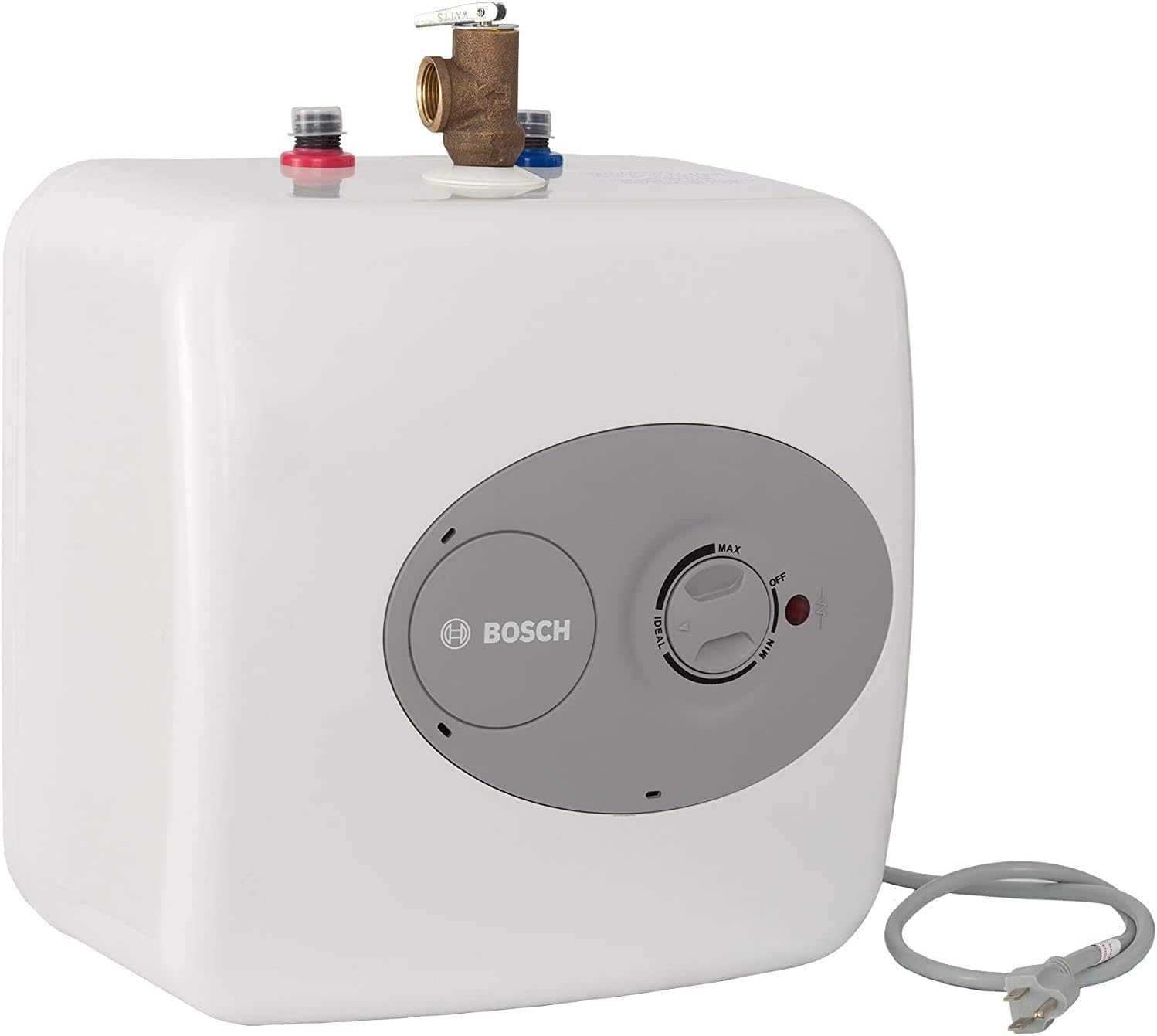
| Capacity | 4 gallons |
|---|---|
| Wattage | 1440 watts |
| Voltage | 120 volts |
| Maximum Temperature | 140 °F |
| Water Pressure Range | 150 psi |
The Bosch Tronic 3000 ES4 is a compact 4-gallon electric mini-tank made for point-of-use hot water needs. It plugs into a standard 120 V outlet and can be shelf-, wall- or floor-mounted, which makes it easy to install under a sink or in a small utility space. The glass-lined tank and thick CFC-free foam insulation support durability and high standby efficiency, while the external temperature dial and included temperature-and-pressure relief valve give simple control and safety. At 1440 watts the unit produces a fast recovery rate for short waits at the tap and can serve one or two nearby sinks. Practical limitations are its small capacity—useful for quick tasks but not suitable for bathing—and the requirement to inspect and replace the anode rod periodically to avoid tank damage. For homeowners who want a neat, low-profile solution to get hot water at a distant or secondary fixture, the ES4 is a straightforward, reliable choice.
Best for: Buyers who want a reliable, space-saving way to get hot water at a single sink or as a supplement to a distant main heater and value simple plug-in installation and efficient standby performance.
Less Ideal for: People who need a primary water heater for bathing, continuous multi-fixture use, or larger households requiring sustained hot water flow.
- Point-of-use design provides hot water quickly at a sink without running the main heater
- Glass-lined tank and thick foam insulation improve durability and thermal efficiency
- Plugs into a 120 V outlet for independent installation without hardwiring
- Flexible mounting options: wall, shelf, or floor with included bracket
- External temperature dial and pressure relief valve for simple control and safety
- 4-gallon capacity is too small for showers or continuous high-demand use
- Requires annual anode rod inspection and replacement to prevent tank failure
Verdict: A compact, efficient plug-in mini-tank that delivers fast hot water at a single sink or as a supplement to a main heater.
GE 18 Gallon Electric Water Heater

| Power Source | Electric |
|---|---|
| Voltage | 120 volts |
| Wattage | 14400 watts |
| Capacity | 45 liters |
| Heat Output | 140 °F |
The GE 18 Gallon Electric Water Heater is a compact point-of-use storage tank that brings hot water to tight spaces or supplements an existing system. It is typically installed in kitchens, laundry rooms, garages, RVs, cabins, or inline with a larger heater to boost long plumbing runs or washing machines. The unit runs on a 120-volt supply, uses standard 3/4-in NPT water connections for straightforward installation, and lets you adjust temperature and power with a simple control knob. Practical features include a stainless steel heating element and anode rod for corrosion resistance and a rust-proof drain valve for easier maintenance. At 18 gallons (45 liters) capacity it delivers usable hot water for single fixtures or small apartments but is not sized for whole-house high-demand use. Buyers should plan for the usual recovery limits of a small electric tank and confirm the 120-volt circuit can supply the heater's 14,400-watt rating or choose appropriate electrical setup before installation.
Best for: Buyers who need a performance-minded point-of-use heater or booster to deliver reliable hot water in confined spaces and value durable heating components and simple temperature control.
Less Ideal for: Large households or anyone needing continuous hot water for multiple fixtures should choose a larger capacity or higher-capacity system instead.
- Compact point-of-use design fits tight spaces like under sinks, laundry rooms, or garages
- Works on standard 120-volt supply and uses common 3/4-in NPT water connections for easy install
- Stainless steel heating element and anode rod improve corrosion resistance and durability
- Adjustable thermostat provides simple control over output temperature
- 18-gallon capacity limits continuous hot water delivery for multiple simultaneous fixtures
- High wattage rating may require checking circuit capacity or professional electrical setup
Verdict: Choose this GE 18-gallon electric heater when you need a compact, durable point-of-use or booster unit that delivers adjustable hot water on a standard 120V supply.
Fisoceny 2.5 Gallon Water Heater

| Capacity | 2.5 gallons |
|---|---|
| Wattage | 1500 watts |
| Voltage | 120 volts |
| Flow Rate | 0.25 gpm |
| Maximum Temperature | 149 °F |
This 2.5 gallon Fisoceny mini tank provides near-instant hot water for a sink or small point-of-use application by heating water with a 1500W L-shaped element and a thermostatic knob that ranges from 86 to 149°F. It is intended to be wall- or floor-mounted under a cabinet or in an RV and comes with installation accessories including hoses and a pressure relief valve to simplify setup. Safety features include UL-listed cord, overheat and high-pressure protection, and a built-in magnesium anode to limit scaling and extend life. With an advertised 95% heating efficiency and polyurethane insulation that retains heat for up to 48 hours, the unit reduces standby losses compared with poorly insulated small tanks. Limitations are the small 2.5 gallon capacity and low flow rate (0.25 gpm), so it cannot supply continuous high-flow uses like showers and will run out if large volumes are demanded at once. The simple mechanical control is easy to use but lacks digital precision or presets. For kitchens, RVs, or offices needing quick hot water at a fixture, it is a practical, space-saving choice.
Best for: Buyers who want a compact, ready-to-install point-of-use heater to deliver quick hot water for a sink, RV, or small office and prioritize space savings and simple operation.
Less Ideal for: Homes or users who need continuous hot water for showers, multiple fixtures, or higher flow demands should choose a larger tank or tankless solution.
- Compact 2.5 gallon tank fits under sinks and in RVs for point-of-use hot water
- 1500W heating element brings tank to temperature in about 5–8 minutes
- Included hoses, bracket kit and pressure relief valve simplify installation
- Multiple safety features including UL cord, overheat protection and pressure relief
- Built-in magnesium rod and good insulation reduce scaling and standby heat loss
- Very low flow rate (0.25 gpm) and small capacity prevent continuous or high-flow uses like showers
- Temperature control is a basic mechanical knob without digital readout or presets
Verdict: A compact, practical under-sink mini tank that delivers fast hot water for a single fixture while saving space and offering strong basic safety features.
xwdzswgs 3000W Tankless Water Heater

| Power | 3000W |
|---|---|
| Power Source | AC 110V |
| Mount Type | Wall |
| Maximum Temperature | 122 °F |
| Special Features | Dry Combustion Protection, LED Display, Lightweight |
This compact tankless unit delivers on-demand hot water for small point-of-use needs like kitchen sinks, utility sinks, or RVs. The 3000W heater heats water quickly at low flow rates and shows outlet temperature on an LED screen with Celsius/Fahrenheit switching. It is designed for vertical wall mounting and emphasizes safety with water-electrical isolation, IPX4 splash protection, dry-boil protection, and automatic shutoff on overheating. Installation is straightforward for someone comfortable with basic plumbing and electrical work since it uses a 1/2 inch NPT inlet, includes mounting screws, and requires a dedicated circuit and heavier gauge wiring as recommended. Practical limits are clear: higher flow uses lower outlet temperatures and the manufacturer warns it is not suitable for showers because typical shower flow exceeds its effective range. For buyers on a budget who need instant hot water at a single fixture, this unit is space-saving and energy efficient, but expect professional help for wiring or if you need higher flow or shower-capable output.
Best for: Buyers wanting an inexpensive, space-saving point-of-use heater for a sink, RV, or small utility area who prioritize instant hot water without installing a full-size heater.
Less Ideal for: Homes that need hot water for full bathrooms or multiple fixtures at once should choose a higher-capacity or shower-rated unit instead.
- Compact vertical wall-mount design saves under-sink or small-space real estate
- 3000W element provides near-instant hot water at low flow rates
- LED display with Celsius/Fahrenheit readout for outlet temperature
- Multiple built-in protections including dry-boil, leakage protection, and auto shutoff
- Not suitable for shower use because it cannot sustain typical shower flow rates
- Requires a dedicated higher-amp circuit and heavier gauge wiring for safe operation
Verdict: A budget-friendly, compact tankless heater that provides fast hot water at a single sink or small point-of-use location.
ThermoMate ES 2.5-Gallon Mini Tank

| Capacity | 2.5 gallons |
|---|---|
| Wattage | 1440 watts |
| Voltage | 120 volts |
| Maximum Temperature | 149 °F |
| Maximum Pressure | 150 psi |
The ThermoMate ES 2.5-gallon mini tank is a compact point-of-use electric water heater that preheats a small reserve of water so you get hot water immediately at a single faucet. It plugs into a standard 120V outlet and uses a 1440W Incoloy 800 heating element and a titanium/porcelain-lined stainless tank to resist corrosion and prolong service life. Installation can be wall- or floor-mounted under a sink and it includes a T&P relief valve and mounting kit for straightforward setup. The unit is UL listed and rated for up to 150 psi, and its insulated tank helps hold heat so the element cycles less often, which reduces running cost for small loads. Limitations are inherent to mini tanks: the 2.5-gallon capacity is sized for one faucet or as a booster and cannot supply showers or high-flow demands, and recovery is finite so very frequent heavy use will deplete the reserve. For a small kitchen, workshop, RV or cabin where reliable, quick hot water at a single point is the priority, this model provides durable, factory-quality components and simple plug-in convenience.
Best for: Buyers who need a reliable, low-maintenance source of instant hot water at a single sink or small workspace and value durable, factory-quality components over maximum capacity.
Less Ideal for: Homes or installations that require continuous hot water for showers, multiple fixtures, or high-flow appliances should choose a larger tank or a demand-style heater instead.
- Durable corrosion-resistant tank with fused porcelain/enamel lining for long life
- Incoloy 800 heating element offers high heating efficiency and better corrosion resistance
- Plug-in 120V design with included mounting kit and T&P valve simplifies installation
- UL listed and rated to 150 psi for recognized safety and pressure handling
- 2.5-gallon capacity only supports a single faucet or light point-of-use tasks
- Not suitable for showers or applications requiring sustained high flow
Verdict: Choose this mini tank when you want a compact, UL-listed, corrosion-resistant point-of-use heater that reliably supplies instant hot water to a single sink.
CAMPLUX ME60 6-Gallon Mini Tank

| Capacity | 6 gallons |
|---|---|
| Wattage | 1440 watts |
| Voltage | 120 volts |
| Maximum Temperature | 140 °F |
| Maximum Pressure | 150 psi |
The CAMPLUX ME60 is a compact 120V mini-tank that provides immediate hot water at a single sink or point of use without relying on a housewide water heater. It holds 6 gallons in a glass-lined, foam-insulated tank and uses a 1440W element with thermostat control to reach up to 140°F; the unit includes a T&P relief valve and mounting bracket for wall or floor installation. Typical uses are under-sink kitchen or bathroom installs, supplementing a distant water heater to cut wait time and water waste. Benefits include plug-in electrical wiring for simple installation, built-in safety features such as overheat and high-pressure protection, and the foam insulation that helps reduce standby heat loss. Limitations are inherent to mini tanks: the 6-gallon capacity will serve short tasks like handwashing, dish rinsing, or a quick cleanup but not continuous showering, and recovery is modest because it runs on a 120V/12A circuit. For buyers relying on product feedback, the model has a long track record and a high average rating, which supports its reliability for single-point needs.
Best for: Buyers who want a proven, compact point-of-use heater to cut wait time and water waste at a single sink and who value products with established customer feedback.
Less Ideal for: Households that need whole-home hot water, frequent long showers, or simultaneous hot water at multiple fixtures should choose a larger tank or a whole-house solution.
- Compact 6-gallon tank fits under sinks or mounts on wall to supply hot water at point of use
- Plug-in 120V design simplifies installation without hardwiring
- Includes safety features: T&P relief valve, overheat protection, and high-pressure protection
- Glass-lined tank with foam insulation reduces heat loss and supports longer service life
- Limited hot-water supply not suitable for continuous showering or multiple simultaneous uses
- Operates on a 120V/12A circuit so recovery rate and flow for large tasks are modest
Verdict: A compact, well-reviewed 120V mini-tank that reliably delivers hot water at a single sink to reduce wait time and water waste.
Choosing the Right Small Electric Water Heater: Key Factors to Consider
Tank Capacity and First-Hour Delivery
Capacity determines how much hot water is available before the unit runs cold. For small electric water heaters, usable capacity and first-hour delivery are the best practical measures because they combine the stored volume with how quickly incoming cold water is heated. Smaller tanks are fine for single sinks or point-of-use applications, but if you expect to run a shower and a sink in quick succession you need higher first-hour delivery to avoid interruptions.
Estimate your peak simultaneous demand by counting fixtures and typical flow rates. That lets you match a unit whose first-hour delivery covers the most common scenarios rather than relying on nominal tank gallons alone.
Recovery Rate and Element Power
Recovery rate describes how fast the heater restores temperature after hot water is used. Electric units rely on one or two heating elements and published wattage to determine recovery. Higher wattage and efficient element placement shorten recovery time but require a compatible electrical circuit.
Consider whether your installation can support the electrical load and whether quick recovery is necessary for successive uses. In low-demand settings, slower recovery may be acceptable and can reduce electrical requirements.
Installation Footprint and Mounting Options
Space constraints are often the primary reason to choose a small electric water heater, so the physical footprint, orientation (vertical versus horizontal), and available mounting or floor clearance matter. Measure the intended location and allow for service access, piping, and required clearances around valves and controls.
Also check whether the unit supports wall mounting or needs dedicated floor space. Compact units that can be installed close to fixtures reduce heat loss in piping and minimize wait time for hot water.
Electrical Requirements and Safety
Electric water heaters impose specific circuit and breaker requirements based on element wattage and whether single- or dual-element control is used. Confirm the electrical service in your home and whether upgrades or dedicated circuits are necessary. Proper grounding, correctly sized wiring, and an appropriate disconnect are essential for safe operation.
Safety features such as temperature and pressure relief valves, thermostatic limits, and high-temperature cutouts reduce risks. These mechanisms also influence local code compliance and insurance considerations.
Energy Efficiency and Standby Loss
Small tanks can lose heat quickly relative to their capacity, so insulation quality and standby heat loss directly affect operating cost. Look for adequate insulation thickness, low standby loss ratings, and thermostat accuracy to minimize wasted electricity. For units mounted near usage points, shorter piping can further reduce heat loss and improve effective efficiency.
Consider how often the heater cycles and whether intermittent or continuous occupancy patterns will increase energy consumption. Efficient controls can limit cycling and stabilize water temperature.
Serviceability and Long-Term Reliability
Access to components such as elements, anode rods, and thermostats affects maintenance time and cost. Units designed for easy element replacement and with corrosion-resistant linings tend to last longer in hard-water areas. Warranties and replaceable parts also matter when evaluating lifetime cost and downtime.
Plan for periodic inspections, draining to remove sediment where applicable, and local serviceability when choosing a unit for long-term residential use.
Sizing a Small Electric Water Heater for Your Space
Sizing is more than picking the largest compact tank available. Determine the number of fixtures you need to serve at once and estimate flow rates. A bathroom sink typically uses 0.5 to 1.5 gallons per minute, while a low-flow shower ranges from 1.5 to 2.5 gpm. Multiply expected simultaneous flows by typical usage duration to estimate needed usable capacity.
Also factor in recovery rate. If two fixtures are used back-to-back, a smaller tank with fast recovery can outperform a larger tank with slow recovery. Finally, verify the electrical service and panel capacity before committing to a higher-wattage model.
- Measure available installation space and allow service clearance.
- Match first-hour delivery to typical simultaneous use.
- Check electrical panel capacity before upgrading wattage.
Installation Best Practices and Location Tips
Place the heater as close as practical to the primary fixture to reduce wait time and heat loss in piping. For under-sink or closet installs, ensure the unit has sufficient ventilation and access to pressure relief drainage. If wall mounting, use manufacturer-recommended anchors and confirm stud or blocking locations.
Plumbing connections should use proper fittings and dielectric unions when connecting to copper or galvanized piping. Install a drain pan with a routed drain if the unit will be located above living areas. For electrical work, follow local codes and use a dedicated circuit if required by the unit's rating.
- Locate near point-of-use where possible.
- Provide drainage and access for maintenance.
- Follow local electrical and plumbing codes.
Dealing With Hard Water and Corrosion
Mineral buildup from hard water shortens element life and reduces effective capacity. In areas with higher mineral content, plan on more frequent maintenance such as flushing and element inspection. Selecting units with replaceable anode rods or corrosion-resistant linings can extend service life.
Consider installing a point-of-use water softener or a sacrificial anode to reduce scale and corrosion. Regularly scheduled flushing every 6 to 12 months helps remove sediment before it affects performance.
- Flush tank periodically to remove sediment.
- Use replaceable anodes where available.
- Evaluate water treatment options for very hard water.
Controls, Thermostats, and Temperature Settings
Accurate thermostats and accessible controls make everyday use safer and more comfortable. Most small electric units allow temperature adjustment; setting the thermostat to a moderate temperature reduces scald risk and energy use. Consider tempering valves at fixtures when children or vulnerable adults are present.
Digital controls can provide finer temperature control and diagnostic indicators, while simple mechanical thermostats can be robust and easier to service. Choose the control style that matches your comfort needs and technical comfort level for maintenance.
- Set thermostat to safe, efficient temperature ranges.
- Use tempering valves where necessary.
- Prefer accessible controls for routine adjustments.
When to Choose a Dual-Element Vs Single-Element Unit
Dual-element units often provide faster recovery and some redundancy if one element fails. Single-element designs can be simpler and may draw less circuit capacity depending on configuration. Evaluate whether recovery speed or electrical simplicity is more important for your use case.
For continuous moderate demand, dual-element setups give better sustained hot water. For isolated point-of-use installations with low demand, a single-element unit may be adequate and easier to wire.
- Dual-element for faster recovery and redundancy.
- Single-element for simpler wiring and low-demand use.
- Match element configuration to electrical capacity and usage patterns.
How We Chose the Best Small Electric Water Heater
We focused on attributes that directly affect whether a small electric water heater performs well in tight spaces and daily routines. Core evaluation criteria included tank capacity and first-hour delivery to assess usable hot water for typical fixtures; recovery rate and heating element power to evaluate how quickly the unit regenerates hot water; installation flexibility, including footprint, mounting options, and required clearances; energy efficiency and standby heat loss to estimate operating cost and heat retention; build quality and safety features such as pressure relief valves, thermostats, and corrosion protection; and serviceability and warranty coverage for long-term ownership. We excluded full-size residential and commercial water heaters, gas-powered models, and tankless systems since those do not match the compact electric tank scope. Our selections favor units that balance compact dimensions with practical delivery rates, straightforward electrical and plumbing connections, and durable components that simplify maintenance and reduce downtime.
Our full evaluation process is outlined in our review methodology.
FAQ
How much electricity does a small electric water heater use?
Usage depends on element wattage, cycling frequency, and standby loss. Higher-wattage units recover faster but draw more power while heating. Estimate consumption by multiplying element wattage by hours of active heating and adding a small allowance for standby losses.
Can I install a small electric water heater myself?
Basic installations are possible for competent DIYers who understand plumbing and electrical work, but many locations require permits and inspections. If the job involves new dedicated circuits or complex plumbing, hire a licensed electrician or plumber to ensure code compliance and safety.
Will a small electric water heater provide enough hot water for a shower?
It can, depending on the tank size, first-hour delivery, and recovery rate. For low-flow showers and single-fixture use, a compact unit with adequate recovery can suffice. For longer showers or multiple concurrent fixtures, a larger capacity or faster recovery is preferable.
How often should I maintain my small electric water heater?
Plan for an annual inspection and flushing to remove sediment, more often in hard-water areas. Check elements, thermostats, and the pressure relief valve during maintenance and replace the anode rod if applicable to prolong tank life.
Do small electric water heaters need special electrical circuits?
Many units require a dedicated circuit sized to the element wattage and local electrical code. Check the unit's electrical rating before installation and confirm that existing panel capacity and wiring gauge are appropriate.
Final Verdict
Choose a small electric water heater by balancing usable capacity, recovery rate, and installation constraints. Prioritize a unit that meets your peak simultaneous demand while fitting the available space and electrical capacity. Expect tradeoffs between recovery speed and circuit requirements, and plan for routine maintenance to manage sediment and corrosion. With the right match of capacity, mounting, and controls, a compact electric heater can reliably supply hot water with minimal footprint.