
Note: This article contains affiliate links. If you click on these links and make a purchase, we may earn a small commission at no extra cost to you. This helps support our research and content. Read our full affiliate disclosure here.
If you need extra frozen storage but have limited space and a location that sees temperature swings, choosing the right small freezer for garages matters. Garage environments expose freezers to hot summers, cold winters, dust, and variable humidity, so buying the wrong unit can mean inconsistent temperatures, higher energy use, and spoiled food. This guide summarizes a short list of seven top small freezers designed or suitable for garage placement, highlighting how they perform in temperature stability, insulation, and durability. Use the evaluation criteria below to match features to your specific garage conditions, then review the shortlisted options to find the best fit.
Top Picks at a Glance
| Best Overall The best all-around choice for most situations | Frigidaire Upright Freezer 6.5 cu ft |  |
| Best Quality Built to a higher standard if you want something more solid | Frigidaire Chest Freezer 5.0 Cu. Ft. |  |
| Best Value The sweet spot between price and what you get | BLACK+DECKER 2.0 Cu. Ft. Chest Freezer |  |
| Best Budget The cheapest option that still gets the job done reliably | BODACIOUS 3.5 Cu Ft Chest Freezer |  |
| Top Rated A top-rated pick with lots of positive feedback | Whynter CUF-301SS 3.0 cu ft Upright Freezer |  |
| Most Popular A crowd favorite that many people choose with confidence | Kismile 3.2 Cu Ft Chest Freezer BD-80 |  |
| Best Seller A high-volume bestseller chosen again and again | BODACIOUS 7.0 Cu Ft Chest Freezer |  |
Frigidaire Upright Freezer 6.5 cu ft

| Capacity | 6.5 cubic feet |
|---|---|
| Wattage | 760 watts |
| Voltage | 120 volts |
| Number Of Shelves | 6 |
| Door Orientation | Reversible |
This Frigidaire upright freezer is a compact freestanding unit designed to add extra frozen storage without taking up much floor space. It fits flush against a wall and has a recessed handle and reversible door so you can position it in tight corners or inside a garage layout where clearance matters. The interior uses six wire shelves to keep items organized and accessible, and manual temperature control gives basic but reliable freezing performance. Practical touches like adjustable leveling legs, a removable basket for small items, and a manual defrost drain make maintenance straightforward for occasional garage use. Expect standard household power draw at 760 watts and a simple mechanical interface rather than smart controls. If you need heavy-duty freezer performance in very cold or fluctuating garage temperatures, this model lacks advanced insulation or garage-rated temperature compensation, so location and ambient temperature should be considered. For everyday extra storage where form factor and straightforward operation matter, it is a sensible choice.
Best for: Buyers who want reliable extra frozen storage in a small footprint for a garage, workshop, or other limited spaces and value straightforward controls and organized shelving.
Less Ideal for: Those who need a freezer guaranteed to operate in very cold garages or who want a frost-free, low-maintenance commercial solution should consider purpose-built garage or chest freezers instead.
- Compact flush-back design and recessed handle for tight spaces
- Six wire shelves plus removable basket for organized storage
- Reversible door and adjustable legs for flexible placement
- Manual defrost drain and simple controls make maintenance easy
- Not specified as garage-rated for extreme or fluctuating ambient temperatures
- Manual defrost requires periodic maintenance versus frost-free models
Verdict: A compact, well-organized upright freezer that adds dependable extra frozen storage where space is limited and simple operation is preferred.
Frigidaire Chest Freezer 5.0 Cu. Ft.
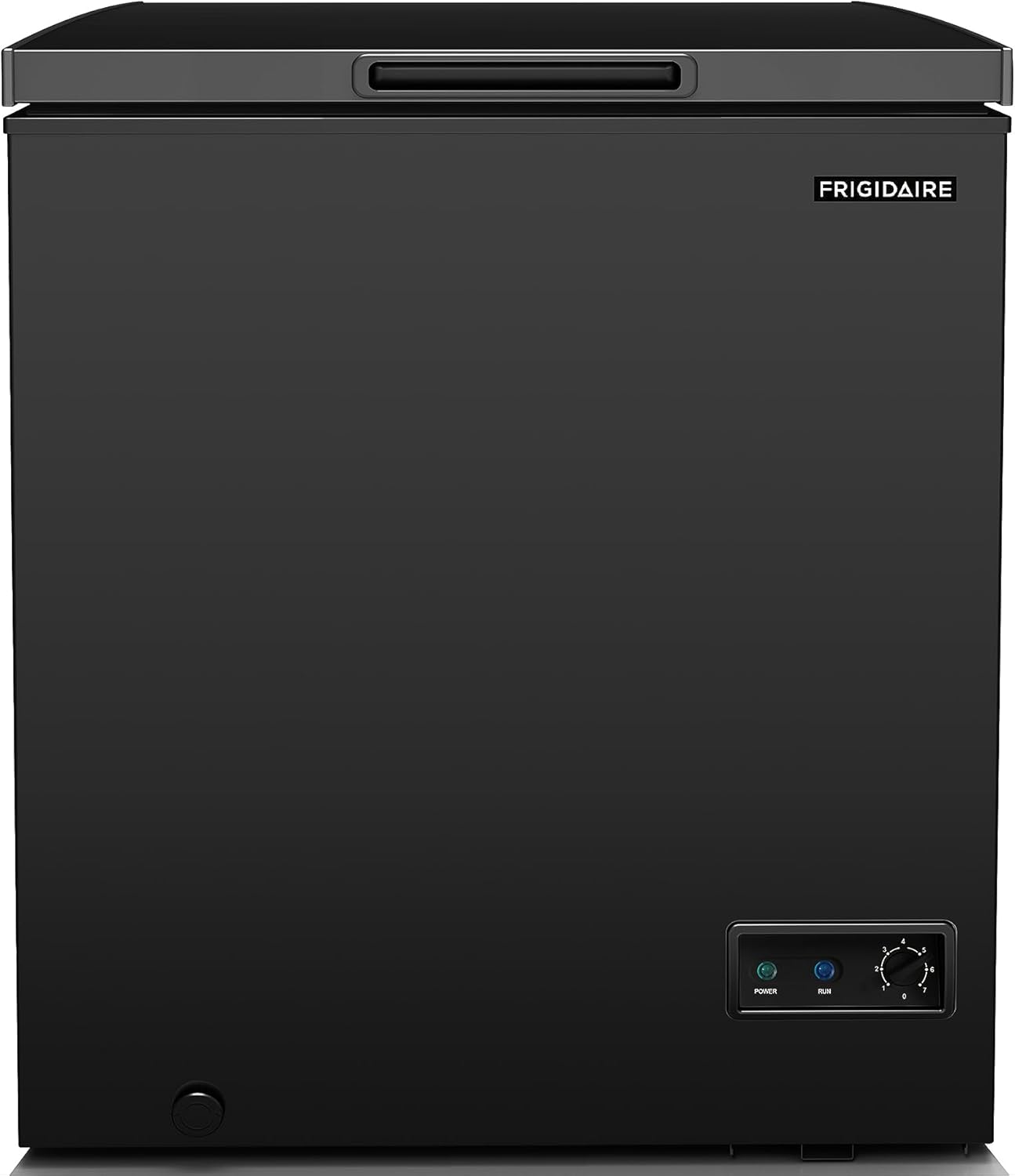
| Capacity | 5 cubic feet |
|---|---|
| Voltage | 120 volts |
| Door Orientation | Top |
| Number Of Shelves | 1 |
This Frigidaire chest freezer delivers straightforward frozen storage for a garage or utility space where reliability matters more than bells and whistles. It uses a manual adjustable thermostat and a front-mounted power indicator so you can control and monitor temperatures easily, and the recessed top lid and removable vinyl-coated wire basket help organize smaller items while keeping bulk below. The aluminum interior and adjustable leveling legs give a stable, durable feel suited to tougher environments, and the exterior defrost drain simplifies periodic manual defrosting. Expect simple operation and efficient use of its 5.0 cu. ft. capacity, but note it is a basic model without an auto-defrost system or advanced temperature alarms. For buyers who need compact, dependable extra freezer space that stands up to garage conditions, this unit covers the essentials with solid build quality.
Best for: Buyers who prioritize dependable, no-frills frozen storage for a garage or utility area and want a compact, durable unit that is easy to operate and maintain.
Less Ideal for: Customers who need automatic defrost, smart controls, precise digital temperature monitoring, or larger commercial-capacity storage should consider other models.
- Compact 5.0 cu. ft. capacity suitable for garages and small spaces
- Adjustable thermostat for straightforward temperature control
- Removable vinyl-coated wire basket for organizing frequently used items
- Durable aluminum interior and adjustable legs for stability on uneven floors
- External defrost drain speeds manual defrosting and cleanup
- Manual defrost requires periodic draining and is not automatic
- No advanced features such as alarms, digital controls, or fast-freeze mode
Verdict: A simple, robust 5.0 cu. ft. chest freezer built for dependable garage use and easy manual maintenance.
BLACK+DECKER 2.0 Cu. Ft. Chest Freezer

| Capacity | 2 cubic feet |
|---|---|
| Voltage | 115 volts |
| Number Of Shelves | 1 |
This BLACK+DECKER 2.0 cu. ft. chest freezer adds practical cold storage for kitchens, garages, or basements where space is limited. It stores up to about 70 pounds of frozen food and uses a top-opening lid with a removable wire basket to keep frequently used items accessible while larger items sit below. Temperature is adjusted with an external mechanical dial that offers seven settings and an indicator light so you can change settings without opening the lid. The unit uses R600a refrigerant, has a manual defrost cycle and an easy-access drain to simplify cleaning and maintenance. Because it is compact and freestanding, it fits tight spaces but still accepts bulky items like frozen turkeys or bags of ice. Expect straightforward performance with basic mechanical controls rather than digital precision, and plan to manually defrost periodically since it is not frost-free. For a small garage freezer the unit balances usable capacity and simple upkeep without excess complexity.
Best for: Buyers who want an efficient, no-frills secondary freezer to maximize cold storage in a small garage or utility space and prefer simple mechanical controls over advanced features.
Less Ideal for: People who need a frost-free, low-maintenance freezer with digital temperature control or those who require large commercial capacity.
- Compact 2.0 cu. ft. footprint fits small spaces like garages and apartments
- Holds up to about 70 lbs. of frozen food for extra cold storage
- Removable storage basket keeps small or frequently used items organized
- External mechanical temperature dial with indicator light is simple and easy to use
- Manual defrost with drain makes cleaning and thawing straightforward
- Manual defrost requires periodic maintenance and is not frost-free
- Mechanical control lacks digital precision or programmable settings
Verdict: A compact, no-frills chest freezer that delivers practical extra cold storage for garages or small spaces with simple, easy-to-use controls.
BODACIOUS 3.5 Cu Ft Chest Freezer

| Capacity | 3.5 cubic feet |
|---|---|
| Voltage | 110 volts |
| Number Of Shelves | 1 |
| Specification Met | ETL |
| Installation Type | Freestanding |
This small chest freezer provides simple, space-saving frozen storage for garages, apartments, and RVs. It uses thick foam insulation and an energy-efficient compressor to keep running costs low, with the listing estimating about $15.33 per year at typical rates. The unit includes a removable basket, a built-in defrost drain, a recessed handle, and a user-accessible temperature control, and the manufacturer highlights a quiet operation under 40 dB and a fast-freeze mode that can bring room-temperature items to 0°F in roughly 90 minutes. Setup is plug-and-play but the brand recommends waiting 24 hours after delivery before turning it on. Trade-offs are its manual defrost design and compact 3.5 cu ft capacity, which limit long-term bulk storage compared with larger freezers, and it lacks advanced features like digital controls or an automatic defrost cycle. For straightforward, low-cost frozen storage where footprint and low energy use matter, it handles the basics well.
Best for: Buyers who prioritize a budget-friendly, low-energy freezer for a garage or small household space and need a compact, quiet unit for everyday frozen storage.
Less Ideal for: People who need high-capacity freezer space, frequent no-fuss operation with auto-defrost, or advanced temperature management should consider larger or feature-rich models instead.
- Compact footprint fits tight spots such as garages, apartments, or beside laundry machines
- Low estimated energy use for cheap ongoing operation
- Quiet operation suitable for living areas or workspaces
- Removable basket and built-in drain simplify organization and defrosting
- Fast-freeze mode for quickly bringing fresh items down to freezing temperatures
- Manual defrost requires periodic maintenance and thawing
- Small 3.5 cu ft capacity limits long-term bulk storage or large items
Verdict: A compact, energy-efficient chest freezer that delivers quiet, low-cost frozen storage for garages and small living spaces.
Whynter CUF-301SS 3.0 cu ft Upright Freezer

| Capacity | 3 cubic feet |
|---|---|
| Temperature range | -14° to 50° F |
| Wattage | 100 |
| Door orientation | Reversible |
| Number of shelves | 3 |
The Whynter CUF-301SS is a small upright freezer designed for tight spaces such as garages, offices, dorms, or kitchens and can be switched to refrigerator mode when you need chilled storage. It uses a compressor-based cooling system with a mechanical dial that sets refrigerator temperatures from 32 to 50°F or freezer temperatures from -14 to -11°F, and includes two wire shelves plus a removable slide-out basket for basic organization. The reversible-swing stainless steel door and recessed handle make placement flexible while the included cylinder lock and keys let you secure contents in shared spaces. Rated to use relatively little energy, this unit is quiet enough for nearby rooms and runs on standard 115V household power. Limitations for garage use include modest capacity—only 3 cubic feet—and basic mechanical controls rather than precise digital settings, so it is best for regular food and beverage storage rather than long-term bulk freezing or temperature-critical items.
Best for: Practical buyers who need a compact, energy-conscious cold storage unit for a garage, office, or small household space and value flexibility between fridge and freezer modes.
Less Ideal for: Users who need large capacity or precise temperature control for long-term freezing, or those who store large frozen loads regularly.
- Convertible freezer/refrigerator mode for flexible cold storage needs
- Reversible stainless steel door and recessed handle for flexible placement
- Integrated lock with two keys for secure shared-space storage
- Quiet compressor operation suitable for near-room placement
- Includes removable shelf and slide-out basket for basic organization
- Only 3.0 cu ft capacity, limiting bulk storage
- Mechanical thermostat lacks precise digital control
- Not designed for heavy-duty or large-volume freezing tasks
Verdict: A compact, energy-conscious convertible freezer that fits garages and small spaces when you need a reliable, secure solution for everyday frozen or chilled storage.
Kismile 3.2 Cu Ft Chest Freezer BD-80

| Capacity | 3.2 cubic feet |
|---|---|
| Door Orientation | Top |
| Number Of Shelves | 1 |
| Installation Type | Freestanding |
The Kismile 3.2 cu ft chest freezer is a compact top-opening unit intended for tight spaces like garages, dorms, or small kitchens. It provides seven thermostat settings so you can choose milder or deep-freeze temperatures from about 6.8 F down to -7.6 F, and the balanced hinge lid holds open between 45 and 90 degrees for loading. Two removable wire baskets make organizing small items and quick-access foods straightforward, and a built-in drain speeds defrost cleanup. The compressor is marketed as energy efficient and runs under 40 dB, so it should operate quietly in a garage. Practical limits include modest capacity that only suits small long-term storage and a temperature range that is adequate for everyday frozen goods but not for very low-temperature commercial needs. The unit ships freestanding and has a left-side cord placement when facing the freezer, which matters for siting. For buyers wanting a compact, easy-to-use chest freezer for occasional bulk storage, this model covers the basics well.
Best for: Buyers who want a compact, reliable chest freezer to keep extra food, bulk buys, or seasonal items close at hand in a garage or small space and who prioritize quiet, energy-conscious operation.
Less Ideal for: Anyone who needs large-volume frozen storage, deep commercial freezing, or a built-in upright freezer style should consider larger or different models.
- Small footprint fits tight spaces suitable for garages or apartments
- Seven-step adjustable thermostat for flexible freezing needs
- Two removable baskets for organized storage and quick access
- Balanced hinge lid that stays open at multiple angles for easier loading
- Quick-drain port simplifies defrosting and cleaning
- Limited 3.2 cu ft capacity not suited for large households or heavy bulk storage
- Temperature range tops out around -7.6 F so it may not reach ultra-low commercial freezing
Verdict: A space-saving chest freezer that delivers quiet, energy-conscious freezing and simple internal organization for homeowners needing modest extra cold storage in a garage.
BODACIOUS 7.0 Cu Ft Chest Freezer

| Capacity | 7 cubic feet |
|---|---|
| Voltage | 110 volts |
| Number Of Shelves | 2 |
| Installation Type | Countertop, Freestanding |
| Specification Met | ETL |
This 7.0 cu ft chest freezer is a straightforward, no-frills deep freezer aimed at extra food storage in homes, apartments, or garages. It uses an adjustable 6-step thermostat so you can dial in colder or milder settings, and a removable wire basket keeps frequently used items accessible without digging through the whole chest. The unit emphasizes energy efficiency and quiet operation, making it suitable for spaces where noise and running cost matter. Practical touches include a front defrost drain for easier cleaning and a top-opening door that helps keep cold air contained. Expect typical chest-freezer behavior: steady freezing, occasional compressor noise, and warmth on the exterior while running. Its compact footprint fits in tighter garage spots but limits how you stack or organize larger items compared with an upright freezer. The manufacturer recommends letting the freezer sit 24 hours before first use and avoiding continual use at the coldest "MAX" setting to preserve compressor life. For someone seeking dependable, efficient garage storage without advanced features, this model covers the basics well.
Best for: Buyers who prioritize reliable, low-noise cold storage and lower operating costs for a garage or small space and want a simple, easy-to-maintain freezer.
Less Ideal for: Users who need upright shelving, digital controls, or advanced fast-freeze performance for large-volume or frequent-access freezing should consider other formats.
- Energy-efficient design that reduces daily power use
- Quiet operation suitable for garages or living areas
- Adjustable 6-setting thermostat for flexible temperature control
- Removable basket and defrost drain make organization and cleaning easier
- Top-open chest layout can make accessing deeply stacked items less convenient
- No advanced features such as digital temperature display or fast-freeze mode
Verdict: A compact, energy-conscious chest freezer that delivers quiet, dependable extra storage for a garage without unnecessary complexity.
Choosing the Right Small Freezer for Garages: Key Factors to Consider
Ambient Operating Range
A freezer's ambient operating range specifies the external temperatures in which the unit can maintain set internal temperatures reliably. In a garage, ambient temperatures can go well above or below typical indoor ranges, and models rated only for moderate indoor conditions may have trouble running the compressor correctly or may enter protection modes.
Choosing a freezer with a documented wide ambient range reduces the chance of thawing in summer or excessive cycling in winter. If your garage experiences extreme seasonal swings, prioritize units explicitly rated for unheated or uncooled spaces to avoid performance issues and costly food losses.
Insulation and Cold Retention
Thicker, higher-quality insulation and well-sealed doors help a small freezer retain cold during compressor off cycles and brief power interruptions. Good insulation reduces compressor runtime and makes the unit less sensitive to short-term ambient spikes.
Look for specifications on cabinet insulation thickness or R-value when available, as well as door gasket quality and tightness. Strong cold retention improves efficiency and food safety in garages where temperature control is less consistent than inside the home.
Compressor and Cooling System Durability
The compressor and condenser are the most stressed parts of a freezer and are vulnerable to dust, vibration, and temperature extremes common in garages. A durable cooling system with protective housings and accessible service panels will last longer under rougher conditions.
Consider models with proven serviceability features such as easily reachable components, replaceable parts, and clear maintenance instructions. Less complex refrigeration systems can also be easier and cheaper to repair if exposed to garage dust and debris.
Energy Usage and Efficiency
Energy efficiency matters more in garage-installed freezers because they may run longer to maintain temperature against wider ambient swings. Lower power consumption reduces long-term operating cost and less heat output can help the garage environment stay cooler overall.
Review energy consumption specs and expected annual kWh when available. Features like efficient compressors, adaptive defrost controls, and strong insulation all contribute to better efficiency. If your garage is not climate-controlled, small differences in efficiency will compound over time.
Size, Capacity, and Interior Organization
Small freezers for garages must balance footprint and usable capacity. Interior layout, removable baskets, and shelf options determine how much practical storage you get for frozen goods versus the unit's nominal volume.
Choose a size that fits available garage floor space while leaving clearance for ventilation. Consider how you plan to store items—bulk-freezer bags, flat-packed meals, or small packages—to select an interior configuration that minimizes wasted space and makes retrieval easy.
Location and Installation Requirements
Where you place the freezer in the garage affects performance and longevity. Units need clearance for airflow around the condenser, a relatively level surface, and protection from direct sun or water intrusion.
Check ventilation clearances in the manual and leave enough room for service access. If your garage is subject to heavy dust or rodents, plan for protective measures such as elevated placement or a screened enclosure. Proper installation reduces frost buildup, prevents overheating, and simplifies maintenance.
Preparing Your Garage for a Freezer
Before installing a small freezer in a garage, evaluate the immediate environment. Choose a location away from direct sunlight, heat sources, and areas that collect water. A level, solid surface is important to prevent vibration and ensure the compressor operates smoothly.
Dust, debris, and pest access are common garage issues. Keep the area around the freezer clean, and consider a raised platform or mat if the floor is damp. Regularly inspect and vacuum external coils or vents to maintain airflow and efficiency.
- Place the unit under an overhang or away from exterior doors to limit temperature swings.
- Allow recommended clearance on all sides for ventilation and servicing.
- Use weatherproofing or a simple shelter if your garage is uninsulated and exposed to extreme elements.
Temperature Management Tips
To keep the freezer working reliably, monitor both internal and ambient temperatures. A separate thermometer inside the freezer provides redundancy, while an ambient gauge in the garage alerts you to conditions that may stress the unit.
During very cold weather, some freezers may struggle to maintain set temperatures because compressors cycle differently at low ambient temps. In those cases, insulating the immediate area or using a small garage-safe heater on a thermostat can help keep the ambient temperature within the device's rated range.
- Use thermometers to track performance over a few days, especially during seasonal transitions.
- Avoid frequent door openings which allow warm air into the cabinet and increase compressor workload.
- Schedule defrosting and maintenance during milder weather to avoid exposing the unit to extreme temps during service.
Maintenance Practices for Garage Use
Regular maintenance extends service life. Clean vents and coils every few months, check door gaskets for seal integrity, and ensure the unit remains level. These simple steps prevent efficiency losses and excessive wear on the compressor.
If you notice unusual noises, persistent temperature drift, or steadily increasing energy use, address issues promptly. Early attention to small problems avoids food loss and larger repairs in a garage environment where components face more stress than indoor use.
- Vacuum or brush condenser coils quarterly to remove dust build-up.
- Replace or repair damaged door seals immediately to maintain cold retention.
- Keep an eye on drip pans and drainage paths to prevent mold and corrosion.
Storage Organization for Maximum Usable Space
Use baskets and bins to separate items by type and frequency of use. Grouping similar foods reduces time the door is open and helps you maintain a steady internal temperature. Flat-pack items stack more efficiently than bulky containers, which is important in limited-capacity freezers.
Consider a simple inventory system such as labeled bins or an app-based list so you avoid repeatedly searching through the freezer. This saves energy and keeps commonly used items easily reachable near the top.
- Reserve top-access drawers or baskets for frequently used items.
- Flatten and label packages for efficient stacking.
- Rotate older items forward to minimize long-term storage losses.
Dealing with Power Outages and Seasonal Storage
Power interruptions are a primary risk for garages, especially in areas with storms. Know how long your chosen small freezer can hold safe temperatures without power and plan accordingly for contingency storage or rapid usage.
For seasonal changes, adjust how you stock the freezer. In summer, avoid overfilling which can reduce airflow. In winter, if ambient temps approach the lower limit of the unit's operating range, verify that the compressor continues to cycle normally and consider temporary insulating measures if needed.
- Keep a thermometer and a list of foods that should be used first after an outage.
- Consider a battery backup or generator for frequent outages, ensuring compatibility with the freezer's power needs.
- Inspect the freezer after extended outages before refreezing thawed items.
How We Chose the Best Small Freezer for Garages
We prioritized features and specifications that directly affect performance and reliability when a small freezer is placed in a garage environment. Our selection filtered for units with documented temperature-stability features, robust insulation, and components rated to tolerate a wider ambient temperature range. We also weighed build quality and serviceability, since compressors and condensers placed in dusty or fluctuating conditions need easier access and durable housings. Energy efficiency mattered because garages often lack the same climate control as indoor spaces, so units that minimize runtime without compromising cold retention scored higher. Finally, we considered usable interior storage and organization options that help buyers make the most of a compact footprint. Units lacking clear ambient operating-range ratings, inadequate insulation specs, or limited serviceability information were excluded. The final short list balances cold-holding performance, resilience to garage conditions, efficiency, and practical storage capacity.
Our full evaluation process is outlined in our review methodology.
FAQ
Can I put a small freezer in an unheated garage year-round?
Often it depends on the freezer's ambient operating range. Some models are rated for unheated spaces and can handle seasonal swings, while others are designed only for moderate indoor temperatures. Check the manufacturer's ambient range and choose a unit rated for the extremes you expect.
How should I protect a garage freezer from dust and pests?
Keep the area around the unit clean and elevated if rodents are a concern. Regularly vacuum vents and condenser coils, seal gaps between the floor and walls, and avoid storing food or boxes directly adjacent to the freezer that could harbor pests.
Will a small freezer use more energy in a garage than inside the house?
Usually yes, because a garage's wider temperature swings make the compressor run more often. Choosing a model with strong insulation and an efficient compressor helps mitigate this, but expect somewhat higher energy use in harsher ambient conditions.
What maintenance should I perform for a garage-mounted small freezer?
Perform quarterly coil and vent cleaning, check door gaskets for tight seals, level the cabinet, and inspect for moisture or corrosion. Promptly address unusual noises or temperature drift to avoid larger failures.
How can I test if my freezer is suitable for garage placement?
Monitor internal temperature stability over a range of ambient conditions, and review the unit's ambient operating specification. Run trials through seasonal highs and lows, or use short-term ambient simulations, to confirm consistent performance before committing to long-term garage placement.
Final Verdict
When choosing a small freezer for garage use, prioritize models with a documented wide ambient operating range, strong insulation, and accessible serviceability. Balance usable interior capacity with a compact footprint and pay attention to energy consumption if your garage is unconditioned. Proper placement, routine maintenance, and sensible organization will extend service life and protect stored food. Focus on the criteria discussed here to select a unit that matches your garage conditions and storage needs with confidence.