
Note: This article contains affiliate links. If you click on these links and make a purchase, we may earn a small commission at no extra cost to you. This helps support our research and content. Read our full affiliate disclosure here.
If you need extra long-term frozen storage without a big investment, a budget deep freezer can be a practical solution. Choosing the right Deep Freezer under $200 matters because lower-priced units vary widely in usable capacity, insulation quality, and run-time efficiency, all of which affect how well your food stays frozen and how much power you pay for. This guide shortlists the top options in the under-$200 bracket and evaluates them across capacity, energy use, build durability, and user-friendly features. Read on to see which compact freezers made the cut and why they might fit your garage, basement, or small apartment storage plan.
Top Picks at a Glance
| Best Overall The best all-around choice for most situations | Frigidaire Chest Freezer 2.0 Cu. Ft. |  |
| Best Quality Built to a higher standard if you want something more solid | DEMULLER 3.5 cu ft Chest Freezer |  |
| Best Value The sweet spot between price and what you get | BANGSON Chest Freezer 3.5 Cu.Ft |  |
| Best Budget The cheapest option that still gets the job done reliably | Climate Choice 3.5 cu ft Chest Freezer |  |
| Top Rated A top-rated pick with lots of positive feedback | Whynter CUF-112SS Mini Freezer |  |
| Most Popular A crowd favorite that many people choose with confidence | Kismile Chest Freezer BD-80 |  |
| Best Seller A high-volume bestseller chosen again and again | BODACIOUS 5.0 Cu Ft Chest Freezer |  |
Frigidaire Chest Freezer 2.0 Cu. Ft.
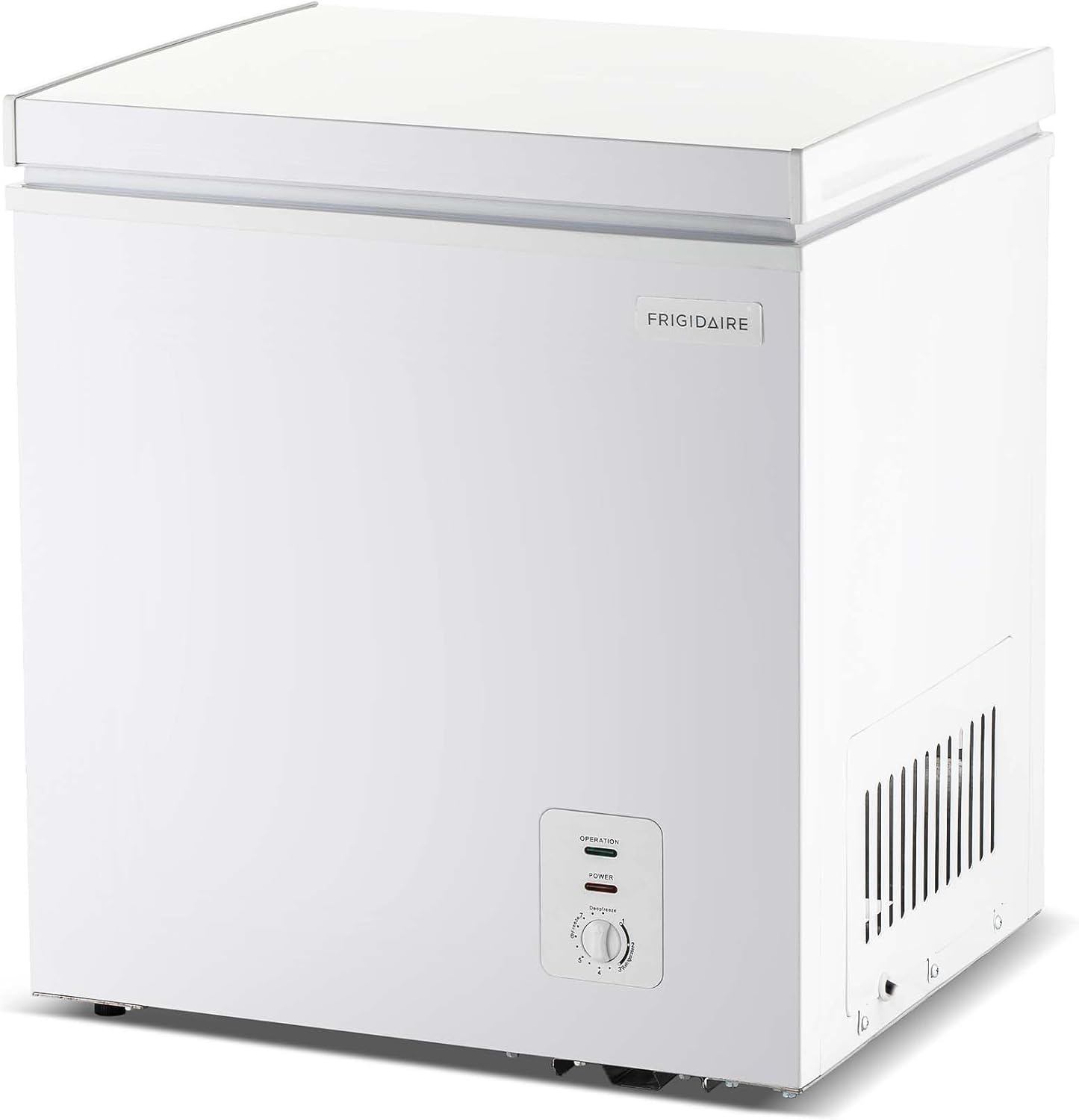
| Capacity | 2.1 cubic feet |
|---|---|
| Wattage | 300 watts |
| Voltage | 120 volts |
| Number Of Shelves | 1 |
This Frigidaire chest freezer is a straightforward, space‑saving unit for extra frozen storage in a garage, basement, or small kitchen. It provides roughly 2.1 cubic feet of usable space with a single removable vinyl‑coated wire basket to organize smaller items while larger packages sit below. Temperature is controlled by an adjustable exterior thermostat and a power‑on indicator shows when the compressor is running. The manual defrost design keeps the appliance simple and less expensive, and a built‑in drain plug makes defrosting and cleaning easier than older models without one. Adjustable feet and a recessed handle help with placement and access, and the 300 watt compressor is sized for modest household loads. Expect the usual limitations of a compact manual‑defrost chest freezer: you will need to plan defrost cycles and it lacks advanced features like auto defrost, rapid freeze, or digital controls. For buyers seeking a basic, reliable secondary freezer under $200, it covers the essentials without extra complexity.
Best for: Buyers who want an affordable, no‑frills secondary freezer to add reliable frozen storage in limited spaces and value straightforward controls over extra features.
Less Ideal for: Those who need large capacity, automatic defrost, precise digital temperature control, or frequent heavy-duty freezing for long term storage should consider larger or feature‑rich models instead.
- Compact footprint fits small spaces while still offering about 2.1 cu ft of storage.
- Removable vinyl‑coated wire basket helps organize frequently used items.
- Adjustable exterior thermostat and compressor power indicator give simple, direct temperature control and status feedback.
- Interior drain plug and manual defrost design simplify cleaning and draining.
- Manual defrost requires periodic maintenance and thawing time.
- No digital controls, rapid‑freeze mode, or advanced temperature features for fine tuning.
Verdict: A compact, budget‑focused chest freezer that delivers dependable extra frozen storage and simple controls for buyers who want value over bells and whistles.
DEMULLER 3.5 cu ft Chest Freezer

| Capacity | 3.5 cubic feet |
|---|---|
| Wattage | 70 watts |
| Voltage | 110 volts |
| Door Orientation | Top |
This DEMULLER 3.5 cu ft chest freezer is built for buyers who need reliable frozen storage in cramped spaces. It uses D-shaped cooling tubes and a high-efficiency compressor to deliver steady temperatures while running quietly under 38 dB, and the electronic digital display lets you set temperatures precisely to 1°F from -15°F to 41°F. Typical use is extra household storage for meat, seafood, ice cream, or bulk items in an apartment, garage, or dorm; the two removable stainless baskets help keep small items organized. Manual defrost requires occasional draining through the side drain hole, so maintenance is hands-on rather than automatic. At about 70 watts it is energy modest for its class, and the top-opening door and full door seal aid cold retention. The unit is straightforward to install as a freestanding freezer and includes a one-year support plan, but buyers should expect manual defrosting and a compact internal volume that limits long items or large bulk loads.
Best for: Buyers who prioritize steady cooling performance and precise temperature control in a compact freezer for small homes, dorms, or garages.
Less Ideal for: Anyone who needs automatic defrost, large-capacity storage, or to store long bulky items should consider larger upright or frost-free models.
- Digital temperature control with 1°F precision covers -15°F to 41°F
- Quiet operation under 38 dB suitable for shared living spaces
- Compact 3.5 cu ft footprint fits apartments, dorms, or garages
- Two removable stainless steel baskets for organization
- Manual defrost requires periodic draining and user effort
- Limited internal dimensions restrict large or bulky items
Verdict: If you need a quiet, performance-focused compact chest freezer with precise digital temperature control under $200, this 3.5 cu ft DEMULLER is a strong choice.
BANGSON Chest Freezer 3.5 Cu.Ft

| Capacity | 3.5 cubic feet |
|---|---|
| Wattage | 50 watts |
| Voltage | 110 volts |
| Door Orientation | Top |
This BANGSON 3.5 cu ft chest freezer is a compact, freestanding deep freezer aimed at small households, dorms, or offices that need extra frozen storage without taking much floor space. It uses a top-opening design with a removable wire basket for organizing smaller items and a manual thermostat with seven settings that let you tailor temperatures down to the low negatives or shut the compressor off. The unit runs on a low-wattage compressor and is promoted as quiet, making it suitable for living areas and garages where noise matters. Practical touches include a removable door seal for easier cleaning and relatively light weight for occasional repositioning. Expect manual defrosting and modest capacity, so this works best for bulk bags, frozen meals, or ice cream rather than large-volume long-term storage. Buyers should also allow the freezer to stand upright after delivery per the instructions before starting it.
Best for: Buyers seeking an affordable, space-saving secondary freezer for occasional bulk purchases, meal prep, or small household storage who prioritize quiet operation and straightforward controls.
Less Ideal for: Those who need high-capacity long-term storage for large families or for freezing many bulk items should consider a larger-capacity freezer instead.
- Compact 3.5 cu ft capacity fits small spaces like apartments, dorms, or offices
- Removable wire basket helps organize small items and improves accessibility
- Adjustable thermostat with seven settings for tailored freezing temperatures
- Quiet, low-wattage compressor suitable for noise-sensitive locations
- Removable door seal simplifies cleaning and maintenance
- Manual defrost requires periodic thawing and maintenance
- Limited total storage compared with larger chest freezers
Verdict: A budget-friendly, compact chest freezer that delivers quiet, adjustable freezing for small households or as a secondary unit under $200.
Climate Choice 3.5 cu ft Chest Freezer

| Capacity | 3.5 cubic feet |
|---|---|
| Wattage | 58 watts |
| Voltage | 115 volts |
| Installation Type | Freestanding |
This small chest freezer serves as an affordable secondary freezer for apartments, garages, or offices where space is limited. It offers seven adjustable temperature settings (from about -11.4°F to 10.2°F) so you can fine-tune storage for frozen meals, pet food, or bulk buys, and a removable basket keeps frequently used items accessible. The top-opening lid with a 70° arc and dual side handles makes loading and unloading straightforward in tight spaces, while built-in wheels simplify moving it during setup. Noise is low (under 40 dB reported) and the unit is energy conscious at roughly 0.37 kWh per 24 hours, which helps contain running costs. Practical features like a drain for defrosting and a strong door seal help maintain performance. The trade-offs are inherent to its size: 3.5 cu ft limits long-term bulk storage, and being a basic freestanding chest freezer it lacks advanced controls or smart features, but for buyers focused on a simple, quiet, energy-efficient freezer on a budget it performs well.
Best for: Buyers on a tight budget who need a quiet, energy-efficient secondary freezer for small spaces or occasional bulk storage and prioritize straightforward, no-frills operation.
Less Ideal for: Households that need large-capacity long-term storage, advanced temperature monitoring, or built-in organizational shelving should consider larger or feature-rich freezers.
- Compact 3.5 cu ft capacity fits small spaces like apartments or garages
- Seven temperature settings for tailored freezing from -11.4°F to 10.2°F
- Removable storage basket and 70° lid arc make access and organization easy
- Low noise operation under 40 dB and modest energy use (~0.37 kWh/24h)
- Built-in wheels and dual side handles for easier moving and placement
- Small overall capacity limits long-term bulk storage
- Basic feature set with no smart controls or advanced monitoring
Verdict: A budget-friendly, compact chest freezer that delivers quiet, energy-efficient secondary storage for small homes and tight spaces.
Whynter CUF-112SS Mini Freezer

| Capacity | 1.1 cubic feet |
|---|---|
| Wattage | 79 watts |
| Door Orientation | Reversible |
| Number Of Shelves | 1 |
| Voltage | 115 volts |
The Whynter CUF-112SS is a compact 1.1 cubic foot upright freezer designed for small spaces like kitchens, offices, garages, or basements. It uses a compressor-based cooling system with a mechanical thermostat that holds temperatures roughly between -11°F and 10.4°F, and a single removable slide-out wire shelf lets you organize small packages or containers. The reversible door and recessed handle make siting the unit flexible, and the included cylinder lock with two keys adds security for shared or garage setups. Its Energy Star rating and modest 79W power draw help keep running costs low compared with larger units. Expect manual defrosting, which is straightforward but adds occasional maintenance, and the small capacity limits bulk storage and long-term meal prep. For people who need compact, reliable frozen storage and place a premium on energy efficiency and a secure door, this model covers the basics without extra frills.
Best for: Buyers who want a compact, energy-efficient upright freezer for occasional or supplemental frozen storage and who value a secure, simple appliance that runs reliably in small spaces.
Less Ideal for: People who need large-capacity long-term storage or frequent meal-prep freezing should choose a larger chest or upright freezer instead.
- Energy Star rated for lower energy consumption
- Reversible door and recessed handle for flexible placement
- Cylinder lock with two keys for added security
- Removable slide-out wire shelf for basic organization
- Manual defrost requires periodic thawing and cleanup
- Small 1.1 cu ft capacity limits bulk freezing
Verdict: A compact, energy-efficient mini upright freezer that reliably adds secure frozen storage in tight spaces under a modest budget.
Kismile Chest Freezer BD-80

| Capacity | 3.2 cubic feet |
|---|---|
| Door Orientation | Top |
| Number Of Shelves | 1 |
| Installation Type | Freestanding |
This compact chest freezer provides practical extra frozen storage for small households, dorms, or offices. It offers 3.2 cubic feet of usable space with two removable baskets that help organize smaller items while leaving room underneath for larger packages. Temperature is controlled by a seven-grade adjustable thermostat that ranges roughly from 6.8 F down to -7.6 F so you can pick a setting for normal freezing or deeper cold. The balanced hinge-style top lid holds open at multiple angles for easier loading and a built-in drain simplifies defrosting and cleaning. The unit is designed to be energy efficient and quiet, reporting low daily power use and noise under 40 dB, which makes it suitable for living spaces. Trade-offs are its compact capacity if you need long-term bulk storage and the temperature range is not as cold as some larger freezers, so very long-term deep-freeze applications may be better suited to bigger models.
Best for: Buyers seeking an affordable, space-saving secondary freezer backed by solid customer feedback who want a quiet, energy-conscious unit for everyday frozen storage.
Less Ideal for: Anyone who needs large-volume or ultra-low-temperature long-term storage for hunting, bulk meat processing, or long-term food preservation should consider a larger deep freezer instead.
- Compact 3.2 cu ft footprint fits small spaces like dorms, kitchens, or offices
- Seven-level adjustable thermostat for choosing milder or colder settings
- Two removable baskets for separating small items and quick access
- Balanced hinge lid that stays open at multiple angles for easier loading
- Built-in water drain simplifies defrosting and cleaning
- Limited overall capacity for shoppers needing long-term bulk storage
- Lowest achievable temperature is modest compared with larger deep freezers
Verdict: A budget-friendly, compact chest freezer that delivers quiet, energy-efficient extra frozen storage for small spaces.
BODACIOUS 5.0 Cu Ft Chest Freezer

| Capacity | 5 cubic feet |
|---|---|
| Wattage | 58 watts |
| Voltage | 110 volts |
| Number Of Shelves | 1 |
| Specification Met | ETL |
This BODACIOUS 5.0 cu ft chest freezer is a small, no-frills deep freezer aimed at apartments, garages, and small households. It provides simple chest-style storage with one removable shelf/basket and a top-access lid that helps keep temperatures steady. Notable practical features include an advertised fast-freeze mode to quickly lower food temperatures and an efficient compressor that the listing says uses about 0.36 kWh per 24 hours, which translates to low running costs. The unit is ETL-listed and runs quietly under 40 dB, so it can sit near living spaces without being disruptive. Setup is straightforward — freestanding or countertop installation — and the built-in drain and hidden handle make maintenance and cleaning easier. Limitations to expect are the basic control set and compact internal organization compared with larger freezers, and the modest feature set means you will not get precise digital controls or advanced temperature zones. For shoppers focused on quiet, energy-efficient extra freezer space, it covers the essentials reliably.
Best for: Buyers who want a reliable, low-noise secondary freezer that keeps operating costs down and is easy to place in small living spaces.
Less Ideal for: Large households or users who need precise digital controls, multiple temperature zones, or extensive internal shelving and organization options.
- Compact 5.0 cu ft capacity fits small kitchens, garages, or dorms
- Low power consumption (~0.36 kWh/24h) for lower operating costs
- Ultra-quiet operation (under 40 dB) suitable near living spaces
- Built-in drain and removable basket simplify cleaning and organization
- ETL listing indicates basic safety and regulatory compliance
- Basic control interface with no advanced digital temperature display
- Limited internal organization compared with larger or higher-end models
Verdict: A quiet, energy-efficient 5.0 cu ft chest freezer that delivers dependable secondary frozen storage for budget-conscious, space-limited buyers.
Choosing the Right Deep Freezer: Key Factors to Consider
Usable Interior Capacity
Interior capacity is the single most important factor for buyers who need meaningful frozen storage. Manufacturers often quote gross volume, but the actual usable space depends on basket layout, wall thickness, and the presence of interior compartments. Consider what you will store first. Bulk meats and large roasts require wide, uninterrupted space, while frozen meals and packaged goods are easier to organize if the freezer has removable baskets.
Also factor in headroom for stacking and how the lid hinge affects access. A unit with modest gross liters but efficient internal organization can hold more usable food than a larger but poorly laid-out chest.
Temperature Control and Stability
How steadily the freezer holds low temperatures affects food safety and the acceptable duration between power interruptions. Look for models that allow precise temperature adjustment and that maintain set points under modest loading. Temperature stability is influenced by compressor quality, thermostat design, and interior insulation.
For short power outages, thicker insulation and a tight lid seal are more important than ultra-low set points. If you plan to store delicate items like ice cream, choose a unit known for consistent control rather than one that fluctuates widely during everyday use.
Energy Consumption and Operating Cost
Upfront cost is only part of ownership expense for a freezer. Energy draw and runtime determine monthly electricity impact, which can add up over years. Compare estimated wattage or annual energy usage when available and consider energy-saving features like thicker foam insulation or compressors that cycle efficiently.
Placement matters too. Locating the freezer in a temperate, shaded spot reduces compressor workload. If energy efficiency is a priority, prioritize models with documented lower running watts and good insulation over slightly larger capacity units with poor thermal performance.
Build Quality and Seal Performance
Durable construction and an effective lid gasket preserve cold and reduce frost buildup. Inspect how the lid seals: a continuous magnetic or rubber gasket that closes flush will limit warm air intrusion and reduce compressor runtime. Look for reinforced corners or thicker outer panels if you expect the unit to sit in a garage or utility space.
Durability also covers hinge strength and the quality of interior baskets. Weak hinges or thin baskets make everyday loading harder and shorten useful life, so factor in construction details even when targeting a budget price point.
User Controls and Defrosting
Simple, reliable controls reduce the chance of accidental misconfiguration. Mechanical thermostats are common on budget deep freezers and can be perfectly adequate, but digital controls offer more precise set points when available. Consider whether the unit requires manual defrosting and how often that will be needed based on expected frost buildup.
Ease of defrosting affects maintenance time and food handling. Removable baskets and a drain plug or sloped interior make defrost cycles quicker and less messy, which matters if you will be rotating inventory frequently.
Noise, Placement, and Ventilation Needs
Compressor noise and vibration are practical considerations for apartment or interior placement. Even small chest freezers can produce a steady hum that becomes noticeable in quiet spaces. Check documented decibel levels when available and plan placement to minimize disturbance.
Ventilation clearance is also critical. Freezers need breathable space around the compressor and coils to dissipate heat. Installing a unit in a cramped closet or directly against a wall increases energy use and reduces lifespan, so allow for manufacturer-recommended clearances when planning where it will sit.
Sizing a Budget Deep Freezer for Your Household
Estimate how much frozen food you want to store in practical terms, not just liters. Think in common units such as grocery bags, family-size meat packages, or the number of frozen dinners you plan to keep on hand. A working rule is that smaller households often do fine with compact freezers, while bulk-buy shoppers need a larger chest to avoid frequent rotation.
Consider long-term growth. If you expect to store seasonal harvests or bulk buys irregularly, choose a unit with flexible interior organization so you can adapt between big and small loads without wasting space.
- Measure entry paths and doorways before purchasing to ensure the unit can be positioned where intended.
- Allow for at least 2 to 4 inches of clearance behind and above the unit for ventilation.
- Plan for how often you will defrost and access contents to pick the right lid style and basket configuration.
Installation and Location Tips
Place the freezer on a level, stable surface and avoid direct sun or heat sources that force the compressor to work harder. A shaded garage or basement is ideal if temperatures remain within the unit's recommended ambient range. Avoid unconditioned spaces that experience extreme hot or cold swings unless the unit is rated for those conditions.
Ensure electrical supply is on a dedicated circuit or on a circuit that does not frequently trip. Older wiring or shared circuits can lead to nuisance trips and risk of temperature loss.
- Keep at least a few inches clearance from walls for airflow.
- Use a grounded outlet and avoid extension cords for long-term operation.
- Level the freezer to ensure the lid seals evenly and the compressor runs without excess vibration.
Storing Food Efficiently
Organize items by frequency of use. Place commonly used items near the top or in an accessible basket and reserve deeper space for long-term storage. Use clear freezer-safe bins or labeled bags to reduce time with the lid open and limit warm-air exchange.
Package foods to minimize air pockets and frost buildup. Removing excess air and using uniform-sized packages makes stacking easier and improves thermal performance because cold transfers more uniformly.
- Label items with dates and rotate older items to the top.
- Freeze items flat where possible to save space and speed freezing.
- Use internal baskets selectively to separate small items from bulk storage.
Maintenance and Troubleshooting Basics
Routine maintenance keeps a budget freezer running well. Clean the gasket periodically with mild soap to preserve seal integrity and wipe away any condensation. Check for frost buildup and defrost when frost exceeds approximately a quarter inch to preserve capacity and efficiency.
If you notice rising temperatures or excessive cycling, verify ventilation, check the gasket for gaps, and ensure the thermostat is set correctly. Persistent issues may indicate compressor strain or refrigerant problems that require professional service.
- Defrost according to observed frost accumulation rather than a fixed calendar interval.
- Keep the exterior coils or compressor area free of dust if accessible.
- Document any temperature swings and consult support if stability cannot be restored with basic maintenance.
How Storage Practices Affect Energy Use
Packing strategy influences running time. A mostly full chest freezer retains cold better than a nearly empty one, because the frozen mass buffers temperature swings during compressor off cycles. Conversely, overloading with warm items raises the compressor burden significantly.
Frequent lid openings cause the biggest single energy penalty for chest-style freezers. Plan retrievals and organize contents so you can grab items quickly to reduce warm air infiltration.
- Pre-chill items before adding them when possible to limit compressor workload.
- Group similar items together to speed access.
- Avoid placing hot or warm containers directly into the freezer.
How We Chose the Best Deep Freezer
We selected models that deliver dependable frozen storage while meeting the under-$200 price constraint. Primary evaluation criteria focused on usable interior capacity, insulation and temperature stability, and running cost, since these determine how much food you can store and how well it stays frozen over time. We also considered energy efficiency ratings or documented input power to estimate operating expenses, and build quality features such as lid seal design, basket layout, and exterior durability for real-world handling. Practical usability factors were included: control simplicity, defrost method, and noise level, because owners often place these freezers in living-adjacent spaces where convenience and quiet matter. We excluded units with unclear capacity specs, unreliable temperature control, or poor customer-reported longevity. Models lacking warranty information or basic safety listings were also filtered out. The resulting picks balance storage, efficiency, and everyday ease of use for buyers prioritizing an economical long-term freezer solution.
Our full evaluation process is outlined in our review methodology.
FAQ
How much electricity does a small deep freezer typically use?
Usage varies by insulation and compressor efficiency, but budget deep freezers often draw moderate power. Expect lower energy costs if the unit has good insulation and is not overworked by warm ambient conditions. Check documented wattage or estimated annual kWh when available to compare running costs.
Can a chest-style deep freezer sit in an unheated garage?
Many budget models can operate in a garage but performance depends on the freezer's rated ambient temperature range. Extremely low or high ambient temperatures can hinder proper cycling, so confirm the unit's specified operating range and choose a more temperate location when possible.
How often should I defrost a manual-defrost deep freezer?
Defrosting is typically needed when frost buildup reaches about a quarter inch. Frequency depends on use and humidity, but for active households this might be once or twice a year. Regular defrosting preserves capacity and efficiency.
Are small deep freezers noisy to run indoors?
Noise levels vary by compressor design and installation. Many compact freezers run at a low hum that is unobtrusive in utility spaces but may be noticeable in quiet living areas. Proper placement and a stable, level surface reduce vibration noise.
What should I do if the freezer temperature is warmer than the set point?
First check for obvious causes: a compromised lid seal, excessive frost, overloading with warm items, or insufficient ventilation. Adjust the thermostat to a colder setting and monitor. If the issue persists despite correct placement and maintenance, professional inspection may be needed.
Final Verdict
When shopping for a Deep Freezer under $200, prioritize usable capacity, insulation quality, and energy consumption. Those factors determine how much usable frozen food you can store and what the unit will cost to run over time. Balance build and seal quality with practical controls and ease of maintenance to get reliable service from an economical unit. Ultimately, pick the model that fits your storage needs and the place where it will operate. Accepting small tradeoffs in extras can lead to better core performance in budget units, so focus on capacity, temperature stability, and efficient operation for the best long-term value.