
Note: This article contains affiliate links. If you click on these links and make a purchase, we may earn a small commission at no extra cost to you. This helps support our research and content. Read our full affiliate disclosure here.
Choosing the right solar security camera system matters when you need continuous outdoor surveillance without running power lines. A well-chosen system reduces blind spots, avoids frequent battery swaps, and resists weather so it actually records when you need it. This guide presents the top shortlisted options in the solar security camera category and explains the practical differences that matter for everyday home use. We focus on how long systems run between charges, how well they record motion and detail, and how they stand up to weather and common installation constraints. Read on for a clear set of evaluation points that will help you match a system to your property.
Top Picks at a Glance
| Best Overall The best all-around choice for most situations | ANSQUE GU01 4-Cam Solar Kit |  |
| Best Quality Built to a higher standard if you want something more solid | REOLINK Home Hub Mini 4-Pack |  |
| Best Value The sweet spot between price and what you get | aosu SolarCam C7L |  |
| Best Budget The cheapest option that still gets the job done reliably | Hiseeu 4MP Solar Security Cameras (2-Pack) |  |
| Top Rated A top-rated pick with lots of positive feedback | Fociey 4K Solar Camera Kit |  |
| Most Popular A crowd favorite that many people choose with confidence | aosu D1 Classic 4-Cam Kit |  |
| Best Seller A high-volume bestseller chosen again and again | eufyCam C37 4‑Cam Kit |  |
ANSQUE GU01 4-Cam Solar Kit
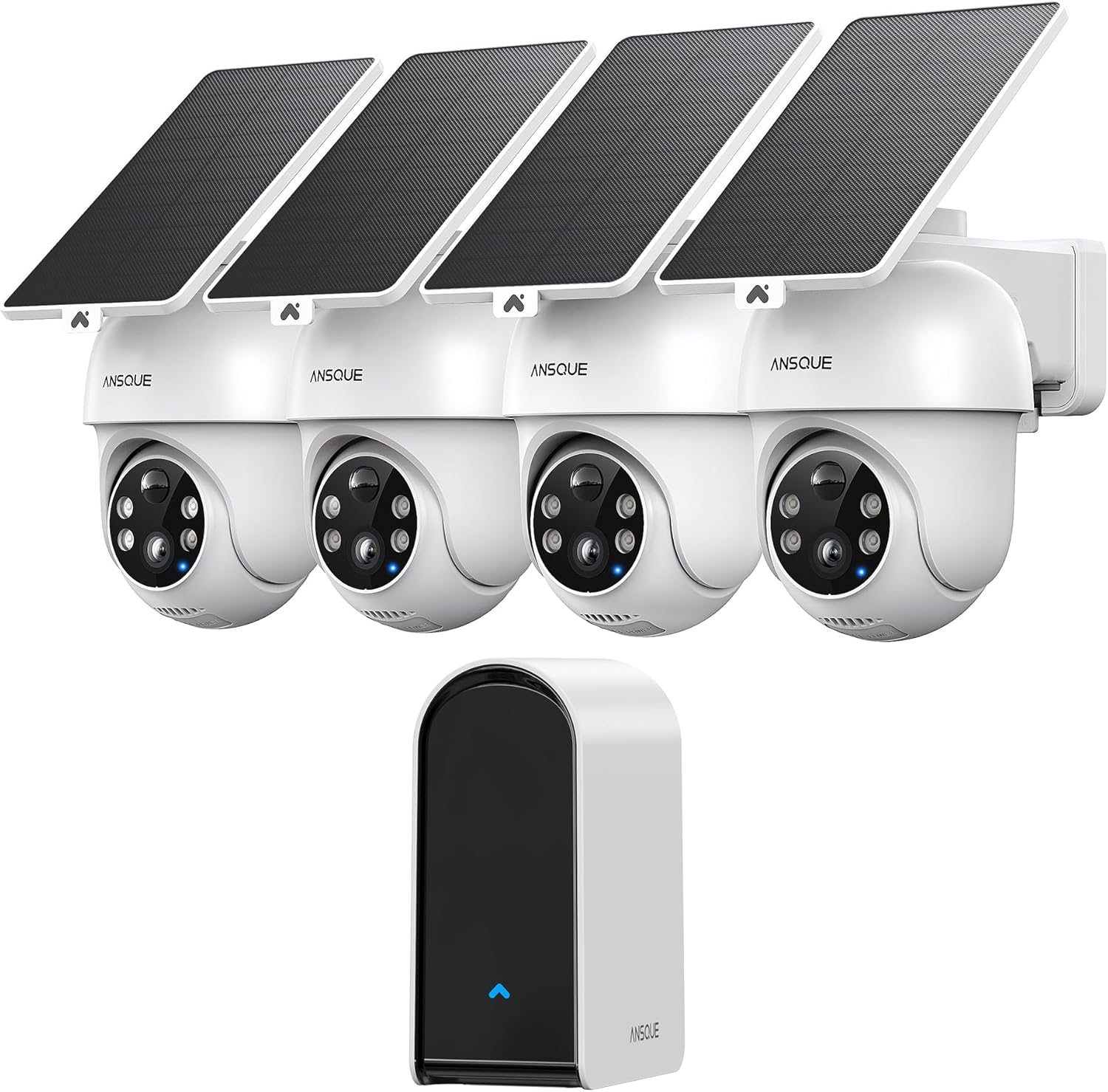
| Video Capture Resolution | 2K 3MP |
|---|---|
| Night Vision Range | 12 meters |
| Power Source | Solar Powered |
| Flash Memory Installed Size | 32 GB |
| Waterproof Rating | IP65 |
The ANSQUE GU01 kit combines four wireless dome cameras, detachable solar panels, and a central AnsqueBase signal hub to deliver whole-property coverage without monthly fees. Each PTZ-style camera provides a panoramic 360 degree sweep, 2K (3MP) capture, 8× digital zoom and color night vision aided by four LED spotlights, and the system uses AI to detect and auto-track people across cameras. It stores events locally on the included 32 GB storage (expandable up to 256 GB) and wakes quickly on motion to record MP4 clips, while two-way audio and an audible light alarm add active deterrence. Setup is aimed at DIY users: the solar panels and reinforced mounts simplify outdoor installs and the app supports scheduled recording, custom detection zones and sharing. Trade-offs to note are no 24/7 continuous recording and reliance on local storage rather than cloud backups, so off-site footage protection requires manual backup or a larger SD card, and digital zoom cannot match optical zoom detail at long distances.
Best for: Buyers who want a complete solar-powered outdoor system that prioritizes no-subscription local storage, wide-area coverage, and simple DIY installation for everyday home security.
Less Ideal for: Users who need guaranteed cloud backups, continuous 24/7 recording, or optical zoomed detail for long-range identification should look at alternative systems.
- Solar-powered cameras with detachable panels for long runtimes and low maintenance
- 360° PTZ coverage with AI human detection and cross-camera tracking to reduce blind spots
- 2K color night vision plus 4 LED spotlights for clearer night images
- Built-in 32 GB local storage with support up to 256 GB so you avoid subscription fees
- App features include custom detection zones, scheduled recording, two-way talk and device sharing
- Does not support continuous 24/7 recording, only event-based clips
- Local storage only by default, so footage is vulnerable if a camera is stolen or damaged
- Zoom is digital only, which reduces clarity when heavily magnified
Verdict: A no-subscription, solar-powered four-camera kit that delivers wide 360° coverage and color night vision for homeowners who want reliable, low-maintenance outdoor security.
REOLINK Home Hub Mini 4-Pack

| Video Capture Resolution | 5MP |
|---|---|
| Frame Rate | 15 frames per second |
| Power Source | Solar Powered |
| Flash Memory Supported Size Maximum | 1 TB |
| Waterproof Rating | IP66 |
This REOLINK kit bundles four 5MP Argus PT solar cameras with a Home Hub Mini to deliver continuous outdoor surveillance without monthly fees. Each camera supports 360° pan and wide tilt with auto-tracking and AI detection for people, vehicles, and animals, while a built-in spotlight enables color night vision and two-way talk through the app. The system is designed for solar operation and stores footage locally on the Home Hub Mini or microSD (up to 1TB), which keeps recordings private and viewable when internet is intermittent. Setup requires initial internet configuration and mounting hardware, and the hub-centric design means advanced features like RTSP/ONVIF output are available only when cameras connect through the hub. Video records at 5MP and 15 fps with digital zoom and autofocus; that delivers clear detail for identification at short to medium ranges but is not the same as a 4K feed. For buyers prioritizing on-site storage, privacy, and hands-off solar power, this kit balances strong tracking and detection features with the practical limits of battery/solar performance and hub-dependent integrations.
Best for: Buyers who want a performance-focused solar security package that emphasizes autonomous tracking, local encrypted storage, and minimal ongoing costs for outdoor home monitoring.
Less Ideal for: Users who require continuous 4K/60fps footage, enterprise NVR features, or camera-only RTSP/ONVIF streaming without a hub should consider other solutions.
- 360° pan‑tilt auto‑tracking with AI person/vehicle/animal detection for active monitoring
- Solar power support and detachable solar panels reduce the need for frequent recharging
- Local storage via Home Hub Mini or microSD up to 1TB with AES128 encryption for privacy
- Color night vision with built‑in spotlight for clearer low‑light footage
- App control, push alerts, and multi-user access with role permissions
- 15 fps 5MP video is clear for identification but not as sharp as 4K systems
- Some advanced integrations and stream outputs depend on connection through the Home Hub Mini
- Performance relies on solar/battery conditions which can vary by installation
Verdict: This kit is the best fit for homeowners who want a solar powered, locally stored system with strong auto-tracking and AI detection without subscription fees.
aosu SolarCam C7L

| Resolution | 2K QHD (3MP) |
|---|---|
| Power Source | Solar Powered |
| Waterproof Rating | IP65 |
| Flash Memory Installed Size | 32 GB |
| Connectivity Technology | Wireless |
The aosu SolarCam C7L kit is a compact solar-powered outdoor surveillance system designed for continuous, low-maintenance monitoring. It records in true 2K QHD, offers a 6x zoom for closer inspection, and keeps footage locally on the included 32 GB aosuBase so you can avoid subscription fees. The split solar panel and battery system let you position the camera for coverage while placing the panel where it gets the best sun, reducing manual recharging. In daily use you get multi-cam live view, cross-camera tracking that groups the same person across cameras, and PIR plus AI human detection to cut down on false alerts. Full-color night vision, a spotlight and siren provide clearer nighttime ID and active deterrence. Setup and app control via the aosu app and smart assistant support are straightforward, though solar performance depends on placement and sun exposure. Also, extended storage requires adding a microSD card and very bright or very long-range zoom shots may show some softness compared with higher-resolution 4K models.
Best for: Buyers looking to minimize ongoing costs and hands-on maintenance who want reliable outdoor coverage with local storage and smart filtering of alerts.
Less Ideal for: People who need the absolute highest-resolution footage or those who cannot guarantee good solar exposure at their camera locations should consider alternative power or higher-resolution options.
- True 2K QHD video with 6x optical zoom for clearer close-ups
- Solar-powered design with separate panel for flexible placement and reduced recharging
- 32 GB local aosuBase storage included so no mandatory subscription is required
- PIR sensor plus AI human detection reduces false alerts
- Full-color night vision plus spotlight and siren for identification and active deterrence
- Local storage is limited to the included 32 GB without an added microSD card
- Solar charging effectiveness varies with sunlight, season, and mounting location
Verdict: A practical, subscription-free solar camera system that balances good 2K image quality, smart person detection, and low-maintenance solar power for whole-home outdoor monitoring.
Hiseeu 4MP Solar Security Cameras (2-Pack)

| Video Capture Resolution | 4 MP |
|---|---|
| Night Vision Range | 33 feet |
| Field Of View | 135 degrees |
| Battery Power | 5200 milliampere_hour |
| Waterproof Rating | IP65 |
These Hiseeu cameras are a budget-oriented solar security kit that pairs 4MP video with a built-in 5200mAh rechargeable battery and included solar panels for mostly cable-free outdoor monitoring. Typical use is wall-mounted home or yard surveillance where you want continuous coverage without running power; the cameras connect over Wi-Fi and offer two-way audio, a siren/LED alarm, and customizable activity zones through the mobile app. The kit delivers practical benefits like full color night vision from the integrated spotlight, PIR plus AI human detection to cut false alerts, and support for local SD storage up to 256 GB or optional cloud recording. Expect straightforward setup and Alexa compatibility, but note the cameras list 15 fps frame rate and H.264/H.265 compression which is fine for general monitoring but not optimized for high-frame action footage. Also the product depends on 2.4 GHz Wi-Fi and the solar performance will vary by location and sun exposure, so placement matters for consistent battery top-up.
Best for: Buyers who want an affordable, mostly wireless outdoor camera system to monitor yards or entryways without running power lines and who prioritize clear daytime and color night images over high-frame-rate video.
Less Ideal for: Users who need professional-grade surveillance with high frame rates, wired PoE reliability, or those without reliable 2.4 GHz Wi-Fi or sufficient sun exposure for solar charging should consider other options.
- Solar panels plus 5200mAh rechargeable battery enable mostly wireless outdoor installation.
- 4MP resolution with 135° field of view and full color night vision for clearer detail day or night.
- PIR sensor with AI human detection reduces false motion alerts.
- Two-way audio, siren and LED alarm give active deterrent and remote interaction.
- Supports local SD storage up to 256 GB and optional cloud recording for flexible retention.
- Frame rate is limited to 15 fps which is lower than higher-end cameras for fast motion.
- Relies on 2.4 GHz Wi-Fi only, so it needs compatible network placement for reliable streaming.
Verdict: A cost-conscious two-camera solar kit that delivers clear 4MP daytime and color night footage with flexible local or cloud storage for everyday home monitoring.
Fociey 4K Solar Camera Kit

| Video Capture Resolution | 4k |
|---|---|
| Effective Video Resolution | 8 MP |
| Power Source | Solar Powered |
| Night Vision Range | 33 feet |
| Flash Memory Installed Size | 32 GB |
This Fociey kit bundles four weatherproof 4K/8MP bullet cameras with a local storage base that eliminates mandatory cloud subscriptions. Cameras are pre-paired to the base for quick setup and connect to your router via the base station, which supports dual-band Wi‑Fi and up to six cameras. The cameras offer full 360° pan/tilt rotation with automatic tracking and cross-camera follow so moving subjects are kept in frame, and motion-triggered recording saves storage by capturing only events. Built-in 32 GB storage is expandable to 128 GB and sits in the base for safer local retention if a camera is tampered with. The included detachable solar panels and an improved charging circuit aim to keep batteries topped off with minimal sunlight, and the system features AI motion filtering to cut false alerts from wind or small animals. Important limits: the base must be wired to your router, truly continuous multiweek operation depends on local sun exposure, and advanced cloud features are optional but separate from the no-fee local recording.
Best for: Buyers who prioritize a reliable, subscription-free outdoor security setup that keeps recorded video locally and uses solar charging to reduce maintenance.
Less Ideal for: People who need guaranteed continuous operation through long periods of low sunlight or who want a completely wireless system without a wired base-to-router connection.
- 4K/8MP resolution for detailed live view and zoomed-in footage
- Local storage base with 32 GB built-in and support up to 128 GB, so no required subscription
- 360° pan/tilt with automatic tracking and cross-camera follow to reduce blind spots
- Solar-powered cameras with detachable panels and improved charging circuit for extended off-grid operation
- Dual-band Wi‑Fi support via the base for a more stable network connection
- Battery solar charging performance can drop after extended cloudy weather requiring USB charging
- Base station requires Ethernet connection to router which adds a wired dependency
Verdict: A dependable solar-powered 4K system built around local storage and automatic tracking that avoids monthly fees while focusing on continuous, low-maintenance outdoor surveillance.
aosu D1 Classic 4-Cam Kit

| Power Source | Solar Powered |
|---|---|
| Video Capture Resolution | 2K/3MP |
| Flash Memory Installed Size | 32 GB |
| Waterproof Rating | IP65 |
| Night Vision Range | 33 feet |
The aosu D1 Classic 4-Cam Kit is a solar-powered outdoor security system that combines 360 degree pan-and-tilt coverage with automatic motion tracking and local storage on the included aosuBase. Typical use is perimeter monitoring of yards, driveways, and entryways where you want continuous coverage without subscription fees; the system records in 2K/3MP and supports viewing up to four cameras on one screen via the app. Notable features include built-in solar charging, full-color night vision using four LEDs, two-way audio, siren and light alerts, and a 32 GB aosuBase for local encrypted storage and loop recording. In practice the kit reduces ongoing costs and privacy concerns by keeping footage local and offers stable live viewing from farther corners of a property thanks to the base station boosting wireless range. Important limitations are that performance depends on Wi-Fi signal and adequate sunlight for charging, and the 32 GB storage will eventually loop older footage on busy sites, so it may not replace cloud backup for long-term retention.
Best for: Buyers who prioritize a solar-powered, subscription-free system with local encrypted storage and wide-area automatic tracking for outdoor perimeter security.
Less Ideal for: People who need very long-term archival cloud storage or who lack reliable Wi-Fi or consistent sunlight at camera locations.
- Solar-powered cameras with built-in panels reduce or eliminate the need for wiring and frequent battery swaps
- 32 GB aosuBase local storage provides encrypted, subscription-free loop recording
- 360° pan and tilt with automatic motion tracking covers wide areas and reduces blind spots
- Full-color night vision with four LEDs and 2K/3MP resolution captures clearer nighttime detail
- App control with multi-cam live view, two-way talk, and smart alerts simplifies monitoring
- Storage is limited to the included 32 GB, which will loop and overwrite older footage on busy properties
- System relies on Wi-Fi and base station range, so very large or Wi-Fi-poor properties may need signal planning
Verdict: Choose this kit if you want a solar-powered, subscription-free outdoor camera system with local encrypted storage and wide 360° tracking for thorough perimeter monitoring.
eufyCam C37 4‑Cam Kit

| Video Capture Resolution | 2k |
|---|---|
| Night Vision Range | 6 meters |
| Connectivity Technology | 2.4GHz 802.11 b/g/n (WPA/WPA2/WPA3) |
| Power Source | Battery Powered |
| Built-In Media | HomeBase Mini with 64GB built-in |
The eufyCam C37 4-Cam Kit pairs four pan-and-tilt outdoor cameras with a HomeBase Mini to deliver wide coverage without a monthly cloud fee. Each camera offers 360-degree pan and tilt with automatic tracking, 2K video at 15 fps, color night vision using a built-in spotlight, and AI classification for people, vehicles, pets, and faces. Cameras are battery powered and supported by detachable 3W solar panels so you can mount cameras for the best view while placing panels where they get optimal sun. Recordings save locally to the HomeBase Mini (64 GB built-in) or to microSD when used standalone, and the system works through the eufy app with Alexa integration. Important limitations: the cameras do not support continuous 24/7 recording, and solar charging depends on sunlight and event frequency so battery life will vary; HomeKit is not supported and the C37 needs HomeBase 3 or HomeBase Mini for full AI features. For buyers who want a self-hosted, solar-friendly kit with strong night-time clarity and automated tracking, this is a sensible option.
Best for: Buyers who prioritize privacy, low ongoing costs, and flexible solar-powered placement will appreciate a system that stores footage locally and reduces cloud dependence.
Less Ideal for: Users who need uninterrupted 24/7 continuous recording, HomeKit integration, or guaranteed battery-free operation in very low-sunlight climates should consider other options.
- 360° pan and tilt with auto-tracking covers large areas with a single camera
- 2K color night vision and spotlight improve identification in low light
- Detachable solar panels allow flexible placement and extended battery life
- Built-in HomeBase Mini provides local storage and no-subscription operation
- AI detection distinguishes people, vehicles, pets, and faces to reduce false alerts
- Does not support 24/7 continuous recording
- Battery life and solar charging depend heavily on sunlight and event frequency
Verdict: A solar-ready, no-subscription pan-and-tilt camera kit that maximizes coverage and local storage for buyers who want private, low‑maintenance outdoor monitoring.
Choosing the Right Solar Security Camera Systems: Key Factors to Consider
Battery Life and Solar Charging
Battery capacity and how effectively the solar panel recharges it directly determine how long a system can operate without manual intervention. In practice, look at real-world run-time estimates and whether the system specifies recharge times under partial sun.
Siting matters: panel orientation, shading, and seasonal sun angles change charging performance. Systems with larger panels, MPPT or smart charging, and energy-efficient standby modes will need fewer maintenance visits for battery replacement or recharging.
Image Resolution and Night Performance
High-resolution sensors and good low-light processing make it easier to identify faces, license plates, and other details at a distance. Pay attention to the effective viewing angles and the resolution delivered at common surveillance distances.
Night vision style matters. Infrared illumination offers reliable monochrome images in complete darkness, while color night vision or low-light sensors can produce more recognizable details under minimal ambient lighting. Consider the tradeoff between field of view and identifiable detail when choosing resolution and lens specs.
Motion Detection and Alert Quality
A system that conserves power must reliably detect meaningful events while avoiding frequent false alerts from wind, insects, or passing shadows. Look for adjustable detection zones, sensitivity settings, and human/vehicle recognition features when available.
Good motion handling affects both storage and battery life. Systems that combine local pre-processing with smart rules reduce cloud uploads and wasted recordings, which is especially important for solar-powered setups with limited energy budgets.
Weatherproofing and Build Durability
Outdoor systems must resist rain, dust, temperature swings, and UV exposure. IP ratings provide a baseline for ingress protection, but mounting materials, gaskets, and cable entry design also influence long-term reliability.
Consider the installation environment: coastal locations need better corrosion resistance, while areas with heavy snow need mounts and panels rated to handle load and freeze-thaw cycles. Durable enclosures and protected connectors reduce failures over time.
Installation Flexibility and Mounting
How and where you can place the camera and solar panel affects both performance and usefulness. Systems that allow the solar panel to be mounted separately from the camera give you more options to find unobstructed sun while placing the camera for optimal coverage.
Check mount types, tilt and swivel ranges, and whether the system includes extension cables. Easier mounting reduces installation time and lets you position components for best power and sightlines without compromise.
Connectivity and Storage Options
A robust system should handle network interruptions gracefully and offer a mix of cloud and local storage options. Local recording or edge storage maintains capture continuity during outages, while selective cloud uploads preserve important clips.
Also consider whether the system supports standard Wi-Fi bands, cellular backup, or wired network options. Power-conserving connectivity modes and efficient video codecs reduce data transfer and battery drain.
Choosing the Best Location for Panel and Camera
Separate placement of the solar panel from the camera is often the best approach because optimal sun exposure and ideal camera sightlines rarely align. Aim the panel to face the strongest seasonal sun and avoid shade from trees or roof elements during peak charging hours.
When mounting the camera, prioritize coverage of entry points and high-traffic approaches rather than maximizing field of view. A slightly narrower angle that captures faces clearly is more useful than a wide angle that obscures detail.
- Mount panels where morning and midday sun are unobstructed.
- Avoid mounting cameras directly under overhangs that create blind spots.
- Use lengthened cables where possible to separate panel and camera placements.
Optimizing Power Use to Extend Runtime
Adjust motion sensitivity and recording schedules to conserve battery. Many systems let you configure active hours, detection zones, and clip lengths so the camera only records when it matters. Reducing continuous recording time has a large effect on daily power draw.
Enable power-saving features like scheduled wireless radios and lower frame rates during idle periods. When sunlight is limited, run the camera in event-only modes and rely on local pre-buffering to still capture pre-event footage without continuous streaming.
- Use event-triggered recording rather than continuous capture when possible.
- Limit clip length and frame rate during low-power periods.
- Disable nonessential features like constant two-way audio or high-frequency uploads.
Mounting Hardware and Theft Resistance
Solar systems are often more vulnerable to tampering because panels are visible and removable. Choose mounts and fasteners that are not trivial to unscrew without tools, and consider theft-deterrent brackets or tamper screws if available.
Position panels out of easy reach when possible and use security plates or cages for cameras in exposed locations. Quick-release designs for maintenance are convenient but should not compromise security in lower-trust settings.
- Use tamper-resistant screws and concealed fasteners.
- Place panels higher or behind angled brackets to deter casual removal.
- Consider locking housings or cable ties for additional restraint.
Data Management: Local Vs Cloud
Solar systems that rely heavily on cloud uploads can drain batteries faster and depend on consistent internet connectivity. Local microSD or networked storage can preserve footage during outages and lower daily data transfer requirements.
A hybrid approach is often best: store routine clips locally and upload flagged events or lower-resolution thumbnails to cloud storage. That keeps critical evidence off-site without exhausting power for constant high-bitrate uploads.
- Check maximum supported local storage and overwrite behavior.
- Prefer systems with scheduled or selective cloud uploads to save bandwidth.
- Ensure encryption or password protection for any local storage to protect privacy.
Maintenance and Seasonal Care
Seasonal changes affect both solar production and camera performance. In winter, panels may need angled cleaning to remove snow and debris, while summer heat can accelerate battery degradation if the unit is in direct midday sun.
Plan periodic checks for panel cleanliness, secure mounts, and firmware updates. Firmware updates can improve power management and detection algorithms, so occasional maintenance keeps the system efficient and reliable.
- Clean panels quarterly or after heavy storms.
- Inspect mounts and seals for water intrusion annually.
- Keep firmware current for stability and efficiency fixes.
How We Chose the Best Solar Security Camera Systems
We shortlisted systems that meet common real-world needs for off-grid outdoor surveillance and then applied specific, measurable filters to separate practical choices from novelty products. Key evaluation dimensions included battery endurance under mixed light conditions, recorded image quality for identification at typical distances, and motion detection reliability for minimizing false alerts. We also assessed weather and environmental durability using stated IP ratings and design features that affect outdoor lifespan. Installation flexibility was another decisive factor, covering mounting options and whether the system supports adjustable solar panel placement. Finally, we considered connectivity resilience and local storage options that affect continuous recording during network interruptions. Excluded from consideration were indoor-only cameras, devices that require constant AC power, or systems lacking basic outdoor weatherproofing. The result is a focused set of systems suitable for common home and property surveillance scenarios.
Our full evaluation process is outlined in our review methodology.
FAQ
How long will a solar security camera system run between charges?
Runtime depends on battery capacity, solar panel wattage, sunlight exposure, and recording habits. In good sun and with event-based recording, many systems last days to weeks; continuous recording reduces that dramatically.
Can I mount the solar panel away from the camera?
Yes. Mounting the panel separately is recommended to optimize sun exposure while positioning the camera for best coverage. Make sure the included cable length or an approved extension supports the distance.
Will solar cameras work in cloudy or winter conditions?
They can, but performance decreases with less sunlight. Systems with larger panels, efficient charging circuits, and bigger batteries handle cloudy stretches better. You may need to adjust settings seasonally to conserve power.
Is local storage necessary with a solar system?
Local storage is highly valuable because it preserves footage during network outages and reduces daily upload demands, which saves battery. A hybrid local-plus-cloud setup combines continuity with off-site backups.
How weatherproof should my system be?
Choose systems with clear outdoor ratings and protected connectors. Higher IP ratings and robust enclosures reduce water and dust ingress, which is essential for long-term outdoor operation.
Final Verdict
When selecting a solar security camera system, prioritize sustained power and reliable image capture over nonessential features. Focus first on battery and charging capability for your site, then verify that resolution and night performance meet identification needs. Balance connectivity and storage to ensure footage survives network outages without draining the battery. The right system for you will depend on sun exposure, installation constraints, and how much maintenance you want to do. Choose a system that matches those constraints and tune its settings to extend runtime and reduce false alerts for a dependable off-grid surveillance solution.