
Note: This article contains affiliate links. If you click on these links and make a purchase, we may earn a small commission at no extra cost to you. This helps support our research and content. Read our full affiliate disclosure here.
Basements often feel colder and damper than the rest of the house, so selecting the right space heater matters for comfort, moisture control, and safety. You want a unit that warms the room efficiently, runs without escalating electricity costs, and includes protections against tipping, overheating, and moisture exposure. This guide highlights seven shortlisted space heaters for basements chosen for their heating effectiveness, safety features, and suitability for lower-ceiling, smaller-windowed underground rooms. Below we summarize how we evaluated each option and what to prioritize when you pick a heater for your basement space.
Top Picks at a Glance
| Best Overall The best all-around choice for most situations | Lasko Ceramic Tower Heater 751320 |  |
| Best Quality Built to a higher standard if you want something more solid | Dr. Infrared Heater DR-968 |  |
| Best Value The sweet spot between price and what you get | DREO Atom One Space Heater |  |
| Best Budget The cheapest option that still gets the job done reliably | Amazon Basics Ceramic Mini Heater |  |
| Top Rated A top-rated pick with lots of positive feedback | DREO Space Heater HSH006 |  |
| Most Popular A crowd favorite that many people choose with confidence | GiveBest Portable Space Heater PTC-905 |  |
| Best Seller A high-volume bestseller chosen again and again | Mr. Heater Portable Buddy F232000 |  |
Lasko Ceramic Tower Heater 751320

| Heat Output | 1500 watts |
|---|---|
| Heating Element | Ceramic |
| Special Features | Adjustable Thermostat, Auto-Off Timer, Widespread Oscillation, Remote Control |
| Power Source | Corded Electric |
| Indoor Outdoor Usage | Indoor |
The Lasko Ceramic Tower Heater 751320 is a compact 1500-watt electric tower heater designed to deliver targeted warmth in small to medium rooms. It uses a ceramic heating element and forced-air delivery combined with widespread oscillation to spread heat more evenly across a basement or living area. Controls include two heat settings plus an adjustable electronic thermostat, a seven-hour auto-off timer, and a multi-function remote with onboard storage so you can change temperature, oscillation and timer from across the room. Built-in safety features such as overheat protection, cool-touch housing, and ETL listing add peace of mind for unattended cycles. The slim tower footprint and carry handle make it easy to move and position, but like most fan-forced ceramic heaters it provides faster spot heating rather than whole-house warmth in very large or poorly insulated basements. It also lacks some advanced safety locks and tip-over switch options found on other models, so placement on a stable surface and routine supervision are recommended.
Best for: Buyers who want a portable, easy-to-use heater to quickly warm a finished basement room or similar small-to-medium space and value adjustable thermostat, timer, and remote control.
Less Ideal for: People needing to heat large, open, or poorly insulated basements as a primary heat source should consider higher-capacity or whole-room heating options.
- 1500-watt ceramic element provides quick, effective spot heating for small to medium rooms
- Widespread oscillation helps circulate warm air across a basement area
- Electronic thermostat and 7-hour timer allow more precise temperature control and scheduled runs
- Includes multi-function remote with on-board storage for convenient adjustments from anywhere in the room
- Designed for room-level heating so it may not heat large or poorly insulated basements evenly
- Does not list a tip-over switch or child-lock on this model, limiting safety features compared with some competitors
Verdict: A portable, feature-rich 1500W ceramic tower heater that delivers fast spot heat and convenient remote-controlled comfort for finished basement rooms.
Dr. Infrared Heater DR-968

| Wattage | 1500 Watts |
|---|---|
| Heating Coverage | 576 square feet |
| Number of Speeds | 3 |
| Voltage | 120 |
| Amperage | 12.5 A |
The Dr. Infrared Heater DR-968 combines a quartz infrared tube and a PTC element with a high-pressure, low-noise blower to heat rooms quickly and more evenly than many single-element 1500 W heaters. It is typically used as a freestanding portable heater for large indoor spaces such as basements, living rooms, or home offices where faster warm-up and object-focused infrared heating help occupants feel comfortable sooner. Notable features include an electronic thermostat with a 50 to 85 F range, Auto energy-saving mode that switches between high and low power, three power settings (Auto, 1000 W Low, 1500 W High), a 12-hour timer, caster wheels for repositioning, and an IR remote for hands-off control. Safety features include tip-over protection and overheat auto shutoff, and the unit is UL certified. Trade-offs are typical for a powerful portable heater: it draws about 12.5 amps and relies on a corded connection, so it must be used on an appropriate circuit, and at 19 pounds it is portable but not pocketable. For basement use its stronger heat output and blower make it effective at overcoming cool, open spaces when placed strategically.
Best for: Buyers who prioritize strong, fast warmth and efficient heat distribution in larger or cooler basement spaces and want a heater that balances infrared comfort with convection airflow.
Less Ideal for: People who need a tiny, ultra-light personal heater for close-range desk use or those who cannot provide a dedicated circuit for a 1500 W appliance.
- Dual heating system (quartz infrared + PTC) for faster, more efficient heat transfer than single-element heaters
- High-pressure, low-noise blower improves heat distribution across larger rooms
- Electronic thermostat with Auto energy-saving mode maintains set temperature while cycling between power levels
- Built-in safety features including tip-over and overheat protection and UL certification
- Remote control, timer, and caster wheels for convenient placement and operation
- Requires a dedicated 12.5 A circuit and uses a standard corded connection, limiting placement near overloaded outlets
- Heavier than basic personal heaters, at about 19 pounds, which reduces easy one-handed portability
Verdict: Choose the DR-968 when you need a powerful, fast-heating portable unit that spreads infrared warmth across a large basement while keeping noise low and safety features built in.
DREO Atom One Space Heater
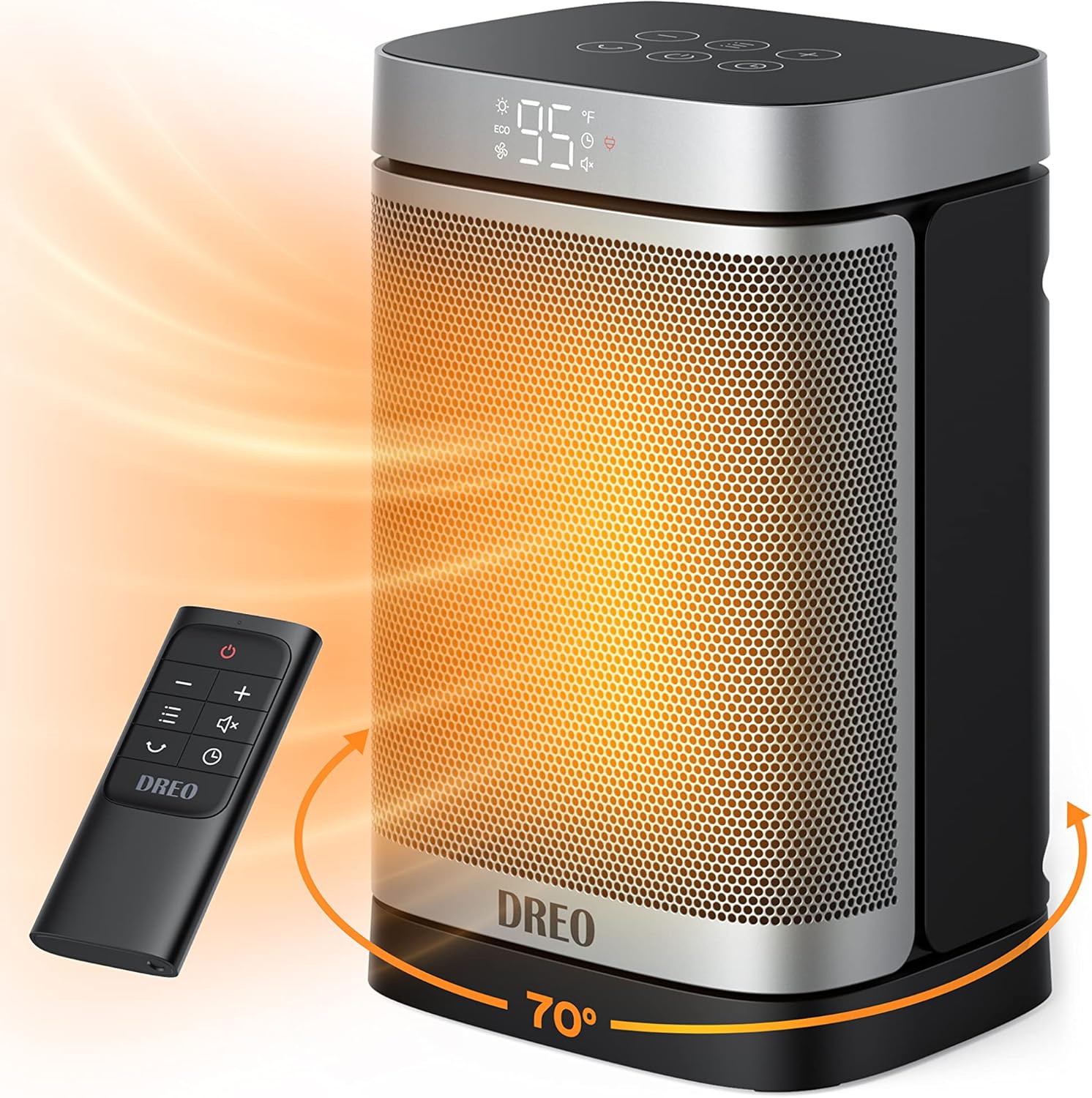
| Heat Output | 1500 watts |
|---|---|
| Heating Coverage | 200 sq.ft |
| Heating Element | PTC Ceramic |
| Oscillation | 70° |
| Timer | 1-12 H |
The DREO Atom One is a compact tower heater that uses a PTC ceramic element and up to 1500 watts to heat small to medium rooms quickly. It runs from a digital thermostat adjustable between 41 and 95°F in 1°F increments, and offers five fan speeds, ECO mode, a 1–12 hour timer, and 70° oscillation to spread warmth across a basement area. Practical touches include a detachable filter, LED control panel, and a remote for hands-off adjustments. Safety is addressed with ETL-listed protections for tip-over and overheating and an enhanced safety plug. The unit is engineered to be relatively quiet thanks to a brushless DC motor and aerodynamic blade design, which helps when you need background heat while working or using a finished basement. Limitations are its intended coverage of about 200 sq ft—larger or poorly insulated basements will need a higher-capacity heater—and like all ceramic forced-air units it provides spot and circulating heat rather than whole-house warmth.
Best for: Buyers who want a compact, efficient heater to warm a finished basement room or a specific basement zone with precise thermostat control and energy-saving modes.
Less Ideal for: People needing to heat large, open, or poorly insulated basements where a higher-output or radiant heater would be required.
- 1500W PTC ceramic output for fast, localized heating
- Programmable digital thermostat with 1°F increments for precise temperature control
- 70° oscillation and multiple fan speeds improve heat distribution
- Safety features including tip-over and overheat protection and ETL listing
- Remote control, timer, and detachable filter for convenient everyday use
- Rated coverage ~200 sq ft may be insufficient for large or uninsulated basements
- Tower form focuses on directional airflow rather than radiating heat for entire spaces
Verdict: A precise, safety-minded 1500W tower heater that’s ideal for efficiently warming a finished basement room or targeted basement zone.
Amazon Basics Ceramic Mini Heater
| Heat Output | 500 watts |
|---|---|
| Heating Coverage | 107.6 square feet |
| Power Source | Corded Electric |
| Voltage | 120 volts |
| Special Features | Tip-Over Protection |
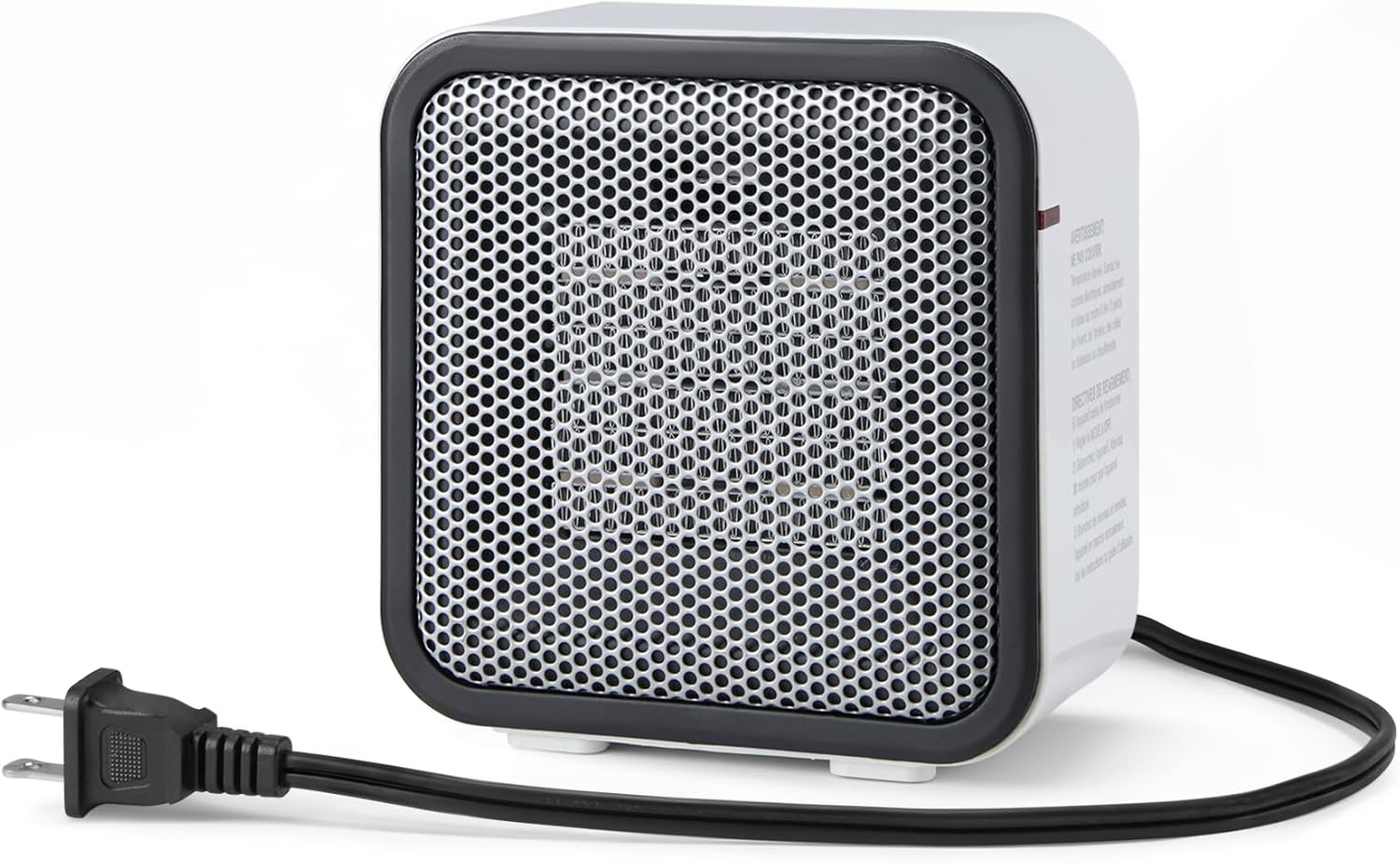
This Amazon Basics ceramic mini heater is a small, lightweight tabletop heater that delivers quick warmth from a 500-watt ceramic element. It is meant for one-person use at a desk, bedside, or other compact spots and produces heat rapidly while running quietly. The heater is portable and easy to reposition thanks to its 1.4 lb weight and compact footprint, and it includes basic safety with tip-over shutoff. It runs on standard 120V power and uses convection and radiant heating to raise local temperature; noise is modest at around 48 dB. Limitations are clear: at 500W it cannot heat large or very cold basement rooms and has only a single heat setting, so it is best for spot heating rather than whole-room comfort. The simple controls and low power draw make it an inexpensive, no-frills option when you need immediate localized warmth without complexity.
Best for: Buyers seeking a very inexpensive, portable heater for short-term spot heating in small areas like a workbench, desk, or a finished basement nook where quick local warmth is needed.
Less Ideal for: People who need to heat large, open, uninsulated basement rooms or want adjustable multi-speed heating controls should look at higher-powered heater options.
- Compact and very portable for moving between workspaces or small rooms
- Quick heat from a 500W ceramic element for rapid spot warming
- Built-in tip-over protection adds basic safety for tabletop use
- Quiet operation suitable for home office or bedside use
- Only one power/heat setting limits control over output
- 500W output is insufficient to heat large or poorly insulated basement spaces
Verdict: A very affordable, portable 500W heater that delivers fast spot warmth for small basement work areas or nooks.
DREO Space Heater HSH006

| Heat Output | 1500 watts |
|---|---|
| Heating Element | PTC Ceramic |
| Heating Coverage | 200 sq.ft |
| Number of Speeds | 4 |
| Min-Max Temperature | 41 °F – 95 °F |
This DREO tower heater is built to deliver quick, controllable warmth to small to medium rooms using a 1500W PTC ceramic element and forced-air circulation. It is typically used in bedrooms, offices or basements where you need on-demand heat and a modest footprint; the brushless DC motor and winglet fan design aim to keep operation quiet at about 34 dB. Controls include an adjustable thermostat with 1°F increments from 41 to 95°F, four speed/heat settings plus ECO and fan-only modes, a 12-hour timer and a handy remote for unattended adjustments. Safety is a clear focus: ETL listing, tip-over detection, overheat protection, flame-retardant materials and a safety plug reduce failure risks. Practical benefits for basement use are fast warm-up, precise thermostat control to avoid overheating damp spaces, and portability with a carry handle. Limitations are expected for a 1500W portable heater: it is sized for up to roughly 200 sq ft and will struggle to heat large or very uninsulated basements without supplemental insulation or a higher-capacity heater.
Best for: A buyer who values dependable, safety-focused portable heating for smaller finished basements or rooms and wants quiet, precise temperature control with remote operation.
Less Ideal for: Not a good fit for large, cold, poorly insulated basements that need high-capacity or continuous radiant heat; those spaces require larger or permanent heating solutions.
- Fast PTC ceramic heating that warms up quickly
- Precise thermostat control with 1°F increments for consistent temperature
- Multiple safety features including tip-over and overheat protection and ETL listing
- Quiet brushless DC motor design suitable for bedrooms or occupied basements
- Convenient remote control and 12-hour timer for unattended operation
- 1500W power limits effective coverage to about 200 sq ft, so not for large basements
- Tower form and forced-air heating provide less stored radiant warmth than oil-filled heaters
Verdict: Choose this DREO heater if you need a reliable, safety-focused 1500W portable heater that delivers quick, quiet, and precise warmth for small to medium basements.
GiveBest Portable Space Heater PTC-905

| Heat Output | 1500 watts |
|---|---|
| Heating Coverage | 200 sq.ft |
| Number of Speeds | 2 |
| Power Source | Corded Electric |
| Max Temperature Setting | 158 °F |
The GiveBest PTC-905 is a small ceramic space heater meant to warm single rooms and workspaces quickly. It offers two heat modes (1500W and 750W) plus a cool fan, and an adjustable thermostat that cycles the unit to maintain a chosen temperature without constant fiddling. The PTC ceramic element and high-speed fan produce fast, even warmth rated for up to about 200 sq ft, while the unit's lightweight, built-in carry handle makes it easy to move between a basement workbench, home office, or small living area. Safety features include overheat shutoff, tip-over protection with an alert beep, and flame-retardant housing. Practical limits are its small footprint and 2-speed control, which mean it is best for localized heating rather than whole-basement climate control, and it relies on a standard two-prong cord so placement needs a nearby outlet. For users who want quiet, targeted heat with basic automatic temperature control and strong safety protections, this model is an efficient, no-frills option.
Best for: Buyers who want a safe, quiet, and portable heater to provide quick localized warmth in a basement workspace or small finished area and who value easy, automatic temperature control.
Less Ideal for: People looking to heat a large or open-plan basement continuously or those who need advanced controls, multi-speed airflow, or hardwired installation should consider larger dedicated basement heating solutions.
- Two heat settings plus cool fan for year-round use.
- Adjustable electronic thermostat for automatic temperature control.
- Multiple safety features including overheat and tip-over shutdown.
- Compact, lightweight design with carry handle for easy placement.
- Limited to two fan speeds and basic controls rather than precise multi-zone management.
- Designed for spot heating so not intended to heat large or whole-basement areas effectively.
Verdict: A compact, safety-focused portable heater that delivers quick spot heat for smaller basement zones where quiet, automatic warmth is the priority.
Mr. Heater Portable Buddy F232000

| Heat Output | 9000 british thermal units |
|---|---|
| Heating Coverage | 225 |
| Fuel Type | Propane |
| Number of Speeds | 2 |
The Mr. Heater Portable Buddy is a compact radiant propane heater designed for quick spot heating in garages, patios, and basements where temporary warmth is needed. It offers two heat settings (low and high) that deliver up to 9,000 BTU and can heat roughly 225 square feet, running from a 1 lb. propane cylinder for several hours depending on the setting. The heater is built with safety features aimed at indoor use including a low-oxygen sensor, thermal shutoff, and tip-over switch, and its swivel regulator and optional adapter let you connect larger tanks with accessories. Practical benefits include easy portability with an integrated handle, fast radiant heat that feels like a small personal fire pit, and simple piezo ignition. Limitations are that it runs on propane so fuel must be stored and replaced, it produces open radiant heat rather than whole-room convection warmth, and proper ventilation and safety clearances are required for indoor basement use.
Best for: Homeowners who want a dependable, portable heater to warm a single basement zone quickly and who prioritize built-in safety features for indoor propane use.
Less Ideal for: People seeking a whole-basement heating solution or those unwilling to manage propane fuel and ventilation should look at electric convection or forced-air options instead.
- Produces up to 9,000 BTU with two heat settings for quick spot heating
- Safety systems include oxygen depletion sensor, thermal shutoff, and tip-over switch
- Runs on standard 1 lb propane cylinders and can adapt to larger tanks with accessories
- Lightweight design with an easy-grip handle for portable indoor or outdoor use
- Uses propane fuel which requires safe storage and periodic replacement
- Radiant heating is best for nearby warming rather than uniform basement heating
Verdict: Choose the Portable Buddy when you need a safe, portable propane heater that delivers fast radiant warmth to a single basement area.
Choosing the Right Space Heater for Basements: Key Factors to Consider
Heat Output and Room Coverage
Basements require adequate heat output to overcome cold concrete floors and poor insulation. Look at wattage and manufacturer coverage estimates to match the heater to your basement square footage.
A unit with adjustable heat settings and a programmable thermostat helps maintain a steady temperature without constant on-off cycling. If your basement has high ceilings or an open-plan layout, choose a model rated for larger coverage or consider combining a primary heater with supplemental radiant panels.
Safety and Overheat Protection
Basement environments increase the chance of accidental knocks, dust buildup, and moisture exposure, so safety features are critical. Seek heaters with tip-over shutoff, automatic overheat protection, and cool-touch housing to reduce burn and fire risk.
Also prefer models with robust electrical safety certifications and clear placement guidelines. Avoid settings where the heater sits on uneven ground or near fabrics and stored items that could obstruct airflow.
Energy Efficiency and Thermostat Control
Running a heater in a basement can add substantially to your energy usage if it lacks efficient controls. A precise thermostat, programmable timer, and eco or low-power mode help reduce runtime while keeping temperatures comfortable.
Look for models that allow temperature setpoints and have variable power levels so you can dial in heat instead of running at full power continuously. Better controls translate to lower operating costs and fewer temperature swings.
Moisture Resistance and Durability
Basements often have higher humidity and occasional dampness; materials and design should tolerate that environment. Metal housings with corrosion-resistant coatings, raised feet to keep the unit off mildly damp floors, and sealed control panels prolong service life.
Avoid heaters with exposed heating elements or open grills in basements that are prone to water intrusion. Regular cleaning to prevent dust accumulation also extends longevity.
Noise and Day-to-Day Comfort
If the basement is used as a living area, home office, or media room, noise level matters. Fan-forced heaters are effective but can produce audible sound at higher settings, while ceramic and oil-filled radiators are usually quieter.
Consider where the heater will sit relative to seating or sleeping areas and choose quieter operation if the space will be occupied for long periods.
Placement, Ventilation, and Safety Zone
Proper placement ensures efficient heat distribution and reduces hazards. Maintain manufacturer-recommended clearances from walls, furniture, and stored items, and place the heater on a stable, level surface.
Good ventilation helps prevent stale air and excessive moisture buildup. For finished basements with limited airflow, schedule periodic breaks or use a small fan to distribute warm air more evenly.
Types of Space Heaters Suitable for Basements
Different heater technologies offer tradeoffs in warmth, noise, and safety. Convection heaters and oil-filled radiators provide steady, quiet heat that is comfortable for finished basements and small living spaces. Fan-forced and infrared models deliver faster warm-up and more targeted heat for spot-warming an area.
When choosing, weigh how quickly you need the space to warm up against how long you will run the heater. For continuous background heat, low-noise convectors or oil-filled units are efficient. For occasional, immediate warmth in a work area, a fan-forced or infrared option can be a better match.
- Convection / oil-filled: quiet, steady, good for maintaining temperature
- Fan-forced: fast warm-up, adjustable fan speeds, more audible
- Infrared: direct radiant heat, efficient for occupants in the path
- Combination models: offer both fan and radiant modes for flexibility
Safe Installation and Placement Tips
Place the heater on a stable, level surface away from water sources, laundry appliances, and high-traffic storage zones. Keep at least the recommended clearance on all sides to ensure airflow and avoid fire hazards.
If your basement floor is concrete that can collect moisture, elevate the heater a few inches on a stable base or use a raised platform designed for appliances. Avoid placing units under shelves or in enclosed cubbyholes where heat can build up and controls may overheat.
- Maintain recommended clearances from walls and objects
- Keep cords away from walkways and moisture-prone areas
- Do not use extension cords unless the manufacturer explicitly allows them
- Position heaters where they can distribute warm air to main occupant areas
Managing Humidity and Indoor Air Quality
Heaters do not remove moisture and, in some cases, can exacerbate humidity-related problems if they encourage condensation on cold surfaces. Pair heating with a dehumidifier for damp basements or improve ventilation to reduce mold and musty odors.
Regular cleaning of filters and grills reduces dust circulation. If your basement has limited fresh-air exchange, open a small vent or run a fan periodically to avoid stagnant air.
- Use a dehumidifier in persistently damp basements
- Clean heater intakes and grills periodically to maintain airflow
- Monitor for condensation on walls and floors after running the heater
Power Considerations and Circuit Load
Most portable space heaters draw significant current, often on a dedicated 15 or 20 amp circuit. Check the circuit capacity for your basement outlets before running a heater alongside other high-draw appliances like washers or dehumidifiers.
Avoid plugging multiple heavy loads into the same circuit to reduce the risk of tripped breakers and overheating outlets. If the basement lacks adequate circuits, consider professional electrical upgrades to safely support continuous heater use.
- Know the amperage of the circuit you plan to use
- Do not run space heaters on extension cords unless rated for heater use
- Consider staggering operation times for other high-draw devices
Routine Maintenance to Extend Lifespan
Basic maintenance keeps a heater efficient and safe. Regularly dust and vacuum intake vents and clean accessible grills to prevent reduced airflow and overheating. Check power cords for frays or damage and replace any compromised units.
Store portable heaters in a dry place when not in use and inspect internal components if the unit shows signs of failure such as unusual smells, persistent tripping, or erratic controls.
- Clean vents and surfaces every few months or more often in dusty basements
- Inspect power cords and controls before each heating season
- Follow manufacturer guidance for filter changes or internal servicing
How We Chose the Best Space Heater for Basements
We focused on practical performance and safety attributes most relevant to basement heating. Our selection criteria emphasized consistent heat output measured by wattage and coverage estimates, safety systems such as tip-over shutoff and overheat protection, and design features that handle basement conditions like elevated humidity or limited ventilation. We also weighed energy efficiency and thermostat control to estimate operating cost and user comfort, plus build quality and clear user controls that reduce misuse risk. Noise levels were considered for finished basements used as living areas or offices. Units were excluded if they lacked basic safety certifications or were unsuitable for enclosed or damp environments. In short, we filtered for heaters that deliver dependable warmth, reduce safety hazards, and remain practical to run in typical basement layouts.
Our full evaluation process is outlined in our review methodology.
FAQ
Can I run a space heater in a finished basement overnight?
Running a heater overnight depends on the unit's safety features and the room setup. Use heaters with automatic shutoff, reliable thermostats, and tip-over protection. Ensure clearances and follow manufacturer instructions, and consider using a lower thermostat setpoint or timer to limit continuous runtime.
How large of a heater do I need for an unfinished basement?
Heater size depends on square footage, ceiling height, and insulation. Unfinished basements lose heat faster, so choose a higher wattage unit or multiple heaters to cover the area. Estimate required coverage from manufacturer guidance and allow extra capacity for poor insulation.
Are oil-filled radiators better for basement bedrooms?
Oil-filled radiators are often a good choice for basement bedrooms because they operate quietly and provide steady, long-lasting heat without exposed elements. They are slower to heat a space but maintain temperature efficiently for extended use.
Is it safe to use a space heater near laundry machines or water pipes?
Keep heaters away from water sources, laundry appliances, and piping to prevent contact with moisture and accidental splashes. Elevated placement and adequate distance reduce risks related to water exposure and electrical hazards.
Will a space heater increase mold risk in my basement?
A heater alone does not cause mold, but it can create temperature differences that lead to condensation on cold surfaces. Use a dehumidifier and improve ventilation alongside heating to control moisture and reduce mold risk.
Final Verdict
When picking a space heater for a basement, prioritize safety features and sufficient heat output for the room geometry and insulation level. Balance energy-efficient controls and thermostat accuracy against noise and warm-up speed to match how you use the space. For damp or unfinished basements, choose units with moisture-resistant designs and keep the heater elevated and well-ventilated. In short, pick a heater that meets your basement size and usage pattern, offers robust safety protections, and provides the controls needed to manage runtime and efficiency. That approach will keep the area comfortable while minimizing safety and operating concerns.