
Note: This article contains affiliate links. If you click on these links and make a purchase, we may earn a small commission at no extra cost to you. This helps support our research and content. Read our full affiliate disclosure here.
If you make pizza at home regularly, a mixer built to handle heavy, hydrated dough can save time and produce more consistent results than hand-kneading. A stand mixer for pizza dough needs robust torque, stable construction, and attachments that replicate the stretch-and-fold action dough requires. This guide lists seven shortlisted stand mixers that meet those needs and explains the key specs and features to weigh when choosing one. We evaluate motor strength, bowl capacity, durability, and dough-specific performance to help you pick the right mixer for thin-crust batches, high-hydration doughs, or frequent large-volume baking.
Top Picks at a Glance
| Best Overall The best all-around choice for most situations | NutriMill Artiste Stand Mixer |  |
| Best Quality Built to a higher standard if you want something more solid | ooni Halo Pro Spiral Mixer |  |
| Best Value The sweet spot between price and what you get | Aucma Stand Mixer 6.5QT |  |
| Best Budget The cheapest option that still gets the job done reliably | Kitchen in the box 3.2QT Stand Mixer | 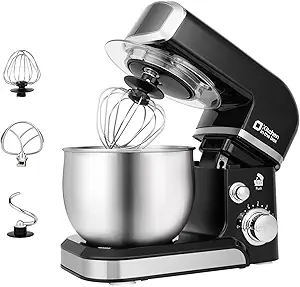 |
| Top Rated A top-rated pick with lots of positive feedback | Cuisinart Stand Mixer SM-50R |  |
| Most Popular A crowd favorite that many people choose with confidence | KitchenAid Classic Series 4.5-Qt Mixer |  |
| Best Seller A high-volume bestseller chosen again and again | KitchenAid Artisan 5-Qt Mixer |  |
NutriMill Artiste Stand Mixer

| Wattage | 500 watts |
|---|---|
| Number of Speeds | 6 |
| Capacity | 6.5 liters |
| Noise Level | 70 db |
The NutriMill Artiste is a bottom-drive stand mixer built to handle everyday baking and heavier doughs without the tilt-head bulk. Its 500 W motor delivers consistent torque through the bottom drive, and the supplied 6.5-quart bowl is roomy enough for multi-loaf bread or pizza dough batches up to the stated capacity. The mixer includes an extended dough hook and wire whips so you can knead, whip, and mix right away, while suction feet and a low-profile footprint help keep it stable on crowded counters. Six speed settings and a simple knob control make it easy to ramp up for kneading or slow mixing for delicate batters. Noise is moderate at about 70 dB, and the plastic bowl and included lid with access window make messy jobs neater. Limitations include a mostly plastic bowl material rather than stainless steel and a one-year warranty, so serious home bakers who want heavier-duty metal bowls or extended support may want to compare higher-end models. For typical home pizza dough and regular baking tasks, the Artiste balances power, capacity, and counter-friendly design effectively.
Best for: Home bakers who want a reliable, space-efficient mixer that can handle pizza dough and other heavy mixing tasks without a premium price tag.
Less Ideal for: Professional bakers or users who need all-metal bowls, extended warranties, or the highest-end long-term durability should consider commercial-grade or higher-tier mixers.
- Bottom-drive 500 W motor provides strong torque for kneading dough.
- Large 6.5-quart bowl handles multi-loaf or sizable pizza dough batches.
- Included extended dough hook and wire whips cover common mixing and kneading tasks.
- Suction feet and compact footprint increase stability on the counter.
- Simple six-speed knob control is easy to use and adjust while mixing.
- Mixing bowl is plastic rather than stainless steel.
- Noise level around 70 dB is noticeable during heavy kneading.
Verdict: Choose the NutriMill Artiste if you want a compact, bottom-drive mixer that reliably handles pizza dough and everyday baking at home.
ooni Halo Pro Spiral Mixer

| Capacity | 7.3 quarts |
|---|---|
| Wattage | 650 watts |
| Number of Speeds | 58 |
| Noise Level | 65 db |
| Voltage | 110 volts |
The ooni Halo Pro Spiral Mixer is built to bring professional spiral-mixer performance to a home kitchen, focusing on dough and pizza applications. It uses dual-kneading spiral technology with a rotating bowl, spiral hook, and removable breaker bar to develop strong gluten networks, which produces more consistent, extensible dough for high‑hydration pizza and artisan loaves. The unit includes four attachments — spiral hook, flexible beater, geared whisk, and breaker bar — so you can switch to whisking or beating for cakes and creams without swapping machines. Controls are touch based with 58 precise speed settings spanning roughly 60 RPM up to over 1000, letting you slow-knead or crank up for mixing tasks. At 650 watts and a reported noise level near 65 dB, it is reasonably powerful and not excessively loud for a heavy-duty mixer. The 7.3 quart removable stainless steel bowl handles large batches, but the mixer is relatively heavy and takes counter space like a pro-style appliance. For pizza bakers seeking restaurant-style dough handling at home, the Halo Pro delivers targeted, bakery-grade kneading while remaining versatile for general baking.
Best for: Home bakers and serious pizza makers who prioritize professional-style dough development and want precise speed control and specialized spiral kneading for better crust and crumb.
Less Ideal for: Casual bakers who only make small, occasional batches or need a lightweight, compact mixer for tight kitchens should consider simpler, smaller mixers.
- Spiral dual‑kneading system designed to develop stronger gluten for superior pizza and bread dough
- Wide 58-step speed control for precise mixing from slow knead to high-speed whisking
- Includes four attachments for dough, whisking, and beating without extra purchases
- Large 7.3 quart removable stainless steel bowl suitable for multi-batch pizza dough
- Relatively heavy and sizable, requiring substantial counter or storage space
- 650W motor may run hot on extremely long, heavy commercial sessions
Verdict: If you want bakery-grade pizza dough at home, the Halo Pro delivers professional spiral kneading and fine speed control in a single versatile mixer.
Aucma Stand Mixer 6.5QT

| Wattage | 660 watts |
|---|---|
| Capacity | 6.5 quarts |
| Number of Speeds | 6 |
| Voltage | 120 volts |
| Noise Level | 76 db |
This Aucma stand mixer targets home bakers who need a budget-friendly, high-capacity machine for heavy doughs like pizza. The 660W copper motor and dough hook are designed to handle sticky bread and pizza dough, while the 6.5‑quart stainless steel bowl provides enough room for multi‑loaf or large pizza batters. Its tilt‑head design makes attaching and removing the whisk, beater, and hook straightforward, and the splash guard helps keep ingredients contained when adding flour or water. Six speeds plus a pulse give fine control from whipping egg whites to kneading dense dough. Practical touches include non‑slip feet and dishwasher‑safe accessories for easier cleanup, though the ABS housing and 76 dB noise level mean it is not as quiet or as heavy‑duty feeling as premium metal‑body mixers. For routine pizza dough batches and general home baking this mixer offers capable performance at a modest price, but power users who make very large or extremely frequent batches may prefer a heavier commercial‑style machine.
Best for: Home bakers who prioritize practical performance and capacity for regular pizza dough and bread baking without paying for pro commercial units.
Less Ideal for: Commercial bakers or users who need a near‑silent, all‑metal, high‑duty mixer for continuous large‑volume production.
- 660W pure copper motor suitable for kneading dense doughs
- Generous 6.5‑quart stainless steel bowl for batch baking or multiple pizzas
- Includes whisk, dough hook, beater and splash guard for versatile mixing tasks
- Tilt‑head design and non‑slip feet make attachments easy to use and keep the unit stable
- Dishwasher‑safe attachments speed cleanup after dough or batter work
- Plastic (ABS) housing feels less durable than all‑metal mixers
- Noise level up to 76 dB can be noticeable during heavy kneading
Verdict: Aucma’s 6.5QT mixer gives home pizza bakers a powerful, roomy, and affordable machine that can reliably mix and knead everyday pizza dough.
Kitchen in the box 3.2QT Stand Mixer

| Capacity | 3.2QT |
|---|---|
| Power | 300 watts |
| Number of Speeds | 6 |
| Included Components | Whisk, Beater, Dough Hook |
This Kitchen in the box stand mixer is a lightweight, space-saving machine aimed at everyday home bakers and small households. It uses a 3.2QT stainless steel bowl, a tilt-head design, and planetary mixing to handle tasks like whipping cream, beating batters, and light dough mixing. The mixer includes an aluminum dough hook, flat beater, and a stainless-steel whisk, and offers six speed settings with a knob control for gradual speed adjustments. Four anti-slip suction feet and a transparent splash guard help keep the workspace tidy during use. At 300 watts and a compact footprint it is easy to store and simple to operate, making it practical for occasional baking and small batches. Important limitations are the small bowl capacity and modest motor power, so it will struggle with large pizza dough batches or heavy, dense doughs that a higher-capacity, higher-wattage mixer would handle more reliably.
Best for: Buyers who want an inexpensive, compact stand mixer for occasional baking, small batches, and kitchens with limited space and storage.
Less Ideal for: Serious home bakers who regularly make large pizza dough batches or need strong motor torque should choose a larger, higher-powered mixer instead.
- Compact, lightweight design that saves counter and storage space
- Includes three standard attachments (dough hook, flat beater, whisk) for basic baking tasks
- Six speed settings with knob control let you fine-tune mixing for different recipes
- Stainless steel removable bowl and dishwasher-safe accessories simplify cleaning
- 3.2QT bowl and 300W motor limit capacity and torque for large or very dense pizza doughs
Verdict: A budget-friendly, compact mixer that works well for small-batch doughs and everyday baking but is not built for heavy, large pizza doughs.
Cuisinart Stand Mixer SM-50R

| Capacity | 5.5 quarts |
|---|---|
| Motor power | 500 watts |
| Number of speeds | 12 |
| Controls type | Knob |
This Cuisinart stand mixer is built around a 500-watt motor and a 5.5-quart stainless steel bowl that make it well suited for mixing and kneading pizza dough for family-size batches. The die-cast metal construction and 12-speed knob control let you start slow for hydration and ramp up for kneading without hunting for the right setting, while the tilt-back head makes attaching the dough hook and removing the bowl straightforward. Included accessories cover common tasks and the splash guard with pour spout keeps flour and water contained during messy dough mixes. The mixer is heavier than compact hobby units, which helps stability during long kneads, and the bowl plus accessories are dishwasher-safe for easier cleanup. It does not advertise planetary action details or professional bakery-grade attachments out of the box, so very large or continuous heavy-duty commercial dough workloads may push it harder than intended.
Best for: Home bakers who prioritize a solid, reliable mixer for regular pizza dough batches and want a durable metal machine that stays stable during kneading.
Less Ideal for: Commercial kitchens or bakers who need a machine rated for continuous heavy-duty production or those who require a mixer with specialized professional dough features.
- 500-watt motor provides enough power for regular pizza dough batches
- 5.5-quart stainless steel bowl handles family-size dough quantities
- Die-cast metal body and heavier weight improve stability during kneading
- 12 speed settings give fine control from slow mixing to aggressive kneading
- Tilt-back head and included splash guard make attachment changes and messy mixes easier
- Not specified as a commercial or continuous-use bakery machine for heavy professional workloads
- No specialized planetary action detail or included specialty dough-specific attachments beyond the basic dough hook
Verdict: A sturdy 5.5-quart mixer with a 500W motor and 12 speeds that reliably handles family-size pizza dough batches at home.
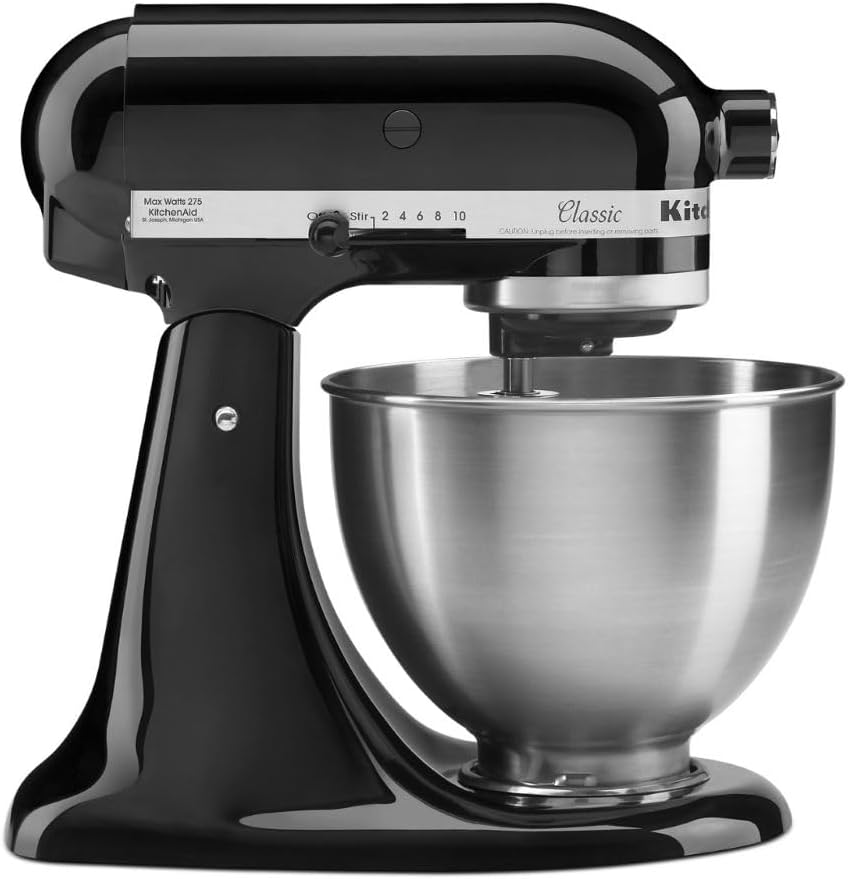
KitchenAid Classic Series 4.5-Qt Mixer
| Capacity | 4.5 quarts |
|---|---|
| Wattage | 275 watts |
| Number of Speeds | 10 |
| Included Components | Bowl, flat beater, dough hook, 6-wire whip |
The KitchenAid Classic Series 4.5-Quart tilt-head stand mixer is a straightforward, workhorse appliance for home bakers. It mixes, whips, and kneads using a 275-watt motor and 10 speed settings, and it ships with a stainless steel bowl plus a coated flat beater, dough hook, and wire whip for common tasks. The tilt-head design makes adding ingredients and changing attachments quick, and the mixer includes a power hub to run optional attachments such as grinders and pasta makers. For pizza dough specifically, the included coated dough hook and 4.5-quart bowl handle typical home batches comfortably and the metal construction feels stable under load. Expect reliable, consistent mixing results thanks to the 59 touchpoints around the bowl that promote thorough incorporation. Limitations include a mid-range motor compared with heavier-duty commercial machines and a 4.5-quart capacity that may be tight for very large or multiple dough batches, but for most home pizza makers this mixer provides durable, familiar performance and broad accessory support.
Best for: Home bakers who want a reliable, well-known stand mixer that can mix and knead single to medium pizza dough batches and who value proven design and wide accessory support.
Less Ideal for: People who regularly make very large or commercial quantities of dough or who need a higher-power, industrial-grade mixer for continuous heavy use.
- Sturdy metal construction that feels durable during kneading
- Includes coated dough hook, flat beater, and 6-wire whip for common mixing tasks
- Tilt-head design allows easy ingredient addition and attachment changes
- 10 speed settings provide control from slow mixing to high-speed whipping
- Power hub supports optional attachments to expand functionality
- 275-watt motor is less powerful than heavy-duty or commercial mixers
- 4.5-quart bowl can be limiting for very large pizza dough batches
Verdict: A dependable, classic stand mixer that handles typical home pizza dough batches with stable performance and broad attachment options.
KitchenAid Artisan 5-Qt Mixer

| Capacity | 5 quarts |
|---|---|
| Wattage | 325 watts |
| Number of Speeds | 10 |
| Voltage | 120 |
The KitchenAid Artisan 5-Quart Tilt-Head Stand Mixer is a durable, full-featured kitchen mixer built for everyday and larger-batch baking tasks. It uses a metal housing and a powerful 325-watt motor with 10 speeds to handle tasks from stirring and whipping to kneading dough; the 5-quart stainless steel bowl with a comfortable handle can mix up to roughly nine dozen cookies or multiple loaves of dough in one batch. The tilt-head design makes adding ingredients and changing attachments straightforward, and the mixer accepts a wide range of optional hub-driven accessories for shredding, grinding, and pasta making. Practical benefits include consistent mixing across speed settings, a dishwasher-safe bowl for cleanup, and a broad color selection to match kitchens. Limitations are the tilt-head layout, which can be less convenient than a bowl-lift for very heavy doughs, and the mixer is a substantial countertop appliance that needs a stable surface and storage space.
Best for: Home bakers who prioritize a reliable, proven mixer for regular baking and dough-making and prefer a straightforward, low-risk purchase backed by a durable design.
Less Ideal for: Users who need a bowl-lift mixer specifically for very heavy commercial-style doughs or those who require a compact, lightweight portable mixer.
- 5-quart stainless steel bowl handles large batches, including multiple loaves or dozens of cookies
- Durable metal construction designed for long-term use
- 10-speed control covers gentle stirring through high-speed whipping
- Tilt-head design makes adding ingredients and swapping accessories easy
- Tilt-head style can be less stable than bowl-lift mixers for very heavy doughs
- Relatively heavy and requires dedicated counter or storage space
Verdict: Choose this KitchenAid Artisan if you want a durable, versatile stand mixer that reliably handles home pizza dough and large baking batches.
Choosing the Right Stand Mixer for Pizza Dough: Key Factors to Consider
Motor Torque and Sustained Power
Kneading pizza dough, especially high-hydration or whole-grain formulas, requires more torque than light mixing tasks. A motor with strong starting torque and the ability to run at low speeds for extended periods reduces the chance of motor strain and overheating. Look for specifications that mention continuous-duty capability rather than peak watts alone.
In practical terms, higher torque helps maintain consistent mixing action when the dough tightens around the hook. This affects gluten development and final crust structure because the mixer can work the dough thoroughly without stalling or needing frequent rest periods.
Bowl Capacity and Shape
Bowl capacity determines how much dough you can make in a single batch. For two to four medium pizzas, a larger bowl is more convenient and reduces the need to split recipes. Bowl shape matters too: a rounded bowl with a low center helps the hook reach all the dough, ensuring even development.
If you plan to scale recipes or bake for a family, choose a capacity that leaves room for the dough to expand during mixing. Tight fills lead to poor mixing and uneven hydration. Consider the physical size of the mixer and whether the bowl fits comfortably on your countertop.
Dough Hook Geometry and Attachment
The design of the dough hook impacts how efficiently it kneads. Spiral or C-shaped hooks that match the bowl profile will fold and stretch dough with fewer dead zones. Attachment stability is also critical; a wobbling or loose hook interrupts consistent mixing and increases wear on gears.
Compatibility with additional attachments can be useful, but for pizza-making the hook's shape and reach are the primary concerns. A well-designed hook reduces mixing time and delivers more uniform gluten structure.
Build Quality and Stability
A heavy, well-balanced mixer resists walking and vibration during long kneading cycles. Metal gears or reinforced drive systems generally outlast plastic gearing when subjected to repeated heavy loads. The stand and base should feel solid so the machine remains stable at low speeds when torque is highest.
Durability affects long-term ownership cost and reliability. If you bake pizza frequently, prioritize machines with proven mechanical construction and sturdy materials to avoid premature failure.
Ease of Cleaning and Maintenance
Dough contact surfaces should be easy to remove and clean. Smooth, dishwasher-safe bowls and hook finishes speed cleanup after sticky dough mixes. Sealed motor housings and accessible attachment points reduce the chance of debris buildup that can lead to maintenance issues.
Consider how often you will be making pizza and whether frequent disassembly is practical. Simpler cleaning routines increase the likelihood that you will keep the machine sanitary and in good working order.
Why Torque Matters More Than Peak Wattage
Many manufacturers list wattage, which can be misleading for dough work because it does not directly indicate torque at low speeds. For kneading, the ability to deliver steady torque at slow RPMs is what prevents stalling and ensures thorough gluten development. A mixer with a lower wattage but a gear reduction system optimized for torque can outperform a higher-wattage motor designed for whipping.
When evaluating specs, look for wording about continuous-duty ratings or gear-driven torque. Practical signals of good torque performance include the machine's ability to handle dense mixtures without loud strain noises, and user-accessible controls that allow low-speed, sustained kneading.
- Prefer mixers with gear reduction or direct-drive systems optimized for low-speed torque
- Watch for manufacturer notes about continuous-duty capability
- Physical weight and base design often correlate with stability under torque
Sizing Batches for Home Pizza Making
Match bowl size to your typical pizza workload. A small bowl may be fine for a single 10-inch pie, but families or small gatherings require larger-capacity bowls to mix multiple dough balls at once. Overfilling a bowl reduces mixing efficiency and increases kneading time.
Also consider the type of dough you prefer. High-hydration Neapolitan-style dough spreads and needs more headroom, while low-hydration doughs are more compact. Plan capacity with both dough type and batch count in mind.
- Leave space in the bowl for dough expansion during mixing
- Factor in hydration level when estimating needed capacity
- Consider storage and counter footprint of larger mixers
Attachments and Versatility Beyond Dough
While dough performance is the priority for pizza makers, a versatile mixer that accepts additional attachments can handle sauces, vegetable prepping, and other kitchen tasks. Consider whether the mixer's head and hub design support common accessory types and whether accessories are easy to attach and remove.
That said, do not sacrifice dough-specific performance for a long list of extras. Prioritize a machine that kneads reliably, and view additional attachments as useful but secondary benefits.
- Check whether the motor and gearing can handle non-dough attachments safely
- Verify ease of swapping attachments during busy prep sessions
- Consider storage for extra accessories if countertop space is limited
Noise, Heat, and Practical Use During Long Kneading Cycles
Long kneading cycles can generate heat and noise. Some motors are better at dissipating heat, letting you run longer batches without hitting thermal cutoffs. Quieter operation matters if you bake early in the morning or in apartments where sound travels.
Look for designs with good ventilation and user feedback indicating reasonable noise levels. In many cases, a slightly heavier machine with a well-damped base will feel quieter and more controlled during operation.
- Prefer models with thermal protection and good ventilation
- Consider user environment and acceptable noise levels
- Long mixing times are less stressful on robust drive systems
Countertop Space and Storage Considerations
Stand mixers designed for dough are often heavier and taller than small countertop appliances. Measure the intended storage spot and the clearance needed to lift the bowl and attachments. If the mixer will remain on the counter, ensure it fits comfortably and leaves room for other prep tasks.
If you plan to store the mixer in a cabinet, check weight and how easy it is to move. Frequent lifting of a heavy machine can be impractical, so balance capacity and build quality with your storage habits.
- Measure height and width including bowl and attachment clearance
- Assess whether the mixer will be stored on the counter or in cabinets
- Consider handles or grips that make moving heavy mixers easier
How We Chose the Best Stand Mixer for Pizza Dough
We focused on attributes that directly affect how well a stand mixer handles pizza dough and on real-world usability for home bakers. Evaluation criteria included motor torque and sustained power to ensure the mixer can knead dense or high-hydration dough without stalling. Bowl capacity and shape were considered so users can mix typical pizza recipes and scale up for multiple pies. We assessed dough hook design and attachment stability because those determine mixing efficiency and gluten development. Build quality and drive-train reliability were reviewed to predict long-term performance under heavy kneading cycles. Ease of cleaning and accessory compatibility were included to measure day-to-day convenience. We excluded mixers that are primarily designed for light tasks such as whipping or small-batch mixing where kneading performance is marginal. We also filtered out models with insufficient motor ratings or small bowls that limit practical pizza dough batches. Our choices emphasize machines that balance sustained torque, usable capacity, durable construction, and user-friendly maintenance.
Our full evaluation process is outlined in our review methodology.
FAQ
Can a handheld mixer handle pizza dough instead of a stand mixer?
A handheld mixer is usually not suited to heavy pizza dough because it lacks the sustained torque and stability required for thorough kneading. Hand mixers can work for very small, low-hydration doughs, but they often overheat or struggle with denser batches.
How large a bowl do I need to make two medium pizzas at once?
For two medium pizzas, plan for a bowl that comfortably holds at least 4 to 6 quarts, leaving room for hydration and expansion. Exact needs depend on your dough hydration and whether you are mixing additional ingredients in the same batch.
Is a heavy mixer base important for kneading?
Yes. A heavier, well-balanced base reduces walking and vibration, which improves kneading consistency and reduces stress on the drive system. Lightweight mixers are more likely to move when under heavy load.
How long should I knead pizza dough in a stand mixer?
Kneading time varies by recipe and hydration, but many home pizza doughs reach good gluten development in 5 to 10 minutes on low to medium-low speed. Watch dough elasticity and windowpane tests rather than timing alone.
Will a higher-wattage mixer always be better for pizza dough?
Not necessarily. Wattage alone does not equal torque. A mixer with optimized gearing and torque delivery at low speeds can knead dough more effectively than a higher-wattage motor that is not configured for heavy loads.
Final Verdict
Choosing a stand mixer for pizza dough depends on balancing torque, bowl capacity, and durability against your typical batch sizes and kitchen layout. Prioritize sustained low-speed torque and a hook shape that matches the bowl for the best gluten development. Consider ease of cleaning and a stable base if you plan to knead frequently. Ultimately, pick a mixer sized for the dough volumes you make most often and built to withstand repeated heavy kneading cycles. That approach minimizes frustration and delivers more consistent pizza crusts over the long term.