
Note: This article contains affiliate links. If you click on these links and make a purchase, we may earn a small commission at no extra cost to you. This helps support our research and content. Read our full affiliate disclosure here.
Picking the right steel knife sharpener matters because a properly honed blade improves safety, reduces cutting effort, and prolongs the life of your knives. Whether you sharpen daily or only occasionally, the right sharpener will match the steel type and edge angle you use most and make maintenance quick and repeatable. This guide shortlists seven leading steel knife sharpeners across common styles and use cases, and evaluates them on practical factors like edge retention, ease of use, and blade compatibility. Read on for the features that matter and concise guidance to help you pick the best sharpener for your kitchen routine.
Top Picks at a Glance
| Best Overall The best all-around choice for most situations | Henckels Fine Edge Sharpening Steel |  |
| Best Quality Built to a higher standard if you want something more solid | WÜSTHOF 9" Honing Steel |  |
| Best Value The sweet spot between price and what you get | Victorinox Swiss Classic 10" Honing Steel |  |
| Best Budget The cheapest option that still gets the job done reliably | LUFFEXX 12-Inch Honing Rod |  |
| Top Rated A top-rated pick with lots of positive feedback | Utopia Kitchen 12" Honing Rod |  |
| Most Popular A crowd favorite that many people choose with confidence | ALLWIN 12-Inch Carbon Honing Rod |  |
| Best Seller A high-volume bestseller chosen again and again | Kota Japan Diamond Sharpening Rod |  |
Henckels Fine Edge Sharpening Steel

| Material Type | Stainless Steel |
|---|---|
| Grit Type | Fine |
| Included Components | Sharpening Steel |
The Henckels Fine Edge 9" sharpening steel is a straightforward honing rod for keeping knives performing between full sharpenings. Made from stainless steel with a fine grit finish and a comfortable polypropylene handle, it is used by drawing the knife blade along the rod at the correct angle to realign the cutting edge. The ergonomic, weight-centered handle helps with control and makes the rod comfortable for repeated use, while the 9" length suits most chef and utility knives. Because it is a honing steel rather than an abrasive stone, it straightens and refines an edge rather than removing significant metal, so it is best for regular maintenance rather than restoring very dull or chipped blades. The tool is easy to clean and low maintenance, and the included instructions help beginners learn proper technique. Backed by a lifetime warranty, this rod is a simple, reliable option for home cooks who want to keep knives ready for everyday tasks.
Best for: Home cooks who want an easy, low-maintenance tool to keep knives sharp between professional or stone sharpenings and value a comfortable, well-balanced hand tool.
Less Ideal for: People who need to restore heavily dulled, chipped, or reshaped blades should choose a whetstone or powered sharpener instead.
- Stainless steel construction provides durable, corrosion-resistant honing
- Fine grit surface effectively straightens and refines knife edges for daily use
- Ergonomic polypropylene handle with balanced weight improves control during honing
- 9-inch length fits most chef and utility knives for consistent contact along the blade
- Not an abrasive sharpener so it cannot reprofile very dull or damaged edges
- No multiple grit options for progressive sharpening needs
Verdict: A reliable, well-balanced honing rod that keeps everyday knives aligned and ready with simple, regular maintenance.
WÜSTHOF 9" Honing Steel

| Included Components | Honing Steel |
|---|---|
| Material Type | Steel, plastic |
| Grit Type | Ultra Fine |
The Wüsthof 9" Honing Steel is a simple, workmanlike rod for keeping chef and utility knives cutting smoothly between sharpenings. The grooved, magnetic steel rod helps capture metal filings and the ultra-fine grit surface gently realigns edges rather than removing large amounts of metal, so it is best used frequently to maintain performance rather than as a full resharpening tool. The textured composite handle and protective bolster give a secure grip during use, and the nine-inch length provides good blade coverage for most kitchen knives. It lacks a hanging loop, so storage is typically in a block or drawer, and because it is an ultra-fine honing steel it will not replace a whetstone or multi-stage sharpener for fixing chips or very dull blades. Built to Wüsthof standards and backed by a lifetime warranty, it is a durable, no-frills maintainer for cooks who prioritize edge performance day to day.
Best for: Buyers who want a precise, everyday edge maintainer to preserve knife performance and prefer a simple, durable tool from a respected cutlery maker.
Less Ideal for: People who need to restore heavily dulled or damaged blades and require a whetstone or multi-stage sharpener to remove material and reshape edges.
- Grooved magnetic rod captures metal fibers during honing
- Ultra-fine grit realigns edges without heavy material removal
- Textured composite handle with protective bolster for a secure grip
- Nine-inch length offers broad coverage for most kitchen knives
- Covered by a lifetime warranty
- Not suitable as a primary tool for sharpening very dull or chipped blades
- No hanging loop for wall storage
Verdict: A rugged, ultra-fine 9-inch honing steel that keeps high-performance knives at peak cutting readiness between full sharpenings.
Victorinox Swiss Classic 10" Honing Steel

| Material Type | Stainless Steel |
|---|---|
| Grit Type | Fine / Medium |
| Item Type Name | Swiss Classic Steels 10" Continental Cut Black |
| Number of Items | 1 |
The Victorinox Swiss Classic 10" honing steel is a professional-style rod meant to maintain and realign kitchen knife edges rather than remove metal like a true sharpener. It is typically used by drawing the blade along the steel at a consistent angle several times per side to roll the edge back into alignment, which helps knives cut cleanly with less frequent full sharpening. The steel is chrome-plated industrial brush stainless steel for durability and improved stain resistance, and the textured Swiss Classic handle gives a secure grip for controlled strokes. At 10 inches it handles most chef and slicing knives comfortably and its balanced weight makes routine use easy. Because it is a honing tool it will not restore a badly dulled or nicked edge, so occasional sharpening with stones or a dedicated sharpener is still needed. The straightforward build, lifetime warranty, and simple technique make it a practical choice for cooks who want to keep blades performing between proper sharpenings.
Best for: Buyers who want a simple, durable tool to keep kitchen knives cutting reliably between professional or stone sharpenings and prefer low-maintenance care.
Less Ideal for: If you need to restore severely dull, chipped, or damaged blades you should choose a sharpening stone or abrasive sharpener instead.
- Maintains and realigns knife edges to extend time between full sharpenings
- Chrome-plated stainless steel construction offers hardness and stain resistance
- Textured Swiss Classic handle provides a comfortable, secure grip
- 10-inch length accommodates most kitchen knives and allows controlled strokes
- Does not remove metal or fix severely dull or damaged edges
- Requires proper technique and consistent use to be effective
Verdict: A rugged, easy-to-use 10-inch honing steel that keeps knives performing between full sharpenings.
LUFFEXX 12-Inch Honing Rod

| Material Type | High Carbon Steel |
|---|---|
| Grit Type | Fine |
| Item Count | 1 |
This 12-inch LUFFEXX honing rod is a straightforward steel sharpener for restoring edge alignment and refining blades between full sharpening sessions. Made from nickel-chrome plated high-carbon steel with a fine grit, it is held in a molded handle with an anti-roll base and a hanging hook for easy storage. In practice it realigns burrs and improves cutting performance in seconds, making prep safer and faster for home cooks. The plated finish resists corrosion and the magnetic surface captures metal filings for cleaner use, and cleanup is just a wipe with a dry cloth. It is not a replacement for abrasive stones or guided systems when you need to reprofile very dull or damaged blades, and users should learn basic stropping angle and light, consistent strokes to avoid overworking the edge. For the price and simplicity this rod delivers a durable, low-maintenance way to keep knives serviceable between more intensive sharpening sessions.
Best for: Buyers seeking an affordable, no-frills tool to keep kitchen knives sharp between major sharpening sessions will appreciate this rod for routine home use.
Less Ideal for: If you need to restore severely dull, chipped, or reshaped blades, or you prefer guided sharpening systems, this honing rod is not the complete solution.
- Long 12-inch rod covers large chef blades comfortably
- High-carbon steel with nickel-chrome plating for effective honing and corrosion resistance
- Anti-roll base and hanging hook for safe storage and stability
- Magnetic surface helps collect metal filings for cleaner sharpening
- Fine-grit steel is intended for realigning edges, not re-profiling very dull or damaged blades
Verdict: A budget-friendly 12-inch high-carbon steel honing rod that keeps knives serviceable with quick, low-maintenance touch-ups.
Utopia Kitchen 12" Honing Rod

| Material Type | Carbon Steel |
|---|---|
| Grit Type | Fine |
| Item Weight | 0.33 kg |
| Item Dimensions L x W x H | 17"L x 2"W x 3"H |
This 12-inch honing rod is built for routine maintenance of kitchen and utility knives rather than major reprofiling. The carbon steel rod is nickel-chrome plated and finished fine, so it straightens and refines edges without removing large amounts of metal. Use it by drawing the blade across the rod at a consistent angle several times per side to restore a razor-like bite between full sharpenings. The ergonomic handle and slip-resistant base give a confident grip during use and the hanging loop keeps it handy in a busy kitchen. Practical benefits include wide compatibility with standard and serrated blades and easy upkeep by wiping and air-drying; avoid the dishwasher. The fine grit and relatively narrow rod make it quick for touch-ups but not a substitute for a whetstone or coarse sharpener when a blade is very dull or damaged.
Best for: Buyers who want a reliable, easy-to-use tool for regular edge maintenance and who prioritize a solid, no-frills steel rod that holds up to frequent use.
Less Ideal for: If you need to repair chipped edges or reshape bevels, choose a coarse stone or dedicated sharpening system instead.
- Nickel-chrome plated carbon steel construction for durable, fine honing.
- Ergonomic, non-slip handle and rubber base for secure control during use.
- 12-inch length offers good reach for most kitchen and utility knives.
- Hanging loop allows convenient storage and quick access.
- Fine finish is for maintenance only and will not reprofile heavily dulled or damaged blades.
- Not dishwasher safe; requires hand care and drying to prevent corrosion.
Verdict: A straightforward, durable 12-inch steel honing rod that reliably keeps kitchen knives sharp with regular touch-ups.
ALLWIN 12-Inch Carbon Honing Rod
| Material Type | Carbon Steel |
|---|---|
| Grit Type | Super Fine |
| Item Count | 1 |
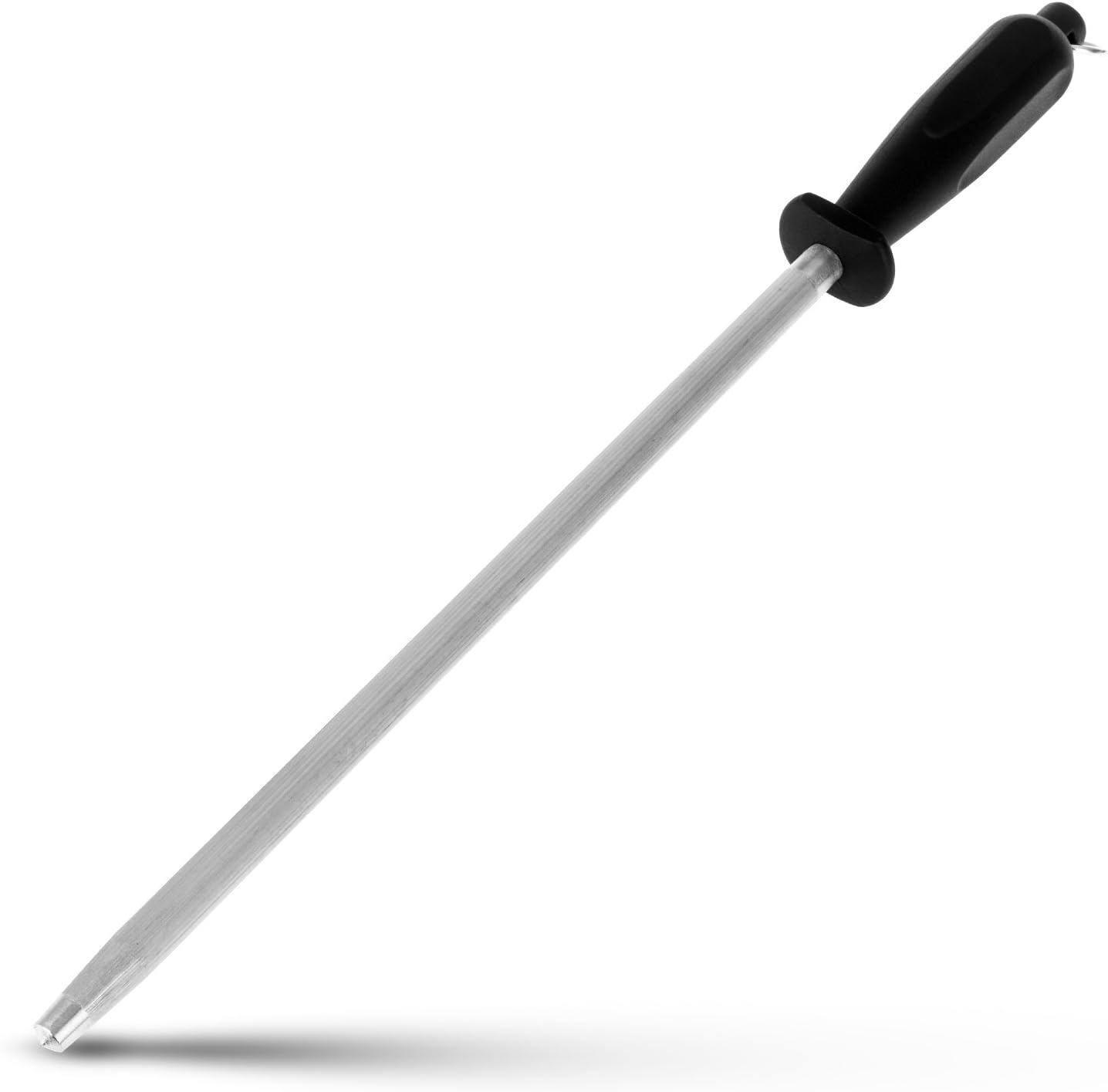
This 12-inch carbon steel honing rod is built to realign knife edges for smoother cutting during everyday meal prep. You use it by holding the rod steady—its anti-slip metal tip braces on a board or countertop—and running a knife blade along the rod at a gentle angle to restore edge alignment without removing significant metal. The hardened carbon-steel rod is durable for frequent home use and its super-fine grit is suited to finishing and maintenance rather than heavy re-profiling. The textured non-slip handle gives a secure grip when hands are damp, and the hanging loop makes storage simple. Practical touches like the stable metal tip and chef‑knife–friendly length make it a useful daily tool, though it will not replace a sharpening stone when a blunt or damaged edge needs material removed. For cooks who want quick, low‑effort edge maintenance, this honing rod keeps knives performing between full sharpenings.
Best for: Home cooks who prioritize maintaining a consistently sharp knife edge with quick, low-effort touch-ups and who rely on community reviews to confirm reliable everyday performance.
Less Ideal for: Someone who needs to re-profile very dull or damaged blades or prefers a tool that both sharpens and hones in a single pass should look at sharpening stones or powered sharpeners instead.
- Durable hardened carbon steel construction for frequent maintenance use
- Super-fine grit suitable for finishing and daily edge realignment
- Textured non-slip handle and hanging loop for secure use and easy storage
- Anti-slip metal tip allows stable bracing against a cutting board
- Not designed to remove metal or repair heavily dulled or chipped blades
Verdict: Buy this if you want a simple, durable honing rod that keeps kitchen knives aligned for reliable day-to-day cutting.
Kota Japan Diamond Sharpening Rod

| Material Type | Carbon Steel |
|---|---|
| Grit Type | Ultra Fine |
| Number of Items | 1 |
| Unit Count | 1 Count |
The Kota Japan Diamond Sharpening Rod is an oval, diamond-electroplated carbon steel rod intended for routine sharpening and honing of kitchen and outdoor blades. You use it like a traditional honing steel: secure the plastic tip, hold the rod steady, and draw the blade heel-to-tip at the recommended angle a few times per side. The diamond coating gives a more aggressive cutting surface than plain steels, so it removes burrs and re-profiles edges faster while still allowing a light touch. Its ultra-fine grit makes it suitable for finishing an edge after coarser work or for maintaining factory edges between full sharpening sessions. The oval profile helps maintain consistent contact but it will slowly remove metal, so it is best used for maintenance rather than heavy material removal. The plastic tip and compact single-piece design make it easy to store and use in the kitchen or in the field, though users seeking non-abrasive honing only should consider a ceramic rod instead.
Best for: Buyers who want a reliable, easy-to-use maintenance tool to keep kitchen or hunting knives sharp between full sharpening sessions and who prefer a product with predictable, proven performance.
Less Ideal for: People who only want to realign edges without removing any metal or those who need an abrasive system for heavy reshaping of very dull or damaged blades.
- Diamond-electroplated surface sharpens and finishes edges faster than plain steel
- Ultra-fine grit suitable for edge maintenance and finishing after coarse sharpening
- Oval profile promotes consistent blade contact for even honing
- Light pressure required, making it easy to control and safer for less experienced users
- Removes metal over time so it is not ideal for purely gentle honing
- No handle material or ergonomic details provided beyond a plastic tip
Verdict: A compact diamond-coated rod that gives predictable, fast edge maintenance for cooks and outdoorsmen who want a dependable everyday sharpener.
Choosing the Right Steel Knife Sharpener: Key Factors to Consider
Edge Restoration
How effectively a sharpener restores a keen cutting edge determines how many passes you need and how well the knife will cut afterward. A device that quickly re-establishes a burr and refines it to a clean edge reduces time at the counter and lowers the risk of uneven cutting. For many home cooks, the goal is a balance between rapid correction of a dull edge and gentle refinement that preserves blade geometry.
If the sharpener removes too much metal it shortens blade life, while a device that only hones without rebuilding an edge can leave significantly dull knives marginally improved. Consider how frequently you plan to sharpen and whether the tool can move from coarse restoration to fine polishing or if you will need secondary steps.
Ease of Use
A sharpener should be straightforward and safe for routine use. Look for intuitive guides, stable bases, or comfortable handles that help you maintain a consistent angle and stroke. Models that require complex setups or precise angling with no guides are better suited to experienced users, while home cooks often benefit from simple guided slots or ergonomic steels that promote repeatable results.
Also consider how easy it is to store and deploy the tool during meal prep. Faster, low-effort maintenance encourages regular honing, which keeps knives performing well and reduces the need for aggressive sharpening.
Blade Compatibility
Not all sharpeners work equally well with every blade profile. Consider the typical knives you own, including their steel type, edge angle, and whether they have serrations. Many steel sharpeners are optimized for straight edges and standard angles used on chef knives, utility knives, and paring knives. If you have high-angled blades or very thin Japanese-style knives, ensure the sharpener can match or accommodate those angles without damaging the edge.
Serrated knives usually need specialized treatment, so verify whether the device is intended for serrations or only for plain edges. A versatile sharpener that handles multiple blade sizes and shapes reduces the need for additional tools.
Safety and Handling
Sharpening involves exposed cutting edges, so stability and protective features matter. A secure grip, non-slip base, or finger guards reduce the chance of slips and accidental cuts. Safe operation also depends on how the tool positions the blade relative to your hands and whether it keeps the cutting edge moving away from your body.
Think about whether the sharpener's maintenance actions are comfortable to perform repeatedly. Tools that force awkward wrist positions or need high pressure raise the risk of accidents and make consistent sharpening harder.
Durability and Materials
The materials and construction determine how long the sharpener will keep working as intended. Hardened steels, ceramic rods, or well-bonded abrasive surfaces resist wear and maintain effective grit levels. Inexpensive coatings or soft materials can degrade quickly, reducing sharpening performance and increasing long-term cost.
Also consider corrosion resistance and how easy parts are to clean. A durable sharpener should tolerate routine handling, occasional food debris, and normal kitchen humidity without rapid decline.
Maintenance and Upkeep
Some sharpeners require periodic cleaning, resurfacing, or replacement rods to maintain performance. Understand what maintenance the unit needs and whether replacement parts are readily available. Simple cleaning routines and modular parts that can be swapped without special tools make it easier to keep the sharpener effective.
Maintenance burden affects long-term value. A tool that needs frequent recalibration or specialized upkeep may deliver better edges but will demand more attention than most home cooks want to give.
Types of Steel Sharpeners and How They Work
Steel sharpeners come in a few common forms: guided slot sharpeners that use fixed angles, handheld honing steels or rods that realign and refine the edge, and combination tools that pair ceramic or abrasive rods with guided slots. Guided units make it easy to achieve consistent angles, while rods and steels require more user control but offer quick maintenance and portability.
Understanding how each type interacts with a blade helps you choose the right tool for your routine. Guided devices often handle dull edges faster, while honing steels are ideal for frequent touch-ups between full sharpenings.
- Guided sharpeners: fixed-angle slots for repeatability.
- Honing steels: realign and polish edges with simple strokes.
- Combination tools: offer coarse to fine stages in one unit.
Matching Sharpening Angle to Your Knives
Different knives are ground to different edge angles, and matching a sharpener to those angles preserves blade geometry. Many Western-style chef knives use angles around 20 degrees per side, while thinner Asian blades use smaller angles. Guided sharpeners sometimes offer multiple angle settings; with rods you must control the angle manually.
If you are unsure of your knives' angles, choose a versatile sharpener that supports a range of common settings or opt for a honing steel to maintain edges between more precise sharpening sessions.
- Estimate angle by manufacturer guidance or by measuring with simple angle tools.
- When in doubt, pick a slightly wider angle for durability over extreme sharpness.
Daily Maintenance Vs Full Sharpening Sessions
Daily or weekly honing keeps an edge aligned and reduces the frequency of aggressive material removal. Use a honing steel or fine ceramic rod for routine maintenance after use to keep knives cutting well. Full sharpening with abrasives is needed when a blade is noticeably dull or damaged.
Establish a simple routine: frequent light honing and less frequent abrasive sharpening. This approach preserves blade life and keeps performance consistent for common kitchen tasks.
- Hone after heavy use or when slicing resistance increases.
- Use coarser abrasives only when the edge loses its profile or has chips.
Safe Sharpening Practices
Always secure the tool or blade before applying pressure. A non-slip surface under a guided sharpener or a firm clamp for bench-mounted tools reduces movement. Keep your fingers behind the cutting edge during each stroke and use controlled, steady passes rather than aggressive sawing motions.
Inspect the blade for nicks and clean it before sharpening to avoid embedding debris into abrasive surfaces. Wear protective gloves only if you are comfortable and trained in their use, and prioritize stable, repeatable angle work to reduce the chance of slips.
- Work slowly and deliberately for the first passes to establish the burr.
- Wipe the blade clean after sharpening to remove abrasive residue.
Caring for the Sharpener Itself
Maintain your sharpener per the manufacturer's care instructions. Abrasive surfaces can clog with metal particles and food debris; periodic cleaning keeps them cutting effectively. Ceramic rods and steels can be wiped or rinsed, while some guided units benefit from occasional surface dressing or replacement of wear elements.
Store the sharpener in a dry place to prevent corrosion and avoid dropping ceramic components, which can fracture if mistreated.
- Clean rods with a cloth after every few uses.
- Replace worn abrasive elements to preserve performance.
How We Chose the Best Steel Knife Sharpener
We focused on tools that produce repeatable, serviceable edges while minimizing risk to common kitchen blades. Our selection emphasized sharpeners and honing steels that accommodate standard chef knives and common edge angles without aggressive stock removal. Key evaluation criteria included the effectiveness at restoring a keen edge, the ease and safety of operation for everyday users, and compatibility with a wide range of blade types and sizes. We also prioritized durability and maintenance needs so a chosen sharpener will perform well over time. We excluded tools that require extensive setup, specialized training, or are intended only for industrial or professional sharpening systems. Products that damaged edges, used unsafe guides, or had poor build quality were not considered. The final list balances real-world usefulness, safety, and longevity across typical home-kitchen scenarios.
Our full evaluation process is outlined in our review methodology.
FAQ
How often should I use a steel knife sharpener?
Often depends on use, but many home cooks benefit from honing a few times per week and doing full sharpening every few months. Frequent light maintenance reduces the need for aggressive reshaping.
Can I use a steel sharpener on all my kitchen knives?
Most steel sharpeners work on plain-edged chef, utility, and paring knives, but not all are suitable for very thin Japanese blades or serrated edges. Check compatibility with your blade profile and angle before use.
Will regular sharpening damage my knives?
Regular honing does not damage knives and actually extends their useful life by preventing excessive dulling. Aggressive abrasive sharpening, if done too frequently, removes metal and shortens blade life, so follow a balanced maintenance routine.
What is the difference between a honing steel and a sharpener?
A honing steel realigns and polishes the existing edge without removing much metal, making it ideal for routine maintenance. A sharpener with abrasives removes material to re-form the edge and is used when the blade is dull or has chips.
How do I know when a knife needs full sharpening?
When honing no longer restores cutting performance, when the blade has visible nicks, or when it fails common slicing tests, it is time for full sharpening. Loss of edge geometry or persistent dullness after maintenance signals the need for abrasives.
Final Verdict
Prioritize a sharpener that matches how you use and maintain your knives. For most home cooks, tools that balance effective edge restoration, simple operation, and safe handling deliver the best long-term results. Keep up light honing to reduce the need for aggressive sharpening, choose a device compatible with your blade angles, and maintain the sharpener so it stays effective. With the right balance of ease and capability, you can keep kitchen knives performing well without unnecessary risk to blades or users.