
Note: This article contains affiliate links. If you click on these links and make a purchase, we may earn a small commission at no extra cost to you. This helps support our research and content. Read our full affiliate disclosure here.
If you want café-style espresso with minimal effort, a super-automatic espresso machine simplifies the daily routine by automating grinding, tamping, brewing, and in many cases milk texturing. Choosing the right model matters because machines in this class vary widely in grind quality, temperature stability, and how easy they are to clean and maintain. This guide covers our top five shortlisted super-automatic espresso machines under $1,000, chosen for consistent shot quality, user-friendly controls, and manageable long-term upkeep. Below we outline what to expect from this price range and which evaluation points we used to narrow the field.
Top Picks at a Glance
| Best Overall The best all-around choice for most situations | Ninja AutoBarista AE1001 |  |
| Best Quality Built to a higher standard if you want something more solid | PHILIPS 5500 Series EP5544/94 | 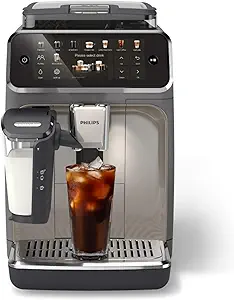 |
| Best Value The sweet spot between price and what you get | De'Longhi Magnifica Evo ECAM29084SB |  |
| Most Popular A crowd favorite that many people choose with confidence | PHILIPS Series 3300 EP3341/50 |  |
| Best Seller A high-volume bestseller chosen again and again | Ninja Luxe Café Premier ES601 |  |
Ninja AutoBarista AE1001

| Operation Mode | Fully Automatic |
|---|---|
| Wattage | 1650 watts |
| Coffee Input Type | Ground, Whole Bean |
| Capacity | 250 g |
The Ninja AutoBarista AE1001 is a super-automatic espresso machine designed to deliver a broad range of café-style drinks with minimal effort. It accepts whole beans or ground coffee, uses an integrated grinder with 50 grind settings to tailor extraction, and produces 9-bar espresso with real crema alongside presets for drip-style coffee and rapid cold brew. FrothPerfect milk technology offers hands-free microfoam in several styles, hot or iced, and the touchscreen interface plus 10 one-touch drink options makes it easy to select lattes, cappuccinos, Americanos and more. Practical features include an auto-rinse and self-drying interior to simplify maintenance and a built-in water filter housing with cleaning supplies included. Trade-offs are its large footprint for smaller counters and the complexity of a built-in grinder and milk system that may need routine cleaning and occasional descaling; power draw is relatively high at 1650 watts. For buyers seeking versatile, café-quality drinks at home without manual steaming or repeated barista steps, the AutoBarista covers nearly every base under a single machine.
Best for: Buyers who want a single, versatile machine that consistently produces a wide range of café-style hot and iced drinks with minimal manual brewing or steaming effort.
Less Ideal for: Those with very limited counter space or buyers who prefer a simple manual espresso setup and hands-on control over every extraction step.
- Built-in grinder with 50 grind settings for tailored fresh-ground extraction
- Ten one-touch drink presets that cover hot and iced options including cold brew
- Automated milk frothing with multiple microfoam styles for consistent texture
- Auto-rinse and self-drying features plus included cleaning accessories to simplify maintenance
- Large physical footprint that requires substantial counter space
- Integrated systems (grinder and frother) require regular cleaning and occasional descaling
Verdict: Choose the Ninja AutoBarista AE1001 when you want an all-in-one, fully automatic machine that grinds, brews, and froths to deliver café-style drinks at home with one-touch convenience.
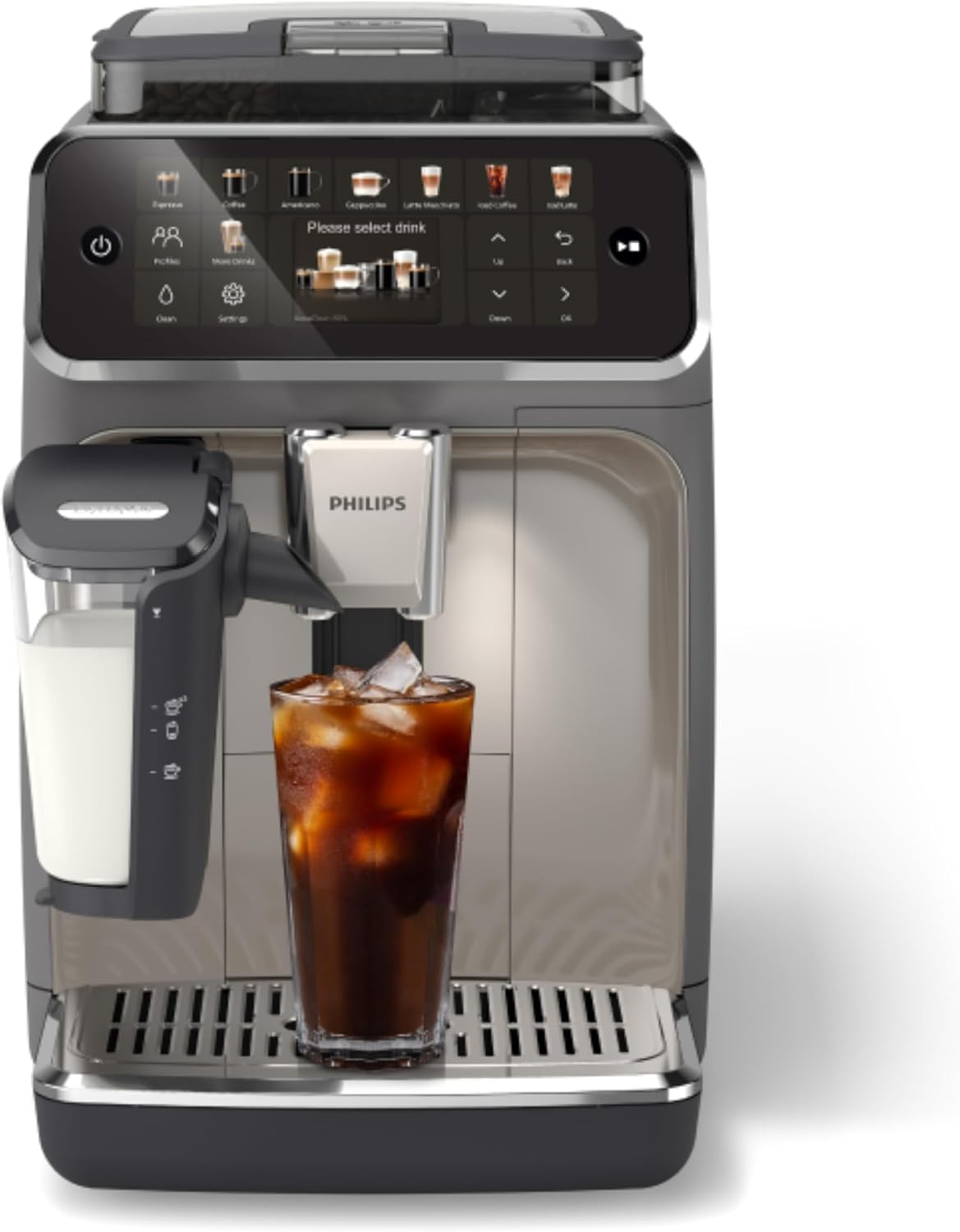
PHILIPS 5500 Series EP5544/94
| Operation Mode | Fully Automatic |
|---|---|
| Output Pressure | 15 bar |
| Coffee Input Type | Ground, Whole Bean |
| Wattage | 1500 watts |
| Capacity | 1.8 liters |
The Philips 5500 Series EP5544/94 is a super-automatic espresso machine that grinds, tamps, brews and steams milk at the push of a button, making cafe-style drinks with minimal fuss. Use its color touchscreen to choose from 20 presets or customize strength, volume and milk froth, then save profiles for repeat drinks. The integrated ceramic grinder and 15-bar pump aim for consistent extraction while SilentBrew reduces grinding and brewing noise, and QuickStart gets the machine ready in about three seconds. The LatteGo milk system produces smooth milk froth and is very simple to clean because it has only a few parts and no hidden tubes. Practical benefits include fast single-button operation, quiet performance, and the option to use whole beans or ground coffee. Limitations include a higher initial cost compared with basic machines and the need for routine cleaning and descaling to keep the grinder and milk system performing at their best.
Best for: Buyers who prioritize consistent extraction, quiet operation, and fast one-touch preparation for a range of drinks and who want to replicate cafe-style results at home.
Less Ideal for: If you want a bare-bones manual machine for hands-on espresso crafting or need the lowest possible purchase price, this automated, feature-rich unit is not the best fit.
- One-touch operation with 20 presets and customizable strength, volume and milk level
- Built-in ceramic grinder and 15-bar pump for consistent extraction
- LatteGo milk system produces smooth froth and is quick to clean
- QuickStart ready-to-brew in about 3 seconds and quieter operation via SilentBrew
- Requires regular cleaning and occasional descaling to maintain performance
- Higher upfront cost compared with entry-level espresso machines
Verdict: Choose the Philips 5500 if you want a fast, quiet super-automatic that delivers consistent, cafe-style drinks with easy milk frothing and programmable presets.
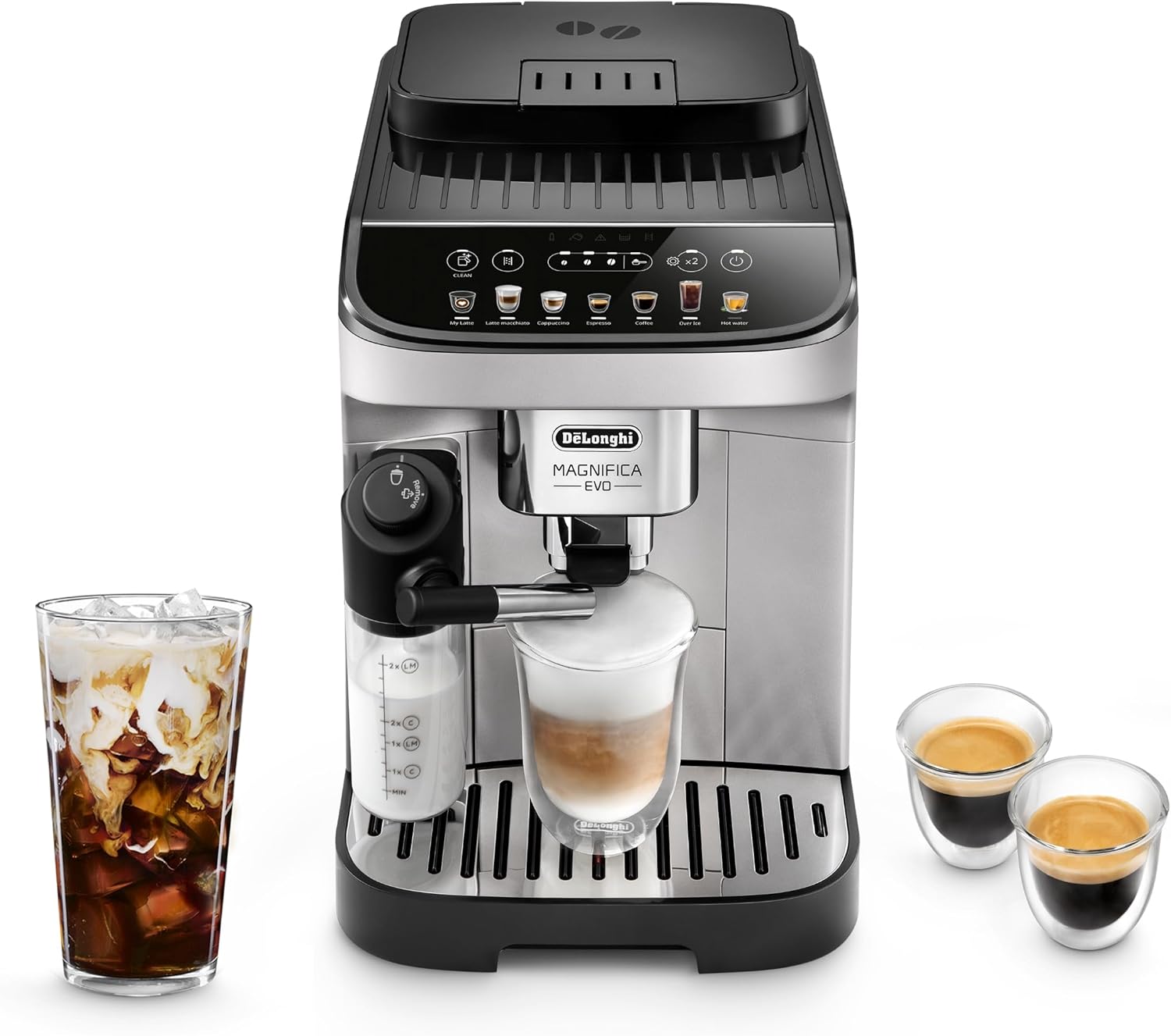
De'Longhi Magnifica Evo ECAM29084SB
| Operation Mode | Fully Automatic |
|---|---|
| Output Pressure | 15 bar |
| Coffee Input Type | Whole Bean |
| Wattage | 1250 watts |
| Capacity | 60 fluid ounces |
The De'Longhi Magnifica Evo is a compact super-automatic espresso machine that grinds, doses, brews, and textures milk with minimal user intervention. It offers seven one-touch or customizable drinks, a conical burr grinder with 13 grind settings for fresher extraction, and the LatteCrema system to produce stable, silky milk foam that can be stored in the fridge between uses. A touchscreen panel and user profile options make it easy to program and save preferences, while removable dishwasher-safe parts and an auto-clean function simplify maintenance. Practical features such as an adjustable output pressure (15 bar), a reusable filter, and a 60 fl oz water capacity reduce refill frequency for daily use. Expect good café-style espresso and milk drinks without the manual steps required by semi-automatic machines, but be aware the machine still needs routine descaling and cleaning of the brewing unit and milk circuit, and its plastic construction keeps it lightweight rather than premium-feeling. For buyers focused on consistent, everyday convenience and repeatable drinks, this model hits the essential marks.
Best for: Buyers who want a practical, countertop-ready super-automatic that delivers consistent espresso and milk drinks with minimal daily effort and easy programming.
Less Ideal for: Those seeking a heavyweight, all-metal commercial build or users who prefer fully manual control and hands-on barista technique.
- One-touch access to seven preset and customizable beverages for fast, repeatable drinks
- Built-in conical burr grinder with 13 grind settings for fresher, adjustable extraction
- LatteCrema milk system produces consistent, silky foam and is removable for fridge storage
- Touchscreen controls and user profiles let multiple users save personalized drink settings
- Removable, dishwasher-safe components and an auto-clean function simplify upkeep
- Mostly plastic construction lacks the heavier, premium feel of higher-end machines
- Requires regular descaling and milk-circuit cleaning to maintain performance
Verdict: A feature-rich, user-friendly super-automatic that delivers cafe-style espresso and milk drinks with reliable one-touch convenience under $1,000.
PHILIPS Series 3300 EP3341/50

| Operation Mode | Fully Automatic |
|---|---|
| Output Pressure | 15 bar |
| Coffee Input Type | whole bean |
| Capacity | 1.8 liters |
| Wattage | 1500 watts |
The Philips Series 3300 EP3341/50 is a user-friendly super-automatic espresso machine that grinds, tamps, brews, and textures milk at the push of a button. It offers six hot and iced presets—including espresso, coffee, cappuccino, and latte macchiato—and a color touchscreen for quick selection and customization of strength, volume, and temperature. The LatteGo milk module produces smooth milk for café-style drinks and is designed for fast cleaning with just three parts and no internal tubing, and the AquaClean filter extends time between descales. A ceramic grinder and 15-bar pump aim to preserve bean flavor and deliver consistent extraction, while SilentBrew technology reduces operating noise. Practical trade-offs are routine maintenance steps like emptying the grounds, replacing filters, and occasional guided descaling, and the machine uses a plastic-heavy construction that may feel less premium than metal-bodied competitors. For buyers wanting straightforward daily specialty drinks without manual steaming, it balances convenience and performance well under $1,000.
Best for: Buyers who prioritize easy, repeatable specialty coffee at home and want clear social-proof that the machine performs reliably without complex setup or barista skills.
Less Ideal for: People seeking a fully metal, pro-grade build or those who want manual steam wand control for advanced milk texturing should consider other models.
- One-touch presets for hot and iced drinks simplify daily use
- LatteGo milk system produces smooth milk and is quick to clean
- AquaClean filter reduces frequency of descaling for lower upkeep
- Ceramic grinder preserves flavor and offers consistent grind quality
- Quiet operation compared with prior models thanks to SilentBrew technology
- Predominantly plastic construction may feel less durable than metal alternatives
- Requires regular filter changes and occasional descaling to maintain performance
Verdict: A convenient, low-hassle super-automatic that delivers café-style drinks with a fast-to-clean milk system and sensible maintenance features for everyday home use.
Ninja Luxe Café Premier ES601

| Operation Mode | Fully Automatic |
|---|---|
| Wattage | 1650 watts |
| Coffee Input Type | Ground, Whole Bean |
| Filter Type | Reusable |
The Ninja Luxe Café Premier ES601 is a guided, fully automatic 3-in-1 machine that handles espresso, drip coffee, and rapid cold brew without a steep learning curve. It uses a built-in conical burr grinder with 25 settings and weight-based dosing to grind and dose beans, an assisted tamper to press the puck, and Barista Assist technology to walk you through each step. Hands-free frothing comes from a dual froth system that pairs a magnetic whisk with an automatic steamer and a self-cleaning steam wand to reduce maintenance. Practical touches include a 70 oz removable water reservoir, reusable filter, built-in accessory storage, and several preset drink sizes and strengths for consistent results. At 1650 watts it delivers the power needed for quick brewing but the machine is fairly large and heavy, so it requires a permanent countertop spot. Users seeking fully manual control or a compact travel-friendly unit may find it more machine than they need, and repair complexity for integrated grinders and electronics can be higher than for simpler machines.
Best for: Buyers who want an easy, guided route to café-style drinks at home and prioritize consistent results and automated milk-frothing over manual espresso techniques.
Less Ideal for: People who need a compact or lightweight travel-friendly unit or those who prefer full manual control and simpler, easily serviceable components.
- Combines espresso, drip coffee, and rapid cold brew in one machine for wide drink versatility.
- Integrated conical burr grinder with 25 settings and weight-based dosing for consistent extraction.
- Barista Assist guides reduce guesswork for beginners and speed up learning.
- Hands-free dual froth system and self-cleaning steam wand simplify milk drinks.
- Large removable water reservoir and built-in accessory storage improve daily convenience.
- Bulky and heavy so it needs dedicated countertop space.
- Integrated systems (grinder, electronics) make servicing more complex than basic machines.
Verdict: If you want one countertop machine that reliably produces espresso, drip coffee, and cold brew with guided automation and built-in frothing, the Ninja Luxe Café Premier ES601 is an easy all-in-one choice under $1,000.
Choosing the Right Super-Automatic Espresso Machine: Key Factors to Consider
Grind Quality and Built-In Grinder
A super-automatic integrates a grinder and brewer, so grinder performance is central to shot consistency. Look for adjustable grind settings, a consistent burr type, and stable dose control to avoid under- or overextraction.
Coarse or inconsistent grind distribution leads to channeling and weak crema, while excessively fine or uneven grind can clog the brew path. For home use under $1,000, prioritize machines with stepwise or stepless grind adjustments and burrs designed for espresso rather than coarse drip coffee.
Brew Temperature and Thermal Management
Temperature stability affects flavor balance. Machines with robust heating systems, predictable preinfusion, and minimal thermal drift produce more consistent shots from the same bean and recipe.
In this price band, look for clear temperature presets or the ability to fine-tune brew temperature. Consistent temperature reduces the need to compensate with grind or dose adjustments and makes dialing in a bean faster.
Milk System Design and Steam Performance
If you drink milk-based drinks, the milk circuit or steam wand design matters. Integrated milk systems can auto-texture efficiently but vary in how easily they clean and how much control they offer over microfoam.
Consider whether you prefer automatic milk frothing for convenience or an external steam wand for manual control. Evaluate how the milk circuit is accessed and cleaned because milk residue left behind can affect flavor and require frequent maintenance.
Maintenance, Cleaning, and Descaling
Daily and periodic cleaning determine real ownership cost and convenience. Removable brew groups, easily emptied drip trays, and clear descaling procedures save time and reduce long-term issues.
Machines that provide guided cleaning cycles, user-replaceable filters, and accessible internal components reduce the chance of buildup and mechanical problems. Under $1,000, favor units where routine tasks can be completed without tools and where consumables are widely available.
Capacity and Usability for Home Routines
Consider water tank and bean hopper size relative to how often you make espresso. Larger capacity lowers refill frequency but can increase staling of beans if you do not buy in small quantities.
Also assess the user interface and programmable drink presets. Clear menus, physical buttons for common drinks, and the ability to save custom profiles streamline daily use and reduce the time spent dialing in shots each morning.
Durability and Repairability
Materials and serviceability affect how long the machine will remain reliable. Metal components in high-wear areas, replaceable seals, and accessible parts extend usable life and simplify repairs.
Check whether the brew group is removable for cleaning and whether common wear items can be replaced by the owner or a local technician. Investing a little time to verify these traits prevents surprising downtime and costly service visits.
What to Expect From Machines Under $1,000
At this price point you can expect integrated grinders with usable grind ranges, decent thermal control, and automatic milk functions on many models. You will typically get features designed for home convenience rather than commercial duty cycles.
Understand that compromises are common: hopper and water tank sizes may be modest, and grinder quality will vary. Expect to do some routine cleaning and occasional descaling to maintain taste and reliability.
- Integrated grinder suitable for daily home use
- Programmable shot and milk presets on many models
- Routine maintenance required to preserve flavor
Dialing In a Consistent Espresso Shot
Start with a single-bean profile and set the grind one notch finer than the coarsest setting that still produces some resistance during extraction. Pull a shot and evaluate 25 to 35 seconds as a typical extraction window for a double shot, adjusting grind and dose gradually.
If shots run too fast and taste sour, move to a finer grind or increase dose slightly. If shots are slow and bitter, coarsen the grind or reduce dose. Small, incremental changes work best with super-automatics because built-in grinders often change output significantly with minor adjustments.
- Target extraction time and visual flow rather than just relying on presets
- Make one change at a time and document results
- Use freshly roasted beans and store them properly to preserve oils
Milk Texturing Tips for Auto-and Manual Systems
For automatic milk systems, purge hot water and run a short cleaning cycle before and after use to prevent buildup. When evaluating foam quality, check how quickly the system produces dense microfoam and whether drink temperature meets your preference.
If a machine includes a manual steam wand, practice positioning the wand tip near the surface for stretch and then deeper for texturing. Manual wands offer more control but require some technique and extra cleaning attention.
- Purge and clean milk circuits daily
- Experiment with milk temperature and froth level presets
- Manual steam wands need brief post-use wipedowns and periodic deep cleaning
Routine Cleaning Schedule
Establish a simple routine: empty the drip tray and puck container daily, rinse or refill the water tank, and run any manufacturer-supplied cleaning cycles weekly. Monthly descaling or water filter checks depend on your local water hardness and machine prompts.
Keep replacement parts like seals and water filters on hand if you use the machine heavily. Staying on top of routine tasks reduces the chance of flavor issues and mechanical faults in the long run.
- Daily: empty drip tray, purge milk circuit if used
- Weekly: clean brew group if removable and run maintenance cycles
- Monthly: check water hardness and perform descaling when indicated
Energy Use and Placement in Your Kitchen
Super-automatic machines typically draw significant power during heating cycles, so place the unit near a grounded outlet and avoid extension cords. Machines with rapid heat-up times can be left on for quick access, but turning them off overnight reduces standby energy use.
Also consider ventilation and clearance for the steam wand, water tank access, and the bean hopper lid. Positioning the machine so you can easily empty waste and refill water makes daily use smoother.
- Provide 2 to 4 inches of clearance around the unit for ventilation
- Place near an accessible water source for frequent refills
- Avoid putting under low cabinets that could be damaged by steam
How We Chose the Best Super-Automatic Espresso Machine
We prioritized machines that deliver reliable extraction and consistent crema across a range of beans, since even small differences in grinder quality and brew temperature affect daily results. We evaluated grind-to-shot integration, looking for built-in grinders with adjustable settings and stable dose control. Thermal management was a second filter. Models that maintain stable brew temperature and offer predictable preinfusion scored higher because temperature swings cause sour or underextracted shots. Milk steaming performance and steamer design were weighed for buyers who want cappuccinos or lattes without a separate device. We also scored machines on ease of cleaning and serviceability, favoring units with accessible brew groups, removable milk circuits, and clear descaling processes. Usability criteria included intuitive controls, programmable profiles, and practical water-and-bean capacity for daily home use. Finally, long-term reliability indicators such as durable materials and straightforward replacement parts influenced inclusion. Excluded from consideration were machines that require complex third-party modifications to perform well, units with nonstandard service parts, and models lacking basic safety or descaling features. The shortlist reflects machines that balance extraction quality, milk performance, and reasonable upkeep within the under $1,000 constraint.
Our full evaluation process is outlined in our review methodology.
FAQ
How often should I descale a super-automatic espresso machine?
Descaling frequency depends on your water hardness and how often you use the machine. Many owners on moderate water hardness follow a two- to three-month cadence, while those with very hard water may need monthly descaling or a water-softening solution.
Can I use preground coffee with a super-automatic machine?
Some models offer a bypass doser for preground coffee, but using whole beans is generally recommended for best crema and flavor. Preground coffee can speed extraction and lead to less vibrant shots, so only use it for convenience or when the grinder is unavailable.
What is the lifespan of a super-automatic espresso machine?
Lifespan varies with usage, maintenance, and build quality. With regular cleaning, timely part replacements, and moderate daily use, a well-made machine can last many years. Poor maintenance, especially of the milk system and brew group, shortens service life.
Is an automatic milk frother better than a steam wand?
Automatic milk frothers offer consistent convenience and are easier for daily nontechnical use. Steam wands provide more control and can produce superior microfoam for latte art, but they require practice and more diligent cleaning.
How do I adjust grind settings on a built-in grinder?
Adjustments vary by machine, but the best practice is to make small incremental changes and test the resulting extraction. Change one setting at a time, pull a shot, and evaluate extraction time and flavor before making further tweaks.
Final Verdict
When shopping for a super-automatic espresso machine under $1,000, focus on the grinder quality, thermal stability, and how the machine handles milk if that matters to you. Balance convenience features against the effort required for cleaning and routine maintenance. Prioritize models that make routine tasks easy and provide access to serviceable parts. That approach delivers consistently better espresso and fewer surprises down the road, enabling you to pick a machine that fits your daily routine and long-term expectations.