
Note: This article contains affiliate links. If you click on these links and make a purchase, we may earn a small commission at no extra cost to you. This helps support our research and content. Read our full affiliate disclosure here.
When temperatures climb, a well-chosen table fan can make living spaces more comfortable without turning on central air. You want a model that delivers steady airflow, runs quietly, and fits on a bedside table or desk. This guide shortlists seven top table fans for summer use and explains how each type meets common home cooling needs. We evaluated options for airflow control, noise, and day-to-day convenience so you can pick a fan that suits your room size and sleeping or working habits. Read on to see the top picks and the criteria to use when choosing the right fan.
Top Picks at a Glance
| Best Overall The best all-around choice for most situations | Vornado 133 Compact Air Circulator |  |
| Best Quality Built to a higher standard if you want something more solid | DREO TurboPoly 11" Table Fan |  |
| Best Value The sweet spot between price and what you get | Amazon Basics Air Circulator FT19-16AB |  |
| Best Budget The cheapest option that still gets the job done reliably | Gaiatop USB Desk Fan TF30 | 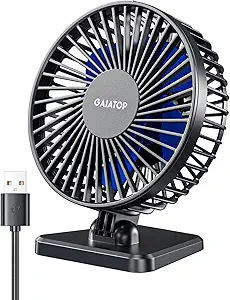 |
| Top Rated A top-rated pick with lots of positive feedback | IRIS USA WOOZOO Desk Fan PCF-HE15N |  |
| Most Popular A crowd favorite that many people choose with confidence | Honeywell TurboForce HT-900 |  |
| Best Seller A high-volume bestseller chosen again and again | Honeywell TurboForce HT-904 |  |
Vornado 133 Compact Air Circulator

| Number of Speeds | 2 |
|---|---|
| Noise Level | 44 db |
| Wattage | 25 watts |
| Air Flow Capacity | 350 cfm |
| Control Type | Control Dial |
The Vornado 133 is a compact tabletop circulator designed to deliver focused, room-moving airflow from a small footprint. It uses Vornado's Vortex technology with a deep-pitched blade and spiral grille to push air effectively up to about 25 feet, and the head tilts so you can direct airflow vertically or horizontally. Controls are simple: a two-speed dial and a toggle-style switch make operation intuitive for desk or nightstand use. At 25 watts and about 44 dB on its higher setting, it balances power and modest noise for personal comfort without dominating a small room. The detachable grille helps keep the fan clean, and the plastic construction keeps it lightweight and easy to move. Limitations include only two speeds and basic manual controls, so it lacks fine-grain speed adjustment or timers, and plastic parts mean it is not as premium-feeling as larger metal fans. For summer use it excels at targeted cooling and air circulation in small spaces but is not intended to replace larger whole-room fans.
Best for: Buyers who want a reliable, no-frills tabletop fan that delivers strong directional airflow for personal cooling in bedrooms, dorms, or home offices while prioritizing simplicity and small size.
Less Ideal for: People seeking precise speed control, smart features, or a fan intended to cool large open-plan rooms should look at larger or more feature-rich models instead.
- Compact footprint fits on desks, nightstands, and small tables
- Vortex technology circulates air effectively up to roughly 25 feet
- Adjustable tilt head for directing airflow where needed
- Detachable grille for easier cleaning
- Low power draw (25 watts) for energy-efficient operation
- Only two speed settings limit fine control of airflow
- Plastic construction feels less durable than metal alternatives
- No timer, remote, or advanced controls for automation
Verdict: If you need a compact, easy-to-use tabletop circulator that pushes air efficiently for personal summer cooling, the Vornado 133 is a solid, no-frills choice.
DREO TurboPoly 11" Table Fan

| Air Flow Capacity | 750 cfm |
|---|---|
| Noise Level | 25 db |
| Number of Speeds | 4 |
| Wattage | 40 watts |
| Control Method | Remote, Touch |
The DREO TurboPoly 11" table fan is designed to move a lot of air from a small footprint, using an AC motor and a custom blade to push up to 750 CFM as far as 65 feet. It is typically used on desks, nightstands, or small room tabletops where targeted whole-room circulation is needed; the 90° horizontal oscillation and 120° manual tilt let you direct airflow to eliminate hot spots. Controls are flexible with four speed settings, remote and touch operation, and an 8-hour timer for overnight use. Notable practical benefits include a detachable front grille and blades for easier cleaning, a relatively quiet rated noise level around 25 dB for bedroom use, and an included remote for convenient adjustments. The fan runs on 40 watts and is freestanding, so it is simple to position but lacks wall- or stand-mounting options. The plastic construction keeps weight low but may feel less premium than metal alternatives, and the tilt is manual rather than motorized which requires occasional repositioning by hand.
Best for: Buyers who prioritize strong, measurable airflow from a compact table fan and need quiet, controllable circulation for bedrooms or home offices.
Less Ideal for: People looking for premium metal construction, motorized tilt, or dedicated mounting options should consider other fan types.
- High airflow capacity (750 CFM) suitable for whole-room circulation from a tabletop
- Remote and touch controls with four speeds and an 8-hour timer for flexible use
- Quiet operation around 25 dB, appropriate for bedrooms and offices
- Detachable front grille and blades for straightforward cleaning
- Plastic construction may feel less durable compared with metal-bodied fans
- Tilt adjustment is manual rather than motorized, requiring hands-on repositioning
Verdict: Choose this fan when you want compact, high-performance tabletop airflow with quiet operation and convenient remote control.
Amazon Basics Air Circulator FT19-16AB

| Power Source | Corded Electric |
|---|---|
| Number of Speeds | 3 |
| Wattage | 35 watts |
| Noise Level | 60 db |
| Special Features | Adjustable Tilt |
This Amazon Basics table air circulator is a small, no-frills fan intended to boost airflow in bedrooms, home offices, and living areas. It uses a 35-watt corded motor driving three 7-inch plastic blades and offers a back-mounted rotary knob with three speed settings plus off. The head tilts up to 90 degrees so you can aim airflow precisely, and the unit is light and free-standing, making it easy to move between rooms or place on a desk or table. In practice it delivers focused, directional cooling rather than whole-room circulation, and the simple controls and plastic construction keep operation straightforward and low-maintenance. Noise is specified at 60 dB on high, so expect audible operation at top speed. The fan is energy efficient for continuous use but lacks advanced features like variable-speed digital controls, timers, or remote control. If you want an inexpensive, portable circulator to add direct airflow where you sit or sleep, this does the job reliably; power users seeking quieter high-performance or smart features will want a different model.
Best for: Buyers who prioritize a practical, portable fan to add directed airflow in small rooms or at a desk and want a straightforward, energy-efficient unit without extra features.
Less Ideal for: Users who need whisper-quiet operation, whole-room circulation for large spaces, or advanced features like timers, remote control, or app connectivity.
- Compact, lightweight free-standing design that is easy to move and fits small surfaces
- Adjustable 90-degree tilt for directing airflow where needed
- Simple rotary control with three clear speed settings
- Energy-efficient 35-watt motor suitable for extended use
- Plastic blades and housing limit durability compared with metal constructions
- Specified noise level around 60 dB on high can be noticeable in quiet rooms
Verdict: A budget-friendly, portable table circulator that reliably delivers directed airflow for small rooms and workspaces.
Gaiatop USB Desk Fan TF30

| Power Source | USB Powered |
|---|---|
| Number of Speeds | 3 |
| Noise Level | 50 db |
| Wattage | 8 watts |
| Blade Material | Plastic |
The Gaiatop USB Desk Fan TF30 is a small, USB-powered table fan designed to deliver focused airflow at close range. It runs from any USB power source and offers three speed settings controlled by a single push button, letting you step up from a quiet low breeze to a stronger high setting. The head tilts about 30 degrees so you can angle airflow toward your face, laptop, or a small area of a desk, and the rubber feet reduce vibration and protect surfaces. At roughly 8 watts and with a plastic five-blade design, it is lightweight and portable for moving between office, bedroom, or travel use. Noise is reported under 50 dB on stronger settings, so it remains acceptable for work or light sleeping environments. Practical limits are its small coverage area and brushed motor construction, which means it is best for personal cooling rather than circulating air in larger rooms. The modest cable length and USB power requirement make it very wallet-friendly but dependent on an external USB supply for full output.
Best for: Buyers looking for an inexpensive, portable personal fan to keep at a desk, bedside, or in a small workspace and who prioritize low cost and simple USB power.
Less Ideal for: People who need whole-room airflow or a fan with advanced speed controls, timer features, or quieter brushless motor operation should consider larger or premium models.
- USB power works with laptops, power banks, and USB adapters for flexible placement
- Three convenient speed settings for quiet low-breeze use up to stronger high output
- Adjustable head (about 30 degrees) lets you aim airflow precisely
- Rubber pads on the base reduce vibration and protect surfaces
- Very compact and lightweight for travel or small desks
- Small fan area makes it unsuitable for cooling full rooms
- Brushed motor design may be less durable and slightly louder than brushless motors
Verdict: A tiny, budget-friendly USB desk fan that delivers targeted personal cooling when you need a cheap, portable option.
IRIS USA WOOZOO Desk Fan PCF-HE15N

| Power Source | Electric Corded |
|---|---|
| Number of Speeds | 3 |
| Noise Level | 30 db |
| Air Flow Capacity | 353 cfm |
| Motor Type | DC |
The WOOZOO PCF-HE15N is a small desk air circulator designed to deliver focused airflow from a compact footprint. Its 5.5" deep-pitch 3-blade design and DC motor produce a reported airflow capacity of 353 cfm and can push air up to roughly 52 ft, which makes it useful for bedrooms, dorms, home offices, or kitchen counters. The fan offers three push-button speed settings and a fully vertical 360° tilt head for directing the breeze where you need it. Noise is kept low, with a 30 dB figure on the low setting that supports quiet tasks like sleep or study. The unit is lightweight and freestanding with a long power cord for flexible placement. Trade-offs are its small coverage area compared with larger circulators and basic controls with no remote or timer functions, so it is best for personal or close-proximity cooling rather than whole-room ventilation.
Best for: Buyers who prioritize a dependable, low-noise personal fan for bedrooms, dorms, or home workspaces and want simple, no-frills operation.
Less Ideal for: People seeking a fan to move air across large rooms, those who need oscillation or remote/timer features, or buyers wanting multi-function smart controls.
- Compact footprint fits on desks and shelves without taking much space
- 360° vertical tilt lets you direct airflow precisely
- Quiet low-speed operation suitable for sleep or study (30 dB)
- DC motor with three speeds provides efficient, steady airflow
- No oscillation or remote control for hands-off whole-room circulation
- Basic push-button controls without timer or advanced modes
Verdict: A compact, quietly performing desk fan that reliably delivers targeted personal cooling with simple controls.
Honeywell TurboForce HT-900
| Power Source | Corded Electric |
|---|---|
| Number of Speeds | 3 |
| Air Flow Capacity | 185 cfm |
| Wattage | 35 watts |
| Motor Type | brushless |
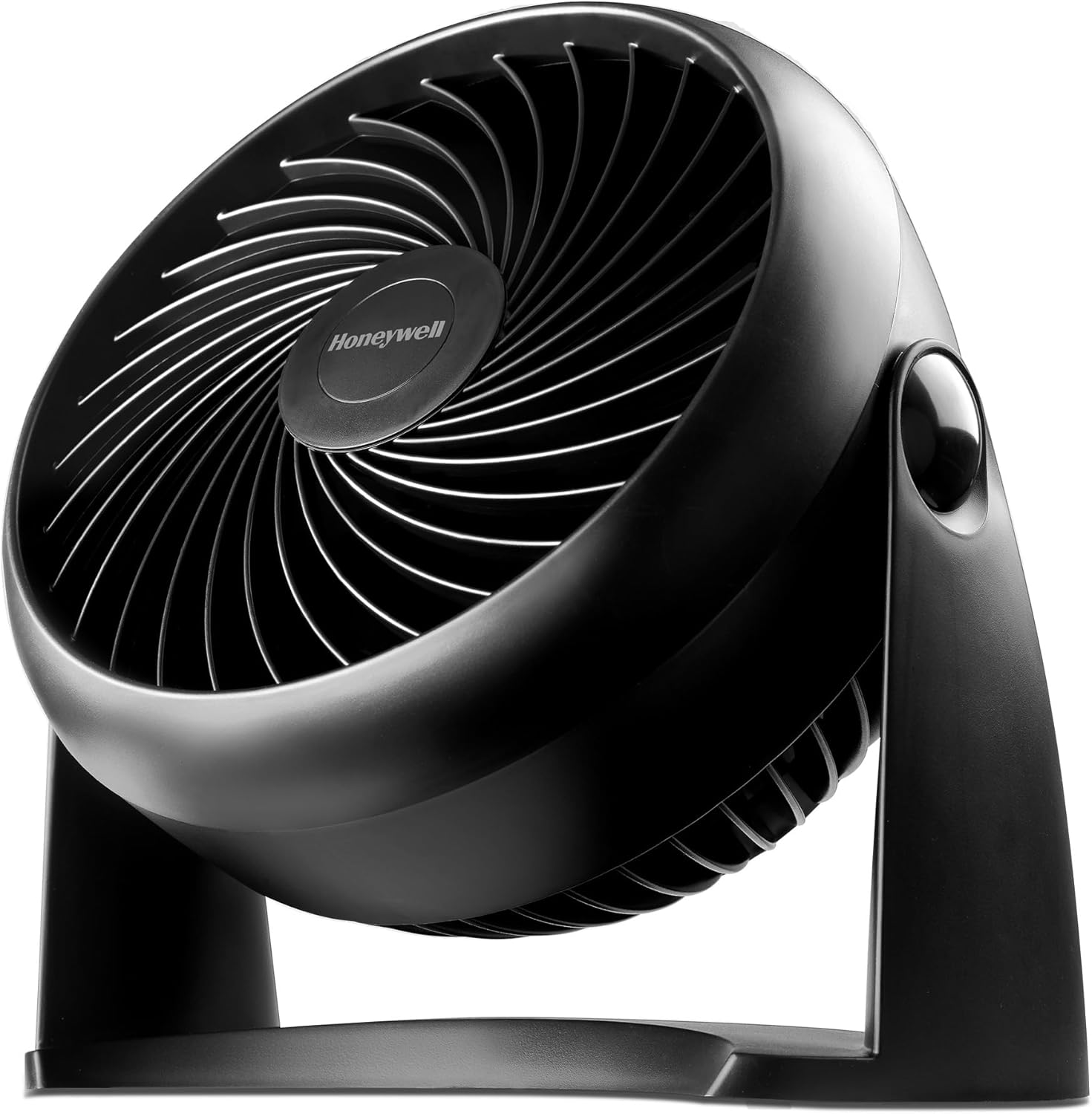
The Honeywell TurboForce HT-900 is a small tabletop air circulator built to deliver focused cooling for desks, nightstands, or small rooms. It uses an aerodynamic turbo blade design and a brushless motor to push airflow up to the mid-hundreds of CFM, and three speed settings let you dial in gentle breeze or stronger circulation. The head pivots 90 degrees so you can aim air precisely, and the unit can be wall-mounted if you need hands-free placement. In daily use it functions as a quiet personal fan for bedrooms or home offices and is small enough to move between rooms or tuck on a shelf. The fan is plastic-bodied and uses a standard corded electric plug, so it is simple to operate but lacks smart controls or timers. Noise is advertised as very low, and the modest wattage keeps power draw down, though its small size limits coverage to small-to-medium rooms rather than whole-house use. For buyers who want a reliable, no-frills desk fan with solid airflow and straightforward controls, the HT-900 performs well.
Best for: Buyers seeking a proven, fuss-free personal fan backed by many positive reviews who prioritize reliable performance and low noise over connected features.
Less Ideal for: If you need whole-room or multiroom cooling, advanced controls like remote or app integration, or a heavier-duty metal build, this small tabletop fan is not the best choice.
- Aerodynamic turbo blade and brushless motor deliver strong directed airflow for a compact fan.
- Three speed settings and 90-degree pivoting head allow precise control of airflow direction and intensity.
- Quiet operation suitable for bedrooms or home offices.
- Can be used tabletop or wall-mounted for flexible placement.
- Basic manual controls only with no remote, timer, or smart features.
- Plastic construction may feel less durable than heavier units.
Verdict: A compact, quiet, and reliable tabletop fan that delivers strong directed airflow for personal cooling during summer.
Honeywell TurboForce HT-904
| Power Source | Corded Electric |
|---|---|
| Number of Speeds | 3 |
| Air Flow Capacity | 185 cfm |
| Motor Type | Brushless |
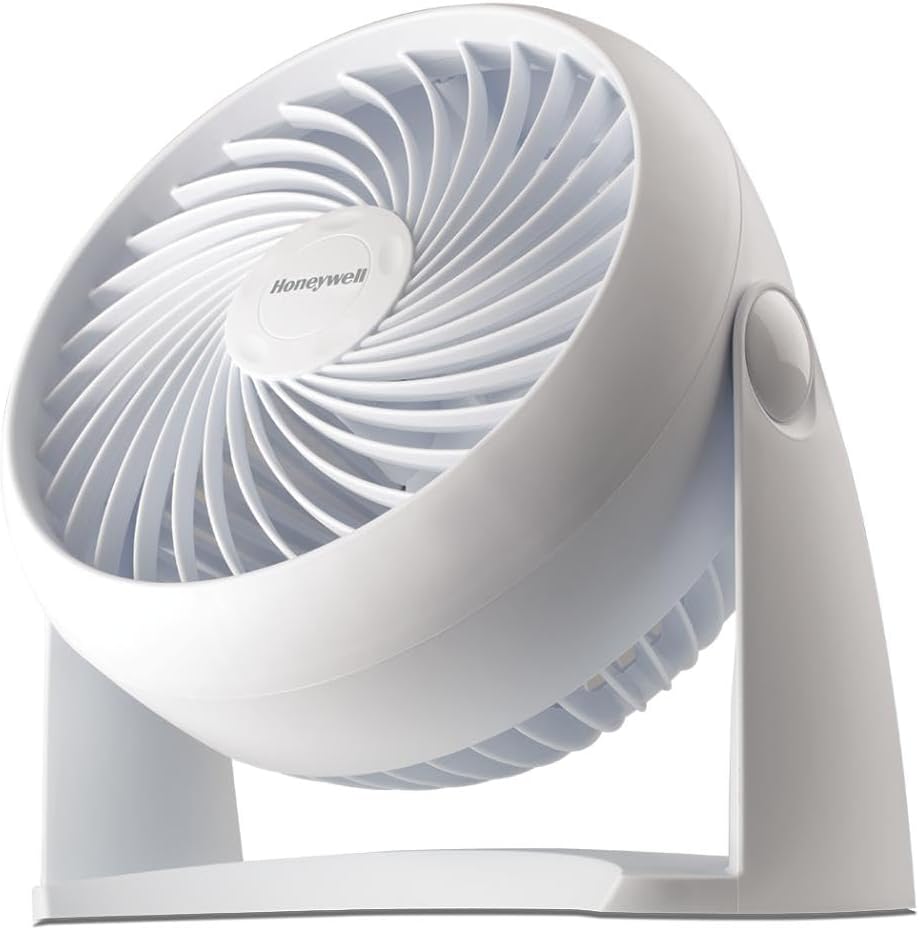
The Honeywell TurboForce HT-904 is a small, portable tabletop fan built to move a surprising amount of air for its size. It is typically used on desks, nightstands, or mounted on a wall to boost circulation and provide direct cooling; the aerodynamic TurboForce design and 185 cfm rating let it push air across a room and supplement an air conditioner. Three push-button speeds and a 90-degree pivoting head make it easy to dial in direction and intensity, while a brushless motor keeps operation relatively quiet and efficient. Practical benefits include versatile placement options, a lightweight build for easy repositioning, and a simple control layout that is intuitive for everyday use. Limitations are its small footprint, which makes it best for local or small-room cooling rather than whole-room circulation, and its basic manual controls that lack timers or remote features. For buyers seeking a straightforward, reliable personal fan, it delivers predictable performance without complexity.
Best for: Practical buyers who want a dependable, easy-to-use personal table fan for bedrooms, home offices, or dorms and prefer simple controls and proven brand reliability.
Less Ideal for: People looking for a smart, feature-rich fan or a single unit to cool large open-plan living spaces should consider larger or more advanced alternatives.
- Aerodynamic TurboForce design provides strong airflow for a compact fan
- Three-speed push-button control with 90-degree pivoting head for directional cooling
- Brushless motor and manufacturer-stated low noise for quieter operation
- Lightweight and portable for easy repositioning as a tabletop or wall-mounted unit
- No advanced controls such as timer, remote, or smart connectivity
- Small footprint limits effectiveness as a primary whole-room fan
Verdict: Choose the HT-904 if you want a no-nonsense, powerful small tabletop fan that reliably delivers directional cooling with simple controls.
Choosing the Right Table Fan for Summer: Key Factors to Consider
Airflow and Speed Settings
How much air a table fan can move and how many distinct speed settings it offers directly affects how effective it will be in different rooms. Higher cubic feet per minute output is useful for larger spaces, while multiple speeds let you dial in a comfortable breeze for sleeping or working.
Variable speed control also impacts power use and noise. Fans with fine-grain or stepless speed adjustment give more precise comfort control than units with only two or three fixed speeds.
Noise Output
Noise levels matter for bedrooms and home offices where a fan runs close to your head. Look for models with documented low-decibel operation or qualitative noise descriptions that indicate a gentle white-noise hum rather than distracting whines or rattles.
The blade design, motor quality, and housing resonance all influence perceived sound. Features like rubberized feet and balanced blades reduce vibration and make low-speed settings much more tolerable for overnight use.
Size, Footprint, and Mounting
Table fans need to fit on the surfaces where you plan to use them. Consider the fan's base diameter and height so it does not overcrowd a bedside table or desk. A compact footprint is helpful in small rooms, but very small fans may struggle to move enough air in larger spaces.
Some table fans offer tilt or variable-height features to direct airflow precisely, which can be useful when you want to cool a seated person without creating a draft across the entire room.
Oscillation and Directional Control
Oscillation spreads airflow across a broader area, which is useful for circulating air in a room rather than blasting one person. Adjustable oscillation angles let you choose between focused cooling and broader circulation.
For targeted cooling, look for models with independent vertical tilt and horizontal sweep controls so you can aim air where you need it without repositioning the entire unit.
Energy Use and Runtime
Running a fan for many hours during hot months can add to household energy use. Check power draw at common settings and whether the fan offers energy-saving modes or an ECO setting. Lower wattage at effective airflow levels means you can run the fan longer for less cost.
If you plan to use timers or overnight modes, lower power consumption on those settings will keep utility impact minimal while maintaining comfort.
Controls and Convenience Features
Controls influence the day-to-day experience. Simple rotary knobs are intuitive, while digital interfaces and remote controls provide convenience from across the room. Timers, memory settings, and programmable schedules make overnight and unattended use easier.
Maintenance conveniences such as tool-free grille removal for cleaning and accessible power cords also matter. A fan that is easy to clean and adjust will perform better long term and require less troubleshooting.
Best Table Fan Sizes for Different Rooms
Match fan size to room function. A small 6 to 8-inch tabletop fan is often enough for a nightstand or personal desk cooling, giving direct airflow without taking much space. For living rooms or larger bedrooms, a larger 10 to 12-inch fan provides stronger circulation and can help mix cool air from other sources.
Also think about placement. A slightly larger fan positioned on a shelf or dresser can circulate air across a room without hogging tabletop space, while a compact model works better where surface area is limited.
- Small fans: best for personal, close-range cooling.
- Medium fans: balance portability with greater airflow.
- Large table fans: better for circulating air in medium rooms.
Quiet Operation Tips for Overnight Use
To get the best sleep, select a fan that reports quiet low-speed operation and has features that reduce vibration. Place it on a stable surface with rubber feet and avoid touching the housing while it runs. Running on a low steady speed usually produces a consistent white-noise effect that many people find helpful for sleep.
If the room is still too warm on low, use a timed higher setting to kickstart cooling, then switch to low or sleep mode. Avoid models with plastic housings that rattle easily when set to oscillate.
- Use a timer or sleep mode to reduce overnight noise.
- Place on a vibration-damping pad if the surface transmits sound.
- Check for balanced blades and sealed motor housings for quieter operation.
Placement Strategies to Improve Room Cooling
Table fans can do more than blow air directly at you. Position a fan near a doorway or across from a window to encourage cross-ventilation. In rooms with a ceiling fan, aim a tabletop unit to push cool air down into occupied zones or to help move cool air from one side of the room to the other.
Avoid blocking airflow with walls or clutter. A fan placed higher on a dresser can move air across a larger footprint than one tucked low behind objects.
- Use two fans to create cross-breezes in deeper rooms.
- Aim slightly upward if trying to circulate air rather than directly cool a person.
- Keep intake and output unobstructed for best performance.
Maintenance and Safety for Table Fans
Routine maintenance keeps a table fan running efficiently. Dust builds up on blades and in the grille, which reduces airflow and can increase noise. Choose models with grilles that open without tools to make cleaning easier. Wipe blades with a dry cloth and vacuum the grille periodically.
Safety-wise, ensure the fan base is stable and that cord routing avoids tripping hazards. If a fan will run unattended, look for models with thermal cutoff or other motor protection to reduce the risk of overheating.
- Clean blades and grille every few weeks during heavy use.
- Check power cord integrity and route away from walkways.
- Replace units that develop wobble or overheating signs.
Feature Tradeoffs: Portability Vs. Power
Compact, lightweight table fans are easy to move from room to room but often sacrifice maximum airflow. Heavier, larger units provide stronger circulation but are less convenient to reposition. Decide whether you need a portable fan for spot cooling or a more powerful unit to aid whole-room circulation.
Also weigh control complexity. A simple knob is low-friction and unlikely to fail, while programmable or app-enabled controls offer flexibility at the cost of increased complexity and potential battery or pairing issues.
- Portable fans: quick repositioning, lighter airflow.
- Heavier models: better for sustained room circulation.
- Digital features: convenience versus potential reliability tradeoffs.
How We Chose the Best Table Fan for Summer
We focused on features that matter for everyday summer use in typical home rooms. Primary evaluation criteria included measurable airflow control options and speed range, acoustic performance measured as low-noise operation at common settings, build and mounting stability for safe table use, and energy efficiency for long runtime without excessive power draw. We also considered usability features such as intuitive controls, oscillation range, and timer or automatic modes that help with overnight or unattended use. Excluded items included non-table-mounted cooling appliances and units intended primarily for outdoor use. We filtered out devices lacking basic safety features for tabletop placement. Final selections were those that offered clear specification advantages in airflow, low-noise operation, and ease of use for summer conditions.
Our full evaluation process is outlined in our review methodology.
FAQ
How big of a table fan do I need for a bedroom?
For a typical bedroom, a medium table fan with a 10 to 12-inch blade diameter usually balances airflow and footprint. Smaller fans work for personal cooling but may struggle to move air across the entire room.
Are quieter fans less effective at cooling?
Not necessarily. Some designs prioritize aerodynamic blades and smoother motors to deliver good airflow at lower noise levels. Look for units that list airflow figures and noise ratings to compare effectiveness.
Can a table fan reduce my energy bills?
Table fans use far less power than whole-home cooling systems and can make a room feel cooler by increasing evaporation on skin. They do not lower room temperature but can allow you to raise thermostat settings with similar comfort, which may reduce overall energy use.
How often should I clean a table fan?
During heavy seasonal use, clean the grille and blades every few weeks. Light dusting weekly helps maintain performance and keeps noise down. Models with easy-access grilles reduce cleaning time.
Is oscillation important for a table fan?
Oscillation helps distribute airflow across a wider area, which is useful for circulating air in a room. If you need targeted cooling, a non-oscillating fan with adjustable tilt might be sufficient.
Final Verdict
Choose a table fan by matching size and airflow to the room and prioritizing low-noise operation if you plan to use it while sleeping or working. Consider energy use, oscillation range, and how easy the fan is to clean and control. Balance portability against the power you need for whole-room circulation. With those tradeoffs in mind, you can confidently pick a table fan that keeps your space comfortable all summer.