
Note: This article contains affiliate links. If you click on these links and make a purchase, we may earn a small commission at no extra cost to you. This helps support our research and content. Read our full affiliate disclosure here.
Choosing the right tankless water heater for a washing machine matters because laundry routines demand steady hot water at the right temperature and flow. A mismatched unit can lead to long cycle times, weak cleaning performance, or cold spots in loads. This guide covers seven shortlisted tankless water heaters selected for laundry use and highlights the practical features that matter for household washers. Below you will find top candidates evaluated for flow capacity, temperature control, and installation considerations. The goal is to help you match a unit to your washer, plumbing, and household hot-water habits with clear decision criteria and actionable guidance.
Top Picks at a Glance
| Best Overall The best all-around choice for most situations | ThermoMate ET080 8kW Tankless Heater |  |
| Best Quality Built to a higher standard if you want something more solid | Rinnai V53DeP Propane Tankless |  |
| Best Value The sweet spot between price and what you get | CAMPLUX 4.5kW Tankless Water Heater |  |
| Best Budget The cheapest option that still gets the job done reliably | xwdzswgs 3000W Tankless Water Heater |  |
| Top Rated A top-rated pick with lots of positive feedback | Rheem RTEX-18 Tankless Electric |  |
| Most Popular A crowd favorite that many people choose with confidence | EcoSmart ECO 27 Tankless Water Heater |  |
| Best Seller A high-volume bestseller chosen again and again | Rheem RTEX-04T 3.5 kW Tankless |  |
ThermoMate ET080 8kW Tankless Heater

| Wattage | 8 KW |
|---|---|
| Voltage | 240 volts |
| Flow Rate | 1.9 gpm |
| Maximum Temperature | 131 °F |
| Mount Type | Wall |
The ThermoMate ET080 is a small, wall-mounted electric tankless unit built to deliver on-demand hot water at a modest flow rate for point-of-use needs. It uses self-modulating electronics to adjust power based on incoming water temperature and flow, which helps keep energy use efficient while producing up to about 1.56 GPM at a 35°F rise and a maximum outlet temperature near 131°F. The unit separates the heating element from the water path with a cast aluminum heating chamber to reduce scale on the element and lower leak risk, and it includes safety features such as overheat protection and automatic shutoff when no water flow is detected. Installation requires a 240V feed, a 40A double-pole breaker and 8 AWG wiring, so expect a professional electrical hookup for safe operation. The key trade-offs are the limited flow rate—suitable for single fixtures or a washing machine if matched to local supply temperatures—but not for simultaneous high-demand fixtures or whole-house service.
Best for: Buyers who want a compact, energy-efficient point-of-use heater for a single appliance or fixture and who prioritize lower operating cost and reduced scale on the heating element.
Less Ideal for: Homes needing hot water for multiple fixtures at once or whole-house service should choose a higher-capacity tankless model or a conventional water heater.
- Compact wall-mounted design saves floor space and fits tight locations
- Self-modulating control improves energy efficiency by adjusting power to flow and inlet temperature
- Cast aluminum heating chamber isolates the element to reduce scaling and leakage risk
- Safety protections include overheat cutoff and auto-stop on no-flow
- Maximum flow (~1.56 GPM at 35°F rise / 1.9 gpm listed) limits use to one faucet or a single appliance at a time
- Requires 240V, 40A double-pole breaker and 8 AWG wiring which may need electrical upgrades
Verdict: A compact, energy-efficient point-of-use tankless heater best suited to powering a single appliance or fixture where space and operating cost matter.
Rinnai V53DeP Propane Tankless

| Power Source | Gas Powered |
|---|---|
| Flow Rate | 5.3 gpm |
| Heat Output | 81 KW |
| Special Features | Tankless, High-Efficiency, Wi-Fi Capable, Enhanced Scale Detection, Endless Hot Water Flow |
| Mount Type | Wall |
The Rinnai V53DeP is a compact, propane tankless water heater designed to deliver continuous hot water for busy households and smaller homes. It provides up to 5.3 GPM, which is typically sufficient to run a washing machine plus one or two additional fixtures without significant temperature drop. The unit is wall-mountable, stainless steel construction, and includes enhanced scale detection to improve longevity in harder-water areas. Wi-Fi monitoring is supported via an optional module for remote status checks and diagnostics, and the heater emphasizes energy savings by heating only when water is needed. Practical benefits include a small footprint that frees up space compared with tank systems and a strong factory warranty that covers the heat exchanger for up to 10 years. Limitations to consider are the 5.3 GPM ceiling, which may be marginal for simultaneous high-demand loads in larger homes, and the need for professional installation and proper propane supply plumbing. Overall, it is a reliable, efficient choice for homeowners prioritizing continuous hot water and performance for typical washing machine usage.
Best for: Buyers seeking a performance-oriented, space-saving propane tankless heater that reliably supplies continuous hot water for laundry and typical household loads.
Less Ideal for: Large households that frequently run several high-demand fixtures at once or anyone without accessible propane service should consider higher-flow or alternative-fuel models.
- Delivers continuous hot water with a 5.3 GPM flow suitable for laundry plus additional fixtures
- High-efficiency tankless design heats only when needed to reduce energy waste
- Stainless steel construction with enhanced scale detection for improved durability
- Wi-Fi capable for remote monitoring and diagnostics with an optional module
- Compact wall-mount profile saves space compared with traditional tank heaters
- 5.3 GPM maximum may be insufficient for large homes with multiple simultaneous high-demand fixtures
- Requires professional installation and proper propane setup
- Wi-Fi functionality needs a separately sold module
Verdict: Choose the Rinnai V53DeP if you want a compact, high-efficiency propane tankless heater that reliably supplies continuous hot water for washing machines and typical household loads.
CAMPLUX 4.5kW Tankless Water Heater

| Wattage | 4.5 KW |
|---|---|
| Voltage | 120 volts |
| Flow Rate | 1 gpm |
| Maximum Temperature | 131 °F |
| Maximum Pressure | 150 psi |
This CAMPLUX 4.5 kW tankless unit delivers on-demand hot water for single-point tasks and is built for tight spaces. It is typically wall-mounted under a sink or in a small laundry nook and uses self-modulating electronics to vary power based on flow and temperature, so it only heats when water is running. The touch control panel and LED display let you set temperature quickly, and protections for overheating, dry combustion, and electrical leakage increase safety. Practical benefits include rapid heat-up (hot water in seconds), a very small footprint for cramped installations, and modest electrical needs compared with larger whole-house electric units. Important limitations are its low flow capacity—around 1 gpm—which means it can reliably serve a single faucet but will struggle to supply enough hot water for a typical washing machine cycle or simultaneous fixtures. It also requires hardwiring to a 40 A circuit and 8 AWG wiring, so installation can be more involved than a plug-in point-of-use heater.
Best for: Buyers prioritizing compact, energy-efficient point-of-use hot water for a single fixture who need a space-saving, quick-heating unit and are comfortable arranging a hardwired installation.
Less Ideal for: Homes that need to supply a washing machine, multiple fixtures, or shower simultaneously should choose a higher-flow point-of-use or a dedicated laundry heater instead.
- Very compact under-sink design fits limited spaces
- Self-modulating power adjusts output to flow for energy efficiency
- LED touch display for straightforward temperature control
- Built-in safety: overheating, dry-heat, and electrical leakage protections
- Maximum flow about 1 gpm limits use to a single fixture
- Requires hardwired connection to a 40 A circuit and heavier gauge wiring
Verdict: Choose this compact CAMPLUX unit if you need an efficient, space-saving point-of-use heater for a single faucet, but not as the primary hot source for a washing machine.
xwdzswgs 3000W Tankless Water Heater

| Power | 3000 watts |
|---|---|
| Voltage | 110V |
| Maximum Temperature | 131 °F |
| Special Features | Dry Combustion Protection, LED Display, IPX4 waterproof |
This compact 3000W tankless unit is designed to deliver instant hot water at small fixtures like sinks or compact appliances. It mounts vertically and heats water on demand with an LED display that shows temperature and allows Celsius/Fahrenheit switching. Safety features include IPX4 splash resistance, dry-burning protection, over-temperature shutoff, and leakage protection, and the manufacturer recommends a dedicated 32A breaker and 13 AWG wiring for safe operation. The unit is very small and light, so it fits under sinks, in RVs, or in tight utility spaces where space and budget are limited. Practical limits are its modest flow performance and 110V power: the listing notes it is not suitable for showers and requires about 0.3–0.5 GPM to reach the listed temperature rises, so it will struggle with high-demand appliances or multiple outlets at once. Installation requires vertical mounting and standard 1/2 inch NPT connections and may need an electrician to meet wiring and breaker requirements.
Best for: Buyers on a tight budget who need a small, space-saving point-of-use heater for a single sink or compact appliance and value simple temperature control and safety features.
Less Ideal for: Homes that need hot water for showers, multiple fixtures, or washing machines with higher flow requirements should choose a higher-capacity or higher-voltage unit instead.
- Compact wall-mounted design saves under-sink or RV space
- Digital LED display with Celsius/Fahrenheit selection for clear temperature control
- Multiple safety protections including dry-burning, over-temperature shutoff, and IPX4 splash resistance
- ETL-qualified with standard 1/2 inch NPT plumbing connections and included mounting hardware
- Low flow capacity; manufacturer warns it is not suitable for showers
- Requires a dedicated ≥32A circuit and recommended heavier-gauge wiring which may need professional installation
Verdict: A very affordable, space-saving point-of-use tankless heater that delivers safe on-demand hot water for a single sink or small appliance but is not intended for shower or heavy-load use.
Rheem RTEX-18 Tankless Electric
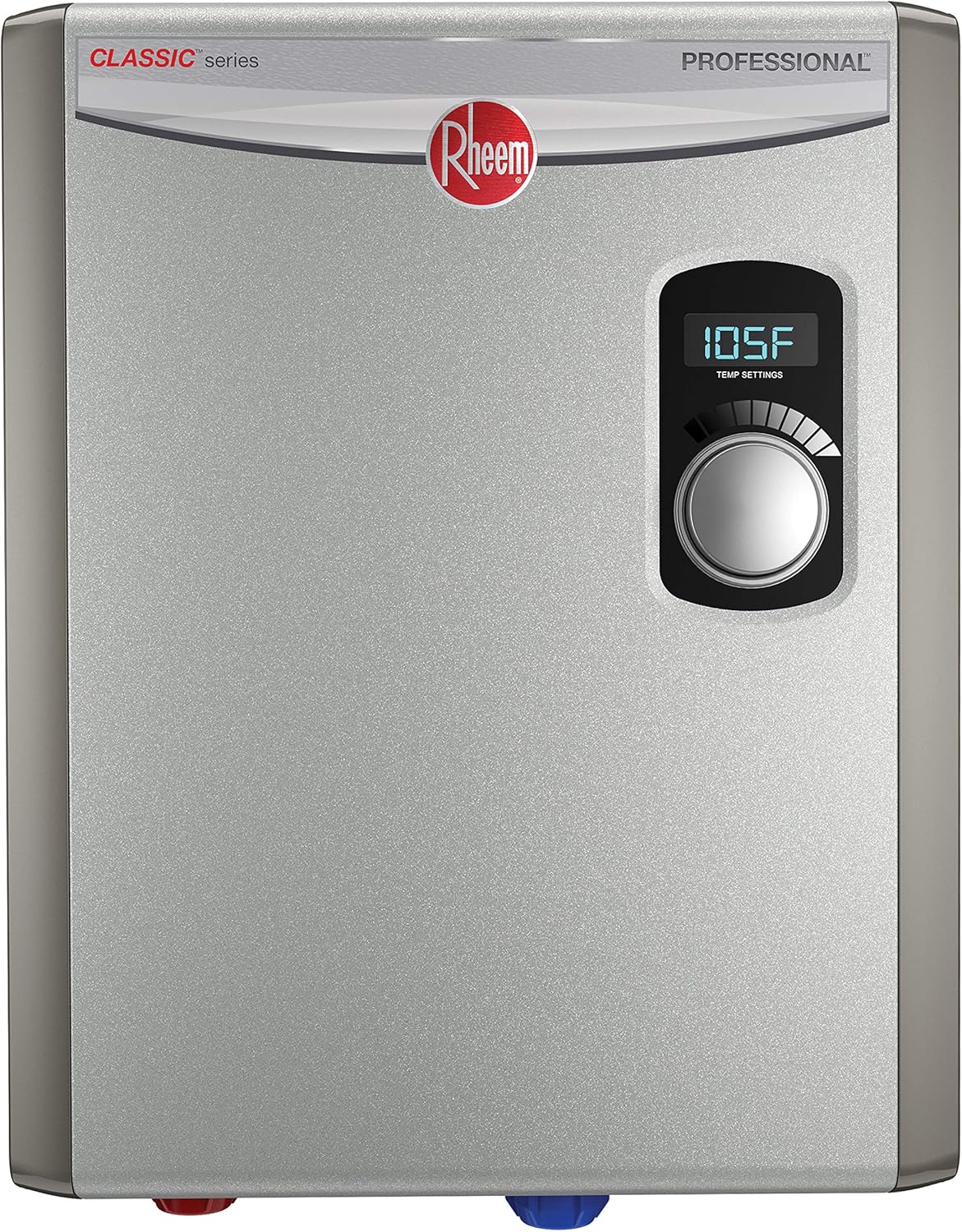
| Wattage | 18000 watts |
|---|---|
| Voltage | 240 volts |
| Flow Rate | 4.4 gpm |
| Maximum Temperature | 140 °F |
| Efficiency | 99.8% |
The Rheem RTEX-18 is a wall-mounted tankless electric water heater built to provide on-demand hot water for mid-size homes and single-shower whole-home use. It uses self-modulating electronics and two field-serviceable copper heating elements to match power to flow, with a digital LED temperature control that lets you dial in the outlet temperature precisely. The unit delivers up to 4.4 gallons per minute, which in many climates is sufficient to run a washing machine plus occasional taps or a single shower; it requires hardwiring to 240V and multiple breakers as part of installation. Practical benefits include compact, vent-free installation that frees space and lower standby energy use compared with tank heaters. Important limits are its flow ceiling and kilowatt rating: it will struggle to supply simultaneous high-demand loads like two showers and an active washer in colder inlet temperatures, and installation requires appropriate electrical capacity and wiring. For reliability-focused buyers who need a simple, serviceable electric tankless for laundry and modest hot-water loads, the RTEX-18 is a straightforward choice.
Best for: Buyers who prioritize dependable, low-maintenance hot water for medium laundry loads and occasional showers and want a compact, energy-saving electric tankless solution.
Less Ideal for: Homes that routinely run multiple simultaneous high-flow fixtures or need to serve several full baths at once should consider higher-kW units or alternative solutions.
- Self-modulating control adjusts power to match hot-water demand for efficient operation
- Digital LED temperature control provides precise setpoint adjustments
- Compact, wall-mounted design requires no venting and saves space
- Field-serviceable copper heating elements simplify maintenance
- Maximum flow rate (4.4 GPM) limits simultaneous high-demand fixtures in cold climates
- Requires 240V electrical hookup and adequate breaker capacity for installation
Verdict: A compact, serviceable 18 kW electric tankless that reliably supplies hot water for washing machines and modest whole-home needs while minimizing standby energy use.
EcoSmart ECO 27 Tankless Water Heater
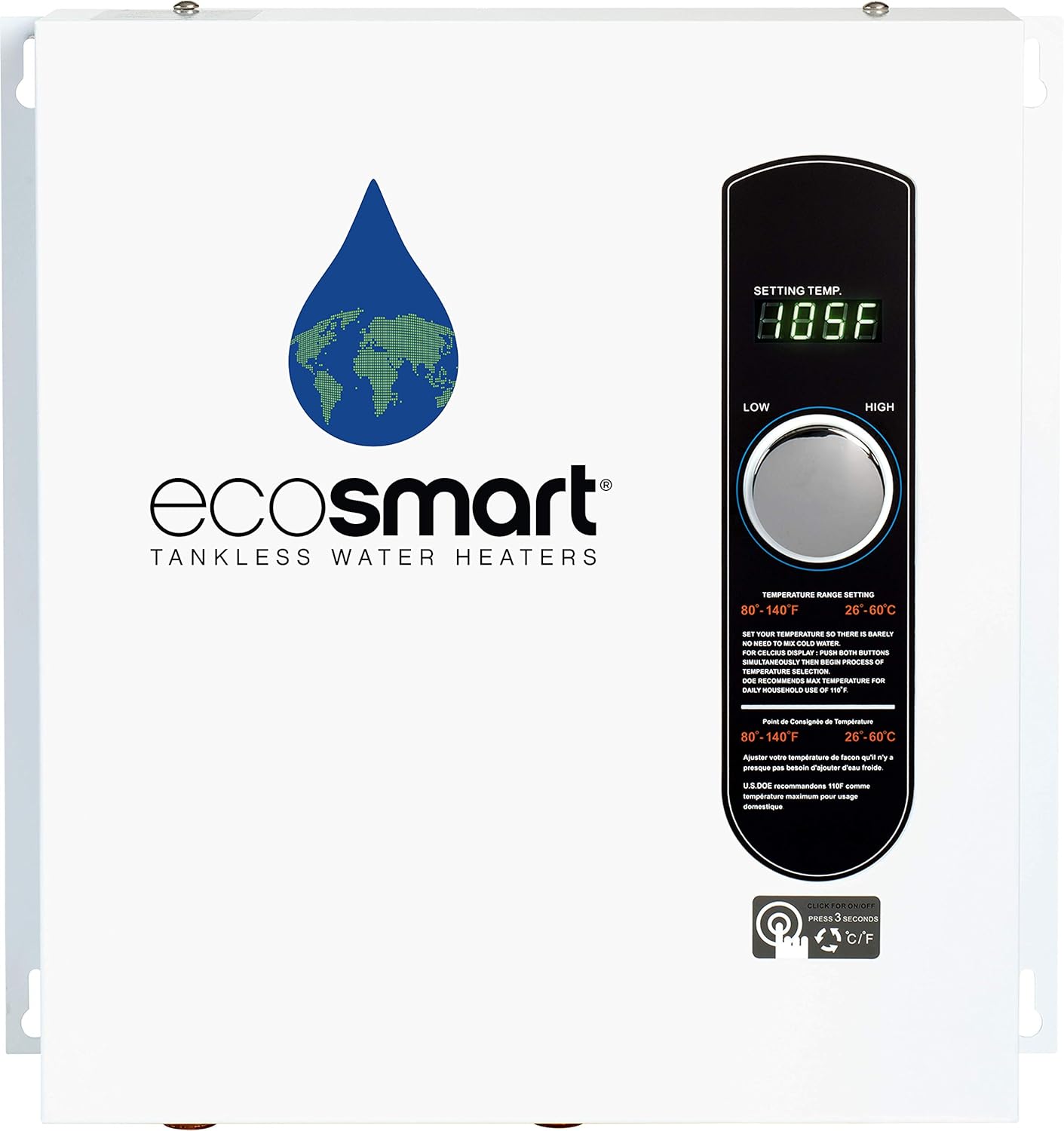
| Wattage | 27 KW |
|---|---|
| Voltage | 240 volts |
| Flow Rate | 6.6 gpm |
| Maximum Temperature | 120 °F |
| Maximum Pressure | 150 psi |
The EcoSmart ECO 27 is a high-capacity electric tankless water heater intended for homes with heavier hot-water needs such as washing machines plus large tubs or multiple simultaneous uses. It uses patented self-modulating electronics to adjust power based on flow and inlet temperature, and the unit provides up to about 6.6 gpm under favorable conditions and roughly 2.7 to 3 gpm at low inlet temperatures. The heater mounts on the wall and offers digital temperature control in 1 degree increments, which helps dial in wash temperatures for appliances. Installation requires substantial electrical service — three 40A double-pole breakers and three 8 AWG wires — so plan for professional electrical work. Benefits include endless on-demand hot water, a compact wall footprint that frees floor space, and ETL/lead-free certifications. Limitations are the electrical capacity required and the practical flow limits in cold climates, so it may not support high-flow simultaneous use without careful sizing and possibly multiple units or supplemental heating.
Best for: Buyers who prioritize reliable on-demand hot water for washing machines and other heavy-use fixtures and who prefer a compact, energy-efficient electric solution backed by broad user feedback.
Less Ideal for: Homes without adequate electrical service or buyers who need high combined flow in very cold climates without planning for multiple units or supplemental heating.
- High 27 kW heat output for multiple-demand or larger homes
- Self-modulating control adjusts energy use to current flow and inlet temperature
- Digital temperature control with 1°F increments for precise settings
- Compact wall-mounted design saves floor space and is suited to point-of-use placement
- ETL listed and certified for lead-free compliance
- Requires three 40A double-pole breakers and three 8 AWG wires, so electrical upgrades are likely
- Flow rate drops at low inlet temperatures and may not support several high-flow fixtures simultaneously
Verdict: Choose the ECO 27 when you need a compact, high‑output electric tankless heater that reliably supplies on‑demand hot water for washing machines and other heavy household uses provided your electrical system can support it.
Rheem RTEX-04T 3.5 kW Tankless

| Wattage | 3500 watts |
|---|---|
| Voltage | 120 volts |
| Flow Rate | 0.9 gpm |
| Maximum Temperature | 140 °F |
| Mount Type | Wall |
The Rheem RTEX-04T is a small thermostatic tankless electric unit intended for point-of-use installation where space is limited. It heats water on demand with a 3.5 kW element on 120V and offers digital temperature control in 1-degree increments up to 140°F, so you can dial in a stable outlet temperature for a nearby fixture. Because it supplies roughly 0.5 to 0.9 gpm depending on inlet temperature, it works best for a single sink, wet bar, or light-duty applications; pairing it with a washing machine is possible only if the machine uses low flow and you accept slower fill times and limited simultaneous hot water demand. The unit is wall-mounted, stainless steel, requires no venting, and needs a dedicated 30-amp circuit and #10 AWG wiring, so professional electrical work is normally required. Benefits include compact size, energy savings from on-demand heating, and precise temperature control, while limitations are low flow rate and modest heat output that make it unsuitable as a whole-house solution or for high-flow laundry cycles without supplementary hot water capacity.
Best for: Buyers who prioritize a compact, factory-quality point-of-use heater for a single low-flow appliance or fixture and prefer predictable, thermostatic temperature control.
Less Ideal for: People who need a primary or whole-house supply for a standard washing machine, multi-fixture bathrooms, or higher-flow laundry cycles should choose a higher-kW or 240V model instead.
- Compact point-of-use design saves space and installs near the fixture.
- Digital thermostatic control with 1°F increments for precise temperature setting.
- No venting required so placement options are flexible.
- Heats on demand which reduces standby energy loss compared with tank heaters.
- Very low maximum flow rate (~0.9 gpm) limits its usefulness for typical washing machine cycles.
- Requires a dedicated 30-amp 120V circuit and professional electrical installation.
- Not suitable as a whole-house or multi-fixture hot water source due to limited kW output.
Verdict: Choose the RTEX-04T when you need a compact, thermostatic point-of-use heater for a single low-flow appliance and value precise temperature control and space savings.
Choosing the Right Tankless Water Heater for Washing Machine: Key Factors to Consider
Flow Rate and Temperature Rise
Flow rate determines whether a tankless water heater can supply enough hot water for a washing machine without dropping below the required temperature. Washing machines typically need a steady flow over several minutes; if the unit cannot provide the necessary gallons-per-minute at the desired temperature rise, cycles may extend or rely on cold water. Compare the unit's advertised GPM at various temperature rises to match your incoming ground water temperature and the washer's hot-water demand.
Temperature rise is the difference between incoming groundwater temperature and the setpoint. A unit that lists high GPM at small temperature rises may perform poorly in colder climates. Estimating your incoming water temperature and the washer's hot setting will let you pick a heater with the right combination of flow and heating capacity.
Compatibility With Washer Fill Patterns
Different washing machines draw hot and cold water in varying ratios depending on cycle and load. Some cycles use mostly cold or warm water, while others request a lot of hot. Look at your washer's specified hot-water inlet usage and cycle behavior. Ensure the tankless unit can handle short, intermittent demands as well as longer fills without overshoot or lag.
Also consider whether the washer has a single mixed inlet or separate hot and cold connections. In mixed-inlet designs, the tankless heater may need to supply both volume and consistent temperature under varying mixed-flow conditions.
Installation Location and Plumbing
Where you install the heater affects performance and cost. Laundry rooms often have limited wall space and specific venting or electrical access. Decide if the unit will be mounted near the washer to limit heat loss in short pipe runs. Check required clearances, venting type for gas units, and whether the unit needs a dedicated electrical circuit for electric models.
Plumbing considerations include pipe diameter, shutoff valves, and whether existing hot-water lines need rerouting. A compact unit mounted close to the washer reduces lag and improves temperature stability during fills.
Power Source and Fuel Considerations
Tankless water heaters may be electric or gas. Electric units require high-current circuits and can have limited GPM capacity per unit; they often work well for single-appliance use if the home electrical service supports the load. Gas units can deliver higher flow rates for larger temperature rises but need proper venting and gas-line capacity.
For laundry-room installation, verify electrical panel capacity, conduit and breaker sizing for electric models, or gas-line sizing and venting paths for gas models. Fuel choice affects installation complexity and long-term operational characteristics.
Controls, Temperature Accuracy, and Safety
Accurate temperature control matters for cleaning performance and fabric care. Look for models with adjustable setpoints and reliable thermostatic control or digital feedback loops that prevent overshoot. Safety features such as automatic shutoff on overheating, pressure relief, and freeze protection are important in laundry rooms that may be unheated.
Some units include simple LED indicators or digital displays that make it easy to verify operating temperature. Those feedback features help you confirm the heater is delivering the expected water temperature during cycle fills.
Maintenance Requirements and Reliability
Tankless units require periodic maintenance to maintain heat-exchanger efficiency and reliability, especially in areas with hard water. Consider access for descaling and recommended service intervals. A unit with accessible service ports and clear maintenance instructions makes long-term ownership easier.
Reliability also depends on build quality and available protection against scale and corrosion. For laundry-centric use, choose units that tolerate intermittent draws and include simple diagnostics to troubleshoot common issues without professional service.
Sizing the Unit for Your Laundry Needs
Start sizing with two numbers: the washer's hot-water demand in gallons per minute during fill cycles and your incoming water temperature. Many residential washers specify a nominal fill rate or can be estimated by dividing the tub volume by the fill time. Once you know the required GPM and temperature rise, select a unit whose rated GPM at that rise meets or slightly exceeds the need.
When in doubt, choose a unit with modest headroom rather than an oversized whole-house system. Oversizing increases install complexity and can reduce efficiency for single-appliance use.
- Estimate washer fill GPM by measuring time to fill an empty tub on a hot cycle.
- Check local groundwater temperatures to calculate required temperature rise.
- Allow a safety margin of 10 to 20 percent above calculated GPM.
Electric Vs Gas Options for Laundry Rooms
Electric tankless heaters are simpler to install in spaces without gas lines but require a circuit and panel capacity that can handle continuous high current. They fit well when the washer is the primary hot-water draw and the expected GPM is modest.
Gas-fired tankless units usually deliver higher flow for greater temperature rise but need venting and gas-line capacity. In laundry rooms with space constraints or no convenient venting path, gas installation can be more involved.
- Match electric units to panel capacity and breaker sizing.
- Confirm venting options and gas-line sizing before choosing a gas unit.
Installation Tips to Minimize Temperature Loss
Mount the tankless heater as close to the washing machine as practical to reduce heat loss in the short hot-water run. Use properly sized pipe and insulate short sections to preserve temperature during fills. Minimize elbow and fitting count to keep flow resistance low.
Include accessible shutoff valves and a service loop if routine flushing or descaling is required. For units that recommend a condensate drain or pressure relief valve, make sure routing is planned before installation.
- Use 3/4-inch piping for runs likely to carry higher flow to reduce friction losses.
- Insulate hot-water pipes even over short distances in unheated laundry areas.
Controls and Tuning for Consistent Washes
Fine-tune temperature setpoints to match the washer's hottest cycle while avoiding fabric damage. Some tankless units allow incremental adjustments that help stabilize mixed inlet temperatures when the washer blends hot and cold.
If your washer has programmable cycles, test common cycles after installation and adjust the heater setpoint if you notice cold spots or excessively long fills. Digital displays and diagnostics make this process quicker.
- Begin with a mid-range setpoint and run a test load to verify fill temperature.
- Document the heater setting that produces desired wash temperatures for future reference.
Hard Water, Filters, and Longevity
Hard water accelerates scale buildup inside heat exchangers and reduces heating efficiency. For laundry-room installations, consider installing an inline filter or water-softening option if your supply is hard. Regular descaling intervals will preserve performance and prevent premature failure.
Some units include scale-detection alerts or recommend specific maintenance routines. Planning for maintenance at the time of installation can save downtime and extend service life.
- Check local water hardness and follow manufacturer maintenance guidance.
- Consider an easily accessible service bypass to simplify periodic flushing.
How We Chose the Best Tankless Water Heater for Washing Machine
We focused on criteria that directly affect how well a tankless water heater supports a washing machine during typical home laundry cycles. First, flow rate at use temperature was prioritized because washers need a minimum gallons-per-minute to fill and maintain wash cycles without temperature drop. Second, temperature control and recovery responsiveness were evaluated to ensure consistent hot-water delivery through varied cycle demands. Third, installation and space requirements were considered, including mounting options, plumbing connections, and whether the unit works with common laundry-room layouts. Fourth, energy efficiency during laundry cycles and how the unit handles intermittent draws were assessed to estimate operating behavior. Finally, build quality and safety features relevant to laundry rooms, such as freeze protection and corrosion-resistant heat exchangers, were included. We excluded whole-house sizing approaches that ignore single-appliance use and any units intended solely for point-of-use sinks. Our shortlist favors models whose published flow and temperature-rise specs match typical washing machine requirements and that offer straightforward installation pathways for a laundry area.
Our full evaluation process is outlined in our review methodology.
FAQ
Will a tankless unit delay washer cycle start times?
Often there is a short lead time as the heater reaches operating temperature, but once warmed the unit supplies hot water quickly. Proper sizing and locating the unit close to the washer minimize any noticeable delay.
Can one tankless heater serve a washer and other nearby fixtures?
It depends on combined simultaneous demand. A correctly sized unit can serve a washer and a nearby sink, but if both draw at once you should confirm the unit's GPM at the needed temperature rise to avoid drops in wash temperature.
How important is incoming water temperature for unit selection?
Incoming groundwater temperature directly affects required temperature rise. Colder inlet temperatures require more heating capacity to reach the same setpoint, so factor local groundwater temperatures into sizing calculations.
Do tankless heaters need special wiring for laundry-room installation?
Electric models typically need dedicated circuits and appropriate breaker sizes to handle continuous draw. Verify panel capacity and plan for conduit and breaker installation as part of the project.
How often should I descale a tankless heater used with a washing machine?
Frequency depends on water hardness and usage patterns. In hard-water areas, descaling annually or more often may be necessary. Follow the unit's maintenance recommendations and monitor performance for signs of scale buildup.
Final Verdict
For supplying hot water to a washing machine, prioritize a tankless water heater sized for the washer's GPM and required temperature rise, with reliable temperature control and accessible installation. Balance fuel type, installation complexity, and maintenance needs against the laundry-room layout. Focus on a unit that provides modest headroom in flow, clear controls for setpoint tuning, and straightforward servicing to ensure consistent wash performance over time. Choosing with those tradeoffs in mind will help you pick a system that keeps cycles on time, maintains wash temperatures, and minimizes service interruptions, giving confident, dependable hot-water delivery for laundry needs.