
Note: This article contains affiliate links. If you click on these links and make a purchase, we may earn a small commission at no extra cost to you. This helps support our research and content. Read our full affiliate disclosure here.
Picking the right electric tank water heater affects daily comfort and energy bills. The right tank size, recovery rate, and efficiency determine whether your household has steady hot water during showers, laundry, and dishes. This guide shortlists the seven best electric tank water heaters for home use and explains the tradeoffs between capacity, recovery speed, and long-term operating cost. Below you will find the top picks and clear evaluation notes so you can match a heater to your household size, hot-water habits, and installation constraints.
Top Picks at a Glance
| Best Overall The best all-around choice for most situations | GE Smart 40‑Gallon Short Electric Water Heater |  |
| Best Quality Built to a higher standard if you want something more solid | Stiebel Eltron SHC 2.5 Mini-Tank |  |
| Best Value The sweet spot between price and what you get | Feelrogast 8-Gallon Electric Tank |  |
| Best Budget The cheapest option that still gets the job done reliably | sjcdicnj 2.11 Gal Under-Sink Water Heater |  |
| Top Rated A top-rated pick with lots of positive feedback | Bosch Tronic 3000 T ES2.5 Mini-Tank |  |
| Most Popular A crowd favorite that many people choose with confidence | BISELONG BI-2.5 Mini Tank Water Heater | 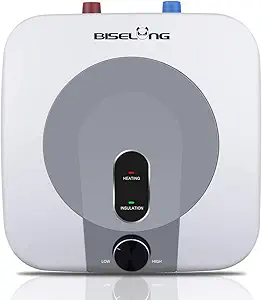 |
| Best Seller A high-volume bestseller chosen again and again | GE 18 Gallon Electric Water Heater |  |
GE Smart 40‑Gallon Short Electric Water Heater

| Capacity | 40 gallons |
|---|---|
| Voltage | 240 volts |
| Power Source | Electric |
| First Hour Rating | 65 gallons |
| Heating Elements | Two 5500W stainless-steel |
This GE 40-gallon short electric water heater is designed as a space-saving replacement for typical household tanks while delivering strong performance for 2–4 person homes. It uses two 5500W stainless steel heating elements for fast recovery and a DOE-rated first hour output of 65 gallons, so it handles busy morning or evening demand. Built-in WiFi and SmartHQ integration let you monitor tank status, adjust temperature, set vacation schedules, and receive alerts from a phone for convenient remote control. Practical durability features include stainless-steel elements that resist corrosion and anode-sensing technology that notifies you when the anode needs replacement to help extend tank life. Installation follows standard water and electrical connections for straightforward swap-in of existing units. Limitations to consider are that this is a free-standing indoor unit requiring 240V wiring and a dedicated circuit, and the short height trades off a bit of storage capacity compared with taller models despite its true 40-gallon rating.
Best for: Buyers who want a compact, reliable electric tank that balances strong first-hour performance with smart remote control for a typical 2–4 person household.
Less Ideal for: Homes without 240V wiring or larger households that routinely need sustained hot water beyond typical family usage.
- Built-in WiFi with SmartHQ for remote monitoring and temperature control
- Dual 5500W stainless-steel heating elements for quick recovery
- DOE-rated 65 gallons first hour output for reliable peak demand performance
- Anode sensing that alerts when maintenance is needed to help extend tank life
- Designed as a short unit for easier fit in tight utility spaces
- Requires 240V electrical hookup and appropriate circuit which may need professional installation
- Short profile may reduce available hot water reserve compared with taller tanks of similar capacity
Verdict: Choose this if you want a compact 40‑gallon electric water heater that pairs fast recovery and smart WiFi control for dependable daily family use.
Stiebel Eltron SHC 2.5 Mini-Tank

| Capacity | 2.5 gallons |
|---|---|
| Wattage | 1300 watts |
| Voltage | 120 volts |
| Flow Rate | 2.5 gpm |
| Maximum Pressure | 150 psi |
The Stiebel Eltron SHC 2.5 mini-tank is a compact electric water heater that plugs into a standard 120V outlet and mounts under or next to a sink to deliver immediate hot water for handwashing and light kitchen use. With a 2.5 gallon capacity, 1300 watts of heating power and a 2.5 gpm flow rating, it recovers quickly for short runs and reduces wait time and water waste by keeping hot water close to the fixture. Installation is straightforward: mount the included bracket, plumb cold water in, fill the tank, and plug into a regular outlet with no special wiring required. The glass-lined steel tank and included T and P valve give durable, code-friendly hardware, and the unit is certified to relevant safety and lead-free standards. Limitations are inherent to the size: it will not support full showers or multiple simultaneous hot outlets, and the modest capacity means frequent cycling under heavier draws. For targeted point-of-use hot water the SHC 2.5 offers fast recovery and compact installation.
Best for: Buyers who prioritize fast, local hot water delivery at a sink and need a compact, easy-to-install solution to reduce wait time and water waste.
Less Ideal for: Households that need whole-house hot water or want to run showers and multiple fixtures at once should choose a larger tank or on-demand solution.
- Plugs into standard 120V outlet so no special wiring is required
- Compact, wall- or floor-mountable design places hot water close to fixtures to reduce wait and water waste
- Fast recovery for its size with 1300W heat output and 2.5 gpm flow
- Glass-lined steel tank and included T and P valve for durable, code-friendly installation
- 2.5 gallon capacity is too small for showers or simultaneous multi-fixture use
Verdict: Choose the SHC 2.5 when you want a compact, plug-in mini-tank that delivers fast near-point hot water and saves space.
Feelrogast 8-Gallon Electric Tank

| Capacity | 8 gallons |
|---|---|
| Wattage | 1500 watts |
| Voltage | 110/120 volts |
| Maximum Temperature | 167 °F |
| Material Type | Stainless Steel |
The Feelrogast 8-gallon electric tank is a compact, wall- or floor-mountable unit built to deliver near-instant small-batch hot water for kitchens, bathrooms, or point-of-use applications. It uses a 1500W (listed 1440W/1500W) stainless steel tank and heating element to bring water up to a user-adjustable temperature range up to 167°F and offers rapid reheat for frequent short draws. The unit includes several safety features—overheat protection, pressure release valve, high water pressure protection, and temperature lock—and is designed to remain upright and filled during operation. Installation is straightforward for a handy homeowner and supports 110/120V circuits with a standard plug and 1/2" NPT connectors, making it easy to add under a sink or in small service areas. Practical buyers will appreciate the compact footprint, hidden install options, and claimed energy use near 1 kWh per hour. Be aware this is a small 8-gallon tank intended for point-of-use rather than whole-house supply and it must stay filled and upright to avoid damage, which limits placement flexibility.
Best for: Buyers who want an efficient, compact point-of-use hot water solution to reduce wait time at a single sink or small fixture and who value built-in safety features and straightforward installation.
Less Ideal for: Households looking to supply multiple bathrooms or large simultaneous hot-water demands should choose a larger tank or tankless system instead.
- Compact 8-gallon tank fits under sinks or small spaces for point-of-use hot water
- Multiple built-in safety features including overheat protection and pressure release valve
- 316 stainless steel tank and heating element for corrosion resistance and durability
- Adjustable temperature up to 167°F and rapid reheat capability for frequent short draws
- Not sized for whole-house use—limited to small fixtures or single-point applications
- Requires upright installation and must remain filled, reducing placement options
Verdict: Choose this compact 8-gallon Feelrogast tank when you need a reliable, space-saving point-of-use heater that delivers fast hot water with solid safety protections.
sjcdicnj 2.11 Gal Under-Sink Water Heater

| Heat Output | 1500 watts |
|---|---|
| Capacity | 2.11 gallons |
| Rated Voltage | 110~120V |
| Waterproof Grade | IPX4 |
| Temperature Range | 0–65°C / 32–149°F |
This small under‑sink tank heater provides point‑of‑use hot water where a full-size water heater is unnecessary. It mounts vertically under or beside a sink and uses a 1500W 316 stainless steel heating tube to heat the 2.11 gallon reservoir in roughly 15 to 30 minutes, controlled with a knob and LED temperature display. Plumbing uses standard 1/2" connections and the unit includes a safety valve rated at 0.75 MPa and several protections against leakage, dry‑burn, and overheating; the IPX4 rating helps it tolerate damp cabinet environments. The compact 29 cm cube footprint saves space and is appropriate for light tasks like handwashing, dishwashing, and small kitchen or salon sinks, but it is not intended for showering or whole‑house use. Installation requires a dedicated 110–120V circuit with at least 1.5 mm² copper wiring and vertical mounting, and the unit does not include a trip switch, which may mean extra electrical work for some installations.
Best for: Buyers who need an inexpensive, compact point‑of‑use water heater to provide hot water for a single sink or light utility use and who prioritize a low‑cost, space‑saving option over whole‑house capacity.
Less Ideal for: Homes that need hot water for showers, multiple fixtures, or larger families should choose a larger capacity or whole‑house water heater instead.
- Compact wall‑mount design saves under‑sink space and works well for point‑of‑use applications
- Heats an 8L/2.11 gal tank in about 15–30 minutes with a 1500W stainless steel heating tube
- Standard 1/2" inlet/outlet simplifies plumbing connections to common fittings
- Multiple safety features including safety valve, anti‑dry burn, overheating protection, and IPX4 splash resistance
- Not suitable for bathing or high hot‑water demand beyond a single sink
- Requires vertical installation and a dedicated circuit with 1.5 mm² copper wiring which can add installation cost
Verdict: A budget‑minded compact under‑sink electric tank that delivers quick hot water for a single sink without taking up countertop space.
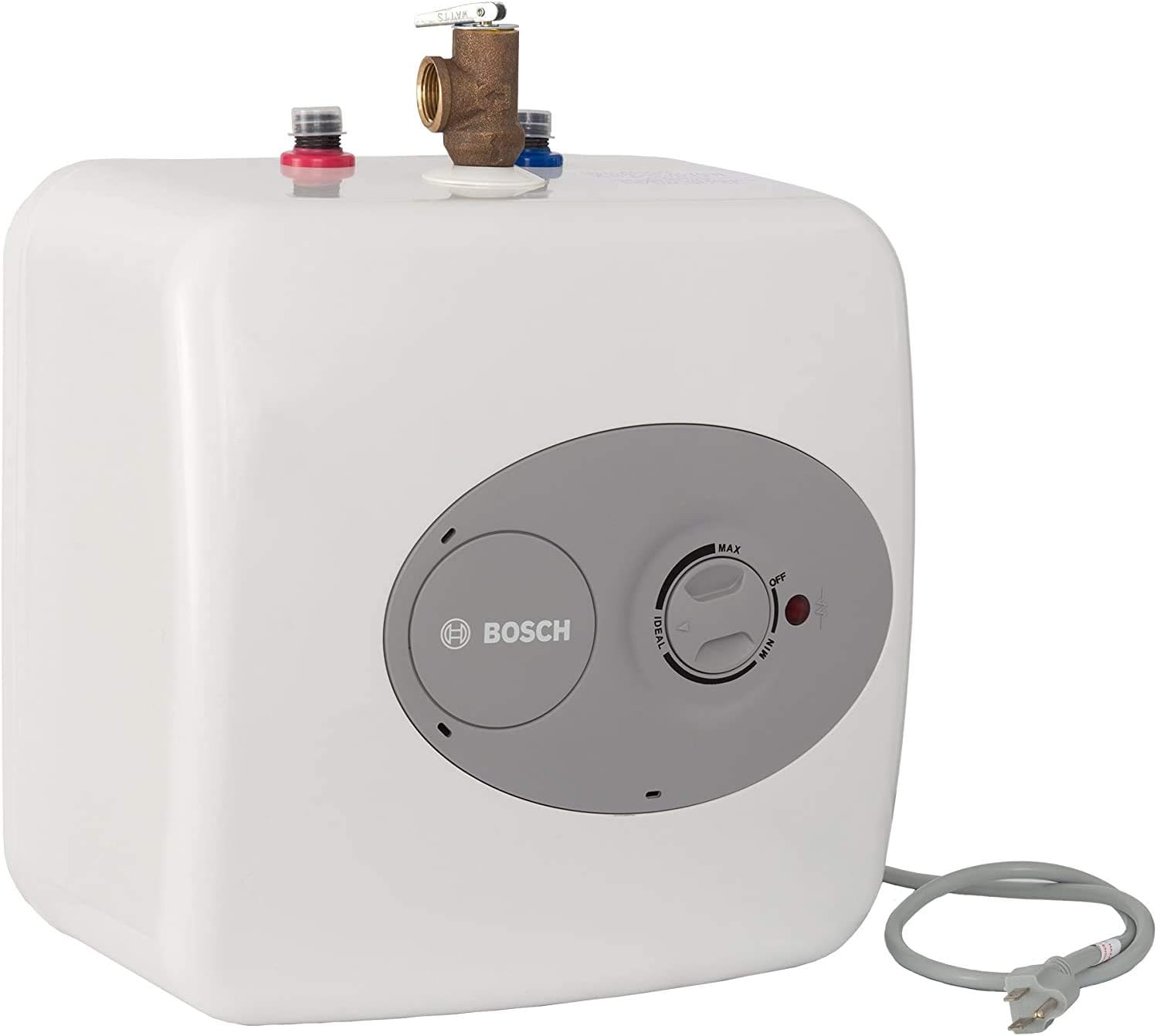
Bosch Tronic 3000 T ES2.5 Mini-Tank
| Capacity | 2.5 gallons |
|---|---|
| Wattage | 1440 watts |
| Voltage | 120 volts |
| Maximum Temperature | 140 °F |
| Efficiency | 98% |
The Bosch Tronic 3000 T ES2.5 is a compact point-of-use electric mini-tank that supplies near-instant hot water for one or two nearby fixtures. It is typically installed under a sink or on a shelf and can be plugged into a standard 120V outlet for independent operation or piped in-line with a larger system. Key features include a glass-lined tank for durability, a manual external thermostat dial for easy temperature control, a temperature-and-pressure relief valve for safety, and a fast recovery rate that reduces wait time for hot water. The unit is energy efficient at about 98% thermal efficiency and operates at 1440 watts, which keeps electrical demand modest on typical household circuits. Practical benefits are straightforward installation options, compact footprint for tight spaces, and reliable construction aimed at long service life. Important limitations are the small 2.5-gallon capacity, which is meant for point-of-use needs rather than whole-house supply, and the fixed 120V power and 1440W heating rate that limit flow and recovery compared with larger hardwired heaters.
Best for: Buyers who prioritize a dependable, low-maintenance source of hot water at a single sink or nearby fixtures and want a compact, easy-to-install unit with proven durability.
Less Ideal for: Homes needing whole-house hot water, high simultaneous flow, or faster recovery for multiple bathrooms should choose a larger or hardwired heater instead.
- Compact point-of-use design fits under sinks or on a shelf
- Glass-lined tank improves durability and corrosion resistance
- Plugs into standard 120V outlet for easy independent installation
- External thermostat dial and T&P relief valve for simple control and safety
- High thermal efficiency (98%) reduces standby heat loss
- Small 2.5-gallon capacity limits supply for multiple or high-flow fixtures
- 1440W heating limit means slower recovery than larger hardwired heaters
Verdict: A compact, reliable plug-in mini-tank that delivers fast, durable point-of-use hot water where whole-house capacity is not required.
BISELONG BI-2.5 Mini Tank Water Heater

| Capacity | 2.5 gallons |
|---|---|
| Wattage | 1500 watts |
| Voltage | 120 volts |
| Maximum Temperature | 149 °F |
| Mount Type | wall mount or shelf mount |
The BISELONG BI-2.5 is a small 2.5-gallon electric storage heater meant to sit under a sink, on a shelf, or be wall-mounted to supply near-instant hot water for one or two sinks. It uses a 1500W L-shaped heating element and a 304/316 stainless steel inner tank to heat water to a maximum of 149°F and recover fairly quickly for short draws. The unit emphasizes energy efficiency with upgraded insulation and a smart control chip that maintains set temperature and reduces standby loss. Installation is straightforward for someone comfortable with plumbing and a 120V circuit since the unit ships with mounting brackets, a 1/2" FIP fitting, and basic pipe fittings. Safety features include over-temperature protection, dry-heat protection, leakage protection, and separated water and electrical lines. Limitations are its small capacity—it will not support large showers or multiple simultaneous heavy draws—and it requires a dedicated 120V circuit with appropriate breaker and wire size for safe installation. Expect it to be most useful as a point-of-use solution rather than a whole-house heater.
Best for: Buyers who prioritize a reliable, compact point-of-use hot water source and want a safer, energy-conscious replacement for cold sink taps, backed by visible product specifications and upgrades.
Less Ideal for: People needing whole-house hot water or enough continuous hot flow for showers, large dishwashers, or multiple simultaneous fixtures should choose a larger storage or tankless system.
- Compact 2.5-gallon tank fits under sinks or in cabinets for point-of-use hot water
- 1500W heating element with stainless steel tank for faster recovery and corrosion resistance
- Smart insulation and temperature control reduce standby heat loss and improve energy efficiency
- Built-in safety protections including over-temperature and dry-heat protection
- Includes mounting brackets and basic fittings for easier installation
- Small capacity not suitable for showers or multiple heavy draws
- Requires a dedicated 120V circuit and correct wire/breaker sizing for safe operation
Verdict: Choose the BI-2.5 if you want a compact, energy-conscious under-sink heater that reliably delivers point-of-use hot water with upgraded stainless steel construction and safety features.
GE 18 Gallon Electric Water Heater

| Power Source | Electric |
|---|---|
| Wattage | 14400 watts |
| Voltage | 120 volts |
| Heat Output | 140 °F |
| Capacity | 45 liters |
This GE 18-gallon electric water heater is a compact point-of-use storage tank intended to deliver hot water where space or wiring limits larger units. It connects to a standard 120-volt supply and 3/4-in NPT plumbing for straightforward installation and can serve a single fixture, a small apartment, or act as a booster inline with a primary heater to handle long pipe runs or washing machines. The unit uses stainless steel heating elements and an anode rod to resist corrosion and prolong service life, and temperature and power are adjusted with a simple knob for basic control. Practical benefits include flexible siting in kitchens, bathrooms, laundry rooms, RVs, or garages and rust-resistant components that reduce maintenance risk. Important limitations are its modest 18-gallon capacity and 120-volt power, which mean it cannot support large households or simultaneous high-demand uses; buyers should size it for point-of-use needs rather than whole-house supply.
Best for: Buyers who prioritize a proven, easy-to-install electric water heater for single fixtures, small apartments, or as a booster and who prefer reliable, low-maintenance components.
Less Ideal for: Larger households or anyone needing whole-house hot water or high simultaneous demand should choose a larger capacity or 240-volt unit instead.
- Compact point-of-use design fits tight spaces and multiple locations
- 120-volt plug-and-play compatible with standard household supply for easier installs
- Stainless steel heating element and anode rod improve corrosion resistance and longevity
- Works standalone or inline as a hot-water booster for long runs or appliances
- 18-gallon capacity limits continuous hot water for multiple simultaneous fixtures
- 120-volt output delivers less recovery than 240-volt models
Verdict: Choose this GE 18-gallon unit when you need a compact, reliable point-of-use electric water heater or inline booster that installs easily on a standard 120-volt circuit.
Choosing the Right Electric Tank Water Heater: Key Factors to Consider
Tank Capacity
Choosing the right tank capacity determines how many consecutive showers or loads of laundry your household can run before the heater runs out of stored hot water. Smaller households or apartments often do well with compact tanks, while families of three or more typically need larger capacities to avoid running out during peak use.
Consider typical hot-water usage patterns when selecting capacity. A household that runs multiple appliances at once will need more stored gallons than one where uses are staggered. Oversizing increases standby heat loss and footprint, while undersizing risks frequent cold-water interruptions.
Recovery Rate
Recovery rate measures how quickly the heater can reheat incoming cold water and refill the tank with usable hot water. A higher recovery rate reduces the time between heavy hot-water uses and is especially important for homes with back-to-back showers or simultaneous appliance use.
Electric units vary by element wattage and control strategy, so factor recovery into decisions when you expect bursts of demand. If you regularly need consecutive hot-water events, choose a model with a faster recovery to minimize interruptions.
Energy Efficiency
Energy efficiency affects monthly operating costs because it determines how much electricity is used to maintain and reheat the tank. Look for higher efficiency ratings and lower standby heat loss to reduce energy consumption over the heater's lifetime.
Efficiency can be improved with better insulation, a programmable thermostat, or a lower standby loss design. While more efficient units may cost more up front, the savings on utility bills and reduced environmental impact can justify the investment over years of use.
Durability and Warranty
Durability influences how long the unit will function without major repairs. Important durability features include robust tank construction, corrosion-resistant linings, and a replaceable anode rod that protects the tank interior.
Warranty terms give a practical signal about expected lifespan and manufacturer confidence. Longer, clearer warranties reduce uncertainty about repair costs and are particularly valuable for units installed in hard-water areas or heavy-use households.
Installation and Electrical Requirements
Electric tank water heaters require appropriate wiring, breaker capacity, and space for safe placement. Installation ease depends on whether your home's electrical service can support the heater's element wattage and whether the unit fits available utility space.
Consider the need for upgraded wiring, dedicated breakers, and accessibility for maintenance. Professional installation is often recommended, and planning ahead for clearances and service access can reduce overall installation time and cost.
Maintenance Needs
Routine maintenance keeps an electric tank water heater operating efficiently and extends its service life. Tasks include flushing sediment from the tank, checking and replacing sacrificial anode rods, and verifying thermostat and element operation.
Homes with hard water may need more frequent flushing to prevent buildup that reduces efficiency and causes premature element failure. Budget time for annual checks so small problems do not become major repairs.
Sizing Your Home's Electric Tank Water Heater
Start by matching tank capacity to household hot-water demand rather than just physical space. Estimate peak hour demand in gallons by adding shower, dishwasher, and laundry usage for a typical hour of highest use. Use that number to pick a tank size that can meet peak needs without excessive standby loss.
Also factor in simultaneous appliance use. If multiple showers and a laundry run are common during the same hour, prioritize a larger tank or a faster recovery rate to avoid cold-water interruptions.
- Small households (1-2 people): smaller tanks or compact models.
- Medium households (2-3 people): medium-capacity tanks.
- Large households (3+ people): larger tanks or higher recovery units.
Installation Location and Clearance
Plan the installation location around access for maintenance and local electrical routing. The unit should have enough clearance for thermostat and element access and room to service the sacrificial anode rope if needed. Avoid cramped utility closets that make flushing and repairs difficult.
Consider whether the existing electrical panel has capacity for the heater's element load. If not, account for the time and cost of panel upgrades or routing a new dedicated circuit.
- Allow space for future element replacement and tank flushing.
- Verify clearances required by local code for safe installation.
Reducing Operating Costs
Beyond picking an efficient model, you can reduce operating costs with insulation and thermostat management. Adding an insulating blanket to an older tank can reduce standby heat loss, while lowering the thermostat a few degrees decreases recovery energy use without a noticeable loss in comfort.
Programmable or smart thermostats can schedule lower setpoints when occupants are away, cutting energy use further. Regular maintenance such as flushing sediment improves heat transfer and reduces energy needed to maintain set temperatures.
- Insulate older tanks to lower standby loss.
- Lower thermostat setpoint by a few degrees for energy savings.
Hard Water and Corrosion Considerations
Hard water increases sediment buildup and accelerates anode consumption, shortening tank life and reducing efficiency. If your home has high mineral content, plan for more frequent tank flushing and anode replacements.
Consider water-treatment options such as water softening upstream of the heater if hard-water problems are severe. Regular inspection of the anode rod is a simple preventive step that can add years to the tank's lifespan.
- Flush tank annually in hard-water areas.
- Inspect and replace the sacrificial anode as needed.
Safety Features and Local Codes
Ensure the chosen heater supports required safety features, such as properly rated temperature and pressure relief valves and compliant electrical disconnects. Local codes may dictate specific clearances or mounting requirements that affect placement and installation method.
Follow manufacturer and code guidance for relief valve piping and safe electrical termination to minimize leak and shock risks. If unsure, consult a licensed electrician or plumber familiar with local code.
- Install proper temperature and pressure relief devices.
- Confirm electrical and clearance code compliance before installation.
How We Chose the Best Electric Tank Water Heater
We focused on attributes that matter most for homeowners choosing an electric tank water heater. Selection prioritized tank capacities that match typical household demand, recovery rates that determine how quickly a unit restores hot water after heavy use, and energy efficiency ratings that influence monthly operating costs. Durability and warranty coverage were considered to reflect long-term ownership costs and failure risk. Installation factors such as footprint, venting and electrical requirements were evaluated because they affect retrofit complexity and contractor time. We also checked ease of maintenance, including access to thermostats and anode rods, since routine upkeep extends service life. Models that required unusual electrical upgrades or nonstandard fittings were excluded to keep installation practical for most homes. The final list balances immediate hot-water performance with energy and maintenance considerations that shape total cost of ownership.
Our full evaluation process is outlined in our review methodology.
FAQ
How do I choose the right tank size for my household?
Estimate peak hour demand by adding typical uses in the busiest hour, such as showers and appliances. Choose a tank capacity that covers that peak with some margin to avoid running out of hot water during heavy use.
Can I install an electric tank water heater myself?
Basic physical installation is straightforward for experienced DIYers, but electrical work often requires a dedicated circuit and correct breaker sizing. Hiring a licensed electrician is recommended if you are not comfortable with high-voltage wiring.
How often should I flush my electric tank water heater?
Flushing once a year is a good baseline for most homes. In hard-water areas flush at least twice a year to remove sediment that reduces efficiency and shortens element life.
Will a bigger tank always solve hot-water shortages?
A bigger tank increases stored hot water but also increases standby loss and footprint. If shortages are due to low recovery rate, a larger tank may help but improving recovery or adjusting usage patterns could be a better solution.
What maintenance tasks extend a tank heater's life?
Regular flushing, inspecting and replacing the anode rod when consumed, checking thermostats and elements, and verifying the pressure relief valve are key maintenance tasks that prevent deterioration and maintain efficiency.
Final Verdict
When choosing an electric tank water heater, balance tank capacity, recovery rate, and energy efficiency against installation constraints and maintenance needs. Prioritize the factor that most directly affects daily comfort for your household, whether that is avoiding cold-water interruptions or lowering monthly energy use. With attention to proper sizing, accessible installation location, and routine maintenance, you can select a heater that meets your hot-water demand while controlling long-term operating costs.