
Note: This article contains affiliate links. If you click on these links and make a purchase, we may earn a small commission at no extra cost to you. This helps support our research and content. Read our full affiliate disclosure here.
If you need durable, long-lasting protection for documents, photos, or classroom materials, a thermal laminator can make the difference between brittle edges and a professional finish. The right thermal laminator delivers consistent heat, reliable pouch feeding, and settings that match the thickness of your materials so laminated items lie flat and last. This guide covers seven shortlisted thermal laminators suited for home, school, and small-office tasks. We evaluated each option for warm-up and run speed, pouch compatibility, temperature control, and ease of use to help you pick the best match for common laminating jobs. Read on to find a laminator that fits your workload and expected results.
Top Picks at a Glance
| Best Overall The best all-around choice for most situations | Scotch PRO TL906 Thermal Laminator |  |
| Best Quality Built to a higher standard if you want something more solid | Fellowes Jupiter 2 125 Laminator |  |
| Best Value The sweet spot between price and what you get | bonsaii 9-Inch Laminator |  |
| Best Budget The cheapest option that still gets the job done reliably | bonsaii 9-Inch Laminator |  |
| Top Rated A top-rated pick with lots of positive feedback | Scotch TL901X Thermal Laminator |  |
| Most Popular A crowd favorite that many people choose with confidence | Amazon Basics 9-Inch Thermal Laminator |  |
| Best Seller A high-volume bestseller chosen again and again | Amazon Basics 12-Inch Thermal Laminator |  |
Scotch PRO TL906 Thermal Laminator

| Warm Up Time | 5 Minutes |
|---|---|
| Speed | 1.25 feet_per_minute |
| Number of Rollers | 2 |
| Accepts pouch width | Up to 9 in |
| Pouch thickness | 3 or 5 mil |
The Scotch PRO TL906 is a straightforward home/office thermal laminator built for everyday projects like recipe cards, photos, flyers and schoolwork. It heats up in about five minutes and uses two heated rollers with selectable 3- or 5-mil settings to produce wrinkle- and bubble-reduced seals; LED controls and an Auto Shutoff after one hour simplify operation and safety. Never Jam technology helps prevent misfeeds, and the unit handles items up to 9 inches wide at roughly 15 inches per minute, so small batches go quickly. The machine is compact and light enough to store when not in use, and it includes two letter-size pouches to get started. Expect reliable, clean laminates for classroom, craft and home-office needs, but this model is meant for light to moderate use rather than heavy commercial workloads and does not offer advanced features like adjustable speed or digital temperature readouts.
Best for: Buyers who want a reliable, easy-to-use laminator for occasional to moderate home, school, or small office projects and value quick setup and simple controls.
Less Ideal for: Users needing high-volume, continuous laminating for commercial production or precise temperature/speed control should consider a more heavy-duty machine.
- Quick 5–6 minute warm up gets projects started fast.
- Supports both 3 mil and 5 mil pouches for common laminate thicknesses.
- Never Jam technology and two rollers reduce misfeeds and produce smoother results.
- Compact, lightweight design is easy to store and move between home and office.
- Not intended for heavy commercial throughput or continuous industrial use.
- No digital temperature display or adjustable speed controls for fine tuning.
Verdict: A compact, user-friendly laminator that delivers fast, reliable results for home, school, and small office projects.
Fellowes Jupiter 2 125 Laminator

| Speed | 47 feet_per_minute |
|---|---|
| Warm Up Time | 60 second |
| Number of Rollers | 6 |
The Fellowes Jupiter 2 125 is built for high-volume lamination in schools or busy offices, converting printouts, signs, and teaching materials into durable, bubble-free documents quickly. It uses a six-roller transport and AutoSense technology to automatically detect pouch thickness and set the correct heat, which reduces manual adjustments and helps produce consistent, clear finishes up to 10 mil. InstaHeat warm-up reaches operating temperature in about 60 seconds, and the unit laminates at a rapid 47 inches per minute so batches move through fast. A pouch tracking system and auto-reverse feature help clear misfeeds and reduce jams during continuous runs. The machine handles up to 12.5-inch-wide documents and includes a starter pouch kit for quick setup. Trade-offs are its professional size and weight that take more counter space and the focus on speed and robustness rather than ultra-compact portability, so it is less suited to occasional home users seeking a small desktop unit.
Best for: Teachers, print-shop staff, and office managers who need a durable, high-throughput laminator that handles mixed pouch thicknesses reliably during heavy daily use.
Less Ideal for: Casual home users or small-space buyers who prioritize compactness and occasional lamination over speed and industrial-style capacity.
- Fast 60-second warm-up with 47 inches per minute lamination speed for high throughput
- AutoSense system automatically adjusts heat for different pouch thicknesses up to 10 mil
- Six-roller transport produces flat, bubble-free finishes and improves feed stability
- Pouch tracking and auto-reverse reduce jams and recover misfeeds during continuous use
- Large, heavier unit that requires significant counter space and is not very portable
- Focused on professional throughput so it may be overkill for light, occasional home use
Verdict: Buy this if you need a robust, fast laminator that automatically handles mixed pouch thicknesses and clears jams for high-volume, professional workflows.
bonsaii 9-Inch Laminator
| Unit Count | 50 Count |
|---|---|
| Speed | 0.98 feet_per_minute |
| Warm Up Time Description | 1-3 Minute |
| Number of Rollers | 2 |
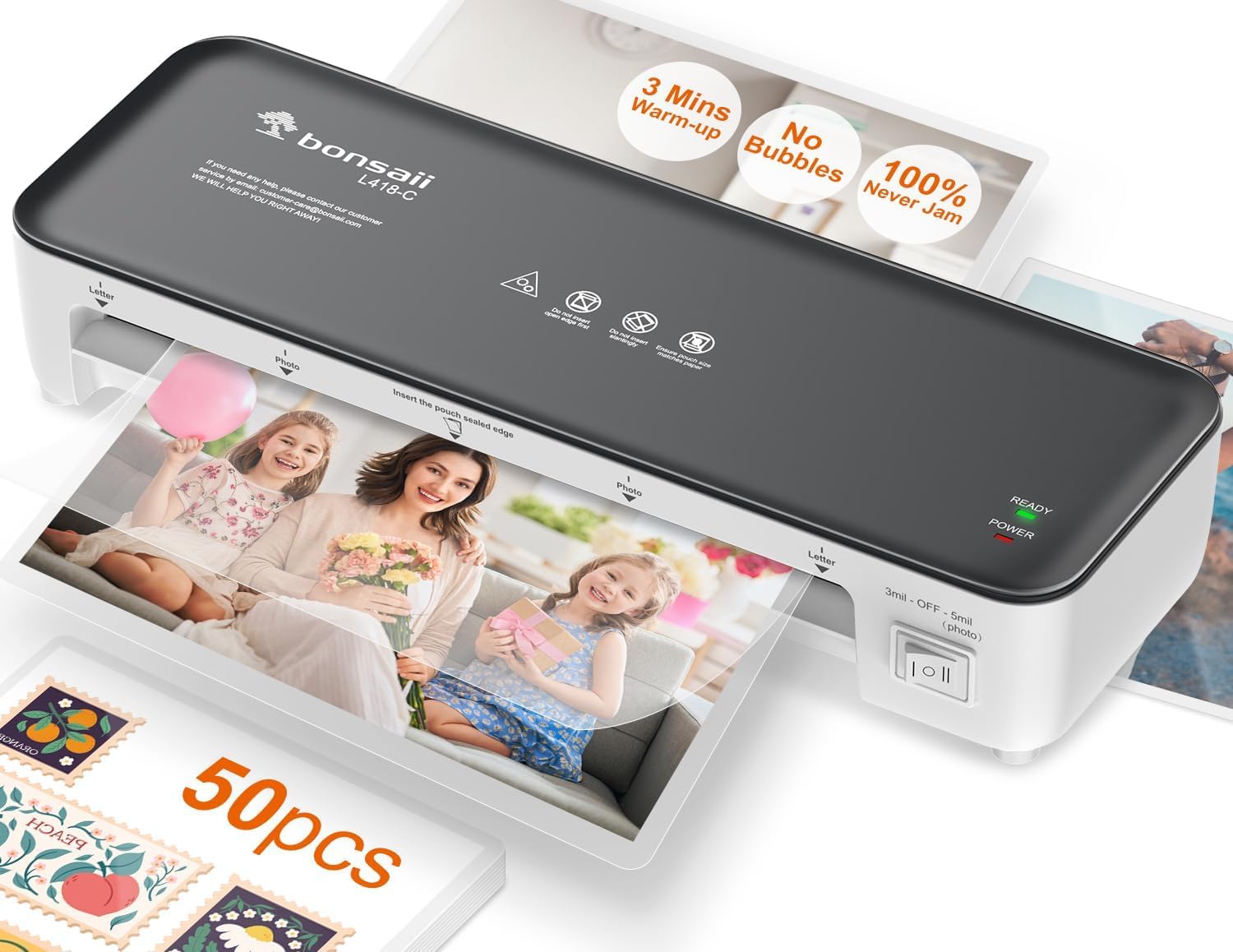
The bonsaii 9-inch laminator is a small thermal machine designed for everyday laminating tasks like ID cards, photos, worksheets, and business cards. It accepts 9-inch (A4) pouches in 3–5 mil thickness and ships with 50 pouches, so you can start laminating right away. Key practical features are its patented anti-jam system and a 1–3 minute warm up time that help keep jobs moving without frequent interruptions. The unit runs at about 0.98 ft/min and uses two rollers to produce consistent, bubble-reduced finishes when used with the recommended pouch thicknesses. Its lightweight, narrow footprint makes it easy to store or move between a classroom and home desk. Limitations are typical for machines this size: it only handles up to 9-inch width so larger documents are out, and it is intended for light to moderate use rather than heavy, continuous production. For routine home, teacher, or small-office tasks it delivers a fast, straightforward laminating experience with fewer jams than cheaper units.
Best for: Buyers who want a practical, no-fuss laminator for routine home, classroom, or small-office projects and value fast setup and reliable jam prevention.
Less Ideal for: Large-format needs or users who require high-volume, continuous laminating for production environments should choose a wider, industrial model.
- Patented anti-jam technology reduces interruptions and protects documents
- Quick 1–3 minute warm up for near-immediate use
- Includes 50 laminating pouches so you can start without buying supplies
- Compact, lightweight design is easy to store and transport
- Two-roller system produces consistent, low-bubble lamination
- Limited to 9-inch width so it cannot laminate larger sheets
- Not built for heavy continuous commercial workloads
Verdict: A compact, reliable 9-inch laminator that gets everyday home and classroom jobs done quickly with built-in anti-jam protection.
bonsaii 9-Inch Laminator

| Warm up time | less 4 min |
|---|---|
| Laminating width | 9 inches |
| Laminating speed | ≥270 mm/min |
| Number of rollers | 2 |
| Included pouches | 5 Count |
The bonsaii 9-inch thermal laminator is a small, straightforward machine for protecting documents, photos, and classroom projects. It heats up in under four minutes and runs at about 270 mm/min, so single sheets and ID-size items are laminated quickly. The unit includes five pouches to get started and has a two-roller feed plus an ABS jam-release button that clears stuck pouches without fiddly tools. Its low weight and compact footprint make it easy to store or move between a desk and a classroom. Expect quiet operation and compatibility with 3 mil film (maximum 0.5 mm thickness), which covers most basic laminating jobs. Limitations are its 9-inch width and light-duty construction, so it is not built for high-volume commercial use or very thick laminating film. For routine home, teacher, or small-office tasks it offers a dependable, no-frills laminating experience at an entry-level value.
Best for: Buyers who need an inexpensive, easy-to-store laminator for occasional home, classroom, or small-office projects and value simple operation over heavy-duty capacity.
Less Ideal for: People who laminate large-format items, run high daily volumes, or need thicker-film and heavy-duty commercial performance should choose a larger machine.
- Fast warm-up under 4 minutes for quick, on-demand laminating
- ABS jam-release system simplifies clearing stuck pouches
- Compact and lightweight for easy storage and portability
- Includes starter pouches so you can use it right away
- Limited to 9-inch width and compatible with up to 3 mil (0.5 mm) film only
- Not intended for heavy or continuous commercial use
Verdict: A budget-friendly, compact laminator that delivers fast, hassle-free results for occasional home and classroom use.
Scotch TL901X Thermal Laminator

| Warm Up Time | 5 minutes |
|---|---|
| Speed | 1 feet_per_minute |
| Number of Rollers | 2 |
| Included Components | Two 9.4" x 11" laminating pouches |
The Scotch TL901X is a small thermal laminator designed for home, school, and light office use that accepts 3- and 5-mil pouches up to 9 inches wide. It uses a two-roller heated system and offers two temperature settings so you can choose the thicker 5-mil pouches for stiffer, more durable finishes or 3-mil for everyday protection. It laminates at about one letter-size page per minute and reaches operating temperature in roughly five minutes, with a release lever to free misfed pouches without forcing them through. Practical benefits include a clean, photo-safe finish that resists markers, tears, and spills and the compact footprint that fits on a desk or craft table. Limitations are its modest throughput and narrow width limit it to small documents and occasional projects rather than high-volume or wide-format commercial jobs, and the single speed means larger batches will take time. For reliability-focused buyers this model emphasizes straightforward, predictable lamination with simple controls and a low chance of jams when used with recommended pouches.
Best for: Buyers who prioritize a dependable, no-fuss laminator for occasional to moderate home, classroom, or small office tasks and want consistent, professional-looking results.
Less Ideal for: Those who need high-volume throughput or wide-format lamination for posters, banners, or commercial print shops should choose a larger, faster machine.
- Two heated rollers produce a smooth, bubble- and wrinkle-reduced finish
- Selectable 3-mil and 5-mil settings for thicker or standard pouches
- Release lever helps clear misfeeds without damaging documents
- Compact size fits on a desk or craft table and is photo-safe
- Limited to items up to 9 inches wide, so not suitable for wide-format projects
- Relatively slow single speed at about 1 foot per minute, so large batches take time
Verdict: A compact, reliable thermal laminator that delivers consistent, professional-looking results for home, classroom, and small office projects.
Amazon Basics 9-Inch Thermal Laminator

| Warm up time | 5 minute |
|---|---|
| Number of rollers | 2 |
| Supports pouch thickness | 3 mil, 5 mil |
| Maximum width | 9 inches |
The Amazon Basics 9-inch thermal laminator is a small, user-friendly machine for protecting letter, legal, photos, business cards and similar paper items. It offers two heat settings for 3‑mil and 5‑mil pouches, a 3–5 minute warm-up with a ready indicator light, and a simple jam-release lever to clear feed problems without disassembly. Two rollers provide steady pressure for most home, classroom, and small office tasks, and the unit ships with sample 3‑mil pouches so you can start laminating right away. Because it accepts pouches up to 9 inches wide it fits standard documents while staying compact on a desk or shelf. Limitations include basic feature set with no cold laminating option and the machine is sized for light to moderate use rather than high-volume commercial jobs; it also cannot laminate non-paper materials such as fabric, wood, or foil. For routine document protection and occasional classroom or home projects, it delivers straightforward performance at a low-profile price point.
Best for: Buyers who want a reliable, no-frills laminator for home, classroom, or small-office projects and who value easy setup and straightforward controls backed by many user reviews.
Less Ideal for: People who need heavy-duty, high-volume laminating, cold lamination, or the ability to laminate non-paper materials should look at more specialized machines.
- Two heat settings for 3‑mil and 5‑mil pouches allow handling of normal documents and thinner papers
- Quick 3–5 minute warm up with indicator light gets you running fast
- Jam-release lever simplifies clearing jams without tools
- Compact footprint fits on a desk and handles letter and legal sizes
- No cold lamination option for heat-sensitive materials
- Not intended for high-volume commercial use
Verdict: A compact, easy-to-use laminator that reliably handles everyday home, school, and small-office lamination needs.
Amazon Basics 12-Inch Thermal Laminator

| Warm Up Time | 1 minute |
|---|---|
| Number of Rollers | 2 |
| Pouch Thickness Settings | 3 mil and 5 mil |
| Included Pouches | 20 assorted 3-mil pouches |
The Amazon Basics 12-Inch Thermal Laminator is a straightforward entry-level machine for protecting documents, photos, and small projects up to 12 inches wide. It heats in about a minute and offers two temperature settings for 3 mil and 5 mil pouches so you can match pouch thickness to the item being laminated. The unit includes 20 assorted 3-mil pouches and a jam release lever plus a metal bracket that helps steady material for cleaner feeds. Typical use is simple: warm the machine, choose the correct setting, and feed the sealed edge first for consistent results. This model is compact and light, so it stores easily and is well suited to occasional home or classroom jobs rather than heavy daily production. Limitations include basic controls with no temperature readout and modest throughput since it is designed for light to medium use rather than continuous commercial laminating.
Best for: Buyers who want a simple, reliable laminator for occasional home, school, or small office projects and prefer minimal setup and predictable results.
Less Ideal for: People who need high-volume, continuous laminating or precise temperature control for specialty materials should look at heavier duty machines.
- Fast 1-minute warm-up reduces wait time before laminating
- Two heat settings support 3 mil and 5 mil pouches for basic material flexibility
- Includes 20 assorted 3-mil pouches so you can start laminating right away
- Jam release lever and metal bracket help prevent and clear feed jams for cleaner results
- No digital temperature display or fine control for precision laminating
- Designed for light to moderate use and not suited for high-volume or heavy-duty shop work
Verdict: A no-frills, fast-warming laminator that reliably handles everyday home, school, and small-office laminating needs.
Choosing the Right Thermal Laminator: Key Factors to Consider
Warm-Up Time and Throughput
Warm-up time affects how quickly you can start a laminating job. Faster warm-up is helpful when you need to laminate multiple small items at different times during the day. Throughput or continuous run speed determines how long larger batches will take and whether the machine is practical for occasional heavy sessions.
If you plan to laminate single pages infrequently, a slightly longer warm-up may be acceptable. For classroom or small-office use where several items are processed in a row, prioritize a laminator with quick warm-up and steady throughput to avoid slowdowns and operator frustration.
Pouch Thickness and Size Support
Pouch thickness, measured in mils, affects rigidity and protection. Thicker pouches give a more durable, stiffer finish but require more heat and slower feed to avoid bubbles. Check the maximum supported mil thickness and whether the unit accepts a range of pouch sizes for documents, IDs, and photos.
Also consider pouch orientation and length limits. Some machines handle oversized pouches or have specialty settings for small ID pouches. Matching the laminator's pouch specs to your typical materials prevents failed jobs and wasted pouches.
Temperature Control and Stability
Consistent temperature across the rollers keeps laminates smooth and bubble-free. Adjustable temperature or multiple heat settings help accommodate different pouch mil ratings and sensitive media like inkjet prints.
Poor temperature regulation can cause wrinkling, uneven bonding, or overheating of delicate materials. For mixed-use environments, a model with clear heat settings reduces trial-and-error and improves first-pass success rates.
Feed Mechanism and Jam Prevention
A reliable feed mechanism ensures straight, wrinkle-free laminates and reduces the chance of jams that can damage materials. Features such as anti-jam reverse, alignment guides, and wide entry slots simplify feeding and rescue partially fed items without destroying them.
If you will laminate laminated-edge-thin items like ID cards or composite pages, a steady, guided feed is especially important. Frequent jams add cost and downtime, so users should prioritize machines with proven anti-jam behavior.
Safety and Ease of Use
Safety features such as protective covers, cool-to-touch surfaces, and clear indicator lights matter in homes, classrooms, and offices. Simple, clearly labeled controls let less experienced users choose the correct setting without risking overheating or misfeeds.
A model that includes straightforward documentation and visual cues will reduce errors and make it easier to train additional users. Consider whether the laminator has an accessible jam-release or reverse function for safe recovery of stuck materials.
Durability and Maintenance
Build quality and recommended maintenance impact how long the laminator performs reliably. Sturdy rollers, stable feed components, and replaceable parts extend usable life. Regular maintenance tasks include cleaning rollers, removing adhesive build-up, and following manufacturer instructions for cool-down.
A more durable machine may cost more upfront but reduces replacement and repair hassles. For environments with frequent use, pick a unit with simple maintenance steps and accessible service information.
Understanding Pouch Mil Ratings
Pouch mil rating indicates thickness and resultant stiffness after lamination. Common household options range from thin 3-5 mil pouches for light protection to 10 mil or thicker for rigid, display-ready results. Matching mil rating to the content is key: photos and frequently handled items benefit from thicker pouches, while soft documents or certificates may only need thinner protection.
Choose heat settings and feed speed appropriate to the pouch mil. Thicker pouches typically require higher temperature and slower feed to ensure full bonding without bubbles or creases. If you expect to work with many different mils, favor a laminator with multiple heat settings and clear guidance.
- 3–5 mil: light protection, flexible finish
- 7–10 mil: common for durable photos and signage
- Over 10 mil: rigid, professional display pieces
Routine Maintenance to Maximize Lifespan
Regular cleaning prevents adhesive build-up on rollers and preserves feed accuracy. Use recommended cleaning sheets or follow the manufacturer instructions to remove residue. Allow the machine to cool before any maintenance task.
Inspect rollers and guides for wear periodically. If the unit has replaceable parts, keep spares on hand if you rely on the laminator for frequent jobs. Proper maintenance reduces jams and keeps lamination quality consistent over time.
- Run cleaning sheets after heavy use
- Wipe exterior surfaces with a soft, dry cloth
- Service or replace worn rollers as recommended
Safe Practices for Home and Classroom Use
Because thermal laminators use heat, place the machine where it has good ventilation and is out of reach of small children. Keep a stable, level work surface to avoid accidental tipping during feeding. Teach students or occasional users how to use heat settings properly and how to use the reverse or jam-release function safely.
Turn off and unplug the machine when not in use and allow it to cool before handling laminated items that may still be hot to the touch. Clear indicator lights and labeled controls lower risk of misuse and heat-related accidents.
- Position on a stable, ventilated surface
- Supervise student use and provide simple instructions
- Always allow cool-down before cleaning or storing
Choosing Between Pouch and Roll Laminating
Most home and small-office users prefer pouch laminators for their simplicity and quick setup. Pouch systems work well for standard document sizes and occasional heavier items. Roll laminators are more suitable for high-volume or wide-format needs and typically sit in a different class of equipment.
When deciding, balance expected volume and typical job sizes. If you rarely exceed standard document widths and you value low maintenance, a pouch-based thermal laminator is usually the practical choice.
- Pouch: simpler, lower maintenance, ideal for documents and photos
- Roll: higher volume, wider widths, more complex setup
Paper and Media Preparation Tips
Trim rough or uneven edges before lamination and make sure ink is fully dry to avoid smearing. For documents with adhesive notes or staples, remove sticky items and metal fasteners to prevent damage to the rollers and poor lamination bonds. Use a backing sheet for thin or porous papers to avoid warping.
Align items in the center of the pouch and leave recommended margins to ensure proper seal. For double-sided prints or items with texture, flatten carefully before feeding to prevent trapping air pockets.
- Remove staples and sticky notes
- Allow ink to dry completely
- Leave consistent margins inside pouches
How We Chose the Best Thermal Laminator
We focused on practical performance and reliability for everyday home, school, and small-office laminating. Key evaluation criteria included warm-up time and continuous run speed to reflect how long you will wait before starting a job and how fast small batches finish. We measured pouch compatibility and maximum mil thickness accepted to ensure the unit works with common pouch sizes for photos, signs, and ID cards. Temperature consistency and control were assessed because even heat prevents bubbles and delamination. Feed accuracy and jam resistance were considered to reduce waste and protect documents. Usability metrics covered controls, indicator lights, and the quality of any included starter pouches or accessories. We excluded heavy industrial roll laminators and specialty cold-laminating systems because this roundup targets countertop thermal laminators for light to moderate use. Units were filtered for safety features appropriate for consumer environments and for clear documentation on supported pouch thickness. Performance, reliability signals, and real-world usability shaped our shortlist rather than marketing claims or bundled promotions.
Our full evaluation process is outlined in our review methodology.
FAQ
How long should a thermal laminator warm up before use?
Warm-up times vary by model, but many consumer thermal laminators take between 3 and 7 minutes to reach operating temperature. Faster warm-up is helpful for intermittent tasks, while slightly longer warm-up may accompany better temperature stability for thicker pouches.
Can I laminate photos printed on inkjet paper?
Yes, but ensure the ink is fully dry and choose a temperature setting suitable for inkjet-safe media. Using too high a temperature or feeding too quickly can cause smearing or trapping solvent; follow manufacturer guidance for photo and inkjet-compatible pouches.
What happens if my pouch bubbles during lamination?
Bubbling usually indicates incorrect temperature, too-fast feed, or incompatible pouch thickness. Let the item cool and inspect whether rebonding is possible by running at a lower speed or adjusting heat. If bubbles persist, discard the pouch and try again with the correct settings.
Are there safety concerns using a thermal laminator around children?
Thermal laminators get hot and should be used under supervision around children. Place the machine on a stable surface, keep it out of reach, and instruct users on safe operation. Many units include indicator lights and cool-touch areas to reduce risk.
How do I remove a jam without damaging my document?
Use the reverse or jam-release function if the machine has one, and wait for the rollers to cool before attempting manual removal. Gently coax the pouch back out along the feed path to avoid creasing the document. Refer to the user guide for model-specific jam procedures.
Final Verdict
Choosing the right thermal laminator means balancing speed, pouch compatibility, and temperature control against the volume of work you expect. Prioritize consistent heat and reliable feed if you laminate frequently, and favor quick warm-up and clear controls for occasional or classroom use. Pay attention to pouch mil ratings and safety features to match your materials and environment. With these tradeoffs in mind, you can select a laminator that delivers dependable protection and straightforward operation for home, school, or small-office tasks.