
Note: This article contains affiliate links. If you click on these links and make a purchase, we may earn a small commission at no extra cost to you. This helps support our research and content. Read our full affiliate disclosure here.
Picking the right thermostat for a heat pump affects comfort, energy use, and system longevity. A well-matched thermostat optimizes how the heat pump stages heating and cooling, avoids unnecessary compressor cycling, and supports the schedules or remote controls you prefer. This guide shortlists the top thermostats for heat pumps and explains the features and compatibility issues that matter most. Use the summaries to compare control methods, compatibility with your heat-pump wiring, and the convenience features that fit your household. Read on for our top picks and the evaluation criteria we used to identify thermostats that balance performance, ease of installation, and useful controls.
Top Picks at a Glance
| Best Overall The best all-around choice for most situations | Honeywell Home Smart Color Thermostat RTH9585WF |  |
| Best Quality Built to a higher standard if you want something more solid | Google Nest Learning Thermostat (4th Gen) |  |
| Best Value The sweet spot between price and what you get | Sensi Smart Thermostat ST55 |  |
| Best Budget The cheapest option that still gets the job done reliably | Miuputake STN601 Thermostat |  |
| Top Rated A top-rated pick with lots of positive feedback | White‑Rodgers Classic 80 Thermostat |  |
| Most Popular A crowd favorite that many people choose with confidence | Google Nest Thermostat |  |
Honeywell Home Smart Color Thermostat RTH9585WF

| Controller Type | Touch Screen, Voice |
|---|---|
| Connectivity Technology | Wi-Fi |
| Power Source | AC Power Supply |
| Voltage | 120 volts |
| Number of Batteries | 1 AAA batteries required. |
The Honeywell Home Smart Color Thermostat is a Wi‑Fi enabled, 7‑day programmable thermostat built for connected homes that need flexible scheduling and remote control. It uses a bright full‑color touchscreen you can personalize to match decor and supports app and voice control for on‑the‑go adjustments. The thermostat includes Smart Response Technology to learn preferences and automate comfort, weather display on the screen, alerts for filter and humidifier pad changes, and Energy Star certification for efficiency tracking and potential utility rebates. It is designed for low‑voltage heating and cooling systems including heat pumps with electric backup but requires a C‑wire and will not work with electric baseboard heat. Installation is intended for DIYers with step‑by‑step guidance, and the interface is straightforward for daily use, though compatibility checks are necessary before purchase. For homes with compatible heat pump systems, it provides solid remote control, scheduling, and energy‑saving features but is not suitable where a C‑wire is absent or for line‑voltage heating setups.
Best for: Homeowners with compatible low‑voltage heat pump or forced‑air systems who want a programmable, app‑controlled thermostat that balances comfort, efficiency, and easy setup.
Less Ideal for: Homes that lack a C‑wire or that use line‑voltage heating such as electric baseboard systems should consider other thermostat types or a power adapter solution.
- Customizable full‑color touchscreen that is easy to read and personalize.
- Wi‑Fi and app control with voice assistant compatibility for remote operation.
- Smart Response Technology learns schedule preferences to maintain comfort.
- Energy Star certified with energy reports and compatibility with utility rebate programs.
- Installation is DIY friendly with included mounting hardware and guidance.
- Requires a C‑wire and is incompatible with line‑voltage or electric baseboard heating systems.
- Only supports 2.4 GHz Wi‑Fi networks, so it will not connect to 5 GHz networks.
Verdict: Choose this thermostat if you want a user‑friendly, Energy Star certified Wi‑Fi thermostat that pairs smart scheduling and remote control with heat pump compatibility (provided you have C‑wire power).
Google Nest Learning Thermostat (4th Gen)

| Connectivity Technology | Wi-Fi |
|---|---|
| Power Source | Battery Powered |
| Voltage | 24 volts |
| Display Type | Touchscreen |
| Number of Batteries | 1 CR2 batteries required. (included) |
The Nest Learning Thermostat (4th gen) is a high-end smart thermostat that learns your preferred temperatures and adjusts schedules to save energy while keeping rooms comfortable. It pairs with the included Nest Temperature Sensor to manage hot and cold spots, and it adapts to outdoor conditions with features like Adaptive Eco and natural heating and cooling that can pause HVAC operation when external conditions are favorable. You control it from the Google Home app, by voice with major assistants, or at the touchscreen display with Dynamic Farsight for easy visibility across a room. Practical benefits include remote control, system health alerts that flag potential HVAC issues, and compatibility with most 24V systems including heat pumps. Trade-offs are that advanced savings depend on consistent use of the app and sensors, and full compatibility details—such as C‑wire requirements for some setups—should be checked before installation. The unit is designed for straightforward DIY install or pro setup and comes with mounting hardware and wiring labels to simplify wiring for common systems.
Best for: Homeowners focused on maximizing heat pump efficiency and who want a smart thermostat that adapts over time and integrates with a broader smart-home setup.
Less Ideal for: People who need a very basic, manual thermostat or who prefer a no‑app, offline solution with minimal configuration.
- Learns schedules and suggests energy-saving adjustments automatically
- Included Nest Temperature Sensor helps manage hot and cold spots
- Works with Google Home app and multiple voice assistants for remote control
- Adaptive Eco and outdoor-aware features can reduce runtime for efficiency
- System Health Monitor provides alerts if the HVAC system needs attention
- Some advanced features rely on app interaction and accepting schedule suggestions
- Compatibility nuances (C‑wire or specific systems) may require checking before install
Verdict: Choose this Nest thermostat if you want an adaptive, app-driven controller that can optimize heat pump performance and manage temperature imbalances across rooms.
Sensi Smart Thermostat ST55

| Controller Type | Amazon Alexa, Apple HomeKit, Google Assistant, SmartThings, Vera |
|---|---|
| Connectivity Technology | Wi‑Fi (2.4 GHz) |
| Power Source | Corded Electric (2 AA batteries included) |
| Temperature Control Type | Programmable, Smart/Remote |
The Sensi ST55 is a wall‑mounted smart thermostat that brings remote control, scheduling, and basic HVAC monitoring to homes with conventional systems and heat pumps. It connects to 2.4 GHz Wi‑Fi and is controlled via the Sensi mobile app, touch buttons, or voice assistants including Alexa, Google Assistant and Apple HomeKit. Installation is aimed at DIYers: the package includes mounting hardware, wire labels, and step‑by‑step app guidance and in most setups does not require a common wire. The thermostat displays simple info on a 5‑inch LED screen and offers energy reports, smart alerts, and filter reminders that help optimize runtime and detect maintenance needs. It is Energy Star certified and supports usage reports that can help reduce HVAC energy use. Limitations include a basic button control interface rather than a full color touchscreen and reliance on 2.4 GHz Wi‑Fi only, which may restrict placement in homes with crowded networks or weak signal near the HVAC closet.
Best for: Buyers who want a straightforward, energy‑focused smart thermostat they can install themselves and manage remotely using an app or voice assistants.
Less Ideal for: Users who need a premium touchscreen interface, advanced zoning controls, or who have unreliable Wi‑Fi and prefer a thermostat that can operate without network access.
- Easy DIY install with included hardware and step‑by‑step app guidance
- Works with Alexa, Google Assistant, Apple HomeKit and SmartThings for voice and smart‑home control
- Energy Star certification plus usage reports and smart alerts to help reduce HVAC energy use
- Supports common heat sources including heat pumps, furnaces, boilers and air conditioners
- No full color touchscreen—uses a 5‑inch LED display with button controls
- Requires 2.4 GHz Wi‑Fi only which can limit connectivity in some network environments
Verdict: The Sensi ST55 is a practical, Energy Star‑certified smart thermostat that lets DIYers control and optimize heat pump systems remotely while delivering useful energy reports.
Miuputake STN601 Thermostat

| Controller Type | Push Button |
|---|---|
| Temperature Control Type | Manual |
| Power Source | 24VAC |
| Display Type | LCD |
The Miuputake STN601 is a simple wall-mounted digital thermostat intended for single-stage heating and cooling systems and heat pumps without auxiliary or emergency heat. It uses a clear backlit LCD and button controls for straightforward temperature setting, and includes adjustable temperature differential, compressor delay protection, and the option to switch between Celsius and Fahrenheit. Installation is designed to be DIY-friendly with a universal sub-base and large terminal blocks, and the unit can run on 24VAC or two AAA batteries when a C-wire is not present on most systems. Practical benefits include an energy-saving swing adjustment and a low-battery indicator that keep operation reliable without advanced programming. Limitations are its nonprogrammable nature and lack of compatibility with heat pumps that require auxiliary/emergency heat or with line-voltage and mini-split systems, so it is not suitable where precise scheduling or multi-stage control is needed.
Best for: Buyers wanting an inexpensive, no-frills thermostat to control a single-stage heat pump (without aux/emergency heat) or simple heating and cooling system and who prefer an easy DIY install over programmable features.
Less Ideal for: Owners who need multi-stage or aux/emergency heat support, programmable scheduling, or compatibility with mini-split and line-voltage systems should look elsewhere.
- Backlit LCD and simple button controls for easy daily use
- Dual power options: runs on 24VAC or two AAA batteries when C-wire is absent
- Universal sub-base and large terminal blocks make DIY installation faster
- Adjustable temperature differential and compressor delay protect system and save energy
- Not programmable so it cannot automate daily temperature schedules
- Incompatible with heat pumps that require auxiliary or emergency heat and some other system types
Verdict: A budget-friendly, easy-to-install digital thermostat that gives reliable manual control for single-stage heat pumps without the complexity of programmable models.
White‑Rodgers Classic 80 Thermostat

| Specific Uses For Product | Air Conditioner, Heat Pump |
|---|---|
| Temperature Control Type | Manual |
| Power Source | Battery Powered |
| Display Type | LCD |
| Number of Batteries | 2 AA batteries required. (included) |
The White‑Rodgers Classic 80 is a straightforward, non‑programmable thermostat that focuses on dependable temperature control rather than bells and whistles. It installs on a standard wall footprint, runs on two included AA batteries, and offers a large backlit LCD that is easy to read in dim conditions. Controls are button and touch based, and the unit includes helpful indicators such as filter and low battery alerts and low‑voltage protection. It is explicitly compatible with single‑stage heating, single‑stage cooling, and heat pump systems without auxiliary heat, making it a practical choice for basic heat pump setups. Because it is non‑programmable and lacks Wi‑scheduling features beyond simple on/off control, it is best used where simplicity and consistent manual control are priorities. The Classic 80 trades advanced scheduling, multi-stage heat pump support,and smart home integration for reliability, ease of use, and straightforward installation and maintenance.
Best for: Buyers who prioritize reliable, fuss‑free thermostat operation for a basic heat pump or single‑stage HVAC system and want easy installation and simple daily control.
Less Ideal for: Users who want programmable schedules, smart home connectivity, or support for multi‑stage or auxiliary heat on more complex heat pump systems should look elsewhere.
- Large backlit LCD for clear temperature readout in low light
- Simple, non‑programmable interface that is easy to use and maintain
- Includes filter and low battery indicators to aid upkeep
- Battery powered with included AA batteries for quick installation
- Does not support programmable schedules or advanced thermostat automation
- Not compatible with heat pump systems that require auxiliary or multi‑stage control
Verdict: Choose this thermostat when you need a dependable, no‑frills controller for a single‑stage heat pump that prioritizes reliability and ease of use.
Google Nest Thermostat
| Connectivity Technology | Bluetooth, Wi-Fi |
|---|---|
| Power Source | Battery Powered |
| Display Type | LCD |
| Control Type | Remote Control, Voice Control |
| Specific Uses For Product | Heat Pump |
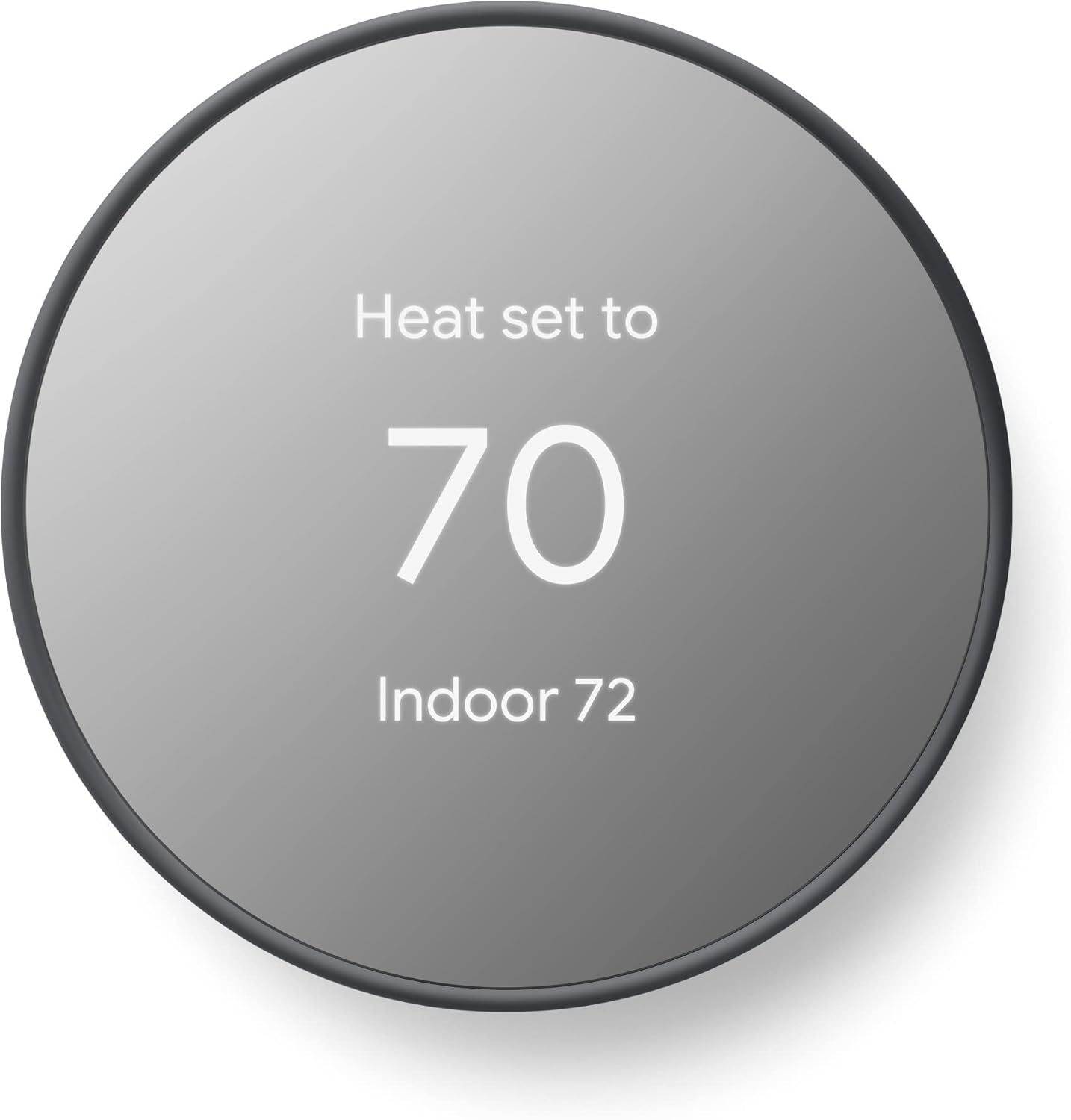
The Google Nest Thermostat is a compact smart thermostat aimed at making temperature control and energy savings simple for heat pump homes. It mounts on the wall and can be controlled with the Google Home app, voice assistants, or the touch bar on the side, letting you change temperature remotely or set a schedule. Notable features include Savings Finder suggestions, Eco Temperatures when you leave, HVAC monitoring that sends alerts for potential system issues, and compatibility with many smart home platforms. Installation is designed for DIY setup in about 30 minutes for most systems and it usually works without a C wire, though some systems will need one or a power accessory. Practical benefits are straightforward scheduling, remote access for family members, and automated nudges to reduce wasted energy. Limitations are that some advanced integrations like Nest Renew require additional Nest devices or service availability in supported regions, and full functionality depends on reliable Wi‑Fi and compatible HVAC wiring.
Best for: Buyers who want a simple, app‑driven smart thermostat that helps reduce energy use on heat pump systems and prefer a product with wide smart home integration and clear user feedback.
Less Ideal for: People who need advanced professional HVAC diagnostics, who lack reliable home Wi‑Fi, or who require a thermostat that works without any possibility of needing a C wire or power accessory.
- Remote control via Google Home app for on‑the‑go temperature changes
- Savings Finder and Eco Temperature features help reduce energy use automatically
- HVAC monitoring sends alerts for potential system issues
- Works without a C wire in most homes and is designed for easy DIY installation
- Some features require additional Nest devices or regional services to be available
- Depends on stable Wi‑Fi and compatible voice assistants for full functionality
Verdict: A user‑friendly smart thermostat that brings easy remote control and energy‑saving features to heat pump homes while being simple to install for most DIYers.
Choosing the Right Thermostat for Heat Pumps: Key Factors to Consider
Heat Pump Compatibility and Reversing Valve Support
A thermostat must explicitly support heat-pump functions such as reversing-valve output and auxiliary/backup heat control. Without proper reversing-valve wiring and logic, the system can attempt to heat when cooling is required or vice versa, which defeats the purpose of the heat pump. Confirm whether the thermostat provides a dedicated O/B terminal and whether it energizes the correct polarity for your system.
Compatibility matters because heat pumps use different control sequences than conventional furnaces. Look for thermostats with documented support for common heat-pump configurations and clear wiring diagrams. This reduces installation errors and ensures the thermostat can manage defrost cycles, backup heat, and multi-stage compressor operation when present.
Control Modes, Staging, and Adaptive Algorithms
Different heat pumps use single-stage, multi-stage, or variable-speed compressors. The thermostat should offer the right control modes and staging options to match the system. For multi-stage or variable-speed systems, choose a thermostat that can modulate stages or at least manage auxiliary heat properly to avoid short-cycling the compressor.
Adaptive algorithms such as adaptive recovery, anticipatory control, or learning schedules can improve comfort and reduce runtime. However, these features must be configurable since aggressive algorithms can trigger unnecessary backup heat or run the compressor inefficiently. Prioritize thermostats that let you tune staging thresholds, cycle minimums, and recovery behavior to match the characteristics of the heat pump and the home.
Wiring, Power Options, and Installation Complexity
Thermostats may require a common 24V C wire, power stealing, or batteries. Heat-pump systems often need firm power for reliable reversing-valve and stage control. Check whether your heat pump wiring supplies a C terminal and whether the thermostat supports the wiring you have. Some smart thermostats require a C wire or an adapter; without it, features can be limited or the thermostat may drain batteries quickly.
Installation complexity also includes terminal labeling consistency and whether the thermostat provides clear wiring guides for heat-pump setups. Installer-friendly features like diagnostic LEDs, circuit labeling, and clear in-app wiring diagrams shorten installation time and reduce miswiring risk.
Smart Controls, Remote Access, and Energy Management
Remote access via Wi-Fi or a smart-home platform makes scheduling and monitoring easier and can improve seasonal energy use. For heat pumps, look for thermostats that support scheduling by temperature setpoint rather than fixed on/off times, and those that integrate with energy-saving features like geofencing or utility demand-response programs.
Consider how the thermostat reports runtime and energy estimates for heat-pump operation. Accurate reporting helps you identify when the system runs inefficiently or when auxiliary heat is engaging too often. If you value automation, choose a thermostat with reliable cloud services and local fallback behavior in case of network outages.
User Interface, Local Controls, and Diagnostics
A clear local interface reduces user error. For heat pumps, the thermostat should display current mode, stage status, and whether auxiliary heat is active. Diagnostic indicators for reversing-valve state, active stages, and fault codes help homeowners and technicians troubleshoot without a separate meter.
Touchscreens, physical buttons, and app controls all have trade-offs. Touchscreens provide rich information but can be harder to operate with gloves or limited dexterity. Physical controls are often faster for day-to-day adjustments. Prioritize thermostats that surface the most relevant heat-pump diagnostics plainly and allow easy overrides or temporary hold modes.
Durability, Firmware Updates, and Long-Term Support
Thermostats are long-lived components of an HVAC system. Ensure the model you choose receives firmware updates to fix bugs, improve heat-pump management logic, and maintain security for connected features. Durable hardware and replaceable mounting plates make service easier and reduce disruption during upgrades.
Consider vendor support policies and whether settings can be backed up or restored. A thermostat that loses schedules after a power interruption or lacks a straightforward reset path can be an ongoing nuisance when paired with a critical heat-pump system.
Matching Thermostat Modes to Your Heat Pump Type
Identify whether your heat pump is single-stage, multi-stage, or variable-speed before selecting a thermostat. Each category requires different control logic to manage compressor stages and auxiliary heat effectively. A mismatch can lead to comfort issues or excessive use of backup heat.
If your heat pump has an outdoor temperature sensor or supports two-stage operation, choose a thermostat that can accept those inputs or emulate the needed sequencing. Otherwise, the thermostat may not take advantage of the system features that improve efficiency.
- Single-stage: simple on/off control, minimal staging options needed
- Multi-stage: requires staging control and adjustable staging thresholds
- Variable-speed: best matched with thermostats that support variable output or communicate with the equipment
Common Wiring Configurations and What They Mean
Common terminal labels include R, C, Y, G, W, and O/B for heat pumps. The presence of a dedicated O or B terminal indicates the thermostat can control the reversing valve. Confirm whether your system uses an O or B energized-on cooling signal and select a thermostat that matches that polarity.
If you lack a C wire, look for thermostats that explicitly support alternative power options, but plan for limited features or the need for a C-wire adapter. Always turn off power to the HVAC system before attempting wiring changes.
- R: 24V power
- C: common 24V return, often required for smart thermostats
- O/B: reversing valve control for heat pumps
- Y: compressor call
- W/Aux: auxiliary or backup heat
Scheduling Strategies That Save Energy With Heat Pumps
Because heat pumps operate most efficiently near moderate temperature differences, try modest setpoint changes rather than large setbacks. Aggressive setbacks can trigger auxiliary heat run and negate savings. Schedule small, consistent setbacks combined with adaptive recovery to preheat or precool ahead of occupancy.
Use features like geofencing or occupancy sensing to reduce runtime when no one is home. If the thermostat supports utility demand-response programs, enroll only if you understand how overrides and priorities work during peak events.
- Use 2 to 4 degree setpoint changes for setbacks
- Prefer gradual recovery rather than abrupt changes
- Monitor auxiliary heat engagement frequency to adjust schedules
Remote Monitoring and What Data to Track
Remote apps can provide runtime summaries, mode history, and alerts when the system triggers auxiliary heat. Track compressor runtime versus auxiliary heat hours to understand system efficiency. Excessive auxiliary heat use often indicates poor thermostat staging or system sizing issues.
Set up alerts for long runtimes or repeated fault conditions. Early notification of issues such as a stuck reversing valve or failed stage can prevent larger repairs and maintain comfort.
- Check daily compressor vs auxiliary runtime
- Use alerts for fault conditions and prolonged runtimes
- Review historical trends after seasonal transitions
Installer Tips: Commissioning and Testing Heat Pump Controls
After wiring, verify that the reversing valve responds correctly in heat and cool modes. Observe whether auxiliary heat engages only when needed and that staging thresholds match the system behavior. Adjust cycle minimums and staging differentials to prevent short cycles.
Use the thermostat diagnostics or installer menus to test individual outputs. Document wiring and any nonstandard terminal mappings for future service and label the wall plate clearly so homeowners and technicians avoid confusion during maintenance.
- Test O/B reversing-valve polarity in both heat and cool
- Verify auxiliary heat locks out until necessary
- Adjust cycle minimums to protect the compressor
How We Chose the Best Thermostat for Heat Pumps
We focused on thermostats that reliably manage the specific demands of heat pumps: correct reversing-valve operation, appropriate compressor staging, and defrost management. Our selection criteria emphasized electrical compatibility with common heat-pump wiring, flexible control modes for single- and multi-stage systems, and scheduling or adaptive controls that help reduce run time without sacrificing comfort. We also evaluated user-facing features such as intuitive interfaces, remote app control, and integration with common smart-home ecosystems when these enhance heat-pump operation. Practical considerations included installation complexity and diagnostic feedback useful to installers and homeowners. We excluded products that lack explicit heat-pump support, cannot control necessary stages or accessories, or demand proprietary hardware that restricts straightforward maintenance. The result is a list of thermostats that meet the functional requirements of heat-pump systems while offering clear differences in control style, connectivity, and installer-friendly diagnostics.
Our full evaluation process is outlined in our review methodology.
FAQ
Do I need a special thermostat for a heat pump?
Usually yes. Thermostats must support reversing-valve outputs and auxiliary heat control to manage a heat pump correctly. Choosing a unit with explicit heat-pump settings reduces the risk of incorrect mode operation.
Can a smart thermostat save energy with a heat pump?
Often. Smart thermostats offer scheduling, adaptive recovery, and remote controls that can reduce run time. Savings depend on how setbacks are configured and whether auxiliary heat is avoided through modest temperature changes.
What if my thermostat does not have a C wire?
Some thermostats can operate without a C wire using batteries or power-stealing, but smart features may be limited. For reliable operation and full feature access, adding a C wire or using a compatible power accessory is recommended.
How do I know if auxiliary heat is running too often?
Monitor runtime reports or check the thermostat display for auxiliary heat indicators. Frequent auxiliary engagement during mild weather suggests staging or control settings need adjustment, or the system may be undersized.
Will a thermostat diagnose heat pump faults?
Some thermostats provide useful diagnostics such as stage status, reversing-valve state, and basic fault indications. They are helpful for initial troubleshooting but do not replace professional diagnostics for complex mechanical or refrigerant issues.
Final Verdict
Choose a thermostat that explicitly supports heat-pump functions, matches your system staging, and provides the wiring and power support your installation requires. Prioritize compatibility and clear control over bells and whistles; well-implemented scheduling and proper staging deliver the biggest comfort and efficiency gains. When in doubt, favor models that make installation and diagnostics straightforward so you and a technician can confirm correct operation and minimize auxiliary heat run.