
Note: This article contains affiliate links. If you click on these links and make a purchase, we may earn a small commission at no extra cost to you. This helps support our research and content. Read our full affiliate disclosure here.
Choosing the right thermostat for your home affects comfort, energy bills, and how your HVAC system performs. A well-matched thermostat keeps temperature stable, reduces wasted runtime, and can make daily life more convenient whether you want basic programmable schedules or smarter automation. This guide shortlists seven top thermostats chosen for real-world home use and evaluates them across practical criteria homeowners care about. Read on to see how these picks score for installation ease, temperature accuracy, control options, and energy-saving potential.
Top Picks at a Glance
| Best Overall The best all-around choice for most situations | ecobee Smart Thermostat Essential |  |
| Best Quality Built to a higher standard if you want something more solid | Google Nest Learning Thermostat (4th Gen) |  |
| Best Value The sweet spot between price and what you get | Honeywell Home X2S Smart Thermostat |  |
| Best Budget The cheapest option that still gets the job done reliably | Aowel Non-Programmable Thermostat AW701 |  |
| Top Rated A top-rated pick with lots of positive feedback | Sensi Smart Thermostat ST55 |  |
| Most Popular A crowd favorite that many people choose with confidence | Google Nest Thermostat |  |
| Best Seller A high-volume bestseller chosen again and again | Amazon Smart Thermostat |  |
ecobee Smart Thermostat Essential

| Connectivity Technology | Wi-Fi |
|---|---|
| Controller Type | Amazon Alexa, Android, Apple HomeKit, Google Assistant, iOS |
| Power Source | Battery Powered |
| Display Type | LCD |
| Mounting Type | Wall Mount |
The ecobee Smart Thermostat Essential is a straightforward Wi‑Fi thermostat that brings smart control and energy-saving features without the premium extras. It installs on the wall and is controlled via a 3.74-inch color touchscreen or the ecobee mobile app, and it integrates with Apple HomeKit, Google Assistant, and Alexa for voice control. The unit supports auto-scheduling, an auto-away mode, fan control, and basic energy reports through ecobee's eco+ features to help reduce heating and cooling costs. It covers most 24 VAC HVAC setups and can use ecobee's Power Extender Kit for systems without a C wire, making DIY installation feasible in many homes. The Essential omits advanced sensors and built-in air quality monitoring found on higher-end models, so room-by-room balancing requires purchasing SmartSensor accessories separately. Battery power and a compact round matte design keep the unit low-profile, but buyers should check compatibility before ordering. For homeowners who want reliable smart scheduling and app control without extra bells and whistles, this model delivers practical savings and easy remote access.
Best for: Homeowners who want a reliable, no-frills smart thermostat that saves energy and gives remote app and voice control without paying for top-tier extras.
Less Ideal for: Buyers who need integrated room sensors, air quality monitoring, or the most advanced comfort features should consider higher-end models or add-on accessories.
- Wi‑Fi connectivity with app control and voice assistant compatibility
- Auto-scheduling and eco+ features for energy savings
- Works with most 24 VAC HVAC systems and offers PEK support for no C‑wire installs
- Compact touch display and simple DIY-friendly installation
- Does not include room sensors or built-in air quality monitoring
- Fewer advanced features than ecobee premium models
Verdict: A practical, budget-friendly smart thermostat that delivers app and voice control plus energy-saving scheduling for most homes.
Google Nest Learning Thermostat (4th Gen)

| Controller Type | Amazon Alexa, Android, Apple HomeKit, Google Assistant, iOS |
|---|---|
| Power Source | Battery Powered |
| Voltage | 24 volts |
| Display Type | graphical lcd, ips |
| Included Components | Nest Temperature Sensor (2nd gen) |
The Nest Learning Thermostat (4th gen) is a premium smart thermostat that learns your temperature preferences and automates schedules to reduce energy use while keeping rooms comfortable. It installs on a standard 24V HVAC system and includes a Nest Temperature Sensor to help manage hot and cold spots, with control available from the Google Home app or voice assistants. Notable features include Adaptive Eco that uses outdoor conditions to pause HVAC when appropriate, Dynamic Farsight for easy readouts across the room, and a System Health Monitor that alerts you to potential equipment issues. The display is larger and more readable than prior models, and Matter compatibility makes it straightforward to integrate into modern smart-home setups. The thermostat aims to save energy by suggesting schedule tweaks and automatically switching to Eco temperatures when you leave, though maximum savings depend on how the system is set up and used. Buyers should expect a well-designed, app-driven experience that prioritizes automated efficiency and visibility into HVAC performance rather than a basic manual thermostat.
Best for: Buyers who want a high-performance, automated thermostat that actively optimizes comfort and energy use and who prefer app and voice control over manual programming.
Less Ideal for: People who want a simple, no-frills programmable thermostat or who need a basic manual unit without smart-home integration.
- Learns user preferences and suggests automated schedule changes to improve comfort and efficiency
- Includes a Nest Temperature Sensor to manage hot and cold spots remotely
- Adaptive Eco and outdoor-aware features can reduce HVAC runtime when conditions allow
- Large Dynamic Farsight display is easy to read from across the room and adjusts brightness automatically
- Energy savings depend on correct setup and user interaction with suggested schedule changes
- Requires a 24V HVAC system and may need professional help for nonstandard installations
Verdict: Choose this Nest thermostat if you want an advanced, learning smart thermostat that actively optimizes comfort and energy use through automation and sensors.
Honeywell Home X2S Smart Thermostat

| Connectivity Technology | Matter, Wi‑Fi |
|---|---|
| Compatibility | Up to 2H/2C conventional or Up to 2H/1C heat pump |
| Power Source | C‑wire required (24 VAC) |
| Scheduling Options | 7 day, 5‑1‑1 day, 5‑2 day, 1 week or non‑programmable option |
| ENERGY STAR Certified | Yes |
The Honeywell Home X2S is a wall‑mounted smart thermostat that gives remote control and scheduling via the First Alert app and supports voice assistants through Matter, Alexa, Google Assistant and Apple HomeKit. It is intended for conventional HVAC and compatible heat pump systems and requires a C‑wire for power, so installation is straightforward for typical modern systems. The X2S offers multiple scheduling options (7‑day, 5‑1‑1, 5‑2 and 1‑week or non‑programmable), auto‑away to reduce wasted runtime, and reminders for filter changes and optional indoor humidity monitoring. The LCD display and interchangeable accent pieces let you match a room aesthetic, while ENERGY STAR certification and demand‑response capability help lower energy use and qualify for utility programs. Limitations include the C‑wire requirement and lack of support for electric baseboard heating, so it is not universal for every home. For buyers who prioritize smart integrations, flexible scheduling, and energy savings, the X2S is a sensible upgrade from basic thermostats.
Best for: Buyers who want a practical, energy‑focused smart thermostat with robust app and voice integrations and flexible scheduling to reduce home energy use.
Less Ideal for: Homeowners with electric baseboard heat or those unwilling to add a C‑wire should consider different solutions.
- Matter certified for broad smart‑home and voice assistant integration
- Flexible scheduling options and auto‑away to cut wasted runtime
- ENERGY STAR certified and demand‑response capable to help lower energy use
- Filter reminders and optional humidity readout for easier maintenance
- Requires a C‑wire, so older homes without one may need rewiring or an adapter
- Not compatible with electric baseboard heating systems
Verdict: Choose the X2S if you want an ENERGY STAR smart thermostat that combines Matter‑based smart home compatibility with flexible scheduling to lower energy use.
Aowel Non-Programmable Thermostat AW701

| Power Source | Battery Powered |
|---|---|
| Compatibility | Conventional single-stage 1H/1C systems |
| Display Type | LCD with blue backlight |
| Control Type | Push Button |
| Terminals | RH/RC, G, Y, W, O, B, C |
The Aowel AW701 is a simple, battery-powered digital thermostat built for single-stage 1 heat/1 cool central HVAC systems. It provides a large blue backlit LCD for easy reading of room temperature and humidity, basic fan ON/AUTO control, and manual push-button setpoint adjustments. The unit supports technician-adjustable heating and cooling swing settings, temperature calibration, and an optional 3-minute compressor delay to protect the system. Installation is straightforward with a universal sub-base and clearly labeled RH/RC, W, Y, G, O, B, and C terminals, and it can run on two AAA batteries so a common wire is not required in most setups. Practical benefits include clear, no-frills operation for users who do not need schedules or smartphone control and modest thermostatic accuracy for everyday comfort. Limitations are that it only supports conventional single-stage systems and lacks programmability, smart connectivity, and advanced energy-saving scheduling, so it is not suitable for multistage or heat pump systems or buyers wanting automation.
Best for: Buyers seeking a low-cost, no-frills replacement thermostat for a standard single-stage gas, oil, or electric furnace who prioritize simple operation and easy installation over smart features.
Less Ideal for: Households that want programmable schedules, Wi-Fi control, or support for multistage or heat pump systems should consider a more capable model.
- Large blue backlit LCD shows temperature and humidity for easy reading
- Works without a C-wire on most systems using two AAA batteries
- Simple push-button controls and universal sub-base make installation and daily use straightforward
- Adjustable heating/cooling swing, temperature calibration, and selectable compressor delay offer basic technician tuning
- Non-programmable with no smart or remote control features
- Compatible only with conventional single-stage systems and not suitable for heat pumps or multistage HVAC
Verdict: Aowel AW701 is an affordable, easy-to-install basic thermostat that gives clear temperature and humidity readouts for single-stage HVAC systems without the complexity of smart features.
Sensi Smart Thermostat ST55

| Connectivity Technology | Wi-Fi |
|---|---|
| Control Method | App, Touch, Voice |
| Specific Uses For Product | Air Conditioner, Boiler, Furnace, Heat Pump |
| Power Source | Corded Electric |
| Number of Batteries | 2 AA batteries required (included) |
The Sensi Smart Thermostat ST55 replaces a conventional wall thermostat with a Wi‑Fi connected, programmable controller that works with common HVAC systems including furnaces, air conditioners, heat pumps, and boilers. It installs as a DIY unit with included mounting hardware and step‑by‑step app guidance and can operate with or without a common wire in many setups. Key features include 2.4 GHz Wi‑Fi remote access, app scheduling and usage reports, voice control through Alexa, Google Assistant and HomeKit integration, and Energy Star certification for energy savings. The physical interface is a simple button and LED display that fits the same footprint as a standard thermostat so you do not need to patch walls. Practical benefits include remote temperature control, run reports and smart alerts for maintenance, plus a focus on data privacy. Limitations are a basic LED screen rather than a full color touchscreen and reliance on 2.4 GHz Wi‑Fi only for smart features, which could be an issue on networks that restrict that band.
Best for: Buyers who prioritize a dependable, factory-quality smart thermostat that integrates with major voice assistants and delivers clear energy and maintenance insights without needing professional installation.
Less Ideal for: Users who want a large color touchscreen interface or need thermostat features tied to 5 GHz Wi‑Fi networks or unusual, nonstandard HVAC systems.
- Energy Star certified with scheduling and usage reports to help reduce HVAC energy use
- Works with Alexa, Google Assistant, Apple HomeKit and other smart platforms for voice and automated control
- Easy DIY installation with app guidance and included mounting hardware and stickers
- Remote access and smart alerts via mobile app for maintenance reminders and equipment notifications
- Uses a basic LED display and button controls rather than a full color touchscreen
- Requires 2.4 GHz Wi‑Fi only, which can limit connectivity on some networks
Verdict: Choose the Sensi ST55 if you want a reliable, Energy Star smart thermostat that is easy to install and integrates with major smart home platforms for consistent, privacy-minded HVAC control.
Google Nest Thermostat
| Connectivity Technology | Bluetooth, Wi-Fi |
|---|---|
| Power Source | Battery Powered |
| Display Type | LCD |
| Screen Size | 2 inches |
| Number of Batteries | 2 A batteries required (included) |
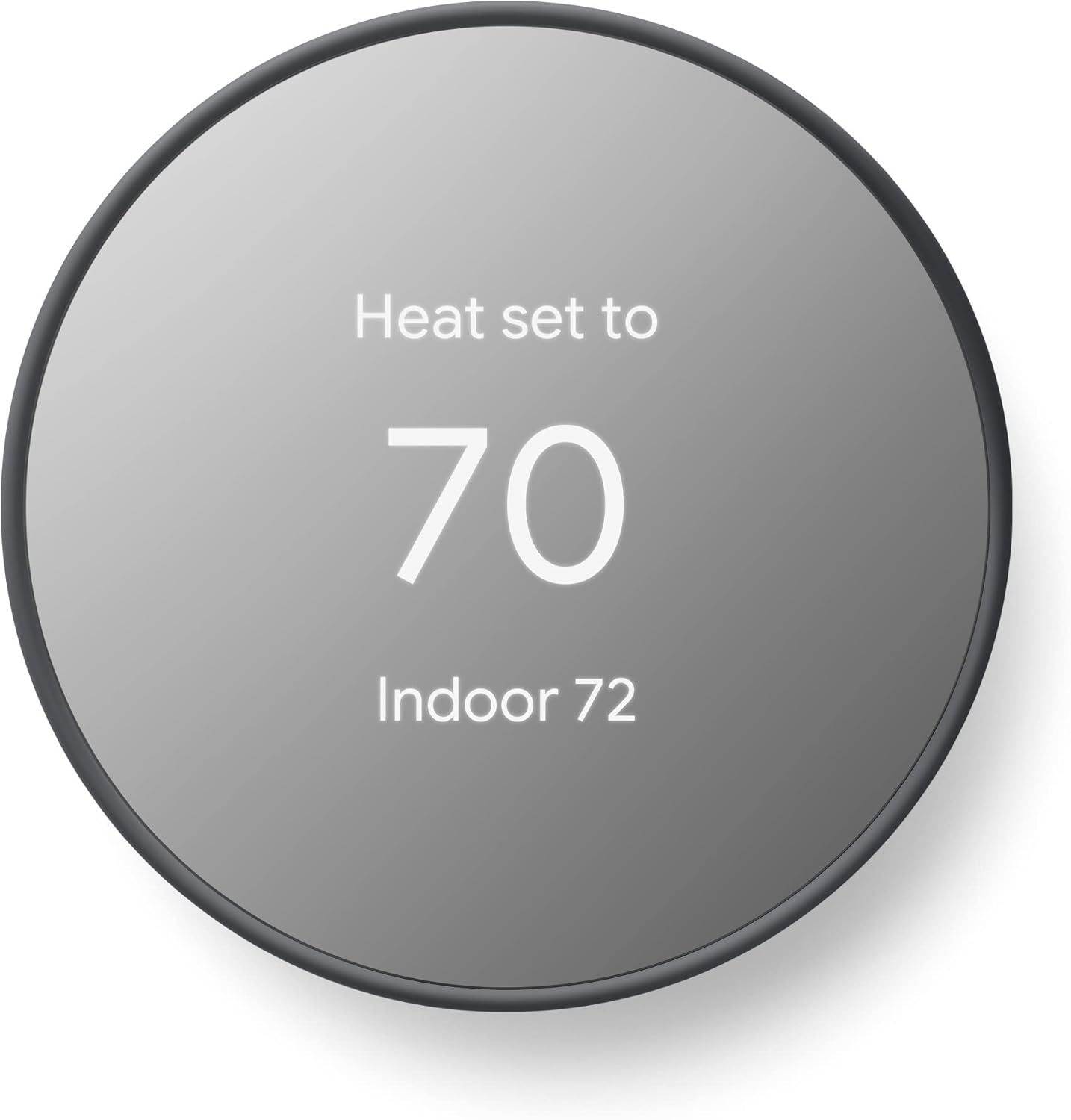
The Google Nest Thermostat is a compact smart thermostat that lets you control heating and cooling from the Google Home app or by voice with compatible assistants. It installs on a wall plate and is designed for DIY setup in most homes, and it can operate without a C wire in many systems while using two A batteries for power. In daily use you can swipe the side touch bar, change temperature remotely from a phone, or rely on features like Eco Temperature and Savings Finder to reduce energy use when you are away. It also provides basic HVAC monitoring and alerts if the system shows signs of problems. The interface is simple and the unit is Energy Star certified, but higher-end learning features and advanced power management are limited compared with Nest's flagship models, and some HVAC setups will still require a C wire or a power accessory. Voice control and remote features require working Wi‑Fi and compatible smart devices.
Best for: Buyers who prioritize easy smart-home integration, straightforward app and voice control, and energy-saving features backed by a well-known brand and strong customer feedback.
Less Ideal for: Homes with complex HVAC setups that need advanced thermostat features or buyers who want the full suite of learning capabilities from Nest’s higher-end models.
- Simple DIY installation designed for most homes
- Remote control via Google Home app for adjustments from anywhere
- Energy-saving features like Eco Temperature and Savings Finder
- Works with voice assistants and supports Wi‑Fi and Bluetooth connectivity
- May require a C wire or power accessory for some HVAC systems
- Fewer advanced learning features than Nest’s premium models
Verdict: A user-friendly, Energy Star certified smart thermostat that gives reliable app and voice control with helpful energy-saving features for mainstream homes.
Amazon Smart Thermostat
| ASIN | B08J4C8871 |
|---|---|
| Brand | Amazon |
| Compatibility | Works with Alexa and Ring |
| Installation | C-wire required |
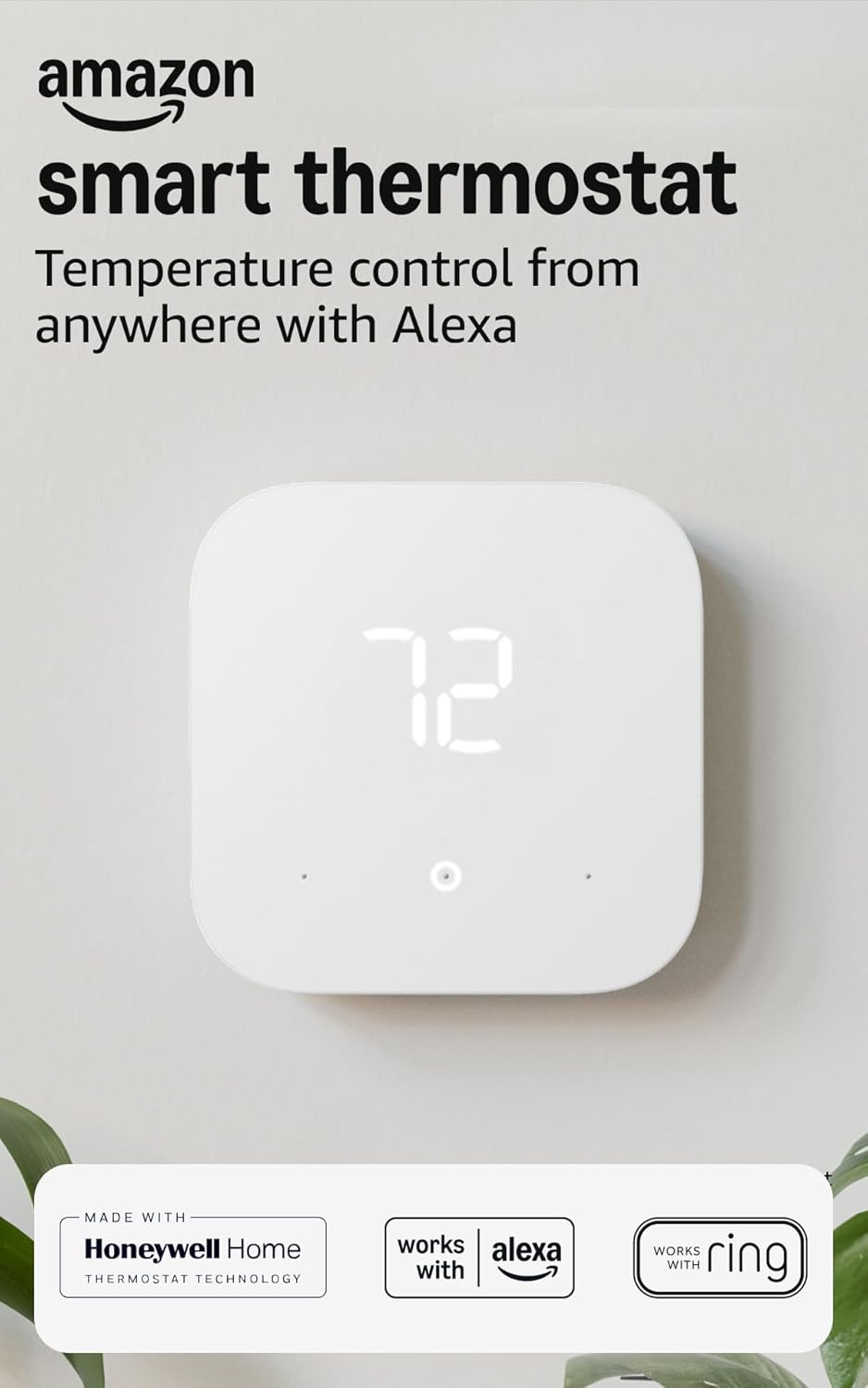
The Amazon Smart Thermostat is a straightforward smart thermostat designed to replace a traditional wall unit and let you control heating and cooling via the Alexa app or voice. It supports scheduling for home, away, and sleep modes, remote temperature monitoring and control, and can use presence detection from select Alexa devices to adjust comfort automatically. The unit is built on proven Honeywell Home thermostat technology and aims to reduce energy use through programmable schedules and Alexa+ automations. Installation is DIY-friendly when a C-wire is present and the Alexa app walks you through setup; Amazon also provides customer support if you run into issues. This model emphasizes simplicity and integration with Alexa and Ring rather than advanced HVAC diagnostics, so it is best for homeowners who want reliable smart control and energy savings without a steep learning curve. It may not meet the needs of users seeking deep professional HVAC features or multi-stage system troubleshooting.
Best for: Buyers who want a low-friction, Alexa-centered smart thermostat that replaces a basic programmable unit and prioritizes ease of setup and reliable energy-saving routines.
Less Ideal for: Homes that need advanced multi-stage HVAC controls, professional-level diagnostics, or those that prefer smart thermostats without any Alexa ecosystem ties.
- Alexa integration for voice control and remote app access
- Simple scheduling and presence-based adjustments to save energy
- Built on Honeywell Home thermostat technology for proven reliability
- DIY-friendly installation with guided setup in the Alexa app
- Requires a C-wire for installation in many homes
- Limited advanced HVAC diagnostic features compared with pro-grade thermostats
Verdict: A simple, reliable Alexa-first smart thermostat that makes it easy for mainstream homeowners to get smart scheduling and energy savings without complexity.
Choosing the Right Thermostat for Your Home: Key Factors to Consider
Wiring and Compatibility
Confirming wiring and system compatibility matters because many homes have different HVAC control interfaces. Thermostats can require a common power wire, often called a C wire, or work on battery power. If your thermostat lacks the right connections, installation will be harder or require an adapter or electrician.
Compatibility also affects control of multi-stage heating and cooling, heat pumps, or auxiliary heat. Know your system type before buying so the thermostat can fully control your equipment and provide accurate status information.
Temperature Sensing And Accuracy
Accurate sensing directly affects comfort and efficiency. A thermostat that reads room temperature poorly will cause short cycling or overrun, making the system work harder and using more energy. Look for reliable sensors and multiple sensing options if you need whole-house accuracy.
Sensor placement and calibration matter too. If the thermostat is mounted in a heat-prone or drafty spot, readings will be skewed. Some models support remote sensors to measure temperature in other rooms, which helps maintain consistent comfort throughout the house.
User Interface And Control Options
How you interact with the thermostat affects daily satisfaction. Simple physical buttons and a clear screen may be best for people who want no-fuss controls, while touchscreens and smartphone apps suit those who prefer remote access. Voice control or integration with home automation can add convenience for some households.
Consider whether you want local control only or remote access. Remote control options let you adjust settings away from home and can enable geofencing-based energy savings, but they also introduce network dependency and potential complexity.
Scheduling And Automation
Programmable schedules let your heating and cooling follow your routine and reduce runtime when you are away or asleep. Basic 7-day schedulers work well for consistent routines, while adaptive or learning schedules can reduce manual setup if your daily patterns vary.
Automation features such as geofencing, occupancy detection, and integration with smart-home scenes can increase savings. However, automated systems should be easy to override so you can maintain comfort when plans change.
Energy-Saving Features
Thermostats that actively reduce energy use can lower bills over time. Look for explicit eco modes, adaptive recovery to reach setpoints without unnecessary runtime, and reporting that shows usage trends. Energy reports help you spot wasteful patterns and adjust settings.
Some models provide demand-response compatibility or optimized schedules for peak periods. While these can improve savings, verify that any automated savings do not sacrifice comfort in your specific climate or household routine.
Installation And Ongoing Maintenance
Ease of installation affects total ownership cost and how soon you can use the thermostat. Units that match common mounting patterns and wiring make DIY installation feasible. Clear instructions, diagnostic LEDs, and helpful setup guides reduce the risk of wiring errors or misconfiguration.
Ongoing maintenance matters too. Battery-powered devices require periodic battery changes, while wired units are largely maintenance-free. Also consider software updates and how easy it is to reset or restore settings after power interruptions.
Smart Versus Programmable Thermostats
Choose a smart thermostat if you want remote control, automation, and energy reports through a mobile app. Smart models can learn patterns, integrate with other home devices, and offer geofencing or voice control, which can simplify daily adjustments.
Programmable thermostats are a strong option if you prefer predictable schedules without network dependency. They are often simpler to configure and more reliable for households that do not need app-based controls.
- Smart: remote access, automation, energy reporting
- Programmable: simple scheduling, less reliance on network
- Consider hybrid models that offer local controls plus optional cloud features
When To Use Remote Temperature Sensors
Remote sensors help when the primary thermostat is in a location that does not represent the whole house, such as a hallway or a room with atypical heat gain. Placing sensors in frequently used rooms ensures the system maintains comfort where it matters most.
Sensors are especially useful for homes with open floor plans or multi-story layouts where upstairs temperatures often differ from the main floor.
- Use sensors in bedrooms or living areas for occupant comfort
- Combine sensor averaging features if available to balance temperatures
- Remember that more sensors can add complexity and require battery changes
Balancing Comfort And Energy Savings
Set sensible setback schedules and use gradual setpoint changes to avoid long recovery periods. Aggressive temperature swings can increase runtime and reduce equipment efficiency. Small adjustments, such as 2 to 4 degrees during away periods, often provide the best balance.
Use eco or smart recovery modes that optimize when the HVAC runs to reach setpoints efficiently. Check usage reports periodically to confirm that automated savings are working without making the home uncomfortable.
- Avoid large overnight setbacks in extreme climates
- Enable adaptive recovery if your thermostat supports it
- Use occupancy features rather than fixed schedules for variable routines
Installation Tips For A Smooth Setup
Turn off HVAC power at the breaker before removing the old thermostat to avoid shorting wires. Label wires during removal to match them easily during installation. If the new thermostat requires a common power wire and your system lacks one, consider a power extender or consult an HVAC technician.
Verify the thermostat's compatibility with heat pump, multi-stage, or two-wire systems prior to purchase. After installation, run a manual call for heat and cool to confirm the new thermostat controls the system as expected.
- Label wires and photograph the old terminal layout
- Confirm C wire requirement before starting
- Test all system functions after installation
Security And Privacy Considerations
If you choose a connected thermostat, consider account security and data privacy. Use strong, unique passwords and enable multi-factor authentication where available. Review what telemetry the device shares and whether it can be limited to necessary diagnostic data.
Keep firmware updated to receive security patches. Consider isolating smart devices on a separate network or VLAN to reduce risk to critical home systems.
- Enable secure account options and update firmware
- Limit data sharing to what is necessary for core features
- Isolate devices on a guest or separate network if possible
How We Chose the Best Thermostat for Your Home
We prioritized practical, measurable dimensions that matter to homeowners and HVAC systems. Key evaluation criteria included installation compatibility with common wiring configurations, accuracy and temperature sensing, user interface and remote control options, programmable scheduling flexibility, and energy-saving features such as eco modes and occupancy sensing. We also considered build quality and long-term reliability signals such as materials and warranty terms, plus how straightforward routine setup and troubleshooting tend to be for typical users. We excluded specialty or commercial-only controls, thermostats requiring uncommon wiring or bespoke HVAC integrations, and devices with user interfaces or ecosystems that create vendor lock-in without clear benefit. Our selections reflect devices that are suitable for most single-family homes and typical split-system heating and cooling setups. The scoring emphasized factors that affect daily comfort and ongoing operating cost rather than niche features.
Our full evaluation process is outlined in our review methodology.
FAQ
Do I need a common power wire for a modern thermostat?
Often yes. Many modern and smart thermostats perform best with a common power wire to avoid frequent battery changes and to power advanced features. Some models offer workarounds or power extenders, but compatibility should be confirmed before purchase.
Can a smart thermostat save money on energy bills?
Smart thermostats can reduce energy use through better scheduling, adaptive recovery, and occupancy-based controls, but actual savings depend on climate, household behavior, and HVAC efficiency. Energy reports can help you track results over time.
Will a new thermostat improve comfort in poorly insulated homes?
A thermostat can improve control precision, but it cannot replace adequate insulation or sealing. In poorly insulated homes you may see limited benefit because heat loss or gain overwhelms control strategies, so address building envelope issues alongside thermostat upgrades.
Are remote sensors worth the added cost?
Remote sensors are valuable when temperature varies significantly between rooms or the thermostat is in an unrepresentative location. They improve comfort in targeted areas but add installation complexity and potential battery upkeep.
How do I know if my HVAC system needs multi-stage control?
If your system regularly cycles rapidly or cannot maintain setpoints without long runtimes, multi-stage or variable-capacity control may help. Consult an HVAC technician to determine whether your equipment supports and benefits from multi-stage thermostat control.
Final Verdict
Choose a thermostat that matches your wiring and system type, then prioritize the control style that fits your household routine. For most homes, temperature accuracy, straightforward scheduling, and reliable energy-saving features deliver the biggest day-to-day benefits. If you want remote access or automation, verify power and compatibility ahead of installation and consider sensor placement to avoid uneven comfort. Focus on the tradeoffs between simplicity and automation to pick a device that improves comfort without adding unnecessary complexity.