
Note: This article contains affiliate links. If you click on these links and make a purchase, we may earn a small commission at no extra cost to you. This helps support our research and content. Read our full affiliate disclosure here.
If you need permanent, space-saving cooling for a single room, a through-the-wall air conditioner is a practical choice. These units sit partially inside the wall cavity, leaving a neat exterior profile and freeing up window views and furniture placement. Choosing the right model matters because cooling capacity, installation complexity, and ongoing energy use all affect comfort and operating cost. This guide shortlists the top through-the-wall air conditioners across common room sizes and installation scenarios. We evaluated units for cooling performance, fitment and install effort, acoustics, and energy use so you can pick the option that best matches your room and priorities. Read on for what to expect and how to decide before you buy.
Top Picks at a Glance
| Best Overall The best all-around choice for most situations | Frigidaire 12000 BTU Wall Air Conditioner |  |
| Best Quality Built to a higher standard if you want something more solid | Cooper & Hunter PTAC 15,000 BTU |  |
| Best Value The sweet spot between price and what you get | OLMO 12,000 BTU Through-the-Wall AC |  |
| Best Budget The cheapest option that still gets the job done reliably | TCL 10,000 BTU Through-the-Wall AC |  |
| Top Rated A top-rated pick with lots of positive feedback | Keystone 10,000 BTU Through-the-Wall AC |  |
| Most Popular A crowd favorite that many people choose with confidence | LG 9,800 BTU Through-the-Wall AC |  |
| Best Seller A high-volume bestseller chosen again and again | LG 7,800 BTU Through-the-Wall AC |  |
Frigidaire 12000 BTU Wall Air Conditioner

| Cooling Power | 12000 BTU |
|---|---|
| Installation Type | Through The Wall |
| Voltage | 115 volts |
| Wattage | 1220 watts |
| SEER | 13 |
This Frigidaire through-the-wall air conditioner delivers steady, room-sized cooling suitable for living rooms or large bedrooms. Its 12,000 BTU capacity and rotary scroll compressor provide reliable cooling while the built-in dehumidifier and air ionizer help reduce humidity and airborne particles for improved comfort. Controls are simple: a remote handles power, three fan speeds, timer and sleep modes, and the unit alerts when the washable mesh filter needs cleaning. Installation is for through-the-wall mounting and the unit runs on standard 115V power with a reported noise level around 59 dB, so it is reasonably quiet for daytime use. Energy efficiency is average for its class with a SEER/efficiency rating of 13 and a listed 1,220 watts annual consumption figure for planning. Expect routine maintenance to be straightforward thanks to the reusable filter, but note this is not an inverter model so it cycles at fixed capacity rather than modulating for maximum efficiency or ultra-quiet operation at low load.
Best for: Buyers who want a straightforward, reliable through-the-wall unit that balances cooling power, basic air-quality features, and easy maintenance for medium to large rooms.
Less Ideal for: People seeking the highest energy savings or the quietest variable-speed operation should consider an inverter-style or ductless mini-split alternative.
- 12,000 BTU cooling suitable for rooms up to about 550 sq ft
- Built-in dehumidifier and air ionizer improve comfort and indoor air quality
- Included remote, 24-hour timer and sleep mode for convenient operation
- Washable mesh filter with filter-clean reminder simplifies maintenance
- Non-inverter compressor so it runs at fixed capacity rather than variable speed
- Reported noise around 59 dB may be noticeable in very quiet rooms
Verdict: A capable, no-nonsense through-the-wall 12,000 BTU unit that pairs solid cooling with simple air-quality features and easy upkeep.
Cooper & Hunter PTAC 15,000 BTU

| Cooling Power | 15000 BTU |
|---|---|
| Capacity | 1.25 tons |
| Floor Area | 800 square_feet |
| SEER | 20 |
| Voltage | 230 volts |
The Cooper & Hunter 15,000 BTU PTAC is a through‑the‑wall packaged unit designed to cool or heat a single room efficiently. It combines a heat pump with a 3.5 kW electric backup heater and uses R‑32 refrigerant, so it handles both mild and cold conditions while avoiding constant electric‑only heat. The unit includes a wireless smart kit and remote for app control and simple scheduling, plus a digital LED control panel for local adjustments. Built‑in inverter technology and a reported SEER of 20 indicate strong part‑load efficiency, and features like defrost and a pre‑filter help maintain performance and indoor air quality. Typical installations are in hotels, apartments, suites, or offices where individual room control and durability matter. Expect moderate noise around the listed 56 dB and note that a wall sleeve and exterior grille are not included for new installs, which adds to installation cost. Also confirm you have a compatible 230/208V receptacle and that freight delivery and through‑wall fitting are planned. For buyers who prioritize robust single‑room performance, this PTAC delivers solid year‑round capacity with smart controls.
Best for: Buyers who need a high‑performance, single‑room through‑the‑wall unit for year‑round comfort and who prioritize energy efficiency and remote control for property or space management.
Less Ideal for: Homeowners without a compatible 230/208V outlet, those unwilling to arrange sleeve/grille installation, or buyers who need ultra‑quiet units for bedroom‑level noise requirements.
- Combined heat pump and 3.5 kW electric heater for reliable year‑round heating and cooling
- Includes wireless smart kit and remote for app control and remote scheduling
- Inverter technology and 20 SEER rating for efficient part‑load operation
- Pre‑filter and defrost function support maintenance and cold‑weather operation
- Wall sleeve and exterior grille not included for new installations
- Listed noise level (~56 dB) may be noticeable in very quiet rooms
- Requires 230/208V 20A receptacle and freight delivery planning for installation
Verdict: A performance‑focused PTAC that pairs a heat pump with smart controls and strong efficiency to deliver dependable, energy‑efficient single‑room heating and cooling.
OLMO 12,000 BTU Through-the-Wall AC

| Cooling Power | 12000 british thermal units |
|---|---|
| Refrigerant | R-32 |
| Voltage | 115 volts |
| Noise | 55.3 db |
| SEER | 14 |
The OLMO 12,000 BTU through-the-wall unit is a straightforward cooling-only A/C built for apartments, offices, and similar single rooms. It delivers 12,000 BTU of cooling using R-32 refrigerant and an inverter-style compressor for steady temperature control, and it includes Wi‑Fi/voice control plus a physical remote for easy adjustments. Practical features like multiple fan speeds, sleep mode, a timer, and auto-restart make daily use convenient, while the self-evaporating design reduces the need to manage condensate. Installation requires a through-the-wall sleeve (sold separately) and a 115V outlet, so plan for a proper opening and power receptacle. Noise is listed around 55.3 dB, which is noticeable in quiet rooms. SEER of 14 indicates modest efficiency for an inverter unit but not top-tier economy. Overall, this model suits buyers who want smart controls and reliable room cooling without heating capability, provided they accept the installation requirements and moderate noise level.
Best for: Buyers seeking a practical, smart-controlled through-the-wall unit to reliably cool a single room who prioritize straightforward features and steady performance over premium efficiency or built-in heating.
Less Ideal for: People who need year-round heating, exceptionally quiet operation for bedrooms, or those unwilling to arrange a dedicated through-the-wall sleeve and installation.
- 12,000 BTU cooling capacity suitable for single rooms and small apartments
- Built-in smart kit with Wi‑Fi and voice control plus included remote
- Inverter-type compressor for steadier temperature control
- Convenience features like multiple fan speeds, sleep mode, timer, and auto-restart
- Cooling-only design with no heat function
- Listed noise around 55.3 dB can be noticeable in quiet spaces
- Wall sleeve is not included and must be purchased separately
Verdict: A practical, smart-enabled 12,000 BTU through-the-wall A/C that reliably cools single rooms for buyers who want straightforward features and inverter performance without heating capability.
TCL 10,000 BTU Through-the-Wall AC

| Cooling Power | 10000 BTU |
|---|---|
| Heating Power | 9800 BTU |
| Voltage | 230 volts |
| Control Method | App, Remote |
| SEER | 9.7 |
The TCL 10,000 BTU Through-the-Wall AC combines cooling, heating, and dehumidifying in one wall-mounted unit for year-round use in medium-sized rooms. It provides 10,000 BTU cooling plus a 9,800 BTU heater, multiple fan speeds, 4-way ventilation and louvers to spread air more evenly, and a washable reusable filter to capture dust and pet hair. Smart features include app and remote control plus compatibility with Alexa and Google Assistant for voice commands, and Eco and Sleep modes to reduce energy use in lower-demand periods. Installation requires a through-the-wall sleeve (not included) sized to the listed dimensions, and the unit runs on 230V which suits houses wired for that voltage. Practical downsides are a relatively modest SEER of 9.7 and a reported noise level around 57 dB, so it is not the most efficient or quietest option compared with high-end inverter models. For buyers who need a straightforward, multifunction wall unit with smart controls, this TCL model covers the basics without extra frills.
Best for: Buyers seeking a budget-focused, multifunction through-the-wall unit that delivers both heat and cool with smart control and simple maintenance.
Less Ideal for: People who prioritize the lowest operating costs or the quietest operation should consider higher-efficiency inverter or quieter premium models instead.
- Provides both cooling and heating in one through-the-wall unit for year-round comfort
- Built-in dehumidifier and washable reusable filter improve indoor air quality
- App and remote control plus Alexa and Google Assistant support for convenient operation
- Multiple fan speeds and 4-way ventilation help distribute air more evenly across the room
- Lower energy efficiency (SEER 9.7) compared with inverter-style units
- Noise level around 57 dB may be noticeable in quiet rooms
- Wall sleeve for installation is not included
Verdict: A practical, budget-minded through-the-wall unit that delivers cooling, heating, and smart controls for medium rooms without premium efficiency or whisper-quiet operation.
Keystone 10,000 BTU Through-the-Wall AC

| Cooling Power | 10000 BTU |
|---|---|
| Noise | 50.2 db |
| Refrigerant | R-32 |
| Voltage | 115 volts |
| Operating Mode | Cooling, Dehumidifying |
The Keystone 10,000 BTU through-the-wall unit is a straightforward cooling and dehumidifying solution for bedrooms and living spaces up to about 450 square feet. It delivers cooling plus a 2.3-pint-per-hour dehumidification function, and offers three cooling modes, three fan speeds, a 24-hour programmable timer, sleep and energy-saver modes. The included remote has a built-in thermostat that samples room temperature and intermittently signals the unit for more accurate local control. Maintenance is simple thanks to a washable mesh filter and a Check Filter alert. Expect measurable noise around 50 dB and modest efficiency (SEER 2.82), so it is best where reliable, no-frills operation and easy servicing are priorities rather than top-tier energy savings. Installation requires a through-the-wall opening and the unit ships with an interior trim kit for a clean fit. This is a practical, budget-focused wall AC that emphasizes dependable cooling and simple controls over advanced inverter efficiency or ultra-quiet operation.
Best for: Buyers who prioritize dependable, easy-to-maintain cooling for small to medium rooms and want straightforward features and a simple remote-based thermostat.
Less Ideal for: People seeking the highest energy efficiency, ultra-quiet operation, or a portable/window solution that can be moved between rooms should consider other types of units.
- Effective cooling for rooms up to 450 sq ft with integrated dehumidification.
- Washable mesh filter with Check Filter alert simplifies maintenance.
- Remote with built-in thermostat allows localized temperature sensing and control.
- Multiple modes and programmable 24-hour timer for flexible, low-effort operation.
- SEER rating is modest, so it is not the most energy-efficient option.
- Through-the-wall installation is permanent and requires an appropriate opening and mounting.
Verdict: A reliable, no-frills through-the-wall air conditioner that gives straightforward cooling and dehumidification for small to medium rooms with easy maintenance.
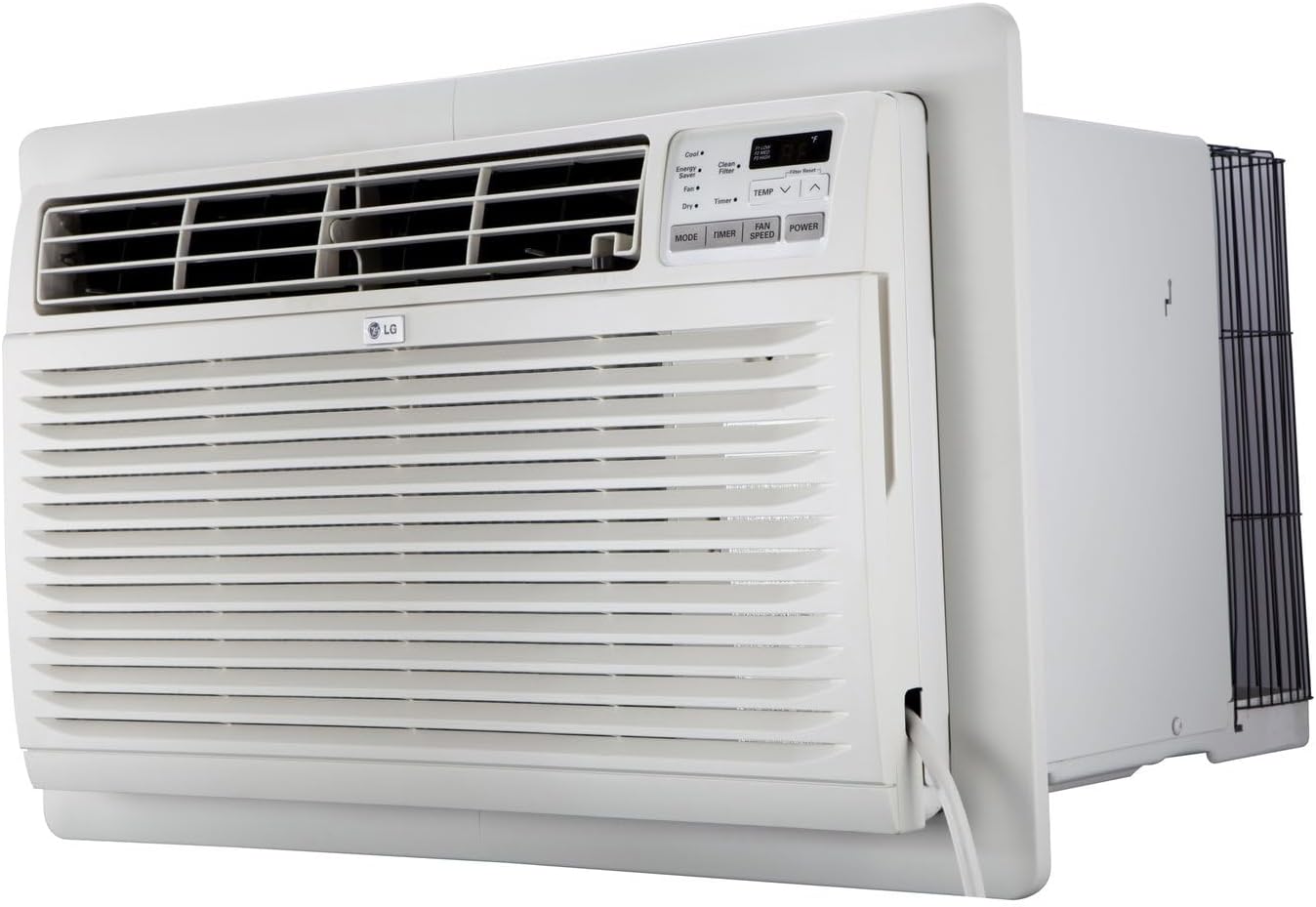
LG 9,800 BTU Through-the-Wall AC
| Cooling Power | 9800 BTU |
|---|---|
| Floor Area | 440 square_feet |
| Refrigerant | R-32 |
| SEER | 10.7 |
| Power Source | 115 volts / Corded Electric |
This LG through-the-wall air conditioner is a straightforward cooling unit sized for medium rooms up to roughly 440 square feet. It provides three cooling and fan speeds, a 24-hour timer, energy saver and dry modes, four-way air deflection for directing airflow, and a remote for convenient adjustments. The washable filter and check-filter light make routine maintenance easy, and the unit uses R-32 refrigerant with an EER of 10.7 for reasonable energy performance. Installation requires a wall sleeve (not included), and the package includes a trim kit and insulation foam to finish the interior. At normal operation the unit lists a noise level around 56 dB, so it is noticeable in quiet rooms, and it is a non-inverter design which means compressor cycling can be less smooth than inverter models. The control set is basic with three power levels rather than precise variable output, but for buyers who want proven, simple cooling without smart features this model covers the essentials reliably.
Best for: Buyers who want a reliable, no-frills through-the-wall AC that covers medium-sized rooms and prioritizes straightforward operation and easy maintenance backed by established user feedback.
Less Ideal for: People seeking the quietest operation, inverter-based variable-speed control, or units with smart connectivity and advanced temperature zoning features should look elsewhere.
- Sized to cool rooms up to about 440 sq. ft., suitable for bedrooms and living rooms.
- Includes remote, 24-hour timer, and multiple operating modes for convenience.
- Washable reusable filter and check-filter reminder simplifies maintenance.
- Uses R-32 refrigerant and has a listed EER of 10.7 for decent energy efficiency.
- Requires a through-wall sleeve for installation which is not included.
- Non-inverter rotary compressor and three fixed speeds limit fine temperature control and smoothness.
- Rated noise around 56 dB may be intrusive in very quiet spaces.
Verdict: A practical, proven through-the-wall cooling unit that delivers reliable performance and simple controls for medium-sized rooms.
LG 7,800 BTU Through-the-Wall AC

| Cooling Power | 7800 BTU |
|---|---|
| Floor Area | 330 square_feet |
| Refrigerant | R-32 |
| Control Method | Remote |
| SEER | 10.6 |
This LG 7,800 BTU through-the-wall air conditioner is built for simple, reliable cooling of small to medium rooms up to about 330 square feet. It installs into a wall sleeve and includes a trim kit, washable filter, and remote for day-to-day control, while three cooling and fan speeds let you balance comfort and noise. The unit offers a dry mode that removes moisture and an energy saver option that cycles the compressor while keeping the fan running to reduce power use. Practical touches include a 24-hour on/off timer, auto-restart after power outages, and a filter-check reminder that helps keep maintenance straightforward. Expect typical through-the-wall noise levels and no inverter technology, so it runs at fixed speeds rather than variable output; performance is steady but not optimized for maximum efficiency during partial-load operation. For buyers wanting a proven, no-frills wall AC with basic energy features and easy upkeep, this LG model covers the essentials without complicated controls.
Best for: Buyers seeking a dependable, easy-to-operate through-the-wall AC that emphasizes straightforward features, simple maintenance, and predictable performance over advanced efficiency bells and whistles.
Less Ideal for: People who need the quietest possible operation or highest part-load energy efficiency should consider inverter-based or split-system alternatives instead.
- Designed for through-the-wall installation with included trim kit and outdoor grille
- Remote control and 24-hour timer for convenient daily use
- Washable reusable filter and filter check reminder simplify maintenance
- Dry mode and energy saver option help reduce humidity and lower energy use
- No inverter technology, so compressor runs at fixed speeds rather than variable output
- Reported noise level around 56 dB may be noticeable in quiet rooms
Verdict: A straightforward, reliable through-the-wall air conditioner that delivers predictable cooling and easy upkeep for mainstream buyers who prioritize low risk and simple operation.
Choosing the Right Through-the-Wall Air Conditioner: Key Factors to Consider
Cooling Capacity and Room Size
Matching a unit's cooling capacity to your room size is the foundation of a good through-the-wall installation. Capacity is measured in BTUs and should scale with square footage, ceiling height, insulation quality, and typical sun exposure. Undersized units will run continuously and struggle to maintain comfort, while oversized units cycle frequently and can cause humidity issues.
When estimating needs, factor in how the room is used and whether adjacent spaces share load. A bedroom used overnight needs less short-term cooling than a sunny living room. Aim to size conservatively based on real conditions rather than nominal room area alone.
Sleeve and Rough-In Compatibility
A through-the-wall air conditioner requires a compatible sleeve or opening in the wall. Sleeve dimensions and mounting requirements vary, so confirming rough-in size and wall thickness limits is crucial. Some units fit a standard sleeve while others need custom framing or shims.
Consider whether you have an existing sleeve to reuse or will perform new construction. New installs should account for flashing, weatherproofing, and a level exterior finish. Compatibility reduces installation time and prevents air or water infiltration problems.
Energy Efficiency and Operating Cost
Energy efficiency affects how much it costs to run the unit and its environmental footprint. Look for energy performance indicators relevant to fixed installations, and compare typical power draw at expected thermostat settings. Even small efficiency gains matter for units that run for many hours in hot climates.
Also assess features that influence efficiency in practice, such as multi-speed fans, programmable timers, and thermostatic controls. Better controls let you avoid overcooling and reduce runtime, improving real-world operating expense.
Noise and Acoustic Impact
Through-the-wall air conditioners place noise sources near living space, so operational sound levels are a real comfort factor. Compressor and fan noise can be disruptive in bedrooms or home offices. Manufacturers report decibel levels, but actual perception depends on mounting firmness, wall construction, and where the unit sits relative to occupied areas.
Look for units with multiple fan speeds, quieter compressor designs, and good vibration isolation. Consider placement away from primary sleeping or listening zones when possible to minimize disturbance.
Maintenance, Drainage, and Serviceability
Long-term reliability depends on how easy the unit is to maintain. Accessible air filters, straightforward condensate drainage paths, and removable front panels simplify routine cleaning and seasonal service. Units designed with service access in mind reduce labor for basic upkeep and inspection.
Also review how condensate is handled. Some models use gravity or internal pumps; choose the approach that matches your wall slope and maintenance willingness. Clear access to electrical and refrigerant components speeds professional repairs when needed.
Controls, Ventilation, and Comfort Features
Control options influence how conveniently you can operate the unit and fine-tune comfort. Basic thermostats are sufficient for steady use, while programmable timers, remote control, and smart connectivity add convenience and potential energy savings. Variable fan speeds and mode selections help manage humidity and air distribution.
Additionally, air delivery patterns and louver adjustability affect perceived comfort. Units with wider airflow options or oscillating louvers distribute cool air more evenly in longer rooms, reducing hot spots.
Sizing Your Room: Simple Steps
Start by measuring the room floor area and noting ceiling height and sun exposure. Use a conservative BTU-per-square-foot guideline adjusted for insulation quality, occupancy, and appliance heat gains to estimate required cooling capacity.
If you have high ceilings, lots of windows, or intense afternoon sun, increase the capacity estimate. For shaded rooms or modest occupancy, lean toward the lower end of the guideline. Always account for how the room will be used during peak cooling hours.
- Measure room length and width to calculate square footage.
- Adjust for ceiling height greater than 8 feet by adding 10 to 15 percent.
- Add capacity for kitchens or rooms with many occupants or heat-generating equipment.
Preparing the Wall Opening and Sleeve
Verify the existing sleeve dimensions or plan the new rough-in to match the unit's specifications. A snug, level sleeve reduces vibration and prevents air leaks. Include weatherproofing details like exterior flashing and interior trim to finish the installation cleanly.
If replacing an existing sleeve, inspect for rot or damage to surrounding framing. Replace compromised framing before setting the unit to ensure a secure, long-lasting mount.
- Confirm wall thickness limits for the chosen unit.
- Use flashing and sealants rated for exterior exposure.
- Ensure the sleeve is level and square to avoid drainage problems.
Managing Condensate and Drainage
Through-the-wall units produce condensate that must be routed away from the building. Depending on model design, drainage can be gravity-fed to the exterior, collected in a pan with a pump, or redirected to a condensate drain line. Choose an approach that matches your wall pitch and maintenance preferences.
Proper drainage prevents water damage to exterior finishes and interior framing. Verify that the path for condensate is unobstructed and that any pumps are accessible for maintenance.
- Check whether the unit requires a condensate pump for your installation height.
- Slope drain paths slightly downward toward the exterior.
- Inspect seals regularly to prevent leaks into the wall cavity.
Noise Control and Mounting Tips
Minimizing vibration and sound transfer starts with a solid, level sleeve and good exterior supports. Use vibration-damping materials where recommended and ensure the unit is securely fastened to prevent rattles and intermittent noise.
Consider locating the unit away from primary sleeping walls when possible. If sound is a high priority, prioritize models with documented lower operational decibels and multi-speed fan control.
- Use foam or rubber isolators to reduce vibration transfer.
- Seal gaps to prevent flanking noise between rooms.
- Test multiple fan speeds to find a balance between airflow and acceptable noise.
Controls, Thermostats, and Smart Options
Decide how you want to control the unit: basic onboard thermostat, remote control, or integration with a smart home system. Programmable and smart-enabled controls can reduce runtime and energy use by tailoring schedules to occupancy patterns.
If you prefer simplicity, a reliable manual thermostat with multiple fan speeds provides straightforward comfort. For frequent temperature adjustments or remote operation, look for Wi-Fi or programmable capability.
- Remote control adds convenience when the unit is mounted high or in an awkward spot.
- Programmable schedules reduce unnecessary run time.
- Smart integrations can enable voice control and energy tracking if available.
How We Chose the Best Through-the-Wall Air Conditioner
We started by filtering for models designed specifically for through-the-wall installation and sized for common room capacities. Our selection emphasized units with clear published cooling capacities (BTUs), compatible sleeve or rough-in dimensions, and documented power and airflow specifications. We excluded portable or window-only units and any product that lacked clear installation guidance or basic safety certifications. Key evaluation dimensions included cooling capacity relative to room square footage, installation and sleeve compatibility, energy efficiency ratings and estimated operating cost, fan and compressor noise levels during typical loads, and available controls and air distribution features. We also considered durability factors like condensate management and service access for maintenance. The resulting shortlist favors models that balance straightforward installation with reliable daily performance in real room conditions.
Our full evaluation process is outlined in our review methodology.
FAQ
Can I install a through-the-wall air conditioner myself?
DIY installation is possible for those with carpentry and basic electrical skills, especially when an existing sleeve is present. New rough-in installations often require cutting framing, flashing, and safe electrical connection and may need a licensed electrician depending on local code.
How do I know what BTU rating I need?
Estimate required BTUs from room square footage, adjusting for ceiling height, sun exposure, and typical occupancy. Use published BTU guidelines as a starting point and increase capacity for kitchens or very sunny rooms to ensure adequate cooling.
How loud are through-the-wall units compared with window units?
Noise varies by model and mounting quality, but through-the-wall units can be similar to window units since both place mechanical components near living space. Proper sleeve mounting and vibration isolation help reduce perceived sound.
What maintenance does a through-the-wall air conditioner need?
Routine tasks include cleaning or replacing filters, checking condensate paths for blockages, and inspecting seals around the sleeve. Periodic professional service for refrigerant system checks and compressor health is also recommended.
Will a through-the-wall unit cause drafts or leaks in the wall?
A properly installed sleeve with correct flashing and sealant prevents drafts and water infiltration. Poorly fitted installations or degraded seals can lead to air leaks and moisture issues, so careful sealing and periodic inspection are important.
Final Verdict
Choosing the right through-the-wall air conditioner means balancing cooling capacity, installation fit, and daily comfort factors like noise and efficiency. Prioritize a unit sized to your room and confirm sleeve compatibility before committing to an install. Tradeoffs typically involve a small premium for quieter operation and better controls versus slightly higher initial complexity. Focus on clear measurements, a sound installation plan, and features that match how you will use the room. That approach will help you pick a through-the-wall option that provides reliable, efficient cooling with minimal disruption to the space.