
Note: This article contains affiliate links. If you click on these links and make a purchase, we may earn a small commission at no extra cost to you. This helps support our research and content. Read our full affiliate disclosure here.
Picking the right tile vacuum floor scrubber makes routine cleaning faster and keeps grout lines looking better for longer. You want something that lifts dirt without leaving excess water behind, and that handles both sealed and glazed tile surfaces without damage. This guide summarizes the top shortlisted machines in the category and explains the evaluation criteria we used, including cleaning power, water and detergent control, and ease of upkeep. Read on for focused advice on choosing a scrubber that fits the size of your home and the condition of your tile surfaces.
Top Picks at a Glance
| Best Overall The best all-around choice for most situations | Shark HydroVac MessMaster AW261 |  |
| Best Value The sweet spot between price and what you get | Tineco Floor ONE i5 Stretch |  |
| Best Budget The cheapest option that still gets the job done reliably | BISSELL SpinWave Hard Floor Expert 20393 |  |
| Top Rated A top-rated pick with lots of positive feedback | Tineco Floor One S7 Stretch Ultra |  |
| Most Popular A crowd favorite that many people choose with confidence | Hoover FloorMate Deluxe FH40160PC |  |
| Best Seller A high-volume bestseller chosen again and again | Bissell SpinWave Cordless PET |  |
Shark HydroVac MessMaster AW261

| Capacity | 0.38 quarts |
|---|---|
| Power Source | Battery Powered |
| Voltage | 21.6 volts |
| Battery Description | Lithium-Ion |
The Shark HydroVac MessMaster AW261 is a cordless upright that combines vacuuming and wet mopping in one pass while automatically rinsing its brushroll and system on the dock. In typical use you push it across sealed hard floors or over area rugs where its hydro mopping pulls up spills and grime while the brushroll and suction pick up solids; Stain Boost increases solution delivery for tougher spots. The two-tank design keeps clean and dirty water separate and the docked rinse cycle helps avoid messy hand-cleaning after use. Practical benefits include included multi-surface concentrate with odor neutralizer for homes with pets, a continuously self-cleaning brushroll to reduce redepositing, and an LED display that shows battery and tank status. Limitations are the relatively loud 80 dB noise level and the cordless runtime trade-offs that come with compact battery systems, and it is designed for sealed hard floors and surface rug refreshes rather than deep-cleaning thick carpets.
Best for: Buyers who want one machine to handle everyday sealed hard-floor cleaning and quick rug refreshes with minimal post-use cleanup and pet-odor control.
Less Ideal for: People who need a deep carpet cleaner for thick, soiled carpets or who prioritize whisper-quiet operation in shared living spaces.
- Combines vacuuming and hydro-mopping in a single pass for faster cleaning
- Self-cleaning brushroll and dock rinse cycle reduce post-cleaning maintenance
- Separate clean and dirty water tanks for more hygienic mopping
- Includes cleaning solution with odor neutralizer ideal for pet odors
- Cordless design lets you move room to room without an outlet
- Designed for sealed hard floors and light rug refreshing, not for deep carpet shampooing
- Rated noise level is relatively high at about 80 dB
Verdict: Choose the HydroVac MessMaster if you want a cordless all-in-one vacuum and mop that cleans sealed hard floors and self-maintains to minimize cleanup work.
Tineco Floor ONE i5 Stretch

| Suction | 20 kPa |
|---|---|
| Filter Type | HEPA Filter |
| Clean Water Capacity | 0.8 liters |
| Runtime | 30 minutes |
| Noise Level | 75 db |
The Tineco Floor ONE i5 Stretch combines vacuuming and wet mopping into a single cordless stick unit designed for routine home floor care. It uses a motorized roller and 20 kPa suction to pick up debris and hair while spraying clean water to mop, with an anti-tangle design that funnels hair into the dirty-water tank instead of wrapping the brush. The 180 degree lay-flat head helps reach under low furniture and dual-sided edge cleaning improves coverage along baseboards. For convenience there is an on‑device one-press self-cleaning routine and a HEPA filter for finer particle capture. Runtime is about 30 minutes per charge, and the 0.8 liter clean water tank and included charging dock make quick touch-ups and weekly mop-vac cycles straightforward. Limitations to expect are the typical trade-offs of cordless stick moppers: shorter runtime than corded machines and modest tank capacity that may require refills for larger areas, and a 75 dB noise level that is noticeable during use. The i5 Stretch suits frequent maintenance cleaning on hard floors where combined vacuuming and mopping saves time.
Best for: Buyers who want a practical all-in-one cordless cleaner for regular upkeep of hard floors and value features that reduce brush tangles and simplify maintenance.
Less Ideal for: Households that need long continuous run times, very large floor areas, or heavy-duty carpet deep cleaning should consider more powerful corded or upright machines instead.
- Combines vacuuming and mopping in one pass for faster floor maintenance
- Anti-tangle roller design that directs hair into the dirty-water tank
- 180° lay-flat head and dual-sided edge cleaning reach under furniture and along baseboards
- One-press self-cleaning and included charging dock simplify upkeep
- Around 30 minutes runtime can be limiting for larger homes
- 0.8 liter water tank may need frequent refills during extended mopping sessions
Verdict: If you want a cordless, easy-to-use vacuum-and-mop that reduces hair tangles and cleans edges well, the Floor ONE i5 Stretch is an efficient choice for routine hard-floor maintenance.
BISSELL SpinWave Hard Floor Expert 20393
| Model Number | 20393 |
|---|---|
| Included Components | Instruction Guide |
| Handle Material | Metal |
| Head Material | Polyester |
| Surface Recommendation | Floor |
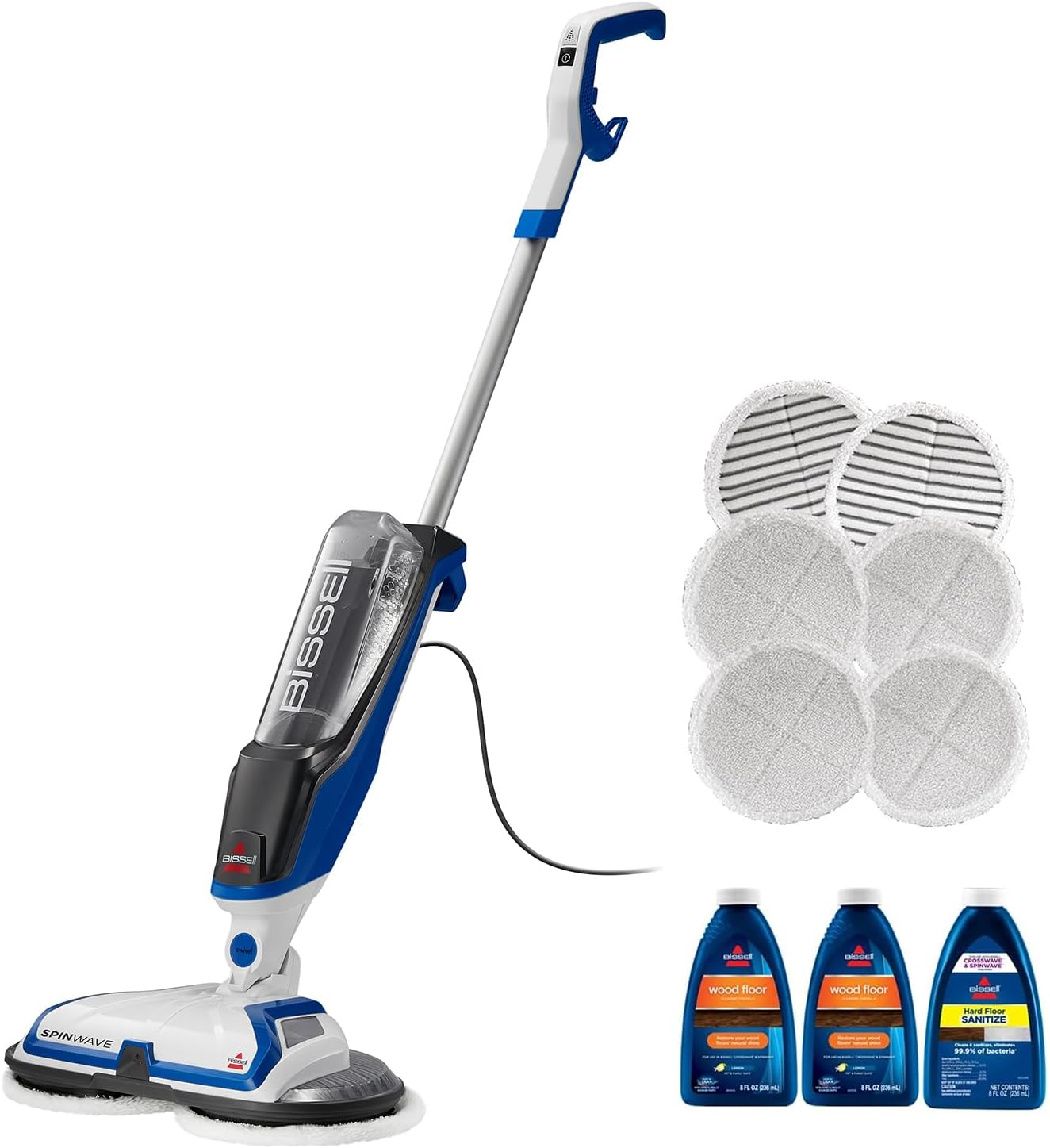
The BISSELL SpinWave Hard Floor Expert is a corded electric spin mop that replaces scrubbing on hands and knees with rotating mop pads and a push-button spray dispenser. It is designed for sealed hard surfaces including tile, sealed wood, laminate, linoleum and similar floors; users fill the removable clean-water tank with water plus the included trial formulas and select the soft or scrubby pad depending on the mess. In practice the swivel head and lightweight design make it easy to reach under furniture and along baseboards, and the machine runs relatively quietly compared with bulky vacuums. Washable, reusable pads and included sample formulas let you clean multiple sessions without running back to the store. The main limitations are that it is corded so you need an outlet nearby and it is intended for sealed hard floors only, not for unsealed wood or heavy wet pickup like a wet-dry vacuum. For regular spot cleaning and routine maintenance of sealed floors it speeds the job and reduces manual scrubbing.
Best for: Buyers who rely on peer reviews and want a proven, easy-to-use powered mop for maintaining sealed hard floors will appreciate this model's dependability and low-friction operation.
Less Ideal for: If you need cordless freedom, heavy wet pickup, or a tool for unsealed wood floors, choose a different type of cleaner.
- Powered spinning pads handle sticky spots without manual scrubbing
- On-demand spray with removable tank gives controlled dispensing of cleaning solution
- Includes multiple washable pads for repeated use and lower running cost
- Lightweight with swivel steering for cleaning under furniture and along baseboards
- Includes trial cleaning formulas for sanitizing and wood-safe cleaning
- Corded design limits reach compared with cordless models
- Not intended for unsealed wood or for heavy liquid pickup like a wet-dry vacuum
Verdict: A reliable, corded spin mop that makes routine cleaning of sealed hard floors faster and far less hands-on.
Tineco Floor One S7 Stretch Ultra

| Suction Power | 21kPa |
|---|---|
| Filter Type | HEPA Filter |
| Runtime | 50 minutes |
| Form Factor | Wet Dry Vacuum Mop |
| Noise Level | 78 db |
The Tineco Floor One S7 Stretch Ultra is a cordless wet-dry vacuum mop built to clean hard floors end-to-end. It combines 21 kPa suction with continuous fresh-water washing and a dual-sided brush to pick up dirt, hair, and light spills while mopping. The 180° lay-flat design and long handle make it easy to reach under furniture and along baseboards, and the DualBlock anti-tangle system reduces hair clogs for less maintenance. After use the FlashDry self-cleaning cycle flushes the brush path with heated water and then dries components with 185°F air to cut odors and speed storage. Runtime is rated up to 50 minutes on the pouch battery, which is enough for multi-room jobs without recharging. Practical trade-offs are noise around 78 dB during operation and the unit is tuned for sealed hard floors rather than heavy carpet deep-cleaning; it also carries the size and weight of a full-featured wet-dry mop, so storage and occasional filter maintenance are required. For buyers focused on high-end hard-floor care, it streamlines wet vacuuming and reduces post-clean cleanup.
Best for: Buyers who want a high-end, time-saving solution for maintaining luxury vinyl plank and other sealed hard floors with minimal after-use cleanup and fewer brush tangles.
Less Ideal for: People who need deep carpet cleaning or a lightweight handheld cordless for brief spot jobs should consider different specialized machines.
- Combines vacuuming and mopping for one-step cleaning on sealed hard floors
- DualBlock anti-tangle design minimizes brush hair wrap and clogging
- FlashDry self-cleaning and 185°F drying reduces odor and speeds turnaround
- 180° lay-flat head and dual-sided edge cleaning improve access under furniture and along baseboards
- Up to 50 minutes runtime supports cleaning multiple rooms on a single charge
- Designed for hard floors and not for deep-cleaning carpets
- Louder operation at about 78 dB may be noticeable in small homes
Verdict: If you prioritize an all-in-one, low-maintenance wet-vacuum and mop for luxury vinyl plank and other hard floors, the S7 Stretch Ultra delivers powerful cleaning plus self-cleaning convenience.
Hoover FloorMate Deluxe FH40160PC

| Power Source | Corded Electric |
|---|---|
| Wattage | 420 watts |
| Voltage | 120 volts |
| Noise Level | 80 db |
| Capacity | 1 quarts |
The Hoover FloorMate Deluxe is a corded hard-floor cleaner designed to wash and dry sealed floors like tile, hardwood, laminate, and vinyl. It uses rotating SpinScrub brushes to loosen stuck-on dirt while suction pulls dirty water into a separate tank so you are not pushing grime around. There are two modes: wash mode runs the brushes while vacuuming up solution and mess, and dry mode stops the brushes to speed water pickup and reduce dry time. The unit is relatively lightweight for a floor scrubber, has fingertip push-button controls, removable tanks for easy filling and emptying, and ships with a trial cleaning solution. Practical benefits include visible cleaning results without hands-and-knees scrubbing and a dual-tank system that preserves clean water. Limitations are typical for corded scrubbers: it requires an outlet and some storage space, the 1 quart capacity means more frequent refills for large areas, and noise can be noticeable during use. For tile floors it excels at loosening grout-line dirt and lifting residue when used with an appropriate cleaning solution.
Best for: Buyers who want a reliable machine that visibly removes soil from tile and other sealed hard floors and who prioritize proven cleaning performance backed by many user reviews.
Less Ideal for: Homes that need a lightweight spot cleaner for quick touch-ups or fully cordless operation should consider other options.
- SpinScrub rotating brushes provide aggressive cleaning without scrubbing on hands and knees
- Dual-tank system keeps clean and dirty water separate for more effective cleaning
- Wash and dry modes let you choose between scrubbing with suction or quick pickup for faster drying
- Relatively lightweight and has removable tanks for easy filling, emptying, and storage
- Corded design limits mobility compared with cordless alternatives
- Small 1 quart tank capacity means more frequent refills and empties in large rooms
- Noise level around 80 dB can be loud for extended use
Verdict: Choose the FloorMate Deluxe when you want a proven scrub-and-suction cleaner that lifts grout and stuck-on messes from tile using SpinScrub brushes and a dual-tank system.
Bissell SpinWave Cordless PET
| Power Source | Battery Powered |
|---|---|
| Voltage | 18 volts |
| Form Factor | Stick |
| Capacity | 8 ounces |
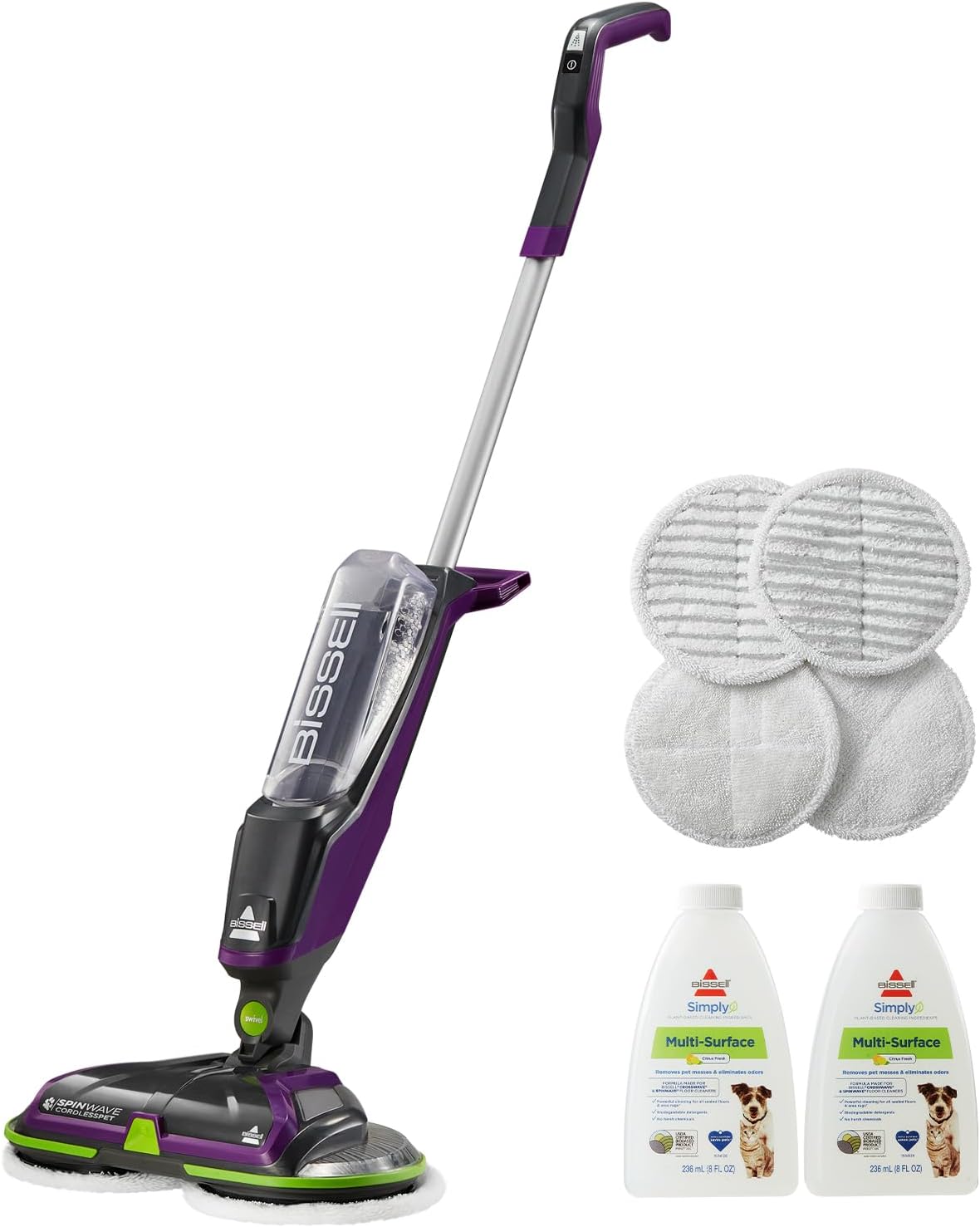
The Bissell SpinWave Cordless PET is a lightweight, battery-powered spin mop built to clean sealed hard floors and handle everyday pet messes. It uses rotating mop pads and an on-demand spray to apply BISSELL cleaning formula to targeted spots, while a low-profile swivel head helps reach along baseboards and under furniture. The kit includes four reusable, washable pads and trial cleaning solution so you can start cleaning right away, and the 18V lithium-ion battery charges in about four hours for roughly 20 minutes of runtime per charge. Practical benefits include quiet operation, easy pad removal for laundering, and a maneuverable stick form factor that reduces bending and scrubbing. Limitations are the relatively short cordless runtime for larger homes and modest liquid capacity, which mean you may need to recharge or refill during longer sessions, and it is intended only for sealed hard floors rather than rugs or unsealed wood. For pet owners wanting a gentle, low-effort floor cleaner, it simplifies spot and routine maintenance but is not a replacement for heavier-duty wet vacuums for deep-soil or large-area cleaning.
Best for: Buyers who want a low-effort, pet-focused cleaner for routine maintenance on sealed hard floors and prioritize convenience and easy cleanup over long runtime.
Less Ideal for: People who need heavy-duty deep cleaning, long continuous runtime, or frequent large-area cleaning should consider more powerful wet vacuums or corded machines.
- Cordless 18V lithium-ion power for tangle-free maneuvering
- Rotating washable mop pads that are reusable and easy to remove
- On-demand spray for targeted stain and pet mess treatment
- Low-profile swivel head reaches edges and under furniture
- Includes multiple pads and trial cleaning solution to start cleaning immediately
- About 20 minutes runtime may be short for larger cleaning jobs
- Small onboard liquid capacity requires more frequent refills for extended use
Verdict: A convenient, pet-friendly cordless spin mop that makes quick maintenance cleaning of sealed hard floors easy and low effort.
Choosing the Right Tile Vacuum Floor Scrubber: Key Factors to Consider
Cleaning Power and Brush Action
How aggressively a scrubber agitates the tile and grout affects both cleaning outcomes and surface safety. Strong brush action or high-shear pads are effective at dislodging ground-in dirt from grout lines, but overly abrasive action can dull glazed finishes or damage softer natural stone. Consider machines with adjustable brush speed or interchangeable brush heads so you can match agitation to surface type.
Cleaning power also interacts with chemical use. A machine that provides good mechanical action will often require less detergent to get the same result, which simplifies rinsing and reduces residue risk. For heavily soiled grout, look for scrubbers that deliver focused agitation at the grout width rather than only broad sweeping action.
Water Use and Recovery Capacity
A tile vacuum floor scrubber must manage water carefully to avoid leaving puddles that can grime back onto the floor. Recovery capacity refers to how much dirty solution the machine can hold and how effectively the vacuum and squeegee pull moisture back into the recovery tank. Larger recovery tanks let you clean longer between empties, but they add weight and bulk.
Also assess the clean solution tank design and whether the unit meters detergent accurately. Machines that over-dispense require extra passes to rinse residue. Effective separation between clean and dirty tanks prevents recontamination and ensures you are scrubbing with fresh solution throughout the job.
Maneuverability and Reach
Tile floors often include tight corners, cabinets, and grout patterns that require precise handling. Maneuverability covers handle design, swivel head action, overall weight, and whether the scrubber can lie flat or reach under low-clearance furniture. Lighter, more nimble machines make it easier to work around obstacles and reduce fatigue on larger jobs.
Cord length or battery run time also affects practical reach. If you will clean large areas or rooms with limited outlets, prioritize longer cords or reliable battery life. Consider how quickly an operator can transition between rooms and whether the scrubber is simple to lift for stair or threshold moves.
Brush and Pad Compatibility
Different tile and grout combinations need different cleaning heads. Nylon brushes are common for durable glazed tile and grout, while softer pads may be better for delicate natural stone or polished tile. Interchangeable heads let you tailor the machine to seasonal or situational needs.
Check whether the scrubber supports specialty attachments such as narrow grout brushes or corner tools for edges. Machines that accept industry-standard brushes or pads make sourcing replacements and upgrades easier over the long term.
Maintenance and Consumables
Routine maintenance determines how often the scrubber is out of service and how much time you spend on upkeep. Important maintenance items include access to the recovery tank for cleaning, brush and squeegee replacement, filter cleaning, and simple drain paths for emptying dirty water. Machines that require tool-free access reduce downtime.
Consumable availability also matters. Brushes, squeegees, and filters wear with use, particularly when cleaning gritty grout. Choose scrubbers with commonly available parts or clear OEM supply channels so you do not face long waits for replacements. Finally, evaluate how easy it is to sanitize tanks to prevent odors or bacterial growth.
Durability and Build Quality
Tile cleaning can be physically demanding on parts, so build quality influences long-term ownership cost and reliability. Look for robust housings, reinforced brush mounts, and corrosion-resistant hardware in areas exposed to solution.
Durability considerations also include warranty terms and the presence of modular parts that can be serviced easily. A well-built machine will maintain suction and brush alignment over time, reducing performance degradation and preserving cleaning consistency across many cleaning cycles.
Best Uses For Tile Vacuum Floor Scrubbers
Tile vacuum floor scrubbers are ideal for homes and commercial spaces that need more than a mop can deliver. They remove suspended soil and extract dirty solution, which is especially important in kitchens, entryways, and bathrooms where grime and residues build up in grout lines.
These machines work well for periodic deep cleaning and for refreshing floors after renovations or seasonal grime. They are less useful for very small spot-clean tasks where a handheld would be faster, but for continuous runs across large tile areas they save time and improve cleanliness.
- Periodic deep cleaning of grout and textured tile
- Large open areas like kitchens and mudrooms
- Post-construction or heavy-traffic refreshes
Surface Preparation and Pre-Cleaning
Before using a tile vacuum floor scrubber, sweep or vacuum loose debris so brushes do not wear prematurely. Large particulate and sand can abrade brushes and squeegees, reducing their effectiveness and lifespan.
For greasy or waxy residues, a short pre-soak with an appropriate cleaning solution helps the scrubber work more efficiently. Allow any heavy cleaners to dwell briefly, then run the scrubber to agitate and remove the loosened soil.
- Remove loose dirt first to protect brushes
- Use a light pre-soak for greasy soils
- Test strong cleaners in an inconspicuous area
Operating Tips To Maximize Results
Work in manageable sections and make slow, overlapping passes so brushes and recovery systems have time to loosen and extract soil. Avoid rushing; faster passes can push dirty solution into grout instead of extracting it.
Monitor recovery tank color and stop to change the solution when it becomes visibly dirty. Rinsing the brush periodically during long sessions keeps it working at peak performance. If the machine has adjustable solution flow, start low and increase only if necessary.
- Make overlapping passes for even cleaning
- Empty recovery tank when it becomes murky
- Rinse brushes during extended use
Care For Different Tile Types
Match brush aggressiveness to the tile material. Use softer pads on polished or delicate natural stone and more aggressive nylon brushes for unglazed or heavily textured tile. Always verify that the chosen cleaner is safe for the specific tile material before running a full pass.
For grout lines, consider a narrow brush or a targeted setting to concentrate agitation where it is needed. Avoid prolonged scrubbing on porous stone without appropriate sealers, because excess moisture can penetrate and cause staining or structural issues.
- Soft pads for polished and soft stone
- Nylon brushes for textured or unglazed tile
- Targeted agitation for grout lines
Storage and Winterizing
After cleaning, empty both clean and recovery tanks and run the vacuum briefly to clear internal hoses. Leave tanks open to air-dry to prevent mildew and odors. Removing and drying brushes and squeegees extends their life.
If you store the scrubber in an unheated area, drain all water and solution completely to prevent freeze damage. Keep consumables in a dry, labeled container so replacements are easy to find when needed.
- Empty and rinse tanks after each use
- Air-dry parts to prevent mildew
- Fully drain before cold storage
How We Chose the Best Tile Vacuum Floor Scrubber
We evaluated machines that combine wet-scrubbing action with an integrated vacuum so they actually remove the dirty solution instead of just spreading it around. Key evaluation criteria included cleaning performance on tile and grout, water and detergent containment and recovery, maneuverability around tight spaces, brush or pad compatibility with common tile finishes, and routine maintenance needs such as filter and tank access. We prioritized durability of parts that see regular wear, such as brushes, squeegees, and vacuum fans, and considered how repeatable results are across different tile pore depths. We excluded units that are designed only for carpets, handheld spot cleaners with minimal recovery, or devices that do not provide separate clean and recovery tanks. We also filtered out products with unclear consumable availability or designs that make regular maintenance difficult. The final shortlist focuses on machines that deliver measurable soil removal, sensible water use, and straightforward upkeep for homeowners with tile floors.
Our full evaluation process is outlined in our review methodology.
FAQ
How often should I deep-clean tile with a scrubber?
Deep cleaning frequency depends on traffic and soil. High-traffic kitchens or entryways often benefit from a deep scrub every 1 to 3 months, while low-traffic areas may only need it seasonally.
Will a tile scrubber damage my grout?
Most scrubbers are safe when used correctly. Avoid excessively aggressive brushes or prolonged agitation on weak grout, and test settings in a hidden area first. Proper technique reduces risk of grout wear.
Can I use regular floor cleaner in the scrubber?
You can use many standard tile cleaners, but check manufacturer guidance for dilution and compatibility. Avoid oily or wax-based cleaners that can leave residues and reduce recovery effectiveness.
How do I prevent streaking or residue after scrubbing?
Use measured detergent, perform a final rinse pass with clean water when needed, and ensure the recovery tank captures the dirty solution. Too much detergent or poor recovery increases residue risk.
Is a corded machine better than battery-powered for tile cleaning?
Corded machines often provide continuous power and consistent suction for long jobs, while battery models add portability and lighter weight. Choose based on room size and whether uninterrupted run time matters more than mobility.
Final Verdict
When selecting a tile vacuum floor scrubber, prioritize effective cleaning power balanced with reliable water recovery so you remove soil rather than re-deposit it. Match brush type and agitation level to your tile material, and factor in maintenance convenience and consumable availability to keep the machine performing well over time. Focus on the tradeoffs between tank capacity and maneuverability, and choose a machine whose serviceability fits how often you will use it. With the right balance of agitation, recovery, and upkeep, you can restore tile and grout with fewer repeat passes and maintain a cleaner-looking floor.