
Note: This article contains affiliate links. If you click on these links and make a purchase, we may earn a small commission at no extra cost to you. This helps support our research and content. Read our full affiliate disclosure here.
If you want steady, high-quality drinking water directly from your kitchen faucet, an under-sink reverse osmosis water filter for faucet is a practical upgrade. These systems sit out of sight under the sink and route purified water to a dedicated or integrated faucet, reducing common contaminants while improving taste and odor. Choosing the right under-sink RO affects water purity, faucet flow rate, and how often you need to change filters. This guide highlights seven top shortlisted systems that fit typical kitchen setups and usage patterns. We evaluated them across performance, installation and maintenance needs, and daily convenience so you can pick a unit that matches your household's water demand and plumbing layout.
Top Picks at a Glance
| Best Overall The best all-around choice for most situations | FRIZZLIFE PD600 Tankless RO |  |
| Best Quality Built to a higher standard if you want something more solid | Waterdrop G3P600 Tankless RO |  |
| Best Value The sweet spot between price and what you get | APEC Water ROES-50 |  |
| Best Budget The cheapest option that still gets the job done reliably | Express Water RO5DX 50 GPD |  |
| Top Rated A top-rated pick with lots of positive feedback | Home Master Artesian TMAFC-ERP |  |
| Most Popular A crowd favorite that many people choose with confidence | iSpring RCC7AK-BN RO System |  |
| Best Seller A high-volume bestseller chosen again and again | iSpring RCC7-BN 75 GPD RO System |  |
FRIZZLIFE PD600 Tankless RO

| Purification Method | Reverse Osmosis, Alkaline/Remineralize |
|---|---|
| Flow Rate | 600 GPD |
| Power Source | Corded Electric |
| Pure to Drain Ratio | 2:1 |
| Maximum Flow Rate | 0.41 gpm |
The FRIZZLIFE PD600 Tankless RO is an under-sink reverse osmosis system designed to deliver fast, remineralized alkaline drinking water without a storage tank. It uses a 600 GPD RO membrane plus a TAM3 alkaline/reminderalization stage to restore minerals and raise pH above 7.5, and a pleated carbon prefilter to reduce sediment and chlorine before RO. The unit is tankless and compact, so it takes up little under-sink space and avoids tank-related secondary contamination; its advertised 600 gallons-per-day capacity and roughly 0.41 gpm flow mean you can fill a cup quickly. A color smart LED display shows real-time TDS and filter life, and filters are designed for tool-free quick changes. The system requires electricity and connects to a dedicated faucet included in the kit, and it operates at a low 2:1 pure-to-drain ratio to save water compared with older RO designs. Important trade-offs are the electrical requirement and the need to replace multi-stage filters periodically, and actual performance depends on feed water quality and correct installation.
Best for: Buyers who want a compact, fast under-sink RO that prioritizes pure, remineralized alkaline water and easy monitoring without a bulky storage tank.
Less Ideal for: People who need a completely passive, non-electric filtration solution or who prefer a simple single-filter pitcher-style system.
- Tankless, compact design saves under-sink space and avoids tank-related contamination
- 600 GPD membrane for high daily production and quicker fill times
- Built-in TDS readout and filter life indicators for continuous water-quality monitoring
- Alkaline remineralization stage restores minerals and raises pH for taste and health benefits
- Low 2:1 pure-to-drain ratio improves water efficiency versus many traditional RO systems
- Requires a power connection to run the display and RO pump
- Filter replacements are periodic and multiple stages increase running costs
Verdict: Choose the FRIZZLIFE PD600 if you want a tankless under-sink RO that delivers high-output, remineralized alkaline water with on-device TDS and filter-life monitoring.
Waterdrop G3P600 Tankless RO
| Purification Method | Carbon Block, Reverse Osmosis |
|---|---|
| Filtration Stages | 8-stage Filtration |
| Flow Rate | 600 GPD |
| Pure to Drain Rate | 2:1 |
| Power Source | Corded Electric |
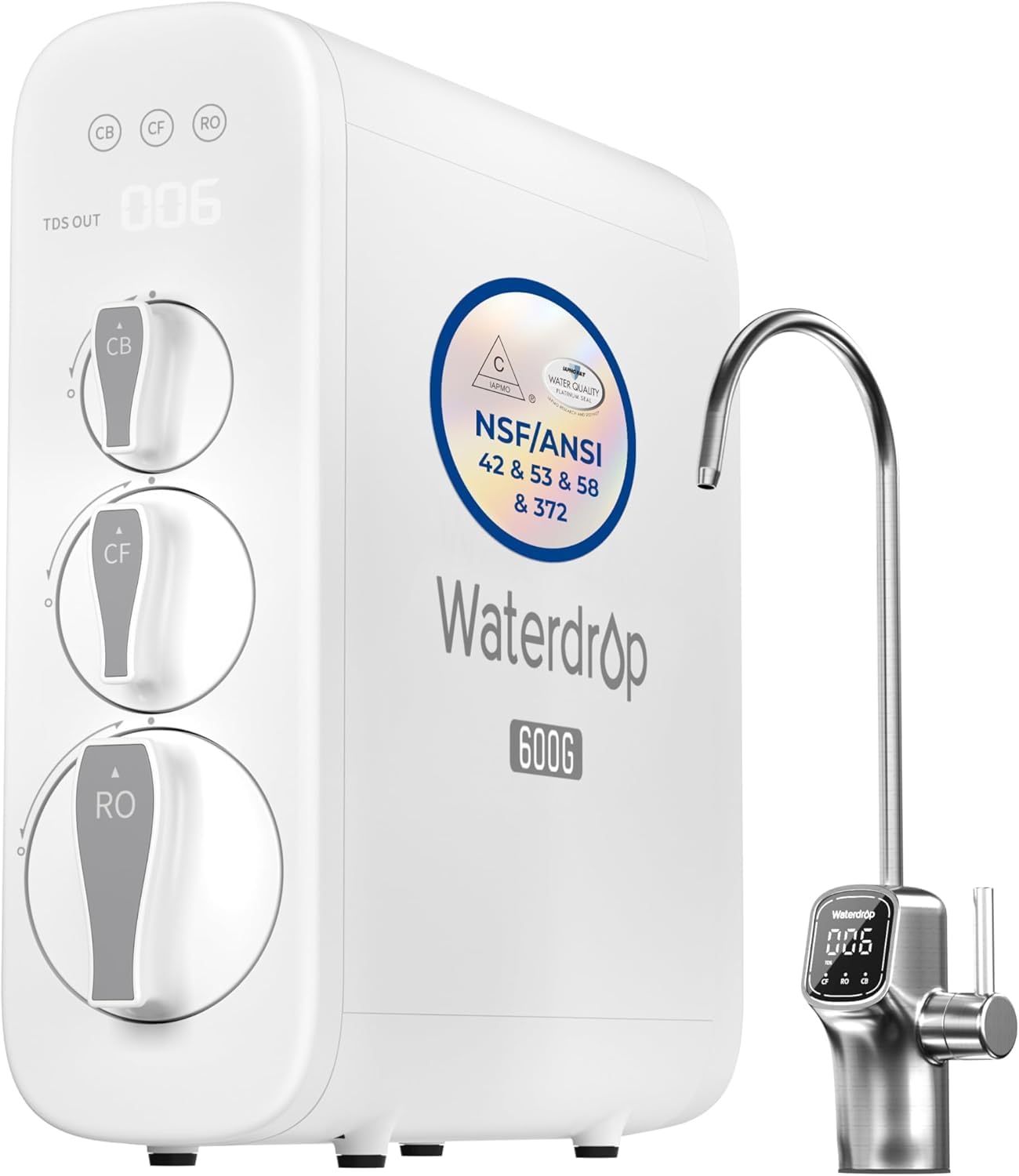
The Waterdrop G3P600 is a high-capacity tankless reverse osmosis system designed for under-sink installation and regular kitchen use. It uses an 8-stage filtration pathway including RO membrane and carbon block elements to reduce TDS, heavy metals, PFAS, chlorine, and other contaminants, and the system produces an 8 oz cup in about 8 seconds. The unit is tankless to save under-sink space and includes a smart display faucet that shows TDS readout and filter life so you can monitor quality and maintenance needs. It runs on plug-in power and features an automatic flushing function to help keep the membrane cleaner. The claimed 2:1 pure-to-drain ratio is better than many RO systems, which reduces wastewater compared with older designs. Expect a larger under-sink footprint than simple cartridge filters and a required electrical connection; installation requires drilling a faucet hole and a drain connection and filter replacements follow the specified lifespans.
Best for: Buyers who prioritize high throughput and measurable contaminant reduction and want fast, on-demand drinking water while preserving under-sink space and tracking filter health.
Less Ideal for: People who need a non-electric countertop filter, have no easy under-sink power access, or want a purely plug-and-play setup without drilling or a more involved install.
- High 600 GPD production for fast dispensing and heavy household use
- 8-stage filtration that targets TDS, heavy metals, PFAS, chlorine, and other common contaminants
- Tankless design saves under-sink space and allows quick 3-second filter swaps
- Smart faucet with TDS readout and filter life indicator for on-demand quality monitoring
- Low 2:1 pure-to-drain ratio to reduce wastewater compared with many RO units
- Requires under-sink electrical outlet and a drill hole for faucet and drain connections
- Larger and more complex installation than basic counter or cartridge filters
Verdict: Choose the G3P600 if you want a tankless, high-throughput under-sink RO with robust multistage contaminant removal and a smart faucet for real-time water quality monitoring.
APEC Water ROES-50

| Purification Method | Reverse Osmosis |
|---|---|
| Filtration Stages | 5-Stage |
| Capacity | 50 gallons |
| Operating Pressure Range | 40-85 psi |
| Filter Life Cycle | 6 months |
The APEC ROES-50 is a five-stage under-sink reverse osmosis system designed to deliver very low-TDS drinking water for a household faucet. It uses a sequence of prefilters, an RO membrane, and a post-filter to remove chlorine, heavy metals, fluoride, PFAs, microplastics, and many other contaminants while storing treated water in the included tank for steady flow at the faucet. The unit is DIY-friendly with quick-connect fittings, color-coded tubing, and a brushed-nickel faucet in the kit, so a handy homeowner can install it without specialty tools. Filters are large-capacity and rated for roughly 6 to 24 months depending on incoming water quality, and the system is certified for stringent safety and contaminant-rejection standards. Trade-offs are typical for RO: it requires a drain line, produces some wastewater, and relies on periodic filter and membrane replacements, and the flow rate to the faucet is limited by the 50 GPD membrane and storage tank. For buyers who prioritize very high contaminant rejection and reliable under-sink performance, it provides strong, proven filtration in a compact footprint.
Best for: Buyers who want a compact, high-rejection under-sink RO system they can install themselves and who prioritize very low-TDS, great-tasting tap water for drinking and cooking.
Less Ideal for: People who need high continuous flow without a storage tank, those unable to install a drain line, or users who prefer zero-maintenance filtration options.
- Five-stage filtration removes a broad range of contaminants including heavy metals, chlorine, fluoride, and microplastics.
- Includes faucet, storage tank, and installation kit for a complete under-sink setup.
- DIY-friendly quick-connect fittings and color-coded tubing simplify installation and service.
- Filters have long capacity ranges, reducing how often you need to replace parts.
- WQA/NSF-level certifications indicate validated contaminant rejection and material safety.
- Produces wastewater as part of the RO process and requires a drain connection.
- Flow rate to the faucet depends on the 50 GPD membrane and storage tank, so fast continuous flow is limited.
- Periodic replacement of prefilters, membrane, and post-filter is required and adds ongoing maintenance cost.
Verdict: Choose the ROES-50 if you want a proven, DIY-friendly under-sink RO that delivers very high contaminant removal and complete faucet-ready setup.
Express Water RO5DX 50 GPD

| Filtration stages | 5-stage (SED, GAC, ACB, ROM, PAC) |
|---|---|
| Production rate | 50 GPD |
| Flow rate | 0.8 gpm |
| Installation type | Under Sink |
| Power source | No Power Needed |
The Express Water RO5DX is a complete under-sink reverse osmosis kit built for delivering very pure drinking water to a dedicated faucet. It uses five filtration stages — sediment, two carbon stages, an RO membrane, and a post-carbon — to cut a wide range of contaminants and improve taste, and the system is NSF-tested to standards that cover dissolved solids, lead, chlorine and other common impurities. Installation is designed for a homeowner DIYer with quick-connect fittings, included feed adapters for common supply lines, a tank and a labeled, color-matched layout to simplify filter swaps. A built-in leak stop valve and a 0.8 gpm faucet flow keep everyday use convenient, and the unit runs without electricity while producing up to 50 GPD for typical household needs. Expect normal RO behavior such as requiring annual membrane replacement, periodic pre/post filter changes, and producing 1–3 gallons of wastewater per gallon produced depending on feed pressure. It is compact enough for under-cabinet mounting but may need a booster pump or extra tubing for distant installs or very low inlet pressure.
Best for: Buyers who want a budget-friendly, full under-sink RO system that delivers near-bottled-water quality at the kitchen faucet and who prefer a DIY-installable kit with included parts.
Less Ideal for: Homes with consistently low municipal water pressure or users who want a zero-waste system or completely maintenance-free water treatment.
- Five-stage filtration including RO membrane and post-activated carbon for broad contaminant removal
- NSF-tested performance for reduction of dissolved solids, heavy metals, fluoride and VOCs
- Includes tank, chrome faucet, extra filter set and quick-connect fittings for easier DIY installation
- Leak stop valve and labeled/color-matched housings simplify maintenance and help prevent damage
- Produces up to 50 gallons per day and 0.8 gpm faucet flow for everyday kitchen use
- Produces wastewater at a 1:1 to 3:1 ratio typical of RO systems
- Requires periodic consumable replacements (membrane annually, some filters twice a year)
- May need a booster pump or additional tubing for low-pressure or remote installations
Verdict: A cost-conscious, DIY-friendly five-stage RO kit that delivers high-quality drinking water to a dedicated faucet without needing electricity.
Home Master Artesian TMAFC-ERP

| Purification Method | Alkaline, Reverse Osmosis |
|---|---|
| Maximum Flow Rate | 1 gpm |
| Operating Pressure Range | 40-95 psi |
| Supported Water TDS Level Maximum (PPM) | 500 |
| Capacity | 2000 gallons |
The Home Master Artesian Full Contact TMAFC-ERP is an under-sink reverse osmosis system designed to deliver very pure, better-tasting water and to address common RO frustrations like slow flow and high wastewater. It uses seven stages of filtration including catalytic carbon and a DOW RO membrane, plus a patented two-pass remineralization that adds calcium and magnesium back into the water. A built-in non-electric permeate pump raises production while cutting wastewater to roughly a 1:1 ratio and the Fast Flo kit increases faucet fill speed for practical everyday use. The modular, canister-style filters are easy to service annually without wrenches, and the kit ships with a storage tank, faucet, fittings, and installation parts. Important limits to note are the system's need for under-sink space and water pressure within the 40-95 psi range, and annual filter/membrane maintenance to keep performance at peak levels. For buyers prioritizing consistent purity, improved taste, and reduced waste, this system combines high filtration performance with practical user-friendly features.
Best for: Buyers who want a dependable under-sink RO that prioritizes consistent water purity, better taste, and reduced wastewater without adding electrical components.
Less Ideal for: People with very limited under-sink space, low household water pressure, or those seeking a maintenance-free or cartridge-free water solution.
- Patented two-pass remineralization restores beneficial minerals for better-tasting water
- Non-electric permeate pump increases output while reducing wastewater to about a 1:1 ratio
- Fast Flo fittings and larger tubing give significantly faster faucet fill rates
- Modular canister design makes annual filter changes straightforward without tools
- Catalytic carbon stage improves removal of chloramines and chlorine compared with standard carbon
- Requires sufficient under-sink space and 40-95 psi operating pressure
- Annual filter and membrane replacements are necessary to maintain performance
Verdict: Pick this system if you want a reliable, high-performance under-sink RO that improves taste with remineralization while cutting water waste and boosting flow.
iSpring RCC7AK-BN RO System

| Purification Method | Reverse Osmosis, Alkaline, Activated Carbon, Carbon block |
|---|---|
| Power Source | No Power Needed |
| Maximum Flow Rate | 284 liters_per_day |
| Operating Pressure Range | 70 psi |
| Filter Life Cycle | 6 months |
The iSpring RCC7AK-BN is an under-sink reverse osmosis system that delivers mineral-balanced drinking water by running feed water through six filtration stages including sediment, carbon, RO membrane and an alkaline remineralization stage. It is installed under the sink and pairs with the included brushed-nickel faucet and storage tank so you have filtered water on demand without electricity. Notable practical features include a transparent first-stage housing for easy visual checks, push-to-connect fittings and color-coded tubing that simplify DIY installation, and a patented top-mounted fastener that lets you secure the faucet from above the countertop. The system is NSF/ANSI 58 certified for the full system, and the mineral boost stage raises pH and restores healthy minerals for better taste. Expect routine maintenance every 6 months for some prefilters and periodic RO membrane replacement, and be prepared for the under-sink footprint and tank storage that come with point-of-use RO systems. For buyers who want verified performance and clearer-tasting water, this system offers proven contaminant reduction and straightforward serviceability.
Best for: Buyers who prioritize verified performance and social proof and want a factory-certified RO system that produces better-tasting, mineralized drinking water with clear documentation and support.
Less Ideal for: Those who need a countertop or portable solution, or who cannot accommodate an under-sink storage tank or regular filter maintenance schedule.
- NSF/ANSI 58 full-system certification confirming contaminant reduction
- Six-stage filtration with alkaline remineralization for improved taste and balanced pH
- Transparent first-stage housing for quick visual inspection of sediment buildup
- Push-to-connect fittings and color-coded tubing that support DIY installation
- Includes faucet and storage tank so system is ready for typical under-sink use
- Requires regular filter and membrane maintenance on a multi-stage schedule
- Takes under-sink space for the tank and housings, which may limit fit in small cabinets
Verdict: Choose the iSpring RCC7AK-BN when you want a proven, NSF-certified under-sink RO system that adds minerals back for better taste and solid third-party verification.
iSpring RCC7-BN 75 GPD RO System

| Purification Method | Reverse Osmosis, Activated Carbon, Carbon block |
|---|---|
| Installation Type | Under Sink |
| Power Source | No Power Needed |
| Capacity | 75 gallons |
| Supported Water TDS Level Maximum (PPM) | 750 |
The iSpring RCC7-BN is a 5-stage under-sink reverse osmosis system that delivers bottled-quality drinking water by routing tap water through sediment, carbon, RO membrane, and polishing filters into a pressurized storage tank and dedicated faucet. It is typically installed beneath a kitchen sink and requires no electricity, using a tank to supply filtered water on demand; push-to-connect fittings and a top-mounted faucet design simplify DIY installation and routine checks. Notable features include NSF/ANSI 58 certification, a transparent first-stage housing for easy visual filter inspection, and a 75 GPD-rated membrane suitable for most household needs. Practical benefits are strong contaminant reduction (including lead and PFAS), improved taste for beverages and cooking, and low maintenance thanks to long-life filter stages and clear replacement part numbers. Limitations include incompatibility with untreated well water without prefiltration, a sizable footprint that needs adequate under-sink space, and the need to change filters periodically to maintain performance.
Best for: Buyers who prioritize proven, low-risk water purification and want a factory-quality under-sink RO that is straightforward to install and inspect themselves.
Less Ideal for: Homes using untreated well water without a whole-house prefilter or buyers who lack adequate under-sink space for a tank and three to five filter housings.
- Certified to NSF/ANSI 58 for RO performance and safety
- Transparent first-stage housing makes it easy to see when the sediment filter needs replacing
- Push-to-connect fittings reduce leak risk and simplify DIY installation
- 75 GPD membrane and 5-stage filtration remove a broad range of contaminants including PFAS and lead
- Not designed for untreated well water without additional point-of-entry filtration
- Requires significant under-sink space and a storage tank footprint
- Periodic filter and membrane replacements are necessary to maintain TDS reduction
Verdict: A reliable, NSF-certified 5-stage under-sink RO system that gives risk-averse buyers noticeably cleaner, better-tasting drinking water with easy visual maintenance.
Choosing the Right Under-Sink Reverse Osmosis Water Filter for Faucet: Key Factors to Consider
Contaminant Reduction and Certification
How well an under-sink RO removes specific contaminants matters because different homes face different water quality issues. Look for systems that specify removal rates for common concerns such as lead, chlorine, hardness-related particulates, and volatile organic compounds. Third-party certifications or lab test data provide confidence the membrane and carbon stages perform as claimed.
If your water comes from a private well, check for additional testing or media that targets bacteria and nitrates. For municipal water, pay attention to chlorine and taste-odor reduction. Knowing which contaminants you need removed helps you pick a system with the right membrane and polishing stages.
Faucet Flow Rate and Recovery
Under-sink RO systems vary in how quickly they deliver purified water to the faucet. Flow rate affects daily convenience for filling pitchers, cooking, or providing drinking water to multiple people. Recovery rate, or how efficiently the system converts feed water to filtered water versus waste, affects both usability and water usage.
Higher flow or faster recovery typically reduces wait times but may come with more complex membranes or pump-assisted designs. Consider household demand patterns: small households can accept slower recovery, while larger households or frequent cooks usually need faster flow and higher daily output.
Installation Complexity and Plumbing Fit
Installation matters because many buyers will install an under-sink RO themselves or with minimal plumber time. Check whether the system requires a separate dedicated faucet, ties into an existing faucet, or supports integrated faucet adapters. Consider the physical footprint under your sink, whether a storage tank is included and where it can sit, and if the system's fittings match standard sink plumbing.
Some units include quick-connect fittings and clear instructions, which shorten install time. Others require mounting brackets, drillings for separate faucet holes, or additional valve components. Knowing your sink layout and tool comfort level will guide the best choice.
Maintenance Frequency and Filter Access
Regular cartridge and membrane changes are part of owning an RO system. Filter life varies by stage and by feed water quality; prefilters often need replacement more frequently than membranes. Systems with easy-to-reach cartridges, tool-free housings, or visible filter-change indicators make upkeep less disruptive.
Factor in the availability and cost of replacement filters and whether the system uses proprietary cartridges. Simpler maintenance reduces the chance of skipped service, which helps sustain water quality and system longevity.
Waste Water Ratio and Efficiency
Reverse osmosis inherently produces some reject water. The waste ratio determines how much feed water ends up down the drain versus as usable purified water. Lower waste ratios reduce overall water consumption, which matters in regions with water restrictions or for households aiming to reduce utilities.
Some modern systems improve efficiency with permeate pumps or optimized membrane designs. Consider whether you want a tankless system that prioritizes efficiency or a tanked unit that may offer better immediate flow but potentially more waste.
Space Requirements and Tank Vs Tankless
Under-sink space is limited in many kitchens, so you should match the physical dimensions of the system to your cabinet layout. Tanked systems include a storage bladder that supplies instant faucet flow but requires a clear footprint for the tank. Tankless units are more compact and can save storage space, though they may rely on faster membranes or booster pumps to maintain flow.
Also consider access to shutoff valves and the ability to reposition tubing or mount filters vertically to fit around plumbing traps and garbage disposals. Measuring available space before purchase ensures a smoother installation.
Dedicated Faucet Versus Integrated Faucet Output
Under-sink RO systems typically route purified water to a dedicated small faucet or integrate with a combined faucet assembly. Dedicated faucets keep the system separate from the main tap, reducing the risk of cross-contamination and simplifying plumbing connections. They are a good choice if you do not want to alter your main kitchen faucet.
Integrated outputs can be more convenient and visually streamlined but may require an adapter or a faucet with a built-in port. If you plan to tie the RO into an existing faucet, confirm compatibility and whether an adapter is needed to maintain proper flow and pressure.
- Dedicated faucet: simpler plumbing, clear separation from unfiltered water
- Integrated output: cleaner counter look, may need special faucet or adapter
- Verify hole availability on countertop or faucet spout design before choosing
Tanked Versus Tankless Designs
Tanked systems store purified water in a pressurized bladder so you get instant flow at the faucet. This improves user experience for tasks that need a steady stream but requires space for the tank and slightly more maintenance plumbing.
Tankless systems do not store water and rely on higher throughput membranes or booster pumps to provide on-demand flow. They save cabinet space and reduce standing water concerns but may deliver slower flow at peak demand without a tank buffer.
- Tanked: immediate flow, more under-sink space required
- Tankless: compact, on-demand delivery but may need pump assistance
- Consider household size and peak water needs when choosing
Filter Stages and What Each Does
Most under-sink RO systems use multiple stages: sediment prefilters to capture particles, activated carbon to reduce chlorine and odors, the reverse osmosis membrane for dissolved solids, and a postcarbon stage for final taste polishing. Understanding these stages helps you prioritize which filters are most important for your water concerns.
Prefilters protect the membrane and should be replaced more often. The membrane is the workhorse for dissolved contaminants and typically has the longest service life. A final carbon stage improves taste right before the water reaches the faucet.
- Sediment: protects downstream components from particulates
- Carbon: removes chlorine, organic tastes, and odors
- RO membrane: reduces dissolved solids and many heavy metals
- Postcarbon: polishes taste immediately before dispensing
Monitoring Water Quality and When to Test
You should test your incoming water periodically, especially if you rely on well water or there are local quality advisories. Baseline testing identifies target contaminants and informs which RO setup and replacement schedule make sense. After installation, occasional testing verifies the system is performing and that cartridges have been changed at the appropriate intervals.
Simple TDS meters provide a quick sense of total dissolved solids and show how much the RO reduces mineral load. For specific contaminants like lead, nitrates, or bacteria, use certified laboratory testing at recommended intervals or when you notice changes in taste or odor.
- Test incoming water to identify contaminant priorities
- Use TDS meters for routine performance checks
- Lab testing is recommended for specific health-related contaminants
Common Installation Pitfalls and How to Avoid Them
Typical installation challenges include insufficient under-sink space, incompatible fittings, lack of a dedicated faucet hole, and routing tubing around trap arms or disposal units. Planning ahead and measuring available space avoids most surprises.
Choose systems with clear instructions and components that match standard plumbing sizes. If you are not comfortable with cutting a countertop hole or working near the supply shutoff, enlist a professional for those steps to ensure leak-free connections.
- Measure cabinet interior and track where the drain and water lines run
- Confirm fitting sizes and whether adapters are included
- Avoid tight bends in tubing and secure lines with clips to prevent stress
Maintenance Tips to Extend System Life
Follow the recommended schedule for replacing prefilters, membranes, and polishing cartridges. Keep spare prefilters on hand so you are not tempted to delay service, which can reduce membrane life and water quality. Flushing new membranes and cartridges per manufacturer instructions prevents early cloudiness or off-tastes.
Check fittings and tank pressure periodically. For tanks with precharged bladders, a quick pressure check ensures the system will deliver proper flow. Clean the area under the sink and inspect for any slow leaks after the first week of operation and after each service interval.
- Stock replacement filters and set calendar reminders for changes
- Flush new filters and membranes as instructed
- Inspect fittings and tank pressure every few months
How We Chose the Best Under-Sink Reverse Osmosis Water Filter for Faucet
We selected systems that deliver consistent contaminant reduction and practical everyday performance for faucet-mounted or integrated outputs. Our filters were chosen for measurable removal capabilities for common municipal and well contaminants, reliable permeate flow to minimize user frustration at the faucet, and robust multi-stage filtration designs that include prefilters, RO membranes, and postcarbon polishing. Installation and compatibility were decisive. We favored units with clear under-sink mounting options, compact tanks or tankless designs that fit under standard cabinets, and straightforward connections for a dedicated or existing faucet. Ease of maintenance was another filter: systems with accessible filter cartridges, clearly documented filter life, and commonly available replacement elements scored higher. We also evaluated water waste and output efficiency, since RO systems vary in how much reject water they produce and how that affects household plumbing. Materials, certification claims, and build quality informed durability expectations. Exclusions: we did not consider whole-house filtration systems, countertop devices, or systems requiring specialized plumbing beyond typical kitchen sink hookups.
Our full evaluation process is outlined in our review methodology.
FAQ
How often should I change RO filters and membranes?
Prefilters typically need changing every 6 to 12 months depending on feed water quality. RO membranes usually last 2 to 3 years under normal conditions, while postcarbon cartridges are often annual changes. Exact intervals depend on your water quality and household usage.
Will an under-sink RO reduce my faucet water pressure?
RO systems can reduce perceived faucet flow because filtration and storage affect delivery. Tanked systems provide immediate flow from stored water, while tankless units may be slower at peak demand. Choosing a system with an adequate recovery rate or a booster pump mitigates flow limitations.
Can I connect an RO system to my existing kitchen faucet?
Some systems support integration with compatible faucets via adapters, but many recommend a dedicated faucet to avoid cross-contamination and simplify connections. Check your faucet for a spare hole or consider using an adapter kit designed for your sink setup.
How much water does an RO system waste?
Waste varies by system design. Traditional RO units may produce one to four gallons of reject water per gallon of purified water, while higher-efficiency or pump-assisted systems lower that ratio. If water efficiency is a priority, look for systems that specify a low waste ratio or include a permeate pump.
Is a pressure tank necessary for my kitchen needs?
Pressure tanks smooth out delivery and provide instant flow at the faucet, which most users appreciate. Smaller households with low demands might prefer tankless units for space savings, but busy kitchens often benefit from the immediate availability a tank provides.
Final Verdict
Focus your choice on the combination of contaminant reduction and daily usability. Prioritize systems that address the specific contaminants you care about and deliver acceptable faucet flow and recovery for your household size. Balance installation complexity, under-sink space, and maintenance frequency when deciding between tanked and tankless designs. With these tradeoffs in mind, pick a system that matches your plumbing layout and water-use patterns so you get reliable purified water at the faucet without unnecessary service headaches.